

Falls in young, middle-aged and older community dwelling adults: perceived cause, environmental factors and injury
Open accessThe DOI matches its Crossref record; 41 of the 41 references it cites were found in a registry or an index.
Abstract
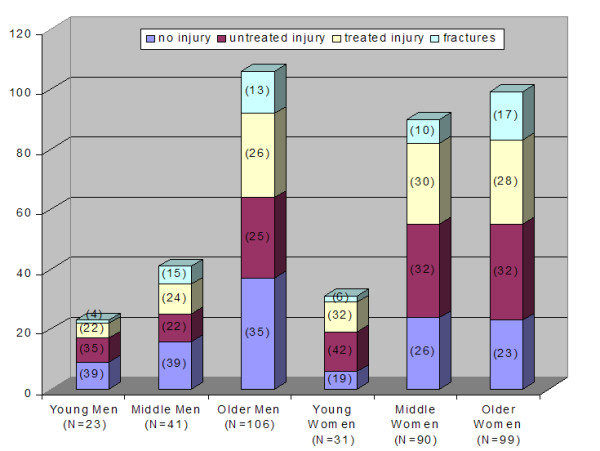
Background: Falls in older people have been characterized extensively in the literature, however little has been reported regarding falls in middle-aged and younger adults. The objective of this paper is to describe the perceived cause, environmental influences and resultant injuries of falls in 1497 young (20–45 years), middle-aged (46–65 years) and older (> 65 years) men and women from the Baltimore Longitudinal Study on Aging. Methods: A descriptive study where participants completed a fall history questionnaire describing the circumstances surrounding falls in the previous two years. Results: The reporting of falls increased with age from 18% in young, to 21% in middle-aged and 35% in older adults, with higher rates in women than men. Ambulation was cited as the cause of the fall most frequently in all gender and age groups. Our population reported a higher percentage of injuries (70.5%) than previous studies. The young group reported injuries most frequently to wrist/hand, knees and ankles; the middle-aged to their knees and the older group to their head and knees. Women reported a higher percentage of injuries in all age groups. Conclusion: This is the first study to compare falls in young, middle and older aged men and women. Significant differences were found between the three age groups with respect to number of falls, activities engaged in prior to falling, perceived causes of the fall and where they fell.
Overview
The claims and statistics of this paper haven’t been checked yet.
Free: it reads the open-access text and checks the first 5 claims that cite a source we can check. Create a free account to check every claim.
Integrity signals
Registry
Cites
Statistics
Figures
Verification
Claims the paper makes
The claims and statistics of this paper haven’t been checked yet.
Free: it reads the open-access text and checks the first 5 claims that cite a source we can check. Create a free account to check every claim.
Self-check
Percentages, sums and reported differences re-computed from the paper’s own numbers.
The self-check needs the paper’s full text.
Citations
Cites
1 retracted
Interventions for preventing falls in elderly people
Gillespie, L. D., Gillespie, W. J., Robertson, M. C., Lamb, S. E., Cumming, R. G., & Rowe, B. H. (2003) · The Cochrane Database of Systematic Reviews · doi:10.1002/14651858.cd000340 · Cited by 1,422
RetractedThe CES-D Scale: A Self-Report Depression Scale for Research in the General Population
Radloff, L. S. (1977) · Applied Psychological Measurement · doi:10.1177/014662167700100306 · Cited by 53,267
Sensitivity and False Alarm Rate of a Fall Sensor in Long-Term Fall Detection in the Elderly
Kangas, M., Korpelainen, R., Vikman, I., Nyberg, L., & Jämsä, T. (2015) · Gerontology · doi:10.1159/000362720 · Cited by 18,909
Risk Factors for Falls among Elderly Persons Living in the Community
Tinetti, M. E., Speechley, M., & Ginter, S. F. (1988) · New England Journal of Medicine · doi:10.1056/nejm198812293192604 · Cited by 6,509 · cited 3×
“Tinetti et al [32] found in a prospective study that 24% of the falls in community dwelling older aged persons resulted in serious injury and 6 percent had fractures.”
BackgroundResultThe cochrane database of systematic reviews
Geddes, J. (1996) · Journal of Psychosomatic Research · doi:10.1016/s0022-3999(96)90063-x · Cited by 5,989
Verbrugge, L. M., & Jette, A. M. (1994) · Social Science & Medicine · doi:10.1016/0277-9536(94)90294-1 · Cited by 3,310 · cited 1×
“In older people, falls are a risk factor for disability and frailty, and exacerbate the disablement process [3,4].”
BackgroundThe Cochrane Database of Systematic Reviews
Handoll, H. H. (2004) · The British Journal of Hand Therapy · doi:10.1177/175899830400900201 · Cited by 1,513
FALLS BY ELDERLY PEOPLE AT HOME: PREVALENCE AND ASSOCIATED FACTORS
BLAKE, A. J., MORGAN, K., BENDALL, M. J., DALLOSSO, H., EBRAHIM, S. B. J., ARIE, T. H. D., FENTEM, P. H., & BASSEY, E. J. (1988) · Age and Ageing · doi:10.1093/ageing/17.6.365 · Cited by 1,261 · cited 1×
“Most older fallers reported tripping as the cause for their fall [18,23], with a large percentage unable to give any reason in a one year retrospective study [24].”
BackgroundCAMPBELL, A. J., BORRIE, M. J., SPEARS, G. F., JACKSON, S. L., BROWN, J. S., & FITZGERALD, J. L. (1990) · Age and Ageing · doi:10.1093/ageing/19.2.136 · Cited by 803 · cited 2×
“Campbell et al [17] found in a prospective study of participants (over 69 years) from a rural setting no gender difference in fall rate; however men were more likely to fall outside and at more intense levels of activity.”
BackgroundResultFactors Associated with Falls in the Elderly: A Community Study
Prudham, D., & Evans, J. G. (1981) · Age and Ageing · doi:10.1093/ageing/10.3.141 · Cited by 803 · cited 2×
“Most older fallers reported tripping as the cause for their fall [18,23], with a large percentage unable to give any reason in a one year retrospective study [24].”
Background
Research works printed but not linked: 2
- 26. Adler-Traines M Falls in the senior population. Physical Therapy Forum 1994 9 14 17
- 38. Metter EJ Yim-Chipless PK Musiol R Talbot LA Balance Training: Preventing Falls in Older Adults The American Journal of Medicine and Sports 2003 5 94 99
Cited by
Comparison of low-complexity fall detection algorithms for body attached accelerometers
Kangas, M., Konttila, A., Lindgren, P., Winblad, I., & Jämsä, T. (2008) · Gait & Posture · doi:10.1016/j.gaitpost.2008.01.003 · Cited by 493
Wrisley, D. M., & Kumar, N. A. (2010) · Physical Therapy · doi:10.2522/ptj.20090069 · Cited by 386
Falls and Fall-Related Injuries among Community-Dwelling Adults in the United States
Verma, S. K., Willetts, J. L., Corns, H. L., Marucci-Wellman, H. R., Lombardi, D. A., & Courtney, T. K. (2016) · PLOS ONE · doi:10.1371/journal.pone.0150939 · Cited by 304
“more falls in the previous two years.[21] In this case, the recall period was twice as long as in the current study, and these proportions are correspondingly about double the values we report.”
ResultGrevendonk, L., Connell, N. J., McCrum, C., Fealy, C. E., Bilet, L., Bruls, Y. M. H., Mevenkamp, J., Schrauwen-Hinderling, V. B., Jörgensen, J. A., Moonen-Kornips, E., et al. (2021) · Nature Communications · doi:10.1038/s41467-021-24956-2 · Cited by 298
Falls and fear of falling: burden, beliefs and behaviours
Boyd, R., & Stevens, J. A. (2009) · Age and Ageing · doi:10.1093/ageing/afp053 · Cited by 290
“Research shows that most fall injuries are minor and only a small percentage result in severe injury [22].”
BackgroundZecevic, A. A., Salmoni, A. W., Speechley, M., & Vandervoort, A. A. (2006) · The Gerontologist · doi:10.1093/geront/46.3.367 · Cited by 287
“The Gerontologist Copyright 2006 by The Gerontological Society of America Vol. 46, No. 3, 367–376”
Gerards, M. H. G., McCrum, C., Mansfield, A., & Meijer, K. (2017) · Geriatrics & Gerontology International · doi:10.1111/ggi.13082 · Cited by 266
Matsuda, P. N., Shumway‐Cook, A., Bamer, A. M., Johnson, S. L., Amtmann, D., & Kraft, G. H. (2011) · PM&R · doi:10.1016/j.pmrj.2011.04.015 · Cited by 239
Grimmer, M., Riener, R., Walsh, C. J., & Seyfarth, A. (2019) · Journal of NeuroEngineering and Rehabilitation · doi:10.1186/s12984-018-0458-8 · Cited by 249
Pai, Y.-C., Bhatt, T., Yang, F., & Wang, E. (2014) · The Journals of Gerontology Series A: Biological Sciences and Medical Sciences · doi:10.1093/gerona/glu087 · Cited by 216
Hollman, J. H., Childs, K. B., McNeil, M. L., Mueller, A. C., Quilter, C. M., & Youdas, J. W. (2010) · Gait & Posture · doi:10.1016/j.gaitpost.2010.02.017 · Cited by 197
Granacher, U., Muehlbauer, T., & Gruber, M. (2012) · Journal of Aging Research · doi:10.1155/2012/708905 · Cited by 169
“, steady-state balance) in the elderly [35] or during slipping and tripping events (i.”
BackgroundVisual loss and falls: a review
Dhital, A., Pey, T., & Stanford, M. R. (2010) · Eye · doi:10.1038/eye.2010.60 · Cited by 193
“A descriptive study based on questionnaire results found 18p of individuals below 40 and 21p of middle aged individuals reported a fall in the previous year”
MethodPerturbation-based balance training: Principles, mechanisms and implementation in clinical practice
McCrum, C. L., Bhatt, T. S., Gerards, M. H. G., Karamanidis, K., Rogers, M. W., Lord, S. R., & Okubo, Y. (2022) · Frontiers in Sports and Active Living · doi:10.3389/fspor.2022.1015394 · Cited by 200
A review of stairway falls and stair negotiation: Lessons learned and future needs to reduce injury
Jacobs, J. V. (2016) · Gait & Posture · doi:10.1016/j.gaitpost.2016.06.030 · Cited by 169
Terrier, P., & Reynard, F. (2015) · Gait & Posture · doi:10.1016/j.gaitpost.2014.09.024 · Cited by 168
“Interestingly, a largescale epidemiological study showed that the frequency of falls in middle-aged adults (46–65 years) was higher than in younger adults (20–45 years) [30].”
BackgroundQuijoux, F., Vienne-Jumeau, A., Bertin‐Hugault, F., Zawieja, P. P., Lefèvre, M., Vidal, P., & Ricard, D. (2020) · Ageing Research Reviews · doi:10.1016/j.arr.2020.101117 · Cited by 180
Timsina, L. R., Willetts, J. L., Brennan, M. J., Marucci-Wellman, H., Lombardi, D. A., Courtney, T. K., & Verma, S. K. (2017) · PLOS ONE · doi:10.1371/journal.pone.0176561 · Cited by 169
“[73–74] However, very few studies have examined the role of surface contamination on the risk of falls in the general population.[15] As discussed in the Place section, a home hazard checklist from CDC and the components of home modification intervention from the study by Keall et al.”
BackgroundResultInfluentialGranacher, U., Muehlbauer, T., Gollhofer, A., Kressig, R. W., & Zahner, L. (2010) · Gerontology · doi:10.1159/000320250 · Cited by 188
Age-Related Effects on Postural Control under Multi-Task Conditions
Granacher, U., Bridenbaugh, S. A., Muehlbauer, T., Wehrle, A., & Kressig, R. W. (2010) · Gerontology · doi:10.1159/000322196 · Cited by 164
“Thus, it is not surprising that a large number of falls occur during ambulation in the elderly [”
BackgroundThe Efficacy of Injury Prevention Programs in Adolescent Team Sports: A Meta-analysis
Soomro, N., Sanders, R., Hackett, D., Hubka, T., Ebrahimi, S., Freeston, J., & Cobley, S. (2016) · The American Journal of Sports Medicine · doi:10.1177/0363546515618372 · Cited by 130
“Balance exercises in these contexts are used to help meet the performance demands that are imposed by asymmetrical, varied, and dynamic movements (ie, laterally and vertically) and that increase the risk of fall-related injuries.(43) Thus, IPPs with a combination of muscular strength as well as proprioceptive balance…”
BackgroundDetection of falls using accelerometers and mobile phone technology
Lee, R. Y. W., & Carlisle, A. J. (2011) · Age and Ageing · doi:10.1093/ageing/afr050 · Cited by 141
“Although physical activity is important in the prevention of disease and improving the quality of life [1, 2], falls often happen during physical exercise, walking and various forms of physical activity [3, 4].”
BackgroundThe Burden of Acute Traumatic Spinal Cord Injury among Adults in the United States: An Update
Selvarajah, S., Hammond, E. R., Haider, A. H., Abularrage, C. J., Becker, D., Dhiman, N., Hyder, O. N., Gupta, D. K., Black, J. H., & Schneider, E. B. (2013) · Journal of Neurotrauma · doi:10.1089/neu.2013.3098 · Cited by 157
Barros, A. C. D., Leitão, R., & Ribeiro, J. (2014) · Procedia Computer Science · doi:10.1016/j.procs.2014.02.041 · Cited by 136
Characteristics of outdoor falls among older people: a qualitative study
Nyman, S. R., Ballinger, C., Phillips, J. E., & Newton, R. (2013) · BMC Geriatrics · doi:10.1186/1471-2318-13-125 · Cited by 141
“We employed a coding framework used previously [13,31].”
BackgroundMethodInfluentialMuscle power is more important than strength in preventing falls in community-dwelling older adults
Simpkins, C., & Yang, F. (2022) · Journal of Biomechanics · doi:10.1016/j.jbiomech.2022.111018 · Cited by 128
Epidemiology of fall and its socioeconomic risk factors in community-dwelling Korean elderly
Kim, T., Choi, S. D., & Xiong, S. (2020) · PLoS ONE · doi:10.1371/journal.pone.0234787 · Cited by 132
“Around one third of older adults aged 65 or over experience at least one fall each year [1,2].”
BackgroundBarker, A. L., Bird, M., & Talevski, J. (2014) · Archives of Physical Medicine and Rehabilitation · doi:10.1016/j.apmr.2014.11.021 · Cited by 139
Incidence of and risk factors for falls among adults with an intellectual disability
Cox, C., Clemson, L. M., Stancliffe, R. J., Durvasula, S., & Sherrington, C. (2010) · Journal of Intellectual Disability Research · doi:10.1111/j.1365-2788.2010.01333.x · Cited by 128
Shu, F., & Shu, J. (2021) · Scientific Reports · doi:10.1038/s41598-021-81115-9 · Cited by 126
Hip fracture types in men and women change differently with age
Tanner, D. A., Kloseck, M., Crilly, R. G., Chesworth, B. M., & Gilliland, J. (2010) · BMC Geriatrics · doi:10.1186/1471-2318-10-12 · Cited by 127
“Equally important, and perhaps even more so with increasing age, is the tendency to fall and to fall in a different way [17].”
BackgroundLiving Alone and Fall Risk Factors in Community-Dwelling Middle Age and Older Adults
Elliott, S. J., Painter, J. A., & Hudson, S. (2009) · Journal of Community Health · doi:10.1007/s10900-009-9152-x · Cited by 130
“5% of young adults fell, compared to 21% of middle-aged adults, and 35% of older adults [27].”
BackgroundEffect of Rhythmic Auditory Cueing on Aging Gait: A Systematic Review and Meta-Analysis
Ghai, S., Ghai, I., & Effenberg, A. O. (2018) · Aging and Disease · doi:10.14336/ad.2017.1031 · Cited by 115
“Moreover, medications, depression, and anxiety are additional precipitators [9-11].”
BackgroundHealthy aging and muscle function are positively associated with NAD+ abundance in humans
Janssens, G. E., Grevendonk, L., Perez, R. Z., Schomakers, B. V., de Vogel-van den Bosch, J., Geurts, J. M. W., van Weeghel, M., Schrauwen, P., Houtkooper, R. H., & Hoeks, J. (2022) · Nature Aging · doi:10.1038/s43587-022-00174-3 · Cited by 103
Heijnen, M., & Rietdyk, S. (2015) · Human Movement Science · doi:10.1016/j.humov.2015.12.007 · Cited by 110
Effect of arm swing strategy on local dynamic stability of human gait
Punt, M., Bruijn, S. M., Wittink, H. M., & van Dieën, J. H. (2014) · Gait & Posture · doi:10.1016/j.gaitpost.2014.12.002 · Cited by 100
“This latter finding is interesting as older people are more likely to fall [9] and hence might benefit more from a stable gait.”
BackgroundLoss of otolith function with age is associated with increased postural sway measures
Serrador, J. M., Lipsitz, L. A., Gopalakrishnan, G. S., Black, F. O., & Wood, S. J. (2009) · Neuroscience Letters · doi:10.1016/j.neulet.2009.08.057 · Cited by 107
“Concurrent with loss of balance with aging is the increased incidence of falls in elderly individuals [29].”
Peeters, G. M. E. E., van Schoor, N. M., Cooper, R., Tooth, L. R., & Kenny, R. A. (2018) · PLoS ONE · doi:10.1371/journal.pone.0201989 · Cited by 105
Prasertsakul, T., Kaimuk, P., Chinjenpradit, W., Limroongreungrat, W., & Charoensuk, W. (2018) · BioMedical Engineering OnLine · doi:10.1186/s12938-018-0550-0 · Cited by 110
“The incidence of falls can occur in people of all ages and is not exclusively restricted to the elderly population [1].”
Hartmann, A., Murer, K., de Bie, R. A., & de Bruin, E. D. (2009) · Gait & Posture · doi:10.1016/j.gaitpost.2009.06.008 · Cited by 109
“Most falls in older adults occur at home during whole-body movements like transferring and walking [1,2].”
BackgroundGait stability in response to platform, belt, and sensory perturbations in young and older adults
Roeles, S., Rowe, P. J., Bruijn, S. M., Childs, C. R., Tarfali, G., Steenbrink, F., & Pijnappels, M. A. G. M. (2018) · Medical & Biological Engineering & Computing · doi:10.1007/s11517-018-1855-7 · Cited by 99
“Sincewalking is one of themost common activities in our everyday life, it is not surprising that most falls occur while walking, due to trips or slips [2, 3].”
Lee, S. (2021) · BMC Geriatrics · doi:10.1186/s12877-021-02499-x · Cited by 96
Coutinho, E. S., Fletcher, A., Bloch, K. V., & Rodrigues, L. C. (2008) · BMC Geriatrics · doi:10.1186/1471-2318-8-21 · Cited by 96
“An active research agenda exists with a focus on prevention [2].”
BackgroundRisk of fall-related injury in people with lower limb amputations: A prospective cohort study
Wong, C. K., Chihuri, S. T., & Li, G. (2016) · Journal of Rehabilitation Medicine · doi:10.2340/16501977-2042 · Cited by 91
Influence of a visual–verbal Stroop test on standing and walking performance of older adults
Wollesen, B., Voelcker‐Rehage, C., Regenbrecht, T., & Mattes, K. (2016) · Neuroscience · doi:10.1016/j.neuroscience.2016.01.031 · Cited by 94
Böhm, S., Mademli, L., Mersmann, F., & Arampatzis, A. (2015) · Sports Medicine · doi:10.1007/s40279-015-0413-9 · Cited by 99
“However, aging increases the risk of falls [3], particularly, during walking [4, 5].”
BackgroundDiurnal patterns of objectively measured physical activity and sedentary behaviour in older men
Sartini, C., Wannamethee, S. G., Iliffe, S., Morris, R. W., Ash, S., LENNON, L. T., Whincup, P. H., & Jefferis, B. J. M. H. (2015) · BMC Public Health · doi:10.1186/s12889-015-1976-y · Cited by 86
“Indeed, the combination of darkness and visual problems have been previously investigated as potential causes of falls [31].”
BackgroundAssociation Between Sarcopenic Obesity and Falls in a Multiethnic Cohort of Postmenopausal Women
Follis, S., Cook, A., Bea, J. W., Going, S. B., Laddu, D., Cauley, J. A., Shadyab, A. H., Stefanick, M. L., & Chen, Z. (2018) · Journal of the American Geriatrics Society · doi:10.1111/jgs.15613 · Cited by 77
Okubo, Y., Schoene, D., Caetano, M. J. D., Pliner, E. M., Osuka, Y., Toson, B., & Lord, S. R. (2020) · Ageing Research Reviews · doi:10.1016/j.arr.2020.101238 · Cited by 90
Hamed, A., Böhm, S., Mersmann, F., & Arampatzis, A. (2018) · Sports Medicine - Open · doi:10.1186/s40798-018-0170-z · Cited by 92
Dannhauser, T. M., Cleverley, M., Whitfield, T. J., Fletcher, B., Stevens, T., & Walker, Z. (2014) · BMC Psychiatry · doi:10.1186/1471-244x-14-129 · Cited by 73
“The risk of falls is increased in older adults and can be exaggerated by brisk walking [27, 48].”
BackgroundPhysiological Changes Associated with Aging and Immobility
Nigam, Y., KNIGHT, J. C., Bhattacharya, S., & Bayer, A. J. (2012) · Journal of Aging Research · doi:10.1155/2012/468469 · Cited by 91
Self‐reported sleep duration and falls in older adults
Mesas, A. E., López‐García, E., & Rodríguez‐Artalejo, F. (2011) · Journal of Sleep Research · doi:10.1111/j.1365-2869.2010.00867.x · Cited by 85
“, 2000), in very old persons (Talbot et al., 2005), in those with physical or cognitive limitation (Kannus et al.”
BackgroundInfluentialSvoboda, Z., Bizovská, L., Janura, M., Kuboňová, E., Janurová, K., & Vuillerme, N. (2017) · PLoS ONE · doi:10.1371/journal.pone.0171997 · Cited by 80
Sousa, E. B., Brandão, L. F. D. S., Tavares, C. B., Borges, I. B. C., Neto, N. G. F., & Kessler, I. M. (2013) · BMC Surgery · doi:10.1186/1471-2482-13-5 · Cited by 75
“This is comparable to many studies that show an average of 56 to 77% of CSDH patients with a history of a fall [13-15,17].”
ResultMargolis, K. L., Palermo, L., Vittinghoff, E., Evans, G. W., Atkinson, H. H., Hamilton, B. P., Josse, R. G., O’Connor, P. J., Simmons, D. L., Tiktin, M., et al. (2014) · Journal of General Internal Medicine · doi:10.1007/s11606-014-2961-3 · Cited by 77
“8 % of people age 65 and older.(59) At baseline in the ACCORD BP trial, 66 % were age 40–64 and 34 % were 65 years and older.”
BackgroundOccupational and environmental risk factors for falls among workers in the healthcare sector
Drebit, S. K., Shajari, S., Alamgir, H., Yu, S., & Keen, D. (2010) · Ergonomics · doi:10.1080/00140130903528178 · Cited by 75
“2005 ) and that a higher incidence of falls is common with ageing and is often attributed to muscle weakness in older adults (Greeves et al .”
BackgroundSüptitz, F., Catalá, M. M., Brüggemann, G., & Karamanidis, K. (2013) · Human Movement Science · doi:10.1016/j.humov.2013.07.008 · Cited by 74
Gender Differences in Dual Task Gait Performance in Older Adults
Hollman, J. H., Youdas, J. W., & Lanzino, D. J. (2009) · American Journal of Men s Health · doi:10.1177/1557988309357232 · Cited by 81
“Although not investigated as part of the study, given that fatality rates associated with falling are more dramatic in older men than in women (Centers for Disease Control and Prevention, 2006) and given that most falls occur during walking (Talbot et al., 2005), the study’s findings provide justification for further…”
ResultYap, A. U., Cao, Y., Zhang, M., Lei, J., & Fu, K. (2020) · Journal of Oral Rehabilitation · doi:10.1111/joor.13121 · Cited by 73
Gait initiation: The first four steps in adults aged 20–25 years, 65–79 years, and 80–91 years
Muir, B. C., Rietdyk, S., & Haddad, J. M. (2013) · Gait & Posture · doi:10.1016/j.gaitpost.2013.08.037 · Cited by 87
“2 m walkway in this study, but these gait speeds are more consistent with behavior observed in the home, where more falls occur in older adults [7,9].”
BackgroundResultCircumstances and consequences of falls in polio survivors
Bickerstaffe, A., Beelen, A., & Nollet, F. (2010) · Journal of Rehabilitation Medicine · doi:10.2340/16501977-0620 · Cited by 74
Lin, C.-H., Liao, K., Pu, S.-J., Chen, Y., & Liu, M.-S. (2011) · PLoS ONE · doi:10.1371/journal.pone.0018976 · Cited by 82
Impact of dizziness and obesity on the prevalence of falls and fall-related injuries
Lin, H. W., & Bhattacharyya, N. (2014) · The Laryngoscope · doi:10.1002/lary.24806 · Cited by 71
“5% have been reported, depending on the definition of an injury, including fractures, soft-tissue injuries, lacerations, and need for medical attention.(3,5,28,29,32,36)”
BackgroundMethodInoue, W., Ikezoe, T., Tsuboyama, T., Sato, I., Malinowska, K. B., Kawaguchi, T., Tabara, Y., Nakayama, T., Matsuda, F., & Ichihashi, N. (2016) · Aging Clinical and Experimental Research · doi:10.1007/s40520-016-0568-8 · Cited by 81
“reported that most falls occur during walking [3, 4], and decreased walking speed [5, 6] and increased gait vari-”
BackgroundDesign of a Semipowered Stance-Control Swing-Assist Transfemoral Prosthesis
Lee, J., Bartlett, H. L., & Goldfarb, M. T. (2019) · IEEE/ASME Transactions on Mechatronics · doi:10.1109/tmech.2019.2952084 · Cited by 71
“Among the implications of TFA, individuals with TFA exhibit a drastic increase in frequency of falls [4], [5] and increased frequency of joint overuse injuries [6], relative to age-matched healthy individuals.”
Chronic Pain and Risk of Injurious Falls in Community-Dwelling Older Adults
Cai, Y., Leveille, S. G., Shi, L., Chen, P., & You, T. (2020) · The Journals of Gerontology Series A · doi:10.1093/gerona/glaa249 · Cited by 75
Leisure-Time Physical Activity, Falls, and Fall Injuries in Middle-Aged Adults
Caban-Martinez, A. J., Courtney, T. K., Chang, W.-R., Lombardi, D. A., Huang, Y.-H., Brennan, M. J., Perry, M. J., Katz, J. N., Christiani, D. C., & Verma, S. K. (2015) · American Journal of Preventive Medicine · doi:10.1016/j.amepre.2015.05.022 · Cited by 73
“More attention may need to be directed to the middle-aged adult population where approximately 21% in an earlier study (similar to our study findings) reported falling at least once in a 2-year period.(33) Given the trends toward increased sedentary behavior as worksites, homes, and public spaces have been evolving in…”
ResultStark, S. L., Keglovits, M., Somerville, E. K., Hu, Y., Barker, A. R., Sykora, D., & Yan, Y. (2021) · JAMA Network Open · doi:10.1001/jamanetworkopen.2021.22044 · Cited by 75
Jørgensen, V., Forslund, E. B., Opheim, A. I., Franzén, E., Wahman, K., Hultling, C., Seiger, Å., Ståhle, A., Stanghelle, J. K., & Roaldsen, K. S. (2017) · Journal of physiotherapy · doi:10.1016/j.jphys.2016.11.010 · Cited by 73
Lamb, S. E., McCabe, C. J., Becker, C., Fried, L. P., & Guralnik, J. M. (2008) · The Journals of Gerontology Series A · doi:10.1093/gerona/63.10.1082 · Cited by 72
“as the result of engaging in vigorous activities more often, but otherwise the risk profile is similar (15, 34 ).”
BackgroundGender and Age Differences in Hip Fracture Types among Elderly: a Retrospective Cohort Study
Alpantaki, K., Papadaki, C., Raptis, K., Dretakis, K., Samonis, G., & Koutserimpas, C. (2020) · MAEDICA – a Journal of Clinical Medicine · doi:10.26574/maedica.2020.15.2.185 · Cited by 68
Skalska, A., Wizner, B., Piotrowicz, K., Klich‐Rączka, A., Klimek, E., Mossakowska, M., Rowiński, R., Kozak-Szkopek, E., Jóźwiak, A., Gąsowski, J., et al. (2012) · Experimental Gerontology · doi:10.1016/j.exger.2012.12.003 · Cited by 67
Review of balance recovery in response to external perturbations during daily activities
Tokur, D. S., Grimmer, M., & Seyfarth, A. (2019) · Human Movement Science · doi:10.1016/j.humov.2019.102546 · Cited by 70
Relationship between location and activity in injurious falls: an exploratory study
Bleijlevens, M. H. C., Diederiks, J. P. M., Hendriks, M. R., van Haastregt, J. C. M., Crebolder, H. F. J. M., & van Eijk, J. T. M. (2010) · BMC Geriatrics · doi:10.1186/1471-2318-10-40 · Cited by 63
“These findings resemble the findings of previous studies, which found that vigorous persons were more likely to fall outside the home during displacement activities such as climbing ladders or engaging in sports, while frail older persons fell during routine daily activities at home [42-44].”
ResultLi, Y., Hsu, J., & Fernie, G. R. (2012) · Journal of Urban Health · doi:10.1007/s11524-012-9779-2 · Cited by 63
“Icy surfaces are one of the most cited factors that lead to falls.(5) Few studies have been done to investigate pedestrians’ perception of how the winter weather changes a normally accessible route to an inaccessible one.”
BackgroundAssociation of Balance, Strength, and Power Measures in Young Adults
Muehlbauer, T., Gollhofer, A., & Granacher, U. (2012) · The Journal of Strength and Conditioning Research · doi:10.1519/jsc.0b013e31825c2bab · Cited by 62
“, 54 fallers of 292 young participants) (26).”
BackgroundInfluentialWang, Y., Wang, S., Bolton, R., Kaur, T., & Bhatt, T. S. (2019) · Aging Clinical and Experimental Research · doi:10.1007/s40520-019-01268-6 · Cited by 70
“This is consistent with previous findings [53] and provided laboratory-based evidence for generally reported higher rates of falls and fall-related injuries in older women [54].”
ResultCitySurfaces: City-scale semantic segmentation of sidewalk materials
Hosseini, M., Miranda, F., Lin, J., & Silva, C. T. (2022) · Sustainable Cities and Society · doi:10.1016/j.scs.2021.103630 · Cited by 72
“Aside from the mentioned impacts, sidewalk pavements can also lead to public health hazards such as outdoor falls, or pose a barrier to walkability and accessibility of public spaces, specifically for the more vulnerable population and wheelchair users (Talbot et al., 2005; Clifton et al., 2007; Aghaabbasi et al., 201…”
BackgroundKomisar, V., Dojnov, A., Yang, Y., Shishov, N., Chong, H., Yu, Y., Bercovitz, I., Cusimano, M. D., Becker, C., Mackey, D. C., et al. (2022) · BMC Geriatrics · doi:10.1186/s12877-022-03041-3 · Cited by 66
“Fatalities and injuries from falls among older adults---United States, 1993--2003 and 2001-- 2005.”
BackgroundMethodInfluentialDifferences in fall-related characteristics across cognitive disorders
Minta, K., Colombo, G., Taylor, W. R., & Schinazi, V. R. (2023) · Frontiers in Aging Neuroscience · doi:10.3389/fnagi.2023.1171306 · Cited by 61
“It is estimated that one-third of elderly individuals above 65 years of age fall at least once per year (Talbot et al., 2005).”
BackgroundLocomotor stability and adaptation during perturbed walking across the adult female lifespan
McCrum, C. L., Epro, G., Meijer, K., Zijlstra, W., Brüggemann, G., & Karamanidis, K. (2016) · Journal of Biomechanics · doi:10.1016/j.jbiomech.2016.02.051 · Cited by 58
“Women over 45 have an increased susceptibility to bone fractures (Donaldson et al., 1990), and experience more fall-related injuries (Talbot et al., 2005) and hip fractures (Parkkari et al., 1999) than men.”
BackgroundInfluentialCollado-Mateo, D., Gallego-Diaz, J. M., Adsuar, J. C., Domínguez-Muñoz, F. J., Olivares, P. R., & Gusi, N. (2015) · BioMed Research International · doi:10.1155/2015/589014 · Cited by 57
Adams, M., Gordt, K., Bongartz, M., Zimmermann, S., Seide, S., Braun, V., & Schwenk, M. (2023) · Sports Medicine - Open · doi:10.1186/s40798-023-00606-3 · Cited by 66
“4% in middle-aged adults [2, 3, 8, 9], of which 35% are injurious falls [3].”
BackgroundFalls Among Adults Aging With Disability
Matsuda, P. N., Verrall, A. M., Finlayson, M. L., Molton, I. R., & Jensen, M. P. (2014) · Archives of Physical Medicine and Rehabilitation · doi:10.1016/j.apmr.2014.09.034 · Cited by 67
Pfortmueller, C. A., Kunz, M., Lindner, G., Zisakis, A. K., Puig, S., & Exadaktylos, A. K. (2014) · The Scientific World JOURNAL · doi:10.1155/2014/256519 · Cited by 59
“In contrast to other studies, elderly patients in our study were less likely to be injuredmore severely than were younger patients [6, 14, 24].”
BackgroundResultEpro, G., McCrum, C. L., Mierau, A., Leyendecker, M., Brüggemann, G., & Karamanidis, K. (2018) · Journal of Applied Physiology · doi:10.1152/japplphysiol.00545.2017 · Cited by 68
“Approximately one-third of older adults fall at least once a year, and these falls occur most frequently during locomotion, usually due to tripping or slipping (4, 51).”
BackgroundMorgan, P. E., & McGinley, J. L. (2018) · Handbook of clinical neurology · doi:10.1016/b978-0-444-63916-5.00020-3 · Cited by 57
Abdel‐Rahman, E. M., Yan, G., Turgut, F. H., & Balogun, R. A. (2011) · Nephron Clinical Practice · doi:10.1159/000322275 · Cited by 60
“Our data confirm the hypothesis that the rate of falls is high in HD patients and more so in the older HD patients. None of the hospitalization episodes or death noted in our study were a direct result of a fall, suggesting that falls are markers for functional loss and frailty.We have found the 1-year incidence of fa…”
ResultFatores ambientais e risco de quedas em idosos: revisão sistemática
de Oliveira, A. S., Trevizan, P. F., Bestetti, M. L. T., & de Melo, R. C. (2014) · Revista Brasileira de Geriatria e Gerontologia · doi:10.1590/1809-9823.2014.13087 · Cited by 141
Whole-body and segment angular momentum during 90-degree turns
Nolasco, L. A., Silverman, A. K., & Gates, D. H. (2019) · Gait & Posture · doi:10.1016/j.gaitpost.2019.02.003 · Cited by 61
Walking adaptability for targeted fall-risk assessments
Geerse, D. J., Roerdink, M., Marinus, J., & van Hilten, J. J. (2019) · Gait & Posture · doi:10.1016/j.gaitpost.2019.02.013 · Cited by 57
Falls in young adults: The effect of sex, physical activity, and prescription medications
Cho, H., Heijnen, M., Craig, B. Α., & Rietdyk, S. (2021) · PLoS ONE · doi:10.1371/journal.pone.0250360 · Cited by 55
“Since vigorous activities are recommended for population health, it is important to understand the association between sports/vigorous-intensity activity and falls/fall-related injuries observed here and in earlier research [2, 9, 12, 31, 33].”
BackgroundResultInfluentialPighills, A., Ballinger, C., Pickering, R. M., & Chari, S. (2015) · British Journal of Occupational Therapy · doi:10.1177/0308022615600181 · Cited by 55
“Similarly, a retrospective study by Talbot et al (2005) observed ‘accident/environment’ factors to be the second most commonly perceived cause of falls by older people, specifically identifying wet and uneven surfaces, objects on floors, external forces and icy surfaces as key contributors.”
Patient perceptions and experiences with falls during hospitalization and after discharge
Shuman, C. J., Liu, J., Montie, M., Galinato, J. G., Todd, M. A., Hegstad, M., & Titler, M. G. (2016) · Applied Nursing Research · doi:10.1016/j.apnr.2016.01.009 · Cited by 51
Epro, G., Mierau, A., McCrum, C. L., Leyendecker, M., Brüggemann, G., & Karamanidis, K. (2018) · Journal of Neurophysiology · doi:10.1152/jn.00513.2017 · Cited by 55
“Approximately one-third of older adults fall at least once a year, with the majority of the falls occurring during locomotion, usually as a result of tripping or slipping (Berg et al. 1997; Talbot et al. 2005).”
BackgroundSevere hypoglycemia is associated with high risk for falls in adults with type 1 diabetes
Shah, V. N., Wu, M., Foster, N. C., Dhaliwal, R., & Mukaddam, M. A. (2018) · Archives of Osteoporosis · doi:10.1007/s11657-018-0475-z · Cited by 52
Bhattacharya, P., Altai, Z., Qasim, M., & Viceconti, M. (2018) · Biomechanics and Modeling in Mechanobiology · doi:10.1007/s10237-018-1081-0 · Cited by 53
McCrum, C. L., Karamanidis, K., Grevendonk, L., Zijlstra, W., & Meijer, K. (2019) · GeroScience · doi:10.1007/s11357-019-00130-x · Cited by 50
Variability of centre of pressure movement during gait in young and middle-aged women
Bizovská, L., Svoboda, Z., Kutílek, P., Janura, M., Gába, A., & Kovačíková, Z. (2014) · Gait & Posture · doi:10.1016/j.gaitpost.2014.05.065 · Cited by 49
“In addiEtion, reports of gait or balance deterioration-related falls increased with increasing age [2].”
Background
Metadata
- Authors
- Talbot, L. A., Musiol, R. J., Witham, E. K., & Metter, E. J.
- Affiliations
- Uniformed Services University of the Health Sciences (US)
- Holy Cross Hospital (US)
- Henry M. Jackson Foundation (US)
- National Institutes of Health (US)
- Corresponding author
- Talbot, Laura A
- ORCID
- Talbot, Laura A
- Venue
- BMC Public Health
- Published
- 2005-08-18
- Volume
- 5
- Issue
- 1
- Pages
- 86-86
- ISSN
- 1471-2458 (ISSN-L)
- PMC
- PMC1208908
- OpenAlex
- W2118856586
- Cited by
- 654
- References
- 41
- Citations by year
- 2026: 27 · 2025: 48 · 2024: 54 · 2023: 43 · 2022: 55 · 2021: 57 · 2020: 56 · 2019: 44 · 2018: 37 · 2017: 29 · 2016: 35 · 2015: 28 · 2014: 29 · 2013: 20 · 2012: 20
- FWCI
- 17.37
- Type
- journal article
- Language
- en
- Open access
- gold
- doi.org
- Licence
- Locations
- BMC Public Health (publishedVersion, cc-by)
- PubMed Central (publishedVersion, cc-by)
- PubMed (publishedVersion)
- DOAJ (DOAJ: Directory of Open Access Journals) (submittedVersion, cc-by-sa)
- Funders
- Johns Hopkins University
- National Institutes of Health
- National Institute on Aging
- Topics
- Health Sciences › Health Professions › Physical Therapy, Sports Therapy and Rehabilitation › Balance, Gait, and Falls Prevention
- Health Sciences › Medicine › Public Health, Environmental and Occupational Health › Injury Epidemiology and Prevention
- Health Sciences › Medicine › Surgery › Hip and Femur Fractures
- Keywords
- falls, fall-related injuries, environmental factors, age differences, young adults, middle-aged adults, older adults, ambulation, sex differences, wrist injuries, knee injury, traumatic brain injury, community-dwelling adults
- MeSH terms
- Accidental Falls, Activities of Daily Living, Adult, Aged, Aged, 80 and over, Cross-Sectional Studies, District of Columbia, Female, Humans, Longitudinal Studies, Male, Middle Aged, Surveys and Questionnaires, Wounds and Injuries, Baltimore, Age Distribution, Sex Distribution, Risk Assessment
About these checks
Registry, retraction, Cites and statistics results are computed, not judged, with one exception: a printed reference that no index lists is read once by a model before it counts as a citation error. Claims are extracted by a model and kept only when their quote appears verbatim in the text; each cited source is then checked, with a model’s help, for whether it says what the claim relies on. Those verdicts can be wrong — read the claim’s quote and the cited source before relying on one.
Statistics and arithmetic are recomputed, not judged.
Confidence bands are shown only for fields calibrated on our annotated test set. None is calibrated yet, so no band is shown.
What counts as a claim ›How we measure confidence ›How we check this ›
Are you an author, or do you see a problem with this page? Request a review
Data sources
Bibliographic data: Semantic Scholar, OpenAlex, Crossref.
Contains information from the Semantic Scholar Academic Graph Datasets, made available under the ODC Attribution License (ODC-BY 1.0).
Semantic Scholar’s data is described in: Kinney, R., et al. (2023). The Semantic Scholar Open Data Platform. arXiv:2301.10140.
