

Utilization of health services in relation to mental health problems in adolescents: A population based survey
Open accessThe DOI matches its Crossref record; 22 of the 22 references it cites were found in a registry or an index.
Abstract
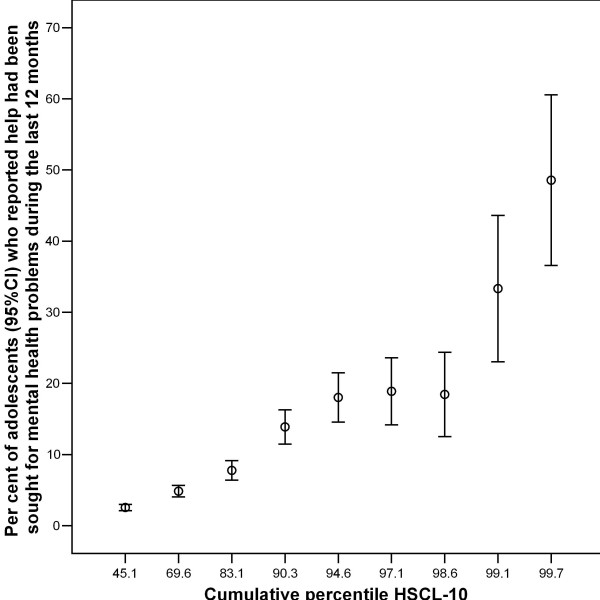
Background: Only a minority of adolescents reporting symptoms above case-levels on screenings for mental health seeks and receives help from specialist health services. The objective of this study was to a) examine help-seeking for symptoms of anxiety and depression in relation to symptom load dimensionally, b) identify the level of specialization in mental health among service-providers, and c) identify associations between mental health problems and contact with different types of health services. Methods: This cross-sectional school-based study (response-rate 88%, n = 11154) is based on Norwegian health surveys among 15 and 16 year olds. Results: We found a dose-response association between symptom-load and help seeking. Only 34% of individuals with mental symptom-load above 99 th percentile reported help-seeking in the last 12 months. Forty percent of help seekers were in contact with specialists (psychiatrists or psychologists), the remaining were mainly in contact with GPs. Mental health problems increased help seeking to all twelve service providers examined. Conclusion: It might not be reasonable to argue that all adolescents with case-level mental health problems are in need of treatment. However, concerning the 99 th percentile, claiming treatment need is less controversial. Even in the Norwegian context where mental health services are relatively available and free of charge, help-seeking in individuals with the highest symptom-loads is still low. Most help seekers achieved contact with health care providers, half of them at a non specialized level. Our results suggest that adolescents' recognition of mental health problems or intention to seek help for these are the major "filters" restricting treatment.
Overview
The claims and statistics of this paper haven’t been checked yet.
Free: it reads the open-access text and checks the first 5 claims that cite a source we can check. Create a free account to check every claim.
Integrity signals
Registry
Cites
Statistics
Figures
Verification
Claims the paper makes
The claims and statistics of this paper haven’t been checked yet.
Free: it reads the open-access text and checks the first 5 claims that cite a source we can check. Create a free account to check every claim.
Claims other papers make about this one
Each is checked against this paper’s own text: does it say what the citing paper says it does?
The source backs part of the claim, not all of it — or backs it for a different population, condition or comparison.
In the citing paper
“Illustrating this, a cross-sectional school-based study of >11.000 Norwegian adolescents aged 15 to 16 years found that only 34% of those with high levels of mental health symptoms reported help-seeking in the previous year (Zachrisson et al., 2006).”
From Internet-based cognitive behavioral therapy for adolescents with anxiety disorders: A feasibility study (2018) · cites this paper as Zachrisson et al., 2006
Experimental — accuracy not yet measured
Self-check
Percentages, sums and reported differences re-computed from the paper’s own numbers.
The self-check needs the paper’s full text.
Citations
Cites
Strand, B. H., Dalgard, O. S., Tambs, K., & Rognerud, M. (2003) · Nordic Journal of Psychiatry · doi:10.1080/08039480310000932 · Cited by 1,304 · cited 1×
“Mental health status Mental health status was measured using the Hopkins Symptom Check List, 10 item version (HSCL-10), which is a condensed version of the HSCL-25 [ 17 ,18].”
MethodChildren's Mental Health Service Use Across Service Sectors
Burns, B. J., Costello, E. J., Angold, A., Tweed, D., Stangl, D., Farmer, E. M. Z., & Erkanli, A. (1995) · Health Affairs · doi:10.1377/hlthaff.14.3.147 · Cited by 1,145
Sawyer, M. G., Arney, F. M., Baghurst, P. A., Clark, J. J., Graetz, B. W., Kosky, R. J., Nurcombe, B., Patton, G. C., Prior, M. R., Raphael, B., et al. (2001) · Australian & New Zealand Journal of Psychiatry · doi:10.1046/j.1440-1614.2001.00964.x · Cited by 826 · cited 2×
“The few population based studies have addressed adolescent help-seeking directed towards the general health-services, and found rates varying from 13% to 25% [1,15,16].”
BackgroundMental Illness in the Community: The Pathway to Psychiatric Care.
Higgins, A. C., Goldberg, D., & Huxley, P. (1982) · Contemporary Sociology · doi:10.2307/2068429 · Cited by 625
MENTAL ILLNESS IN THE COMMUNITY: THE PATHWAY TO PSYCHIATRIC CARE
Hannay, D. (1981) · PubMed Central · Cited by 598
Social-psychological factors affecting help-seeking for emotional problems
Rickwood, D. J., & Braithwaite, V. A. (1994) · Social Science & Medicine · doi:10.1016/0277-9536(94)90099-x · Cited by 583 · cited 1×
“The few population based studies have addressed adolescent help-seeking directed towards the general health-services, and found rates varying from 13% to 25% [1,15,16].”
BackgroundThe Prevalence of DSM-III-R Diagnoses in a National Sample of Dutch Adolescents
Verhulst, F. C. (1997) · Archives of General Psychiatry · doi:10.1001/archpsyc.1997.01830160049008 · Cited by 554 · cited 1×
“Background The prevalence of mental health problems in adolescent populations is found to be between 16% and 22% across several studies [1-7].”
BackgroundCanino, G., Shrout, P. E., Rubio-Stipec, M., Bird, H. R., Bravo, M., Ramírez, R., Chavez, L., Alegría, M., Bauermeister, J. J., Hohmann, A., et al. (2004) · Archives of General Psychiatry · doi:10.1001/archpsyc.61.1.85 · Cited by 462
Factors Associated With Child Mental Health Service Use in the Community
VERHULST, F. C., & DER ENDE, J. V. (1997) · Journal of the American Academy of Child & Adolescent Psychiatry · doi:10.1097/00004583-199707000-00011 · Cited by 312 · cited 3×
“Two Dutch studies found that among adolescents with mental health problems, the percentages referred for mental health services within the past year were 13% [6] and 8% [8] respectively.”
BackgroundZwaanswijk, M., Verhaak, P. F. M., Bensing, J. M., van der Ende, J., & Verhulst, F. C. (2003) · European Child & Adolescent Psychiatry · doi:10.1007/s00787-003-0322-6 · Cited by 263 · cited 1×
“In line with previous research [20] the MD (including GP) see a Table 1: Level of specialization in health services reached”
Method
Cited by
Gulliver, A., Griffiths, K. M., & Christensen, H. (2010) · BMC Psychiatry · doi:10.1186/1471-244x-10-113 · Cited by 3,292
“Similarly, a large study of over 11,000 Norwegian adolescents in school aged 15 to 16 years found that only 34% of those with high levels of depression and anxiety symptoms had sought professional help in the previous year [8].”
BackgroundWhen and how do young people seek professional help for mental health problems?
Rickwood, D. J., Deane, F. P., & Wilson, C. J. (2007) · Medical Journal of Australia · doi:10.5694/j.1326-5377.2007.tb01334.x · Cited by 1,195
Conceptual measurement framework for help-seeking for mental health problems
Rickwood, D., & Thomas (2012) · Psychology Research and Behavior Management · doi:10.2147/prbm.s38707 · Cited by 541
Ebert, D. D., Zarski, A.-C., Christensen, H., Stikkelbroek, Y., Cuijpers, P., Berking, M., & Riper, H. (2015) · PLOS ONE · doi:10.1371/journal.pone.0119895 · Cited by 533
“However, up to 80% of children and adolescents with mental health needs receive no treatment [20–24].”
Background(2012) · doi:10.1787/9789264124523-en · Cited by 490
A meta-analytic review on treatment dropout in child and adolescent outpatient mental health care
de Haan, A. M., Boon, A. E., de Jong, J. T. V. M., Hoeve, M., & Vermeiren, R. R. J. M. (2013) · Clinical Psychology Review · doi:10.1016/j.cpr.2013.04.005 · Cited by 479
“However, only 2.5 percent of the young population finds its way to youth mental health care (YMHC) (De Haan et al., 2012; Meltzer et al., 2000; Zachrisson et al., 2006).”
BackgroundInfluentialEbert, D. D., Van Daele, T., Nordgreen, T., Karekla, M., Compare, A., Zarbo, C., Brugnera, A., Øverland, S., Trebbi, G., Jensen, K. L., et al. (2018) · European Psychologist · doi:10.1027/1016-9040/a000318 · Cited by 437
‘Something needs to change’: Mental health experiences of young autistic adults in England
Crane, L., Adams, F., Harper, G., Welch, J., & Pellicano, E. (2019) · Autism · doi:10.1177/1362361318757048 · Cited by 397
“One key barrier to meeting the mental health needs of young people is that they are often reluctant to seek professional support (Essau, 2005; Rickwood et al., 2007; Zachrisson et al., 2006).”
BackgroundThe stigma of mental illness in children and adolescents: a systematic review
Kaushik, A., Kostaki, E., & Kyriakopoulos, M. (2016) · Psychiatry Research · doi:10.1016/j.psychres.2016.04.042 · Cited by 307
Mental Health Literacy: A Review of What It Is and Why It Matters
Furnham, A., & Swami, V. (2018) · International Perspectives in Psychology · doi:10.1037/ipp0000094 · Cited by 279
Cheng, Q., Li, T. M., Kwok, C.-L., Zhu, T., & Yip, P. S. (2017) · Journal of Medical Internet Research · doi:10.2196/jmir.7276 · Cited by 235
“However, distressed or suicidal people often have low motivation to seek help from professionals [10-12].”
BackgroundWright, A., Jorm, A. F., Harris, M. G., & McGorry, P. D. (2007) · Social Psychiatry and Psychiatric Epidemiology · doi:10.1007/s00127-006-0156-x · Cited by 221
“Indeed, studies have found that level of symptomatology [27, 35, 36] and level of distress [10, 26, 36] are strongly predictive of receipt of help amongst young people.”
Background250 labels used to stigmatise people with mental illness
Rose, D., Thornicroft, G., Pinfold, V., & Kassam, A. (2007) · BMC Health Services Research · doi:10.1186/1472-6963-7-97 · Cited by 219
“Background Most young people who are mentally ill do not seek help [1-5].”
BackgroundPotrebny, T., Wiium, N., & Lundegård, M. M.-I. (2017) · PLOS ONE · doi:10.1371/journal.pone.0188374 · Cited by 172
Help-Negation and Suicidal Ideation: The Role of Depression, Anxiety and Hopelessness
Wilson, C. J., & Deane, F. P. (2010) · Journal of Youth and Adolescence · doi:10.1007/s10964-009-9487-8 · Cited by 163
Help seeking for mental health problems in an adolescent population: the effect of gender
Haavik, L., Joa, I., Hatloy, K., Stain, H. J., & Langeveld, J. (2019) · Journal of Mental Health · doi:10.1080/09638237.2017.1340630 · Cited by 163
“…and impact of mental illness (Wittchen et al., 2011), but studies from the European Union, Australia, United States and Norway indicate that only 13–36% of adolescents who are in need of treatment seek professional help (Rickwood et al., 2007; Zachrisson et al., 2006; Zwaanswijk et al., 2003).”
Lillevoll, K. R., Vangberg, H. C. B., Griffiths, K. M., Waterloo, K., & Eisemann, M. R. (2014) · BMC Psychiatry · doi:10.1186/1471-244x-14-14 · Cited by 150
“The majority of adolescents suffering from depression remain untreated [4-6].”
BackgroundChisholm, K., Patterson, P., Torgerson, C., Turner, E., Jenkinson, D., & Birchwood, M. (2016) · BMJ Open · doi:10.1136/bmjopen-2015-009435 · Cited by 143
“Similarly, stigma, and a lack of knowledge or ‘mental health literacy’,(14) has also been linked to a chronic delay in help-seeking, with only a minority of young people experiencing a diagnosable mental disorder accessing professional help.(16) 19 As prevalence for the development of many mental disorders peaks in ad…”
BackgroundScholten, H., & Granic, I. (2019) · Journal of Medical Internet Research · doi:10.2196/11528 · Cited by 138
“As a result of the increasing overall prevalence rates, increases in the rates of mental health concerns for young people specifically [1], and a constant number of available treatments over time, 64%-87% of mental health issues in young people are undetected and untreated [6,7-9].”
Nearchou, F. A., Bird, N., Costello, A., Duggan, S., Gilroy, J., Long, R., McHugh, L., & Hennessy, E. (2018) · Journal of Adolescence · doi:10.1016/j.adolescence.2018.05.003 · Cited by 135
A Time-Aware Transformer Based Model for Suicide Ideation Detection on Social Media
Sawhney, R., Joshi, H., Gandhi, S., & Shah, R. R. (2020) · Conference on Empirical Methods in Natural Language Processing (EMNLP) · doi:10.18653/v1/2020.emnlp-main.619 · Cited by 158
“…require participants to either answer questionnaires (Venek et al., 2017) or engage in interviews (Scherer et al., 2013), hence not reaching suicidal people who are either unable to access these resources or have a low motivation to seek professional help (Zachrisson et al., 2006; Essau, 2005).”
BackgroundSauter, F. M., Heyne, D., & Michiel Westenberg, P. (2009) · Clinical Child and Family Psychology Review · doi:10.1007/s10567-009-0058-z · Cited by 113
“While the prevalence of mental health problems, and specifically anxiety disorders, is very high amongst adolescents, many adolescents refrain from seeking professional help (Raviv et al. 2009; Zachrisson et al. 2006).”
BackgroundJagdeo, A., Cox, B. J., Stein, M. B., & Sareen, J. (2009) · The Canadian Journal of Psychiatry · doi:10.1177/070674370905401106 · Cited by 110
Lifestyle Behavior and Mental Health in Early Adolescence
Loewen, O. K., Maximova, K., Ekwaru, J. P., Faught, E. L., Asbridge, M., Ohinmaa, A., & Veugelers, P. J. (2019) · Pediatrics · doi:10.1542/peds.2018-3307 · Cited by 102
“For example, in a school-based study of 11 154 Norwegian youth, only 29% of students with the highest symptom levels sought professional help.(42) Although Canada has a public health care system that offers health services free of charge, reluctance to seek health services is most likely at play in the current study a…”
BackgroundBuilding and Using Personal Knowledge Graph to Improve Suicidal Ideation Detection on Social Media
Cao, L., Zhang, H., & Feng, L. (2020) · IEEE Transactions on Multimedia · doi:10.1109/tmm.2020.3046867 · Cited by 133
“For those who are suffering but tend to hide inmost thoughts and refuse to seek helps from others, the approach cannot work [6, 7, 8, 9].”
Depressive symptoms and help-seeking intentions in young people
Wilson, C. J., Rickwood, D., & Deane, F. P. (2007) · Clinical Psychologist · doi:10.1080/13284200701870954 · Cited by 103
A review of mental health treatment dropout by ethnic minority youth
de Haan, A. M., Boon, A. E., de Jong, J. T. V. M., & Vermeiren, R. R. J. M. (2017) · Transcultural Psychiatry · doi:10.1177/1363461517731702 · Cited by 122
Domhardt, M., Steubl, L., & Baumeister, H. (2020) · Zeitschrift für Kinder- und Jugendpsychiatrie und Psychotherapie · doi:10.1024/1422-4917/a000625 · Cited by 101
Cao, L., Zhang, H., Feng, L., Wei, Z., Wang, X., Li, N., & He, X. (2019) · Conference on Empirical Methods in Natural Language Processing (EMNLP) · doi:10.18653/v1/d19-1181 · Cited by 112
“While these measurements are professional and effective, they require respondents to either fill in a questionnaire or participate in a professional interview, constraining its touching to suicidal people who have low motivations to seek help from professionals (Essau, 2005; Rickwood et al., 2007; Zachrisson et al., 2…”
BackgroundInfluentialMental Health Service Use Among Suicidal Adolescents: Findings From a U.S. National Community Survey
Wu, P., Katic, B. J., Liu, X., Fan, B., & Fuller, C. J. (2010) · Psychiatric Services · doi:10.1176/ps.2010.61.1.17 · Cited by 94
Persson, S., Hagquist, C., & Michelson, D. (2017) · Clinical Child Psychology and Psychiatry · doi:10.1177/1359104516656722 · Cited by 91
Help-Seeking Measures and Their Use in Adolescents: A Systematic Review
Divin, N., Harper, P., Curran, E., Corry, D., & Leavey, G. (2018) · Adolescent Research Review · doi:10.1007/s40894-017-0078-8 · Cited by 83
“While help-seeking involves a number of topics such as attitudes towards clinicians and fearing negative judgment from others (Rickwood et al. 2007; Zachrisson et al. 2006; Corry and Leavey 2017), no previous review has attempted to identify and synthesize the multiple facets of help-seeking behavior and the measures…”
BackgroundPsykiske lidelser i Norge : et folkehelseperspektiv
Mykletun, A., Knudsen, A. K., & Mathiesen, K. S. (2009) · NORA - Norwegian Open Research Archives · Cited by 326
Self-citationEarly access and help seeking: practice implications and new initiatives
Wilson, C. J., Bushnell, J. A., & Caputi, P. (2011) · Early Intervention in Psychiatry · doi:10.1111/j.1751-7893.2010.00238.x · Cited by 79
Connecting youth with health services: Systematic review.
Anderson, J. E., & Lowen, C. A. (2010) · PubMed · Cited by 94
Haugland, B. S. M., Haaland, V. Ø., Baste, V., Bjaastad, J. F., Hoffart, A., Rapee, R. M., Raknes, S., Himle, J. A., Husabø, E. B., & Wergeland, G. J. (2020) · Journal of the American Academy of Child & Adolescent Psychiatry · doi:10.1016/j.jaac.2019.12.003 · Cited by 107
Help-seeking intention for depression in early adolescents: Associated factors and sex differences
Ando, S., Nishida, A., Usami, S., Koike, S., Yamasaki, S., Kanata, S., Fujikawa, S., Furukawa, T. A., Fukuda, M., Sawyer, S. M., et al. (2018) · Journal of Affective Disorders · doi:10.1016/j.jad.2018.05.077 · Cited by 89
Stjerneklar, S., Hougaard, E., McLellan, L. F., & Thastum, M. (2019) · PLOS ONE · doi:10.1371/journal.pone.0222485 · Cited by 71
Hernáez, Á. M., Maicas, N. C., DiGiacomo, S. M., & Ariste, S. (2016) · Child and Adolescent Psychiatry and Mental Health · doi:10.1186/s13034-015-0088-x · Cited by 110
“This may help to explain why young men in general have a lower level of mental health literacy [34], and why they are more likely to avoid using professional mental health services in the course of help-seeking, a tendency widely reported in the literature [7–10, 34].”
BackgroundEffects of education and social contact on mental health-related stigma among high-school students
Lanfredi, M., Macis, A., Ferrari, C., Rillosi, L., Ughi, E. C., Fanetti, A., Younis, N., Cadei, L., Gallizioli, C., Uggeri, G., et al. (2019) · Psychiatry Research · doi:10.1016/j.psychres.2019.112581 · Cited by 92
Evensen, M., Lyngstad, T. H., Melkevik, O., & Mykletun, A. (2016) · European Sociological Review · doi:10.1093/esr/jcw001 · Cited by 68
Self-citationNon-professional-help-seeking among young people with depression: a qualitative study
Martínez-Hernáez, A., DiGiacomo, S. M., Carceller-Maicas, N., Correa-Urquiza, M., & Martorell-Poveda, M. A. (2014) · BMC Psychiatry · doi:10.1186/1471-244x-14-124 · Cited by 66
“However, most young people with clinical or subclinical depression do not seek professional help [6-9].”
BackgroundThomson, K., Richardson, C. G., Gadermann, A., Emerson, S. D., Shoveller, J., & Guhn, M. (2019) · JAMA Network Open · doi:10.1001/jamanetworkopen.2018.6694 · Cited by 80
Barriers and facilitators to mental health care: A systematic review in Pakistan
Choudhry, F. R., Khan, N., & Munawar, K. (2021) · International Journal of Mental Health · doi:10.1080/00207411.2021.1941563 · Cited by 91
Depression in late adolescence: a cross-sectional study in senior high schools in Greece
Magklara, K., Bellos, S., Niakas, D., Stylianidis, S., Kolaitis, G., Mavreas, V., & Skapinakis, P. (2015) · BMC Psychiatry · doi:10.1186/s12888-015-0584-9 · Cited by 59
“The finding is consistent with previous studies suggesting that adolescents’ mental health problems increase help-seeking from all health-service providers [64].”
ResultGender differences in the mental health literacy of young people
Furnham, A., Annis, J., & Cleridou, K. (2014) · International Journal of Adolescent Medicine and Health · doi:10.1515/ijamh-2013-0301 · Cited by 59
Ramsdal, G. H., Bergvik, S., & Wynn, R. (2018) · Cogent Psychology · doi:10.1080/23311908.2018.1455365 · Cited by 98
Insomnia in adolescents: prevalence, help‐seeking behaviors, and types of interventions
Chung, K., Kan, K. K., & Yeung, W. (2014) · Child and Adolescent Mental Health · doi:10.1111/camh.12009 · Cited by 58
PHASE: Learning Emotional Phase-aware Representations for Suicide Ideation Detection on Social Media
Sawhney, R., Joshi, H., Flek, L., & Shah, R. R. (2021) · Conference of the European Chapter of the Association for Computational Linguistics · doi:10.18653/v1/2021.eacl-main.205 · Cited by 83
“, 2013), hence not reaching people who cannot access these resources or have a low motivation to seek professional help (Zachrisson et al., 2006; Essau, 2005).”
BackgroundMykletun, A., Knudsen, A. K., Tangen, T., & Øverland, S. (2010) · BMC Health Services Research · doi:10.1186/1472-6963-10-35 · Cited by 57
Self-citationSocial Determinants of Health among Youth Seeking Substance Use and Mental Health Treatment.
Settipani, C. A., Hawke, L. D., Virdo, G., Yorke, E., Mehra, K., & Henderson, J. L. (2018) · Europe PMC (PubMed Central) · Cited by 69
Care-Seeking Pattern among Persons with Depression and Anxiety: A Population-Based Study in Sweden
Wallerblad, A., Möller, J., & Forsell, Y. (2012) · International Journal of Family Medicine · doi:10.1155/2012/895425 · Cited by 55
Yoshioka, K., Reavley, N. J., Mackinnon, A. J., & Jorm, A. F. (2013) · Psychiatry Research · doi:10.1016/j.psychres.2013.10.034 · Cited by 52
“…is of particular importance, as evidence suggests that, despite adolescence being the period of peak onset of mental disorders, young people with symptoms of mental disorders are less likely seek appropriate help than those in other age groups (Zachrisson et al., 2006; Rickwood et al., 2007).”
BackgroundServices according to mental health needs for youth in foster care? – A multi-informant study
Larsen, M. H., Baste, V., Bjørknes, R., Myrvold, T. M., & Lehmann, S. (2018) · BMC Health Services Research · doi:10.1186/s12913-018-3365-6 · Cited by 61
“9% have sought help from different services for mental health problems during the last year [33], which is substantially lower than our findings.”
ResultGeneral psychological distress symptoms and help-avoidance in young Australians
Wilson, C. J. (2010) · Advances in Mental Health · doi:10.5172/jamh.9.1.63 · Cited by 45
“A Norwegian study of 11,154 high school students found that at the highest levels of anxiety and depression symptoms, only a third of adolescents sought professional help for their symptoms – two-thirds did not (Zachrisson et al., 2006).”
Baklola, M. I., Terra, M., Taha, A., Elnemr, M., Yaseen, M., Maher, A., Buzaid, A. H., Alenazi, R., Mohamed, S. A. O., Abdel-Hady, D., et al. (2024) · BMC Psychiatry · doi:10.1186/s12888-024-05620-7 · Cited by 63
“A study from Norway revealed that only 34% of adolescents displaying significant symptoms of depression and anxiety sought professional help in the preceding year [17].”
BackgroundAmone‐P’Olak, K., Ormel, J., Oldehinkel, A. J., Reijneveld, S. A., Verhulst, F. C., & Burger, H. (2010) · Journal of the American Academy of Child & Adolescent Psychiatry · doi:10.1016/j.jaac.2010.03.007 · Cited by 53
Adolescent Behavioral Risk Screening and Use of Health Services
Chisolm, D. J., Klima, J., Gardner, W. P., & Kelleher, K. J. (2009) · Administration and Policy in Mental Health and Mental Health Services Research · doi:10.1007/s10488-009-0245-8 · Cited by 43
“Consistent with other studies, we found that those with mental health issues were higher service users even before screening (Neighbors et al. 2005; Rief et al. 2005; Zachrisson et al. 2006; Koopmans and Lamers 2006).”
ResultTuri, A. L., Bals, M., Skre, I., & Kvernmo, S. E. (2009) · BMC Public Health · doi:10.1186/1471-2458-9-378 · Cited by 57
“At the same time, epidemiological studies have shown that a substantial proportion of adolescents in the general population with significant levels of psychopathology do not receive specialist treatment for their problems [23,24].”
BackgroundAdolescent school absenteeism and service use in a population-based study
Askeland, K. G., Haugland, S., Stormark, K. M., Bøe, T., & Hysing, M. (2015) · BMC Public Health · doi:10.1186/s12889-015-1978-9 · Cited by 52
“Previous studies suggest that there is a decrease in health service use from childhood to adolescence [16, 17] and adolescents are generally underrepresented in the health care system [16, 18, 19].”
BackgroundFleming, T., Lucassen, M., Stasiak, K., Shepherd, M., & Merry, S. (2016) · Clinical Psychologist · doi:10.1111/cp.12052 · Cited by 39
Fekih‐Romdhane, F., Chebbi, O., Sassi, H., & Cheour, M. (2020) · Early Intervention in Psychiatry · doi:10.1111/eip.13080 · Cited by 44
“Another population based survey including 11 154 Norwegian adolescents (aged 15–16 years) found that 34% of individuals with high levels of depression and anxiety symptoms reported help-seeking in the last 12 months (Zachrisson et al., 2006).”
BackgroundChen, W., Corvo, K., Lee, Y., & Hahm, H. C. (2016) · Community Mental Health Journal · doi:10.1007/s10597-016-0031-5 · Cited by 50
“…services during their young adulthood were found to be marginally mediating the effect from direct victimization on 1 3 for these are the major “filters” restricting treatment (Zachrisson et al. 2006), more than the parental perception of a child’s mental health service need (Wu et al. 1999).”
BackgroundYouth work service providers' attitudes towards computerized CBT for adolescents
Fleming, T., & Merry, S. (2013) · Behavioural and Cognitive Psychotherapy · doi:10.1017/s1352465812000306 · Cited by 37
Stjerneklar, S., Hougaard, E., Nielsen, A. D., Gaardsvig, M. M., & Thastum, M. (2018) · Internet Interventions · doi:10.1016/j.invent.2018.01.001 · Cited by 36
“Illustrating this, a cross-sectional school-based study of> 11.000 Norwegian adolescents aged 15 to 16 years found that only 34% of those with high levels of mental health symptoms reported help-seeking in the previous year (Zachrisson et al., 2006).”
BackgroundInfluentialDoan, N., Patte, K. A., Ferro, M. A., & Leatherdale, S. T. (2020) · International Journal of Environmental Research and Public Health · doi:10.3390/ijerph17197128 · Cited by 36
‘Are You OK?’ Students’ Trust in a Chatbot Providing Support Opportunities
Pesonen, J. A. (2021) · Lecture notes in computer science · doi:10.1007/978-3-030-77943-6_13 · Cited by 69
“Regarding help-seeking for mental health, only a minority of adolescents reporting symptoms for mental health seek and receive help from specialist health services [47].”
BackgroundMansbach‐Kleinfeld, I., Farbstein, I., Levinson, D., Apter, A., Erhard, R., Palti, H., Geraisy, N., Brent, D. A., Ponizovsky, A. M., & Levav, I. (2010) · Psychiatric Services · doi:10.1176/ps.2010.61.3.241 · Cited by 40
Casañas, R., Arfuch, V.-M., Castellví, P., Gil, J.-J., Torres, M., Pujol, A., Castells, G., Teixidó, M., San-Emeterio, M. T., Sampietro, H. M., et al. (2018) · BMC Public Health · doi:10.1186/s12889-018-5855-1 · Cited by 34
Newlove‐Delgado, T., Moore, D. A., Ukoumunne, O. C., Stein, K., & Ford, T. J. (2015) · The Journal of Mental Health Training Education and Practice · doi:10.1108/jmhtep-02-2015-0007 · Cited by 44
“The prevalence of contact was lower amongst children with an emotional disorder, echoing findings from previous community studies(Costello et al., 2014; Ford et al. 2005; Zachrisson et al., 2006).”
ResultFang, S., Wang, X. Q., Yang, B. X., Liu, X. J., Morris, D. L., & Yu, S. H. (2019) · Comprehensive Psychiatry · doi:10.1016/j.comppsych.2019.152127 · Cited by 35
Sælid, G. A., & Nordahl, H. M. (2016) · Cognitive Behaviour Therapy · doi:10.1080/16506073.2016.1233453 · Cited by 43
Professional and informal mental health support reported by Canadians aged 15 to 24.
Findlay, L., & Sunderland, A. (2014) · PubMed · Cited by 53
Teen Mental Health First Aid for years 7–9: a description of the program and an initial evaluation
Hart, L., Bond, K. S., Morgan, A. J., Rossetto, A., Cottrill, F. A., Kelly, C. M., & Jorm, A. F. (2019) · International Journal of Mental Health Systems · doi:10.1186/s13033-019-0325-4 · Cited by 39
Huen, J. M. Y., Lai, E. S., Shum, A. K. Y., So, S. W., Chan, M. K. Y., Wong, P. W. C., Law, Y. W., & Yip, P. S. F. (2016) · JMIR Mental Health · doi:10.2196/mental.5656 · Cited by 38
“Mental illness of young people is associated with poor academic performance, social dysfunction, high-risk sexual behavior, teen pregnancy, substance abuse, and self-mutilating behavior [3-5].”
Attitudes toward Health-Seeking Behaviors of College Students in Ukraine
Burlaka, V., Churakova, I., Aavik, O. A., Staller, K. M., & Delva, J. (2014) · International Journal of Mental Health and Addiction · doi:10.1007/s11469-014-9483-4 · Cited by 27
“Prior research indicates, however, that only a small number of young people seek help for mental health problems even in countries where such services are free and widely available (Zachrisson et al. 2006).”
BackgroundEthnic differences in utilization of youth mental health care
de Haan, A. M., Boon, A. E., Vermeiren, R. R. J. M., & de Jong, J. T. V. M. (2012) · Ethnicity and Health · doi:10.1080/13557858.2011.645150 · Cited by 27
“Several studies done in western Europe (i.e., Norway, England, and The Netherlands), have indicated that only an estimated 2.5% finds its way to youth mental health care (YMHC) (Meltzer et al. 2000, Sytema et al. 2006, Zachrisson et al. 2006, Boon et al. 2010).”
BackgroundInfluentialThe black hole of the transition process: dropout of care before transition age in adolescents
Reneses, B., Escudero, A., Tur, N., Agüera-Ortíz, L., Moreno, D. M., Sáiz-Ruiz, J., Bruguera, M. R., Pando, M.-F., Bravo‐Ortiz, M. F., Moreno, A., et al. (2022) · European Child & Adolescent Psychiatry · doi:10.1007/s00787-021-01939-8 · Cited by 34
Loos, S., Walia, N., Becker, T., & Puschner, B. (2018) · Child and Adolescent Psychiatry and Mental Health · doi:10.1186/s13034-018-0249-9 · Cited by 26
Vogel, A., & Rosner, R. (2020) · Clinical Child and Family Psychology Review · doi:10.1007/s10567-019-00305-0 · Cited by 25
Sum, M. Y., Chan, S. K. W., Tsui, H. K. H., & Wong, G. H. Y. (2023) · Early Intervention in Psychiatry · doi:10.1111/eip.13455 · Cited by 43
“Consistent with previous findings, majority of the respondents in this study, particularly those with moderate-to-severe levels of depressive symptoms, reported not having sought professional help for psychological issues (Bland et al., 1997; Essau, 2005; Zachrisson et al., 2006).”
ResultUsing the Theory of Planned Behavior to Predict Korean College Students’ Help-Seeking Intention
Lee, J., & Shin, Y. (2020) · The Journal of Behavioral Health Services & Research · doi:10.1007/s11414-020-09735-z · Cited by 46
Casañas, R., Castellví, P., Gil, J.-J., Torres-Torres, M., Barón, J., Teixidó, M., Sampietro, H. M., López, M. D., Fernández, R., de Oraa, R. S. M., et al. (2022) · BMC Public Health · doi:10.1186/s12889-022-14558-y · Cited by 31
Service use in adolescents at risk of depression and self-harm: prospective longitudinal study
Sayal, K. S., Yates, N., Spears, M. R., & Stallard, P. N. (2014) · Social Psychiatry and Psychiatric Epidemiology · doi:10.1007/s00127-014-0843-y · Cited by 28
“Severity of problems is an important determinant of service use [8, 21–24].”
BackgroundHomlong, L., Rosvold, E. O., & Haavet, O. R. (2013) · BMJ Open · doi:10.1136/bmjopen-2013-003125 · Cited by 34
“for mental health problems and symptom load of anxiety and depression.(41) Furthermore, the early-onset mental disorders have been shown to be associated with lower educational attainment.”
BackgroundTowards Suicide Ideation Detection Through Online Conversational Context
Sawhney, R., Agarwal, S., Neerkaje, A. T., Αλέτρας, Ν., Nakov, P., & Flek, L. (2022) · International ACM SIGIR Conference on Research and Development in Information Retrieval (SIGIR) · doi:10.1145/3477495.3532068 · Cited by 32
“Studies have shown that such professional methods are sometimes inaccessible for individuals with lowmotivation to seek help [107], or may even have a negative impact on individuals who do take such assessments [44].”
BackgroundYoung people and their GP: a register-based study of 1717 Norwegian GPs
Hetlevik, Ø., Haug, K., & Gjesdal, S. (2009) · Family Practice · doi:10.1093/fampra/cmp073 · Cited by 25
Fleming, T. M., Stasiak, K., Moselen, E., Hermansson-Webb, E., Shepherd, M., Lucassen, M. F. G., Bavin, L. M., & Merry, S. (2019) · Frontiers in Psychiatry · doi:10.3389/fpsyt.2019.00802 · Cited by 28
“Cognitive behavioral therapy (CBT) is a first-line treatment (2), but the majority of adolescents do not use professional services despite significant symptoms (3, 4).”
BackgroundRacial/ethnic disparities in prior mental health service use among incarcerated adolescents
Lee, L. H., Goodkind, S. A., & Shook, J. J. (2017) · Children and Youth Services Review · doi:10.1016/j.childyouth.2017.04.019 · Cited by 30
Laukkanen, E., Hintikka, J. J., Kylmä, J., Kekkonen, V., & Marttunen, M. (2010) · BMC Health Services Research · doi:10.1186/1472-6963-10-261 · Cited by 21
“[19] also concluded in their study that the poor recognition of mental health problems in adolescents or their unwillingness to seek help for these problems are the major hindrances restricting treatment.”
BackgroundTrends in the utilization of youth primary healthcare services and psychological distress
Potrebny, T., Wiium, N., Haugstvedt, A., Sollesnes, R., Wold, B., & Thuen, F. (2021) · BMC Health Services Research · doi:10.1186/s12913-021-06124-w · Cited by 24
Alavi, N., Stefanoff, M., Hirji, A., & Khalid‐Khan, S. (2018) · International Journal of Pediatrics · doi:10.1155/2018/1396216 · Cited by 25
“Since many adolescents are wary of seeking treatment for mental health concerns, the existence of a more accessible virtual treatment modality may increase adolescents’ willingness to both seek out and participate in treatment [16].”
BackgroundCastellví, P., Casañas, R., Arfuch, V. M., Moreno, J. J. G., Torres, M. T., Forero, C. G., Ruiz-Castañeda, D., Alonso, J., & Lalucat-Jo, L. (2019) · International Journal of Environmental Research and Public Health · doi:10.3390/ijerph17010072 · Cited by 23
“A lack in mental health literacy (MHL) is associated with mental illness and delays in seeking help, so an increase in the community’s MHL is needed to empower the community in improving mental health [5,6].”
BackgroundSleep Duration and Insomnia in Adolescents Seeking Treatment for Anxiety in Primary Health Care
Haugland, B. S. M., Hysing, M., Baste, V., Wergeland, G. J., Rapee, R. M., Hoffart, A., Haaland, V. Ø., & Bjaastad, J. F. (2021) · Frontiers in Psychology · doi:10.3389/fpsyg.2021.638879 · Cited by 24
Chen, C., Chen, Y., & Song, Y. (2023) · Journal of Affective Disorders · doi:10.1016/j.jad.2023.04.121 · Cited by 20
Loos, S., Walia, N., Becker, T. M., & Puschner, B. (2018) · BMC Health Services Research · doi:10.1186/s12913-018-3462-6 · Cited by 23
Self-care strategies for emotional distress among young adults in Catalonia: a qualitative study
Martorell‐Poveda, M., Hernáez, Á. M., Maicas, N. C., & Urquiza, M. C. (2015) · International Journal of Mental Health Systems · doi:10.1186/s13033-015-0001-2 · Cited by 28
“Similarly, research has shown that adolescents tend to reject and have negative attitudes toward seeking professional help, preferring self-help to treat these problems [2,6-9].”
BackgroundBøe, T., Hysing, M., Askeland, K. G., Skogen, J. C., & Heradstveit, O. (2021) · Health Services Insights · doi:10.1177/11786329211055302 · Cited by 23
Kosidou, K., Lundin, A., Lewis, G., Fredlund, P., Dal, H., & Dalman, C. (2017) · BMC Psychiatry · doi:10.1186/s12888-017-1499-4 · Cited by 17
“The GHQ-12 has been shown to measure psychological distress regardless of age [21, 31], but the stability of levels of distress over time has not been tested in different age groups.”
Behandlungsangebote der Adoleszenzpsychiatrie – Ergebnisse einer deutschlandweiten Erhebung
Abzieher, P., Lipp, M., Staats, J. H., Banaschewski, T., Drießen, M., & Karow, A. (2019) · Fortschritte der Neurologie · Psychiatrie · doi:10.1055/a-1011-4198 · Cited by 19
Metadata
- Authors
- Zachrisson, H. D., Rödje, K., & Mykletun, A.
- Affiliations
- Norwegian Institute of Public Health (NO)
- Corresponding author
- Zachrisson, Henrik D
- Venue
- BMC Public Health
- Published
- 2006-02-16
- Volume
- 6
- Issue
- 1
- Pages
- 34-34
- ISSN
- 1471-2458 (ISSN-L)
- PMC
- PMC1386725
- OpenAlex
- W1888477366
- Cited by
- 230
- References
- 22
- Citations by year
- 2026: 6 · 2025: 5 · 2024: 10 · 2023: 15 · 2022: 11 · 2021: 11 · 2020: 15 · 2019: 17 · 2018: 20 · 2017: 9 · 2016: 17 · 2015: 15 · 2014: 14 · 2013: 11 · 2012: 21
- FWCI
- 5.60
- Type
- journal article
- Language
- en
- Open access
- gold
- doi.org
- Licence
- Locations
- BMC Public Health (publishedVersion, cc-by)
- Europe PMC (PubMed Central) (publishedVersion)
- PubMed Central (publishedVersion)
- PubMed (publishedVersion)
- NORA - Norwegian Open Research Archives (submittedVersion, other-oa)
- DOAJ (DOAJ: Directory of Open Access Journals) (submittedVersion)
- Summit (Simon Fraser University) (submittedVersion)
- Funders
- Norwegian Institute of Public Health
- Topics
- Health Sciences › Medicine › Psychiatry and Mental health › Mental Health Treatment and Access
- Social Sciences › Psychology › Clinical Psychology › Child and Adolescent Psychosocial and Emotional Development
- Social Sciences › Psychology › Clinical Psychology › Psychology and Mental Health
- Keywords
- help-seeking, adolescent mental health, anxiety, depression, symptom burden, mental health service utilization, specialist mental health services, general practitioners, treatment needs, barriers to treatment, school-based survey
- MeSH terms
- Adolescent, Anxiety Disorders, Cross-Sectional Studies, Depressive Disorder, Female, Health Services Needs and Demand, Humans, Male, Mental Health Services, Norway, Patient Acceptance of Health Care, Surveys and Questionnaires, School Health Services, Students, Adolescent Health Services, Health Care Surveys
About these checks
Registry, retraction, Cites and statistics results are computed, not judged, with one exception: a printed reference that no index lists is read once by a model before it counts as a citation error. Claims are extracted by a model and kept only when their quote appears verbatim in the text; each cited source is then checked, with a model’s help, for whether it says what the claim relies on. Those verdicts can be wrong — read the claim’s quote and the cited source before relying on one.
Statistics and arithmetic are recomputed, not judged.
Confidence bands are shown only for fields calibrated on our annotated test set. None is calibrated yet, so no band is shown.
What counts as a claim ›How we measure confidence ›How we check this ›
Are you an author, or do you see a problem with this page? Request a review
Data sources
Bibliographic data: Semantic Scholar, OpenAlex, Crossref.
Contains information from the Semantic Scholar Academic Graph Datasets, made available under the ODC Attribution License (ODC-BY 1.0).
Semantic Scholar’s data is described in: Kinney, R., et al. (2023). The Semantic Scholar Open Data Platform. arXiv:2301.10140.
