

Risk factors for developing a cutaneous injection-related infection among injection drug users: a cohort study
Open accessThe DOI matches its Crossref record; 34 of the 34 references it cites were found in a registry or an index; 5 of the 24 sources its claims cite were checked for support.
Abstract
Background: Cutaneous injection-related infections (CIRI), such as abscesses and cellulitis, are common and preventable among injection drug users (IDU). Methods: A longitudinal analysis of factors associated with developing a CIRI among 1,065 participants enrolled in the Scientific Evaluation of Supervised Injecting (SEOSI) cohort in Vancouver between January 1, 2004 and December 31, 2005 was conducted. Results: In a multivariate generalized linear mixed-effects model, female sex (AOR = 1.68), unstable housing (AOR = 1.49, 95% CI: 1.10-2.03), borrowing a used syringe (AOR = 1.60), and daily cocaine injection (AOR = 1.41) were associated with increased risk of having a CIRI.
Overview
CoChat Summary
TL;DR
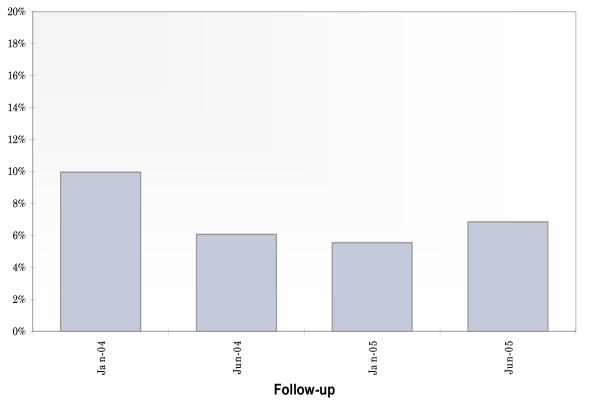
In a cohort of 1,065 supervised injection facility users in Vancouver, current cutaneous injection-related infections (CIRI) remained under 10% over two years. Female sex, unstable housing, borrowing used syringes, requiring help injecting, and daily cocaine injection were independently associated with increased odds of CIRI.
Key findings
- The proportion of participants with a current CIRI ranged from 6% to 10% over the study period; at baseline, 106 (10%) reported a CIRI.
- In multivariate generalized linear mixed-effects models, CIRI was associated with female sex (AOR = 1.68, 95% CI: 1.16–2.43), unstable housing (AOR = 1.49, 95% CI: 1.10–2.03), borrowing used syringes (AOR = 1.60, 95% CI: 1.03–2.48), requiring help injecting (AOR = 1.42, 95% CI: 1.03–1.94), and injecting cocaine daily (AOR = 1.41, 95% CI: 1.02–1.95).
- In univariate analyses, older age and always using the supervised injection facility for injections were associated with decreased likelihood of CIRI (SIF use OR = 0.47, 95% CI: 0.23–0.94), while female sex, unstable housing, sex trade involvement, borrowing syringes, requiring help injecting, daily cocaine, daily heroin, and daily speedball injection were positively associated.
- Median follow-up was 12.6 months (IQR: 6.2–17.7); 877 (82%) returned for at least one follow-up visit, and 312 (29%) were female.
Methods
- Longitudinal analysis of the Scientific Evaluation of Supervised Injecting (SEOSI) cohort, recruited from North America’s first supervised injection facility in Vancouver’s Downtown Eastside; participants completed interviewer- and nurse-administered questionnaires semi-annually.
- Eligible participants completed both baseline questionnaires between January 1, 2004 and December 31, 2005; 1,065 of 1,090 recruited participants (97%) were included.
- Outcome was a current CIRI reported and visually confirmed by a study nurse; univariate and multivariate generalized linear mixed-effects models with fixed and time-updated variables and random intercepts were used, with variables significant at p < 0.05 in univariate analysis entered into the multivariate model.
Limitations
- The authors state they could not examine “skin popping” as an independent variable due to low numbers reporting it, and the questionnaire may not have captured accidental subcutaneous or intramuscular injection.
- The authors state reliance on self-report may introduce social desirability bias, though they know of no reason to suspect differential reporting by CIRI status.
- The authors state SIF users may differ from non-users and results may not generalize to the broader local IDU population; external validity should be interpreted cautiously because Vancouver’s Downtown Eastside is unique with a large open drug scene and high cocaine injection prevalence.
- Evident from the text: the observational cohort design cannot establish causality, and the study only investigates CIRI related to injection drug use rather than other behaviours.
Model-written summary. Check it against the paper before relying on it.
Integrity signals
Registry
Cites
Statistics
Figures
Verification
Claims the paper makes
5 Valid · 0 Not valid · 14 Not checked · 14 Own results and interpretations
The cited sources support only part of this claim — read each source’s verdict below.
In the paper
“With regard to the association between cocaine injection and development of CIRI [12,13], cocaine's anaesthetic properties may make it more difficult for individuals to know whether or not they are hitting a vein (as opposed to injecting in the surrounding tissue or skin), resulting in trauma through repetitive attempts to access the vein [22,23].”
§ Risk factors for developing a cutaneous injection-related infection among injection drug users: a cohort study > Discussion
What the sources say
- Not matchedcites [22] Sydney Medically Supervised Injecting Centre Final report of the evaluation of the Sydney Medically Supervised Injecting Centre 2003
Its entry has no title and year that we can search by.
- Supportedcites [23] Rhodes T Briggs D Kimber J Jones S Holloway G Crack-heroin speedball injection and its implications for vein care: qualitative study Addiction 2007 102 1782 1790 17784900 10.1111/j.1360-0443.2007.01969.x source
The 'Vein damage' section states that crack acts as a local anaesthetic at the injection site, that missed hits (including injection of solute into surrounding tissue) were common and exacerbated crack-related vein damage, and that concern over missed hits led to repeated 'flushing' — injecting and drawing back the solute — which was itself associated with increased vein damage; the 'Risk awareness and acceptability' section adds that 'the anaesthetic effects of crack on the injection site increased the chances of missing the femoral vein' ('They won't even know they are missing the vein because the crack is numbing the site'). The citing sentence's hedge ('may') matches the source's framing, which reports these as injectors' accounts plus a logical inference in the Discussion rather than clinical proof. Minor slippage only: the source's 'repeated' trauma is chiefly about flushing, not repeated needle passes. (LLM, conf=0.82)
hedgedstates a possible cause- Asserted: passes — The authors put it forward as true.
- Checkable: passes — It can be checked against evidence.
- Load-bearing: unclear — It is unclear whether the paper’s conclusions depend on it.
- Based: passes — The paper gives a reason why it holds.
- Not matched
The cited sources support only part of this claim — read each source’s verdict below.
In the paper
“Missing a vein increases vulnerability for CIRI since injecting into the surrounding tissue creates a niche environment in which bacteria can thrive [9].”
§ Risk factors for developing a cutaneous injection-related infection among injection drug users: a cohort study > Discussion
What the sources say
- Partly supportedcites [9] Ciccarone D Bourgois P Explaining the geographical variation of HIV among injection drug users in the United States Subst Use Misuse 2003 38 2049 2063 14677781 10.1081/JA-120025125 PMC1343535 sourceExperimental — accuracy not yet measured
The Clinical Observations passage (listed under Abstract; no page provided) says soft-tissue infections are common after intramuscular and subcutaneous injection of black tar heroin. It does not discuss missing a vein or say that surrounding tissue provides a niche where bacteria thrive. (LLM, conf=0.84)
plainstates a cause- Asserted: passes — The authors put it forward as true.
- Checkable: passes — It can be checked against evidence.
- Load-bearing: unclear — It is unclear whether the paper’s conclusions depend on it.
- Based: passes — The paper gives a reason why it holds.
- Partly supported
The cited sources support only part of this claim — read each source’s verdict below.
In the paper
“The observed associations between female sex, daily cocaine injection, living in unstable housing and an elevated risk of having a CIRI are congruent with previous analyses.”
§ Risk factors for developing a cutaneous injection-related infection among injection drug users: a cohort study > Discussion
What the sources say
- Partly supportedcites [10] Taylor A Hutchinson S Lingappa J Wadd S Ahmed S Gruer L Severe illness and death among injecting drug users in Scotland: a case-control study Epidemiol Infect 2005 13 193 204 15816144 10.1017/S0950268804003504 PMC2870238 sourceExperimental — accuracy not yet measured
Table 1 and the matched multivariate analysis associate female sex with increased severe illness among Scottish injecting drug users. The Discussion says cocaine users and injectors had a lower risk of illness, contrary to the claimed direction for cocaine injection; the available passages do not establish an association with unstable housing. Page numbers are not available in our copy. (LLM, conf=0.88)
- Not matchedcites [12] Lloyd-Smith E Kerr T Hogg RS Li K Montaner JSG Wood E Prevalence and correlates of abscesses among a cohort of injection drug users Harm Reduct J 2005 2 16281979 PMC1308840
We searched by its title and found no matching paper.
- Not checked — no full text of the sourcecites [13] Spijkerman IJ van Ameijden EJ Mientjes GH Coutinho RA Hoek A van den Human immunodeficiency virus infection and other risk factors for skin abscesses and endocarditis among injection drug users J Clin Epidemiol 1996 49 1149 54 8826995 10.1016/0895-4356(96)00180-1 source
plainstates an association- Asserted: passes — The authors put it forward as true.
- Checkable: passes — It can be checked against evidence.
- Load-bearing: unclear — It is unclear whether the paper’s conclusions depend on it.
- Based: passes — The paper gives a reason why it holds.
- Partly supported
A result the paper reports from its own data — it cites no other source for it, so there is none to check. The quote shows it is in the paper.
In the paper
“At baseline, 106 (10%) of participants reported a CIRI.”
§ Risk factors for developing a cutaneous injection-related infection among injection drug users: a cohort study > Results
plain- Asserted: passes — The authors put it forward as true.
- Checkable: passes — It can be checked against evidence.
- Load-bearing: unclear — It is unclear whether the paper’s conclusions depend on it.
- Based: passes — The paper gives a reason why it holds.
- Rests on an assumption not shown here.
A result the paper reports from its own data — it cites no other source for it, so there is none to check. The quote shows it is in the paper.
In the paper
“borrowing a used syringe (AOR = 1.60 [95% CI: 1.03–2.48])”
- Also stated in: § Results · plain
“borrow used syringes (AOR = 1.60 [95% CI: 1.03–2.48])”
§ Risk factors for developing a cutaneous injection-related infection among injection drug users: a cohort study > Abstract > Results
plainstates an association- Asserted: passes — The authors put it forward as true.
- Checkable: passes — It can be checked against evidence.
- Load-bearing: passes — The paper’s conclusions depend on it.
- Based: passes — The paper gives a reason why it holds.
- Rests on 2 assumptions not shown here.
- Also stated in: § Results · plain
9 more claims
Create a free account to see all 33 claims and every source verdict.
- Probably not a substantial claim. 11
- It may state two separate claims as one. 11
Claims other papers make about this one
Each is checked against this paper’s own text: does it say what the citing paper says it does?
The source backs part of the claim, not all of it — or backs it for a different population, condition or comparison.
In the citing paper
“Interestingly, being HIV positive was not a risk factor for the development of CIRI but was a predictor of hospitalization for a CIRI or related infectious complication.”
From Determinants of hospitalization for a cutaneous injection-related infection among injection drug users: a cohort study (2010) · cites this paper as [20]
Experimental — accuracy not yet measuredThe cited source says what the claim attributes to it.
In the citing paper
“Over a two year period, 6-10 per cent of IDU had a CIRI at time of interview [20].”
From Determinants of hospitalization for a cutaneous injection-related infection among injection drug users: a cohort study (2010) · cites this paper as [20]
The cited source says what the claim attributes to it.
In the citing paper
“Using the same cohort, the risk factors for the outcome of developing a CIRI have been reported to include being female, living in unstable housing, borrowing syringes, requiring help injecting and injecting cocaine daily [20].”
From Determinants of hospitalization for a cutaneous injection-related infection among injection drug users: a cohort study (2010) · cites this paper as [20]
In the citing paper
“Requiring assistance with injecting has been reported to be related to an elevated risk of HIV [20, 25, 26].”
From Determinants of Cutaneous Injection-Related Infections Among Injection Drug Users at an Emergency Department (2012) · cites this paper as [20]
In the citing paper
“as well as CIRI development [20]”
From Determinants of Cutaneous Injection-Related Infections Among Injection Drug Users at an Emergency Department (2012) · cites this paper as [20]
Self-check
Percentages, sums and reported differences re-computed from the paper’s own numbers.
Each contradiction between two passages listed here was confirmed by an independent check.
Rated minor: it would not touch a result — a value no result rests on, a p-value that stays on the same side of the significance level, or a conflict that is clerical, resolved elsewhere in the paper, or outside its own findings.
In the paper
§ Risk factors for developing a cutaneous injection-related infection among injection drug users: a cohort study > Results
“Table: Table 1 Univariate and multivariate analysis of developing a CIRI among SEOSI participants (n = 1065)”
§ Risk factors for developing a cutaneous injection-related infection among injection drug users: a cohort study > Results
“There were 14 (1%) individuals with missing data on HIV serostatus and 33 (3%) individuals with missing data on HCV serostatus at baseline; due to these small counts, these individuals were excluded from further analyses.”
Citations
Cites
Fitzmaurice, G. M., Laird, N. M., & Ware, J. H. (2011) · Wiley Series in Probability and Statistics · doi:10.1002/9781119513469 · Cited by 4,639
The ‘risk environment’: A framework for understanding and reducing drug-related harm
Rhodes, T. (2002) · International Journal of Drug Policy · doi:10.1016/s0955-3959(02)00007-5 · Cited by 1,241 · cited 2×
“The association between homelessness and an injection site infection has been reported [24].”
BackgroundAlter, M. J. (1997) · Hepatology · doi:10.1002/hep.510260711 · Cited by 1,075
Needle exchange is not enough: lessons from the Vancouver injecting drug use study
Strathdee, S. A., Patrick, D. M., Currie, S. L., Cornelisse, P. G. A., Rekart, M. L., Montaner, J. S. G., Schechter, M. T., & OʼShaughnessy, M. V. (1997) · AIDS · doi:10.1097/00002030-199708000-00001 · Cited by 661 · cited 1×
“Variable definitions were consistent with previous work [16-19].”
ResultSelf-citationThe estimated prevalence and incidence of HIV in 96 large US metropolitan areas.
Holmberg, S. D. (1996) · American Journal of Public Health · doi:10.2105/ajph.86.5.642 · Cited by 539 · cited 14×
“Discussion In this study we found that the proportion of IDU reporting a CIRI remained within the range of six to 10 per cent over a median follow-up of 12.6 (IQR: 6.2–17.7) months after SIF recruitment.”
BackgroundInfluentialIntensive injection cocaine use as the primary risk factor in the Vancouver HIV-1 epidemic
Tyndall, M. W., Currie, S., Spittal, P., Li, K., Wood, E., O'Shaughnessy, M. V., & Schechter, M. T. (2003) · AIDS · doi:10.1097/00002030-200304110-00014 · Cited by 373 · cited 14×
“Hagan H, Des Jarlais DC: HIV and HCV infection among injecting drug users.”
BackgroundResultInfluentialSelf-citationThe Everyday Violence of Hepatitis C among Young Women Who Inject Drugs in San Francisco
Bourgois, P., Prince, B., & Moss, A. (2004) · Human Organization · doi:10.17730/humo.63.3.h1phxbhrb7m4mlv0 · Cited by 318 · cited 1×
“The link between being female and having a CIRI echoes the findings of previous studies [10,12,13], and may reflect, in part, the complex gender dynamics that exist within injection drug using populations where women are often dependent on men for the attainment and administration of drugs [21].”
ResultBinswanger, I. A., Kral, A. H., Bluthenthal, R. N., Rybold, D. J., & Edlin, B. R. (2000) · Clinical Infectious Diseases · doi:10.1086/313703 · Cited by 300 · cited 2×
“The prevalence of CIRI among IDU typically ranges from 10% to 30% [ 7 ,8].”
BackgroundHospital utilization and costs in a cohort of injection drug users.
(2001) · PubMed Central · Cited by 263
Self-citationMolenberghs, G. (2005) · Journal of the American Statistical Association · doi:10.1198/jasa.2005.s24 · Cited by 262
Risk Factors for Skin and Soft‐Tissue Abscesses among Injection Drug Users: A Case‐Control Study
Murphy, E. L., DeVita, D., Liu, H., Vittinghoff, E., Leung, P., Ciccarone, D. H., & Edlin, B. R. (2001) · Clinical Infectious Diseases · doi:10.1086/320879 · Cited by 262 · cited 5×
“The level of CIRI is relatively low in the context of previously reported prevalence (10–30% [7,8]).”
BackgroundInfluentialMiller, C. L., Johnston, C., Spittal, P. M., Li, K., LaLiberté, N., Montaner, J. S. G., & Schechter, M. T. (2002) · Hepatology · doi:10.1053/jhep.2002.35065 · Cited by 259 · cited 1×
“Variable definitions were consistent with previous work [ 16-19 ].”
ResultSelf-citationRisk factors for elevated HIV incidence among Aboriginal injection drug users in Vancouver.
Craib, K. J. P., Spittal, P. M., Wood, E., Laliberté, N., Hogg, R. S., Li, K. K., Heath, K., TYNDALL, M. W., O’Shaughnessy, M. V., & Schechter, M. T. (2003) · PubMed Central · Cited by 241
Self-citationRaoult, D., Foucault, C., & Brouqui, P. (2001) · The Lancet Infectious Diseases · doi:10.1016/s1473-3099(01)00062-7 · Cited by 240 · cited 1×
“A recent review of homelessness found that between 15–50% of homeless individuals inject drugs, and it was further reported that breaks of the skin were common among such individuals, often leading to bacterial infections due to a lack of hygiene [26].”
BackgroundCutaneous complications of intravenous drug abuse
Del Giudice, P. (2004) · British Journal of Dermatology · doi:10.1111/j.1365-2133.2004.05607.x · Cited by 187 · cited 2×
“, human immunodeficiency virus [HIV], hepatitis C virus [HCV]) among injection drug users (IDU) [1-3], considerably less attention has been devoted to the problem of bacterial infections of the skin [4].”
BackgroundSocial determinants predict needle‐sharing behaviour among injection drug users in Vancouver, Canada
STRATHDEE, S. A., PATRICK, D. M., ARCHIBALD, C. P., OFNER, M., CORNELISSE, P. G. A., REKART, M., SCHECHTER, M. T., & O'SHAUGHNESSY, M. V. (1997) · Addiction · doi:10.1111/j.1360-0443.1997.tb02852.x · Cited by 166
Young, D. M. (2004) · Archives of Surgery · doi:10.1001/archsurg.139.9.947 · Cited by 162 · cited 1×
“Expansion of such programs among harm reduction services may be reasonable, especially as many IDU remain medically underserved [33].”
BackgroundHIV and HCV infection among injecting drug users.
Hagan, H., & Jarlais, D. C. D. (2000) · PubMed · Cited by 154
Spijkerman, I. J. B., van Ameijden, E. J. C., Mientjes, G. H. C., Coutinho, R. A., & van den Hoek, A. (1996) · Journal of Clinical Epidemiology · doi:10.1016/0895-4356(96)00180-1 · Cited by 137 · cited 6×
“For example: injecting under the skin (also known as "skin popping") in San Francisco and Glasgow [8,10,11]; frequent injection in Amsterdam and Vancouver [12,13]; and injection of heroin plus cocaine (i.e. "speedballs") in San Francisco and Amsterdam [8,13] have been associated with CIRI.”
BackgroundResultInfluentialTYNDALL, M. W., Kerr, T. H., Zhang, R., King, E., Montaner, J. G., & Wood, E. (2005) · Drug and Alcohol Dependence · doi:10.1016/j.drugalcdep.2005.11.011 · Cited by 123 · cited 1×
“Users of the SIF, located in Vancouver's Downtown Eastside (DTES) neighbourhood, were randomly invited to enroll in a prospective cohort study known as the Scientific Evaluation of Supervised Injection (SEOSI) and have since been interviewed semi-annually [14].”
MethodSelf-citationDo Supervised Injecting Facilities Attract Higher-Risk Injection Drug Users?
Wood, E., Tyndall, M. W., Li, K., Lloyd-Smith, E., Small, W., Montaner, J. S. G., & Kerr, T. (2005) · American Journal of Preventive Medicine · doi:10.1016/j.amepre.2005.04.011 · Cited by 122 · cited 14×
“Discussion In this study we found that the proportion of IDU reporting a CIRI remained within the range of six to 10 per cent over a median follow-up of 12.6 (IQR: 6.2–17.7) months after SIF recruitment.”
BackgroundInfluentialSelf-citationDeterminants of HIV seroconversion in drug users during a period of rising prevalence in Vancouver
Patrick, D. M., Strathdee, S. A., Archibald, C. P., Ofner, M., Craib, K. J. P., Cornelisse, P. G. A., Schechter, M. T., Rekart, M. L., & O'Shaughnessy, M. V. (1997) · International Journal of STD & AIDS · doi:10.1258/0956462971920497 · Cited by 119
Wood, E., Kerr, T., Lloyd-Smith, E., Buchner, C., Marsh, D. C., Montaner, J. S., & Tyndall, M. W. (2004) · Harm Reduction Journal · doi:10.1186/1477-7517-1-9 · Cited by 107 · cited 2×
“However, the SEOSI cohort was randomly recruited from within the SIF [ 15 ].”
MethodSelf-citationExplaining the Geographical Variation of HIV Among Injection Drug Users in the United States
Ciccarone, D., & Bourgois, P. (2003) · Substance Use & Misuse · doi:10.1081/ja-120025125 · Cited by 107 · cited 2×
“white heroin in British Columbia, Canada), intensity of drug use, and availability and access to clean injection paraphernalia [9].”
BackgroundPrevalence and correlates of abscesses among a cohort of injection drug users
Lloyd-Smith, E., Kerr, T., Hogg, R. S., Li, K., Montaner, J. S., & Wood, E. (2005) · Harm Reduction Journal · doi:10.1186/1477-7517-2-24 · Cited by 102 · cited 5×
“For example: injecting under the skin (also known as "skin popping") in San Francisco and Glasgow [8,10,11]; frequent injection in Amsterdam and Vancouver [12,13]; and injection of heroin plus cocaine (i.e. "speedballs") in San Francisco and Amsterdam [8,13] have been associated with CIRI.”
BackgroundResultInfluentialSelf-citationShannon, K., Ishida, T., Lai, C., & Tyndall, M. W. (2006) · International Journal of Drug Policy · doi:10.1016/j.drugpo.2005.09.002 · Cited by 95 · cited 1×
“In addition, the small size, shared facilities and often unhygienic environment of single room occupancy hotels that are common in the DTES promote disease transmission [27].”
BackgroundSelf-citationExpanding Harm Reduction Services Through a Wound and Abscess Clinic
Grau, L. E., Arevalo, S., Catchpool, C., & Heimer, R. (2002) · American Journal of Public Health · doi:10.2105/ajph.92.12.1915 · Cited by 82 · cited 1×
“Specifically, integrating wound management care into existing harm reduction services, such as needle exchange programs and SIF, in community settings has been found to be feasible, cost-effective and beneficial for preventing and treating CIRI and other related skin infections such as necrotizing fasciitis [32].”
BackgroundSmall, W., Wood, E., Lloyd-Smith, E., Tyndall, M., & Kerr, T. (2008) · Drug and Alcohol Dependence · doi:10.1016/j.drugalcdep.2008.05.014 · Cited by 75 · cited 1×
“Since a positive impact of the SIF on access to assessment, care, and treatment of CIRI has been noted [31], it is likely that the rate of CIRI observed here may be lower than the rate observed in the broader community.”
ResultSelf-citationCrack–heroin speedball injection and its implications for vein care: qualitative study
Rhodes, T., Briggs, D., Kimber, J., Jones, S., & Holloway, G. (2007) · Addiction · doi:10.1111/j.1360-0443.2007.01969.x · Cited by 75 · cited 1×
“With regard to the association between cocaine injection and development of CIRI [12,13], cocaine's anaesthetic properties may make it more difficult for individuals to know whether or not they are hitting a vein (as opposed to injecting in the surrounding tissue or skin), resulting in trauma through repetitive attemp…”
BackgroundSoft Tissue Infections Among Injection Drug Users--San Francisco, California, 1996-2000
(2001) · JAMA: The Journal of the American Medical Association · doi:10.1001/jama.285.21.2707 · Cited by 58
Rhodes, T., Stoneman, A., Hope, V., Hunt, N., Martin, A., & Judd, A. (2006) · International Journal of Drug Policy · doi:10.1016/j.drugpo.2006.02.011 · Cited by 51
Skin and Soft Tissue Infections and Vascular Disease among Drug Users, England
Irish, C., Maxwell, R., Dancox, M., Brown, P., Trotter, C., Verne, J., & Shaw, M. (2007) · Emerging Infectious Diseases · doi:10.3201/eid1310.061196 · Cited by 33
Severe illness and death among injecting drug users in Scotland: a case-control study
TAYLOR, A., HUTCHINSON, S., LINGAPPA, J., WADD, S., AHMED, S., GRUER, L., TAYLOR, T. H., ROY, K., GILCHRIST, G., McGUIGAN, C., et al. (2005) · Epidemiology and Infection · doi:10.1017/s0950268804003504 · Cited by 13 · cited 3×
“For example: injecting under the skin (also known as "skin popping") in San Francisco and Glasgow [8,10,11]; frequent injection in Amsterdam and Vancouver [12,13]; and injection of heroin plus cocaine (i.e. "speedballs") in San Francisco and Amsterdam [8,13] have been associated with CIRI.”
BackgroundResult
Cited by
Supervised injection services: What has been demonstrated? A systematic literature review
Potier, C., Laprévote, V., Dubois-Arber, F., Cottencin, O., & Rolland, B. (2014) · Drug and Alcohol Dependence · doi:10.1016/j.drugalcdep.2014.10.012 · Cited by 495
McNeil, R., Small, W., Wood, E., & Kerr, T. (2014) · Social Science & Medicine · doi:10.1016/j.socscimed.2014.01.010 · Cited by 284
“, 2002), injection-related soft tissue infections (Cooper et al., 2007; Lloyd-Smith et al., 2008), and other co-morbidities common among this population, lead to frequent hospitalizations (Gebo et al.”
BackgroundSelf-citationKennedy, M. C., Karamouzian, M., & Kerr, T. (2017) · Current HIV/AIDS Reports · doi:10.1007/s11904-017-0363-y · Cited by 256
Self-citationA systematic review of injecting-related injury and disease among people who inject drugs
Larney, S., Peacock, A., Mathers, B. M., Hickman, M., & Degenhardt, L. (2017) · Drug and Alcohol Dependence · doi:10.1016/j.drugalcdep.2016.11.029 · Cited by 244
Supervised Injection Facilities as Harm Reduction: A Systematic Review
Levengood, T. W., Yoon, G. H., Davoust, M. J., Ogden, S. N., Marshall, B. D. L., Cahill, S. R., & Bazzi, A. R. (2021) · American Journal of Preventive Medicine · doi:10.1016/j.amepre.2021.04.017 · Cited by 230
Metadata
- Authors
- Lloyd-Smith, E., Wood, E., Zhang, R., Tyndall, M. W., Montaner, J. S., & Kerr, T.
- Affiliations
- University of British Columbia (CA)
- St. Paul's Hospital (CA)
- Corresponding author
- Kerr, Thomas
- Venue
- BMC Public Health
- Published
- 2008-12
- Volume
- 8
- Issue
- 1
- Pages
- 405-405
- ISSN
- 1471-2458 (ISSN-L)
- PMC
- PMC2621202
- OpenAlex
- W2056127182
- Cited by
- 123
- References
- 33
- Citations by year
- 2026: 6 · 2025: 7 · 2024: 1 · 2023: 5 · 2022: 7 · 2021: 13 · 2020: 10 · 2019: 10 · 2018: 6 · 2017: 6 · 2016: 8 · 2015: 7 · 2014: 7 · 2013: 5 · 2012: 7
- FWCI
- 3.97
- Type
- journal article
- Language
- en
- Open access
- gold
- doi.org
- Licence
- Locations
- BMC Public Health (publishedVersion, cc-by)
- PubMed Central (publishedVersion, cc-by)
- PubMed (publishedVersion)
- cIRcle (University of British Columbia) (submittedVersion, cc-by)
- DOAJ (DOAJ: Directory of Open Access Journals) (submittedVersion, cc-by-sa)
- Open Collections
- Funders
- Michael Smith Health Research BC
- Health Canada
- Canadian Institutes of Health Research
- Topics
- Health Sciences › Medicine › Epidemiology › HIV, Drug Use, Sexual Risk
- Health Sciences › Medicine › Emergency Medicine › Intramuscular injections and effects
- Social Sciences › Sociology and Political Science › Homelessness and Social Issues
- Keywords
- people who inject drugs, supervised injection facilities, risk factors, abscess, cellulitis, unstable housing, cocaine use, female sex
- MeSH terms
- Adult, British Columbia, Female, Heroin Dependence, Ill-Housed Persons, Humans, Injections, Subcutaneous, Male, Middle Aged, Needles, Prospective Studies, Risk Factors, Risk-Taking, Skin Diseases, Infectious, Syringes, Substance Abuse, Intravenous, Prevalence, Substance Abuse Treatment Centers, Needle Sharing, Risk Assessment, Needle-Exchange Programs, Cocaine-Related Disorders, Drug Users, Young Adult
About these checks
Registry, retraction, Cites and statistics results are computed, not judged, with one exception: a printed reference that no index lists is read once by a model before it counts as a citation error. Claims are extracted by a model and kept only when their quote appears verbatim in the text; each cited source is then checked, with a model’s help, for whether it says what the claim relies on. Those verdicts can be wrong — read the claim’s quote and the cited source before relying on one.
The claim verdicts this report counts are experimental: their accuracy is not yet measured.
A language model drew the claims from the paper on 2026-10-10, under version 3 of the claim definition (model deepseek-v4.1-flash, prompt extract-v3).
A second model labelled each claim on 2026-10-10 (model jev-1.13-20260917, definition revision gold-guideline-v0.2).
Cited sources are checked with a language model’s help (qwen3.8-omni-flash and gpt-6-sol).
Statistics and arithmetic are recomputed, not judged.
Confidence bands are shown only for fields calibrated on our annotated test set. None is calibrated yet, so no band is shown.
What counts as a claim ›How we measure confidence ›How we check this ›
Are you an author, or do you see a problem with this page? Request a review
Data sources
Bibliographic data: Semantic Scholar, OpenAlex, Crossref.
Contains information from the Semantic Scholar Academic Graph Datasets, made available under the ODC Attribution License (ODC-BY 1.0).
Semantic Scholar’s data is described in: Kinney, R., et al. (2023). The Semantic Scholar Open Data Platform. arXiv:2301.10140.
