

Sick-leave track record and other potential predictors of a disability pension. A population based study of 8,218 men and women followed for 16 years
Open accessThe DOI matches its Crossref record; 35 of the 36 references it cites were found in a registry or an index, and 1 are not checked yet.
Abstract
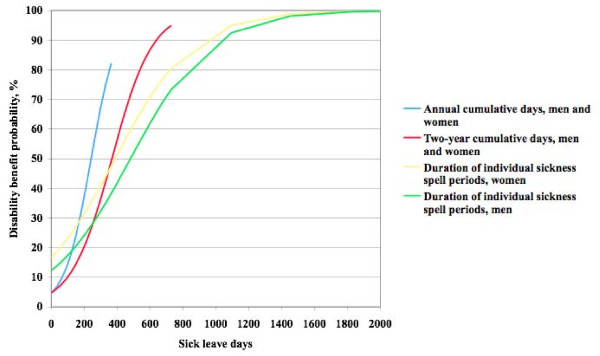
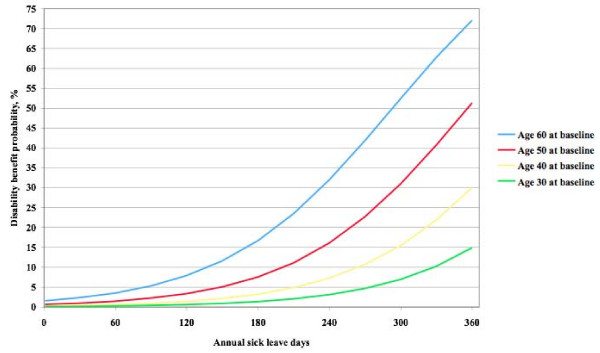
BACKGROUND: A number of previous studies have investigated various predictors for being granted a disability pension. The aim of this study was to test the efficacy of sick-leave track record as a predictor of being granted a disability pension in a large dataset based on subjects sampled from the general population and followed for a long time. METHODS: Data from five ongoing population-based Swedish studies was used, supplemented with data on all compensated sick leave periods, disability pensions granted, and vital status, obtained from official registers. The data set included 8,218 men and women followed for 16 years, generated 109,369 person years of observation and 97,160 sickness spells. Various measures of days of sick leave during follow up were used as independent variables and disability pension grant was used as outcome. RESULTS: There was a strong relationship between individual sickness spell duration and annual cumulative days of sick leave on the one hand and being granted a disability pension on the other, among both men and women, after adjustment for the effects of marital status, education, household size, smoking habits, geographical area and calendar time period, a proxy for position in the business cycle. The interval between sickness spells showed a corresponding inverse relationship. Of all the variables studied, the number of days of sick leave per year was the most powerful predictor of a disability pension. For both men and women 245 annual sick leave days were needed to reach a 50% probability of transition to disability. The independent variables, taken together, explained 96% of the variation in disability pension grantings. CONCLUSION: The sick-leave track record was the most important predictor of the probability of being granted a disability pension in this study, even when the influences of other variables affecting the outcome were taken into account.
Overview
The claims and statistics of this paper haven’t been checked yet.
Free: it reads the open-access text and checks the first 5 claims that cite a source we can check. Create a free account to check every claim.
Integrity signals
Registry
Cites
Statistics
Figures
Verification
Claims the paper makes
The claims and statistics of this paper haven’t been checked yet.
Free: it reads the open-access text and checks the first 5 claims that cite a source we can check. Create a free account to check every claim.
Self-check
Percentages, sums and reported differences re-computed from the paper’s own numbers.
The self-check needs the paper’s full text.
Citations
Cites
Sickness absence as a measure of health status and functioning: from the UK Whitehall II study.
Marmot, M., Feeney, A., Shipley, M., North, F., & Syme, S. L. (1995) · Journal of Epidemiology and Community Health · doi:10.1136/jech.49.2.124 · Cited by 668 · cited 1×
“Numerous studies have analysed the effects of other disability pension predictors [6-8,11,15,34-37], including a review performed by The Swedish Council on Technology Assessment in Health Care [26].”
BackgroundChapter 5. Risk factors for sick leave - general studies
Allebeck, P., & Mastekaasa, A. (2004) · Scandinavian Journal of Public Health · doi:10.1080/14034950410021853 · Cited by 462
Mykletun, A. (2006) · American Journal of Psychiatry · doi:10.1176/appi.ajp.163.8.1412 · Cited by 237 · cited 1×
“Potential prognostic factors, such as age, sex, socio-economic factors, time on sick leave, and others have been investigated in several studies [5-25].”
BackgroundPredictors of disability retirement
Krause, N., Lynch, J., Kaplan, G. A., Cohen, R., Goldberg, D., & Salonen, J. T. (1997) · Scandinavian Journal of Work, Environment & Health · doi:10.5271/sjweh.262 · Cited by 230 · cited 1×
“Potential prognostic factors, such as age, sex, socio-economic factors, time on sick leave, and others have been investigated in several studies [5-25].”
BackgroundSickness absence as a risk marker of future disability pension: the 10-town study: Table 1
Kivimäki, M., Forma, P., Wikström, J., Halmeenmäki, T., Pentti, J., Elovainio, M., & Vahtera, J. (2004) · Journal of Epidemiology and Community Health · doi:10.1136/jech.2003.015842 · Cited by 219 · cited 1×
“A number of other longitudinal studies, some with very large study populations, have investigated the effects of sick-leave duration on the probability of a disability pension [4,6,7,10,12,13,30-33].”
BackgroundThe Long-term Effect of Insomnia on Work Disability
Sivertsen, B., Overland, S., Neckelmann, D., Glozier, N., Krokstad, S., Pallesen, S., Nordhus, I. H., Bjorvatn, B., & Mykletun, A. (2006) · American Journal of Epidemiology · doi:10.1093/aje/kwj145 · Cited by 173 · cited 1×
“Potential prognostic factors, such as age, sex, socio-economic factors, time on sick leave, and others have been investigated in several studies [5-25].”
BackgroundLund, T., Kivimäki, M., Labriola, M., Villadsen, E., & Christensen, K. B. (2008) · Occupational and Environmental Medicine · doi:10.1136/oem.2006.031393 · Cited by 167 · cited 1×
“A number of other longitudinal studies, some with very large study populations, have investigated the effects of sick-leave duration on the probability of a disability pension [4,6,7,10,12,13,30-33].”
BackgroundVirtanen, M., Kivimäki, M., Vahtera, J., Elovainio, M., Sund, R., Virtanen, P., & Ferrie, J. E. (2006) · Occupational and Environmental Medicine · doi:10.1136/oem.2005.020297 · Cited by 163 · cited 2×
“Potential prognostic factors, such as age, sex, socio-economic factors, time on sick leave, and others have been investigated in several studies [5-25].”
BackgroundKivimäki, M., Honkonen, T., Wahlbeck, K., Elovainio, M. J., Pentti, J., Klaukka, T., Virtanen, M., & Vahtera, J. (2007) · Journal of Epidemiology & Community Health · doi:10.1136/jech.2006.050955 · Cited by 153
Chapter 9. Consequences of being on sick leave
Vingård, E., Alexanderson, K., & Norlund, A. (2004) · Scandinavian Journal of Public Health · doi:10.1080/14034950410021899 · Cited by 151 · cited 1×
“Several studies have shown that disability pensioners have a lower quality of life [1,2], more extensive health care utilisation irrespective of underlying morbidity [3], and a poorer survival irrespective of underlying morbidity [4] than working people.”
Background
Cited by
De Ridder, K. A. A., Pape, K., Johnsen, R., Westin, S., Holmen, T. L., & Bjørngaard, J. H. (2012) · Journal of Epidemiology and Community Health · doi:10.1136/jech-2011-200047 · Cited by 120
Hultin, H., Lindholm, C., & Möller, J. (2012) · PLoS ONE · doi:10.1371/journal.pone.0035614 · Cited by 97
Halford, C., Wallman, T., Welin, L., Rosengren, A., Bardel, A., Johansson, S., Eriksson, H., Palmer, E., Wilhelmsen, L., & Svärdsudd, K. (2012) · BMC Public Health · doi:10.1186/1471-2458-12-1103 · Cited by 106
“The study population has previously been described in detail [23,24].”
Self-citationHultin, H., Lindholm, C., Malfert, M., & Möller, J. (2012) · BMC Public Health · doi:10.1186/1471-2458-12-861 · Cited by 99
“Another study showed that the duration of sick-leave spells and the total number of sick-leave days in a year were the strongest predictors of disability pension, which led the researchers to conclude that the pathway to disability pension starts with short term sick-leave periods, then increasing in length until the…”
BackgroundSalonen, L., Blomgren, J., Laaksonen, M., & Niemelä, M. (2018) · BMJ Open · doi:10.1136/bmjopen-2017-020491 · Cited by 94
“In general, our study agrees with previous findings in that the association between the length of SA and the risk of disability retirement does not differ much between diagnostic groups of SAs.(40) However, in this study, there was an indication that the length of SA due to mental and behavioural disorders predicted d…”
ResultLeinonen, T., Martikainen, P., & Lahelma, E. T. (2012) · Scandinavian Journal of Public Health · doi:10.1177/1403494811435492 · Cited by 75
Polvinen, A., Gould, R., Lahelma, E. T., & Martikainen, P. (2013) · Scandinavian Journal of Public Health · doi:10.1177/1403494813482400 · Cited by 95
Finnes, A., Ghaderi, A., Dahl, J., Nager, A., & Enebrink, P. (2019) · Journal of Occupational Health Psychology · doi:10.1037/ocp0000097 · Cited by 67
“In addition, prolonged and repeated exposure to SA is in itself a predictor of future SA and disability pension (Hultin, Lindholm, & Möller, 2012; Vingård, Alexanderson, & Norlund, 2004; Wallman et al., 2009).”
BackgroundØyeflaten, I., Lie, S. A., Ihlebæk, C., & Eriksen, H. R. (2012) · BMC Public Health · doi:10.1186/1471-2458-12-748 · Cited by 87
“The probability of being granted disability pension following sick leave often begins with short term sick leave periods followed by episodes increasing in length, and with shorter and shorter intervals between them [31].”
BackgroundInfluentialAbsenteísmo-doença no serviço público municipal de Goiânia
Leão, A. L. D. M., Barbosa‐Branco, A., Neto, E. R., Ribeiro, C. A. N., & Turchi, M. D. (2015) · Revista Brasileira de Epidemiologia · doi:10.1590/1980-5497201500010020 · Cited by 68
Tamminga, S. J., de Boer, A. G. E. M., Bos, M. M. E. M., Fons, G., Kitzen, J. J. E. M., Plaisier, P. W., Verbeek, J. H. A. M., & Frings‐Dresen, M. H. W. (2012) · Journal of Occupational Rehabilitation · doi:10.1007/s10926-012-9372-2 · Cited by 49
“An early intervention is most appropriate, as longer periods of sick leave often cause patients return to work to be more difficult [9, 10].”
BackgroundLosing independence – the lived experience of being long-term sick-listed
Lännerström, L., Wallman, T., & Holmström, I. K. (2013) · BMC Public Health · doi:10.1186/1471-2458-13-745 · Cited by 49
“After a few months of sickness absence, the probability of returning to work decreases drastically [2,6,17].”
BackgroundSelf-citationDevelopment and validation of a risk prediction model for work disability: multicohort study
Airaksinen, J., Jokela, M. M., Virtanen, M., Oksanen, T., Pentti, J., Vahtera, J., Koskenvuo, M., Kawachi, I. I., Batty, G. D., & Kivimäki, M. (2017) · Scientific Reports · doi:10.1038/s41598-017-13892-1 · Cited by 59
Leisure-Time Physical Activity and Disability Retirement: A Prospective Cohort Study
Lahti, J., Rahkonen, O., Lahelma, E. T., & Laaksonen, M. (2013) · Journal of Physical Activity and Health · doi:10.1123/jpah.10.5.669 · Cited by 50
Stapelfeldt, C. M., Labriola, M., Jensen, A. B., Andersen, N. T., Momsen, A. H., & Nielsen, C. V. (2015) · BMC Public Health · doi:10.1186/s12889-015-2062-1 · Cited by 39
“Among cancer survivors who do RTW some may face both health-related and work-related difficulties leading to reduced workability and recurrence of sick leave [11], which further increases the risk of prematurely exit from the labour market [12].”
BackgroundWorking conditions as risk factors for early exit from work—in a cohort of 2351 employees in Germany
d’Errico, A., Burr, H., Pattloch, D., Kersten, N., & Rose, U. (2020) · International Archives of Occupational and Environmental Health · doi:10.1007/s00420-020-01566-x · Cited by 39
Bardel, A., Wallander, M.-A. A., Wallman, T., Rosengren, A., Johansson, S., Eriksson, H., & Svärdsudd, K. (2019) · PLoS ONE · doi:10.1371/journal.pone.0211532 · Cited by 38
Self-citationSickness benefit claims due to mental disorders in Brazil: associations in a population-based study
Barbosa‐Branco, A., Bültmann, U., & Steenstra, I. A. (2012) · Cadernos de Saúde Pública · doi:10.1590/s0102-311x2012001000005 · Cited by 30
Salonen, L., Blomgren, J., & Laaksonen, M. (2020) · BMC Public Health · doi:10.1186/s12889-020-09158-7 · Cited by 29
“To eliminate confounding by LTSA spells that lead directly to disability retirement and by unfinished spells, the spells that started in 2006 were not assessed, which has also been the convention in previous studies [16].”
ResultSickness absence among municipal workers in a Brazilian municipality: a secondary data analysis
Leão, A. L. D. M., Barbosa‐Branco, A., Turchi, M. D., Steenstra, I. A., & Cole, D. C. (2017) · BMC Research Notes · doi:10.1186/s13104-017-3116-5 · Cited by 34
“Sickness absence contributes substantially to healthcare costs, insurance expenditures, loss of economic productivity, and increases the risk of disability pension and mortality [1, 2].”
BackgroundType D personality, depressive symptoms and work-related health outcomes
Mommersteeg, P. M. C., Denollet, J., & Martens, E. J. (2011) · Scandinavian Journal of Public Health · doi:10.1177/1403494811421533 · Cited by 37
“Other studies have significantly predicted disability pension by depression [18], burnout, sick leave [29], and number of days on sick leave [30].”
BackgroundAsthma related to workplace dampness and impaired work ability
Karvala, K., Nordman, H., Luukkonen, R. A., & Uitti, J. (2012) · International Archives of Occupational and Environmental Health · doi:10.1007/s00420-012-0830-0 · Cited by 26
Sumanen, H., Pietiläinen, O. P. H., Lahelma, E. T., & Rahkonen, O. (2017) · BMC Public Health · doi:10.1186/s12889-016-3951-7 · Cited by 26
“Early signs of work disability include repeated short spells and increasing sickness absence [10].”
BackgroundWikman, A., Wiberg, M., Marklund, S., & Alexanderson, K. A. E. (2012) · BMC Public Health · doi:10.1186/1471-2458-12-745 · Cited by 25
“However, thus far, such studies have mainly included selected and often small groups, and most have been performed to study future sick-leave periods among people with specific health problems, types of rehabilitation, or attitudes [4-14].”
BackgroundAbsenteeism and Presenteeism Among American Workers
Maestas, N., Mullen, K. J., & Rennane, S. (2020) · Journal of Disability Policy Studies · doi:10.1177/1044207320933211 · Cited by 25
“…& Ziebarth, 2016), and other studies that relate absenteeism patterns to future disability benefit take up for manufacturing workers in the United States (Harrati et al., 2018) and for the overall workforce in Scandinavian countries (Andren, 2007; Gjesdal & Bratberg, 2003; Wallman et al., 2009).”
BackgroundPredictors of Sickness Absence in a Clinical Population With Chronic Pain
LoMartire, R., Dahlström, Ö., Björk, M., Vixner, L., Frumento, P., Constan, L., Gerdle, B. U. C., & Äng, B. O. (2021) · Journal of Pain · doi:10.1016/j.jpain.2021.03.145 · Cited by 25
Using Administrative Data to Assess the Risk of Permanent Work Disability: A Cohort Study
Bethge, M., Spanier, K., & Streibelt, M. (2020) · Journal of Occupational Rehabilitation · doi:10.1007/s10926-020-09926-7 · Cited by 23
Leino‐Arjas, P., Seitsamo, J. T., Nygård, C., Prakash, K. C., & Neupane, S. (2021) · International Journal of Environmental Research and Public Health · doi:10.3390/ijerph18052614 · Cited by 24
Kausto, J., Virta, L. J., Luukkonen, R. A., & Viikari-Juntura, E. R. A. (2010) · BMC Public Health · doi:10.1186/1471-2458-10-361 · Cited by 22
“In agreement with previous studies on predictors of disability pensions [3-5,15-20], we found that higher age, a mental or musculoskeletal disorder, and a higher number of sickness absence days were associated with subsequent partial or full disability pension.”
Stapelfeldt, C. M., Nielsen, C. V., Andersen, N. T., Krane, L., Borg, V., Fleten, N., & Jensen, C. (2014) · BMJ Open · doi:10.1136/bmjopen-2013-003941 · Cited by 24
“1–14 829 (60) 445 (32) 61 (4) 38 (3) 824 (61) 438 (32) 60 (4) 38 (3)”
Risikoindex Erwerbsminderungsrente (RI-EMR)
Bethge, M., Egner, U., Streibelt, M., Radoschewski, F. M., & Spyra, K. (2011) · Bundesgesundheitsblatt - Gesundheitsforschung - Gesundheitsschutz · doi:10.1007/s00103-011-1366-2 · Cited by 22
Ármannsdóttir, B., MÅRDBY, A.-C. M., Haukenes, I., & Hensing, G. K. E. (2013) · BMC Public Health · doi:10.1186/1471-2458-13-329 · Cited by 22
“Other studies have found that sickness absence increases the future risk of disability pension [20,21] and that sick leave lasting longer than three weeks is associated with poor self-reported health, physical complaints, low mental well-being and poor work ability [22].”
BackgroundCasimirri, E., Vaccari, A., Schito, M., Bonci, M., Stendardo, M., Stefanati, A., Nardini, M., & Boschetto, P. (2014) · International Journal of Occupational Medicine and Environmental Health · doi:10.2478/s13382-014-0256-x · Cited by 21
“Sickness absence has also been shown to predict future adverse health outcomes, mortality and increased future risk of disability pension in an ageing workforce [1,3,4].”
BackgroundKnapstad, M., Holmgren, K. E., Hensing, G. K. E., & Øverland, S. N. (2014) · BMJ Open · doi:10.1136/bmjopen-2014-005963 · Cited by 26
Laaksonen, M., Blomgren, J., & Gould, R. (2016) · European Journal of Public Health · doi:10.1093/eurpub/ckw081 · Cited by 25
Chen, L., Glimelius, I. C., Neovius, M., Ekberg, S., Martling, A., Eloranta, S., & Smedby, K. E. E. (2016) · Cancer Epidemiology Biomarkers & Prevention · doi:10.1158/1055-9965.epi-16-0112 · Cited by 20
“Independent of the underlying disease, work loss can be seen as a proxy for comorbidity or poorer health condition, and is therefore expected to be an important predictor for future SL and/orDP (30, 31).”
BackgroundNexø, M. A., Borg, V., Sejbæk, C. S., Carneiro, I. G., Hjarsbech, P. U., & Rugulies, R. (2015) · BMC Public Health · doi:10.1186/s12889-015-1973-1 · Cited by 23
“Depression is a common mental disorder [1, 2] and is one of the leading causes of early retirement by disability pension in many Western Countries [2–12].”
BackgroundLaaksonen, M., & Blomgren, J. (2020) · International Journal of Environmental Research and Public Health · doi:10.3390/ijerph17051756 · Cited by 34
“Previous studies have shown that sickness absence levels are increased already several years before disability retirement [2,3].”
BackgroundLoMartire, R., Björk, M., Dahlström, Ö., Constan, L., Frumento, P., Vixner, L., Gerdle, B. U. C., & Äng, B. O. (2021) · European Journal of Pain · doi:10.1002/ejp.1832 · Cited by 20
“…to receive adequate healthcare and sickness absence (Adler & Newman, 2002; Cylus et al., 2011; Dorner et al., 2015; Lager et al., 2019; LoMartire et al., 2021; Mastekaasa & Melsom, 2014; Moscelli et al., 2018; Patton & Johns, 2007; Ropponen et al., 2020; Wallman et al., 2009; Wang et al., 2013).”
BackgroundKaijankoski, H., Nissen, M., Ikäheimo, T.-M., zu Fraunberg, M. V. U., Airaksinen, O., & Huttunen, J. (2018) · Neurosurgery · doi:10.1093/neuros/nyy530 · Cited by 17
Determinants for return to work among sickness certified patients in general practice
von Celsing, A., Svärdsudd, K., Eriksson, H.-G., Björkegren, K., Eriksson, M., & Wallman, T. (2012) · BMC Public Health · doi:10.1186/1471-2458-12-1077 · Cited by 16
“Moreover, in a previous publication from this project previous sick leave, or sick leave track record, was closely associated with being granted a disability pension [10].”
InfluentialSelf-citationGustafsson, Lundh, Svedberg, P., Linder, J., Alexanderson, K. A. E., & Marklund, S. (2011) · Journal of Multidisciplinary Healthcare · doi:10.2147/jmdh.s17138 · Cited by 17
“15 Wallman et al 16 found that the number of annual days of SA had the best prognostic precision for DP compared with other predictors such as age, length of education, and geographical area.”
Smoking and disability pension: a systematic review and meta-analysis
Amiri, S., & Behnezhad, S. (2020) · Public Health · doi:10.1016/j.puhe.2020.04.013 · Cited by 15
Andersén, Å., Larsson, K., Lytsy, P., Berglund, E., Kristiansson, P., & Anderzén, I. (2018) · Journal of Occupational Rehabilitation · doi:10.1007/s10926-017-9752-8 · Cited by 14
“They used the RTW self-efficacy scale, a specific scale for measuring the change in selfefficacy associated with RTW, which shows stronger associations with RTW compared to the GSE [18].”
BackgroundInfluentialKlein, J., Reini, K., & Saarela, J. M. (2021) · Frontiers in Public Health · doi:10.3389/fpubh.2021.556648 · Cited by 12
“Studies with the longest follow-up, which have analysed the association of all-cause SA on DP, cover ∼15 years (19, 38, 39), but have either been based on rather small surveys linked to the population register (19, 39), or on records of one large employer (38).”
BackgroundWarren, P. A. (2013) · Psychological Injury and Law · doi:10.1007/s12207-013-9163-x · Cited by 10
Andersén, Å., Berglund, E., & Anderzén, I. (2020) · BMC Public Health · doi:10.1186/s12889-020-8238-3 · Cited by 11
“However, longer periods of sick leave by itself can have negative impact, including impaired health [3, 4] and reduce the possibility for return to work (RTW) [5].”
BackgroundDisability policies: Reform strategies in a comparative perspective
Böheim, R., & Leoni, T. (2016) · National Bureau of Economic Research · doi:10.3386/w22206 · Cited by 10
“Empirical studies document the strong correlation between prolonged sickness absences and subsequent disability (e. g. Wallman et al. 2009), but in most countries sickness absences and disability are still separate policy areas.”
Warren, P. A. (2013) · Psychological Injury and Law · doi:10.1007/s12207-013-9164-9 · Cited by 9
Gómez, M. A. L., Durán, X., Alonso, J., Martı́nez, J. M., Espallargues, M., & Benavides, F. G. (2014) · Revista Española de Salud Pública · doi:10.4321/s1135-57272014000300005 · Cited by 13
Söderberg, M., Stattin, M., Robroek, S. J., Burdorf, A., & Järvholm, B. (2020) · Scandinavian Journal of Work Environment & Health · doi:10.5271/sjweh.3932 · Cited by 10
“Old age and chronic diseases are thus, unsurprisingly, the strongest predictors for premature labor market exit through disability benefits (DB) (4, 5).”
BackgroundLoMartire, R., Johansson, P., & Frumento, P. (2023) · Journal of Pain · doi:10.1016/j.jpain.2023.06.009 · Cited by 7
A population-based study of nearly 15 000 observations among Swedish women and men during 1973–2003
Halford, C., Welin, C., Bogefeldt, J. P., Wallman, T., Rosengren, A., Bardel, A., Johansson, S., Eriksson, H., & Svärdsudd, K. (2012) · BMJ Open · doi:10.1136/bmjopen-2012-001353 · Cited by 7
“The study population has previously been described in detail.(20) 21 Briefly, random samples based on predefined specifications concerning age, sex and area of residence, were drawn from the national population register.”
Self-citationSundstrup, E., Hansen, Å. M., Mortensen, E. L., Poulsen, O. M., Clausen, T., Rugulies, R., Møller, A., & Andersen, L. L. (2016) · BMC Public Health · doi:10.1186/s12889-016-3290-8 · Cited by 7
Bethge, M., Egner, U., Streibelt, M., Radoschewski, F. M., & Spyra, K. (2012) · Bundesgesundheitsblatt - Gesundheitsforschung - Gesundheitsschutz · doi:10.1007/s00103-012-1444-0 · Cited by 6
Predictors of return to work with and without restrictions in public workers
Días, A., Bernardes, J. M., Coquemala, S. A. S., Gómez-Salgado, J. C., & Ruíz-Frutos, C. (2019) · PLoS ONE · doi:10.1371/journal.pone.0210392 · Cited by 5
Gustavsson, I. N., Müssener, U., & Ståhl, C. (2021) · International Journal of Workplace Health Management · doi:10.1108/ijwhm-09-2020-0162 · Cited by 8
Besen, E. T., & Pransky, G. (2015) · Journal of Occupational and Environmental Medicine · doi:10.1097/jom.0000000000000493 · Cited by 4
Asthma in damp indoor work environments
Karvala, K. (2012) · Helda - University of Helsinki Institutional Repository · Cited by 8
Firms' Sickness Costs and Workers' Sickness Absences
Böheim, R., & Leoni, T. (2014) · National Bureau of Economic Research · doi:10.3386/w20305 · Cited by 4
“Moreover, there is a clear link between temporary sick-leave and permanent disability (Wallman et al., 2009).”
Predicting disability retirement among Abu Dhabi police using multiple measure of sickness absence
Alkaabi, F. A. (2022) · BMC Public Health · doi:10.1186/s12889-022-13713-9 · Cited by 6
“Thirdly, this study is one of very few to evaluate risk of disability retirement for different measures of sickness absence [3, 38] or average length of sickness absence spells [3, 10].”
BackgroundInfluentialSickness absences among young mothers and the child penalty in employment
Fontenay, S., & Tojerow, I. (2024) · Review of Economics of the Household · doi:10.1007/s11150-024-09720-x · Cited by 5
“However, we believe that this exercise is still informative since it is frequent for longer spells to be preceded by several short sick leaves, with various attempts to go back to work in the intervals (Borg et al., 2001; Wallman et al., 2009).”
von Celsing, A., Svärdsudd, K., & Wallman, T. (2014) · Upsala Journal of Medical Sciences · doi:10.3109/03009734.2014.922143 · Cited by 3
“Long-term sickness absence usually starts with recurrent periods of short-term sick-leave that tend to increase in duration, interspersed with shorter and shorter non-sick-leave intervals (2).”
BackgroundSelf-citationInjustice at work affects work ability and role functioning: findings of a cohort study
Spanier, K., Michel, E., Peters, E., Radoschewski, F. M., & Bethge, M. (2017) · International Journal of Public Health · doi:10.1007/s00038-017-1056-4 · Cited by 7
“This is a group gaining particular interest not only in Germany (Ishtiak-Ahmed et al. 2014; Kivimaki et al. 2007; Lund et al. 2008; Wallman et al. 2009).”
Licencia médica psiquiátrica: revisión de los efectos positivos y negativos del reposo
Almonte, J. C., Muñoz, P., & Parrini, J. (2018) · Revista médica de Chile · doi:10.4067/s0034-98872018000400494 · Cited by 3
Söderberg, M., Mannelqvist, R., Järvholm, B., Schiöler, L., & Stattin, M. (2018) · Scandinavian Journal of Public Health · doi:10.1177/1403494818754747 · Cited by 3
“micro-level predictors of premature labour market exit: poor health [3], old age [4] and long-term sick leave [5].”
BackgroundTo be or not to be Sick Certified with Special Reference to Physician and Patient Related Factors
Norrmén, G. (2010) · DiVA (Digitala Vetenskapliga Arkivet) · Cited by 4
von Celsing, A., Kristiansson, P., Svärdsudd, K., & Wallman, T. (2020) · BMC Family Practice · doi:10.1186/s12875-020-01123-y · Cited by 3
Self-citationSuur-Uski, J., Fagerlund, P., Granroth‐Wilding, H. M. V., Salonsalmi, A., Rahkonen, O., & Lallukka, T. M. (2024) · European Journal of Public Health · doi:10.1093/eurpub/ckae023 · Cited by 4
Anttila, A., Nuutinen, M., van Gils, M., Pekki, A., & Sauni, R. (2024) · Preventive Medicine Reports · doi:10.1016/j.pmedr.2024.102899 · Cited by 5
Worker Absenteeism and Employment Outcomes: A Literature Review
Mullen, K. J., & Rennane, S. (2017) · Cited by 2
Laaksonen, M., Blomgren, J., Rinne, H., & Perhoniemi, R. (2023) · Scandinavian Journal of Work Environment & Health · doi:10.5271/sjweh.4122 · Cited by 2
“Studies from various countries show that the sooner a person can return to work, the better the chances that the working career continues (3-5).”
Backgroundde Melo, G. M., Gonçalves, A. J., Walder, F., Ferraz, C., das Neves, M. C., Abrahão, M., & Cervantes, O. (2021) · Brazilian Journal of Otorhinolaryngology · doi:10.1016/j.bjorl.2021.08.008 · Cited by 2
Socio-economic determinants of sickness absence
Piha, K. (2013) · Helda - University of Helsinki Institutional Repository · Cited by 3
Sickness absence and working conditions in the food industry
Siukola, A. (2013) · Tampere University Institutional Repository (Tampere University) · Cited by 14
Sickness absence trajectories and retirement pathways among industrial workers
Neupane, S., Prakash, K. C., Nosraty, L., Kyrönlahti, S. M., Nygård, C., & Oakman, J. (2025) · European Journal of Public Health · doi:10.1093/eurpub/ckaf104 · Cited by 2
“Few studies have indicated that the overall annual number of sick-leave days is a more accurate predictor of disability pension outcomes or early retirement than the number of periods taken by an employee [15] and is also a better item to identify trajectories [3].”
Anttila, A., Nuutinen, M., Leskelä, R., van Gils, M., & Sauni, R. (2025) · BMJ Open · doi:10.1136/bmjopen-2025-101921 · Cited by 1
Pausch, K., Blanke, K., Niederberger, V., Egli, S., Rufer, M., Ajdacic‐Gross, V., Olbrich, S., & Müller, M. (2022) · Neuropsychiatrie · doi:10.1007/s40211-022-00415-2 · Cited by 1
“[50] was to test the effectiveness of sick leave balance as a predictor of the award of a disability pension in a dataset based on individuals from the general population who had been observed long-term.”
BackgroundRisk Factors for Disability Pension : Studies of a Swedish Twin Cohort
Samuelsson, Å. (2013) · DiVA (University of Gävle) · Cited by 2
DISABILITY PENSION AMONG PATIENTS UNDERGOING CORONARY REVASCULARISATION
Zetterström, K. (2015) · Figshare
Chronic pain in widowers 4-5 years after loss
Ásgeirsdóttir, H. G. (2011)
From THE INSTITUTE OF ENVIRONMENTAL MEDICINE
Giuseppe, D. D. (2014)
Return to work : methods for promoting health and productivity in employees on sickness absence
Finnes, A. (2018) · Figshare
Klein, J., Reini, K., & Saarela, J. M. (2022) · SN Social Sciences · doi:10.1007/s43545-022-00451-3
“Socioeconomic position is also inversely related to the risk of becoming a disability pensioner (Klein and Saarela 2019a; Madsen 2020; Wallmann et al. 2009).”
BackgroundKirkegaard, T., Dalgaard, V. L., & Grytnes, R. (2024) · Industrial Relations Journal · doi:10.1111/irj.12447
Johnsen, T. L., Tveito, T. H., Øyeflaten, I., & Lie, S. A. (2025) · Work · doi:10.1177/10519815251353214
“In addition to recurrent and longitudinal data on SL-episodes and DP, the dataset included demographic information on age, gender, ICPC-diagnosis for SL, and occupation.”
InfluentialKujanpää, T., Repo, J. M., Palanne, A., Liukkonen, V., Jääskeläinen, T., Lundqvist, A., Lahti, J., & Luoto, R. (2026) · Scandinavian Journal of Public Health · doi:10.1177/14034948261454741
Metadata
- Authors
- Wallman, T., Wedel, H., Palmer, E., Rosengren, A., Johansson, S., Eriksson, H., & Svärdsudd, K.
- Affiliations
- Uppsala University (SE)
- Nordic School of Public Health (SE)
- AstraZeneca (Sweden) (SE)
- Corresponding author
- Wallman, Thorne
- Venue
- BMC Public Health
- Published
- 2009-04-15
- Volume
- 9
- Issue
- 1
- Pages
- 104-104
- ISSN
- 1471-2458 (ISSN-L)
- PMC
- PMC2674437
- OpenAlex
- W2066641875
- Semantic Scholar
- 6ee4f08d8a62f14d365930d7fb1d4c4d77f50470
- Cited by
- 87
- References
- 35
- Citations by year
- 2026: 1 · 2025: 3 · 2024: 4 · 2023: 2 · 2022: 3 · 2021: 6 · 2020: 9 · 2019: 2 · 2018: 6 · 2017: 6 · 2016: 4 · 2015: 5 · 2014: 7 · 2013: 9 · 2012: 14
- FWCI
- 18.04
- Type
- journal article
- Language
- en
- Open access
- gold
- doi.org
- Licence
- cc-by
- creativecommons.org/licenses/by/2.0 (tdm)
- Locations
- BMC Public Health (publishedVersion, cc-by)
- PubMed Central (publishedVersion, cc-by)
- PubMed (publishedVersion)
- DOAJ (DOAJ: Directory of Open Access Journals) (submittedVersion, cc-by-sa)
- Funders
- Medical Research Council
- Topics
- Social Sciences › Demography › Retirement, Disability, and Employment
- Health Sciences › Medicine › Public Health, Environmental and Occupational Health › Workplace Health and Well-being
- Health Sciences › Health Professions › Physical Therapy, Sports Therapy and Rehabilitation › Medical Practices and Rehabilitation
- Keywords
- sick leave, disability pension, predictors of disability, long-term sickness absence, population-based cohort
- MeSH terms
- Absenteeism, Adult, Female, Persons with Disabilities, Disabled Persons, Health Status Indicators, Humans, Longitudinal Studies, Male, Middle Aged, Pensions, Sweden, Sick Leave
About these checks
Registry, retraction, Cites and statistics results are computed, not judged, with one exception: a printed reference that no index lists is read once by a model before it counts as a citation error. Claims are extracted by a model and kept only when their quote appears verbatim in the text; each cited source is then checked, with a model’s help, for whether it says what the claim relies on. Those verdicts can be wrong — read the claim’s quote and the cited source before relying on one.
Statistics and arithmetic are recomputed, not judged.
Confidence bands are shown only for fields calibrated on our annotated test set. None is calibrated yet, so no band is shown.
What counts as a claim ›How we measure confidence ›How we check this ›
Are you an author, or do you see a problem with this page? Request a review
Data sources
Bibliographic data: Semantic Scholar, OpenAlex, Crossref.
Contains information from the Semantic Scholar Academic Graph Datasets, made available under the ODC Attribution License (ODC-BY 1.0).
Semantic Scholar’s data is described in: Kinney, R., et al. (2023). The Semantic Scholar Open Data Platform. arXiv:2301.10140.
