

Sick-leave track record and other potential predictors of a disability pension. A population based study of 8,218 men and women followed for 16 years
Open accessThe DOI matches its Crossref record; 35 of the 36 references it cites were found in a registry or an index, and 1 are not checked yet.
Abstract
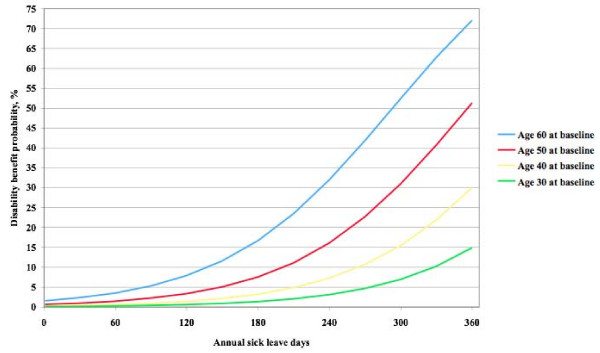
BACKGROUND: A number of previous studies have investigated various predictors for being granted a disability pension. The aim of this study was to test the efficacy of sick-leave track record as a predictor of being granted a disability pension in a large dataset based on subjects sampled from the general population and followed for a long time. METHODS: Data from five ongoing population-based Swedish studies was used, supplemented with data on all compensated sick leave periods, disability pensions granted, and vital status, obtained from official registers. The data set included 8,218 men and women followed for 16 years, generated 109,369 person years of observation and 97,160 sickness spells. Various measures of days of sick leave during follow up were used as independent variables and disability pension grant was used as outcome. RESULTS: There was a strong relationship between individual sickness spell duration and annual cumulative days of sick leave on the one hand and being granted a disability pension on the other, among both men and women, after adjustment for the effects of marital status, education, household size, smoking habits, geographical area and calendar time period, a proxy for position in the business cycle. The interval between sickness spells showed a corresponding inverse relationship. Of all the variables studied, the number of days of sick leave per year was the most powerful predictor of a disability pension. For both men and women 245 annual sick leave days were needed to reach a 50% probability of transition to disability. The independent variables, taken together, explained 96% of the variation in disability pension grantings. CONCLUSION: The sick-leave track record was the most important predictor of the probability of being granted a disability pension in this study, even when the influences of other variables affecting the outcome were taken into account.
Overview
The claims and statistics of this paper haven’t been checked yet.
Free: it reads the open-access text and checks the first 5 claims that cite a source we can check. Create a free account to check every claim.
Integrity signals
Registry
Cites
Statistics
Figures
Verification
Claims the paper makes
The claims and statistics of this paper haven’t been checked yet.
Free: it reads the open-access text and checks the first 5 claims that cite a source we can check. Create a free account to check every claim.
Self-check
Percentages, sums and reported differences re-computed from the paper’s own numbers.
The self-check needs the paper’s full text.
Citations
Cites
Sickness absence as a measure of health status and functioning: from the UK Whitehall II study.
Marmot, M., Feeney, A., Shipley, M., North, F., & Syme, S. L. (1995) · Journal of Epidemiology and Community Health · doi:10.1136/jech.49.2.124 · Cited by 668 · cited 1×
“Numerous studies have analysed the effects of other disability pension predictors [6-8,11,15,34-37], including a review performed by The Swedish Council on Technology Assessment in Health Care [26].”
BackgroundChapter 5. Risk factors for sick leave - general studies
Allebeck, P., & Mastekaasa, A. (2004) · Scandinavian Journal of Public Health · doi:10.1080/14034950410021853 · Cited by 462
Mykletun, A. (2006) · American Journal of Psychiatry · doi:10.1176/appi.ajp.163.8.1412 · Cited by 237 · cited 1×
“Potential prognostic factors, such as age, sex, socio-economic factors, time on sick leave, and others have been investigated in several studies [5-25].”
BackgroundPredictors of disability retirement
Krause, N., Lynch, J., Kaplan, G. A., Cohen, R., Goldberg, D., & Salonen, J. T. (1997) · Scandinavian Journal of Work, Environment & Health · doi:10.5271/sjweh.262 · Cited by 230 · cited 1×
“Potential prognostic factors, such as age, sex, socio-economic factors, time on sick leave, and others have been investigated in several studies [5-25].”
BackgroundSickness absence as a risk marker of future disability pension: the 10-town study: Table 1
Kivimäki, M., Forma, P., Wikström, J., Halmeenmäki, T., Pentti, J., Elovainio, M., & Vahtera, J. (2004) · Journal of Epidemiology and Community Health · doi:10.1136/jech.2003.015842 · Cited by 219 · cited 1×
“A number of other longitudinal studies, some with very large study populations, have investigated the effects of sick-leave duration on the probability of a disability pension [4,6,7,10,12,13,30-33].”
BackgroundThe Long-term Effect of Insomnia on Work Disability
Sivertsen, B., Overland, S., Neckelmann, D., Glozier, N., Krokstad, S., Pallesen, S., Nordhus, I. H., Bjorvatn, B., & Mykletun, A. (2006) · American Journal of Epidemiology · doi:10.1093/aje/kwj145 · Cited by 173 · cited 1×
“Potential prognostic factors, such as age, sex, socio-economic factors, time on sick leave, and others have been investigated in several studies [5-25].”
BackgroundLund, T., Kivimäki, M., Labriola, M., Villadsen, E., & Christensen, K. B. (2008) · Occupational and Environmental Medicine · doi:10.1136/oem.2006.031393 · Cited by 167 · cited 1×
“A number of other longitudinal studies, some with very large study populations, have investigated the effects of sick-leave duration on the probability of a disability pension [4,6,7,10,12,13,30-33].”
BackgroundVirtanen, M., Kivimäki, M., Vahtera, J., Elovainio, M., Sund, R., Virtanen, P., & Ferrie, J. E. (2006) · Occupational and Environmental Medicine · doi:10.1136/oem.2005.020297 · Cited by 163 · cited 2×
“Potential prognostic factors, such as age, sex, socio-economic factors, time on sick leave, and others have been investigated in several studies [5-25].”
BackgroundKivimäki, M., Honkonen, T., Wahlbeck, K., Elovainio, M. J., Pentti, J., Klaukka, T., Virtanen, M., & Vahtera, J. (2007) · Journal of Epidemiology & Community Health · doi:10.1136/jech.2006.050955 · Cited by 153
Chapter 9. Consequences of being on sick leave
Vingård, E., Alexanderson, K., & Norlund, A. (2004) · Scandinavian Journal of Public Health · doi:10.1080/14034950410021899 · Cited by 151 · cited 1×
“Several studies have shown that disability pensioners have a lower quality of life [1,2], more extensive health care utilisation irrespective of underlying morbidity [3], and a poorer survival irrespective of underlying morbidity [4] than working people.”
BackgroundGjesdal, S. (2004) · The European Journal of Public Health · doi:10.1093/eurpub/14.4.398 · Cited by 141 · cited 2×
“The only effect of underlying diagnosis seems to be that subjects with sick-leave compensation for psychiatric diagnoses appear to run a greater risk of being granted a disability pension [5,9,13,15,31], but there is no evidence that the sick leave-track record would be different compared to groups with other diagnose…”
BackgroundResultGjesdal, S., & Bratberg, E. (2003) · Scandinavian Journal of Public Health · doi:10.1080/14034940210165154 · Cited by 135 · cited 6×
“A number of other longitudinal studies, some with very large study populations, have investigated the effects of sick-leave duration on the probability of a disability pension [4,6,7,10,12,13,30-33].”
BackgroundMethodInfluentialChapter 11. Physicians' sick-listing practices
Wahlström, R., & Alexanderson, K. A. E. (2004) · Scandinavian Journal of Public Health · doi:10.1080/14034950410021916 · Cited by 130
Borg, K., Hensing, G., & Alexanderson, K. (2001) · Scandinavian Journal of Public Health · doi:10.1177/14034948010290020701 · Cited by 130
Chapter 7. Sickness absence and psychiatric disorders
Hensing, G., & Wahlström, R. (2004) · Scandinavian Journal of Public Health · doi:10.1080/14034950410021871 · Cited by 126
Diagnosis-specific sick leave as a risk marker for disability pension in a Swedish population
Kivimäki, M., Ferrie, J. E., Hagberg, J., Head, J., Westerlund, H., Vahtera, J., & Alexanderson, K. (2007) · Journal of Epidemiology and Community Health · doi:10.1136/jech.2006.055426 · Cited by 117 · cited 2×
“The only effect of underlying diagnosis seems to be that subjects with sick-leave compensation for psychiatric diagnoses appear to run a greater risk of being granted a disability pension [5,9,13,15,31], but there is no evidence that the sick leave-track record would be different compared to groups with other diagnose…”
BackgroundResultHensing, G., Andersson, L., & Brage, S. (2006) · BMC Medicine · doi:10.1186/1741-7015-4-19 · Cited by 116 · cited 2×
“The only effect of underlying diagnosis seems to be that subjects with sick-leave compensation for psychiatric diagnoses appear to run a greater risk of being granted a disability pension [5,9,13,15,31], but there is no evidence that the sick leave-track record would be different compared to groups with other diagnose…”
BackgroundResultGjesdal, S., & Bratberg, E. (2002) · European Journal of Public Health · doi:10.1093/eurpub/12.3.180 · Cited by 107 · cited 1×
“Gjesdal and Bratberg in a three-year follow-up study, found that sickness spell durations of 270 days were associated with a 40% probability of disability pension, fairly close to our 285 days for women [29].”
BackgroundMÅnsson, N.-O., & RÅstam, L. (2001) · Scandinavian Journal of Public Health · doi:10.1177/14034948010290020201 · Cited by 101 · cited 1×
“Potential prognostic factors, such as age, sex, socio-economic factors, time on sick leave, and others have been investigated in several studies [5-25].”
BackgroundSocioeconomic inequalities and disability pension in middle-aged men
Mansson, N. (1998) · International Journal of Epidemiology · doi:10.1093/ije/27.6.1019 · Cited by 93 · cited 1×
“Potential prognostic factors, such as age, sex, socio-economic factors, time on sick leave, and others have been investigated in several studies [5-25].”
BackgroundBody Mass Index and Disability Pension in Middle-Aged Men—Non-Linear Relations
Månsson, N.-O., Eriksson, K., Israelsson, B., Ranstam, J., Melander, A., & Råstam, L. (1996) · International Journal of Epidemiology · doi:10.1093/ije/25.1.80 · Cited by 93 · cited 1×
“Potential prognostic factors, such as age, sex, socio-economic factors, time on sick leave, and others have been investigated in several studies [5-25].”
BackgroundLeijon, M., Hensing, G., & Alexanderson, K. (1998) · Scandinavian Journal of Social Medicine · doi:10.1177/14034948980260031101 · Cited by 92 · cited 2×
“Numerous studies have analysed the effects of other disability pension predictors [6-8,11,15,34-37], including a review performed by The Swedish Council on Technology Assessment in Health Care [26].”
BackgroundWallman, T., Wedel, H., Johansson, S., Rosengren, A., Eriksson, H., Welin, L., & Svärdsudd, K. (2006) · BMC Public Health · doi:10.1186/1471-2458-6-103 · Cited by 86 · cited 3×
“Several studies have shown that disability pensioners have a lower quality of life [1,2], more extensive health care utilisation irrespective of underlying morbidity [3], and a poorer survival irrespective of underlying morbidity [4] than working people.”
BackgroundSelf-citationWork or retirement? Exit routes for Norwegian elderly
Dahl, S., Nilsen, Ø. A., & Vaage, K. (2000) · Applied Economics · doi:10.1080/000368400425080 · Cited by 71
Alexanderson, K. A. E., Borg, K. E., & Hensing, G. K. E. (2005) · Work · doi:10.3233/wor-2005-00446 · Cited by 69 · cited 2×
“Potential prognostic factors, such as age, sex, socio-economic factors, time on sick leave, and others have been investigated in several studies [5-25].”
BackgroundLabriola, M., & Lund, T. (2007) · International Journal of Medical Sciences · doi:10.7150/ijms.4.153 · Cited by 65 · cited 1×
“A number of other longitudinal studies, some with very large study populations, have investigated the effects of sick-leave duration on the probability of a disability pension [4,6,7,10,12,13,30-33].”
BackgroundMånsson, N.-O., & Merlo, J. (2001) · European Journal of Epidemiology · doi:10.1023/a:1010906402079 · Cited by 61 · cited 1×
“Potential prognostic factors, such as age, sex, socio-economic factors, time on sick leave, and others have been investigated in several studies [5-25].”
BackgroundRisk indicators of disability pension. A 15 year follow-up study.
Biering‐Sørensen, F., Lund, J., Høydalsmo, O. J., Darre, E., Deis, A., Kryger, P., & Müller, C. F. (1999) · PubMed · Cited by 50
Borg, K. E., Hensing, G. K. E., & Alexanderson, K. A. E. (2004) · Scandinavian Journal of Public Health · doi:10.1080/14034940310019524 · Cited by 43
Alcohol Consumption and Disability Pension among Middle-Aged Men
Månsson, N.-O., Råstam, L., Eriksson, K., & Israelsson, B. (1999) · Annals of Epidemiology · doi:10.1016/s1047-2797(99)00014-9 · Cited by 36 · cited 1×
“Potential prognostic factors, such as age, sex, socio-economic factors, time on sick leave, and others have been investigated in several studies [5-25].”
BackgroundBorg, K. E., Hensing, G. K. E., & Alexanderson, K. A. E. (2004) · Work · doi:10.3233/wor-2004-00381 · Cited by 24 · cited 3×
“Numerous studies have analysed the effects of other disability pension predictors [6-8,11,15,34-37], including a review performed by The Swedish Council on Technology Assessment in Health Care [26].”
BackgroundResultHealth care utilisation before and after retirement due to illness
Wallman, T., Burell, G. K., Kullman, S., & Svärdsudd, K. (2004) · Scandinavian Journal of Primary Health Care · doi:10.1080/02813430410005126 · Cited by 22 · cited 1×
“Several studies have shown that disability pensioners have a lower quality of life [1,2], more extensive health care utilisation irrespective of underlying morbidity [3], and a poorer survival irrespective of underlying morbidity [4] than working people.”
BackgroundSelf-citationAndersson, L. M. C., Nyman, C. S., Spak, F., & Hensing, G. K. E. (2006) · Work · doi:10.3233/wor-2006-00530 · Cited by 20
Factors affecting long-term sick leave in an industrial population
Eyal, A., Carel, R. S., & Goldsmith, J. R. (1994) · International Archives of Occupational and Environmental Health · doi:10.1007/bf00454367 · Cited by 15 · cited 1×
“Numerous studies have analysed the effects of other disability pension predictors [6-8,11,15,34-37], including a review performed by The Swedish Council on Technology Assessment in Health Care [26].”
BackgroundQuality of Life Among Early Retirees
Edén, L. (1999) · Experimental Aging Research · doi:10.1080/036107399243959 · Cited by 14 · cited 1×
“Several studies have shown that disability pensioners have a lower quality of life [1,2], more extensive health care utilisation irrespective of underlying morbidity [3], and a poorer survival irrespective of underlying morbidity [4] than working people.”
BackgroundMånsson, N.-O., Merlo, J., & Östergren, P. (2001) · Scandinavian Journal of Public Health · doi:10.1177/14034948010290021101 · Cited by 7 · cited 1×
“Potential prognostic factors, such as age, sex, socio-economic factors, time on sick leave, and others have been investigated in several studies [5-25].”
Background
Cited by
De Ridder, K. A. A., Pape, K., Johnsen, R., Westin, S., Holmen, T. L., & Bjørngaard, J. H. (2012) · Journal of Epidemiology and Community Health · doi:10.1136/jech-2011-200047 · Cited by 120
Hultin, H., Lindholm, C., & Möller, J. (2012) · PLoS ONE · doi:10.1371/journal.pone.0035614 · Cited by 97
Halford, C., Wallman, T., Welin, L., Rosengren, A., Bardel, A., Johansson, S., Eriksson, H., Palmer, E., Wilhelmsen, L., & Svärdsudd, K. (2012) · BMC Public Health · doi:10.1186/1471-2458-12-1103 · Cited by 106
“The study population has previously been described in detail [23,24].”
Self-citationHultin, H., Lindholm, C., Malfert, M., & Möller, J. (2012) · BMC Public Health · doi:10.1186/1471-2458-12-861 · Cited by 99
“Another study showed that the duration of sick-leave spells and the total number of sick-leave days in a year were the strongest predictors of disability pension, which led the researchers to conclude that the pathway to disability pension starts with short term sick-leave periods, then increasing in length until the…”
BackgroundSalonen, L., Blomgren, J., Laaksonen, M., & Niemelä, M. (2018) · BMJ Open · doi:10.1136/bmjopen-2017-020491 · Cited by 94
“In general, our study agrees with previous findings in that the association between the length of SA and the risk of disability retirement does not differ much between diagnostic groups of SAs.(40) However, in this study, there was an indication that the length of SA due to mental and behavioural disorders predicted d…”
Result
Metadata
- Authors
- Wallman, T., Wedel, H., Palmer, E., Rosengren, A., Johansson, S., Eriksson, H., & Svärdsudd, K.
- Affiliations
- Uppsala University (SE)
- Nordic School of Public Health (SE)
- AstraZeneca (Sweden) (SE)
- Corresponding author
- Wallman, Thorne
- Venue
- BMC Public Health
- Published
- 2009-04-15
- Volume
- 9
- Issue
- 1
- Pages
- 104-104
- ISSN
- 1471-2458 (ISSN-L)
- PMC
- PMC2674437
- OpenAlex
- W2066641875
- Semantic Scholar
- 6ee4f08d8a62f14d365930d7fb1d4c4d77f50470
- Cited by
- 87
- References
- 35
- Citations by year
- 2026: 1 · 2025: 3 · 2024: 4 · 2023: 2 · 2022: 3 · 2021: 6 · 2020: 9 · 2019: 2 · 2018: 6 · 2017: 6 · 2016: 4 · 2015: 5 · 2014: 7 · 2013: 9 · 2012: 14
- FWCI
- 18.04
- Type
- journal article
- Language
- en
- Open access
- gold
- doi.org
- Licence
- cc-by
- creativecommons.org/licenses/by/2.0 (tdm)
- Locations
- BMC Public Health (publishedVersion, cc-by)
- PubMed Central (publishedVersion, cc-by)
- PubMed (publishedVersion)
- DOAJ (DOAJ: Directory of Open Access Journals) (submittedVersion, cc-by-sa)
- Funders
- Medical Research Council
- Topics
- Social Sciences › Demography › Retirement, Disability, and Employment
- Health Sciences › Medicine › Public Health, Environmental and Occupational Health › Workplace Health and Well-being
- Health Sciences › Health Professions › Physical Therapy, Sports Therapy and Rehabilitation › Medical Practices and Rehabilitation
- Keywords
- sick leave, disability pension, predictors of disability, long-term sickness absence, population-based cohort
- MeSH terms
- Absenteeism, Adult, Female, Persons with Disabilities, Disabled Persons, Health Status Indicators, Humans, Longitudinal Studies, Male, Middle Aged, Pensions, Sweden, Sick Leave
About these checks
Registry, retraction, Cites and statistics results are computed, not judged, with one exception: a printed reference that no index lists is read once by a model before it counts as a citation error. Claims are extracted by a model and kept only when their quote appears verbatim in the text; each cited source is then checked, with a model’s help, for whether it says what the claim relies on. Those verdicts can be wrong — read the claim’s quote and the cited source before relying on one.
Statistics and arithmetic are recomputed, not judged.
Confidence bands are shown only for fields calibrated on our annotated test set. None is calibrated yet, so no band is shown.
What counts as a claim ›How we measure confidence ›How we check this ›
Are you an author, or do you see a problem with this page? Request a review
Data sources
Bibliographic data: Semantic Scholar, OpenAlex, Crossref.
Contains information from the Semantic Scholar Academic Graph Datasets, made available under the ODC Attribution License (ODC-BY 1.0).
Semantic Scholar’s data is described in: Kinney, R., et al. (2023). The Semantic Scholar Open Data Platform. arXiv:2301.10140.
