

The DOI matches its Crossref record; 23 of the 25 references it cites were found in a registry or an index.
Impact of different food label formats on healthiness evaluation and food choice of consumers: a randomized-controlled study
Open accessAbstract
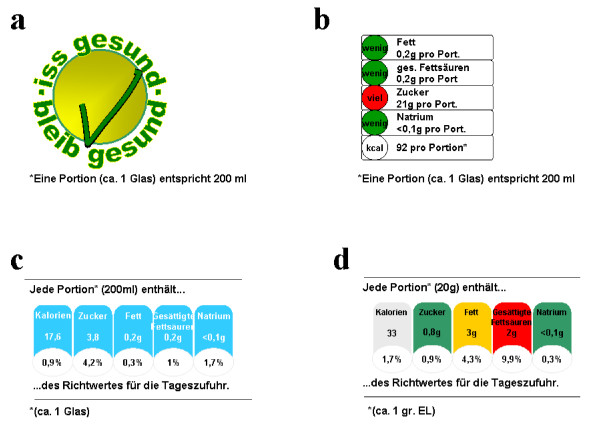
BACKGROUND: Front of pack food labels or signpost labels are currently widely discussed as means to help consumers to make informed food choices. It is hoped that more informed food choices will result in an overall healthier diet. There is only limited evidence, as to which format of a food label is best understood by consumers, helps them best to differentiate between more or less healthy food and whether these changes in perceived healthiness result in changes of food choice. METHODS: In a randomised experimental study in Hamburg/Germany 420 adult subjects were exposed to one of five experimental conditions: (1) a simple "healthy choice" tick, (2) a multiple traffic light label, (3) a monochrome Guideline Daily Amount (GDA) label, (4) a coloured GDA label and (5) a "no label" condition. In the first task they had to identify the healthier food items in 28 pair-wise comparisons of foods from different food groups. In the second task they were asked to select food portions from a range of foods to compose a one-day's consumption. Differences between means were analysed using ANOVAs. RESULTS: Task I: Experimental conditions differed significantly in the number of correct decisions (p < 0.001). In the condition "no label" subjects had least correct decisions (20.2 +/- 3.2), in the traffic light condition most correct decisions were made (24.8 +/- 2.4). Task II: Envisaged daily food consumption did not differ significantly between the experimental conditions. CONCLUSION: Different food label formats differ in the understanding of consumers. The current study shows, that German adults profit most from the multiple traffic light labels. Perceived healthiness of foods is influenced by this label format most often. Nevertheless, such changes in perceived healthiness are unlikely to influence food choice and consumption. Attempts to establish the informed consumer with the hope that informed choices will be healthier choices are unlikely to change consumer behaviour and will not result in the desired contribution to the prevention of obesity and diet related diseases.
Overview
The claims and statistics of this paper haven’t been checked yet.
Run the check — free, no account needed. It reads the open-access text and checks the sources it cites.
Integrity signals
Registry
Cites
Statistics
Figures
Verification
Claims the paper makes
The claims and statistics of this paper haven’t been checked yet.
Run the check — free, no account needed. It reads the open-access text and checks the sources it cites.
Claims other papers make about this one
Each is checked against this paper’s own text: does it say what the citing paper says it does?
In the citing paper
“A larger (N=420) acute (single meal) controlled intervention demonstrated that front-of-pack food labels resulted in improved recognition of more versus less healthful foods but did not alter which foods were selected by subjects.108”
From Population Approaches to Improve Diet, Physical Activity, and Smoking Habits: A Scientific Statement From the American Heart Association (2012) · cites this paper as [108]
Self-check
Percentages, sums and reported differences re-computed from the paper’s own numbers.
The self-check needs the paper’s full text.
Citations
Cites
Bundesgesundheitsblatt - Gesundheitsforschung - Gesundheitsschutz
(2013) · Bundesgesundheitsblatt - Gesundheitsforschung - Gesundheitsschutz · doi:10.1007/103.1437-1588 · Cited by 11,769
Diet, nutrition and the prevention of chronic diseases
Joint, W. (2002) · Medical Entomology and Zoology · Cited by 4,890
Kromeyer-Hauschild, K., Wabitsch, M., Kunze, D., Geller, F., Geiss, H. C., Hesse, V., von Hippel, A., Jaeger, U., Johnsen, D., Korte, W., et al. (2001) · Monatsschrift Kinderheilkunde · doi:10.1007/s001120170107 · Cited by 2,198
Diet, Nutrition, and the Prevention of Chronic Diseases
Leong, A. (1992) · Pathology · doi:10.1016/s0031-3025(16)36541-2 · Cited by 1,633
A review of European research on consumer response to nutrition information on food labels
Grunert, K. G., & Wills, J. M. (2007) · Journal of Public Health · doi:10.1007/s10389-007-0101-9 · Cited by 1,324
Consumer understanding and use of nutrition labelling: a systematic review
Cowburn, G., & Stockley, L. (2005) · Public Health Nutrition · doi:10.1079/phn2005666 · Cited by 994
Consumer Inference: A Review of Processes, Bases, and Judgment Contexts
Kardes, F. R., Posavac, S. S., & Cronley, M. L. (2004) · Journal of Consumer Psychology · doi:10.1207/s15327663jcp1403_6 · Cited by 550
Die Verbreitung von Übergewicht und Adipositas bei Kindern und Jugendlichen in Deutschland
Kurth, B. ‐., & Rosario, A. S. (2007) · Bundesgesundheitsblatt - Gesundheitsforschung - Gesundheitsschutz · doi:10.1007/s00103-007-0235-5 · Cited by 536
Feunekes, G. I. J., Gortemaker, I. A., Willems, A. A., Lion, R., & van den Kommer, M. (2007) · Appetite · doi:10.1016/j.appet.2007.05.009 · Cited by 478
Consumers' Use of Nutritional Labels: A Review of Research Studies and Issues
Drichoutis, A. C., Lazaridis, P., & Nayga, R. M. (2006) · Cited by 438
Kurth, B., & Rosario, A. S. (2007) · Robert-Koch-Institut (RKI) · doi:10.25646/482 · Cited by 406
Use Of Food Nutrition Labels is Associated with Lower Fat Intake
NEUHOUSER, M. L., KRISTAL, A. R., & PATTERSON, R. E. (1999) · Journal of the American Dietetic Association · doi:10.1016/s0002-8223(99)00013-9 · Cited by 308
Satia, J. A., Galanko, J. A., & Neuhouser, M. L. (2005) · Journal of the American Dietetic Association · doi:10.1016/j.jada.2004.12.006 · Cited by 307
Do Nutrition Label Readers Eat Healthier Diets? Behavioral Correlates of Adults’ Use of Food Labels
Kreuter, M. W., Brennan, L. K., Scharff, D. P., & Lukwago, S. N. (1997) · American Journal of Preventive Medicine · doi:10.1016/s0749-3797(18)30175-2 · Cited by 200
Jones, G., & Richardson, M. (2007) · Public Health Nutrition · doi:10.1017/s1368980007258513 · Cited by 191
Impact of the Pick the Tick food information programme on the salt content of food in New Zealand
Young, L. (2002) · Health Promotion International · doi:10.1093/heapro/17.1.13 · Cited by 178
Knowledge, Attitudes, and Label Use among College Students
Misra, R. (2007) · Journal of the American Dietetic Association · doi:10.1016/j.jada.2007.09.001 · Cited by 144
Do dietary intakes affect search for nutrient information on food labels?
Lin, C. J., Lee, J., & Yen, S. T. (2004) · Social Science & Medicine · doi:10.1016/j.socscimed.2004.02.030 · Cited by 134
Nutrition labelling: issues and policies
Baltas, G. (2001) · European Journal of Marketing · doi:10.1108/03090560110388178 · Cited by 120
The Role of Summary Information in Facilitating Consumers’ Comprehension of Nutrition Information
Viswanathan, M., & Hastak, M. (2002) · Journal of Public Policy & Marketing · doi:10.1509/jppm.21.2.305.17596 · Cited by 72
Zobel, M. (1976) · Food / Nahrung · doi:10.1002/food.19760200636 · Cited by 67
Pfau, C., Oltersdorf, U., & Brombach, C. (2008) · Cited by 62
Ticks, claims, tables and food groups: a comparison for nutrition labelling
SCOTT, V., & Worsley, A. (1994) · Health Promotion International · doi:10.1093/heapro/9.1.27 · Cited by 46
Research works printed but not linked: 15
- World Health Organization: Obesity and overweight: What are Overweight and obesity? Fact sheet N°311. 2006, Geneva: WHO
- Altgeld T, Geene R, Glaeske G, Kolip P, Rosenbrock R, Trojan A: Prävention und Gesundheitsförderung – Ein Programm für eine bessere Sozial- und Gesundheitspolitik. 2006, Bonn: Wirtschafts- und sozialpolitischen Forschungs- und Beratungszentrum der Friedrich-Ebert-Stiftung Abteilung Arbeit und Sozialpolitik
- Max Rubner-Institut. Bundesforschungsinstitut für Ernährung und Lebensmittel: Nationale Verzehrs Studie II – Ergebnisbericht Teil 1. Die bundesweite Befragung zur Ernährung von Jugendlichen und Erwachsenen. 2008, Karlsruhe: Bundesforschungsinstitut für Ernährung und Lebensmittel
- Deutsche Gesellschaft für Ernährung, Österreichische Gesellschaft für Ernährung, Schweizerische Gesellschaft für Ernährungsforschung, Schweizerische Vereinigung für Ernährung: Referenzwerte für die Nährstoffzufuhr. 2001, Frankfurt/Main: Umschau Verlag
- Pudel V, Spirik J, Westenhöfer J: Zum Informationsnutzen der Lebensmittelkennzeichnung. Informationsnutzen der Lebensmittelkennzeichnung für deutsche Konsumenten als Entscheidungshilfe bei der Lebensmittelauswahl. Ernährungsbericht 1996. 1996, Deutsche Gesellschaft für Ernährung. Frankfurt: DGE, 307-325.
- European Commission: CORRIGENDA. Corrigendum to Regulation (EC) No 1924/2006 of the European Parliament and of the Council of 20 December 2006 on nutrition and health claims made on foods. Official Journal of the European Union. 2006
- Navigator: Front of Pack Signpost Labelling. Exploratory Research. Report COI 280040 1095 JS. April 2007. 2007, London: Food Standards Agency
- EUFIC: EUFIC Press Release from 25/09/2008: One in four UK consumers look for nutrition information on food labels. [ http://www.eufic.org/jpage/en/page/PRESS/fftid/Consumer-Insights-UK-results/ ]
- Souci SW, Fachmann W, Kraut H: Die Zusammensetzung der Lebensmittel Nährwert-Tabellen 1989/90. 1989, Stuttgart: Wissenschaftliche Verlagsgesellschaft mbH, 4:
- Souci SW, Fachmann W, Kraut H: Die Zusammensetzung der Lebensmittel Nährwert-Tabellen. 1994, Stuttgart: medpharm GmbH Scientific Publisher's, 5:
- Fröleke H: Kleine Nährwerttabelle. 2005, Neustadt/Weinstr.: Neuer Umschau Buchverlag GmbH, 43
- Erhard J: EBISpro für Windows, Version 7.0. 2005, Stuttgart: Universität Hohenheim
- Food Standards Agency: Front-of-pack Traffic light signpost labelling Technical Guidance. 2007, London: Food Standards Agency
- The European Food Information Council: Making sense of Guideline Daily Amounts. FOOD TODAY. 2007, 3:
- Synovate: Qualitative Signpost Labelling. Refinement Research. 2005, London: Food Standards Agency
Cited by
Sorted by citations
OECD (2019) · OECD health policy studies · doi:10.1787/67450d67-en · Cited by 1,227
Nutrition labels on pre-packaged foods: a systematic review
Campos, S. E. V., Doxey, J. R., & Hammond, D. G. (2011) · Public Health Nutrition · doi:10.1017/s1368980010003290 · Cited by 953
Accelerating Progress in Obesity Prevention: Solving the Weight of the Nation
Glickman, D., Parker, L., Sim, L. J., Cook, H. D. V., & Miller, E. A. (2012) · Cited by 653
Grunert, K. G., Wills, J. M., & Fernández-Celemı́n, L. (2010) · Appetite · doi:10.1016/j.appet.2010.05.045 · Cited by 648
Mozaffarian, D., Afshin, A., Benowitz, N. L., Bittner, V., Daniels, S. R., Franch, H. A., Jacobs, D. R., Kraus, W. E., Kris-Etherton, P. M., Krummel, D. A., et al. (2012) · Circulation · doi:10.1161/cir.0b013e318260a20b · Cited by 601
Metadata
- Authors
- Borgmeier, I., & Westenhoefer, J.
- Affiliations
- HAW Hamburg (DE)
- Venue
- BMC Public Health
- Published
- 2009-06-12
- Volume
- 9
- Issue
- 1
- Pages
- 184-184
- ISSN
- 1471-2458 (ISSN-L)
- PMC
- PMC2702386
- OpenAlex
- W2131451081
- Cited by
- 334
- References
- 25
- Citations by year
- 2026: 3 · 2025: 10 · 2024: 15 · 2023: 10 · 2022: 26 · 2021: 15 · 2020: 31 · 2019: 31 · 2018: 19 · 2017: 27 · 2016: 22 · 2015: 29 · 2014: 17 · 2013: 29 · 2012: 28
- FWCI
- 16.73
- Type
- journal article
- Language
- en
- Open access
- gold
- doi.org
- Licence
- Locations
- BMC Public Health (publishedVersion, cc-by)
- PubMed Central (publishedVersion, cc-by)
- PubMed (publishedVersion)
- DOAJ (DOAJ: Directory of Open Access Journals) (submittedVersion, cc-by-sa)
- Topics
- Health Sciences › Medicine › Public Health, Environmental and Occupational Health › Consumer Attitudes and Food Labeling
- Social Sciences › Business, Management and Accounting › Marketing › Consumer Packaging Perceptions and Trends
- Social Sciences › Sociology and Political Science › Consumer behavior in food and health
- Keywords
- traffic light labels, food choice, daily food consumption, obesity prevention
- MeSH terms
- Adult, Choice Behavior, Diet, Educational Status, Female, Food Labeling, Germany, Humans, Male, Nutritional Requirements, Sex Factors, Health Behavior, Body Mass Index, Nutrition Policy, Consumer Health Information
About these checks
Registry, retraction, Cites and statistics results are computed, not judged, with one exception: a printed reference that no index lists is read once by a model before it counts as a citation error. Claims are extracted by a model and kept only when their quote appears verbatim in the text; each cited source is then checked, with a model’s help, for whether it says what the claim relies on. Those verdicts can be wrong — read the claim’s quote and the cited source before relying on one.
Statistics and arithmetic are recomputed, not judged.
Confidence bands are shown only for fields calibrated on our annotated test set. None is calibrated yet, so no band is shown.
What counts as a claim ›How we measure confidence ›How we check this ›
Are you an author, or do you see a problem with this page? Request a review
