

The DOI matches its Crossref record; 81 of the 83 references it cites were found in a registry or an index, and 2 are not checked yet.
A systematic review of longitudinal studies on the association between depression and smoking in adolescents
Open accessAbstract
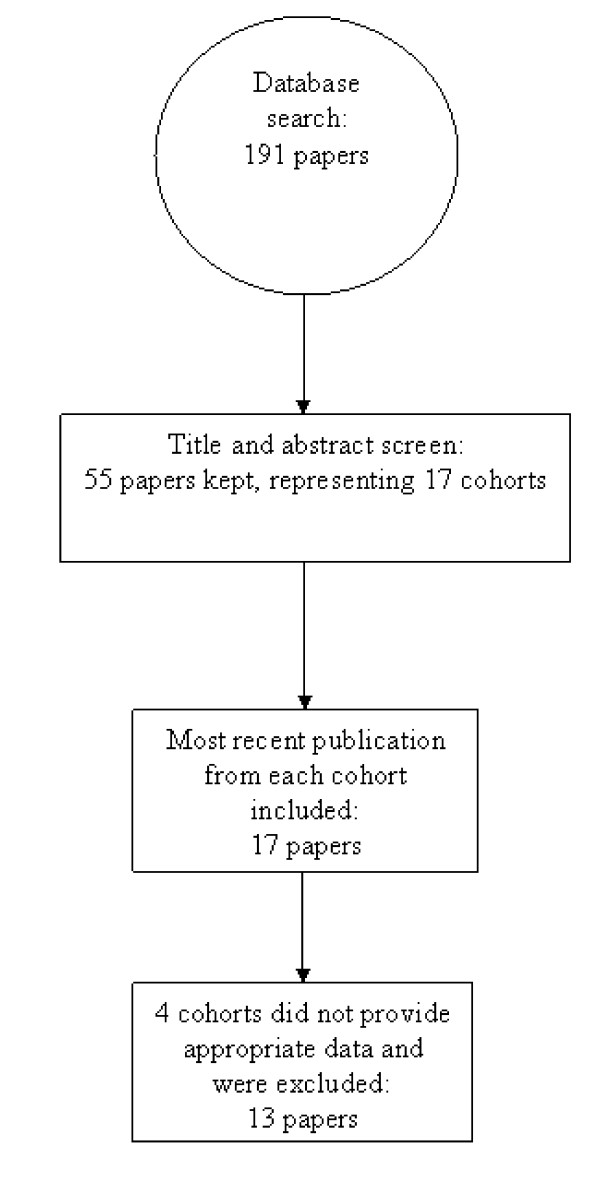
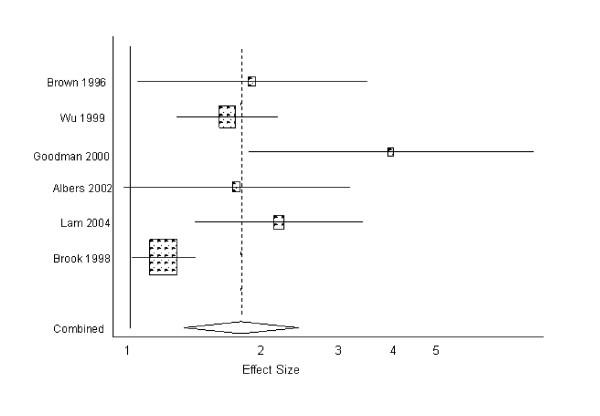
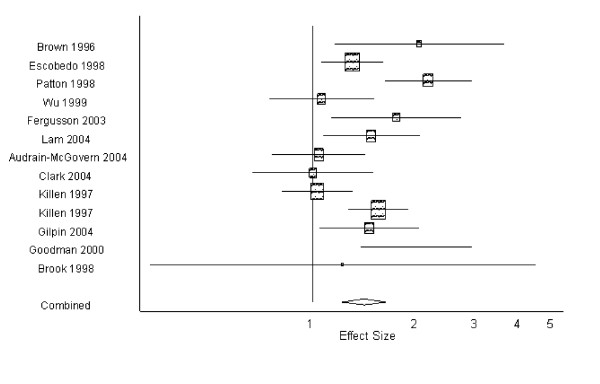
BACKGROUND: It is well-established that smoking and depression are associated in adolescents, but the temporal ordering of the association is subject to debate. METHODS: Longitudinal studies in English language which reported the onset of smoking on depression in non clinical populations (age 13-19) published between January 1990 and July 2008 were selected from PubMed, OVID, and PsychInfo databases. Study characteristics were extracted. Meta-analytic pooling procedures with random effects were used. RESULTS: Fifteen studies were retained for analysis. The pooled estimate for smoking predicting depression in 6 studies was 1.73 (95% CI: 1.32, 2.40; p < 0.001). The pooled estimate for depression predicting smoking in 12 studies was 1.41 (95% CI: 1.21, 1.63; p < 0.001). Studies that used clinical measures of depression were more likely to report a bidirectional effect, with a stronger effect of depression predicting smoking. CONCLUSION: Evidence from longitudinal studies suggests that the association between smoking and depression is bidirectional. To better estimate these effects, future research should consider the potential utility of: (a) shorter intervals between surveys with longer follow-up time, (b) more accurate measurement of depression, and (c) adequate control of confounding.
Overview
The claims and statistics of this paper haven’t been checked yet.
Run the check — free, no account needed. It reads the open-access text and checks the sources it cites.
Integrity signals
Registry
Cites
Statistics
Figures
Verification
Claims the paper makes
The claims and statistics of this paper haven’t been checked yet.
Run the check — free, no account needed. It reads the open-access text and checks the sources it cites.
Claims other papers make about this one
Each is checked against this paper’s own text: does it say what the citing paper says it does?
The cited source says what the claim attributes to it.
In the citing paper
“A meta-analysis of six studies including 15,333 adolescents aged 13-19 showed that smokers were significantly more likely to develop depression than non-smokers over 1-6 year follow-up (OR=1.73, 95% CI: 1.32-2.4) 43 .”
From A meta-review of "lifestyle psychiatry": the role of exercise, smoking, diet and sleep in the prevention and treatment of mental disorders (2020) · cites this paper as [43]
Self-check
Percentages, sums and reported differences re-computed from the paper’s own numbers.
The self-check needs the paper’s full text.
Citations
Cites
Diagnostic and Statistical Manual of Mental Disorders ( DSM ‐ IV ‐ TR )
Segal, D. L. (2010) · Wiley eBooks · doi:10.1002/9780470479216.corpsy0271 · Cited by 4,687
Causal Diagrams for Epidemiologic Research
Greenland, S., Pearl, J., & Robins, J. M. (1999) · Epidemiology · doi:10.1097/00001648-199901000-00008 · Cited by 3,728
Air Pollution and Hospital Admissions for Heart Disease in Eight U.S. Counties
Schwartz, J. D. (1999) · Epidemiology · doi:10.1097/00001648-199901000-00005 · Cited by 3,045
Drug Addiction, Dysregulation of Reward, and Allostasis
Koob, G. (2001) · Neuropsychopharmacology · doi:10.1016/s0893-133x(00)00195-0 · Cited by 2,953
Global Burden of Disease and Risk Factors
López, A. D., Mathers, C. D., Ezzati, M., Jamison, D. T. T., & Murray, C. J. L. (2006) · World Bank, Washington, DC eBooks · doi:10.1596/978-0-8213-6262-4 · Cited by 2,714
Maternal Pesticide Exposure from Multiple Sources and Selected Congenital Anomalies
Shaw, G. M., Wasserman, C. R., O’Malley, C. D., Nelson, V. E., & Jackson, R. J. (1999) · Epidemiology · doi:10.1097/00001648-199901000-00011 · Cited by 1,783
Modern Epidemiology 3rd edition
Rothman, K. J., Lash, T. L., & Greenland, S. (1986) · Cited by 1,736
Methods in Observational Epidemiology
Kelsey, J. L. (1986) · Cited by 1,307
Methods in observational epidemiology
Leck, I. M. (1987) · Journal of Epidemiology & Community Health · doi:10.1136/jech.41.3.263-a · Cited by 1,289
Dieting and binging: A causal analysis.
Polivy, J., & Herman, C. P. (1985) · American Psychologist · doi:10.1037//0003-066x.40.2.193 · Cited by 1,279
Research works printed but not linked: 2
- StataCorp: Stata Statistical Software: Release 10. 2009, College Station, TX: StataCorp LP
- Rothman KJ, Greenland S, Lash TL: Modern epidemiology. 2008, Philadelphia: Wolters Kluwer/Lippincott Williams & Wilkins, 3
Cited by
Sorted by citations
So depression is an inflammatory disease, but where does the inflammation come from?
Berk, M., Williams, L. J., Jacka, F. N., O’Neil, A., Pasco, J. A., Moylan, S., Allen, N. B., Stuart, A. L., Hayley, A. C., Byrne, M. L., et al. (2013) · BMC Medicine · doi:10.1186/1741-7015-11-200 · Cited by 1,423
The association of cigarette smoking with depression and anxiety: a systematic review
Fluharty, M., Taylor, A. E., Grabski, M., & Munafò, M. R. (2017) · Nicotine & Tobacco Research · doi:10.1093/ntr/ntw140 · Cited by 1,299
Firth, J., Solmi, M., Wootton, R. E., Vancampfort, D., Schuch, F. B., Hoare, E., Gilbody, S., Torous, J., Teasdale, S. B., Jackson, S. E., et al. (2020) · World Psychiatry · doi:10.1002/wps.20773 · Cited by 1,242
The Lancet Psychiatry Commission on youth mental health
McGorry, P. D., Mei, C., Dalal, N., Alvarez-Jimenez, M., Blakemore, S.-J., Browne, V., Dooley, B., Hickie, I. B., Jones, P. B., McDaid, D., et al. (2024) · The Lancet Psychiatry · doi:10.1016/s2215-0366(24)00163-9 · Cited by 663
Comorbid depression in medical diseases
Gold, S. M., Köhler‐Forsberg, O., Moss-Morris, R. E., Mehnert-Theuerkauf, A., Miranda, J. J., Bullinger, M., Steptoe, A., Whooley, M. A., & Otte, C. (2020) · Nature Reviews Disease Primers · doi:10.1038/s41572-020-0200-2 · Cited by 583
Metadata
- Authors
- Chaiton, M. O., Cohen, J. E., O'Loughlin, J., & Rehm, J.
- Affiliations
- University of Toronto (CA)
- Centre for Addiction and Mental Health (CA)
- Corresponding author
- Chaiton, Michael O
- Venue
- BMC Public Health
- Published
- 2009-09-22
- Volume
- 9
- Issue
- 1
- Pages
- 356-356
- ISSN
- 1471-2458 (ISSN-L)
- PMC
- PMC2758872
- OpenAlex
- W1964002523
- Cited by
- 391
- References
- 80
- Citations by year
- 2026: 17 · 2025: 22 · 2024: 33 · 2023: 23 · 2022: 37 · 2021: 22 · 2020: 35 · 2019: 32 · 2018: 29 · 2017: 18 · 2016: 17 · 2015: 22 · 2014: 29 · 2013: 17 · 2012: 16
- FWCI
- 1.27
- Type
- journal article
- Language
- en
- Open access
- gold
- doi.org
- Licence
- Locations
- BMC Public Health (publishedVersion, cc-by)
- PubMed Central (publishedVersion, cc-by)
- PubMed (publishedVersion)
- TSpace (University of Toronto) (submittedVersion)
- DOAJ (DOAJ: Directory of Open Access Journals) (submittedVersion, cc-by-sa)
- Funders
- Canadian Institutes of Health Research
- National Cancer Institute
- Topics
- Health Sciences › Medicine › Public Health, Environmental and Occupational Health › Smoking Behavior and Cessation
- Health Sciences › Medicine › Epidemiology › Substance Abuse Treatment and Outcomes
- Social Sciences › Psychology › Clinical Psychology › Child and Adolescent Psychosocial and Emotional Development
- Keywords
- adolescent depression, adolescent smoking, bidirectional relationship, temporal order, depression onset, smoking onset, non-clinical adolescents, longitudinal study, confounding
- MeSH terms
- Adolescent, Depression, Female, Humans, Longitudinal Studies, Male, Smoking, Comorbidity, Disease Progression, Young Adult
About these checks
Registry, retraction, Cites and statistics results are computed, not judged, with one exception: a printed reference that no index lists is read once by a model before it counts as a citation error. Claims are extracted by a model and kept only when their quote appears verbatim in the text; each cited source is then checked, with a model’s help, for whether it says what the claim relies on. Those verdicts can be wrong — read the claim’s quote and the cited source before relying on one.
Statistics and arithmetic are recomputed, not judged.
Confidence bands are shown only for fields calibrated on our annotated test set. None is calibrated yet, so no band is shown.
What counts as a claim ›How we measure confidence ›How we check this ›
Are you an author, or do you see a problem with this page? Request a review
