

Mold sensitization is common amongst patients with severe asthma requiring multiple hospital admissions
Open accessThe DOI matches its Crossref record; 41 of the 41 references it cites were found in a registry or an index.
Abstract
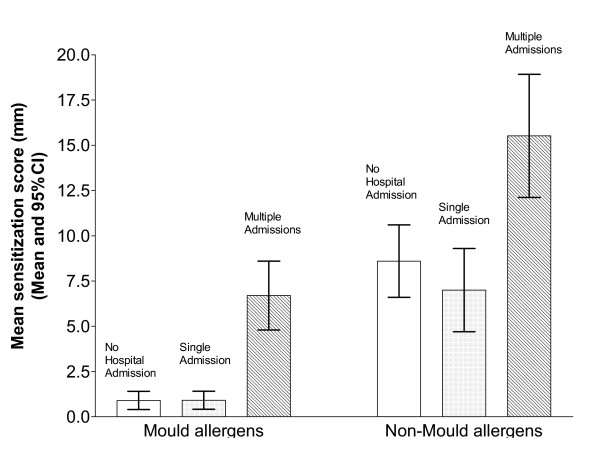
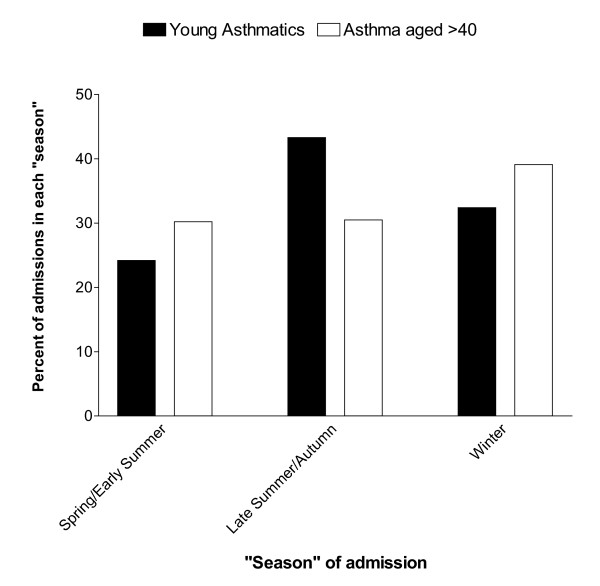
Background: Multiple studies have linked fungal exposure to asthma, but the link to severe asthma is controversial. We studied the relationship between asthma severity and immediate type hypersensitivity to mold (fungal) and non-mold allergens in 181 asthmatic subjects. Methods: We recruited asthma patients aged 16 to 60 years at a University hospital and a nearby General Practice. Patients were categorized according to the lifetime number of hospital admissions for asthma (82 never admitted, 53 one admission, 46 multiple admissions). All subjects had allergy skin prick tests performed for 5 mold allergens (Aspergillus, Alternaria, Cladosporium, Penicillium and Candida) and 4 other common inhalant allergens (D. pteronyssinus, Grass Pollen, Cat and Dog). Results: Skin reactivity to all allergens was commonest in the group with multiple admissions. This trend was strongest for mold allergens and dog allergen and weakest for D. pteronyssinus. 76% of patients with multiple admissions had at least one positive mold skin test compared with 16%-19% of other asthma patients; (Chi squared p < 0.0001). Multiple mold reactions were also much commoner in the group with multiple admissions (50% V 5% and 6%; p < 0.0001). The number of asthma admissions was related to the number and size of positive mold skin allergy tests (Spearman Correlation Coefficient r = 0.60, p < 0.0001) and less strongly correlated to the number and size of non-mold allergy tests (r = 0.34, p = 0.0005). Hospital admissions for asthma patients aged 16–40 were commonest during the mold spore season (July to October) whereas admissions of patients aged above 40 peaked in November-February (Chi Squared, p < 0.02). Conclusion: These findings support previous suggestions that mold sensitization may be associated with severe asthma attacks requiring hospital admission.
Overview
The claims and statistics of this paper haven’t been checked yet.
Free: it reads the open-access text and checks the first 5 claims that cite a source we can check. Create a free account to check every claim.
Integrity signals
Registry
Cites
Statistics
Figures
Verification
Claims the paper makes
The claims and statistics of this paper haven’t been checked yet.
Free: it reads the open-access text and checks the first 5 claims that cite a source we can check. Create a free account to check every claim.
Claims other papers make about this one
Each is checked against this paper’s own text: does it say what the citing paper says it does?
The source backs part of the claim, not all of it — or backs it for a different population, condition or comparison.
In the citing paper
“Fungal sensitization in asthma, mainly due to Aspergillus spp. leads to increased severity, more exacerbations and a higher mortality [146,147].”
From Global and Multi-National Prevalence of Fungal Diseases-Estimate Precision (2017) · cites this paper as [146]
Experimental — accuracy not yet measured
Self-check
Percentages, sums and reported differences re-computed from the paper’s own numbers.
The self-check needs the paper’s full text.
Citations
Cites
Association of Asthma with Serum IgE Levels and Skin-Test Reactivity to Allergens
Burrows, B., Martinez, F. D., Halonen, M., Barbee, R. A., & Cline, M. G. (1989) · New England Journal of Medicine · doi:10.1056/nejm198902023200502 · Cited by 1,659 · cited 2×
“At least two thirds of asthmatic patients are atopic with skin reactivity to common allergens [ 2-4 ].”
O'Hollaren, M. T., Yunginger, J. W., Offord, K. P., Somers, M. J., O'Connell, E. J., Ballard, D. J., & Sachs, M. I. (1991) · New England Journal of Medicine · doi:10.1056/nejm199102073240602 · Cited by 694 · cited 5×
“The results are consistent with previous evidence that atopy (especially to mold allergens) is related to asthma severity or bronchial hyper-reactivity [4-6,12-17].”
InfluentialZureik, M., Neukirch, C., Leynaert, B., Liard, R., Bousquet, J., & Neukirch, F. (2002) · BMJ · doi:10.1136/bmj.325.7361.411 · Cited by 488 · cited 6×
“The results are consistent with previous evidence that atopy (especially to mold allergens) is related to asthma severity or bronchial hyper-reactivity [4-6,12-17].”
InfluentialDamp housing, mould growth, and symptomatic health state.
Platt, S. D., Martin, C. J., Hunt, S. M., & Lewis, C. W. (1989) · BMJ · doi:10.1136/bmj.298.6689.1673 · Cited by 457 · cited 1×
“Many patients believe that their asthma is aggravated by damp housing, especially if there is visible mold growth [18].”
Alternaria as a major allergen for asthma in children raised in a desert environment.
Halonen, M., Stern, D. A., Wright, A. L., Taussig, L. M., & Martinez, F. D. (1997) · American Journal of Respiratory and Critical Care Medicine · doi:10.1164/ajrccm.155.4.9105079 · Cited by 428
Garrett, Rayment, Hooper, Abramson, & Hooper (1998) · Clinical & Experimental Allergy · doi:10.1046/j.1365-2222.1998.00255.x · Cited by 410 · cited 2×
“The risk may be further increased if the patient lives in a damp, moldy house or attends a damp moldy school [19,29,30,37].”
Kauffman, H. F., Tomee, J. F. C., van de Riet, M. A., Timmerman, A. J. B., & Borger, P. (2000) · Journal of Allergy and Clinical Immunology · doi:10.1067/mai.2000.106210 · Cited by 359 · cited 1×
“Some fungal antigens are proteases (Asp f5, Asp f10, Asp f13, Asp f15, Asp f18) and as DP1 is also a protease – a similar pathogenic role can be postulated [35,36].”
Antiallergic drugs and the immune response: Interactions and possible clinical relevance
Canonica, G. W., & Ciprandi, G. (1989) · Allergy · doi:10.1111/j.1398-9995.1989.tb00438.x · Cited by 336
Sensitivity to fungal allergens is a risk factor for life‐threatening asthma
Black, P. N., Udy, A. A., & Brodie, S. M. (2000) · Allergy · doi:10.1034/j.1398-9995.2000.00293.x · Cited by 305 · cited 5×
“The results are consistent with previous evidence that atopy (especially to mold allergens) is related to asthma severity or bronchial hyper-reactivity [4-6,12-17].”
Influential
Research works printed but not linked: 1
- British Thoracic Society The British Guidelines on Asthma Management: 1995 Review and Position Statement Thorax 1997 52 S1 S21
Cited by
Items 201–252 of 252
Impact of Fungal Sensitization on Long-Term Outcomes in Severe Asthma
Réau, R., Nicaise‐Roland, P., Dupont, A., Neukirch, C., Guen, P. L., Garinat, M., Brun, M. L., & Taillé, C. (2025) · The Journal of Allergy and Clinical Immunology In Practice · doi:10.1016/j.jaip.2025.10.025 · Cited by 4
Unveiling the Public Health Impact of Alternaria alternata carried by Pets in Northeast Portugal
Afonso, P., Silva, D., Vieira, A. F., Pinto, E., Soares, A. S., Matos, M., Quintas, H., Cardoso, L., & Coelho, A. C. (2025) · Revista de Ciências Agroveterinárias · doi:10.5965/223811712412025109 · Cited by 1
Padrão clínico e laboratorial de sensibilização a fungos
Santos, A., Carrapatoso, I., Rodrigues, F., Geraldes, L., Loureiro, C. F. G., & Chieira, C. (2009) · Cited by 1
Corrélations entre contrôle de l’asthme et sensibilisation cutanée aux moisissures
Bopaka, R. G., Khattabi, W. E., Bied, B. E., Choubi, M., Aichane, A., & Àfif, H. (2015) · Revue française d'allergologie · doi:10.1016/j.reval.2015.03.006 · Cited by 1
Johannessen, L. N., Løvik, M., Steinshamn, S., & Nilsen, A. M. (2008) · Scandinavian Journal of Immunology · doi:10.1111/j.1365-3083.2008.02162.x · Cited by 1
A Review on the Relationship between Fungal Allergens with Allergy and Respiratory Diseases
Ansari, S., Lotfi, N., & Hedayati, M. T. (2015) · Majallah-i dānishgāh-i ̒ulūm-i pizishkī-i Māzandarān/Journal of Mazandaran University of Medical Sciences · Cited by 1
Moisissures extérieures et santé respiratoire
Caillaud, D. M., Muti, D., & Soumare, D. (2020) · Revue française d'allergologie · doi:10.1016/j.reval.2020.02.013 · Cited by 2
T2-Inflammation bei entzündlichen Atemwegserkrankungen: Grundlage neuer Behandlungsoptionen
Klimek, L., Hagemann, J., Welkoborsky, H. J., Cuevas, M., Casper, I., Förster-Rurmann, U., Klimek, F., Hintschich, C. A., Huppertz, T., Bergmann, K., et al. (2021) · Laryngo-Rhino-Otologie · doi:10.1055/a-1709-7899 · Cited by 2
Choi, Y., Lee, K. S., & Oh, J. (2024) · Allergy Asthma and Immunology Research · doi:10.4168/aair.2024.16.6.571 · Cited by 1
Basics of Severe Asthma in Clinical Practice
Jeong, J. S., & Lee, Y. C. (2017) · Springer eBooks · doi:10.1007/978-981-10-1998-2_1 · Cited by 2
1. Diagnosis and Phenotypes of Severe Asthma
Asano, K. (2019) · Nihon Naika Gakkai Zasshi · doi:10.2169/naika.108.504 · Cited by 1
Environmental Issues in Asthma Management
Mitchell, I., & Govias, G. (2021) · Springer eBooks · doi:10.1007/978-3-030-77896-5_5 · Cited by 1
Quel est le profil d’un asthme sévère chez l’enfant ?
Just, J., & Thouvenin, G. (2007) · Revue Française d Allergologie et d Immunologie Clinique · doi:10.1016/j.allerg.2006.12.006 · Cited by 1
Spores fongiques atmosphériques et allergies respiratoires
Lavaud, F., & Dutau, G. (2013) · Revue française d'allergologie · doi:10.1016/j.reval.2013.10.003 · Cited by 1
Les différents phénotypes de l’asthme du nourrisson
Just, J. (2009) · Revue française d'allergologie · doi:10.1016/j.reval.2009.01.010 · Cited by 2
Allergie et asthme réfractaire : nouvelles pistes étiologiques et thérapeutiques
Cleenewerck, A., Rahérison, C., Magnan, A., & Tunon-de-Lara, J.-M. (2008) · La Presse Médicale · doi:10.1016/j.lpm.2007.08.007 · Cited by 2
Cytomorphology of polymorphous low grade adenocarcinoma--diagnosis and pitfalls.
Sahai, K., Kapila, K., Dahiya, S. M., & Verma, K. (2003) · PubMed · Cited by 1
Moraxellaceae and Moraxella interact with the altered airway mycobiome in asthmaPreprint
Liu, H., Li, C., Liang, Z., Zhang, S., Yang, W., Ye, Y.-M., Lin, Y.-X., Chen, R., Zhou, H., & Su, J. (2019) · bioRxiv (Cold Spring Harbor Laboratory) · doi:10.1101/525113 · Cited by 2
Fungi In Asthma - Investigation Of The Lung Mycobiome And Characterisation Of Allergens
Rick, E. (2019) · Figshare · Cited by 1
Les enfants multi-allergiques : qui sont-ils ?
Karila, C., Scheinmann, P., & Jacques de, B. L. I. C. (2015) · Revue française d'allergologie · doi:10.1016/j.reval.2015.07.006
Prevention Of Asthma In Children
Shahid, S. K., & Pediatrician, C. (2012)
Lezmi, G., Mordacq, C., Tamalet, A., Pouessel, G., Aubertin, G., Thumerelle, C., & Deschildre, A. (2014) · Revue des Maladies Respiratoires Actualités · doi:10.1016/s1877-1203(14)70012-6
Jang, G. C., Shim, J. Y., Ahn, Y. M., Jung, J., Kim, S. W., Chung, H. L., & The Group for the Study of Asthma in Adolescent Children (2015) · Allergy Asthma & Respiratory Disease · doi:10.4168/aard.2015.3.5.326
Allergen Proteinases and Allergic Airway Inflammation: Signaling via Proteinase-Activated Receptors
Polley, D. (2015) · Libraries and Cultural Resources (University of Calgary) · doi:10.11575/prism/24770
Girodet, P., & Lara, J. (2007) · Encyclopédie médico-chirurgicale. Pneumologie · doi:10.1016/s1155-195x(07)45488-3
MICROBICIDAL EVALUATION OF PLANT EXTRACTS - IRON METAL IONS COMPLEX
Sharma, A. K., Kaur, J., & Sharma, A. R. (2017) · Asian Journal of Pharmaceutical and Clinical Research · doi:10.22159/ajpcr.2017.v10i10.19687 · Cited by 1
Gibbs, J. E. M. (2007) · Griffith Research Online · doi:10.25904/1912/3128
Kovesi, T. A., Brenda Louise Giles, M., & Pasterkamp, H. (2012) · Paediatrics & Child Health · doi:10.1093/pch/17.7.e65
Chishimba, L. (2016) · Research Explorer (The University of Manchester)
Clinical phenotypes of severe asthma: children
Teague, W. G., & Roberts, G. C. (2019) · European Respiratory Society eBooks · doi:10.1183/2312508x.10023018
Fungal diversity in the indoor air during spring and autumn in the houses of asthma patients
Ahn, G. R., Kim, S. W., & Kim, S. H. (2019) · Journal of Odor and Indoor Environment · doi:10.15250/joie.2019.18.4.354
Souza, B. D. F. (2020) · Digital Library of Theses and Dissertations (Universidade de São Paulo) · doi:10.11606/d.5.2020.tde-09012020-094933
Nishimoto, Y., Ito, K., Kimura, G., Lucas, K. A., Daly, L., Strong, P., & Kizawa, Y. (2020) · bioRxiv (Cold Spring Harbor Laboratory) · doi:10.1101/2020.07.27.222661
Sunki nealerginė astma: ar visada nealerginė?
Malinauskienė, L., Griguola, L., Černiauskas, K., & Chomičienė, A. (2021) · Pulmonology and allergology · doi:10.37499/pia.757 · Cited by 1
Allergic Bronchopulmonary Mycosis
Tillie‐Leblond, I., Bervar, J.-F., & Deschildre, A. (2014) · Springer eBooks · doi:10.1007/978-1-4471-2401-6_5
ELAMAWY, M., Khatab, N., Ibrahim, A., Refaat, M. M., Farres, M. N., & Ali, A. (2017) · Benha Medical Journal · doi:10.4103/bmfj.bmfj_149_17
Studies on human antigenic protein AVS 41kDa from Aspergillus versicolor
Liang, Y. (2008) · Carleton University's Institutional Repository (MacOdrum Library, Carleton University) · doi:10.22215/etd/2008-09176 · Cited by 1
Ito, K. (2019) · Faculty Opinions – Post-Publication Peer Review of the Biomedical Literature · doi:10.3410/f.735777506.793561995
Benefits of Aeroallergen Testing on Oral Corticosteroid Bursts in Adults with AsthmaPreprint
Gleeson, P. K., Morales, K. H., Buckey, T. M., Fadugba, O. O., Apter, A. J., Christie, J. D., & Himes, B. E. (2024) · medRxiv · doi:10.1101/2024.01.29.24301962
Khan, Z., Roger, J., Patil, P. N., & Christopher, D. J. (2024) · Allergo Journal International · doi:10.1007/s40629-024-00302-y
“Similarly, O’Driscoll [9] and colleagues in Manchester, UK, found the prevalence of fungal sensitization to be as high as 76% in asthmatics with more than one hospital admission, with the commonest being Cladosporium sensitization (41”
Gleeson, P. K., Morales, K. H., Buckey, T. M., Fadugba, O. O., Apter, A. J., Christie, J. D., & Himes, B. E. (2024) · Journal of Allergy and Clinical Immunology Global · doi:10.1016/j.jacig.2024.100348
Choi, Y., Lee, K. S., & Oh, J. (2025) · Springer eBooks · doi:10.1007/978-3-031-90621-3_5
Hasan, A. (2025) · Springer eBooks · doi:10.1007/978-981-96-7810-5_33
Hasan, A. (2025) · Springer eBooks · doi:10.1007/978-981-96-7810-5_43
Variation in airway remodelling genes and their role on asthma severity in children and young adults
Cunningham, J. (2011) · University of Brighton Repository (University of Brighton)
Additional file 1 of The role of antifungals in the management of patients with severe asthma
Rapeport, G., Ito, K., & Denning, D. W. (2020) · Figshare · doi:10.6084/m9.figshare.13199260
Self-citationEggestein, A., Rauer, D., Herrmann, S. M., Kolek, F., Leier-Wirtz, V., Urban, S., Foesel, B. U., Schloter, M., Bhattacharyya, M., Pyrri, I., et al. (2026) · Clinical & Experimental Allergy · doi:10.1111/cea.70216 · Cited by 1
Halpin, D. M. G., Masekela, R., Vogelmeier, C. F., Ozoh, O. B., Cruz, Á. A., Reddel, H. K., Yorgancıoğlu, A., Agustí, A. G. N., & (GINA), O. B. O. T. B. O. D. O. T. G. I. F. C. O. L. D. (. I. F. A. (2026) · Journal of the Pan African Thoracic Society · doi:10.25259/jpats_4_2026
Management and Immunotherapy for Fungal Allergy: Clinical Practice and Unmet Needs
Yang, Y., Fu, Y., Sun, J., Demoly, P. M., & Zhu, R. (2026) · Clinical Reviews in Allergy & Immunology · doi:10.1007/s12016-026-09158-2
Epithélium bronchique de l'enfant asthmatique sévère
Bourée, A. (2016) · theses.fr (ABES) · doi:10.70675/b897efc1zfaa4z40f6z853ez154994d73746
L’inflammation à éosinophile, entre sévérité et allergie dans l’asthme sévère de l’enfant ?
Bourgoin‐Heck, M. (2024) · theses.fr (ABES) · doi:10.70675/83b65838z1e72z422ezb917zfd7820bcb3ad
Exploring the expression and function of CRTh2 in asthma
Stinson, S. (2015) · Figshare
Metadata
- Authors
- O'Driscoll, B. R., Hopkinson, L. C., & Denning, D. W.
- Affiliations
- Salford Royal Hospital (GB)
- University of Manchester (GB)
- ORCID
- Denning, David W
- Venue
- BMC Pulmonary Medicine
- Published
- 2005-02-18
- Volume
- 5
- Issue
- 1
- Pages
- 4-4
- ISSN
- 1471-2466 (ISSN-L)
- PMC
- PMC550663
- OpenAlex
- W1848875774
- Cited by
- 254
- References
- 41
- Citations by year
- 2026: 4 · 2025: 9 · 2024: 11 · 2023: 12 · 2022: 7 · 2021: 14 · 2020: 13 · 2019: 16 · 2018: 11 · 2017: 13 · 2016: 20 · 2015: 13 · 2014: 11 · 2013: 10 · 2012: 18
- FWCI
- 5.22
- Type
- journal article
- Language
- en
- Open access
- gold
- doi.org
- Licence
- cc-by
- creativecommons.org/licenses/by/2.0/ (tdm)
- creativecommons.org/licenses/by/2.0/ (vor)
- Locations
- BMC Pulmonary Medicine (publishedVersion, cc-by)
- PubMed Central (publishedVersion, cc-by)
- PubMed (publishedVersion)
- DOAJ (DOAJ: Directory of Open Access Journals) (submittedVersion, cc-by-sa)
- Research Explorer (The University of Manchester) (submittedVersion)
- Topics
- Health Sciences › Medicine › Pulmonary and Respiratory Medicine › Asthma and respiratory diseases
- Health Sciences › Medicine › Immunology and Allergy › Allergic Rhinitis and Sensitization
- Health Sciences › Medicine › Public Health, Environmental and Occupational Health › Occupational exposure and asthma
- Keywords
- mold sensitization, severe asthma, asthma hospital admissions, fungal allergens, Aspergillus, Alternaria, Cladosporium, Penicillium, Candida, house dust mites, aeroallergens, skin prick test, asthma severity
- MeSH terms
- Acute Disease, Adolescent, Adult, Allergens, Asthma, Cross-Sectional Studies, Female, Fungi, Hospitalization, Humans, Hypersensitivity, Male, Middle Aged, Patient Readmission, Severity of Illness Index, Skin Tests
About these checks
Registry, retraction, Cites and statistics results are computed, not judged, with one exception: a printed reference that no index lists is read once by a model before it counts as a citation error. Claims are extracted by a model and kept only when their quote appears verbatim in the text; each cited source is then checked, with a model’s help, for whether it says what the claim relies on. Those verdicts can be wrong — read the claim’s quote and the cited source before relying on one.
Statistics and arithmetic are recomputed, not judged.
Confidence bands are shown only for fields calibrated on our annotated test set. None is calibrated yet, so no band is shown.
What counts as a claim ›How we measure confidence ›How we check this ›
Are you an author, or do you see a problem with this page? Request a review
Data sources
Bibliographic data: Semantic Scholar, OpenAlex, Crossref.
Contains information from the Semantic Scholar Academic Graph Datasets, made available under the ODC Attribution License (ODC-BY 1.0).
Semantic Scholar’s data is described in: Kinney, R., et al. (2023). The Semantic Scholar Open Data Platform. arXiv:2301.10140.
