

Mold sensitization is common amongst patients with severe asthma requiring multiple hospital admissions
Open accessThe DOI matches its Crossref record; 41 of the 41 references it cites were found in a registry or an index.
Abstract
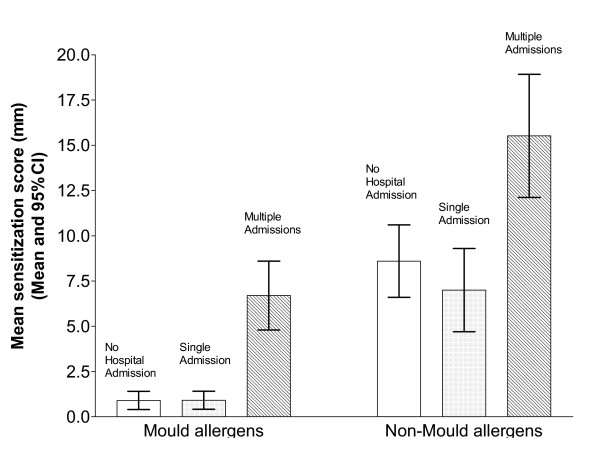
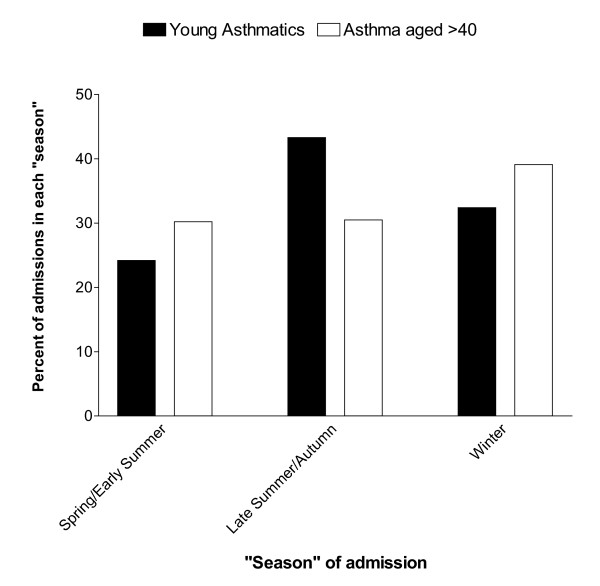
Background: Multiple studies have linked fungal exposure to asthma, but the link to severe asthma is controversial. We studied the relationship between asthma severity and immediate type hypersensitivity to mold (fungal) and non-mold allergens in 181 asthmatic subjects. Methods: We recruited asthma patients aged 16 to 60 years at a University hospital and a nearby General Practice. Patients were categorized according to the lifetime number of hospital admissions for asthma (82 never admitted, 53 one admission, 46 multiple admissions). All subjects had allergy skin prick tests performed for 5 mold allergens (Aspergillus, Alternaria, Cladosporium, Penicillium and Candida) and 4 other common inhalant allergens (D. pteronyssinus, Grass Pollen, Cat and Dog). Results: Skin reactivity to all allergens was commonest in the group with multiple admissions. This trend was strongest for mold allergens and dog allergen and weakest for D. pteronyssinus. 76% of patients with multiple admissions had at least one positive mold skin test compared with 16%-19% of other asthma patients; (Chi squared p < 0.0001). Multiple mold reactions were also much commoner in the group with multiple admissions (50% V 5% and 6%; p < 0.0001). The number of asthma admissions was related to the number and size of positive mold skin allergy tests (Spearman Correlation Coefficient r = 0.60, p < 0.0001) and less strongly correlated to the number and size of non-mold allergy tests (r = 0.34, p = 0.0005). Hospital admissions for asthma patients aged 16–40 were commonest during the mold spore season (July to October) whereas admissions of patients aged above 40 peaked in November-February (Chi Squared, p < 0.02). Conclusion: These findings support previous suggestions that mold sensitization may be associated with severe asthma attacks requiring hospital admission.
Overview
The claims and statistics of this paper haven’t been checked yet.
Free: it reads the open-access text and checks the first 5 claims that cite a source we can check. Create a free account to check every claim.
Integrity signals
Registry
Cites
Statistics
Figures
Verification
Claims the paper makes
The claims and statistics of this paper haven’t been checked yet.
Free: it reads the open-access text and checks the first 5 claims that cite a source we can check. Create a free account to check every claim.
Claims other papers make about this one
Each is checked against this paper’s own text: does it say what the citing paper says it does?
The source backs part of the claim, not all of it — or backs it for a different population, condition or comparison.
In the citing paper
“Fungal sensitization in asthma, mainly due to Aspergillus spp. leads to increased severity, more exacerbations and a higher mortality [146,147].”
From Global and Multi-National Prevalence of Fungal Diseases-Estimate Precision (2017) · cites this paper as [146]
Experimental — accuracy not yet measured
Self-check
Percentages, sums and reported differences re-computed from the paper’s own numbers.
The self-check needs the paper’s full text.
Citations
Cites
Association of Asthma with Serum IgE Levels and Skin-Test Reactivity to Allergens
Burrows, B., Martinez, F. D., Halonen, M., Barbee, R. A., & Cline, M. G. (1989) · New England Journal of Medicine · doi:10.1056/nejm198902023200502 · Cited by 1,659 · cited 2×
“At least two thirds of asthmatic patients are atopic with skin reactivity to common allergens [ 2-4 ].”
O'Hollaren, M. T., Yunginger, J. W., Offord, K. P., Somers, M. J., O'Connell, E. J., Ballard, D. J., & Sachs, M. I. (1991) · New England Journal of Medicine · doi:10.1056/nejm199102073240602 · Cited by 694 · cited 5×
“The results are consistent with previous evidence that atopy (especially to mold allergens) is related to asthma severity or bronchial hyper-reactivity [4-6,12-17].”
InfluentialZureik, M., Neukirch, C., Leynaert, B., Liard, R., Bousquet, J., & Neukirch, F. (2002) · BMJ · doi:10.1136/bmj.325.7361.411 · Cited by 488 · cited 6×
“The results are consistent with previous evidence that atopy (especially to mold allergens) is related to asthma severity or bronchial hyper-reactivity [4-6,12-17].”
InfluentialDamp housing, mould growth, and symptomatic health state.
Platt, S. D., Martin, C. J., Hunt, S. M., & Lewis, C. W. (1989) · BMJ · doi:10.1136/bmj.298.6689.1673 · Cited by 457 · cited 1×
“Many patients believe that their asthma is aggravated by damp housing, especially if there is visible mold growth [18].”
Alternaria as a major allergen for asthma in children raised in a desert environment.
Halonen, M., Stern, D. A., Wright, A. L., Taussig, L. M., & Martinez, F. D. (1997) · American Journal of Respiratory and Critical Care Medicine · doi:10.1164/ajrccm.155.4.9105079 · Cited by 428
Garrett, Rayment, Hooper, Abramson, & Hooper (1998) · Clinical & Experimental Allergy · doi:10.1046/j.1365-2222.1998.00255.x · Cited by 410 · cited 2×
“The risk may be further increased if the patient lives in a damp, moldy house or attends a damp moldy school [19,29,30,37].”
Kauffman, H. F., Tomee, J. F. C., van de Riet, M. A., Timmerman, A. J. B., & Borger, P. (2000) · Journal of Allergy and Clinical Immunology · doi:10.1067/mai.2000.106210 · Cited by 359 · cited 1×
“Some fungal antigens are proteases (Asp f5, Asp f10, Asp f13, Asp f15, Asp f18) and as DP1 is also a protease – a similar pathogenic role can be postulated [35,36].”
Antiallergic drugs and the immune response: Interactions and possible clinical relevance
Canonica, G. W., & Ciprandi, G. (1989) · Allergy · doi:10.1111/j.1398-9995.1989.tb00438.x · Cited by 336
Sensitivity to fungal allergens is a risk factor for life‐threatening asthma
Black, P. N., Udy, A. A., & Brodie, S. M. (2000) · Allergy · doi:10.1034/j.1398-9995.2000.00293.x · Cited by 305 · cited 5×
“The results are consistent with previous evidence that atopy (especially to mold allergens) is related to asthma severity or bronchial hyper-reactivity [4-6,12-17].”
InfluentialHouse dust mite exposure as a cause of asthma
SPORIK, R., CHAPMAN, M. D., & PLATTS‐MILLS, T. A. E. (1992) · Clinical & Experimental Allergy · doi:10.1111/j.1365-2222.1992.tb02062.x · Cited by 285 · cited 2×
“However, it is believed that multiple mold sensitization skin test reactions are usually due to sensitivity to multiple antigens rather than cross reactivity [ 25 ].”
Effect of environmental molds on risk of death from asthma during the pollen season
Targonski, P. V., Persky, V. W., & Ramekrishnan, V. (1995) · Journal of Allergy and Clinical Immunology · doi:10.1016/s0091-6749(95)70095-1 · Cited by 283 · cited 2×
“Asthma deaths, hospital admissions, respiratory symptoms, and Peak Expiratory Flow rates can be adversely affected by high fungal spore concentrations in outdoor air [7-11].”
Salvaggio, J., & Aukrust, L. (1981) · Journal of Allergy and Clinical Immunology · doi:10.1016/0091-6749(81)90131-7 · Cited by 281 · cited 2×
“Airborne spore levels may be up to 1000 times higher than pollen levels [ 26 ].”
PEAT, J. K., TOVEY, E., MELLIS, C. M., LEEDER, S. R., & WOOLCOCK, A. J. (1993) · Clinical & Experimental Allergy · doi:10.1111/j.1365-2222.1993.tb00258.x · Cited by 267 · cited 4×
“pteronyssinus) sensitization in our patients with more severe asthma [15,25].”
InfluentialHealth Risk Assessment of Fungi in Home Environments
Verhoeff, A. P., & Burge, H. A. (1997) · Annals of Allergy, Asthma & Immunology · doi:10.1016/s1081-1206(10)63214-0 · Cited by 254
Barnes, P., & Woolcock, A. (1998) · European Respiratory Journal · doi:10.1183/09031936.98.12051209 · Cited by 225
Damp housing and asthma: a case-control study
Williamson, I. J., Martin, C. J., McGill, G., Monie, R. D., & Fennerty, A. G. (1997) · Thorax · doi:10.1136/thx.52.3.229 · Cited by 207 · cited 3×
“The study of Williamson and colleagues in Scotland reported that asthmatic patients were more than twice as likely than control patients to live in a house that was considered damp or moldy by a building surveyor [ 19 ].”
InfluentialThe effect of outdoor fungal spore concentrations on daily asthma severity.
Delfino, R. J., Zeiger, R. S., Seltzer, J. M., Street, D. H., Matteucci, R. M., Anderson, P. R., & Koutrakis, P. (1997) · Environmental Health Perspectives · doi:10.1289/ehp.97105622 · Cited by 191
Nelson, H. S., Szefler, S. J., Jacobs, J., Huss, K., Shapiro, G., & Sternberg, A. L. (1999) · Journal of Allergy and Clinical Immunology · doi:10.1016/s0091-6749(99)70287-3 · Cited by 178 · cited 3×
“The results are consistent with previous evidence that atopy (especially to mold allergens) is related to asthma severity or bronchial hyper-reactivity [4-6, 12-17 ].”
InfluentialSalvaggio, J. E., Seabury, J. H., & Schoenhardt, E. A. (1971) · Journal of Allergy and Clinical Immunology · doi:10.1016/0091-6749(71)90091-1 · Cited by 169 · cited 2×
“Asthma deaths, hospital admissions, respiratory symptoms, and Peak Expiratory Flow rates can be adversely affected by high fungal spore concentrations in outdoor air [ 7-11 ].”
ABC of allergies: The epidemiology of allergic disease
Jarvis, D., & Burney, P. (1998) · BMJ · doi:10.1136/bmj.316.7131.607 · Cited by 157
Serum IgE as an important aid in management of allergic bronchopulmonary aspergillosis
Ricketti, A. J., Greenberger, P. A., & Patterson, R. (1984) · Journal of Allergy and Clinical Immunology · doi:10.1016/0091-6749(84)90089-7 · Cited by 133
PENICILLIN TOLERANCE AND BACTERIAL ENDOCARDITIS
Holloway, Y., Dankert, J., & Hess, J. (1980) · The Lancet · doi:10.1016/s0140-6736(80)91070-3 · Cited by 122
Fungus Spores, Air Pollutants, and Other Determinants of Peak Expiratory Flow Rate in Children
Neas, L. M., Dockery, D. W., Burge, H., Koutrakis, P., & Speizer, F. E. (1996) · American Journal of Epidemiology · doi:10.1093/oxfordjournals.aje.a008818 · Cited by 115 · cited 2×
“Asthma deaths, hospital admissions, respiratory symptoms, and Peak Expiratory Flow rates can be adversely affected by high fungal spore concentrations in outdoor air [7-11].”
TRICHOPHYTON ASTHMA: SENSITISATION OF BRONCHI AND UPPER AIRWAYS TO DERMATOPHYTE ANTIGEN
Ward, G. W., Rose, G., Karlsson, G., & Platts-Mills, T. E. (1989) · The Lancet · doi:10.1016/s0140-6736(89)92863-8 · Cited by 110
Presence of viable mould propagules in indoor air in relation to house damp and outdoor air
Verhoeff, A. P., van Wijnen, J. H., Brunekreef, B., Fischer, P., van Reenen‐Hoekstra, E. S., & Samson, R. A. (1992) · Allergy · doi:10.1111/j.1398-9995.1992.tb05093.x · Cited by 108 · cited 1×
“It is not yet known which mold species are most important in causing such reactions or whether indoor or outdoor mold exposure is more important {outdoor levels are usually higher}[ 38 ].”
Taskinen, T. (1999) · Acta Paediatrica · doi:10.1080/080352599750030112 · Cited by 100 · cited 2×
“The risk may be further increased if the patient lives in a damp, moldy house or attends a damp moldy school [19,29,30,37].”
A Three‐Year‐Survey of Microfungi in the Air of Copenhagen 1977–79
Larsen, L. S. (1981) · Allergy · doi:10.1111/j.1398-9995.1981.tb01819.x · Cited by 90 · cited 6×
“The Cardiff authors reported maximal levels of Cladosporium in July, Alternaria and hyaline basidiospores in August, uredospores in September and coloured basidiospores in October.”
InfluentialAllergens of Aspergillus fumigatus and Candida boidinii Share IgE-binding Epitopes
HEMMANN, S., BLASER, K., & CRAMERI, R. (1997) · American Journal of Respiratory and Critical Care Medicine · doi:10.1164/ajrccm.156.6.9702087 · Cited by 86 · cited 1×
“The paper of Hemmann and colleagues suggests that Aspergillus and Candida allergens may share IgE-binding epitopes [34].”
Fungal and other spore counts as predictors of admissions for asthma in the Trent region
Newson, R., Strachan, D., Corden, J., & Millington, W. (2000) · Occupational and Environmental Medicine · doi:10.1136/oem.57.11.786 · Cited by 83 · cited 3×
“The data from Derby (52 miles south-east of Manchester) are similar[11].”
Seasonal variation and time trends of deaths from asthma in England and Wales 1960-82.
Khot, A., & Burn, R. (1984) · BMJ · doi:10.1136/bmj.289.6439.233 · Cited by 63 · cited 4×
“Patients were analyzed in two age groups as it is known that asthma admissions and asthma deaths in Britain are commonest in July to September for patients aged under 35 but older patients are more likely to suffer asthma death in winter [20,21].”
InfluentialEffect of dampness at home in childhood on bronchial hyperreactivity in adolescence
Nicolai, T., Illi, S., & von Mutius, E. (1998) · Thorax · doi:10.1136/thx.53.12.1035 · Cited by 58 · cited 2×
“The risk may be further increased if the patient lives in a damp, moldy house or attends a damp moldy school [19,29,30,37].”
Prevalence of Sensitization to Alternaria in Allergic Patients in Italy
Corsico, R., Cinti, B., Feliziani, V., Gallesio, M. T., Liccardi, G., Loreti, A., Lugo, G., Marcucci, F., Marcer, G., Meriggi, A., et al. (1998) · Annals of Allergy Asthma & Immunology · doi:10.1016/s1081-1206(10)62943-2 · Cited by 57 · cited 1×
“The prevalence of Alternaria sensitization in Italian patients with respiratory symptoms ranges from 2% in Northern Italy to 29% in Southern Italy [39].”
Allergic Bronchopulmonary Candidiasis
Akiyama, K., Mathison, D. A., Riker, J. B., Greenberger, P. A., & Patterson, R. (1984) · CHEST Journal · doi:10.1378/chest.85.5.699 · Cited by 52
The possible role of aero‐allergens in the epidemic of asthma deaths
JENKINS, P. F., MULLINS, J., DAVIES, B. H., & WILLIAMS, D. A. (1981) · Clinical & Experimental Allergy · doi:10.1111/j.1365-2222.1981.tb02182.x · Cited by 52 · cited 4×
“It is also known that asthma deaths in young adults in England and Wales are commonest in the months of July, August and September which coincides with peak levels of mold spores in the outdoor air in the UK [20-22].”
InfluentialAllergic bronchopulmonary aspergillosis
Greenberger, P. A. (1984) · Journal of Allergy and Clinical Immunology · doi:10.1016/0091-6749(84)90223-9 · Cited by 52
Atopic status in patients with briule and non‐briule asthama: a case‐control study
(1995) · Clinical & Experimental Allergy · doi:10.1111/j.1365-2222.1995.tb03254.x · Cited by 43
High Frequency of Atopic Asthma in a Pulmonary Clinic Population
Kalliel, J. N., Goldstein, B. M., Braman, S. S., & Settipane, G. A. (1989) · CHEST Journal · doi:10.1378/chest.96.6.1336 · Cited by 41 · cited 1×
“At least two thirds of asthmatic patients are atopic with skin reactivity to common allergens [ 2-4 ].”
Billings, C., & Howard, P. (1998) · PubMed · Cited by 29
RAST and skin test screening in the investigation of asthma.
Herbert, F. A., Weimer, N., & Salkie, M. L. (1982) · PubMed · Cited by 26
Progression of asthma from childhood to adolescence
Martínez, F. D., Buist, Warner, Price, Barnes, P. J., Björkstén, Barnes, N., Holgate, Laitinen, & Frew (1997) · European Respiratory Review · Cited by 12
Research works printed but not linked: 1
- British Thoracic Society The British Guidelines on Asthma Management: 1995 Review and Position Statement Thorax 1997 52 S1 S21
Cited by
Global and Multi-National Prevalence of Fungal Diseases-Estimate Precision
Bongomin, F., Gago, S., Oladele, R., & Denning, D. (2017) · Journal of Fungi · doi:10.3390/jof3040057 · Cited by 2,953
Self-citationBritish Guideline on the Management of Asthma
British Thoracic Society Scottish Intercollegiate Guidelines Network (2008) · Thorax · doi:10.1136/thx.2008.097741 · Cited by 2,021
The link between fungi and severe asthma: A summary of the evidence
Denning, D. W., O'Driscoll, B. R., Hogaboam, C. M., Bowyer, P., & Niven, R. M. (2006) · European Respiratory Journal · doi:10.1183/09031936.06.00074705 · Cited by 824
Self-citationMelanized Fungi in Human Disease
Revankar, S. G., & Sutton, D. A. (2010) · Clinical Microbiology Reviews · doi:10.1128/cmr.00019-10 · Cited by 569
The Spectrum of Fungal Allergy
Simon-Nobbe, B., Denk, U., Pöll, V., Rid, R., & Breitenbach, M. (2008) · International Archives of Allergy and Immunology · doi:10.1159/000107578 · Cited by 524
Metadata
- Authors
- O'Driscoll, B. R., Hopkinson, L. C., & Denning, D. W.
- Affiliations
- Salford Royal Hospital (GB)
- University of Manchester (GB)
- ORCID
- Denning, David W
- Venue
- BMC Pulmonary Medicine
- Published
- 2005-02-18
- Volume
- 5
- Issue
- 1
- Pages
- 4-4
- ISSN
- 1471-2466 (ISSN-L)
- PMC
- PMC550663
- OpenAlex
- W1848875774
- Cited by
- 254
- References
- 41
- Citations by year
- 2026: 4 · 2025: 9 · 2024: 11 · 2023: 12 · 2022: 7 · 2021: 14 · 2020: 13 · 2019: 16 · 2018: 11 · 2017: 13 · 2016: 20 · 2015: 13 · 2014: 11 · 2013: 10 · 2012: 18
- FWCI
- 5.22
- Type
- journal article
- Language
- en
- Open access
- gold
- doi.org
- Licence
- cc-by
- creativecommons.org/licenses/by/2.0/ (tdm)
- creativecommons.org/licenses/by/2.0/ (vor)
- Locations
- BMC Pulmonary Medicine (publishedVersion, cc-by)
- PubMed Central (publishedVersion, cc-by)
- PubMed (publishedVersion)
- DOAJ (DOAJ: Directory of Open Access Journals) (submittedVersion, cc-by-sa)
- Research Explorer (The University of Manchester) (submittedVersion)
- Topics
- Health Sciences › Medicine › Pulmonary and Respiratory Medicine › Asthma and respiratory diseases
- Health Sciences › Medicine › Immunology and Allergy › Allergic Rhinitis and Sensitization
- Health Sciences › Medicine › Public Health, Environmental and Occupational Health › Occupational exposure and asthma
- Keywords
- mold sensitization, severe asthma, asthma hospital admissions, fungal allergens, Aspergillus, Alternaria, Cladosporium, Penicillium, Candida, house dust mites, aeroallergens, skin prick test, asthma severity
- MeSH terms
- Acute Disease, Adolescent, Adult, Allergens, Asthma, Cross-Sectional Studies, Female, Fungi, Hospitalization, Humans, Hypersensitivity, Male, Middle Aged, Patient Readmission, Severity of Illness Index, Skin Tests
About these checks
Registry, retraction, Cites and statistics results are computed, not judged, with one exception: a printed reference that no index lists is read once by a model before it counts as a citation error. Claims are extracted by a model and kept only when their quote appears verbatim in the text; each cited source is then checked, with a model’s help, for whether it says what the claim relies on. Those verdicts can be wrong — read the claim’s quote and the cited source before relying on one.
Statistics and arithmetic are recomputed, not judged.
Confidence bands are shown only for fields calibrated on our annotated test set. None is calibrated yet, so no band is shown.
What counts as a claim ›How we measure confidence ›How we check this ›
Are you an author, or do you see a problem with this page? Request a review
Data sources
Bibliographic data: Semantic Scholar, OpenAlex, Crossref.
Contains information from the Semantic Scholar Academic Graph Datasets, made available under the ODC Attribution License (ODC-BY 1.0).
Semantic Scholar’s data is described in: Kinney, R., et al. (2023). The Semantic Scholar Open Data Platform. arXiv:2301.10140.
