

The predictive effect of fear-avoidance beliefs on low back pain among newly qualified health care workers with and without previous low back pain: a prospective cohort study
Open accessThe DOI matches its Crossref record; 41 of the 42 references it cites were found in a registry or an index, and 1 are not checked yet.
Abstract
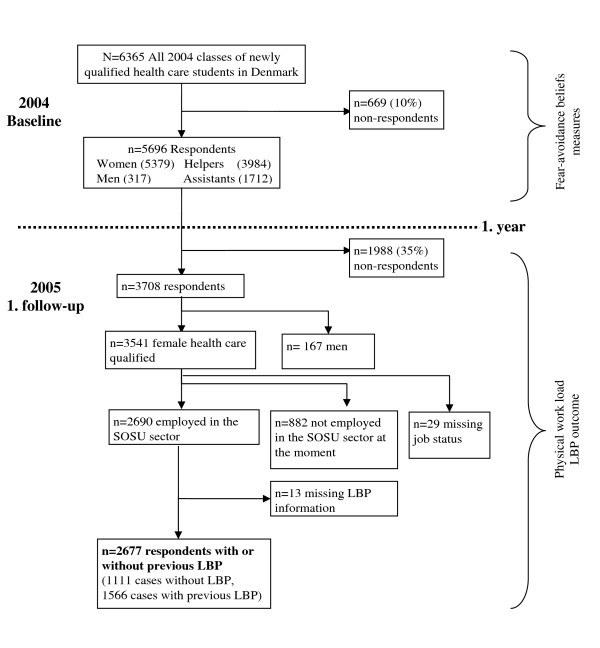
BACKGROUND: Health care workers have a high prevalence of low back pain (LBP). Although physical exposures in the working environment are linked to an increased risk of LBP, it has been suggested that individual coping strategies, for example fear-avoidance beliefs, could also be important in the development and maintenance of LBP. Accordingly, the main objective of this study was to examine (1) the association between physical work load and LBP, (2) the predictive effect of fear-avoidance beliefs on the development of LBP, and (3) the moderating effect of fear-avoidance beliefs on the association between physical work load and LBP among cases with and without previous LBP. METHODS: A questionnaire survey among 5696 newly qualified health care workers who completed a baseline questionnaire shortly before completing their education and a follow-up questionnaire 12 months later. Participants were selected on the following criteria: (a) being female, (b) working in the health care sector (n = 2677). Multinomial logistic regression analysis was used to evaluate the effect of physical work load and fear-avoidance beliefs on the severity of LBP. RESULTS: For those with previous LBP, physical work load has an importance, but not among those without previous LBP. In relation to fear-avoidance beliefs, there is a positive relation between it and LBP of than 30 days in both groups, i.e. those without and with previous LBP. No moderating effect of fear-avoidance beliefs on the association between physical work load and LBP was found among cases with and without LBP. CONCLUSION: Both physical work load and fear-avoidance beliefs matters in those with previous LBP. Only fear-avoidance beliefs matters in those without previous LBP. The study did not find a moderating effect of fear-avoidance beliefs on the association between physical work load and LBP.
Overview
The claims and statistics of this paper haven’t been checked yet.
Free: it reads the open-access text and checks the first 5 claims that cite a source we can check. Create a free account to check every claim.
Integrity signals
Registry
Cites
Statistics
Figures
Verification
Claims the paper makes
The claims and statistics of this paper haven’t been checked yet.
Free: it reads the open-access text and checks the first 5 claims that cite a source we can check. Create a free account to check every claim.
Claims other papers make about this one
Each is checked against this paper’s own text: does it say what the citing paper says it does?
The source backs part of the claim, not all of it — or backs it for a different population, condition or comparison.
In the citing paper
“Therefore, early detection of risk factors for LBP has been identified as a strategy for identifying patients who may be at risk of poor clinical outcomes, and as a potential method for improving the effectiveness and cost-effectiveness of psychological therapies [16].”
From Effectiveness of Acceptance and Commitment Therapy (ACT) for the Management of Postsurgical Pain: Study Protocol of a Randomized Controlled Trial (SPINE-ACT Study) (2023) · cites this paper as [16]
Experimental — accuracy not yet measured
Self-check
Percentages, sums and reported differences re-computed from the paper’s own numbers.
The self-check needs the paper’s full text.
Citations
Cites
Standardised Nordic questionnaires for the analysis of musculoskeletal symptoms
Kuorinka, I., Jonsson, B., Kilbom, A., Vinterberg, H., Biering-Sørensen, F., Andersson, G., & Jørgensen, K. (1987) · Applied Ergonomics · doi:10.1016/0003-6870(87)90010-x · Cited by 5,103 · cited 3×
“Low back pain: information on LBP at follow-up was measured by using the question of 12-months prevalence from the Standardised Nordic Questionnaires for the analyses of musculoskeletal symptoms (SNQ) [32]: "What is the total length of time that you have had low back trouble during the last 12 months?" As in the origi…”
InfluentialFear-avoidance and its consequences in chronic musculoskeletal pain: a state of the art.
Vlaeyen, J. W. S., & Linton, S. J. (2000) · Pain · doi:10.1016/s0304-3959(99)00242-0 · Cited by 4,931 · cited 1×
“These beliefs contributes to the development of musculoskeletal pain into a chronic pain syndrome [22,23].”
Waddell, G., Newton, M., Henderson, I., Somerville, D., & Main, C. J. (1993) · Pain · doi:10.1016/0304-3959(93)90127-b · Cited by 3,167 · cited 3×
“These beliefs contributes to the development of musculoskeletal pain into a chronic pain syndrome [22,23].”
Chapter 4 European guidelines for the management of chronic nonspecific low back pain
Airaksinen, O., Brox, J. I., Cedraschi, C., Hildebrandt, J., Klaber-Moffett, J., Kovacs, F., Mannion, A. F., Reis, S., Staal, J. B., Ursin, H., et al. (2006) · European Spine Journal · doi:10.1007/s00586-006-1072-1 · Cited by 2,594 · cited 1×
“This behaviour is believed to increase the risk of developing chronic pain [18,25,26] and is not in accordance with guidelines based on LBP research, which recommend LBP treatment by staying active and continuing normal daily life, including going to work [27,28].”
Fear of movement/(re)injury in chronic low back pain and its relation to behavioral performance
Vlaeyen, J. W. S., Kole-Snijders, A. M. J., Boeren, R. G. B., & van Eek, H. (1995) · Pain · doi:10.1016/0304-3959(94)00279-n · Cited by 2,446 · cited 1×
“This behaviour is believed to increase the risk of developing chronic pain [18,25,26] and is not in accordance with guidelines based on LBP research, which recommend LBP treatment by staying active and continuing normal daily life, including going to work [27,28].”
The fear-avoidance model of musculoskeletal pain: Current state of scientific evidence
Leeuw, M., Goossens, M. E. J. B., Linton, S. J., Crombez, G., Boersma, K., & Vlaeyen, J. W. S. (2007) · Journal of Behavioral Medicine · doi:10.1007/s10865-006-9085-0 · Cited by 2,261 · cited 1×
“Research suggests that a person’s coping style and beliefs about pain may be relevant in understanding its development [16].”
Kristensen, T. S., Hannerz, H., Høgh, A., & Borg, V (2005) · Scandinavian Journal of Work, Environment & Health · doi:10.5271/sjweh.948 · Cited by 1,430 · cited 1×
“Psychosocial work factors: psychosocial work factors were measured at follow-up by the Copenhagen Psychosocial Questionnaire (COPSOQ) [35].”
Self-citationOutline of a fear-avoidance model of exaggerated pain perception--I.
Lethem, J., Slade, P. D., Troup, J. D. G., & Bentley, G. (1983) · Behaviour Research and Therapy · doi:10.1016/0005-7967(83)90009-8 · Cited by 1,327 · cited 1×
“This behaviour is believed to increase the risk of developing chronic pain [18,25,26] and is not in accordance with guidelines based on LBP research, which recommend LBP treatment by staying active and continuing normal daily life, including going to work [27,28].”
SALTIN, B., & GRIMBY, G. (1968) · Circulation · doi:10.1161/01.cir.38.6.1104 · Cited by 1,015 · cited 2×
“Saltin B, Grimby G: Physiological analysis of middle-aged and old former athletes.”
Psychological aspects of persistent pain: Current state of the science
Keefe, F. J., Rumble, M. E., Scipio, C. D., Giordano, L. A., & Perri, L. M. (2004) · The Journal of Pain · doi:10.1016/j.jpain.2004.02.576 · Cited by 954 · cited 1×
“In the development of LBP in acute and chronic cases, studies have suggested that fear-avoidance beliefs are an influential psychological factor [17-20], and there is some evidence that suggest that fear-avoidance may play a role when pain becomes chronic, but little evidence with regard to early stages of LBP [21].”
Systematic Review of Psychosocial Factors at Work and Private Life as Risk Factors for Back Pain
Hoogendoorn, W. E., van Poppel, M. N. M., Bongers, P. M., Koes, B. W., & Bouter, L. M. (2000) · Spine · doi:10.1097/00007632-200008150-00017 · Cited by 915 · cited 1×
“Previous studies among health care helpers and nurses have found that psychosocial work-related factors were associated with LBP [9,10,12-14].”
Fritz, J. M., George, S. Z., & Delitto, A. (2001) · Pain · doi:10.1016/s0304-3959(01)00333-5 · Cited by 514 · cited 4×
“In the development of LBP in acute and chronic cases, studies have suggested that fear-avoidance beliefs are an influential psychological factor [17-20], and there is some evidence that suggest that fear-avoidance may play a role when pain becomes chronic, but little evidence with regard to early stages of LBP [21].”
InfluentialManual handling activities and risk of low back pain in nurses.
Smedley, J., Egger, P., Cooper, C., & Coggon, D. (1995) · Occupational and Environmental Medicine · doi:10.1136/oem.52.3.160 · Cited by 446 · cited 1×
“Background The prevalence of low back pain (LBP) among health care workers is high; studies have found that the 12-month prevalence is between 45% and 63% [1-5] compared with 40-50% in the general population among employees in general [6].”
Hartvigsen, J., Lings, S., Leboeuf‐Yde, C., & Bakketeig, L. S. (2004) · PubMed Central · Cited by 330
Prospective cohort study of predictors of incident low back pain in nurses
Smedley, J., Egger, P., Cooper, C., & Coggon, D. (1997) · BMJ · doi:10.1136/bmj.314.7089.1225 · Cited by 290 · cited 1×
“As previous history of LBP is a well-known predictor of later LBP [31], we believe that it is important to differentiate between employees with and without previous LBP experience.”
Occupational Psychological Factors Increase the Risk for Back Pain: A Systematic Review
Linton, S. J. (2001) · Journal of Occupational Rehabilitation · doi:10.1023/a:1016656225318 · Cited by 287 · cited 1×
“Previous studies among health care helpers and nurses have found that psychosocial work-related factors were associated with LBP [9,10,12-14].”
Eriksen, W., Bruusgaard, D., & Knardahl, S. (2004) · Occupational and Environmental Medicine · doi:10.1136/oem.2003.008482 · Cited by 281 · cited 2×
“Several well known LBP risk factors are present when working with care of the elderly: physical strain, such as heavy manual work; twisting and bending; standing in forward-bent and twisted postures; poor ergonomic/lifting conditions; and frequent positioning of bedridden patients [9-11].”
Perceived physical demands and reported musculoskeletal problems in registered nurses
Trinkoff, A. M., Lipscomb, J. A., Geiger-Brown, J., Storr, C. L., & Brady, B. A. (2003) · American Journal of Preventive Medicine · doi:10.1016/s0749-3797(02)00639-6 · Cited by 280 · cited 1×
“Background The prevalence of low back pain (LBP) among health care workers is high; studies have found that the 12-month prevalence is between 45% and 63% [1-5] compared with 40-50% in the general population among employees in general [6].”
Fear avoidance and prognosis in back pain: A systematic review and synthesis of current evidence
Pincus, T., Vogel, S., Burton, A. K., Santos, R., & Field, A. P. (2006) · Arthritis & Rheumatism · doi:10.1002/art.22273 · Cited by 259 · cited 1×
“The role of distress and depression has been found to play a role on early stages of LBP due to social withdrawal and reduced activity [40].”
Fear-avoidance beliefs and distress in relation to disability in acute and chronic low back pain
Grotle, M., Vøllestad, N. K., Veierød, M. B., & Brox, J. I. (2004) · Pain · doi:10.1016/j.pain.2004.09.020 · Cited by 227 · cited 3×
“Furthermore, previous studies have found that fear-avoidance beliefs are higher among chronic LBP patients than among those with acute LBP [29], and in our study population, cases with previous LBP have a higher mean score on fear-avoidance beliefs than cases without LBP.”
Are fear-avoidance beliefs related to the inception of an episode of back pain? A prospective study
Linton, S. J., Buer, N., Vlaeyen, J., & Hellsing, A.-L. (2000) · Psychology & Health · doi:10.1080/08870440008407366 · Cited by 207 · cited 3×
“To our knowledge, only Linton and Buer [30] have studied fear-avoidance beliefs in a pain-free general population.”
InfluentialSocial support, job strain and musculoskeletal pain among female health care personnel
Ahlberg-Hultén, G., Theorell, T., & Sigala, F. (1995) · Scandinavian Journal of Work, Environment & Health · doi:10.5271/sjweh.59 · Cited by 173 · cited 1×
“Previous studies among health care helpers and nurses have found that psychosocial work-related factors were associated with LBP [9,10,12-14].”
Occupational health guidelines for the management of low back pain: an international comparison
Staal, J. B., Hlobil, H., van Tulder, M. W., Waddell, G., Burton, A. K., Koes, B. W., & van Mechelen, W. (2003) · Occupational and Environmental Medicine · doi:10.1136/oem.60.9.618 · Cited by 158 · cited 1×
“This behaviour is believed to increase the risk of developing chronic pain [18,25,26] and is not in accordance with guidelines based on LBP research, which recommend LBP treatment by staying active and continuing normal daily life, including going to work [27,28].”
Expectancies and functional impairment in chronic low back pain
Council, J. R., Ahern, D. K., Follick, M. J., & Kline, C. L. (1988) · Pain · doi:10.1016/0304-3959(88)90291-6 · Cited by 154 · cited 2×
“In the development of LBP in acute and chronic cases, studies have suggested that fear-avoidance beliefs are an influential psychological factor [17-20], and there is some evidence that suggest that fear-avoidance may play a role when pain becomes chronic, but little evidence with regard to early stages of LBP [21].”
The Fear-Avoidance Model of exaggerated pain perception--II.
Slade, P. D., Troup, J., Lethem, J., & Bentley, G. (1983) · Behaviour Research and Therapy · doi:10.1016/0005-7967(83)90010-4 · Cited by 150 · cited 1×
“In theory, the response to pain can be seen as a continuum with two extremes: confrontation and avoidance [24].”
Juul‐Kristensen, B., Kadefors, R., Hansen, K., Byström, P., Sandsjö, L., & Sjøgaard, G. (2004) · European Journal of Applied Physiology · doi:10.1007/s00421-004-1220-4 · Cited by 150 · cited 2×
“However, a study by Juul-Kristensen et al. (2006) found that the prevalence of LBP was higher among female computer users with pain in the neck, shoulders or upper back compared with a control group without pain [43].”
Nieuwenhuyse, A. V., Somville, P., Crombez, G., Burdorf, A., Verbeke, G. N., Johannik, K., den Bergh, O. V., Masschelein, R., Mairiaux, P., & Moens, G. F. G. (2005) · Occupational and Environmental Medicine · doi:10.1136/oem.2004.015693 · Cited by 147 · cited 3×
“Their results showed that physical work and high levels of pain-related fear were risk factors for developing LBP one year later among young workers [39].”
InfluentialValidation of a questionnaire for assessing physical work load
Hollmann, S., Klimmer, F., Schmidt, K.-H., & KYLIAN, H. (1999) · Scandinavian Journal of Work Environment & Health · doi:10.5271/sjweh.412 · Cited by 142 · cited 3×
“Hollmann S, Klimmer F, Schmidt KH, Kylian H: Validation of a questionnaire for assessing physical work load.”
InfluentialWhy Has the Search for Causes of Low Back Pain Largely Been Nonconclusive?
Leboeuf-Yde, C., Lauritsen, J. M., & Lauritzen, T. (1997) · Spine · doi:10.1097/00007632-199704150-00010 · Cited by 140 · cited 1×
“In one epidemiologic study it was found that various variables associated differently with LBP and differed depending on the subdefinitions of LBP in the previous year [36].”
Hartvigsen, J., Bakketeig, L. S., Leboeuf-Yde, C., Engberg, M., & Lauritzen, T. (2001) · Spine · doi:10.1097/00007632-200108150-00011 · Cited by 129 · cited 1×
“healthy people can withstand higher work loads [37], while those who have already experienced LBP have a lower threshold level for physical exposure.”
Work-system risk factors for permanent work disability among home-care workers: a case-control study
Dellve, L., Lagerström, M., & Hagberg, M. (2003) · International Archives of Occupational and Environmental Health · doi:10.1007/s00420-002-0414-5 · Cited by 124 · cited 2×
“Several well known LBP risk factors are present when working with care of the elderly: physical strain, such as heavy manual work; twisting and bending; standing in forward-bent and twisted postures; poor ergonomic/lifting conditions; and frequent positioning of bedridden patients [9-11].”
Risk factors for first-ever low back pain among workers in their first employment
Nieuwenhuyse, A. V., Fatkhutdinova, L., Verbeke, G., Pirenne, D., Johannik, K., Somville, P. R., Mairiaux, P., Moens, G. F., & Masschelein, R. (2004) · Occupational Medicine · doi:10.1093/occmed/kqh091 · Cited by 124 · cited 2×
“sectional study that found a significant association between physical work load and “first-ever low back pain” among young workers (mean age 22 years) in their first job (health care or distribution service) [38].”
Back pain and associated factors in French nurses
Niedhammer, I., Lert, F., & Marne, M. J. (1994) · International Archives of Occupational and Environmental Health · doi:10.1007/bf00378369 · Cited by 123 · cited 1×
“Background The prevalence of low back pain (LBP) among health care workers is high; studies have found that the 12-month prevalence is between 45% and 63% [1-5] compared with 40-50% in the general population among employees in general [6].”
Low Back Pain Among Nurses: A Follow-up Beginning at Entry to the Nursing School
Videman, T., Ojaj??rvi, A., Riihim??ki, H., & Troup, J. D. G. (2005) · Spine · doi:10.1097/01.brs.0000182107.14355.ca · Cited by 122 · cited 1×
“Background The prevalence of low back pain (LBP) among health care workers is high; studies have found that the 12-month prevalence is between 45% and 63% [1-5] compared with 40-50% in the general population among employees in general [6].”
Leboeuf-Yde, C., Klougart, N., & Lauritzen, T. (1996) · Spine · doi:10.1097/00007632-199607010-00005 · Cited by 117 · cited 1×
“Background The prevalence of low back pain (LBP) among health care workers is high; studies have found that the 12-month prevalence is between 45% and 63% [1-5] compared with 40-50% in the general population among employees in general [6].”
Brulin, C., Gerdle, B. U. C., Granlund, B., Höög, J., Knutson, A., & Sundelin, G. (1998) · PubMed · Cited by 104
Leijon, O., Wiktorin, C., Härenstam, A., & Karlqvist, L. (2002) · Journal of Occupational and Environmental Medicine · doi:10.1097/00043764-200208000-00007 · Cited by 91 · cited 1×
“Results from other studies [41,42] have suggested that differential misclassification is not enough to bias the results substantially.”
Brulin, C., Gerdle, B., Granlund, B., Höög, J., Knutson, A., & Sundelin, G. (1998) · Scandinavian Journal of Caring Sciences · doi:10.1111/j.1471-6712.1998.tb00483.x · Cited by 61 · cited 1×
“Several well known LBP risk factors are present when working with care of the elderly: physical strain, such as heavy manual work; twisting and bending; standing in forward-bent and twisted postures; poor ergonomic/lifting conditions; and frequent positioning of bedridden patients [9-11].”
Fear-avoidance Beliefs About Back Pain in Patients With Acute LBP
Coudeyre, E., Tubach, F., Rannou, F., Baron, G., Coriat, F., Brin, S., Revel, M., & Poiraudeau, S. (2007) · Clinical Journal of Pain · doi:10.1097/ajp.0b013e31814da407 · Cited by 54 · cited 3×
“In the development of LBP in acute and chronic cases, studies have suggested that fear-avoidance beliefs are an influential psychological factor [17-20], and there is some evidence that suggest that fear-avoidance may play a role when pain becomes chronic, but little evidence with regard to early stages of LBP [21].”
Retrospective versus original information on physical and psychosocial exposure at work
Köster, M., Alfredsson, L. S., Michélsen, H., Vingård, E., & Kilbom, Å. (1999) · Scandinavian Journal of Work Environment & Health · doi:10.5271/sjweh.453 · Cited by 37
Back pain and its correlates among workers in family care
Moens, G. F. G., Dohogne, T., Jacques, P., & Helshoecht, P. V. (1993) · Occupational Medicine · doi:10.1093/occmed/43.2.78 · Cited by 23 · cited 1×
“The prevalence of low back pain (LBP) among health care workers is high; studies have found that the 12-month prevalence is between 45% and 63% [ 1-5 ] compared with 40-50% in the general population among employees in general [6].”
Brulin, C., Gerdle, B. U. C., Granlund, B., et al. (1998) · Scandinavian Journal of Caring Sciences · doi:10.1080/02839319850163039 · Cited by 17
Research works printed but not linked: 3
- Working Group for the Danish Institute for Technology Assessment Low-Back Pain 1999 Copenhagen, Danish Institute for Health Technology Ref Type: Report
- Faber A Nabe-Nielsen K Giver H Jensen JN Flyvholm M Strøyer J SOSU'er årgang 2004 - det første år. SOSU-rapport nr. 5 2007 Copenhagen, National Research Centre for the Working Environment Ref Type: Report
- Pincus T Vogel S Burton AK Santos R Field AP Fear avoidance and prognosis in back pain: a systematic review and synthesis of current evidence Arthritis Rheum 2006 54 3999 4010 17133530 10.1002/art.22273 · DOI · Paper page
Cited by
Psychological and psychosocial determinants of musculoskeletal pain and associated disability
Vargas-Prada, S., & Coggon, D. (2015) · Best Practice & Research Clinical Rheumatology · doi:10.1016/j.berh.2015.03.003 · Cited by 142
“Longitudinal studies have often found that the persistence of musculoskeletal pain is predicted by pessimistic beliefs about the prognosis of pain, and about the relationship of physical activity and work to musculoskeletal symptoms (Table 3), and adverse beliefs and expectations may have stronger influences on the pe…”
BackgroundChronic Low Back Pain and Psychosocial Issues
Moore, J. E. (2010) · Physical Medicine and Rehabilitation Clinics of North America · doi:10.1016/j.pmr.2010.06.005 · Cited by 108
Management of Degenerative Disk Disease and Chronic Low Back Pain
Karppinen, J. I., Shen, F. H., Luk, K. D. K., Andersson, G. B. J., Cheung, K., & Samartzis, D. (2011) · Orthopedic Clinics of North America · doi:10.1016/j.ocl.2011.07.009 · Cited by 97
“Recent studies uniformly suggest that abnormal fear-avoidance behavior predicts prolonged LBP.(50,116,117) Similarly, low expectations on return to work and abnormal fear-avoidance behavior predicted slow recovery after disk surgery.”
BackgroundJensen, J. N., Holtermann, A., Clausen, T., Mortensen, O. S., Carneiro, I. G., & Andersen, L. L. (2012) · BMC Musculoskeletal Disorders · doi:10.1186/1471-2474-13-87 · Cited by 82
“The authors thank the co-workers from the DHCWC-2004 study group for their contribution to data collection.”
Self-citationRasmussen, C. D. N., Holtermann, A., Mortensen, O. S., Søgaard, K., & Jørgensen, M. B. (2013) · BMC Public Health · doi:10.1186/1471-2458-13-1088 · Cited by 64
“Among health care workers both with and without LBP, fear avoidance beliefs is related to future episodes of LBP [15].”
Background
Metadata
- Authors
- Jensen, J. N., Albertsen, K., Borg, V., & Nabe-Nielsen, K.
- Affiliations
- National Research Centre for the Working Environment (DK)
- Corresponding author
- Jensen, Jette Nygaard
- Venue
- BMC Musculoskeletal Disorders
- Published
- 2009-09-24
- Volume
- 10
- Issue
- 1
- Pages
- 117-117
- ISSN
- 1471-2474 (ISSN-L)
- PMC
- PMC2759905
- OpenAlex
- W1983497810
- Cited by
- 30
- References
- 42
- Citations by year
- 2024: 1 · 2023: 2 · 2022: 3 · 2020: 2 · 2018: 2 · 2017: 1 · 2016: 1 · 2015: 1 · 2014: 2 · 2013: 4 · 2012: 5
- FWCI
- 2.64
- Type
- journal article
- Language
- en
- Open access
- gold
- doi.org
- Licence
- Locations
- BMC Musculoskeletal Disorders (publishedVersion, cc-by)
- PubMed Central (publishedVersion, cc-by)
- PubMed (publishedVersion)
- DOAJ (DOAJ: Directory of Open Access Journals) (submittedVersion)
- Research at the University of Copenhagen (University of Copenhagen) (submittedVersion)
- Topics
- Health Sciences › Health Professions › Physical Therapy, Sports Therapy and Rehabilitation › Musculoskeletal pain and rehabilitation
- Health Sciences › Medicine › Public Health, Environmental and Occupational Health › Occupational Health and Safety in Workplaces
- Health Sciences › Medicine › Obstetrics and Gynecology › Pregnancy-related medical research
- Keywords
- low back pain, fear-avoidance beliefs, physical workload, occupational health, coping strategies, moderating effect
- MeSH terms
- Adolescent, Adult, Attitude of Health Personnel, Avoidance Learning, Culture, Fear, Female, Follow-Up Studies, Forecasting, Health Personnel, Humans, Middle Aged, Prospective Studies, Surveys and Questionnaires, Cohort Studies, Workload, Low Back Pain, Young Adult
About these checks
Registry, retraction, Cites and statistics results are computed, not judged, with one exception: a printed reference that no index lists is read once by a model before it counts as a citation error. Claims are extracted by a model and kept only when their quote appears verbatim in the text; each cited source is then checked, with a model’s help, for whether it says what the claim relies on. Those verdicts can be wrong — read the claim’s quote and the cited source before relying on one.
Statistics and arithmetic are recomputed, not judged.
Confidence bands are shown only for fields calibrated on our annotated test set. None is calibrated yet, so no band is shown.
What counts as a claim ›How we measure confidence ›How we check this ›
Are you an author, or do you see a problem with this page? Request a review
Data sources
Bibliographic data: Semantic Scholar, OpenAlex, Crossref.
Contains information from the Semantic Scholar Academic Graph Datasets, made available under the ODC Attribution License (ODC-BY 1.0).
Semantic Scholar’s data is described in: Kinney, R., et al. (2023). The Semantic Scholar Open Data Platform. arXiv:2301.10140.
