Cited by 104Aquaculture disease management and microbiotaAquaculture Nutrition and GrowthPhysiological and biochemical adaptations

The DOI matches its Crossref record; 61 of the 62 references it cites were found in a registry or an index, and 1 are not checked yet.

Intestinal barrier function of Atlantic salmon (Salmo salar L.) post smolts is reduced by common sea cage environments and suggested as a possible physiological welfare indicator

Open access

Abstract

BACKGROUND: Fish farmed under high intensity aquaculture conditions are subjected to unnatural environments that may cause stress. Therefore awareness of how to maintain good health and welfare of farmed fish is important. For Atlantic salmon held in sea cages, water flow, dissolved oxygen (DO) levels and temperature will fluctuate over time and the fish can at times be exposed to detrimentally low DO levels and high temperatures. This experimental study investigates primary and secondary stress responses of Atlantic salmon post smolts to long-term exposure to reduced and fluctuating DO levels and high water temperatures, mimicking situations in the sea cages. Plasma cortisol levels and cortisol release to the water were assessed as indicators of the primary stress response and intestinal barrier integrity and physiological functions as indicators of secondary responses to changes in environmental conditions. RESULTS: Plasma cortisol levels were elevated in fish exposed to low (50% and 60% saturation) DO levels and low temperature (9°C), at days 9, 29 and 48. The intestinal barrier function, measured as electrical resistance (TER) and permeability of mannitol at the end of the experiment, were reduced at 50% DO, in both proximal and distal intestine. When low DO levels were combined with high temperature (16°C), plasma cortisol levels were elevated in the cyclic 1:5 h at 85%:50% DO group and fixed 50% DO group compared to the control (85% DO) group at day 10 but not at later time points. The intestinal barrier function was clearly disturbed in the 50% DO group; TER was reduced in both intestinal regions concomitant with increased paracellular permeability in the distal region. CONCLUSIONS: This study reveals that adverse environmental conditions (low water flow, low DO levels at low and high temperature), that can occur in sea cages, elicits primary and secondary stress responses in Atlantic salmon post smolts. The intestinal barrier function was significantly affected by prolonged hypoxic stress even when no primary stress response was observed. This suggests that intestinal barrier function is a good experimental marker for evaluation of chronic stress and that it can be a valuable tool to study the impact of various husbandry conditions on health and welfare of farmed Atlantic salmon.

Overview

The claims and statistics of this paper haven’t been checked yet.

Run the check — free, no account needed. It reads the open-access text and checks the sources it cites.

A few free checks a day · papers already verified open instantly · results are public

Integrity signals

Registry

Crossref · 10.1186/1472-6793-10-22

Cites

61 of 62 references verified0 citation errors · 0 not checkable

Statistics

Figures

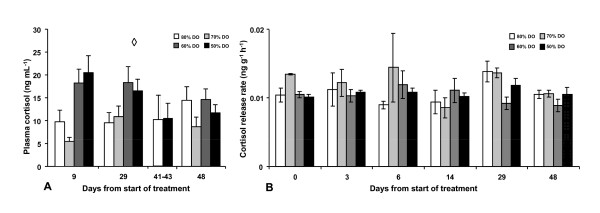
Figure 1 Plasma cortisol and cortisol release rate after long term hypoxia (Experiment 1). This experiment aimed at mimicking an overall situation often found in sea cages when water flow decreases and DO levels are reduced to levels as low as around 50%. Decreased water exchange rate may also cause increased concentrations of toxic metabolites. Four experimental oxygen regimes in triplicate tanks were created, fixed oxygen levels at 50%, 60%, 70% and 80%, automatically regulated by adjusting inflow (range 41-137 L min-1) in response to oxygen consumption of the fish. Blood was sampled for plasma cortisol measurements from all treatment groups at days 9, 29 and 48 and from the 80% and 50% DO between days 41-43. Non-invasive measurement of cortisol status of the fish was conducted by measuring the cortisol release rate into the water. Plasma cortisol levels were analysed using a general linear model with sampling occasion and DO treatment levels (with tank nested within treatment) as factors. DO levels had an effect on plasma cortisol levels (A) (p < 0.001) but were not affected by time (p = 0.607) and no interaction could be observed (p = 0.128). Further, SNK post hoc test grouped the 50% and 60% DO groups in one subset and the 70% and 80% DO groups in one subset at day 9, 29 and 48. No differences could be observed in plasma cortisol between 80% and 50% DO levels in fish sampled for intestinal barrier function between days 41-43. No major differences could be observed in the cortisol release rate between treatment groups (B). All data are expressed as means ± SEM and p < 0.05. The overall effect of treatment is indicated by ◊.
Figure 1 Plasma cortisol and cortisol release rate after long term hypoxia (Experiment 1). This experiment aimed at mimicking an overall situation often found in sea cages when water flow decreases and DO levels are reduced to levels as low as around 50%. Decreased water exchange rate may also cause increased concentrations of toxic metabolites. Four experimental oxygen regimes in triplicate tanks were created, fixed oxygen levels at 50%, 60%, 70% and 80%, automatically regulated by adjusting inflow (range 41-137 L min-1) in response to oxygen consumption of the fish. Blood was sampled for plasma cortisol measurements from all treatment groups at days 9, 29 and 48 and from the 80% and 50% DO between days 41-43. Non-invasive measurement of cortisol status of the fish was conducted by measuring the cortisol release rate into the water. Plasma cortisol levels were analysed using a general linear model with sampling occasion and DO treatment levels (with tank nested within treatment) as factors. DO levels had an effect on plasma cortisol levels (A) (p < 0.001) but were not affected by time (p = 0.607) and no interaction could be observed (p = 0.128). Further, SNK post hoc test grouped the 50% and 60% DO groups in one subset and the 70% and 80% DO groups in one subset at day 9, 29 and 48. No differences could be observed in plasma cortisol between 80% and 50% DO levels in fish sampled for intestinal barrier function between days 41-43. No major differences could be observed in the cortisol release rate between treatment groups (B). All data are expressed as means ± SEM and p < 0.05. The overall effect of treatment is indicated by ◊.CC BY · PubMed Central
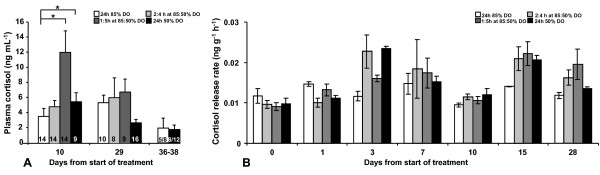
Figure 2 Plasma cortisol and cortisol release rate after fixed and cyclic, low DO levels at high temperature (Experiment 2). This experiment aimed at mimicking DO levels measured in sea cages in fjords sheltered from waves, wind and strong currents. In these situations, cyclic drops in DO levels are frequently observed during slack water at tidal reverse and further decreased DO levels are observed during high temperatures. Four oxygen treatment regimes were initiated: fixed 50% or 85% DO levels, or 50% or 85% DO levels in two different 6 hour cycles (4:2 h at 85:50%; 1:5 h at 85:50%) at 16°C. Blood was sampled for plasma cortisol measurements from all treatment groups day 10 and 29, and from the fixed 85% and 50% DO groups between days 36-38. Cortisol levels in plasma at different time points after start of Experiment 2, assessing the impact of cyclic and fixed DO levels. Plasma cortisol samples below the limit of detection was removed and indicated in each bar (A). DO levels were not affected by sampling occasion (p = 0.572) but slightly influenced by DO treatment levels (p = 0.088). An interaction was observed (p = 0.029) and Bonferroni corrected pair-wise comparison of plasma cortisol levels revealed elevated cortisol levels in the 1:5 h at 85:50% DO group and 50% DO group compared to the 85% DO group (p = 0.002 and p = 0.012 respectively) at the first sampling after 10 days. Thereafter no differences could be observed. Overall, the cortisol release rate (B) reflected the plasma cortisol levels as there was a tendency toward lower cortisol release rate in the 85% DO group (p = 0.1). Further, plasma cortisol levels on day 29 appeared to be reflected in the cortisol release rate on day 28. All data are expressed as means ± SEM and p < 0.05 was regarded as significant and indicated as *, p < 0.01 as ** and p < 0.001 indicated as ***.
Figure 2 Plasma cortisol and cortisol release rate after fixed and cyclic, low DO levels at high temperature (Experiment 2). This experiment aimed at mimicking DO levels measured in sea cages in fjords sheltered from waves, wind and strong currents. In these situations, cyclic drops in DO levels are frequently observed during slack water at tidal reverse and further decreased DO levels are observed during high temperatures. Four oxygen treatment regimes were initiated: fixed 50% or 85% DO levels, or 50% or 85% DO levels in two different 6 hour cycles (4:2 h at 85:50%; 1:5 h at 85:50%) at 16°C. Blood was sampled for plasma cortisol measurements from all treatment groups day 10 and 29, and from the fixed 85% and 50% DO groups between days 36-38. Cortisol levels in plasma at different time points after start of Experiment 2, assessing the impact of cyclic and fixed DO levels. Plasma cortisol samples below the limit of detection was removed and indicated in each bar (A). DO levels were not affected by sampling occasion (p = 0.572) but slightly influenced by DO treatment levels (p = 0.088). An interaction was observed (p = 0.029) and Bonferroni corrected pair-wise comparison of plasma cortisol levels revealed elevated cortisol levels in the 1:5 h at 85:50% DO group and 50% DO group compared to the 85% DO group (p = 0.002 and p = 0.012 respectively) at the first sampling after 10 days. Thereafter no differences could be observed. Overall, the cortisol release rate (B) reflected the plasma cortisol levels as there was a tendency toward lower cortisol release rate in the 85% DO group (p = 0.1). Further, plasma cortisol levels on day 29 appeared to be reflected in the cortisol release rate on day 28. All data are expressed as means ± SEM and p < 0.05 was regarded as significant and indicated as *, p < 0.01 as ** and p < 0.001 indicated as ***.CC BY · PubMed Central
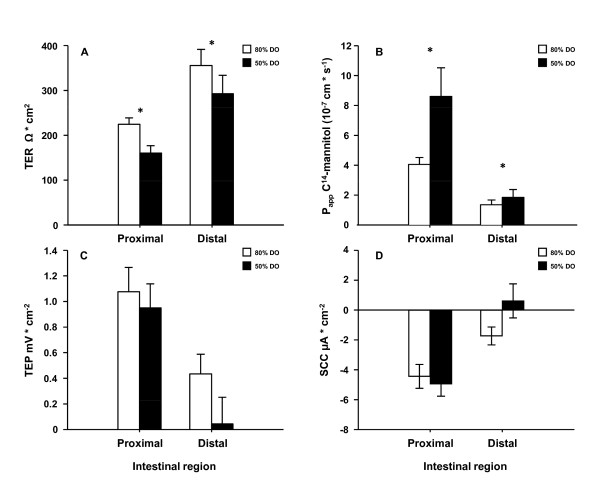
Figure 3 Intestinal barrier function after long term hypoxia (Experiment 1). This experiment aimed at mimicking an overall situation often found in sea cages when water flow decreases and DO levels are reduced to levels as low as around 50%. Decreased water exchange rate may also cause increased concentrations of toxic metabolites. Four fish from each tank in triplicate was sampled between days 41-43, from 80% and 50% DO levels groups created by adjusting inflow (range 41-137 L min-1) in response to oxygen consumption of the fish. The intestine was removed and opened longitudinally, divided into a proximal and a distal part, washed in ice-cold salmon Ringer solution and mounted in Ussing chambers. The electrical parameters; transepithelial resistance (TER), short-circuit current (SCC) and transepithelial potential (TEP) were measured. TER is mainly a measure of the paracellular permeability, and SCC describes the sum of active transports. This, together with the passive leakage of charged molecules across the epithelium is reflected in the TEP. The paracellular permeability of the intestinal epithelium was also assessed as the apparent permeability (Papp) of a well documented paracellular marker 14C-mannitol. Ussing chamber data was analysed using a genral linear model with intestinal region and treatment (with tank nested within treatment) as factors. Paracellular permeability was higher in both intestinal regions in the 50% DO group as indicated by decreased TER (p < 0.05) (A) and the increased Papp for mannitol which increased in both the proximal and distal intestine (p < 0.05) (B). No major differences were observed in TEP (C) or SCC (D). All data are expressed as means ± SEM and p < 0.05 was regarded as significant and indicated as *, p < 0.01 as ** and p < 0.001 indicated as ***.
Figure 3 Intestinal barrier function after long term hypoxia (Experiment 1). This experiment aimed at mimicking an overall situation often found in sea cages when water flow decreases and DO levels are reduced to levels as low as around 50%. Decreased water exchange rate may also cause increased concentrations of toxic metabolites. Four fish from each tank in triplicate was sampled between days 41-43, from 80% and 50% DO levels groups created by adjusting inflow (range 41-137 L min-1) in response to oxygen consumption of the fish. The intestine was removed and opened longitudinally, divided into a proximal and a distal part, washed in ice-cold salmon Ringer solution and mounted in Ussing chambers. The electrical parameters; transepithelial resistance (TER), short-circuit current (SCC) and transepithelial potential (TEP) were measured. TER is mainly a measure of the paracellular permeability, and SCC describes the sum of active transports. This, together with the passive leakage of charged molecules across the epithelium is reflected in the TEP. The paracellular permeability of the intestinal epithelium was also assessed as the apparent permeability (Papp) of a well documented paracellular marker 14C-mannitol. Ussing chamber data was analysed using a genral linear model with intestinal region and treatment (with tank nested within treatment) as factors. Paracellular permeability was higher in both intestinal regions in the 50% DO group as indicated by decreased TER (p < 0.05) (A) and the increased Papp for mannitol which increased in both the proximal and distal intestine (p < 0.05) (B). No major differences were observed in TEP (C) or SCC (D). All data are expressed as means ± SEM and p < 0.05 was regarded as significant and indicated as *, p < 0.01 as ** and p < 0.001 indicated as ***.CC BY · PubMed Central
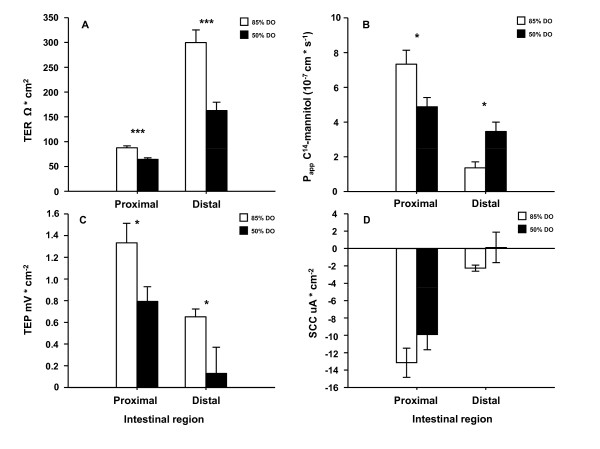
Figure 4 Intestinal barrier function after long term hypoxia at high temperature (Experiment 2). This experiment aimed at mimicking DO levels measured in sea cages in fjords sheltered from waves, wind and strong currents. In these situations, cyclic drops in DO levels are frequently observed during slack water at tidal reverse and further decreased DO levels are observed during high temperatures. Four oxygen treatment regimes were initiated: fixed 50% or 85% DO levels, or 50% or 85% DO levels in two different 6 hour cycles (4:2 h at 85:50%; 1:5 h at 85:50%) at 16°C. Four fish per tank from fixed 85% and 50% DO groups were sampled. The intestine was removed and opened longitudinally, divided into a proximal and a distal part, washed in ice-cold salmon Ringer solution and mounted in Ussing chambers. The electrical parameters; transepithelial resistance (TER), short-circuit current (SCC) and transepithelial potential (TEP) were measured. TER is mainly a measure of the paracellular permeability, and SCC describes the sum of active transports. This, together with the passive leakage of charged molecules across the epithelium is reflected in the TEP. Ussing chamber data was analysed in a genral linear model with intestinal region and treatment (with tank nested within treatment) as factors. The paracellular permeability of the intestinal epithelium was also assessed as the apparent permeability (Papp) of 14C-mannitol. TER was lower in the 50% DO group in both intestinal regions (p < 0.001) (A). An interaction between intestinal region and treatment was found for Papp (p < 0.001), revealing a decrease in Papp of the proximal intestine whereas there was an increase in the distal region in the 50% DO group compared to the 85% DO group (B). In both proximal and distal intestine (p < 0.05) the capability to maintain a potential difference between mucosa and serosa was reduced as shown by decreased TEP (C). No differences in SCC could be observed between treatments in neither proximal nor distal intestine (D). All data are expressed as means ± SEM and p < 0.05 was regarded as significant and indicated as *, p < 0.01 as ** and p < 0.001 indicated as ***.
Figure 4 Intestinal barrier function after long term hypoxia at high temperature (Experiment 2). This experiment aimed at mimicking DO levels measured in sea cages in fjords sheltered from waves, wind and strong currents. In these situations, cyclic drops in DO levels are frequently observed during slack water at tidal reverse and further decreased DO levels are observed during high temperatures. Four oxygen treatment regimes were initiated: fixed 50% or 85% DO levels, or 50% or 85% DO levels in two different 6 hour cycles (4:2 h at 85:50%; 1:5 h at 85:50%) at 16°C. Four fish per tank from fixed 85% and 50% DO groups were sampled. The intestine was removed and opened longitudinally, divided into a proximal and a distal part, washed in ice-cold salmon Ringer solution and mounted in Ussing chambers. The electrical parameters; transepithelial resistance (TER), short-circuit current (SCC) and transepithelial potential (TEP) were measured. TER is mainly a measure of the paracellular permeability, and SCC describes the sum of active transports. This, together with the passive leakage of charged molecules across the epithelium is reflected in the TEP. Ussing chamber data was analysed in a genral linear model with intestinal region and treatment (with tank nested within treatment) as factors. The paracellular permeability of the intestinal epithelium was also assessed as the apparent permeability (Papp) of 14C-mannitol. TER was lower in the 50% DO group in both intestinal regions (p < 0.001) (A). An interaction between intestinal region and treatment was found for Papp (p < 0.001), revealing a decrease in Papp of the proximal intestine whereas there was an increase in the distal region in the 50% DO group compared to the 85% DO group (B). In both proximal and distal intestine (p < 0.05) the capability to maintain a potential difference between mucosa and serosa was reduced as shown by decreased TEP (C). No differences in SCC could be observed between treatments in neither proximal nor distal intestine (D). All data are expressed as means ± SEM and p < 0.05 was regarded as significant and indicated as *, p < 0.01 as ** and p < 0.001 indicated as ***.CC BY · PubMed Central

Verification

Claims the paper makes

The claims and statistics of this paper haven’t been checked yet.

Run the check — free, no account needed. It reads the open-access text and checks the sources it cites.

A few free checks a day · papers already verified open instantly · results are public

Claims other papers make about this one

Each is checked against this paper’s own text: does it say what the citing paper says it does?

Self-check

Percentages, sums and reported differences re-computed from the paper’s own numbers.

The self-check needs the paper’s full text.

Citations

Cites

Show all 61 references

Research works printed but not linked: 1

  1. Hastein T Scarfe AD Lund VL Science-based assessment of welfare: aquatic animals Rev Sci Tech Off Int Epiz 2005 24 2 529 547 16358506

Cited by

Sorted by citations

Items 101–102 of 102

Metadata

Authors
Sundh, H., Kvamme, B., Fridell, F., Olsen, R., Ellis, T., Taranger, G., & Sundell, K.
Affiliations
  • University of Gothenburg (SE)
  • Norwegian Institute of Marine Research (NO)
Corresponding author
Sundh, Henrik
Venue
BMC Physiology
Published
2010
Volume
10
Issue
1
Pages
22
ISSN
1472-6793 (ISSN-L)
OpenAlex
W2141622955
Cited by
104
References
61
Citations by year
2026: 6 · 2025: 10 · 2024: 8 · 2023: 7 · 2022: 5 · 2021: 15 · 2020: 10 · 2019: 7 · 2018: 9 · 2017: 6 · 2016: 5 · 2015: 2 · 2014: 3 · 2013: 2 · 2012: 6
FWCI
1.51
Type
journal article
Language
en
Open access
Licence
cc-by
Locations
  • BMC Physiology (publishedVersion, cc-by)
  • PubMed Central (publishedVersion, cc-by)
  • PubMed (publishedVersion)
  • Gothenburg University Publications Electronic Archive (Gothenburg University) (acceptedVersion)
  • DOAJ (DOAJ: Directory of Open Access Journals) (submittedVersion)
Funders
  • Svenska Forskningsrådet Formas
  • Helge Ax:son Johnsons Stiftelse
  • Vetenskapsrådet
Topics
  • Life Sciences › Immunology and Microbiology › Immunology › Aquaculture disease management and microbiota
  • Life Sciences › Agricultural and Biological Sciences › Aquatic Science › Aquaculture Nutrition and Growth
  • Physical Sciences › Environmental Science › Ecology › Physiological and biochemical adaptations
Keywords
Atlantic salmon, intestinal barrier function, sea cage aquaculture, hypoxia, dissolved oxygen, water temperature, plasma cortisol, transepithelial electrical resistance, intestinal permeability, chronic stress
MeSH terms
Animals, Animal Welfare, Hypoxia, Environmental Exposure, Hydrocortisone, Intestines, Stress, Physiological, Biomarkers, Aquaculture, Salmo salar

About these checks

Registry, retraction, Cites and statistics results are computed, not judged, with one exception: a printed reference that no index lists is read once by a model before it counts as a citation error. Claims are extracted by a model and kept only when their quote appears verbatim in the text; each cited source is then checked, with a model’s help, for whether it says what the claim relies on. Those verdicts can be wrong — read the claim’s quote and the cited source before relying on one.

Statistics and arithmetic are recomputed, not judged.

Confidence bands are shown only for fields calibrated on our annotated test set. None is calibrated yet, so no band is shown.

What counts as a claim ›How we measure confidence ›How we check this ›

Are you an author, or do you see a problem with this page? Request a review