

The DOI matches its Crossref record; 61 of the 62 references it cites were found in a registry or an index, and 1 are not checked yet.
Intestinal barrier function of Atlantic salmon (Salmo salar L.) post smolts is reduced by common sea cage environments and suggested as a possible physiological welfare indicator
Open accessAbstract
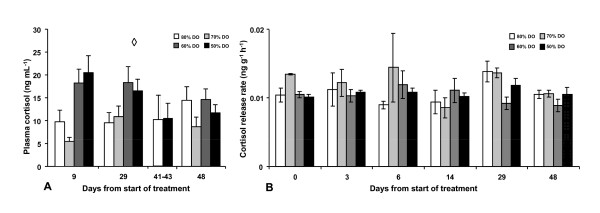
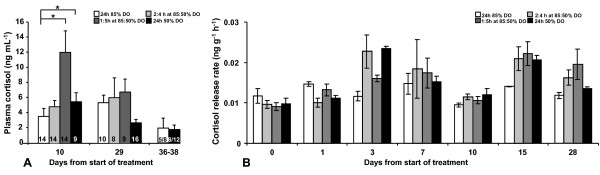
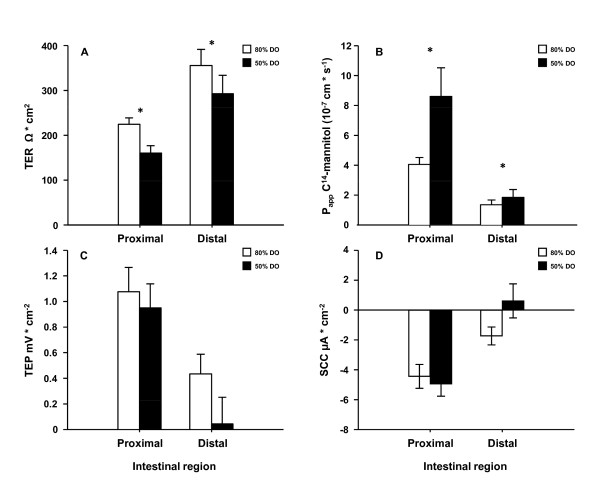
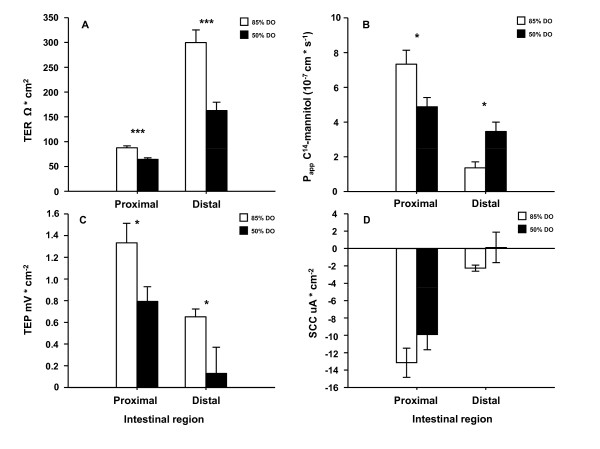
BACKGROUND: Fish farmed under high intensity aquaculture conditions are subjected to unnatural environments that may cause stress. Therefore awareness of how to maintain good health and welfare of farmed fish is important. For Atlantic salmon held in sea cages, water flow, dissolved oxygen (DO) levels and temperature will fluctuate over time and the fish can at times be exposed to detrimentally low DO levels and high temperatures. This experimental study investigates primary and secondary stress responses of Atlantic salmon post smolts to long-term exposure to reduced and fluctuating DO levels and high water temperatures, mimicking situations in the sea cages. Plasma cortisol levels and cortisol release to the water were assessed as indicators of the primary stress response and intestinal barrier integrity and physiological functions as indicators of secondary responses to changes in environmental conditions. RESULTS: Plasma cortisol levels were elevated in fish exposed to low (50% and 60% saturation) DO levels and low temperature (9°C), at days 9, 29 and 48. The intestinal barrier function, measured as electrical resistance (TER) and permeability of mannitol at the end of the experiment, were reduced at 50% DO, in both proximal and distal intestine. When low DO levels were combined with high temperature (16°C), plasma cortisol levels were elevated in the cyclic 1:5 h at 85%:50% DO group and fixed 50% DO group compared to the control (85% DO) group at day 10 but not at later time points. The intestinal barrier function was clearly disturbed in the 50% DO group; TER was reduced in both intestinal regions concomitant with increased paracellular permeability in the distal region. CONCLUSIONS: This study reveals that adverse environmental conditions (low water flow, low DO levels at low and high temperature), that can occur in sea cages, elicits primary and secondary stress responses in Atlantic salmon post smolts. The intestinal barrier function was significantly affected by prolonged hypoxic stress even when no primary stress response was observed. This suggests that intestinal barrier function is a good experimental marker for evaluation of chronic stress and that it can be a valuable tool to study the impact of various husbandry conditions on health and welfare of farmed Atlantic salmon.
Overview
The claims and statistics of this paper haven’t been checked yet.
Run the check — free, no account needed. It reads the open-access text and checks the sources it cites.
Integrity signals
Registry
Cites
Statistics
Figures
Verification
Claims the paper makes
The claims and statistics of this paper haven’t been checked yet.
Run the check — free, no account needed. It reads the open-access text and checks the sources it cites.
Claims other papers make about this one
Each is checked against this paper’s own text: does it say what the citing paper says it does?
The source backs part of the claim, not all of it — or backs it for a different population, condition or comparison.
In the citing paper
“In that study, intestinal barrier function was significantly impaired by increasing the temperature from 10 to 16°C, even when no primary stress response (plasma cortisol) was observed.”
From Insights into thermal sensitivity: Effects of elevated temperature on growth, metabolic rate, and stress responses in Atlantic wolffish (Anarhichas lupus) (2025) · cites this paper as Sundh et al. (2010)
Experimental — accuracy not yet measuredThe cited source says what the claim attributes to it.
In the citing paper
“As part of the secondary stress response, the gut barrier function can be decreased through increased ionic and physical “leakiness” of the gastrointestinal tract (Sundh et al., 2010; Sundh et al., 2018).”
From Insights into thermal sensitivity: Effects of elevated temperature on growth, metabolic rate, and stress responses in Atlantic wolffish (Anarhichas lupus) (2025) · cites this paper as Sundh et al., 2010
The cited source says what the claim attributes to it.
In the citing paper
“Impaired barrier function can be induced in fish by several different husbandry‐related practices, including acute handling stress (Olsen et al., 2005, 2008; Sundh et al., 2018), poor water quality (Sundh et al., 2009; Sundh et al., 2010; Sundh et al., 2019), and chronic feed stress (Estensoro et al., 2016; Knudsen et al., 2008; Venkatakrishnan et al., 2019; Vidakovic et al., 2016).”
From Insights into thermal sensitivity: Effects of elevated temperature on growth, metabolic rate, and stress responses in Atlantic wolffish (Anarhichas lupus) (2025) · cites this paper as Sundh et al., 2010
Self-check
Percentages, sums and reported differences re-computed from the paper’s own numbers.
The self-check needs the paper’s full text.
Citations
Cites
Protective and Damaging Effects of Stress Mediators
McEwen, B. S. (1998) · New England Journal of Medicine · doi:10.1056/nejm199801153380307 · Cited by 6,733
Wendelaar Bonga, S. E. (1997) · Physiological Reviews · doi:10.1152/physrev.1997.77.3.591 · Cited by 4,188
The concept of allostasis in biology and biomedicine
McEwen, B. S., & Wingfield, J. C. (2003) · Hormones and Behavior · doi:10.1016/s0018-506x(02)00024-7 · Cited by 3,302 · cited 1×
“In allostasis, cortisol is an important regulator [9,37,38].”
BackgroundPodolsky, D. K. (2002) · New England Journal of Medicine · doi:10.1056/nejmra020831 · Cited by 3,183
BARTON, B. A. (2002) · Integrative and Comparative Biology · doi:10.1093/icb/42.3.517 · Cited by 2,511
Cortisol in teleosts: dynamics, mechanisms of action, and metabolic regulation
Mommsen, T. P., Vijayan, M. M., & Moon, T. W. (1999) · Reviews in Fish Biology and Fisheries · doi:10.1023/a:1008924418720 · Cited by 2,376
BARTON, B. A., & Iwama, G. K. (1991) · Annual Review of Fish Diseases · doi:10.1016/0959-8030(91)90019-g · Cited by 2,113
Korte, S. M., Koolhaas, J. M., Wingfield, J. C., & McEwen, B. S. (2005) · Neuroscience & Biobehavioral Reviews · doi:10.1016/j.neubiorev.2004.08.009 · Cited by 1,097
Fish welfare: Current issues in aquaculture
Ashley, P. J. (2006) · Applied Animal Behaviour Science · doi:10.1016/j.applanim.2006.09.001 · Cited by 1,076
The biology of animal stress: basic principles and implications for animal welfare.
Moberg, G. P. (2000) · CABI Publishing eBooks · doi:10.1079/9780851993591.0000 · Cited by 1,003
Research works printed but not linked: 1
- Hastein T Scarfe AD Lund VL Science-based assessment of welfare: aquatic animals Rev Sci Tech Off Int Epiz 2005 24 2 529 547 16358506
Cited by
Sorted by citations
Nutritional immunity of fish intestines: important insights for sustainable aquaculture
Dawood, M. A. O. (2020) · Reviews in Aquaculture · doi:10.1111/raq.12492 · Cited by 590
Health of farmed fish: its relation to fish welfare and its utility as welfare indicator
Segner, H. E., Sundh, H., Buchmann, K., Douxfils, J., Sundell, K. S., Mathieu, C., Ruane, N. M., Jutfelt, F., Toften, H., & Vaughan, L. (2011) · Fish Physiology and Biochemistry · doi:10.1007/s10695-011-9517-9 · Cited by 229
Self-citationMucosal Immunity and B Cells in Teleosts: Effect of Vaccination and Stress
Parra, D., Reyes‐López, F. E., & Tort, L. (2015) · Frontiers in Immunology · doi:10.3389/fimmu.2015.00354 · Cited by 194
Stien, L. H., Bracke, M. B. M., Folkedal, O., Nilsson, J., Oppedal, F., Torgersen, T., Kittilsen, S., Midtlyng, P. J., Vindas, M. A., Øverli, Ø., et al. (2013) · Reviews in Aquaculture · doi:10.1111/j.1753-5131.2012.01083.x · Cited by 175
Cascarano, M. C., Stavrakidis‐Zachou, O., Mladineo, I., Thompson, K. D., Papandroulakis, N., & Katharios, P. (2021) · Pathogens · doi:10.3390/pathogens10091205 · Cited by 184
NIKLASSON, L. ‐., Sundh, H., Fridell, F., Taranger, G. L., & Sundell, K. S. (2011) · Fish & Shellfish Immunology · doi:10.1016/j.fsi.2011.09.011 · Cited by 154
Self-citationIntestinal fluid absorption in anadromous salmonids: importance of tight junctions and aquaporins
Sundell, K. S., & Sundh, H. (2012) · Frontiers in Physiology · doi:10.3389/fphys.2012.00388 · Cited by 135
Self-citationModulation of innate immune responses in Atlantic salmon by chronic hypoxia-induced stress
Kvamme, B. O., Gadan, K., Fridell, F., Niklasson, L., Sundh, H., Sundell, K. S., Taranger, G. L., & Evensen, Ø. (2012) · Fish & Shellfish Immunology · doi:10.1016/j.fsi.2012.10.006 · Cited by 106
Self-citationAšmonaitė, G., Sundh, H., Asker, N., & Almroth, B. C. (2018) · Environmental Science & Technology · doi:10.1021/acs.est.8b04848 · Cited by 109
Self-citationKaterina, K., Berge, G. M., Turid, M., Aleksei, K., Grete, B., Trine, Y., Mats, C., John, S., & Bente, R. (2020) · Frontiers in Marine Science · doi:10.3389/fmars.2020.00057 · Cited by 99
Rosengren, M., Kvingedal, E., Näslund, J., Johnsson, J. I., & Sundell, K. S. (2016) · Canadian Journal of Fisheries and Aquatic Sciences · doi:10.1139/cjfas-2015-0515 · Cited by 91
Self-citationSong, C., Liu, B., Xu, P., Xie, J., Ge, X., Zhou, Q., Sun, C., Zhang, H., Shan, F., & Yang, Z. (2018) · Fish & Shellfish Immunology · doi:10.1016/j.fsi.2018.07.049 · Cited by 89
Khansari, A. R., Balasch, J. C., Vallejos‐Vidal, E., Parra, D., Reyes‐López, F. E., & Tort, L. (2018) · Frontiers in Immunology · doi:10.3389/fimmu.2018.00856 · Cited by 80
Association of Gut Microbiota With Metabolism in Rainbow Trout Under Acute Heat Stress
Zhou, C., Yang, S.-W., Ka, W., Gao, P., Li, Y., Long, R., & Wang, J. (2022) · Frontiers in Microbiology · doi:10.3389/fmicb.2022.846336 · Cited by 85
Solomando, A., Capó, X., Alomar, C., Compa, M., Valencia, J. M., Sureda, A., & Deudero, S. (2021) · The Science of The Total Environment · doi:10.1016/j.scitotenv.2021.147479 · Cited by 75
Skirt around a salmon sea cage to reduce infestation of salmon lice resulted in low oxygen levels
Stien, L. H., Nilsson, J., Hevrøy, E. M., Oppedal, F., Kristiansen, T., Lien, A. M., & Folkedal, O. (2012) · Aquacultural Engineering · doi:10.1016/j.aquaeng.2012.06.002 · Cited by 69
Padra, J. T., Sundh, H., Jin, C., Karlsson, N. G., Sundell, K. S., & Lindén, S. K. (2014) · Infection and Immunity · doi:10.1128/iai.01931-14 · Cited by 67
Self-citationMansour, A. T., Espinosa‐Ruíz, C., Beltrán, J. M. G., Miao, L., Ceballos‐Francisco, D., Alsaqufi, A. S., & Esteban, M. Á. (2020) · Fish Physiology and Biochemistry · doi:10.1007/s10695-020-00763-2 · Cited by 67
Fish Pathology Research and Diagnosis in Aquaculture of Farmed Fish; a Proteomics Perspective
Moreira, M., Schrama, D., Farinha, A. P., Cerqueira, M. A. C., de Magalhães, C. R., Carrilho, R., & Rodrigues, P. M. (2021) · Animals · doi:10.3390/ani11010125 · Cited by 71
Functional significance and physiological regulation of essential trace metals in fish
Chandrapalan, T., & Kwong, R. W. M. (2021) · Journal of Experimental Biology · doi:10.1242/jeb.238790 · Cited by 63
Sundh, H., Fridell, F., Ellis, T., Taranger, G. L., NIKLASSON, L. ‐., Pettersen, E. F., Wergeland, H. I., & Sundell, K. S. (2019) · Aquaculture · doi:10.1016/j.aquaculture.2019.734356 · Cited by 62
Self-citationFang, M., Lei, Z., Ma, R., Jing, W., & Du, L. (2023) · Ecotoxicology and Environmental Safety · doi:10.1016/j.ecoenv.2023.115607 · Cited by 61
Ren, G., Xu, L., Lu, T., Zhang, Y., Wang, Y., & Yin, J. (2018) · International Journal of Biological Macromolecules · doi:10.1016/j.ijbiomac.2018.09.121 · Cited by 61
Tapia-Paniagua, S. T., Díaz‐Rosales, P., León-Rubio, J. M., de la Banda, I. G., Lobo, C., Alarcón, F. J., Chabrillón, M., Rosas-Ledesma, P., Varela, J. L., Ruíz-Jarabo, I., et al. (2012) · Aquaculture International · doi:10.1007/s10499-012-9509-5 · Cited by 60
Genome-wide analysis of Atlantic salmon (Salmo salar) mucin genes and their role as biomarkers
Sveen, L. R., Grammes, F., Ytteborg, E., Takle, H., & Jørgensen, S. M. (2017) · PLoS ONE · doi:10.1371/journal.pone.0189103 · Cited by 62
Xia, R., Zhang, Q., Xia, D., Hao, Q., Ding, Q., Ran, C., Yang, Y., Cao, A., Zhang, Z., & Zhou, Z. (2023) · Animal nutrition · doi:10.1016/j.aninu.2023.03.008 · Cited by 59
Brijs, J., Sandblom, E., Axelsson, M., Sundell, K. S., Sundh, H., Kiessling, A., Berg, C., & Gräns, A. (2019) · Scientific Reports · doi:10.1038/s41598-019-45657-3 · Cited by 56
Self-citationZhou, C., Gao, P., & Wang, J. (2023) · International Journal of Molecular Sciences · doi:10.3390/ijms24108569 · Cited by 57
Tran‐Ngoc, K. T., Dinh, N. T., Nguyen, T. H., Roem, A. J., Schrama, J. W., & Verreth, J. A. J. (2016) · Aquaculture · doi:10.1016/j.aquaculture.2016.05.005 · Cited by 51
Torrecillas, S., Terova, G., Makol, A., Serradell, A., Valdenegro, V., Gini, E., Izquierdo, M. S., Acosta, F., & Montero, D. (2019) · PLoS ONE · doi:10.1371/journal.pone.0222063 · Cited by 51
Gadan, K., Marjara, I. S., Sundh, H., Sundell, K. S., & Evensen, Ø. (2012) · Fish & Shellfish Immunology · doi:10.1016/j.fsi.2012.01.004 · Cited by 48
Self-citationEnvironmental impacts on fish mucosa
Sundh, H., & Sundell, K. S. (2015) · Elsevier eBooks · doi:10.1016/b978-0-12-417186-2.00007-8 · Cited by 44
Self-citationRosengren, M., Thörnqvist, P., Winberg, S., & Sundell, K. S. (2017) · General and Comparative Endocrinology · doi:10.1016/j.ygcen.2017.09.020 · Cited by 41
Self-citationHuyben, D. C., Vidaković, A., Sundh, H., Sundell, K. S., Kiessling, A., & Lundh, T. (2019) · Fish & Shellfish Immunology · doi:10.1016/j.fsi.2019.04.047 · Cited by 39
Self-citationWang, J., Kortner, T. M., Chikwati, E., Li, Y., Jaramillo-Torres, A., Jakobsen, J. V., Ravndal, J., Brevik, Ø. J., Einen, O., & Krogdahl, Å. (2020) · Fish & Shellfish Immunology · doi:10.1016/j.fsi.2020.09.019 · Cited by 36
Gut immunity in European sea bass (Dicentrarchus labrax): a review
Picchietti, S., Miccoli, A., & Fausto, A. M. (2020) · Fish & Shellfish Immunology · doi:10.1016/j.fsi.2020.12.001 · Cited by 44
Sutthi, N., & Doan, H. V. (2020) · Aquaculture · doi:10.1016/j.aquaculture.2020.735527 · Cited by 34
Zhao, C., Wang, J., Ren, W., Zheng, S., & Ren, Y. (2023) · Aquaculture · doi:10.1016/j.aquaculture.2023.740465 · Cited by 32
Benktander, J. D., Sundh, H., Sundell, K. S., Murugan, A. V. M., Venkatakrishnan, V., Padra, J. T., Kolarevic, J., Terjesen, B. F., Gorissen, M., & Lindén, S. K. (2021) · International Journal of Molecular Sciences · doi:10.3390/ijms22031488 · Cited by 32
Self-citationMa, Y.-B., Jiang, W., Wu, P., Liu, Y., Jiang, J., Kuang, S., Tang, L., Zhou, X., & Feng, L. (2021) · Aquaculture · doi:10.1016/j.aquaculture.2021.737067 · Cited by 32
Falconer, L., Telfer, T. C., Garrett, A., Hermansen, Ø., Mikkelsen, E., Hjøllo, S. S., McAdam, B. J., & Ytteborg, E. (2022) · PLOS Climate · doi:10.1371/journal.pclm.0000017 · Cited by 37
Abro, R., Sundell, K. S., Sandblom, E., Sundh, H., Brännäs, E., Kiessling, A., Lindberg, J. E., & Lundh, T. (2014) · Comparative Biochemistry and Physiology Part B Biochemistry and Molecular Biology · doi:10.1016/j.cbpb.2014.06.003 · Cited by 32
Self-citationIntestinal response to salinity challenge in the Senegalese sole (Solea senegalensis)
Ruíz-Jarabo, I., Barany-Ruiz, A., Jérez-Cepa, I., Mancera, J. M., & Fuentes, J. (2016) · Comparative Biochemistry and Physiology Part A Molecular & Integrative Physiology · doi:10.1016/j.cbpa.2016.11.009 · Cited by 32
Niklasson, L., Sundh, H., Olsen, R. E., Jutfelt, F., Skjødt, K., Nilsen, T. O., & Sundell, K. S. (2014) · PLoS ONE · doi:10.1371/journal.pone.0094288 · Cited by 30
Self-citationIdentifying and managing maladaptive physiological responses to aquaculture stressors
Afonso, L. O. B. (2020) · Fish physiology · doi:10.1016/bs.fp.2020.10.002 · Cited by 29
Mosberian‐Tanha, P., Øverland, M., Landsverk, T., Reveco, F. E., Schrama, J. W., Roem, A. J., Agger, J. W., & Mydland, L. T. (2016) · Journal of Nutritional Science · doi:10.1017/jns.2016.7 · Cited by 28
Environmental indicators in salmon aquaculture research: A systematic review
Rector, M. E., Weitzman, J., Filgueira, R., & Grant, J. (2021) · Reviews in Aquaculture · doi:10.1111/raq.12590 · Cited by 23
Løvmo, S. D., Whatmore, P., Sundh, H., Sigholt, T., Madaro, A., Bardal, T., & Olsen, R. E. (2021) · Aquaculture · doi:10.1016/j.aquaculture.2021.736653 · Cited by 21
Self-citationIntestinal health in Atlantic salmon post-smolt (Salmo salar) when fed low- and high HUFA diets
Løvmo, S. D., Sundh, H., Whatmore, P., Nordvi, M. F., Sigholt, T., Madaro, A., Bardal, T., & Olsen, R. E. (2022) · Aquaculture · doi:10.1016/j.aquaculture.2022.738318 · Cited by 20
Self-citationDing, J., Finstad, B., Gansel, L. C., Tveten, A., Blindheim, S. H., & Cao, Y. (2023) · Aquaculture · doi:10.1016/j.aquaculture.2023.739299 · Cited by 18
Ectopic epithelial cell clusters in salmonid intestine are associated with inflammation
Bjørgen, H., Koppang, E. O., Gunnes, G., Hordvik, I., Moldal, T., Kaldhusdal, M., & Dale, O. B. (2018) · Journal of Fish Diseases · doi:10.1111/jfd.12780 · Cited by 18
Sandblom, E., Djordjevic, B., Sundh, H., Seth, H., Sundell, K. S., Lines, J. A., & Kiessling, A. (2012) · Aquaculture · doi:10.1016/j.aquaculture.2012.02.030 · Cited by 17
Self-citationKhorshidi, Z., Moghanlou, K. S., Imani, A., & Behrouzi, S. (2016) · Iranian Journal of Science and Technology Transactions A Science · doi:10.1007/s40995-016-0130-8 · Cited by 17
Duan, Y., Li, H., Li, J., Bai, S., Fu, S., Zhou, Y., Liu, S., Li, R., Liu, H., Zhou, C., et al. (2024) · Frontiers in Marine Science · doi:10.3389/fmars.2024.1448313 · Cited by 18
Hoem, K. S., & Tveten, A. (2019) · Reviews in Aquaculture · doi:10.1111/raq.12405 · Cited by 16
Physiological indicators of animal welfare
Serra, M., Wolkers, C. P. B., & Urbinati, E. C. (2018) · Revista Brasileira de Zoociências · doi:10.34019/2596-3325.2018.v19.24726 · Cited by 17
Health of farmed fish: its relation to fish welfare and its utility as welfare indicator
Segner, H. E., Sundh, H., Buchmann, K., Douxfils, J., Sundell, K. S., Mathieu, C., Ruane, N. M., Jutfelt, F., Toften, H., & Vaughan, L. (2011) · Springer eBooks · doi:10.1007/978-94-007-5383-9_6 · Cited by 16
Self-citationMatheus, V. A., Faccioli, C. K., Chedid, R. A., Senhorini, J. A., Franceschini‐Vicentini, I. B., & Vicentini, C. A. (2021) · Journal of Fish Biology · doi:10.1111/jfb.14868 · Cited by 16
Hjelmstedt, P., Brijs, J., Berg, C., Axelsson, M., Sandblom, E., Roques, J. A. C., Sundh, H., Sundell, K. S., Kiessling, A., & Gräns, A. (2020) · Aquaculture · doi:10.1016/j.aquaculture.2020.736258 · Cited by 15
Self-citationGonçalves, A. T., Núñez-Acuña, G., Détrée, C., & Gallardo‐Escárate, C. (2018) · Comparative Biochemistry and Physiology Part D Genomics and Proteomics · doi:10.1016/j.cbd.2018.10.005 · Cited by 14
Fucoidan from Undaria pinnatifida mitigates intestinal inflammation in Atlantic salmon (Salmo salar)
Nordvi, M. F., Løvmo, S. D., Bringslid, I. H., Whatmore, P., Sundh, H., Reitan, K. I., Aachmann, F. L., & Olsen, R. E. (2023) · Aquaculture · doi:10.1016/j.aquaculture.2023.739777 · Cited by 12
Self-citationHinchcliffe, J., Roques, J. A. C., Ekström, A., Hedén, I., Sundell, K., Sundh, H., Sandblom, E., Björnsson, B. T., & Jönsson, E. (2025) · Journal of Fish Biology · doi:10.1111/jfb.16017 · Cited by 11
Self-citationNutritional and functional feed additives in fishes: A comprehensive review
Muneeb, M., Alawam, A. S., Batool, S., Saif, N., Arif, A., Fatima, A., Fatima, M., Ahmad, S., Rudayni, H. A., Allam, A. A., et al. (2026) · Aquaculture Reports · doi:10.1016/j.aqrep.2026.103615 · Cited by 11
Vidal, M. R., Ruiz, T. F. R., dos Santos, D. D., Gardinal, M. V. B., Jesús, F., Faccioli, C. K., Vicentini, I. B. F., & Vicentini, C. A. (2019) · Journal of Fish Biology · doi:10.1111/jfb.14217 · Cited by 12
He, W., Liu, Y., Zhang, W., Zhao, Z., Bu, X., Sui, C., Pan, S., Yao, C., Tang, Y., Mai, K., et al. (2024) · Fish & Shellfish Immunology · doi:10.1016/j.fsi.2024.109651 · Cited by 11
Mosberian‐Tanha, P., Schrama, J. W., Landsverk, T., Mydland, L. T., & Øverland, M. (2017) · Aquaculture Nutrition · doi:10.1111/anu.12539 · Cited by 11
Sundh, H., Gräns, A., Brijs, J., Sandblom, E., Axelsson, M., Berg, C., & Sundell, K. (2018) · Journal of Fish Biology · doi:10.1111/jfb.13658 · Cited by 10
Self-citationLøvmo, S. D., Madaro, A., Whatmore, P., Bardal, T., Östensen, M., Sandve, S. R., & Olsen, R. E. (2020) · Royal Society Open Science · doi:10.1098/rsos.191480 · Cited by 9
Self-citationSun, P., Gao, X., Ling, J., & Jiang, Y. (2024) · Aquaculture · doi:10.1016/j.aquaculture.2024.740615 · Cited by 8
Knobloch, S., Skírnisdóttir, S., Dubois, M., Mayolle, L., Kolypczuk, L., Leroi, F., Leeper, A., Passerini, D., & Marteinsson, V. (2024) · FEMS Microbes · doi:10.1093/femsmc/xtae011 · Cited by 8
Khansari, A. R., Wallbom, N., Sundh, H., Sandblom, E., Tort, L., & Jönsson, E. (2024) · Fish & Shellfish Immunology · doi:10.1016/j.fsi.2024.109733 · Cited by 8
Self-citationMosberian‐Tanha, P., Landsverk, T., Press, C. M., Mydland, L. T., Schrama, J. W., & Øverland, M. (2017) · Journal of Fish Diseases · doi:10.1111/jfd.12710 · Cited by 8
Jiang, D., Li, S., Liang, Y., Ma, J., Wang, B., & Zhang, C. (2022) · Fish Physiology and Biochemistry · doi:10.1007/s10695-022-01162-5 · Cited by 8
Mateus, A. P., Mourad, M. M., & Power, D. M. (2020) · Developmental & Comparative Immunology · doi:10.1016/j.dci.2020.103989 · Cited by 8
Andersson, M., Stedt, K., Steinhagen, S., Roques, J. A. C., Warwas, N., Doyle, D., Hinchcliffe, J., Hedén, I., Sundh, H., Pavia, H., et al. (2025) · Aquaculture · doi:10.1016/j.aquaculture.2025.742685 · Cited by 7
Self-citationFosse, M. M., Méndez, L. R., Rodríguez‐Ramos, T., Dixon, B., Sundh, H., & Olsen, R. E. (2025) · Frontiers in Immunology · doi:10.3389/fimmu.2025.1616076 · Cited by 7
Self-citationSundell, K. S., Berge, G. M., Ruyter, B., & Sundh, H. (2022) · Frontiers in Physiology · doi:10.3389/fphys.2022.883621 · Cited by 7
Self-citationFeeds, water quality, gut morphology and digestion in Nile tilapia (Oreochromis niloticus)
Tran‐Ngoc, K. T. (2017) · doi:10.18174/410628 · Cited by 7
de Gelder, S., Sundh, H., Pelgrim, T. N. M., Rasinger, J. D., van Daal, L., Flik, G., Berntssen, M. H. G., & Klaren, P. H. M. (2017) · Comparative Biochemistry and Physiology Part C Toxicology & Pharmacology · doi:10.1016/j.cbpc.2017.11.006 · Cited by 6
Self-citationBowman, J. P. (2025) · Scientific Reports · doi:10.1038/s41598-025-26485-0 · Cited by 5
Ge, J., Zhou, Y., Huang, M. H., Gao, Q., Dong, Y., & Dong, S. (2021) · BMC Zoology · doi:10.1186/s40850-021-00086-6 · Cited by 5
Ellis, T., Margiotta‐Casaluci, L., Pottinger, T. G., Morris, S., Reese, R. A., Sumpter, J. P., & Scott, A. P. (2019) · General and Comparative Endocrinology · doi:10.1016/j.ygcen.2019.113226 · Cited by 4
Self-citationBarrier function of the gastrointestinal tract
Jutfelt, F., & Sundh, H. (2023) · Elsevier eBooks · doi:10.1016/b978-0-323-90801-6.00038-0 · Cited by 4
Self-citationSun, P., Yuan, X., Gao, X., Ling, J., & Jiang, Y. (2024) · Aquaculture Reports · doi:10.1016/j.aqrep.2024.102344 · Cited by 3
Sevgi̇li̇, H., Kanyılmaz, M., Yılayaz, A., & Diler, İ. (2013) · Aquaculture Research · doi:10.1111/are.12252 · Cited by 3
Hedén, I., Roques, J. A. C., Andersson, M., Warwas, N., de Fonseka, R., Doyle, D., Hinchcliffe, J., Jönsson, E., Sundell, K. S., & Sundh, H. (2025) · Fish Physiology and Biochemistry · doi:10.1007/s10695-025-01456-4 · Cited by 2
Self-citationKrishnamenan, N. S., Jayant, M., Deo, A. D., Varghese, T., Shamna, N., Sundararajan, A., Vasanthakumaran, K., & Annadhurai, R. (2025) · Next research. · doi:10.1016/j.nexres.2025.100488 · Cited by 2
Zhang, J., Fred, B., Tan, B., Zhang, S., Yang, Q., Dong, X., & Chi, S. (2025) · Aquaculture Reports · doi:10.1016/j.aqrep.2025.103282 · Cited by 2
Dong, F., Zhou, F., Feng, W.-P., Zhang, J.-K., Shuai-liang, Z., Sun, Y.-L., Chen, Q., Wang, J.-T., & Han, T. (2026) · Developmental & Comparative Immunology · doi:10.1016/j.dci.2026.105583 · Cited by 2
Farrag, D. M. G., Azab, A. M., & Alabssawy, A. N. (2021) · Egyptian Journal of Aquatic Biology and Fisheries · doi:10.21608/ejabf.2021.138317 · Cited by 2
Thomsson, K. A., Benktander, J. D., Erhardsson, M., Wynne, J. W., Taylor, R. S., & Lindén, S. K. (2025) · Fish & Shellfish Immunology · doi:10.1016/j.fsi.2025.110515 · Cited by 1
Ge, J., Zhou, Y., Huang, M. H., Gao, Q., Dong, Y., & Dong, S. (2021) · Figshare · doi:10.6084/m9.figshare.14820814
Ge, J., Zhou, Y., Huang, M. H., Gao, Q., Dong, Y., & Dong, S. (2021) · Figshare · doi:10.6084/m9.figshare.14820820
Ge, J., Zhou, Y., Huang, M., Gao, Q., Dong, Y., & Dong, S. (2021) · Figshare · doi:10.6084/m9.figshare.14820817
Houdelet, C., Rawling, M. D., Liu, A., To, V. P. T. H., & Leclercq, E. (2025) · SSRN Electronic Journal · doi:10.2139/ssrn.5478108
Seah, T., Cramp, R. L., Smullen, R., Jago, M. K., Barnes, A. C., & English, C. J. (2025) · Aquaculture Research · doi:10.1155/are/8884947
Norris, I. M. (2026) · Springer eBooks · doi:10.1007/978-3-032-11407-5_20
Andersson, M., Warwas, N., Hinchcliffe, J., Johansson, E., Roques, J. A. C., Gunnarsson, P., Stedt, K., Steinhagen, S., Pavia, H., & Sundell, K. S. (2026) · Aquaculture Nutrition · doi:10.1155/anu/8112247
Self-citationAckerman, D. S., Morrow, A. N., Smith, A. L., & Entrican, G. (2026) · BMC Veterinary Research · doi:10.1186/s12917-026-05619-0
Metadata
- Authors
- Sundh, H., Kvamme, B., Fridell, F., Olsen, R., Ellis, T., Taranger, G., & Sundell, K.
- Affiliations
- University of Gothenburg (SE)
- Norwegian Institute of Marine Research (NO)
- Corresponding author
- Sundh, Henrik
- Venue
- BMC Physiology
- Published
- 2010
- Volume
- 10
- Issue
- 1
- Pages
- 22
- ISSN
- 1472-6793 (ISSN-L)
- PMC
- PMC2992494
- OpenAlex
- W2141622955
- Cited by
- 104
- References
- 61
- Citations by year
- 2026: 6 · 2025: 10 · 2024: 8 · 2023: 7 · 2022: 5 · 2021: 15 · 2020: 10 · 2019: 7 · 2018: 9 · 2017: 6 · 2016: 5 · 2015: 2 · 2014: 3 · 2013: 2 · 2012: 6
- FWCI
- 1.51
- Type
- journal article
- Language
- en
- Open access
- hybrid
- doi.org
- Licence
- cc-by
- Locations
- BMC Physiology (publishedVersion, cc-by)
- PubMed Central (publishedVersion, cc-by)
- PubMed (publishedVersion)
- Gothenburg University Publications Electronic Archive (Gothenburg University) (acceptedVersion)
- DOAJ (DOAJ: Directory of Open Access Journals) (submittedVersion)
- Funders
- Svenska Forskningsrådet Formas
- Helge Ax:son Johnsons Stiftelse
- Vetenskapsrådet
- Topics
- Life Sciences › Immunology and Microbiology › Immunology › Aquaculture disease management and microbiota
- Life Sciences › Agricultural and Biological Sciences › Aquatic Science › Aquaculture Nutrition and Growth
- Physical Sciences › Environmental Science › Ecology › Physiological and biochemical adaptations
- Keywords
- Atlantic salmon, intestinal barrier function, sea cage aquaculture, hypoxia, dissolved oxygen, water temperature, plasma cortisol, transepithelial electrical resistance, intestinal permeability, chronic stress
- MeSH terms
- Animals, Animal Welfare, Hypoxia, Environmental Exposure, Hydrocortisone, Intestines, Stress, Physiological, Biomarkers, Aquaculture, Salmo salar
About these checks
Registry, retraction, Cites and statistics results are computed, not judged, with one exception: a printed reference that no index lists is read once by a model before it counts as a citation error. Claims are extracted by a model and kept only when their quote appears verbatim in the text; each cited source is then checked, with a model’s help, for whether it says what the claim relies on. Those verdicts can be wrong — read the claim’s quote and the cited source before relying on one.
Statistics and arithmetic are recomputed, not judged.
Confidence bands are shown only for fields calibrated on our annotated test set. None is calibrated yet, so no band is shown.
What counts as a claim ›How we measure confidence ›How we check this ›
Are you an author, or do you see a problem with this page? Request a review
