

Maternal hair selenium levels as a possible long-term nutritional indicator of recurrent pregnancy loss
Open accessThe DOI matches its Crossref record; 23 of the 23 references it cites were found in a registry or an index.
Abstract
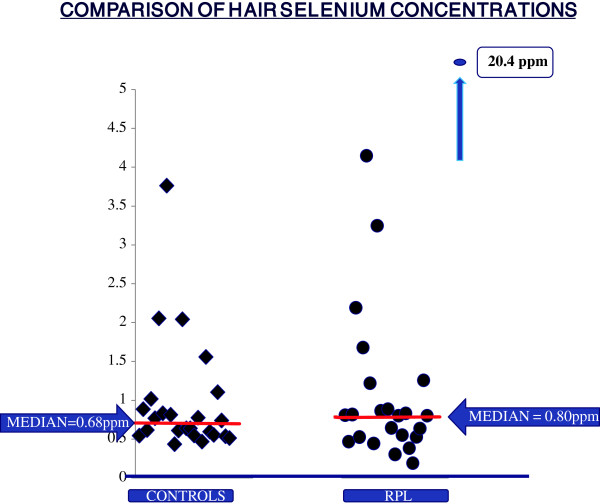
BACKGROUND: Approximately 1% of all couples trying to conceive will suffer from recurrent pregnancy loss (RPL). Nutritional deficiencies have been postulated as a possible cause of RPL and in particular, selenium deficiency has been associated with reproductive failure in animal studies and more recently, in some human studies. This study was undertaken to assess the maternal hair selenium levels in women with RPL without an identified cause and to compare these results with those of women with successful reproductive histories. METHODS: Twenty four patients with RPL and twenty four control subjects with at least one successful pregnancy and no pregnancy failures, who were matched for age and ethnicity, were recruited. A questionnaire was completed, which included demographic and social information and a dietary history. Hair samples were collected and analyzed for selenium content by inductively coupled plasma mass spectrometry. RESULTS: The control subjects had a higher mean income and had completed more years of education compared with the RPL patients. There was no significant difference in the intake of selenium rich foods between the 2 groups. The patients, however, consumed significantly more fruit, cheese, potatoes and chocolate than the controls. The median (range) selenium content was 0.80 ppm (0.19-4.15) and 0.68 ppm (0.43-3.76) in patients and controls respectively (Mann Whitney U test 209.5 p = 0.74). CONCLUSIONS: While there were significant differences in the 2 groups with regard to resources, education and diet our results show that hair selenium concentrations and dietary selenium intake, were similar in the two groups. Both groups had low levels of this important element.
Overview
The claims and statistics of this paper haven’t been checked yet.
Free: it reads the open-access text and checks the first 5 claims that cite a source we can check. Create a free account to check every claim.
Integrity signals
Registry
Cites
Statistics
Figures
Verification
Claims the paper makes
The claims and statistics of this paper haven’t been checked yet.
Free: it reads the open-access text and checks the first 5 claims that cite a source we can check. Create a free account to check every claim.
Claims other papers make about this one
Each is checked against this paper’s own text: does it say what the citing paper says it does?
The cited source says what the claim attributes to it.
In the citing paper
“A number of small studies have assessed dietary variables such as selenium, 33,34 vitamin D 35 and vitamin B12 36 specifically in the population with recurrent miscarriage, although no definitive or clinically altering conclusions can be drawn.”
From Recurrent MiscarriageGreen‐top Guideline No. 17 (2023) · cites this paper as [34]
Self-check
Percentages, sums and reported differences re-computed from the paper’s own numbers.
The self-check needs the paper’s full text.
Citations
Cites
Incidence of early loss of pregnancy
Wilcox, A. J., Weinberg, C. R., O'Connor, J. F., Baird, D. D., Schlatterer, J. P., Canfield, R. E., Armstrong, E. G., & Nisula, B. C. (1988) · New England Journal of Medicine · doi:10.1056/nejm198807283190401 · Cited by 2,354
Rai, R., & Regan, L. (2006) · The Lancet · doi:10.1016/s0140-6736(06)69204-0 · Cited by 1,227
Selenium in reproductive health
Mistry, H. D., Broughton Pipkin, F., Redman, C. W. G., & Poston, L. (2012) · American Journal of Obstetrics and Gynecology · doi:10.1016/j.ajog.2011.07.034 · Cited by 329 · cited 1×
“An expert review article suggests that reduced antioxidant protection may contribute to early pregnancy loss [13].”
BackgroundBoumba, V. A., Ziavrou, K. S., & Vougiouklakis, T. (2006) · International Journal of Toxicology · doi:10.1080/10915810600683028 · Cited by 221 · cited 1×
“Forensic science has utilized hair for analysis of chronic drug exposure, pesticide exposure and post mortem toxicology and these methods are validated and reproducible [17-21].”
MethodSelenium Content of a Range of UK Foods
Barclay, M. N. I., MacPherson, A., & Dixon, J. (1995) · Journal of Food Composition and Analysis · doi:10.1006/jfca.1995.1025 · Cited by 163 · cited 1×
“Other sources of selenium include bread, cereals, meat, poultry and fish [12].”
BackgroundAnalytical pitfalls in hair testing
Mußhoff, F., & Madea, B. (2007) · Analytical and Bioanalytical Chemistry · doi:10.1007/s00216-007-1288-x · Cited by 144 · cited 2×
“As hair selenium levels may be affected by use of hair products, such as certain anti-dandruff shampoos and henna [19,21], we reviewed all products used by subjects in the preceding 6 months.”
MethodSelenium deficiency and miscarriage: a possible link?
Barrington, J. W., Lindsay, P., James, D., Smith, S., & Roberts, A. (1996) · BJOG: An International Journal of Obstetrics & Gynaecology · doi:10.1111/j.1471-0528.1996.tb09663.x · Cited by 141 · cited 1×
“Micronutrient deficiencies associated with malnutrition, such as selenium, copper, zinc and iron have been implicated in miscarriage and selenium deficiency has been identified as a possible cause for RPL in several studies [6-10].”
BackgroundMassafra, C., Gioia, D., De Felice, C., Picciolini, E., De Leo, V, M, B., & Bernabei, A. (2000) · Journal of Endocrinology · doi:10.1677/joe.0.1670447 · Cited by 130 · cited 1×
“therefore excluded any women who had used hormonal contraception over the preceding 6 months [22,23].”
BackgroundThe selenium status of women with a history of recurrent miscarriage
Al‐Kunani, A. S., Knight, R., Haswell, S. J., Thompson, J. W., & Lindow, S. W. (2001) · BJOG: An International Journal of Obstetrics & Gynaecology · doi:10.1111/j.1471-0528.2001.00253.x · Cited by 103 · cited 4×
“and this study were analysed in the same laboratory at the University of Hull, and in comparison with the UK (Al Kunani [10]) results, women in South Africa had comparatively higher selenium concentrations, possibly suggesting higher selenium in South African soils and foods.”
BackgroundResultInfluentialSelf-citationTsatsakis, A. M., Tzatzarakis, M. N., & Tutudaki, M. (2008) · Forensic Science International · doi:10.1016/j.forsciint.2007.07.017 · Cited by 78 · cited 1×
“Forensic science has utilized hair for analysis of chronic drug exposure, pesticide exposure and post mortem toxicology and these methods are validated and reproducible [17-21].”
Methodvan der Spuy, Z. M. (1985) · Clinics in Obstetrics and Gynaecology · doi:10.1016/s0306-3356(21)00137-0 · Cited by 75
Blood selenium and glutathione peroxidases in miscarriage
Zachara, B., Dobrzyński, W., Trafikowska, U., & Szymański, W. (2001) · BJOG An International Journal of Obstetrics & Gynaecology · doi:10.1111/j.1471-0528.2001.00030.x · Cited by 63 · cited 1×
“with RPL have suggested that selenium deficiency may contribute to RPL [10,14-16].”
BackgroundKatz, V. L., & Kuller, J. A. (1994) · American Journal of Perinatology · doi:10.1055/s-2007-994603 · Cited by 58
Selenium and recurrent miscarriage
Jay, P. (1997) · Journal of Obstetrics and Gynaecology · doi:10.1080/01443619750113870 · Cited by 48
Role of red cell selenium in recurrent pregnancy loss
Kumar, K. S. D., Kumar, A., Prakash, S., Swamy, K., Jagadeesan, V., & Jyothy, A. (2002) · Journal of Obstetrics and Gynaecology · doi:10.1080/01443610120113373 · Cited by 36
Association of reduced selenium status in the aetiology of recurrent miscarriage
Nicoll, A., Norman, J. E., Macpherson, A. M., & Acharya, U. (1999) · BJOG An International Journal of Obstetrics & Gynaecology · doi:10.1111/j.1471-0528.1999.tb08146.x · Cited by 34 · cited 1×
“with RPL have suggested that selenium deficiency may contribute to RPL [10,14-16].”
BackgroundRecurrent spontaneous abortion and selenium deficiency
Koçak, İ., Aksoy, E., & Üstün, C. (1999) · International Journal of Gynecology & Obstetrics · doi:10.1016/s0020-7292(99)00022-3 · Cited by 33 · cited 1×
“Micronutrient deficiencies associated with malnutrition, such as selenium, copper, zinc and iron have been implicated in miscarriage and selenium deficiency has been identified as a possible cause for RPL in several studies [6-10].”
BackgroundArsenic and Selenium in Human Hair: A Comparison of Five Countries With and Without Arsenicosis
Spallholz, J. E., Boylan, L. M., Palace, V. P., Chen, J., Smith, L., Rahman, M. M., & Robertson, J. D. (2005) · Biological Trace Element Research · doi:10.1385/bter:106:2:133 · Cited by 33 · cited 2×
“As hair selenium levels may be affected by use of hair products, such as certain anti-dandruff shampoos and henna [19,21], we reviewed all products used by subjects in the preceding 6 months.”
MethodAntioxidant erythrocyte enzyme activities during oral contraception
Massafra, C., Buonocore, G., Berni, S., Gioia, D., Giuliani, A. A., & Vezzosi, P. (1993) · Contraception · doi:10.1016/0010-7824(93)90026-4 · Cited by 30
Muñoz, C., Carson, A. F., McCoy, M. A., Dawson, L. E. R., Irwin, D., Gordon, A. W., & Kilpatrick, D. J. (2009) · Veterinary Record · doi:10.1136/vr.164.9.265 · Cited by 24 · cited 1×
“Micronutrient deficiencies associated with malnutrition, such as selenium, copper, zinc and iron have been implicated in miscarriage and selenium deficiency has been identified as a possible cause for RPL in several studies [6-10].”
BackgroundGeographical distribution of the selenium status of herbivores in South Africa
van Ryssen, J. B. J. (2001) · South African Journal of Animal Science · doi:10.4314/sajas.v31i1.3840 · Cited by 21 · cited 1×
“Soil selenium levels differ between countries and local studies in herbivores have demonstrated that the selenium concentration in South African soils is low [11].”
BackgroundEjezie, F. E., Okaka, A. N. C., & Nwagha, U. I. (2012) · PubMed · Cited by 12
Hair analysis differentiates chronic from acute carbamazepine intoxication
Mantzouranis, E. C., Bertsias, G. K., Pallis, E. G., & Tsatsakis, A. M. (2004) · Pediatric Neurology · doi:10.1016/j.pediatrneurol.2003.12.017 · Cited by 9 · cited 1×
“Forensic science has utilized hair for analysis of chronic drug exposure, pesticide exposure and post mortem toxicology and these methods are validated and reproducible [17-21].”
Method
Research works printed but not linked: 1
- Pattinson RC Snyman LC Kruger TF, Botha MH Miscarriage Clinical Gynaecology 2007 3 Cape Town: Juta 188 197
Cited by
Recurrent MiscarriageGreen‐top Guideline No. 17
Regan, L., Rai, R., Saravelos, S., Li, T., & the Royal College of Obstetricians and Gynaecologists (2023) · BJOG: An International Journal of Obstetrics & Gynaecology · doi:10.1111/1471-0528.17515 · Cited by 158
Definition and Multiple Factors of Recurrent Spontaneous Abortion
La, X., Wang, W., Zhang, M., & Li, L. (2021) · Advances in experimental medicine and biology · doi:10.1007/978-981-33-4187-6_11 · Cited by 120
The role of oxidative stress in patients with recurrent pregnancy loss: a review
Zejnullahu, V. A., Zejnullahu, V. A., & Kosumi, E. (2021) · Reproductive Health · doi:10.1186/s12978-021-01257-x · Cited by 99
“The authors concluded that selenium supplementation in RPL cannot be recommended since the importance of selenium deficiency in recurrent miscarriage has still not been determined [71].”
BackgroundLei, R., Jiang, N., Zhang, Q., Hu, S., Dennis, B. S., He, S., & Guo, X. (2015) · Biological Trace Element Research · doi:10.1007/s12011-015-0495-0 · Cited by 73
Steller, J. G., Alberts, J. R., & Ronca, A. E. (2018) · International Journal of Molecular Sciences · doi:10.3390/ijms19123729 · Cited by 74
Metadata
- Authors
- Thomas, V. V., Knight, R., Haswell, S. J., Lindow, S. W., & van der Spuy, Z. M.
- Affiliations
- University of Cape Town (ZA)
- University of Hull (GB)
- Corresponding author
- Thomas, Viju V
- Venue
- BMC Women's Health
- Published
- 2013-10-22
- Volume
- 13
- Issue
- 1
- Pages
- 40-40
- ISSN
- 1472-6874 (ISSN-L)
- PMC
- PMC4015529
- OpenAlex
- W2049032645
- Cited by
- 19
- References
- 23
- Citations by year
- 2026: 2 · 2024: 1 · 2023: 4 · 2022: 2 · 2021: 2 · 2020: 1 · 2018: 1 · 2017: 1 · 2016: 1 · 2015: 3 · 2014: 1
- FWCI
- 1.54
- Type
- journal article
- Language
- en
- Open access
- gold
- doi.org
- Licence
- cc-by
- creativecommons.org/licenses/by/2.0 (tdm)
- Locations
- BMC Women s Health (publishedVersion, cc-by)
- Europe PMC (PubMed Central) (publishedVersion, cc-by)
- PubMed Central (publishedVersion, cc-by)
- PubMed (publishedVersion)
- Open University of Cape Town (University of Cape Town) (submittedVersion, cc-by)
- Funders
- University of Cape Town
- Topics
- Health Sciences › Nursing › Nutrition and Dietetics › Selenium in Biological Systems
- Life Sciences › Immunology and Microbiology › Immunology › Reproductive System and Pregnancy
- Health Sciences › Nursing › Nutrition and Dietetics › Trace Elements in Health
- Keywords
- recurrent pregnancy loss, hair selenium, selenium deficiency, maternal nutritional status, dietary selenium intake, nutritional deficiency, socioeconomic factors
- MeSH terms
- Abortion, Habitual, Adult, Diet, Female, Hair, Humans, Pregnancy, Surveys and Questionnaires, Selenium, South Africa, Mass Spectrometry, Trace Elements, Nutrition Assessment, Case-Control Studies
About these checks
Registry, retraction, Cites and statistics results are computed, not judged, with one exception: a printed reference that no index lists is read once by a model before it counts as a citation error. Claims are extracted by a model and kept only when their quote appears verbatim in the text; each cited source is then checked, with a model’s help, for whether it says what the claim relies on. Those verdicts can be wrong — read the claim’s quote and the cited source before relying on one.
Statistics and arithmetic are recomputed, not judged.
Confidence bands are shown only for fields calibrated on our annotated test set. None is calibrated yet, so no band is shown.
What counts as a claim ›How we measure confidence ›How we check this ›
Are you an author, or do you see a problem with this page? Request a review
Data sources
Bibliographic data: Semantic Scholar, OpenAlex, Crossref.
Contains information from the Semantic Scholar Academic Graph Datasets, made available under the ODC Attribution License (ODC-BY 1.0).
Semantic Scholar’s data is described in: Kinney, R., et al. (2023). The Semantic Scholar Open Data Platform. arXiv:2301.10140.
