

Effect of exercise therapy on lipid profile and oxidative stress indicators in patients with type 2 diabetes
Open accessThe DOI matches its Crossref record; 81 of the 81 references it cites were found in a registry or an index.
Abstract
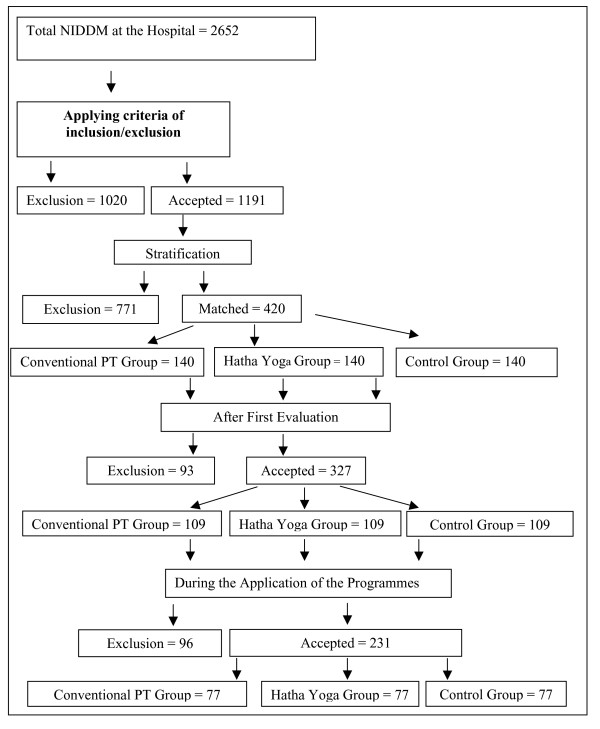
BACKGROUND: Yoga has been shown to be a simple and economical therapeutic modality that may be considered as a beneficial adjuvant for type 2 diabetes mellitus. This study investigated the impact of Hatha yoga and conventional physical training (PT) exercise regimens on biochemical, oxidative stress indicators and oxidant status in patients with type 2 diabetes. METHODS: This prospective randomized study consisted of 77 type 2 diabetic patients in the Hatha yoga exercise group that were matched with a similar number of type 2 diabetic patients in the conventional PT exercise and control groups. Biochemical parameters such as fasting blood glucose (FBG), serum total cholesterol (TC), triglycerides, low-density lipoprotein (LDL), very low-density lipoproteins (VLDL) and high-density lipoprotein (HDL) were determined at baseline and at two consecutive three monthly intervals. The oxidative stress indicators (malondialdehyde - MDA, protein oxidation - POX, phospholipase A2 - PLA2 activity) and oxidative status [superoxide dismutase (SOD) and catalase activities] were measured. RESULTS: The concentrations of FBG in the Hatha yoga and conventional PT exercise groups after six months decreased by 29.48% and 27.43% respectively (P < 0.0001) and there was a significant reduction in serum TC in both groups (P < 0.0001). The concentrations of VLDL in the managed groups after six months differed significantly from baseline values (P = 0.036). Lipid peroxidation as indicated by MDA significantly decreased by 19.9% and 18.1% in the Hatha yoga and conventional PT exercise groups respectively (P < 0.0001); whilst the activity of SOD significantly increased by 24.08% and 20.18% respectively (P = 0.031). There was no significant difference in the baseline and 6 months activities of PLA2 and catalase after six months although the latter increased by 13.68% and 13.19% in the Hatha yoga and conventional PT exercise groups respectively (P = 0.144). CONCLUSION: The study demonstrate the efficacy of Hatha yoga exercise on fasting blood glucose, lipid profile, oxidative stress markers and antioxidant status in patients with type 2 diabetes and suggest that Hatha yoga exercise and conventional PT exercise may have therapeutic preventative and protective effects on diabetes mellitus by decreasing oxidative stress and improving antioxidant status. TRIAL REGISTRATION: Australian New Zealand Clinical Trials Registry (ANZCTR): ACTRN12608000217303.
Overview
The claims and statistics of this paper haven’t been checked yet.
Free: it reads the open-access text and checks the first 5 claims that cite a source we can check. Create a free account to check every claim.
Integrity signals
Registry
Cites
Statistics
Figures
Verification
Claims the paper makes
The claims and statistics of this paper haven’t been checked yet.
Free: it reads the open-access text and checks the first 5 claims that cite a source we can check. Create a free account to check every claim.
Claims other papers make about this one
Each is checked against this paper’s own text: does it say what the citing paper says it does?
The cited source doesn’t support the claim as written.
In the citing paper
“One larger RCT found decreases in total cholesterol with both aerobic and yoga training but no changes in HDL cholesterol or LDL cholesterol ( 98 ), although most have found no effect of any form of exercise training on lipids ( 6 , 175 , 178 , 238 , 258 , 267 ).”
From Exercise and Type 2 Diabetes (2010) · cites this paper as [98]
Checked by a reasoning model — may be wrong.
Experimental — accuracy not yet measuredThe source backs part of the claim, not all of it — or backs it for a different population, condition or comparison.
In the citing paper
“Milder forms of PA, such as yoga and tai chi, may benefit control of BG ( 98 , 117 , 269 , 286 , 291 ), although their inclusion is not supported conclusively at this time.”
From Exercise and Type 2 Diabetes (2010) · cites this paper as [98]
Experimental — accuracy not yet measuredThe cited source says what the claim attributes to it.
In the citing paper
“One study suggested that yoga's benefits on fasting BG, lipids, oxidative stress markers, and antioxidant status are at least equivalent to more conventional forms of PA ( 98 ).”
From Exercise and Type 2 Diabetes (2010) · cites this paper as [98]
Self-check
Percentages, sums and reported differences re-computed from the paper’s own numbers.
The self-check needs the paper’s full text.
Citations
Cites
Bradford, M. M. (1976) · Analytical Biochemistry · doi:10.1016/0003-2697(76)90527-3 · Cited by 255,302
Free radicals in biology and medicine
(1991) · General Pharmacology: The Vascular System · doi:10.1016/0306-3623(91)90478-o · Cited by 17,178
MARKLUND, S., & MARKLUND, G. (1974) · European Journal of Biochemistry · doi:10.1111/j.1432-1033.1974.tb03714.x · Cited by 10,354
(2014) · Medical Entomology and Zoology · Cited by 9,400
Free Radicals in Biology and Medicine
Halliwell, B., & Gutteridge, J. M. C. (2015) · doi:10.1093/acprof:oso/9780198717478.001.0001 · Cited by 8,990
A SPECTROPHOTOMETRIC METHOD FOR MEASURING THE BREAKDOWN OF HYDROGEN PEROXIDE BY CATALASE
Beers, R. F., & Sizer, I. W. (1952) · Journal of Biological Chemistry · doi:10.1016/s0021-9258(19)50881-x · Cited by 6,761
Perceived exertion as an indicator of somatic stress
Borg, G. (1970) · Journal of Rehabilitation Medicine · doi:10.2340/1650197719702239298 · Cited by 4,707
Borg's Perceived Exertion and Pain Scales
Borg, G. A. V. (1998) · Cited by 3,366
Improving the Quality of Reporting of Randomized Controlled Trials: The CONSORT Statement
Begg, C. (1996) · JAMA · doi:10.1001/jama.1996.03540080059030 · Cited by 3,127
Borg's Perceived Exertion and Pain Scales
Heath, E. M. (1998) · Medicine& Science in Sports & Exercise · doi:10.1097/00005768-199809000-00018 · Cited by 3,037
Research works printed but not linked: 1
- Karambelkar PV Deshpande RR Bhole MV Oxygen consumption during ujjayi Pranayama Yoga Mimamsa 1982 21 7 13
Cited by
Items 301–328 of 328
Chan, E., Seto, S. W., Yeung, T. M. A., & Chan, G. H. H. (2018) · IGI Global eBooks · doi:10.4018/978-1-5225-7039-4.ch028
LINKAGE OF YOGA TO OXIDATIVE STRESS IN PATIENTS WITH DIABETES MELLITUS, TYPE 2
Khatri, D., & Tyravska, Y. (2022) · InterConf · doi:10.51582/interconf.19-20.07.2022.022
LIPID PROFILE ABNORMALITIES IN NIDDM WOMEN OF NORTH WEST INDIA: A CASE-CONTROL STUDY
Kaur, N. (2022) · Zenodo (CERN European Organization for Nuclear Research) · doi:10.5281/zenodo.7116713
Effects of Different Types of Meditation on Diastolic Blood Pressure
Panbilnathan, A. (2022) · Epidemiology International · doi:10.24321/2455.7048.202203
Metabolic Response of Diabetic Patients with Obesity and No Obesity during Bruce Treadmill Test
Διαρεμέ, Μ., Kardari, A. P., Trapali, M., & Karkalousos, P. L. (2022) · Journal of Diabetes Mellitus · doi:10.4236/jdm.2022.124016
Clinical relevance of oxidative stress biomarkers in cardiovascular prevention
Pimentel, M. V. D. M. B. (2022) · Digital Library of Theses and Dissertations (Universidade de São Paulo) · doi:10.11606/d.9.2022.tde-15022023-135127
Audi, D., Nutels, G. S., Cabrini, M. L., Priedols, A. M. A., & Audi, M. (2023) · International Journal of Health Science · doi:10.22533/at.ed.1593652329083
CLINICAL STUDY TO EVALUATE THE EFFICACY OF KAPAL BHATI AND TRIKONASANA IN STHOULYA (OBESITY)
Buldak, O., Mishra, P. K., & Sharma, B. (2024) · International Ayurvedic Medical Journal · doi:10.46607/iamj0712022024
Efficacy of Different Yogic Practices on Blood Sugar Random Among the Working Men of North Tripura
Trained Graduate Teacher (P & HE) Kendriya Vidyalaya, K., Saini, M., & Das, P. K. (2024) · Journal of Environmental Pharmaceutical and Sustainability Science · doi:10.52756/jepss.2024.v01.i01.005
Effect of yoga in diabetic patients with hypertension: An observational study
Dash, S., Thakur, A. K., & Nanda, R. (2024) · National Journal of Physiology Pharmacy and Pharmacology · doi:10.5455/njppp.2024.v14.i11.27
Rahman, F., & Ferdousi, S. (2025) · Journal of Bangladesh Society of Physiologist · doi:10.3329/jbsp.v20i1.84054
Pramanik, P., & Chatterjee, S. (2025) · Indian Journal of Community Medicine · doi:10.4103/ijcm.ijcm_640_24
Narnolia, P. K., Binawara, B. K., Mehra, M., & Vyas, P. (2024) · INTERNATIONAL JOURNAL OF TOXICOLOGICAL AND PHARMACOLOGICAL RESEARCH · doi:10.5281/zenodo.14169948
EFFECTS OF YOGA ON BLOOD GLUCOSE, INSULIN AND C-PEPTIDE LEVELS IN PATIENTS OF DIABETES MELLITUS
Shrivastava, N., Verma, S., & Tikariha, B. P. (2014) · Zenodo (CERN European Organization for Nuclear Research) · doi:10.5281/zenodo.4481861
Dahiri Khattabi, B. (2024) · Deposito de Investigacion Universidad de Sevilla (University of Seville)
Phengphan, S. (2018) · NORA - Norwegian Open Research Archives
Biomarkers of oxidative stress in newly diagnosed Tunisian type 2 diabetes mellitus
Khlifi, S., Hmad, H. B., Jemaa, H. B., Abaza, H., Jamoussi, H., & Aouidet, A. (2021) · International Journal of Multidisciplinary and Current Research · doi:10.14741/ijmcr/v.9.3.7
Handouzi, H. R. É. (2022) · Dépôt Institutionnel de lUniversité de Tlemcen
Rohina, K., Raj, K., & Prakash, G. S. (2026) · International Journal of Zoological Investigations · doi:10.33745/ijzi.2026.v12ispl2.005
Mirzaei, R. M., Malekshahi, H., & Vahdatpoor, H. (2025) · Medical Laboratory Journal · doi:10.66224/mlj.19.2.25
Shawar, H. (2026) · International Journal of Medical Sciences And Clinical Research · doi:10.37547/ijmscr/volume06issue10-01
Traditional Indian therapies in type 2 diabetes: strengthening the scientific evidence base
Chattopadhyay, K. (2024) · Nottingham ePrints (University of Nottingham)
Gnanaraj, M. A. (2019) · International Journal of Physical Education & Sports Sciences
Thakur, K., Das, M., Sengupta, R., & Mukhopadhyay, K. (2024) · African Journal of Biomedical Research · doi:10.69980/ajbr.v27i3.9492
Mizuno, J. (2010) · Americanae (AECID Library)
Metadata
- Authors
- Gordon, L. A., Morrison, E. Y., McGrowder, D. A., Young, R., Fraser, Y. T. P., Zamora, E. M., Alexander-Lindo, R. L., & Irving, R. R.
- Affiliations
- University of the West Indies (JM)
- Corresponding author
- Gordon, Lorenzo A
- Morrison, Errol Y
- McGrowder, Donovan A
- Young, Ronald
- Zamora, Eslaen Martorell
- Alexander-Lindo, Ruby L
- Irving, Rachael R
- Venue
- BMC Complementary and Alternative Medicine
- Published
- 2008-05-13
- Volume
- 8
- Issue
- 1
- Pages
- 21-21
- ISSN
- 1472-6882 (ISSN-L)
- PMC
- PMC2390515
- OpenAlex
- W1993492653
- Cited by
- 275
- References
- 81
- Citations by year
- 2025: 10 · 2024: 11 · 2023: 14 · 2022: 20 · 2021: 15 · 2020: 17 · 2019: 11 · 2018: 18 · 2017: 20 · 2016: 17 · 2015: 16 · 2014: 24 · 2013: 26 · 2012: 18
- FWCI
- 8.35
- Type
- journal article
- Language
- en
- Open access
- gold
- doi.org
- Licence
- cc-by
- creativecommons.org/licenses/by/2.0 (tdm)
- Locations
- BMC Complementary and Alternative Medicine (publishedVersion, cc-by)
- PubMed Central (publishedVersion, cc-by)
- PubMed (publishedVersion)
- DOAJ (DOAJ: Directory of Open Access Journals) (submittedVersion)
- Topics
- Health Sciences › Medicine › Public Health, Environmental and Occupational Health › Physical Activity and Health
- Health Sciences › Medicine › Endocrinology, Diabetes and Metabolism › Diabetes, Cardiovascular Risks, and Lipoproteins
- Health Sciences › Medicine › Physiology (medical) › Exercise and Physiological Responses
- Keywords
- type 2 diabetes, hatha yoga, exercise training, exercise therapy, lipid profile, oxidative stress, antioxidant status, malondialdehyde, lipid peroxidation, superoxide dismutase, catalase, fasting blood glucose, total cholesterol, triglycerides, protein oxidation, phospholipase A2, adjuvant therapy, diabetes prevention and management
- MeSH terms
- Adult, Aged, Diabetes Mellitus, Type 2, Exercise Therapy, Female, Glutathione Peroxidase, Glycated Hemoglobin, Humans, Lipids, Cholesterol, HDL, Cholesterol, LDL, Male, Malondialdehyde, Middle Aged, Prospective Studies, Superoxide Dismutase, Triglycerides, Yoga, Lipid Peroxidation, Cholesterol, VLDL, Biomarkers, Treatment Outcome, Oxidative Stress
About these checks
Registry, retraction, Cites and statistics results are computed, not judged, with one exception: a printed reference that no index lists is read once by a model before it counts as a citation error. Claims are extracted by a model and kept only when their quote appears verbatim in the text; each cited source is then checked, with a model’s help, for whether it says what the claim relies on. Those verdicts can be wrong — read the claim’s quote and the cited source before relying on one.
Statistics and arithmetic are recomputed, not judged.
Confidence bands are shown only for fields calibrated on our annotated test set. None is calibrated yet, so no band is shown.
What counts as a claim ›How we measure confidence ›How we check this ›
Are you an author, or do you see a problem with this page? Request a review
Data sources
Bibliographic data: Semantic Scholar, OpenAlex, Crossref.
Contains information from the Semantic Scholar Academic Graph Datasets, made available under the ODC Attribution License (ODC-BY 1.0).
Semantic Scholar’s data is described in: Kinney, R., et al. (2023). The Semantic Scholar Open Data Platform. arXiv:2301.10140.
