

The DOI matches its Crossref record; 26 of the 30 references it cites were found in a registry or an index.
Applying a framework for assessing the health system challenges to scaling up mHealth in South Africa
Open accessAbstract
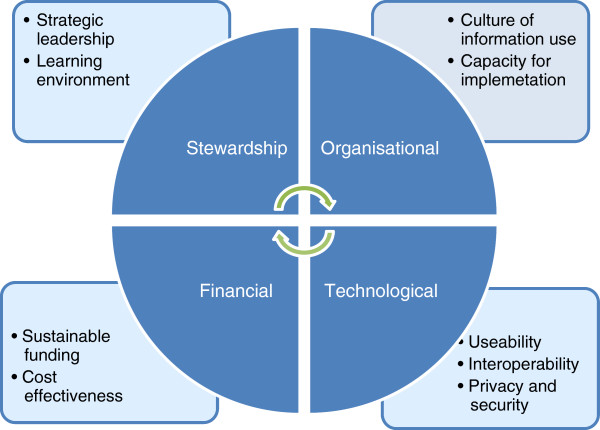
BACKGROUND: Mobile phone technology has demonstrated the potential to improve health service delivery, but there is little guidance to inform decisions about acquiring and implementing mHealth technology at scale in health systems. Using the case of community-based health services (CBS) in South Africa, we apply a framework to appraise the opportunities and challenges to effective implementation of mHealth at scale in health systems. METHODS: A qualitative study reviewed the benefits and challenges of mHealth in community-based services in South Africa, through a combination of key informant interviews, site visits to local projects and document reviews. Using a framework adapted from three approaches to reviewing sustainable information and communication technology (ICT), the lessons from local experience and elsewhere formed the basis of a wider consideration of scale up challenges in South Africa. RESULTS: Four key system dimensions were identified and assessed: government stewardship and the organisational, technological and financial systems. In South Africa, the opportunities for successful implementation of mHealth include the high prevalence of mobile phones, a supportive policy environment for eHealth, successful use of mHealth for CBS in a number of projects and a well-developed ICT industry. However there are weaknesses in other key health systems areas such as organisational culture and capacity for using health information for management, and the poor availability and use of ICT in primary health care. The technological challenges include the complexity of ensuring interoperability and integration of information systems and securing privacy of information. Finally, there are the challenges of sustainable financing required for large scale use of mobile phone technology in resource limited settings. CONCLUSION: Against a background of a health system with a weak ICT environment and limited implementation capacity, it remains uncertain that the potential benefits of mHealth for CBS would be retained with immediate large-scale implementation. Applying a health systems framework facilitated a systematic appraisal of potential challenges to scaling up mHealth for CBS in South Africa and may be useful for policy and practice decision-making in other low- and middle-income settings.
Overview
The claims and statistics of this paper haven’t been checked yet.
Run the check — free, no account needed. It reads the open-access text and checks the sources it cites.
Integrity signals
Registry
Cites
Statistics
Figures
Verification
Claims the paper makes
The claims and statistics of this paper haven’t been checked yet.
Run the check — free, no account needed. It reads the open-access text and checks the sources it cites.
Claims other papers make about this one
Each is checked against this paper’s own text: does it say what the citing paper says it does?
The source backs part of the claim, not all of it — or backs it for a different population, condition or comparison.
In the citing paper
“First, our findings suggest that the successful integration of mobile applications into service delivery may necessitate targeted changes in human resources available at certain health facilities [62].”
From Qualitative Assessment of the Feasibility, Usability, and Acceptability of a Mobile Client Data App for Community-Based Maternal, Neonatal, and Child Care in Rural Ghana (2016) · cites this paper as [62]
Experimental — accuracy not yet measured
Self-check
Percentages, sums and reported differences re-computed from the paper’s own numbers.
The self-check needs the paper’s full text.
Citations
Cites
Chaudhry, B., Wang, J., Wu, S., Maglione, M., Mojica, W., Roth, E., Morton, S. C., & Shekelle, P. G. (2006) · Annals of Internal Medicine · doi:10.7326/0003-4819-144-10-200605160-00125 · Cited by 3,159
The Impact of eHealth on the Quality and Safety of Health Care: A Systematic Overview
Black, A. D., Car, J., Pagliari, C., Anandan, C., Cresswell, K., Bokun, T., McKinstry, B., Procter, R., Majeed, A., & Sheikh, A. (2011) · PLoS Medicine · doi:10.1371/journal.pmed.1000387 · Cited by 1,442
The health and health system of South Africa: Historical roots of current public health challenges
Coovadia, H., Jewkes, R., Barron, P., Sanders, D., & McIntyre, D. (2009) · The Lancet · doi:10.1016/s0140-6736(09)60951-x · Cited by 1,413
How can we achieve and maintain high-quality performance of health workers in low-resource settings?
Rowe, A. K., de Savigny, D., Lanata, C. F., & Victora, C. G. (2005) · The Lancet · doi:10.1016/s0140-6736(05)67028-6 · Cited by 1,048
The use of mobile phones as a data collection tool: A report from a household survey in South Africa
Tomlinson, M., Solomon, W., Singh, Y., Doherty, T., Chopra, M., Ijumba, P., Tsai, A. C., & Jackson, D. (2009) · BMC Medical Informatics and Decision Making · doi:10.1186/1472-6947-9-51 · Cited by 340
Achieving the health Millennium Development Goals for South Africa: challenges and priorities
Chopra, M., Lawn, J. E., Sanders, D. M., Barron, P., Karim, S. S. A., Bradshaw, D., Jewkes, R. K., Karim, Q. A., Flisher, A. J., Mayosi, B. M., et al. (2009) · The Lancet · doi:10.1016/s0140-6736(09)61122-3 · Cited by 312
Information Technology in Context: Studies from the Perspective of Developing Countries
(2017) · Routledge eBooks · doi:10.4324/9781315187785 · Cited by 236
Information and communications technology for future health systems in developing countries
Lucas, H. (2008) · Social Science & Medicine · doi:10.1016/j.socscimed.2008.01.033 · Cited by 227
Electronic Health Records’ Limited Successes Suggest More Targeted Uses
DesRoches, C. M., Campbell, E. G., Vogeli, C., Zheng, J., Rao, S. R., Shields, A. E., Donelan, K., Rosenbaum, S., Bristol, S. J., & Jha, A. K. (2010) · Health Affairs · doi:10.1377/hlthaff.2009.1086 · Cited by 210
e-Health Readiness Assessment Tools for Healthcare Institutions in Developing Countries
Khoja, S., Scott, R. E., Casebeer, A. L., Mohsin, M., Ishaq, A. F. M., & Gilani, S. (2007) · Telemedicine Journal and e-Health · doi:10.1089/tmj.2006.0064 · Cited by 174
Gagnon, M.-P., Légaré, F., Labrecque, M., Frémont, P., Pluye, P., Gagnon, J., Car, J., Pagliari, C., Desmartis, M., Turcot, L., et al. (2009) · Cochrane Database of Systematic Reviews · doi:10.1002/14651858.cd006093.pub2 · Cited by 157
Information Technology for Health in Developing Countries
Bukachi, F., & Pakenham-Walsh, N. M. (2007) · CHEST Journal · doi:10.1378/chest.07-1760 · Cited by 128
GREENHALGH, T., RUSSELL, J., ASHCROFT, R. E., & PARSONS, W. (2011) · Milbank Quarterly · doi:10.1111/j.1468-0009.2011.00642.x · Cited by 119
The challenge of sustainability
Byrne, J., Shen, B., & Li, X. (1996) · Energy Policy · doi:10.1016/0301-4215(96)00011-0 · Cited by 106
Seebregts, C. J., Zwarenstein, M., Mathews, C., Fairall, L. R., Flisher, A. J., Seebregts, C., Mukoma, W., & Klepp, K. (2009) · International Journal of Medical Informatics · doi:10.1016/j.ijmedinf.2008.10.006 · Cited by 100
Chetley, A., Davies, J., Trude, B., McConnell, H. W., Ramirez, R., Shields, T., Drury, P., Kumekawa, J., Louw, J., Fereday, G., et al. (2006) · Cited by 97
Primary health care in SA since 1994 and implications of the new vision for PHC re-engineering
Naledi, T. (2011) · South African Health Review · Cited by 87
Rowe, A. K., Onikpo, F., Lama, M., & Deming, M. S. (2009) · Health Policy and Planning · doi:10.1093/heapol/czp054 · Cited by 78
Wringe, A., Cataldo, F., Stevenson, N., & Fakoya, A. O. (2010) · Health Policy and Planning · doi:10.1093/heapol/czq005 · Cited by 75
Batchelor, S. J., Evangelista, S., Hearn, S., Peirce, M., Sugden, S., & Webb, M. (2003) · World Bank, Washington, DC eBooks · doi:10.1596/14845 · Cited by 61
Tomlinson, M., Doherty, T., Jackson, D. J., Lawn, J. E., Ijumba, P., Colvin, M., Nkonki, L. L., Daviaud, E., Goga, A. E., Sanders, D. M., et al. (2011) · Trials · doi:10.1186/1745-6215-12-236 · Cited by 41
Self-citationEvaluation of use of cellphones to aid compliance with drug therapy for HIV patients
Skinner, D., Rivette, U., & Bloomberg, C. (2007) · AIDS Care · doi:10.1080/09540120701203378 · Cited by 40
ICT Policy Formulation and e-Strategy Development. A Comprehensive Guidebook
Labelle, R. (2005) · Cited by 36
Supporting Home Based Health Care in South African Rural Communities Using USSD Technology
Wouters, B. H., Barjis, J., Maponya, G., Maritz, J., & Mashiri, M. (2009) · Journal of the Association for Information Systems · Cited by 19
A Maturity Model for Telemedicine Implementation
Dyk, L. V., Schutte, C., & Fortuin, J. (2012) · SUNScholar (Stellenbosch University) · Cited by 16
A national audit of home and community-based care (HCBC) organisations in South Africa
Ogunmefun, C., Friedman, I., Mothibe, N., & Mbatha, T. (2011) · AIDS Care · doi:10.1080/09540121.2011.630430 · Cited by 2
Research works printed but not linked: 19
- World Health Organization: Legal frameworks for eHealth. 2012, WHO, Geneva
- World Health Organization: mHealth: new horizons for health through mobile technologies: second global survey on eHealth. 2011, WHO, Geneva
- The Rockefeller Foundation: From Silos to Systems: An Overview of eHealth’s Transformative Power. 2010, Rockefeller Foundation, New York
- Mechael P, Batavia H, Kaonga N, Searle S, Kwan A, Goldberger A, Fu L, Ossman J: Barriers and Gaps Affecting mHealth in Low and Middle Income Countries: Policy White Paper. 2010, Center for Global Health and Economic Development Earth Institute, Columbia University, New York
- Mars M, Seebregts C: Country Case Study for eHealth: South Africa. 2008, Rockefeller Foundation, New York
- United Nations Development Programme: Mobile Technologies and Empowerment: Enhancing human development through participation and innovation. 2012, UNDP, Geneva
- de Tolly K, Nembaware V, Skinner D: Encouraging HIV testing through SMS: Can it work, and do content and dosage impact?. 2011, South African AIDS Conference, Durban, South Africa
- National Department of Health: EHealth strategy South Africa. 2012, South African Government, Pretoria
- Vital Wave Consulting: Health Information Systems in Developing Countries: A Landscape Analysis. 2009, Vital Wave Consulting, Palo Alto, California
- Grameen Foundation: Mobile technology for community health in Ghana: What it is and what Grameen Foundation has learned so far. 2011, Columbia University, New York
- Clarke M, Schoeman H, Friedman I: Towards a generic surveillance system to measure the impact of Community Health Worker programmes in South Africa: a comparison of paper-based and mobile/cell phone methods. 2007, Heath System Trust, Durban
- Ogunmefun C, Mothibe N, Friedman I: Electronic Community Care Giver (CCG) Study: A summative evaluation of the implementation of an Electronic Monitoring and Evaluation Solution for CCG programmes. 2010, Health Systems Trust, Durban
- Ogunmefun C, Friedman I, Mothibe N: Electronic Community Care Giver (CCG) Study: An evaluation of the implementation of an Electronic Monitoring and Evaluation Solution for CCG programmes. 2010, Health Systems Trust, Durban
- deTolly K, Technau K, Benjamin P: Helping HIV+ mothers protect their babies: Improving follow-up and HIV testing rates of exposed infants through SMS. 2011, South African AIDS Conference, Durban
- eHealth Strategies: European countries on their journey towards national eHealth infrastructures: eHealth Strategies Report. 2011, European Commission, Belgium
- Statistics South Africa: National Department of Health: Assessment of the health information system in South Africa, 2009: Technical report. 2009, Statistics South Africa, Pretoria
- National Department of Health: District health information system (DHIS) rapid needs assessment. 2012, Government of South Africa, Pretoria
- Lehmann U, Sanders D: Community health workers: What do we know about them?. 2007, WHO: Evidence and Information for Policy, Department of Human Resources for Health, Geneva
- Odendaal A, Mtshizana Y, Lewin S, Hausler H: A formative evaluation of integrated community-based treatment and adherence support models for TB and HIV clients. 2011, Medical Research Council of South Africa and TB Care Association, Cape Town
Cited by
Sorted by citations
Aranda-Jan, C. B., Mohutsiwa-Dibe, N., & Loukanova, S. (2014) · BMC Public Health · doi:10.1186/1471-2458-14-188 · Cited by 644
A Review of Telehealth Service Implementation Frameworks
Van Dyk, L. (2014) · International Journal of Environmental Research and Public Health · doi:10.3390/ijerph110201279 · Cited by 300
Odendaal, W. A., Anstey Watkins, J., Leon, N., Goudge, J., Griffiths, F., Tomlinson, M., & Daniels, K. (2020) · Cochrane Database of Systematic Reviews · doi:10.1002/14651858.cd011942.pub2 · Cited by 289
“Leon 2012 Leon N, Schneider H, Daviaud E. Applying a framework for assessing the health system challenges to scaling up mHealth in South Africa.”
BackgroundSelf-citationAnstey Watkins, J. O. T., Goudge, J., Gómez-Olivé, F. X., & Griffiths, F. (2018) · Social Science & Medicine · doi:10.1016/j.socscimed.2018.01.011 · Cited by 196
“For example, a qualitative study from South Africa suggests that scaling up mHealth in community-based services is limited by the lack of availability of digital communication technology and privacy of information (Leon et al., 2012).”
BackgroundOdendaal, W., Goudge, J., Griffiths, F. E., Tomlinson, M., Leon, N., & Daniels, K. (2015) · Cochrane Database of Systematic Reviews · doi:10.1002/14651858.cd011942 · Cited by 176
Self-citation
Metadata
- Authors
- Leon, N., Schneider, H., & Daviaud, E.
- Affiliations
- South African Medical Research Council (ZA)
- University of the Western Cape (ZA)
- Corresponding author
- Leon, Natalie
- Venue
- BMC Medical Informatics and Decision Making
- Published
- 2012-11-05
- Volume
- 12
- Issue
- 1
- Pages
- 123-123
- ISSN
- 1472-6947 (ISSN-L)
- PMC
- PMC3534437
- OpenAlex
- W2148500499
- Cited by
- 200
- References
- 30
- Citations by year
- 2026: 2 · 2025: 12 · 2024: 7 · 2023: 5 · 2022: 13 · 2021: 22 · 2020: 24 · 2019: 16 · 2018: 25 · 2017: 26 · 2016: 20 · 2015: 15 · 2014: 12 · 2013: 1
- FWCI
- 15.91
- Type
- journal article
- Language
- en
- Open access
- gold
- doi.org
- Licence
- Locations
- BMC Medical Informatics and Decision Making (publishedVersion, cc-by)
- Europe PMC (PubMed Central) (publishedVersion, cc-by)
- PubMed Central (publishedVersion, cc-by)
- PubMed (publishedVersion)
- DOAJ (DOAJ: Directory of Open Access Journals) (submittedVersion)
- UWC Research Repository (University of the Western Cape) (submittedVersion, cc-by)
- University of the Western Cape Electronic Theses and Dissertations Repository (University of the Western Cape) (submittedVersion, other-oa)
- Funders
- Atlantic Philanthropies
- University of Cape Town
- Centers for Disease Control and Prevention
- Medical Research Council
- Topics
- Health Sciences › Health Professions › General Health Professions › Mobile Health and mHealth Applications
- Physical Sciences › Computer Science › Information Systems › ICT in Developing Communities
- Health Sciences › Medicine › Public Health, Environmental and Occupational Health › Telemedicine and Telehealth Implementation
- Keywords
- mobile health, scale-up, community-based care, information and communication technologies, interoperability, health information privacy, sustainable finance, eHealth policy, primary care, implementation capacity, South Africa
- MeSH terms
- Community Health Services, Decision Making, Organizational, Diffusion of Innovation, Humans, Medical Informatics, South Africa, Organizational Culture, Qualitative Research, Cell Phone
About these checks
Registry, retraction, Cites and statistics results are computed, not judged, with one exception: a printed reference that no index lists is read once by a model before it counts as a citation error. Claims are extracted by a model and kept only when their quote appears verbatim in the text; each cited source is then checked, with a model’s help, for whether it says what the claim relies on. Those verdicts can be wrong — read the claim’s quote and the cited source before relying on one.
Statistics and arithmetic are recomputed, not judged.
Confidence bands are shown only for fields calibrated on our annotated test set. None is calibrated yet, so no band is shown.
What counts as a claim ›How we measure confidence ›How we check this ›
Are you an author, or do you see a problem with this page? Request a review
