

The DOI matches its Crossref record; 26 of the 30 references it cites were found in a registry or an index.
Applying a framework for assessing the health system challenges to scaling up mHealth in South Africa
Open accessAbstract
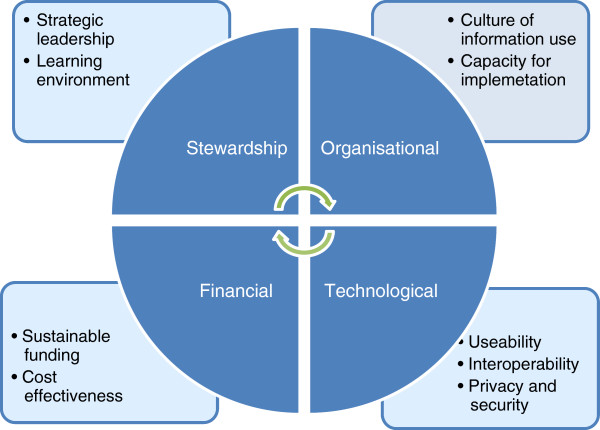
BACKGROUND: Mobile phone technology has demonstrated the potential to improve health service delivery, but there is little guidance to inform decisions about acquiring and implementing mHealth technology at scale in health systems. Using the case of community-based health services (CBS) in South Africa, we apply a framework to appraise the opportunities and challenges to effective implementation of mHealth at scale in health systems. METHODS: A qualitative study reviewed the benefits and challenges of mHealth in community-based services in South Africa, through a combination of key informant interviews, site visits to local projects and document reviews. Using a framework adapted from three approaches to reviewing sustainable information and communication technology (ICT), the lessons from local experience and elsewhere formed the basis of a wider consideration of scale up challenges in South Africa. RESULTS: Four key system dimensions were identified and assessed: government stewardship and the organisational, technological and financial systems. In South Africa, the opportunities for successful implementation of mHealth include the high prevalence of mobile phones, a supportive policy environment for eHealth, successful use of mHealth for CBS in a number of projects and a well-developed ICT industry. However there are weaknesses in other key health systems areas such as organisational culture and capacity for using health information for management, and the poor availability and use of ICT in primary health care. The technological challenges include the complexity of ensuring interoperability and integration of information systems and securing privacy of information. Finally, there are the challenges of sustainable financing required for large scale use of mobile phone technology in resource limited settings. CONCLUSION: Against a background of a health system with a weak ICT environment and limited implementation capacity, it remains uncertain that the potential benefits of mHealth for CBS would be retained with immediate large-scale implementation. Applying a health systems framework facilitated a systematic appraisal of potential challenges to scaling up mHealth for CBS in South Africa and may be useful for policy and practice decision-making in other low- and middle-income settings.
Overview
The claims and statistics of this paper haven’t been checked yet.
Run the check — free, no account needed. It reads the open-access text and checks the sources it cites.
Integrity signals
Registry
Cites
Statistics
Figures
Verification
Claims the paper makes
The claims and statistics of this paper haven’t been checked yet.
Run the check — free, no account needed. It reads the open-access text and checks the sources it cites.
Claims other papers make about this one
Each is checked against this paper’s own text: does it say what the citing paper says it does?
The source backs part of the claim, not all of it — or backs it for a different population, condition or comparison.
In the citing paper
“First, our findings suggest that the successful integration of mobile applications into service delivery may necessitate targeted changes in human resources available at certain health facilities [62].”
From Qualitative Assessment of the Feasibility, Usability, and Acceptability of a Mobile Client Data App for Community-Based Maternal, Neonatal, and Child Care in Rural Ghana (2016) · cites this paper as [62]
Experimental — accuracy not yet measured
Self-check
Percentages, sums and reported differences re-computed from the paper’s own numbers.
The self-check needs the paper’s full text.
Citations
Cites
Chaudhry, B., Wang, J., Wu, S., Maglione, M., Mojica, W., Roth, E., Morton, S. C., & Shekelle, P. G. (2006) · Annals of Internal Medicine · doi:10.7326/0003-4819-144-10-200605160-00125 · Cited by 3,159
The Impact of eHealth on the Quality and Safety of Health Care: A Systematic Overview
Black, A. D., Car, J., Pagliari, C., Anandan, C., Cresswell, K., Bokun, T., McKinstry, B., Procter, R., Majeed, A., & Sheikh, A. (2011) · PLoS Medicine · doi:10.1371/journal.pmed.1000387 · Cited by 1,442
The health and health system of South Africa: Historical roots of current public health challenges
Coovadia, H., Jewkes, R., Barron, P., Sanders, D., & McIntyre, D. (2009) · The Lancet · doi:10.1016/s0140-6736(09)60951-x · Cited by 1,413
How can we achieve and maintain high-quality performance of health workers in low-resource settings?
Rowe, A. K., de Savigny, D., Lanata, C. F., & Victora, C. G. (2005) · The Lancet · doi:10.1016/s0140-6736(05)67028-6 · Cited by 1,048
The use of mobile phones as a data collection tool: A report from a household survey in South Africa
Tomlinson, M., Solomon, W., Singh, Y., Doherty, T., Chopra, M., Ijumba, P., Tsai, A. C., & Jackson, D. (2009) · BMC Medical Informatics and Decision Making · doi:10.1186/1472-6947-9-51 · Cited by 340
Achieving the health Millennium Development Goals for South Africa: challenges and priorities
Chopra, M., Lawn, J. E., Sanders, D. M., Barron, P., Karim, S. S. A., Bradshaw, D., Jewkes, R. K., Karim, Q. A., Flisher, A. J., Mayosi, B. M., et al. (2009) · The Lancet · doi:10.1016/s0140-6736(09)61122-3 · Cited by 312
Information Technology in Context: Studies from the Perspective of Developing Countries
(2017) · Routledge eBooks · doi:10.4324/9781315187785 · Cited by 236
Information and communications technology for future health systems in developing countries
Lucas, H. (2008) · Social Science & Medicine · doi:10.1016/j.socscimed.2008.01.033 · Cited by 227
Electronic Health Records’ Limited Successes Suggest More Targeted Uses
DesRoches, C. M., Campbell, E. G., Vogeli, C., Zheng, J., Rao, S. R., Shields, A. E., Donelan, K., Rosenbaum, S., Bristol, S. J., & Jha, A. K. (2010) · Health Affairs · doi:10.1377/hlthaff.2009.1086 · Cited by 210
e-Health Readiness Assessment Tools for Healthcare Institutions in Developing Countries
Khoja, S., Scott, R. E., Casebeer, A. L., Mohsin, M., Ishaq, A. F. M., & Gilani, S. (2007) · Telemedicine Journal and e-Health · doi:10.1089/tmj.2006.0064 · Cited by 174
Research works printed but not linked: 19
- World Health Organization: Legal frameworks for eHealth. 2012, WHO, Geneva
- World Health Organization: mHealth: new horizons for health through mobile technologies: second global survey on eHealth. 2011, WHO, Geneva
- The Rockefeller Foundation: From Silos to Systems: An Overview of eHealth’s Transformative Power. 2010, Rockefeller Foundation, New York
- Mechael P, Batavia H, Kaonga N, Searle S, Kwan A, Goldberger A, Fu L, Ossman J: Barriers and Gaps Affecting mHealth in Low and Middle Income Countries: Policy White Paper. 2010, Center for Global Health and Economic Development Earth Institute, Columbia University, New York
- Mars M, Seebregts C: Country Case Study for eHealth: South Africa. 2008, Rockefeller Foundation, New York
- United Nations Development Programme: Mobile Technologies and Empowerment: Enhancing human development through participation and innovation. 2012, UNDP, Geneva
- de Tolly K, Nembaware V, Skinner D: Encouraging HIV testing through SMS: Can it work, and do content and dosage impact?. 2011, South African AIDS Conference, Durban, South Africa
- National Department of Health: EHealth strategy South Africa. 2012, South African Government, Pretoria
- Vital Wave Consulting: Health Information Systems in Developing Countries: A Landscape Analysis. 2009, Vital Wave Consulting, Palo Alto, California
- Grameen Foundation: Mobile technology for community health in Ghana: What it is and what Grameen Foundation has learned so far. 2011, Columbia University, New York
- Clarke M, Schoeman H, Friedman I: Towards a generic surveillance system to measure the impact of Community Health Worker programmes in South Africa: a comparison of paper-based and mobile/cell phone methods. 2007, Heath System Trust, Durban
- Ogunmefun C, Mothibe N, Friedman I: Electronic Community Care Giver (CCG) Study: A summative evaluation of the implementation of an Electronic Monitoring and Evaluation Solution for CCG programmes. 2010, Health Systems Trust, Durban
- Ogunmefun C, Friedman I, Mothibe N: Electronic Community Care Giver (CCG) Study: An evaluation of the implementation of an Electronic Monitoring and Evaluation Solution for CCG programmes. 2010, Health Systems Trust, Durban
- deTolly K, Technau K, Benjamin P: Helping HIV+ mothers protect their babies: Improving follow-up and HIV testing rates of exposed infants through SMS. 2011, South African AIDS Conference, Durban
- eHealth Strategies: European countries on their journey towards national eHealth infrastructures: eHealth Strategies Report. 2011, European Commission, Belgium
- Statistics South Africa: National Department of Health: Assessment of the health information system in South Africa, 2009: Technical report. 2009, Statistics South Africa, Pretoria
- National Department of Health: District health information system (DHIS) rapid needs assessment. 2012, Government of South Africa, Pretoria
- Lehmann U, Sanders D: Community health workers: What do we know about them?. 2007, WHO: Evidence and Information for Policy, Department of Human Resources for Health, Geneva
- Odendaal A, Mtshizana Y, Lewin S, Hausler H: A formative evaluation of integrated community-based treatment and adherence support models for TB and HIV clients. 2011, Medical Research Council of South Africa and TB Care Association, Cape Town
Cited by
Sorted by citations
Aranda-Jan, C. B., Mohutsiwa-Dibe, N., & Loukanova, S. (2014) · BMC Public Health · doi:10.1186/1471-2458-14-188 · Cited by 644
A Review of Telehealth Service Implementation Frameworks
Van Dyk, L. (2014) · International Journal of Environmental Research and Public Health · doi:10.3390/ijerph110201279 · Cited by 300
Odendaal, W. A., Anstey Watkins, J., Leon, N., Goudge, J., Griffiths, F., Tomlinson, M., & Daniels, K. (2020) · Cochrane Database of Systematic Reviews · doi:10.1002/14651858.cd011942.pub2 · Cited by 289
“Leon 2012 Leon N, Schneider H, Daviaud E. Applying a framework for assessing the health system challenges to scaling up mHealth in South Africa.”
BackgroundSelf-citationAnstey Watkins, J. O. T., Goudge, J., Gómez-Olivé, F. X., & Griffiths, F. (2018) · Social Science & Medicine · doi:10.1016/j.socscimed.2018.01.011 · Cited by 196
“For example, a qualitative study from South Africa suggests that scaling up mHealth in community-based services is limited by the lack of availability of digital communication technology and privacy of information (Leon et al., 2012).”
BackgroundOdendaal, W., Goudge, J., Griffiths, F. E., Tomlinson, M., Leon, N., & Daniels, K. (2015) · Cochrane Database of Systematic Reviews · doi:10.1002/14651858.cd011942 · Cited by 176
Self-citationIppoliti, N. B., & L’Engle, K. (2017) · Reproductive Health · doi:10.1186/s12978-016-0276-z · Cited by 163
Brinkel, J., Krämer, A., Krumkamp, R., May, J., & Fobil, J. N. (2014) · International Journal of Environmental Research and Public Health · doi:10.3390/ijerph111111559 · Cited by 170
Betjeman, T. J., Soghoian, S. E., & Foran, M. P. (2013) · International Journal of Telemedicine and Applications · doi:10.1155/2013/482324 · Cited by 160
Integrating mHealth at point of care in low- and middle-income settings: the system perspective
Wallis, L. A., Blessing, P., Dalwai, M., & Shin, S. D. (2017) · Global Health Action · doi:10.1080/16549716.2017.1327686 · Cited by 158
Evidence-Based Evaluation of eHealth Interventions: Systematic Literature Review
Enam, A., Torres-Bonilla, J., & Eriksson, H. (2018) · Journal of Medical Internet Research · doi:10.2196/10971 · Cited by 162
An extension of technology acceptance model for mHealth user adoption
Rajak, M., & Shaw, K. (2021) · Technology in Society · doi:10.1016/j.techsoc.2021.101800 · Cited by 164
Leon, N., Surender, R., Bobrow, K., Muller, J., & Farmer, A. (2015) · BMC Family Practice · doi:10.1186/s12875-015-0289-7 · Cited by 126
Self-citationTiffin, N., George, A. S., & LeFevre, A. E. (2019) · BMJ Global Health · doi:10.1136/bmjgh-2019-001395 · Cited by 132
Early, J., Gonzalez, C., Gordon-Dseagu, V., & Robles-Calderon, L. (2019) · Health Promotion Practice · doi:10.1177/1524839919855391 · Cited by 122
Jarosławski, S., & Saberwal, G. (2014) · BMC Medical Informatics and Decision Making · doi:10.1186/1472-6947-14-1 · Cited by 110
The MomConnect mHealth initiative in South Africa: Early impact on the supply side of MCH services
Barron, P., Pillay, Y., Fernandes, A., Sebidi, J., & Allen, R. (2016) · Journal of Public Health Policy · doi:10.1057/s41271-016-0015-2 · Cited by 90
Yusof, M. M. (2015) · International Journal of Medical Informatics · doi:10.1016/j.ijmedinf.2015.03.001 · Cited by 92
e-Health readiness assessment factors and measuring tools: A systematic review
Yusif, S., Hafeez‐Baig, A., & Soar, J. (2017) · International Journal of Medical Informatics · doi:10.1016/j.ijmedinf.2017.08.006 · Cited by 99
Lodhia, V., Karanja, S., Lees, S., & Bastawrous, A. (2016) · JMIR mHealth and uHealth · doi:10.2196/mhealth.4746 · Cited by 86
Rothstein, J. D., Jennings, L., Moorthy, A., Yang, F., Gee, L., Romano, K., Hutchful, D., Labrique, A. B., & LeFevre, A. E. (2016) · International Journal of Telemedicine and Applications · doi:10.1155/2016/2515420 · Cited by 74
Vedanthan, R., Blank, E., Tuikong, N., Kamano, J., Misoi, L., Tulienge, D., Hutchinson, C., Ascheim, D. D., Kimaiyo, S., Fuster, V., et al. (2015) · International Journal of Medical Informatics · doi:10.1016/j.ijmedinf.2014.12.005 · Cited by 79
Bervell, B., & Al-Samarraie, H. (2019) · Social Science & Medicine · doi:10.1016/j.socscimed.2019.04.024 · Cited by 74
Role of community health worker in a mobile health program for early detection of oral cancer
Birur, P. N., Gurushanth, K., Patrick, S., Sunny, S. P., Raghavan, S. A., Gurudath, S., Hegde, U., Tiwari, V., Jain, V. K., Imran, M., et al. (2019) · Indian Journal of Cancer · doi:10.4103/ijc.ijc_232_18 · Cited by 76
Ag Ahmed, M. A., Gagnon, M.-P., Hamelin-Brabant, L., Mbemba, G. I. C., & Alami, H. (2017) · mHealth · doi:10.21037/mhealth.2017.05.04 · Cited by 66
“They are grouped depending on whether they deal with the diffusion of telehealth (16), the concept of e-readiness (17), the use of the Unified Theory of Acceptance and Use of Technology (UTAUT) (18), the use of a global model for telehealth evaluation, project life cycles (19,20) or guidelines that are not based on a…”
BackgroundTools for assessing the scalability of innovations in health: a systematic review
Charif, A. B., Zomahoun, H. T. V., Gogovor, A., Samri, M. A., Massougbodji, J., Wolfenden, L., Ploeg, J., Zwarenstein, M., Milat, A., Rhéault, N., et al. (2022) · Health Research Policy and Systems · doi:10.1186/s12961-022-00830-5 · Cited by 76
Nsaghurwe, A., Dwivedi, V., Ndesanjo, W., Bamsi, H., Busiga, M., Nyella, E., Massawe, J. V., Smith, D., Onyejekwe, K., Metzger, J., et al. (2021) · BMC Medical Informatics and Decision Making · doi:10.1186/s12911-021-01499-6 · Cited by 65
Leonard, E., Kock, I. D., & Bam, W. G. (2020) · Evaluation and Program Planning · doi:10.1016/j.evalprogplan.2020.101832 · Cited by 62
Bardosh, K., Murray, M. C. M., Khaemba, A., Smillie, K., & Lester, R. T. (2017) · Globalization and Health · doi:10.1186/s12992-017-0311-z · Cited by 61
Mastellos, N., Tran, T., Dharmayat, K., Cecil, E. V., Lee, H.-Y., Wong, C. C. P., Mkandawire, W. W., Ngalande, E., Wu, T.-S. J., Hardy, V., et al. (2018) · BMC Medical Education · doi:10.1186/s12909-018-1175-5 · Cited by 59
Krah, E., & de Kruijf, J. G. (2016) · Digital Health · doi:10.1177/2055207616679264 · Cited by 59
A framework for m-health service development and success evaluation
Sadegh, S. S., Saadat, P. K., Sepehri, M. M., & Assadi, V. (2018) · International Journal of Medical Informatics · doi:10.1016/j.ijmedinf.2018.01.003 · Cited by 54
Arrossi, S., Paolino, M., Thouyaret, L., Laudi, R., & Campanera, A. (2017) · Implementation Science · doi:10.1186/s13012-017-0548-1 · Cited by 55
Khubone, T., Tlou, B., & Mashamba-Thompson, T. P. (2020) · Diagnostics · doi:10.3390/diagnostics10050327 · Cited by 54
Siedner, M. J., Santorino, D., Haberer, J. E., & Bangsberg, D. R. (2015) · Journal of Medical Internet Research · doi:10.2196/jmir.3859 · Cited by 51
Swartz, A., LeFevre, A. E., Perera, S., Kinney, M. V., & George, A. S. (2021) · Globalization and Health · doi:10.1186/s12992-021-00716-1 · Cited by 52
Hacking, D., Haricharan, H., Brittain, K., Lau, Y., Cassidy, T., & Heap, M. (2016) · JMIR mHealth and uHealth · doi:10.2196/mhealth.4569 · Cited by 48
Saúde Móvel: novas perspectivas para a oferta de serviços em saúde
Rocha, T. A. H., Thumé, E., da Silva, N. C., Barbosa, A. C. Q., do Carmo, M., Rodrigues, J. M., & Facchini, L. A. (2016) · Epidemiologia e Serviços de Saúde · doi:10.5123/s1679-49742016000100016 · Cited by 49
Afrizal, S. H., Handayani, P. W., Hidayanto, A. N., Eryando, T., Budiharsana, M. P., & Martha, E. (2019) · Informatics in Medicine Unlocked · doi:10.1016/j.imu.2019.100198 · Cited by 49
The Impact of Mobile Health on Cancer Screening: A Systematic Review
Salmani, H., Ahmadi, M., & Shahrokhi, N. (2020) · Cancer Informatics · doi:10.1177/1176935120954191 · Cited by 42
van Heerden, A., Harris, D. M., van Rooyen, H., Barnabas, R. V., Ramanathan, N., Ngcobo, N., Mpiyakhe, Z., & Comulada, W. S. (2017) · Social Science & Medicine · doi:10.1016/j.socscimed.2017.04.046 · Cited by 41
Aamir, J., Ali, S. M., Boulos, M. N. K., Anjum, N., & Ishaq, M. (2017) · Health Policy and Technology · doi:10.1016/j.hlpt.2017.11.005 · Cited by 44
Neupane, S., Odendaal, W., Friedman, I., Jassat, W., Schneider, H. M., & Doherty, T. (2014) · BMC Medical Informatics and Decision Making · doi:10.1186/1472-6947-14-69 · Cited by 41
Self-citationSustainable Cost Models for mHealth at Scale: Modeling Program Data from m4RH Tanzania
Mangone, E., Agarwal, S., L’Engle, K. L., Lasway, C., Zan, T., van Beijma, H., Orkis, J., & Karam, R. (2016) · PLoS ONE · doi:10.1371/journal.pone.0148011 · Cited by 39
Singh, N., Scott, K., George, A. S., LeFevre, A. E., & Ved, R. R. (2021) · BMJ Global Health · doi:10.1136/bmjgh-2021-005041 · Cited by 40
Kohrt, B. A., Rai, S., Vilakazi, K., Thapa, K., Bhardwaj, A., & van Heerden, A. (2019) · JMIR Pediatrics and Parenting · doi:10.2196/12366 · Cited by 29
Rajvanshi, H., Jain, Y., Kaintura, N., Soni, C., Chandramohan, R., Srinivasan, R., Telasey, V., Bharti, P. K., Jain, D., Surve, M., et al. (2021) · Malaria Journal · doi:10.1186/s12936-021-03623-3 · Cited by 38
Sarfo, F. S., Treiber, F., Jenkins, C., Patel, S., Gebregziabher, M., Singh, A., Sarfo-Kantanka, O., Saulson, R., Appiah, L., Oparebea, E., et al. (2016) · Trials · doi:10.1186/s13063-016-1557-0 · Cited by 37
A CONCEPTUAL FRAMEWORK FOR SUSTAINABLE eHEALTH IMPLEMENTATION IN RESOURCE-CONSTRAINED SETTINGS
Fanta, G. B., & Pretorius, L. (2018) · The South African Journal of Industrial Engineering · doi:10.7166/29-3-2055 · Cited by 43
Kenny, G., O’Connor, Y., Eze, E., Ndibuagu, E. O., & Heavin, C. (2017) · Procedia Computer Science · doi:10.1016/j.procs.2017.11.105 · Cited by 34
Pimmer, C., & Tulenko, K. (2015) · Mobile Media & Communication · doi:10.1177/2050157915622657 · Cited by 42
Higman, S. M., Dwivedi, V., Nsaghurwe, A., Busiga, M., Rulagirwa, H., Smith, D., Wright, C., Nyinondi, S. S., & Nyella, E. (2018) · The International Journal of Health Planning and Management · doi:10.1002/hpm.2634 · Cited by 33
Mobile Phone Use by Zimbabwean Smallholder Farmers: A Baseline Study
Musungwini, S. (2018) · The African Journal of Information and Communication (AJIC) · doi:10.23962/10539/26171 · Cited by 33
Prieto, J. T., Zuleta, C., & Rodríguez, J. T. (2017) · Journal of the American Medical Informatics Association · doi:10.1093/jamia/ocw102 · Cited by 32
Timelier notification and action with mobile phones–towards malaria elimination in South Africa
Quan, V., Hulth, A., Kok, G., & Blumberg, L. H. (2014) · Malaria Journal · doi:10.1186/1475-2875-13-151 · Cited by 32
Scale Matters: A Cost-Outcome Analysis of an m-Health Intervention in Malawi
Larsen-Cooper, E., Bancroft, E., Rajagopal, S., O’Toole, M., & Levin, A. (2015) · Telemedicine Journal and e-Health · doi:10.1089/tmj.2015.0060 · Cited by 32
Amirian, P., van Loggerenberg, F., Lang, T. A., Thomas, A., Peeling, R. W. W., Basiri, A., & Goodman, S. N. (2017) · Pervasive and Mobile Computing · doi:10.1016/j.pmcj.2017.06.013 · Cited by 32
George, A. S., LeFevre, A. E., Jacobs, T., Kinney, M. V., Buse, K., Chopra, M., Daelmans, B. M. E. G., Haakenstad, A., Huicho, L., Khosla, R., et al. (2019) · BMJ Global Health · doi:10.1136/bmjgh-2018-001316 · Cited by 33
Self-citationShiferaw, S., Workneh, A., Yirgu, R., Dinant, G.-J., & Spigt, M. (2018) · BMC Medical Informatics and Decision Making · doi:10.1186/s12911-018-0704-9 · Cited by 31
Joos, O., Silva, R., Amouzou, A., Moulton, L. H., Perin, J., Bryce, J., & Mullany, L. C. (2016) · PLoS ONE · doi:10.1371/journal.pone.0145238 · Cited by 34
Information and Communication Technologies and Global Health Challenges
Gutierrez, M. A., Moreno, R. A., & Rebelo, M. S. (2017) · Elsevier eBooks · doi:10.1016/b978-0-12-804591-6.00004-5 · Cited by 33
Overcoming the barriers of mobile health that hamper sustainability in low-resource environments
Greve, M., Brendel, B., van Osten, N., & Kolbe, L. M. (2021) · Journal of Public Health · doi:10.1007/s10389-021-01536-8 · Cited by 32
Yoon, S., Ng, J. H., Kwan, Y. H., & Low, L. L. (2022) · Frontiers in Endocrinology · doi:10.3389/fendo.2022.793473 · Cited by 32
What’s Past is Prologue: A Scoping Review of Recent Public and Global Health Informatics Literature
Dixon, B. E., Pina, J., Kharrazi, H. H. K., Gharghabi, F., & Richards, J. (2015) · Online Journal of Public Health Informatics · doi:10.5210/ojphi.v7i2.5931 · Cited by 27
Innovative Healthcare Applications of ICT for Developing Countries
Ariani, A., Koesoema, A. P., & Soegijoko, S. (2017) · Understanding complex systems · doi:10.1007/978-3-319-55774-8_2 · Cited by 31
Sarfo, F. S., Akpalu, A. K., Bockarie, A. S., Appiah, L. T., Nguah, S. B., Ayisi‐Boateng, N. K., Adamu, S., Neizer, C., Arthur, A., Nyamekye, R. K., et al. (2021) · Journal of Stroke and Cerebrovascular Diseases · doi:10.1016/j.jstrokecerebrovasdis.2021.105888 · Cited by 27
The impact of mHealth interventions on health systems: a systematic review protocol
Fortuin, J., Salie, F., Abdullahi, L., & Douglas, T. S. (2016) · Systematic Reviews · doi:10.1186/s13643-016-0387-1 · Cited by 28
Comulada, W., Wynn, A., van Rooyen, H., Barnabas, R., Eashwari, R., & van Heerden, A. (2018) · Prevention Science · doi:10.1007/s11121-018-0950-1 · Cited by 24
Defining a staged-based process for economic and financial evaluations of mHealth programs
LeFevre, A. E., Shillcutt, S. D., Broomhead, S. C., Labrique, A. B., & Jones, T. (2017) · Cost Effectiveness and Resource Allocation · doi:10.1186/s12962-017-0067-6 · Cited by 28
Mbunge, E., & Sibiya, M. N. (2024) · Global Health Journal · doi:10.1016/j.glohj.2024.08.002 · Cited by 40
Noordam, A. C., George, A. S., Sharkey, A., Jafarli, A., Bakshi, S. S., & Kim, J. C. (2015) · Journal of Health Communication · doi:10.1080/10810730.2014.965363 · Cited by 25
Dolan, S., Alao, M. E., Mwansa, F. D., Lymo, D. C., Bulula, N., Carnahan, E., Beylerian, E. N., Werner, L., & Shearer, J. (2020) · Implementation Science Communications · doi:10.1186/s43058-020-00022-8 · Cited by 25
Tokosi, T. O., Fortuin, J., & Douglas, T. S. (2017) · JMIR Research Protocols · doi:10.2196/resprot.8043 · Cited by 23
Depression care services and telehealth technology use for homebound elderly in the United States
Kim, E. H., Gellis, Z. D., Bradway, C. K., & Kenaley, B. L. D. (2018) · Aging & Mental Health · doi:10.1080/13607863.2018.1481925 · Cited by 24
Shamu, S., Chasela, C., Slabbert, J. D., Farirai, T., Guloba, G., & Nkhwashu, N. (2020) · BMC Public Health · doi:10.1186/s12889-020-8231-x · Cited by 23
Sibuyi, I.-N., de la Harpe, R., & Nyasulu, P. S. (2020) · JMIR mhealth and uhealth · doi:10.2196/18188 · Cited by 23
Krasuska, M., Williams, R., Sheikh, A., Franklin, B. D., Hinder, S., TheNguyen, H., Lane, W., Mozaffar, H., Mason, K., Eason, S., et al. (2021) · BMJ Health & Care Informatics · doi:10.1136/bmjhci-2021-100429 · Cited by 30
Assessing mobile phone use by pregnant women in Nigeria: A capability perspective
Dasuki, S. I., & Zamani, E. D. (2019) · The Electronic Journal of Information Systems in Developing Countries · doi:10.1002/isd2.12092 · Cited by 31
Ochieng, S., Hariharan, N., Abuya, T., Okondo, C., Ndwiga, C., Warren, C., Wickramanayake, A., & Rajasekharan, S. (2024) · BMC Pregnancy and Childbirth · doi:10.1186/s12884-024-06373-7 · Cited by 28
Promoting development and uptake of health innovations: The Nose to Tail Tool
Gupta, A., Thorpe, C. F., Bhattacharyya, O. K., & Zwarenstein, M. (2016) · F1000Research · doi:10.12688/f1000research.8145.1 · Cited by 22
The clinic-level perspective on mHealth implementation: a South African case study
Wolff-Piggott, B., Coleman, J., & Rivett, U. (2018) · Information Technology for Development · doi:10.1080/02681102.2016.1233858 · Cited by 21
MYERS, B. J., Petersen, Z., Kader, R., Koch, J. R., Manderscheid, R., Govender, R., & Parry, C. D. H. (2014) · BMC Psychiatry · doi:10.1186/1471-244x-14-31 · Cited by 21
Wallis, L. A., Hasselberg, M., Barkman, C., Bogoch, I. I., Broomhead, S. C., Dumont, G. A., Groenewald, J., Lundin, J. E., Bergendahl, J. N., Nyasulu, P. S., et al. (2017) · Global Health Action · doi:10.1080/16549716.2017.1340254 · Cited by 20
Quality assurance of health management information system in Kayunga district, Uganda
Kagoya, H. R., & Kibuule, D. (2018) · African Evaluation Journal · doi:10.4102/aej.v6i2.238 · Cited by 21
Considerations for Improved Mobile Health Evaluation: Retrospective Qualitative Investigation
Dick, S., O’Connor, Y., Thompson, M. J., O’Donoghue, J., Hardy, V., Wu, T.-S. J., O’Sullivan, T., Chirambo, G. B., & Heavin, C. (2019) · JMIR mhealth and uhealth · doi:10.2196/12424 · Cited by 23
Ovbiagele, B. I. (2014) · Journal of Stroke and Cerebrovascular Diseases · doi:10.1016/j.jstrokecerebrovasdis.2014.08.011 · Cited by 21
South-Africa (Goodstart III) trial: community-based maternal and newborn care economic analysis
Daviaud, E., Nkonki, L. L., Ijumba, P., Doherty, T., Lawn, J. E., Owen, H., Jackson, D. J., & Tomlinson, M. (2017) · Health Policy and Planning · doi:10.1093/heapol/czw112 · Cited by 20
Self-citationMekonnen, Z. A., Gelaye, K. A., Were, M. C., & Tilahun, B. C. (2021) · Journal of Multidisciplinary Healthcare · doi:10.2147/jmdh.s298167 · Cited by 22
Schnall, R., Liu, J., Alvarez, G., Porras, T., Ganzhorn, S., Boerner, S., Huang, M.-C., Trujillo, P., & Cioe, P. A. (2022) · JMIR Formative Research · doi:10.2196/28626 · Cited by 20
One-Year Rates and Determinants of Poststroke Systolic Blood Pressure Control among Ghanaians
Sarfo, F. S., Kyem, G., Ovbiagele, B., Akassi, J., Sarfo‐Kantanka, O., Agyei, M. K., Badu, E., & Mensah, N. A. (2016) · Journal of Stroke and Cerebrovascular Diseases · doi:10.1016/j.jstrokecerebrovasdis.2016.08.033 · Cited by 19
Application of mHealth to improve service delivery and health outcomes: Opportunities and challenges
Vesel, L., Hipgrave, D. B., Dowden, J., & Kariuki, W. (2015) · African Population Studies · doi:10.11564/29-1-718 · Cited by 22
Patterns of collaboration in mHealth: A network analysis
Capponi, G., & Corrocher, N. (2021) · Technological Forecasting and Social Change · doi:10.1016/j.techfore.2021.121366 · Cited by 18
An Assessment of e-Health Readiness in the Public Health Sector of Mauritius
Beebeejaun, M. R., & Chittoo, H. B. (2017) · International Journal of Sciences: Basic and Applied Research · Cited by 17
Iribarren, S., Sward, K. A., Beck, S. L., Pearce, P. F. F., Thurston, D., & Chirico, C. (2015) · JMIR mhealth and uhealth · doi:10.2196/mhealth.3971 · Cited by 18
Weichelt, B., Bendixsen, C., & Patrick, T. (2019) · JMIR mHealth and uHealth · doi:10.2196/11915 · Cited by 16
Ajmera, P., Miraj, M., Kalra, S., Goyal, R. K., Chorsiya, V., Shaik, R. A., Alzhrani, M., Alanazi, A., Alqahtani, M., Miraj, S. A., et al. (2023) · Frontiers in Oncology · doi:10.3389/fonc.2022.1017343 · Cited by 17
Uesugi, K. H., Dattilo, A. M., Black, M. M., & Saavedra, J. M. (2016) · Journal of Obesity · doi:10.1155/2016/5067421 · Cited by 16
A model for evaluating eHealth preparedness – a case study approach
Yusif, S., Hafeez‐Baig, A., & Soar, J. (2020) · Transforming Government People Process and Policy · doi:10.1108/tg-07-2019-0069 · Cited by 17
Examining E-Government Enabling of E-Health Service Through the Lens of Structuration Theory
Iyamu, T. (2020) · International Journal of Sociotechnology and Knowledge Development · doi:10.4018/ijskd.2020070102 · Cited by 14
Faruk, N., Surajudeen-Bakinde, N. T., Oloyede, A. A., Bello, O. W., Popoola, S. I., Abdulkarim, A., & Olawoyin, L. A. (2017) · doi:10.1109/ireehi.2017.8350380 · Cited by 14
Metadata
- Authors
- Leon, N., Schneider, H., & Daviaud, E.
- Affiliations
- South African Medical Research Council (ZA)
- University of the Western Cape (ZA)
- Corresponding author
- Leon, Natalie
- Venue
- BMC Medical Informatics and Decision Making
- Published
- 2012-11-05
- Volume
- 12
- Issue
- 1
- Pages
- 123-123
- ISSN
- 1472-6947 (ISSN-L)
- PMC
- PMC3534437
- OpenAlex
- W2148500499
- Cited by
- 200
- References
- 30
- Citations by year
- 2026: 2 · 2025: 12 · 2024: 7 · 2023: 5 · 2022: 13 · 2021: 22 · 2020: 24 · 2019: 16 · 2018: 25 · 2017: 26 · 2016: 20 · 2015: 15 · 2014: 12 · 2013: 1
- FWCI
- 15.91
- Type
- journal article
- Language
- en
- Open access
- gold
- doi.org
- Licence
- Locations
- BMC Medical Informatics and Decision Making (publishedVersion, cc-by)
- Europe PMC (PubMed Central) (publishedVersion, cc-by)
- PubMed Central (publishedVersion, cc-by)
- PubMed (publishedVersion)
- DOAJ (DOAJ: Directory of Open Access Journals) (submittedVersion)
- UWC Research Repository (University of the Western Cape) (submittedVersion, cc-by)
- University of the Western Cape Electronic Theses and Dissertations Repository (University of the Western Cape) (submittedVersion, other-oa)
- Funders
- Atlantic Philanthropies
- University of Cape Town
- Centers for Disease Control and Prevention
- Medical Research Council
- Topics
- Health Sciences › Health Professions › General Health Professions › Mobile Health and mHealth Applications
- Physical Sciences › Computer Science › Information Systems › ICT in Developing Communities
- Health Sciences › Medicine › Public Health, Environmental and Occupational Health › Telemedicine and Telehealth Implementation
- Keywords
- mobile health, scale-up, community-based care, information and communication technologies, interoperability, health information privacy, sustainable finance, eHealth policy, primary care, implementation capacity, South Africa
- MeSH terms
- Community Health Services, Decision Making, Organizational, Diffusion of Innovation, Humans, Medical Informatics, South Africa, Organizational Culture, Qualitative Research, Cell Phone
About these checks
Registry, retraction, Cites and statistics results are computed, not judged, with one exception: a printed reference that no index lists is read once by a model before it counts as a citation error. Claims are extracted by a model and kept only when their quote appears verbatim in the text; each cited source is then checked, with a model’s help, for whether it says what the claim relies on. Those verdicts can be wrong — read the claim’s quote and the cited source before relying on one.
Statistics and arithmetic are recomputed, not judged.
Confidence bands are shown only for fields calibrated on our annotated test set. None is calibrated yet, so no band is shown.
What counts as a claim ›How we measure confidence ›How we check this ›
Are you an author, or do you see a problem with this page? Request a review
