

Strengthening district-based health reporting through the district health management information software system: the Ugandan experience
Open accessThe DOI matches its Crossref record; 7 of the 7 references it cites were found in a registry or an index.
Abstract
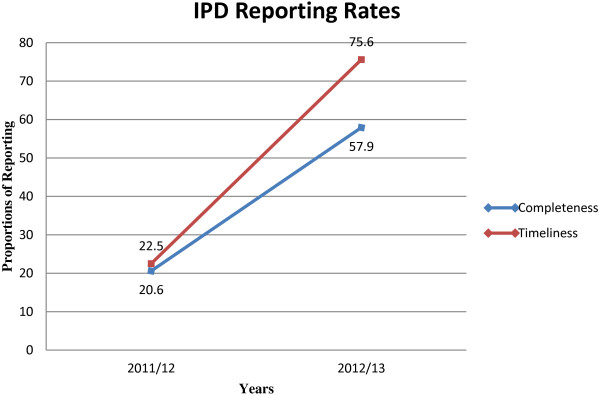
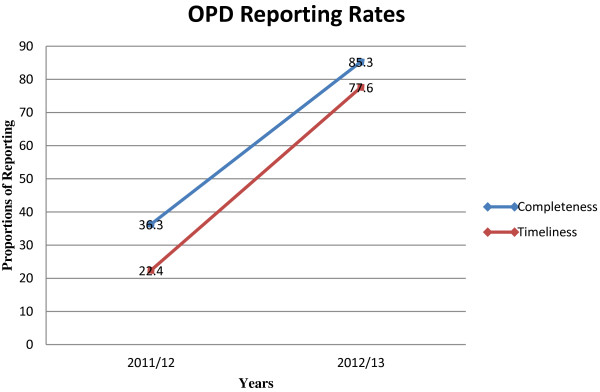
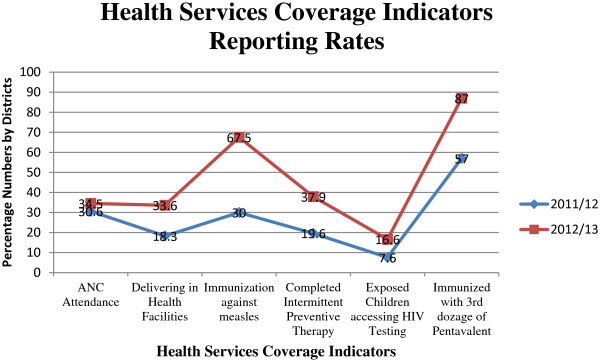
BACKGROUND: Untimely, incomplete and inaccurate data are common challenges in planning, monitoring and evaluation of health sector performance, and health service delivery in many sub-Saharan African settings. We document Uganda's experience in strengthening routine health data reporting through the roll-out of the District Health Management Information Software System version 2 (DHIS2). METHODS: DHIS2 was adopted at the national level in January 2011. The system was initially piloted in 4 districts, before it was rolled out to all the 112 districts by July 2012. As part of the roll-out process, 35 training workshops targeting 972 users were conducted throughout the country. Those trained included Records Assistants (168, 17.3%), District Health Officers (112, 11.5%), Health Management Information System Focal Persons (HMIS-FPs) (112, 11.5%), District Biostatisticians (107, 11%) and other health workers (473, 48.7%). To assess improvements in health reporting, we compared data on completeness and timeliness of outpatient and inpatient reporting for the period before (2011/12) and after (2012/13) the introduction of DHIS2. We reviewed data on the reporting of selected health service coverage indicators as a proxy for improved health reporting, and documented implementation challenges and lessons learned during the DHIS2 roll-out process. RESULTS: Completeness of outpatient reporting increased from 36.3% in 2011/12 to 85.3% in 2012/13 while timeliness of outpatient reporting increased from 22.4% to 77.6%. Similarly, completeness of inpatient reporting increased from 20.6% to 57.9% while timeliness of inpatient reporting increased from 22.5% to 75.6%. There was increased reporting on selected health coverage indicators (e.g. the reporting of one-year old children who were immunized with three doses of pentavelent vaccine increased from 57% in 2011/12 to 87% in 2012/13). Implementation challenges included limited access to computers and internet (34%), inadequate technical support (23%) and limited worker force (18%). CONCLUSION: Implementation of DHIS2 resulted in improved timeliness and completeness in reporting of routine outpatient, inpatient and health service usage data from the district to the national level. Continued onsite support supervision and mentorship and additional system/infrastructure enhancements, including internet connectivity, are needed to further enhance the performance of DHIS2.
Overview
The claims and statistics of this paper haven’t been checked yet.
Free: it reads the open-access text and checks the first 5 claims that cite a source we can check. Create a free account to check every claim.
Integrity signals
Registry
Cites
Statistics
Figures
Verification
Claims the paper makes
The claims and statistics of this paper haven’t been checked yet.
Free: it reads the open-access text and checks the first 5 claims that cite a source we can check. Create a free account to check every claim.
Claims other papers make about this one
Each is checked against this paper’s own text: does it say what the citing paper says it does?
The source backs part of the claim, not all of it — or backs it for a different population, condition or comparison.
In the citing paper
“An evaluation by Kibaru et al. [56] found dramatic improvements in routine reporting, with completeness increasing from 36% to 85% for monthly outpatient reports and 21% to 56% for inpatient reports by 2012/13.”
From Beyond pilotitis: taking digital health interventions to the national level in China and Uganda (2017) · cites this paper as [56]
Experimental — accuracy not yet measuredThe source backs part of the claim, not all of it — or backs it for a different population, condition or comparison.
In the citing paper
“However, consistent power blackouts, loss of internet connectivity and the presence of an unskilled health workforce hinder its uptake.”
From Barriers and opportunities to implementation of sustainable e-Health programmes in Uganda: A literature review (2017) · cites this paper as [64]
Experimental — accuracy not yet measuredThe source backs part of the claim, not all of it — or backs it for a different population, condition or comparison.
In the citing paper
“Similar challenges coupled with inadequate funding and resistance from health workers were encountered in Uganda during implementation of EMRs, such as OpenMRS, mTrack and DHIS2.”
From Barriers and opportunities to implementation of sustainable e-Health programmes in Uganda: A literature review (2017) · cites this paper as [64]
Experimental — accuracy not yet measuredThe cited source says what the claim attributes to it.
In the citing paper
“Kiberu et al. [56] also note that the MoH itself was routinely subject to electricity black-outs, which hindered access to the central server.”
From Beyond pilotitis: taking digital health interventions to the national level in China and Uganda (2017) · cites this paper as [56]
Self-check
Percentages, sums and reported differences re-computed from the paper’s own numbers.
The self-check needs the paper’s full text.
Citations
Cites
(2008) · PubMed · Cited by 237
Improving public health information: a data quality intervention in KwaZulu-Natal, South Africa
Mphatswe, W., Mate, K., Bennett, B., Ngidi, H., Reddy, J., Barker, P., & Rollins, N. (2012) · Bulletin of the World Health Organization · doi:10.2471/blt.11.092759 · Cited by 196 · cited 1×
“In South Africa, the implementation of a web-based data quality intervention improved data completeness from 26% before to 64% after the intervention; and improved overall accuracy of data from 37% at the first data audit to 65% at the third data audit [8].”
BackgroundChaulagai, C. N., Moyo, C. M., Koot, J., Moyo, H. B., Sambakunsi, T. C., Khunga, F. M., & Naphini, P. D. (2005) · Health Policy and Planning · doi:10.1093/heapol/czi044 · Cited by 191
Assessing the quality of data aggregated by antiretroviral treatment clinics in Malawi
Makombe, S. (2008) · Bulletin of the World Health Organization · doi:10.2471/blt.07.044685 · Cited by 104 · cited 3×
“This calls continuous support supervision to build health facility capacity to collect quality data to inform district and national level monitoring and planning [3].”
BackgroundManya, A. S., Braa, J. A., Titlestad, O. H., Øverland, L. H., & Mumo, J. M. (2016) · Cited by 49
DEVELOPMENT OF HMIS IN POOR COUNTRIES: UGANDA AS A CASE STUDY
Kintu, P., Nanyunja, M., Nzabanita, A., & Magoola, R. (2005) · Bioline International (Bioline International) · Cited by 29
The Impact of a Web-based Reporting System on the Collection of Medication Error Occurrence Data
Rudman, W. J., Bailey, J. H., Hope, C. J., Garrett, P., & Brown, C. A. (2005) · Cited by 12
Research works printed but not linked: 2
- Ayub MJB Lars Ø Ola D Jeremiah M Charles N National Roll out of District Health Information Software (DHIS 2) in Kenya IST-Africa 2012 Conference Proceedings
- Makumbi FE Okello C Mutebi A Wabwire-Mangen F Health Sector HIV/AIDs Response Review 2010 Kampala: Uganda Available at: http://danstan.me/HIVHSRReports/HIV%20HSR%20Final%20Reports(2)/HMIS%20Building%20Block%20Final%20Report%20Nov_2010.doc. Accessed March 7, 2014
Cited by
Items 201–272 of 272
Chapter 8 : Participant-Created Documents As An Elicitation Tool
Grant, A. (2018) · Directory of Open access Books (OAPEN Foundation)
IMPLEMENTATION AND BENEFITS OF PHILHEALTH E-CLAIMS IN GOVERNMENT HOSPITALS
ROMERO, E. R. (2021) · International Journal of Research Publications · doi:10.47119/ijrp100701220211742
Model for context-fitting mobile services for monitoring delivery of public health services
Mutungi, F., Mutungi, F., Baguma, R., & Basaza‐Ejiri, A. H. (2021) · American Journal of Data Information and Knowledge Management · doi:10.47672/ajdikm.660
Mwaipopo, Q., & Lema, G. A. (2020) · Tanzania Journal for Population studies and Development · doi:10.56279/tjpsd.v27i2.109
Kirk, K., McClair, T. L., Dakouo, S. P., Abuya, T., & Sripad, P. (2021) · Journal of Global Health · doi:10.7189/jogh.11.07003-f
Reliability of Performance Factors for Evaluating Electronic Health Information Systems
Nagwovuma, M., Maiga, G., Nakakawa, A., & Eilu, E. (2022) · Advances in healthcare information systems and administration book series · doi:10.4018/978-1-7998-8915-1.ch007
Health Records Management System Model for Public Health Centres in Uganda
Nandere, H., & Lowu, F. (2022) · Journal of Health, Medicine and Nursing · doi:10.7176/jhmn/99-04
Health data reporting challenges in Mopti, Mali: Results and implications from a mixed-methods study
Frontline Health Project (2021) · doi:10.31899/rh16.1019
Electronic Health Record can Better Support Primary Care in Mongolia
Chae, Y. M., & Davaasuren, M. (2017) · Central Asian Journal of Medical Sciences · doi:10.24079/cajms.2017.01.001
The Contribution of Health Management Information Systems to Enhancing Healthcare Operations
Omer, M. K. (2023) · International Journal of Advanced Computer Science and Applications · doi:10.14569/ijacsa.2023.0141263
“However, donor policies typically encourage the implementation of vertical programs that support their own information systems and administrative structures [6].”
BackgroundMethodSUHANDARI, H., Bambang, B., & Nurabiah, N. (2024) · GANEC SWARA · doi:10.35327/gara.v18i2.848
Chukwu, E., Garg, L., & Chattu, V. K. (2024) · Elsevier eBooks · doi:10.1016/b978-0-443-22038-8.00001-5 · Cited by 1
Disease Surveillance and Outbreak Investigations
Saleh, J.-E. A. (2024) · BENTHAM SCIENCE PUBLISHERS eBooks · doi:10.2174/9789815274738124010007
Abdulbaqi, H. T., & Kadir, G. S. (2024) · Public Health · doi:10.1016/j.puhe.2024.12.013
Data-Driven Approach to Assess and Identify Gaps in Healthcare Set up in South Asia
Fatima, T., Elahi, R., Zahra, S. W., Abubakar, H. N., Zafar, T., Tahseen, Z., Quddoos, M. T., & Nazir, U. (2025) · Communications in computer and information science · doi:10.1007/978-981-96-7036-9_14
Olomi, G. A., Mmbaga, B. T., Makasi, C. E., Yeates, K., Woodworth, S., Khashan, A. S., & Manongi, R. N. (2026) · Tanzania journal of health research/Tanzania Journal of Health Research · doi:10.4314/thrb.v27i4.23
Kaggwa, P., Sekandi, J. N., McDonald, A., Nabende, P., Nabukeera, S., Katende, K. K., Buregyeya, E., & Tumwesigye, N. M. (2025) · PLoS ONE · doi:10.1371/journal.pone.0337691
“Administrators implement the Health Management Information System (HMIS), a paper-based system, to collect health data, but they struggle to achieve interoperability across facilities [21].”
Doka, B. K., Worku, A. G., Negeri, K. G., & Kassa, D. H. (2025) · INQUIRY The Journal of Health Care Organization Provision and Financing · doi:10.1177/00469580251399390
“30 The interventions we applied; such as training, supervision, mentorship, motivation, and monitoring and evaluation on RHIS, might have helped build the capacity and knowledge of health workers, motivate staff, and enhance data flow and submission processes.”
Ng’etich, A. K. S., Voyi, K. V. V., & Mutero, C. M. (2021) · Figshare · doi:10.6084/m9.figshare.14100415
Njeru, I., Kareko, D., Kisangau, N., Langat, D., Liku, N., Owiso, G., Dolan, S., Rabinowitz, P., Macharia, D., Ekechi, C. O., et al. (2020) · Figshare · doi:10.6084/m9.figshare.12650602
Molla, E., Behaksra, S. W., Tadesse, F. G., Dugassa, S., Gadisa, E., & Mamo, H. (2021) · Figshare · doi:10.6084/m9.figshare.13627250
Begum, T., Khan, S. M., Adamou, B., Ferdous, J., Parvez, M. M., Islam, M. S., Kumkum, F. A., Rahman, A., & Anwar, I. (2020) · Figshare · doi:10.6084/m9.figshare.12375647
Westercamp, N., Staedke, S. G., Maiteki‐Sebuguzi, C., Ndyabakira, A., Okiring, J. M., Kigozi, S. P., Dorsey, G., Broughton, E., Hutchinson, E., Massoud, M. R., et al. (2021) · Figshare · doi:10.6084/m9.figshare.14880926
Bou-Karroum, L., Daher, N., Jabbour, M., Akhu‐Zaheya, L., Khater, W. A., Alloubani, A., Orach, C. G., Komakech, H., Bennett, S., & El‐Jardali, F. (2024) · Figshare · doi:10.6084/m9.figshare.26500311
Begum, T., Khan, S. M., Adamou, B., Ferdous, J., Parvez, M. M., Islam, M. S., Kumkum, F. A., Rahman, A., & Anwar, I. (2020) · Figshare · doi:10.6084/m9.figshare.12375650
Westercamp, N., Staedke, S. G., Maiteki‐Sebuguzi, C., Ndyabakira, A., Okiring, J. M., Kigozi, S. P., Dorsey, G., Broughton, E., Hutchinson, E., Massoud, M. R., et al. (2021) · Figshare · doi:10.6084/m9.figshare.14880917
Njeru, I., Kareko, D., Kisangau, N., Langat, D., Liku, N., Owiso, G., Dolan, S., Rabinowitz, P., Macharia, D., Ekechi, C. O., et al. (2020) · Figshare · doi:10.6084/m9.figshare.12650599
Kigozi, S. P., Kigozi, R. N., Sebuguzi, C. M., Cano, J., Rutazaana, D., Opigo, J., Bousema, T., Yeka, A., Gasasira, A. F., Sartorius, B. K. D., et al. (2020) · Figshare · doi:10.6084/m9.figshare.13467665
Westercamp, N., Staedke, S. G., Maiteki‐Sebuguzi, C., Ndyabakira, A., Okiring, J. M., Kigozi, S. P., Dorsey, G., Broughton, E., Hutchinson, E., Massoud, M. R., et al. (2021) · Figshare · doi:10.6084/m9.figshare.14880923
Ng’etich, A. K. S., Voyi, K. V. V., & Mutero, C. M. (2021) · Figshare · doi:10.6084/m9.figshare.14100403
Wang, D., Kerh, R., Jun, S., Lee, S., Mayega, R. W., Ssentongo, J., Oumer, A., Haque, M., Brunese, P., & Yih, Y. (2022) · Figshare · doi:10.6084/m9.figshare.21087221
Begum, T., Khan, S. M., Adamou, B., Ferdous, J., Parvez, M. M., Islam, M. S., Kumkum, F. A., Rahman, A., & Anwar, I. (2020) · Figshare · doi:10.6084/m9.figshare.12375614
Hung, Y. W., Hoxha, K., Irwin, B. R., Law, M. R., & Grépin, K. A. (2020) · Figshare · doi:10.6084/m9.figshare.12864820
Westercamp, N., Staedke, S. G., Maiteki‐Sebuguzi, C., Ndyabakira, A., Okiring, J. M., Kigozi, S. P., Dorsey, G., Broughton, E., Hutchinson, E., Massoud, M. R., et al. (2021) · Figshare · doi:10.6084/m9.figshare.14880920
Bou-Karroum, L., Daher, N., Jabbour, M., Akhu‐Zaheya, L., Khater, W. A., Alloubani, A., Orach, C. G., Komakech, H., Bennett, S., & El‐Jardali, F. (2024) · Figshare · doi:10.6084/m9.figshare.26500393
Ng’etich, A. K. S., Voyi, K. V. V., & Mutero, C. M. (2021) · Figshare · doi:10.6084/m9.figshare.14100418
Ng’etich, A. K. S., Voyi, K. V. V., & Mutero, C. M. (2021) · Figshare · doi:10.6084/m9.figshare.14100421
Ng’etich, A. K. S., Voyi, K. V. V., & Mutero, C. M. (2021) · Figshare · doi:10.6084/m9.figshare.13585331
Ng’etich, A. K. S., Voyi, K. V. V., & Mutero, C. M. (2021) · Figshare · doi:10.6084/m9.figshare.14100412
Ouma, J., Jeffery, C., Valadez, J. J., Wanyenze, R. K., Todd, J., & Levin, J. (2020) · Figshare · doi:10.6084/m9.figshare.12023487
Self-citationSimmons, E., Singh, K., Mpiima, J., Kumar, M., & Weiss, W. M. (2020) · Figshare · doi:10.6084/m9.figshare.13076688
Waist Circumference and Metabolic Syndrome: Ugandan Perspectives
Lubogo, D., & Matovu, N. (2025) · Springer eBooks · doi:10.1007/978-3-031-32047-7_93-1
Westercamp, N., Staedke, S. G., Maiteki‐Sebuguzi, C., Ndyabakira, A., Okiring, J. M., Kigozi, S. P., Dorsey, G., Broughton, E., Hutchinson, E., Massoud, M. R., et al. (2021) · Figshare · doi:10.6084/m9.figshare.14880911
Westercamp, N., Staedke, S. G., Maiteki‐Sebuguzi, C., Ndyabakira, A., Okiring, J. M., Kigozi, S. P., Dorsey, G., Broughton, E., Hutchinson, E., Massoud, M. R., et al. (2021) · Figshare · doi:10.6084/m9.figshare.14880914
Ng’etich, A. K. S., Voyi, K. V. V., & Mutero, C. M. (2021) · Figshare · doi:10.6084/m9.figshare.14100406
Ng’etich, A. K. S., Voyi, K. V. V., & Mutero, C. M. (2021) · Figshare · doi:10.6084/m9.figshare.14100409
Utilizing Software Analytics to Guide Software Development
Koskinen, M. (2021) · Helda - University of Helsinki Institutional Repository
Habumugisha, M., Ssekamatte, D., & Nakiyaga, D. (2025) · International Journal of Social Science and Economic Research · doi:10.46609/ijsser.2025.v10i08.025
Enabling data-driven decision-making for innovative health care and delivery in Africa
Agamah, F. E., Anyanful, A., Debrah, O., Twum, J., Tunga, M., Skelton, M., Bope, C. D., Chimusa, E. R., & Thomford, N. E. (2025) · npj Health Systems · doi:10.1038/s44401-025-00047-y
Bagyendera, M., Nabende, P., Godman, B., & Nabukenya, J. (2026) · Communications in computer and information science · doi:10.1007/978-3-032-10685-8_13
Zawedde‐Muyanja, S., Najjemba, L., Nsubuga, T., Picho, B., Alfred, E., Dowdy, D. W., & Ryckman, T. S. (2026) · PLOS Global Public Health · doi:10.1371/journal.pgph.0004853
BAMWEBAZE, G., Waititu, G. A., Awichi, R. O., & Adebanji, A. (2026) · PLoS ONE · doi:10.1371/journal.pone.0323859
“We also based on Sample data from the DHIS2 (District Health Information System 2) since this was reported as a better reporting tool by [17] and the UN Inter-agency Group for Child Mortality Estimation (UN IGME) [18].”
Omiel, P. O., Müller, S. D., Namanya, D. B., Behumbiize, P., & Mbaka, P. (2026) · SSM - Health Systems · doi:10.1016/j.ssmhs.2026.100212
“Implemented since 2010, DHIS2 is now deeply embedded in health sector practice, supporting surveillance, reporting, planning, and program monitoring across administrative levels (Kiberu et al., 2014).”
Ramblière, L. (2021) · theses.fr (ABES) · doi:10.70675/f4d9d7f0z0798z4519zb0bez607c991792b0 · Cited by 1
Paasi, G., Alunyo, J. P., Nakiyemba, A., Ocen, G. G., Pande, S. L., Alaroker, F., Waako, P. J., & Olupot‐Olupot, P. (2026) · Journal of Epidemiology and Global Health · doi:10.1007/s44197-026-00562-7
“DHIS2 is the national elec - tronic platform used to collate routine health facility reports from public and most private-not-for-profit facilities [20 ].”
Sulayman, A.-B., Aya, B. M., Chidinma, I. B., Bidemi, O. A., Akande, T. M., Hussain, N. A., Etamesor, E., Sulaiman, S., & Abukakar, M. J. (2026) · nternational Journal of Public Health Pharmacy and Pharmacology · doi:10.37745/ijphpp.15/vol11n12441
Wasswa, R. E., Cora, L. G., Kananura, R. M., Lochoro, P., Mugahi, R., Ogwal, J. O., Ebong, C., Abathun, F., Fisshea, D., Minja, J., et al. (2026) · Journal of Global Health · doi:10.7189/jogh.16.04153
“Uganda adopted the District Health Information Software 2 (DHIS2) as its national RHIS platform in 2011 [ 20 ]; since then, several assessments have examined aspects of RHIS performance [ 21 , 22 ].”
Muliokela, R. K., Nkangu, M., Banda, K., Hussen, A. M., Tsigie, S. T., Sikwibele, K., Asante, J., Mwiche, A., Batoum, E., Kalamatila, N., et al. (2026) · Oxford Open Digital Health · doi:10.1093/oodh/oqag013
Nur, M. J., Ahmad, B., & Abdullah, M. T. (2024) · Journal of Public Representative and Society Provision · doi:10.55885/jprsp.v4i3.977
Data processing pipelines and tools for routine health facility malaria surveillance in UgandaPreprint
Carter, A. R., Eganyu, T., Hergott, D., Rek, J., Okiring, J., Kyabayinze, D., Maiteki‐Sebuguzi, C., Mbaka, P., & Smith, D. L. (2026) · medRxiv · doi:10.64898/2026.07.22.26357569
Odey, F. A., Esu, E., Arikpo, I. A., Okoro, A. T., Ele, M., Meremikwu, C., Ikpi, O., Njoku, C., Iwomi, F., Aquaisua, E., et al. (2026) · BMC Health Services Research · doi:10.1186/s12913-026-15072-2
“Introducing DHIS2 in Uganda was shown to improve the timeliness and completeness of reporting of routine health services data [18].”
Dang, L., Tamfon, B. B., Nkangu, M., Ombogo, F. F., Ngoufack, M. N., Tchuitcheu, G. K., & Nguefack‐Tsague, G. (2026) · Research Square · doi:10.21203/rs.3.rs-10582695/v1
Masimula, S. S., Senekane, M. F., & Naicker, N. (2026) · Frontiers in Health Services · doi:10.3389/frhs.2026.1890673
“A study conducted in Uganda revealed that paper-based systems have bureaucratic delays that affect the data transmission rate, availability and timeliness (29).”
Tizie, S. B., Gebeyew, A. S., Shimie, A. W., Mengistie, M. B., Mengistu, A. K., Bitew, T., Gete, M., Senishaw, A. F., Anteneh, A., Assaye, B. T., et al. (2026) · Digital Health · doi:10.1177/20552076261486950
“7,12,18,28,29,36,37 This is consistent with other resource-limited settings where facility support and accountability systems are important for active participation in health information systems.”
Kawunye¹, O. P., Kiberu, V. M., & Ale, B. M. (2026) · Research Square · doi:10.21203/rs.3.rs-10760714/v1
Self-citationEstablishing Climate Services in Uganda’s Health System: Aligning Actors Through the DHIS2 Platform
Omiel, P. O., Müller, S. D., Namanya, D. B., Nakibuuka, J., Behumbiize, P., & Mbaka, P. (2026) · IFIP advances in information and communication technology · doi:10.1007/978-3-032-30982-2_10
Kembabazi, B. (2021) · SU+ Digital Repository (Strathmore University)
Évaluation des systèmes d’information des centres de santé communautaires de Bamako (Mali)
Poda, G. G., Traoré, F., Doumbia, I., Traore, B. T., Maiga, A., maliDoumbia, L., & Poda, P. (2023) · HEALTH SCIENCES AND DISEASE · doi:10.5281/hsd.v24i4.4363
Readiness of the stroke data ecosystem in Uganda: A multicenter data capability maturity assessmentPreprint
Nakasendwa, S., Nankya-Mutyoba, J., Kadengye, D. T., Birungi, B. B., Wanasolo, T., Kaddumukasa, M. N., Muyinda, A., Musubire, A. K., Ssembatya, J. M., Nannyondo, G., et al. (2026) · Research Square · doi:10.21203/rs.3.rs-11051179/v1
Leone, R., Ouattara, Y., Tognaccini, L., Ricciardi, W., & Gualano, M. R. (2026) · Health Policy OPEN · doi:10.1016/j.hpopen.2026.100187
“Its adoption has produced documented improvements in reporting timeliness and completeness, Uganda's national roll-out being an early and well-characterised case [26], and its use for outbreak response and campaign monitoring is now routine.”
Paasi, G., Ndeezi, G., Namazzi, R., Mupere, E., Munabi, I. G., Kiguli, S., Idro, R., & Olupot‐Olupot, P. (2026) · BMC Global and Public Health · doi:10.1186/s44263-026-00338-y
“Uganda adopted DHIS2 nationally in 2011 and completed phased national rollout by 2012 [30].”
Metadata
- Authors
- Kiberu, V. M., Matovu, J. K., Makumbi, F., Kyozira, C., Mukooyo, E., & Wanyenze, R. K.
- Affiliations
- Makerere University (UG)
- Ministry of Health (UG)
- Corresponding author
- Kiberu, Vincent Micheal
- Matovu, Joseph KB
- Venue
- BMC Medical Informatics and Decision Making
- Published
- 2014-05-13
- Volume
- 14
- Issue
- 1
- Pages
- 40-40
- ISSN
- 1472-6947 (ISSN-L)
- PMC
- PMC4030005
- OpenAlex
- W2167470445
- Cited by
- 261
- References
- 7
- Citations by year
- 2026: 24 · 2025: 19 · 2024: 29 · 2023: 25 · 2022: 30 · 2021: 43 · 2020: 33 · 2019: 18 · 2018: 13 · 2017: 15 · 2016: 6 · 2015: 6
- FWCI
- 16.45
- Type
- journal article
- Language
- en
- Open access
- gold
- doi.org
- Licence
- Locations
- BMC Medical Informatics and Decision Making (publishedVersion, cc-by)
- Europe PMC (PubMed Central) (publishedVersion, cc-by)
- PubMed Central (publishedVersion, cc-by)
- PubMed (publishedVersion)
- Funders
- Centers for Disease Control and Prevention
- Topics
- Health Sciences › Health Professions › Health Information Management › Electronic Health Records Systems
- Health Sciences › Health Professions › Health Information Management › Medical Coding and Health Information
- Health Sciences › Medicine › Public Health, Environmental and Occupational Health › Healthcare Systems and Reforms
- Keywords
- DHIS2, data completeness, data timeliness, user training, implementation barriers, Uganda, sub-Saharan Africa, health information systems, pentavalent vaccine, district health management, technical support, internet access, health workforce capacity, health care delivery
- MeSH terms
- Health Services, Humans, Inpatients, Outpatients, Uganda, Health Information Systems, Health Information Management
About these checks
Registry, retraction, Cites and statistics results are computed, not judged, with one exception: a printed reference that no index lists is read once by a model before it counts as a citation error. Claims are extracted by a model and kept only when their quote appears verbatim in the text; each cited source is then checked, with a model’s help, for whether it says what the claim relies on. Those verdicts can be wrong — read the claim’s quote and the cited source before relying on one.
Statistics and arithmetic are recomputed, not judged.
Confidence bands are shown only for fields calibrated on our annotated test set. None is calibrated yet, so no band is shown.
What counts as a claim ›How we measure confidence ›How we check this ›
Are you an author, or do you see a problem with this page? Request a review
Data sources
Bibliographic data: Semantic Scholar, OpenAlex, Crossref.
Contains information from the Semantic Scholar Academic Graph Datasets, made available under the ODC Attribution License (ODC-BY 1.0).
Semantic Scholar’s data is described in: Kinney, R., et al. (2023). The Semantic Scholar Open Data Platform. arXiv:2301.10140.
