

The DOI matches its Crossref record; 60 of the 61 references it cites were found in a registry or an index.
Data Linkage: A powerful research tool with potential problems
Open accessAbstract
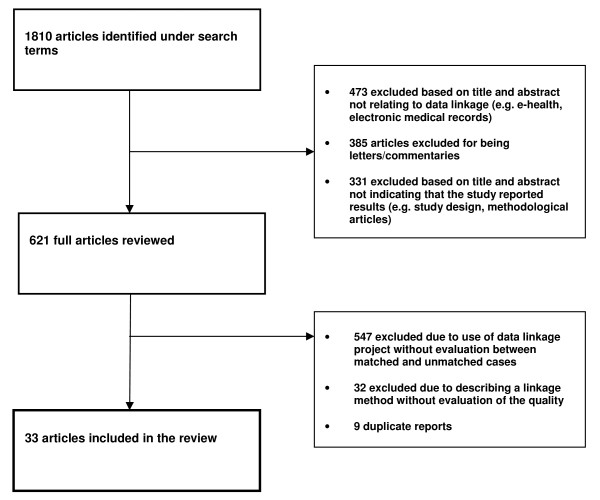
BACKGROUND: Policy makers, clinicians and researchers are demonstrating increasing interest in using data linked from multiple sources to support measurement of clinical performance and patient health outcomes. However, the utility of data linkage may be compromised by sub-optimal or incomplete linkage, leading to systematic bias. In this study, we synthesize the evidence identifying participant or population characteristics that can influence the validity and completeness of data linkage and may be associated with systematic bias in reported outcomes. METHODS: A narrative review, using structured search methods was undertaken. Key words "data linkage" and Mesh term "medical record linkage" were applied to Medline, EMBASE and CINAHL databases between 1991 and 2007. Abstract inclusion criteria were; the article attempted an empirical evaluation of methodological issues relating to data linkage and reported on patient characteristics, the study design included analysis of matched versus unmatched records, and the report was in English. Included articles were grouped thematically according to patient characteristics that were compared between matched and unmatched records. RESULTS: The search identified 1810 articles of which 33 (1.8%) met inclusion criteria. There was marked heterogeneity in study methods and factors investigated. Characteristics that were unevenly distributed among matched and unmatched records were; age (72% of studies), sex (50% of studies), race (64% of studies), geographical/hospital site (93% of studies), socio-economic status (82% of studies) and health status (72% of studies). CONCLUSION: A number of relevant patient or population factors may be associated with incomplete data linkage resulting in systematic bias in reported clinical outcomes. Readers should consider these factors in interpreting the reported results of data linkage studies.
Overview
The claims and statistics of this paper haven’t been checked yet.
Run the check — free, no account needed. It reads the open-access text and checks the sources it cites.
Integrity signals
Registry
Cites
Statistics
Figures
Verification
Claims the paper makes
The claims and statistics of this paper haven’t been checked yet.
Run the check — free, no account needed. It reads the open-access text and checks the sources it cites.
Claims other papers make about this one
Each is checked against this paper’s own text: does it say what the citing paper says it does?
In the citing paper
“Data describing linkage methods and evaluating their success are critical to permit the reader to assess the impact of any linkage error and related bias [51].”
From The Reporting of Studies Conducted Using Observational Routinely-Collected Health Data (RECORD) statement. (2015) · cites this paper as [51]
Self-check
Percentages, sums and reported differences re-computed from the paper’s own numbers.
The self-check needs the paper’s full text.
Citations
Cites
von Elm, E., Altman, D. G., Egger, M., Pocock, S. J., Gøtzsche, P. C., Vandenbroucke, J. P., & Initiative, F. T. S. (2007) · PLoS Medicine · doi:10.1371/journal.pmed.0040296 · Cited by 23,020
von Elm, E., Altman, D. G., Egger, M., Pocock, S. J., Gøtzsche, P. C., & Vandenbroucke, J. P. (2007) · The Lancet · doi:10.1016/s0140-6736(07)61602-x · Cited by 21,320
Crossing the Quality Chasm: A New Health System for the 21st Century
Baker, A. (2001) · BMJ · doi:10.1136/bmj.323.7322.1192 · Cited by 10,779
Crossing the Quality Chasm: A New Health System for the 21st Century
Committee on Quality of Health Care in America (2002) · Journal for Healthcare Quality · doi:10.1111/j.1945-1474.2002.tb00463.x · Cited by 8,508
von Elm, E., Altman, D. G., Egger, M., Pocock, S. J., Gøtzsche, P. C., & Vandenbroucke, J. P. (2007) · Preventive Medicine · doi:10.1016/j.ypmed.2007.08.012 · Cited by 2,698
Teasdale, G. M. (2002) · British Journal of Neurosurgery · doi:10.1080/02688690220148815 · Cited by 1,063
Holman, C. D. J., Bass, A. J., Rouse, I. L., & HOBBS, M. S. T. (1999) · Australian and New Zealand Journal of Public Health · doi:10.1111/j.1467-842x.1999.tb01297.x · Cited by 1,037
A framework for evaluation of secondary data sources for epidemiological research
SØRENSEN, H. T., SABROE, S., & OLSEN, J. (1996) · International Journal of Epidemiology · doi:10.1093/ije/25.2.435 · Cited by 455
Research use of linked health data — a best practice protocol
Kelman, C., Bass, A. J., & Holman, C. D. J. (2002) · Australian and New Zealand Journal of Public Health · doi:10.1111/j.1467-842x.2002.tb00682.x · Cited by 434
The Scottish Record Linkage System.
Kendrick, S. W., & Clarke, J. (1993) · PubMed · Cited by 377
Research works printed but not linked: 4
- Canadian Institute for Health Information: Health Care In Canada 2004. 2004, Ottawa, CA: CIHI
- Winglee M, Valliant R, Scheuren F: A case study in record linkage. Survey Methodology. 2005, 31 (1): 3-11.
- National Community Services Information Management Group: Statistical Data Linkage in Community Services Data Collection. 2004, Canberra Australian Institute of Health and Welfare
- Young AF, Dobson AJ, Byles JE: Health services research using linked records: who consents and what is the gain?[see comment]. Aust N Z J Public Health. 2001, 25 (5): 417-420. · DOI
Cited by
Sorted by citations
Benchimol, E. I., Smeeth, L., Guttmann, A., Harron, K., Moher, D., Petersen, I., Sørensen, H. T., von Elm, E., Langan, S. M., & RECORD Working Committee (2015) · PLOS Medicine · doi:10.1371/journal.pmed.1001885 · Cited by 5,749
Challenges in administrative data linkage for research
Harron, K. L., Dibben, C. J. L., Boyd, J., Hjern, A., Azimaee, M., Barreto, M. L., & Goldstein, H. (2017) · Big Data & Society · doi:10.1177/2053951717745678 · Cited by 404
Big Data in Public Health: Terminology, Machine Learning, and Privacy
Mooney, S. J., & Pejaver, V. (2018) · Annual Review of Public Health · doi:10.1146/annurev-publhealth-040617-014208 · Cited by 325
Padmanabhan, S., Carty, L., Cameron, E., Ghosh, R. E., Williams, R., & Strongman, H. (2019) · European Journal of Epidemiology · doi:10.1007/s10654-018-0442-4 · Cited by 208
Chiu, M., Lebenbaum, M., Lam, K., Chong, N., Azimaee, M., Iron, K., Manuel, D. G., & Guttmann, A. (2016) · BMC Medical Informatics and Decision Making · doi:10.1186/s12911-016-0375-3 · Cited by 213
Metadata
- Authors
- Bohensky, M. A., Jolley, D., Sundararajan, V., Evans, S., Pilcher, D. V., Scott, I., & Brand, C. A.
- Affiliations
- Monash University (AU)
- Australian and New Zealand Intensive Care Society (AU)
- Princess Alexandra Hospital (AU)
- Corresponding author
- Bohensky, Megan A
- Venue
- BMC Health Services Research
- Published
- 2010-12
- Volume
- 10
- Issue
- 1
- Pages
- 346-346
- ISSN
- 1472-6963 (ISSN-L)
- PMC
- PMC3271236
- OpenAlex
- W1975356361
- Cited by
- 234
- References
- 61
- Citations by year
- 2026: 8 · 2025: 19 · 2024: 24 · 2023: 16 · 2022: 27 · 2021: 25 · 2020: 18 · 2019: 16 · 2018: 20 · 2017: 16 · 2016: 13 · 2015: 7 · 2014: 10 · 2013: 4 · 2012: 5
- FWCI
- 5.65
- Type
- journal article
- Language
- en
- Open access
- gold
- doi.org
- Licence
- Locations
- BMC Health Services Research (publishedVersion, cc-by)
- Europe PMC (PubMed Central) (publishedVersion, cc-by)
- PubMed Central (publishedVersion, cc-by)
- PubMed (publishedVersion)
- Minerva Access (University of Melbourne) (submittedVersion, cc-by)
- DOAJ (DOAJ: Directory of Open Access Journals) (submittedVersion, cc-by-sa)
- Funders
- Monash University
- Topics
- Physical Sciences › Computer Science › Information Systems › Data Quality and Management
- Health Sciences › Health Professions › Health Information Management › Medical Coding and Health Information
- Health Sciences › Health Professions › Health Information Management › Electronic Health Records Systems
- Keywords
- data linkage, medical record linkage, systematic bias, patient characteristics, socioeconomic status, health status, clinical outcome measurement
- MeSH terms
- Data Collection, Health Services Research, Health Status, Hospitals, Humans, Outcome and Process Assessment, Health Care, Quality Assurance, Health Care, Research Design, Sensitivity and Specificity, Databases, Bibliographic, Information Storage and Retrieval, Empirical Research, Clinical Audit
About these checks
Registry, retraction, Cites and statistics results are computed, not judged, with one exception: a printed reference that no index lists is read once by a model before it counts as a citation error. Claims are extracted by a model and kept only when their quote appears verbatim in the text; each cited source is then checked, with a model’s help, for whether it says what the claim relies on. Those verdicts can be wrong — read the claim’s quote and the cited source before relying on one.
Statistics and arithmetic are recomputed, not judged.
Confidence bands are shown only for fields calibrated on our annotated test set. None is calibrated yet, so no band is shown.
What counts as a claim ›How we measure confidence ›How we check this ›
Are you an author, or do you see a problem with this page? Request a review
