

The DOI matches its Crossref record; 39 of the 39 references it cites were found in a registry or an index.
How much time do nurses have for patients? a longitudinal study quantifying hospital nurses' patterns of task time distribution and interactions with health professionals
Open accessAbstract
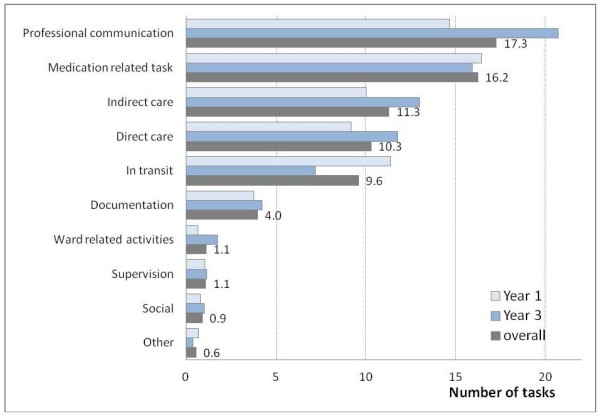
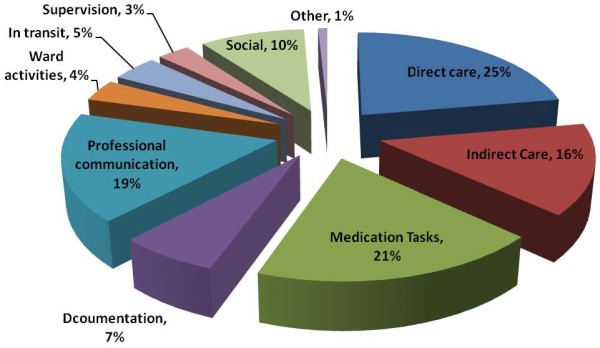
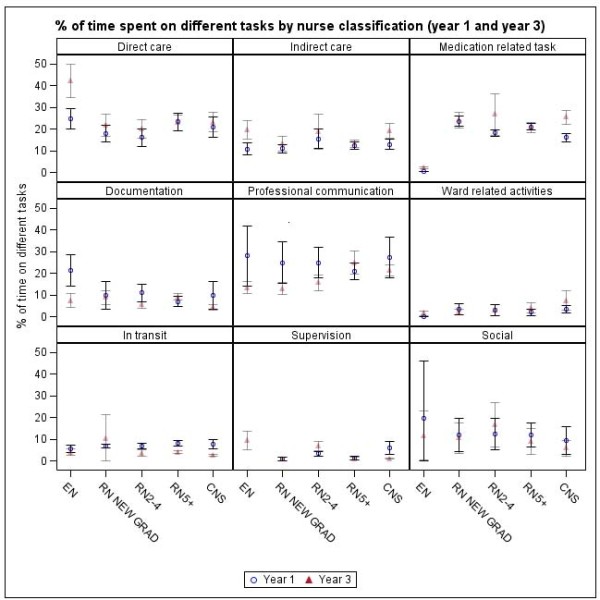
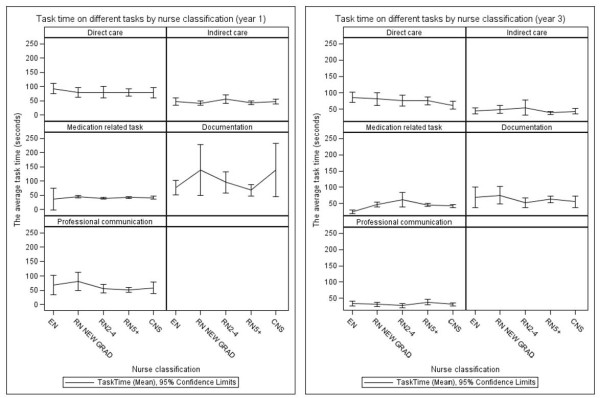
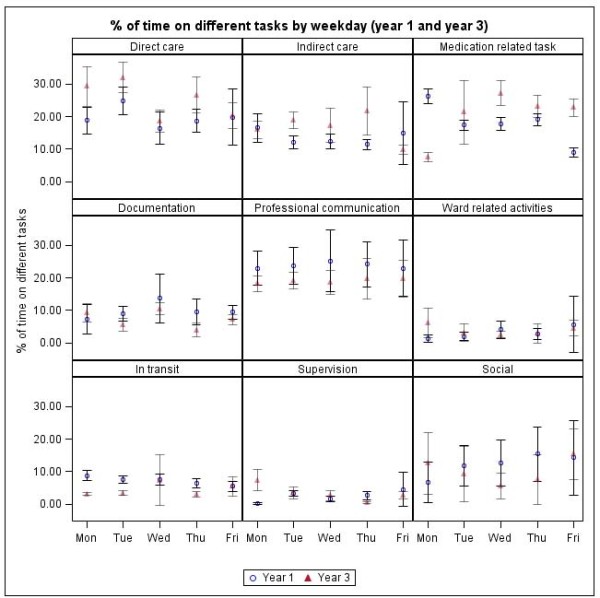
BACKGROUND: Time nurses spend with patients is associated with improved patient outcomes, reduced errors, and patient and nurse satisfaction. Few studies have measured how nurses distribute their time across tasks. We aimed to quantify how nurses distribute their time across tasks, with patients, in individual tasks, and engagement with other health care providers; and how work patterns changed over a two year period. METHODS: Prospective observational study of 57 nurses for 191.3 hours (109.8 hours in 2005/2006 and 81.5 in 2008), on two wards in a teaching hospital in Australia. The validated Work Observation Method by Activity Timing (WOMBAT) method was applied. Proportions of time in 10 categories of work, average time per task, time with patients and others, information tools used, and rates of interruptions and multi-tasking were calculated. RESULTS: Nurses spent 37.0%[95%CI: 34.5, 39.3] of their time with patients, which did not change in year 3 [35.7%; 95%CI: 33.3, 38.0]. Direct care, indirect care, medication tasks and professional communication together consumed 76.4% of nurses' time in year 1 and 81.0% in year 3. Time on direct and indirect care increased significantly (respectively 20.4% to 24.8%, P < 0.01;13.0% to 16.1%, P < 0.01). Proportion of time on medication tasks (19.0%) did not change. Time in professional communication declined (24.0% to 19.2%, P < 0.05). Nurses completed an average of 72.3 tasks per hour, with a mean task length of 55 seconds. Interruptions arose at an average rate of two per hour, but medication tasks incurred 27% of all interruptions. In 25% of medication tasks nurses multi-tasked. Between years 1 and 3 nurses spent more time alone, from 27.5%[95%CI 24.5, 30.6] to 39.4%[34.9, 43.9]. Time with health professionals other than nurses was low and did not change. CONCLUSIONS: Nurses spent around 37% of their time with patients which did not change. Work patterns were increasingly fragmented with rapid changes between tasks of short length. Interruptions were modest but their substantial over-representation among medication tasks raises potential safety concerns. There was no evidence of an increase in team-based, multi-disciplinary care. Over time nurses spent significantly less time talking with colleagues and more time alone.
Overview
The claims and statistics of this paper haven’t been checked yet.
Run the check — free, no account needed. It reads the open-access text and checks the sources it cites.
Integrity signals
Registry
Cites
Statistics
Figures
Verification
Claims the paper makes
The claims and statistics of this paper haven’t been checked yet.
Run the check — free, no account needed. It reads the open-access text and checks the sources it cites.
Claims other papers make about this one
Each is checked against this paper’s own text: does it say what the citing paper says it does?
In the citing paper
“Time studies in nursing highlight the considerable time spent on routine and administrative tasks, thereby supporting the use of AI in areas like monitoring and documentation [39, 40].”
From Nurses’ perceptions, experience and knowledge regarding artificial intelligence: results from a cross-sectional online survey in Germany (2024) · cites this paper as [39]
Self-check
Percentages, sums and reported differences re-computed from the paper’s own numbers.
The self-check needs the paper’s full text.
Citations
Cites
Hospital Nurse Staffing and Patient Mortality, Nurse Burnout, and Job Dissatisfaction
Aiken, L. H. (2002) · JAMA · doi:10.1001/jama.288.16.1987 · Cited by 5,226
Costs of a predictible switch between simple cognitive tasks.
Rogers, R. D., & Monsell, S. (1995) · Journal of Experimental Psychology: General · doi:10.1037/0096-3445.124.2.207 · Cited by 3,170
Monsell, S. (2003) · Trends in Cognitive Sciences · doi:10.1016/s1364-6613(03)00028-7 · Cited by 2,984
Nurse-Staffing Levels and the Quality of Care in Hospitals
Needleman, J., Buerhaus, P. I., Mattke, S., Stewart, M. T., & Zelevinsky, K. (2002) · New England Journal of Medicine · doi:10.1056/nejmsa012247 · Cited by 2,246
Shifting Intentional Set: Exploring the Dynamic Control of Tasks
(1994) · The MIT Press eBooks · doi:10.7551/mitpress/1478.003.0025 · Cited by 1,328
Association of Interruptions With an Increased Risk and Severity of Medication Administration Errors
Westbrook, J. I. (2010) · Archives of Internal Medicine · doi:10.1001/archinternmed.2010.65 · Cited by 772
Self-citation(1994) · The MIT Press eBooks · doi:10.7551/mitpress/1478.001.0001 · Cited by 749
Changes in executive control across the life span: Examination of task-switching performance.
Cepeda, N. J., Kramer, A. F., & Gonzalez de Sather, J. C. M. (2001) · Developmental Psychology · doi:10.1037/0012-1649.37.5.715 · Cited by 657
A 36-hospital time and motion study: how do medical-surgical nurses spend their time?
Hendrich, A., Chow, M. P., Skierczynski, B. A., & Lu, Z. (2008) · The Permanente Journal · doi:10.7812/tpp/08-021 · Cited by 530
Tips for learners of evidence-based medicine: 3. Measures of observer variability (kappa statistic)
McGinn, T. G. (2004) · Canadian Medical Association Journal · doi:10.1503/cmaj.1031981 · Cited by 482
Research works printed but not linked: 3
- Duffield C, Diers D, O'Brien-Pallas L, Aisbett C, Roche M, King M, Aisbett K: Nursing, the work environment and patient outcomes. App Nurs Res. 2011.
- Australian Institute for Health and Welfare: Health Expenditure Australia 2007-08. Health and Welfare Expenditure Series. 2009, Canberra: AIHW
- National Health and Hospitals Reform Commission: A healthier future for all Australians. 2009, Canberra: Commonwealth of Australia
Cited by
Sorted by citations
Allocation of Physician Time in Ambulatory Practice: A Time and Motion Study in 4 Specialties
Sinsky, C., Colligan, L., Li, L., Prgomet, M., Reynolds, S., Goeders, L., Westbrook, J., Tutty, M., & Blike, G. (2016) · Annals of Internal Medicine · doi:10.7326/m16-0961 · Cited by 1,494
Self-citationKieft, R., de Brouwer, B. J. M., Francke, A. L., & Delnoij, D. M. J. (2014) · BMC Health Services Research · doi:10.1186/1472-6963-14-249 · Cited by 436
The impact of electronic health record systems on clinical documentation times: a systematic review
Baumann, L. A., Baker, J., & Elshaug, A. G. (2018) · Health Policy · doi:10.1016/j.healthpol.2018.05.014 · Cited by 320
Dubovi, I., Levy, S. T., & Dagan, E. (2017) · Computers & Education · doi:10.1016/j.compedu.2017.05.009 · Cited by 213
Raban, M. Z., & Westbrook, J. I. (2013) · BMJ Quality & Safety · doi:10.1136/bmjqs-2013-002118 · Cited by 192
Self-citation
Metadata
- Authors
- Westbrook, J. I., Duffield, C., Li, L., & Creswick, N. J.
- Affiliations
- UNSW Sydney (AU)
- University of Technology Sydney (AU)
- Corresponding author
- Westbrook, Johanna I
- Venue
- BMC Health Services Research
- Published
- 2011-11-24
- Volume
- 11
- Issue
- 1
- Pages
- 319-319
- ISSN
- 1472-6963 (ISSN-L)
- PMC
- PMC3238335
- OpenAlex
- W2091893465
- Cited by
- 376
- References
- 39
- Citations by year
- 2026: 17 · 2025: 34 · 2024: 31 · 2023: 24 · 2022: 24 · 2021: 36 · 2020: 37 · 2019: 33 · 2018: 27 · 2017: 23 · 2016: 26 · 2015: 25 · 2014: 22 · 2013: 9 · 2012: 8
- FWCI
- 32.10
- Type
- journal article
- Language
- en
- Open access
- gold
- doi.org
- Licence
- Locations
- BMC Health Services Research (publishedVersion, cc-by)
- Europe PMC (PubMed Central) (publishedVersion, cc-by)
- PubMed Central (publishedVersion, cc-by)
- PubMed (publishedVersion)
- DOAJ (DOAJ: Directory of Open Access Journals) (submittedVersion)
- UTS ePRESS (University of Technology Sydney) (submittedVersion)
- Funders
- University of New South Wales
- Medical Research Council
- Australian Research Council
- National Health and Medical Research Council
- National Medical Research Council
- Topics
- Health Sciences › Nursing › Research and Theory › Nursing education and management
- Social Sciences › Decision Sciences › Management Science and Operations Research › Healthcare Operations and Scheduling Optimization
- Health Sciences › Health Professions › General Health Professions › Nursing Roles and Practices
- Keywords
- nurse-patient interaction, interruptions, multitasking, medication administration, professional communication, wombats, patient safety, quality of care, nursing satisfaction, patient satisfaction, patient outcomes
- MeSH terms
- Australia, Hospitals, Teaching, Humans, Interprofessional Relations, Nurse-Patient Relations, Nursing Care, Nursing Staff, Hospital, Prospective Studies, Time and Motion Studies, Nursing Methodology Research, Workload, Practice Patterns, Nurses'
About these checks
Registry, retraction, Cites and statistics results are computed, not judged, with one exception: a printed reference that no index lists is read once by a model before it counts as a citation error. Claims are extracted by a model and kept only when their quote appears verbatim in the text; each cited source is then checked, with a model’s help, for whether it says what the claim relies on. Those verdicts can be wrong — read the claim’s quote and the cited source before relying on one.
Statistics and arithmetic are recomputed, not judged.
Confidence bands are shown only for fields calibrated on our annotated test set. None is calibrated yet, so no band is shown.
What counts as a claim ›How we measure confidence ›How we check this ›
Are you an author, or do you see a problem with this page? Request a review
