

The DOI matches its Crossref record; 52 of the 52 references it cites were found in a registry or an index.
Group based diabetes self-management education compared to routine treatment for people with type 2 diabetes mellitus. A systematic review with meta-analysis
Open accessAbstract
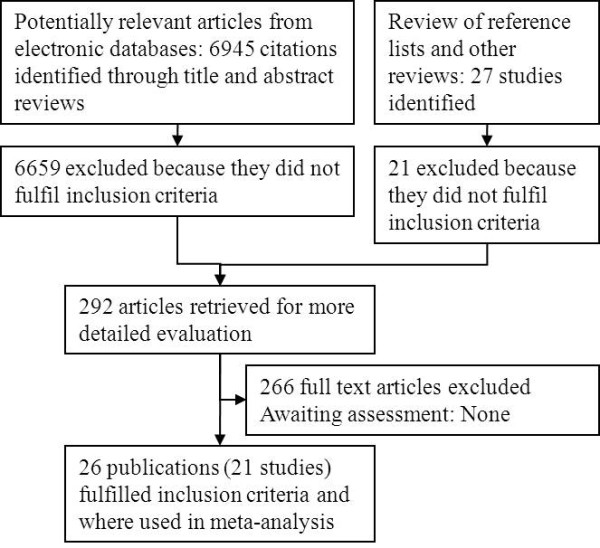
BACKGROUND: Diabetes self-management education (DSME) can be delivered in many forms. Group based DSME is widespread due to being a cheaper method and the added advantages of having patient meet and discuss with each other. assess effects of group-based DSME compared to routine treatment on clinical, lifestyle and psychosocial outcomes in type-2 diabetes patients. METHODS: A systematic review with meta-analysis. Computerised bibliographic database were searched up to January 2008 for randomised controlled trials evaluating group-based DSME for adult type-2 diabetics versus routine treatment where the intervention had at least one session and =/>6 months follow-up. At least two reviewers independently extracted data and assessed study quality. RESULTS: In total 21 studies (26 publications, 2833 participants) were included. Of all the participants 4 out of 10 were male, baseline age was 60 years, BMI 31.6, HbA1c 8.23%, diabetes duration 8 years and 82% used medication. For the main clinical outcomes, HbA1c was significantly reduced at 6 months (0.44% points; P=0.0006, 13 studies, 1883 participants), 12 months (0.46% points; P=0.001, 11 studies, 1503 participants) and 2 years (0.87% points; P<0.00001, 3 studies, 397 participants) and fasting blood glucose levels were also significantly reduced at 12 months (1.26 mmol/l; P<0.00001, 5 studies, 690 participants) but not at 6 months. For the main lifestyle outcomes, diabetes knowledge was improved significantly at 6 months (SMD 0.83; P=0.00001, 6 studies, 768 participants), 12 months (SMD 0.85; P<0.00001, 5 studies, 955 participants) and 2 years (SMD 1.59; P=0.03, 2 studies, 355 participants) and self-management skills also improved significantly at 6 months (SMD 0.55; P=0.01, 4 studies, 534 participants). For the main psychosocial outcomes, there were significant improvement for empowerment/self-efficacy (SMD 0.28, P=0.01, 2 studies, 326 participants) after 6 months. For quality of life no conclusion could be drawn due to high heterogeneity. For the secondary outcomes there were significant improvements in patient satisfaction and body weight at 12 months for the intervention group. There were no differences between the groups in mortality rate, body mass index, blood pressure and lipid profile. CONCLUSIONS: Group-based DSME in people with type 2 diabetes results in improvements in clinical, lifestyle and psychosocial outcomes.
Overview
The claims and statistics of this paper haven’t been checked yet.
Run the check — free, no account needed. It reads the open-access text and checks the sources it cites.
Integrity signals
Registry
Cites
Statistics
Figures
Verification
Claims the paper makes
The claims and statistics of this paper haven’t been checked yet.
Run the check — free, no account needed. It reads the open-access text and checks the sources it cites.
Claims other papers make about this one
Each is checked against this paper’s own text: does it say what the citing paper says it does?
In the citing paper
“For instance, diabetes education often uses group settings to reduce the pressure on health staff resources given the increasing numbers of people diagnosed with diabetes [4].”
From Telehealth Interventions Delivering Home-based Support Group Videoconferencing: Systematic Review (2018) · cites this paper as [4]
In the citing paper
“DSMES is associated with an increased use of primary care and preventive services (27,30,31) and less frequent use of acute care and inpatient hospital services (22).”
From 5. Facilitating Positive Health Behaviors and Well-being to Improve Health Outcomes:Standards of Care in Diabetes—2023 (2023) · cites this paper as [22]
In the citing paper
“DSMES is associated with improved diabetes knowledge and self-care behaviors (17), lower A1C (17-21), lower selfreported weight (22), improved quality of life (19,23,24), reduced all-cause mortality risk (25), positive coping behaviors (5,26), and reduced health care costs (27)(28)(29).”
From 5. Facilitating Positive Health Behaviors and Well-being to Improve Health Outcomes:Standards of Care in Diabetes—2023 (2023) · cites this paper as [22]
Self-check
Percentages, sums and reported differences re-computed from the paper’s own numbers.
The self-check needs the paper’s full text.
Citations
Cites
1 retracted
Group based training for self-management strategies in people with type 2 diabetes mellitus
Deakin, T. A., McShane, C. E., Cade, J. E., & Williams, R. (2005) · Cochrane Database of Systematic Reviews · doi:10.1002/14651858.cd003417.pub2 · Cited by 862
RetractedCochrane Handbook for Systematic Reviews of Interventions: Cochrane Book Series
(2008) · doi:10.1002/9780470712184 · Cited by 25,048
Developing and evaluating complex interventions: the new Medical Research Council guidance
Craig, P., Dieppe, P., Macintyre, S., Michie, S., Nazareth, I., & Petticrew, M. (2008) · BMJ · doi:10.1136/bmj.a1655 · Cited by 10,995 · cited 1×
“Educational programs are frequently defined as complex interventions where it is often difficult to define the 'active ingredient' framework [7].”
BackgroundCochrane Handbook for Systematic Reviews of Interventions Version 5.0.1. The Cochrane Collaboration
Higgins, J., Green, S. R., & Higgins, J. (2008) · Cited by 5,544
Assessing Risk of Bias in Included Studies
Higgins, J. P., & Altman, D. G. (2008) · Cochrane Handbook for Systematic Reviews of Interventions · doi:10.1002/9780470712184.ch8 · Cited by 3,396
Effectiveness of Self-Management Training in Type 2 Diabetes
Norris, S. L., Engelgau, M. M., & Venkat Narayan, K. M. (2001) · Diabetes Care · doi:10.2337/diacare.24.3.561 · Cited by 1,846
Analysing Data and Undertaking Meta‐Analyses
Deeks, J. J., Higgins, J. P., & Altman, D. G. (2008) · Cochrane Handbook for Systematic Reviews of Interventions · doi:10.1002/9780470712184.ch9 · Cited by 1,800
Self-Management Education for Adults With Type 2 Diabetes
Norris, S. L., Lau, J., Smith, S. J., Schmid, C. H., & Engelgau, M. M. (2002) · Diabetes Care · doi:10.2337/diacare.25.7.1159 · Cited by 1,750
National Standards for Diabetes Self-Management Education
Funnell, M. M., Brown, T. L., Childs, B. P., Haas, L. B., Hosey, G. M., Jensen, B., Maryniuk, M. D., Peyrot, M. F., Piette, J. D., Reader, D., et al. (2008) · Diabetes Care · doi:10.2337/dc09-s087 · Cited by 1,363
Behavioral treatment of obesity
Butryn, M. L., Webb, V., & Wadden, T. A. (2011) · Psychiatric Clinics of North America · doi:10.1016/j.psc.2011.08.006 · Cited by 636
Research works printed but not linked: 10
- International Diabetes Federation: Diabetes Atlas. Third Edition. 2006, Brussels: International Diabetes Federation
- World Health Organisation: Therapeutic Patient Education: Continuing Education Programmes for Healthcare Providers in the Field of Prevention of Chronic Diseases. Report of a WHO Working Group. 1998
- International Diabetes Federation: International Curriculum for Diabetes Health Professional Education. 2008, Brussels: International Diabetes Federation
- International Diabetes Federation: International Standards for Diabetes Education. 2009, Brussels: International Diabetes Federation
- Department of Health, Diabetes UK: Structured Patient Education in Diabetes. 2005, London: Department of Health
- Griffin SJ, Kinmonth AL, Skinner C, Kelly J: Educational and psychosocial interventions for adults with diabetes: report to the British Diabetic Association. 1998, London: British Diabetic Association
- Green S, Higgins JPT: Cochrane Handbook for Systematic Reviews of Interventions. 2008, Chichester: Wiley-Blackwell
- Pennings-van der Eerden LM, Ripken T, van Heijst MP, Schrijvers AP: Evaluation of the impact of a patient education programme for NIDDM patients on knowledge, self-care behaviour, metabolic control and lipid profiles. Gedran en gezondheid. 1991, 19: 246-260.
- Trento M, Passera P, Tomalino M, Pagnozzi F, Pomero F, Vaccari P, et al: Therapeutic group education in the follow-up of patients with non-insulin treated, non-insulin dependent diabetes mellitus. Diabetes Nutr Metab Clin Exp. 1998, 11: 212-216.
- Deakin TA, Cade JE, Williams DDR, Greenwood DC: Empowered patients:better diabetes control, greater freedom to eat, no weight gain!. Diabetologia. 2003, 46 (suppl 2): A90.
Cited by
Sorted by citations
Items 601–668 of 668
Psychiatric Care of the Patient with Diabetes
Maruyama, N. C., Ashley, K. B., Casasnovas, C. E., Goschin, S., Kraker, J., Quraishi, S. N., Safin, D. S., Shu, M. A., & Ferrando, S. J. (2017) · Springer eBooks · doi:10.1007/978-3-319-18741-9_46
Anyichie, N. E., Okafor, J. O., Ifemegbulem, V., Ibhafidon, A., EZE-UFODIAMA, S. C., & Iwuagwu, T. E. (2022) · Journal of Health, Medicine and Nursing · doi:10.7176/jhmn/98-04
Psychological Aspects of Diabetes
Chapman, A. (2017) · Springer eBooks · doi:10.1007/978-981-287-082-7_290
Torres, M. C. C., & Ganoza-Calero, A. M. (2020) · Universidad Peruana de Ciencias Aplicadas (UPC) · doi:10.19083/tesis/654659
Rezaeiaghdam, A. (2022) · Queensland University of Technology · doi:10.5204/thesis.eprints.231220
Tejada, F., & Arias, P. (2022) · Archives of Internal Medicine Research · doi:10.26502/aimr.0113
Gomille, L. K., Grammes, J., Lehnart, J., Binz, C., Koehn, S., Kubiak, T., & Benecke, A. (2022) · Diabetologie und Stoffwechsel · doi:10.1055/a-1928-9691
Amer, S. A., Aldehaim, L. A., Ghebawi, R. S. E., Alshammari, A. A., Eissa, N. A. E., & Amri, F. A. A. (2023) · ATHENS JOURNAL OF HEALTH & MEDICAL SCIENCES · doi:10.30958/ajhms.10-1-3
Saddam, A. H., Maatook, M. A., & Altemimi, M. T. (2023) · University of Thi-Qar Journal of Science · doi:10.32792/utq/utjsci/v10i1(si).966
Healthy Lifestyles for the Self-Management of Type 2 Diabetes
Galaviz, K. I., & Ali, M. K. (2023) · Springer eBooks · doi:10.1007/978-3-031-25519-9_31
Bett, S. J. (2019) · Digital Commons - Andrews University (Andrews University) · doi:10.32597/dnp/6/
Hati, A. K., Kristina, S. A., Yasin, N. M., & Lazuardi, L. (2023) · BIO Web of Conferences · doi:10.1051/bioconf/20237505008
Correia, L. I., Sá‐Couto, P., Marques, S. R. A., Raínho, M. C., & Simões, J. F. F. L. (2023) · Research Square · doi:10.21203/rs.3.rs-3705365/v1
Kiçaj, E., Saliaj, A., & Rogozea, L. M. (2024) · Preprints.org · doi:10.20944/preprints202401.0420.v1 · Cited by 1
Fajrin, M. S., Bamahry, A. R., Karsa, N. S., Rijal, S., Murfat, Z., Hasan, & Laurentz, H. (2022) · FAKUMI MEDICAL JOURNAL Jurnal Mahasiswa Kedokteran · doi:10.33096/fmj.v2i1.58
Effectiveness of Diabetes Mellitus Management Training On Health Cadres
Wahyuni, T. D., Jupriyono, J., & Rachman, M. Z. (2024) · EDUTEC Journal of Education And Technology · doi:10.29062/edu.v7i4.793
Agunanne, C. C., Anyigor-Ogah, C. S., Ozioko, I. A., Oguejiofor, N. C., Anyigor-Ogah, O., Agunanne, B. C., Nweke, C. O., & Idika, I. M. (2024) · Indian Journal of Medical Sciences · doi:10.25259/ijms_236_2024
Nam, E., Choi, C., & Lee, J. (2024) · 보건교육·건강증진학회지 · doi:10.14367/kjhep.2024.41.5.125
Nguyen, H. L., Tran, K. H., Nguyen, H. V., Luong, T. H. N., Tran, Q. V., Nguyen, T. H. H., & Ly, D. L. (2024) · Tạp chí Y Dược học Cần Thơ · doi:10.58490/ctump.2024i8ta.2916
Shrestha, D., Napit, I. B., Wang, Y., Ansari, S., Choudhury, S., Ilozumba, O., Gill, P. S., Sartori, J., Griffiths, F. E., Watson, S., et al. (2025) · SSRN Electronic Journal · doi:10.2139/ssrn.5270385
Hu, J., Mion, L. C., Tan, A., Bartle‐Haring, S., Miller, C. K., & Joseph, J. J. (2025) · Contemporary Clinical Trials · doi:10.1016/j.cct.2025.108029
Thylefors, J., Gershater, M. A., Mangrio, E., & Zdravkovic, S. (2025) · Scandinavian Journal of Primary Health Care · doi:10.1080/02813432.2025.2572514
Nair, P., Sree Valsalan, B., & Arora, R. (2025) · IP Journal of Nutrition Metabolism and Health Science · doi:10.18231/j.ijnmhs.12941.1761023022
EDUCAÇÃO EM SAÚDE NO DIABETES MELLITUS TIPO 2: UM RELATO DE EXPERIÊNCIA
TRINDADE, M. E. D. S., Colpo, E., & MENEZES, C. D. R. (2025) · doi:10.48195/sepe2025.29982
Hadziabdic, E., & Hjelm, K. (2025) · Primary Health Care Research & Development · doi:10.1017/s1463423625100595
Enquiry: Why Aren’t People Attending? It’s Good for Their Health!
Bull, E. R., Hall, J., Mallon, R., Walton-Taylor, L., & Scholten, N. (2025) · Springer eBooks · doi:10.1007/978-3-031-94529-8_16
Coxon, A., McBain, H., Pavlova, N. T., Rowlands, H., & Mulligan, K. (2020) · Figshare · doi:10.6084/m9.figshare.12720076
Coningsby, I., Ainsworth, B., & Dack, C. (2022) · Figshare · doi:10.6084/m9.figshare.19695609
Coxon, A., McBain, H., Pavlova, N. T., Rowlands, H., & Mulligan, K. (2020) · Figshare · doi:10.6084/m9.figshare.12720073
Stepanian, N., Larsen, M. H., Mendelsohn, J., Mariussen, K. L., & Heggdal, K. (2024) · Figshare · doi:10.6084/m9.figshare.26612906
Laursen, S. H., Giese, I. E., Udsen, F. W., Hejlesen, O. K., Barington, P. F., Ohrt, M., Vestergaard, P., & Hangaard, S. (2024) · Figshare · doi:10.6084/m9.figshare.25884932
Stepanian, N., Larsen, M. H., Mendelsohn, J., Mariussen, K. L., & Heggdal, K. (2024) · Figshare · doi:10.6084/m9.figshare.26612909
Yu, X., Chau, J. P. C., Huo, L., Li, X., Wang, D., Wu, H., & Zhang, Y. (2022) · Figshare · doi:10.6084/m9.figshare.20444329
Li, Y., Buys, N., Ferguson, S., Li, Z., Shi, Y., Li, L., & Sun, J. (2024) · Figshare · doi:10.6084/m9.figshare.26604535
Stepanian, N., Larsen, M. H., Mendelsohn, J., Mariussen, K. L., & Heggdal, K. (2024) · Figshare · doi:10.6084/m9.figshare.26612912
Shima, T., Ohya, A., Makino, H., Omura‐Ohata, Y., Tamanaha, T., Tochiya, M., Koezuka, R., Matsubara, M., Tomita, T., Noguchi, M., et al. (2026) · BMC Psychology · doi:10.1186/s40359-025-03930-3
Nguyen, A. P.-U., Tran, T.-M., Tu, Q. V., Vo, T., Tran, C., Liu, Y. M., & Nguyen, T. H. (2026) · Diabetology · doi:10.3390/diabetology7020034
Hsu, S.-H., Chiang, C.-H., Lin, C.-H., Huang, S.-H., Keller, J. J., Wang, L., & Tang, K.-P. (2026) · BMC Medical Informatics and Decision Making · doi:10.1186/s12911-026-03426-z
Pravinbhai, C. U., C., P. J., Shoba Graciah, A., Singh, M. S., Chanu, C. A., Lucas, P., Sharma, T. C., Sharma, S., Prabha, N., Jaivin Jaisingh, J., et al. (2026) · International Journal of Research in Medical Sciences · doi:10.18203/2320-6012.ijrms20261001
Elnaem, M. H., Barakat, M., AbouKhatwa, M. M., Hammour, K. A., Barakat, Y., & Farha, R. K. A. (2026) · Critical Public Health · doi:10.1080/09581596.2026.2658905
Type 2 diabetes mellitus Awareness in a Sample of South Asians in the United States
Peter, E., Sripathi, P., Srivastava, A., Dong, F., & Othman, M. (2026) · Scientific Reports · doi:10.1038/s41598-026-52175-6
Panjaitan, Y. R., Sari, R. D. I., & Lase, K. Y. (2025) · The International Journal of Medical Science and Health Research · doi:10.70070/ehg2p341
Hangaard, S., Giese, I. E., Barington, P. F., Vestergaard, P., & Laursen, S. H. (2026) · Primary care diabetes · doi:10.1016/j.pcd.2026.05.004
Ostrowska, J., Kobos, E., Pietrzak, M., Szymczak, A., Wiktorzak, K., & González, M. M. P. (2026) · Scientific Reports · doi:10.1038/s41598-026-55083-x
Giese, I. E., Laursen, S. H., Barington, P. F., Vestergaard, P., & Hangaard, S. (2026) · JMIR Formative Research · doi:10.2196/89964
Kruse‐Diehr, A. J., Rabin, B. A., ELLIOTT, J., DRAKEFORD, V. H., Wright, L. S., McKune, B. L., Glasgow, R. E., Douthitt, K. C., Keck, J. W., & LACY, M. E. (2026) · Implementation Science Communications · doi:10.1186/s43058-026-00978-z
Toring, C. J. T., & Lim-Pacoli, M. R. (2026) · Philippine Journal of Internal Medicine · doi:10.65564/pjim.d369755fa1
Behavior Modifications From CUT-DM, Including Lifestyle Modification and Self-Efficacy
Vidovic, J., Vasconcelos, A. G., Berberian, P., Comstock, B. A., Montour, L., Wright, L. A.-C., & Ehrhardt, N. M. (2026) · Diabetes Obesity and Cardiometabolic CARE · doi:10.2337/doc25-0093
Vysochyna, I. L., Kramarchuk, V. V., & Yashkina, T. O. (2026) · Перспективи та інновації науки · doi:10.52058/2786-4952-2026-5(63)-2217-2228
Panzardi, M., Gomez, A., Borsuk, C., DURGAN, A., Staab, E. M., Thomas, N. C., KASIR, C. D., Wan, W., Quinn, M. T., Guzman, I. A., et al. (2026) · Frontiers in Clinical Diabetes and Healthcare · doi:10.3389/fcdhc.2026.1784495
Exploring the Benefits of Digital Health Technologies in Diabetes Management
(2026) · Frontiers research topics · doi:10.3389/978-2-8325-8238-1
Raghav, S., Kumar, S., Ashraf, H., Khanna, P., & Raghav, A. (2026) · Frontiers in Clinical Diabetes and Healthcare · doi:10.3389/fcdhc.2026.1825788
Pahn, J., Yang, Y., Ahn, J., Kim, J. Y., & Jang, Y. (2026) · Health Education Research · doi:10.1093/her/cyag022
NURSE-LED DIABETES SELF-MANAGEMENT EDUCATION AND SELF-CARE SUPPORT IN DIABETES CARE
Alharbi, R. F., Mutairi, S. M. A., Albugami, R. M., Awaji, F. Y., Shammari, D. M. A., AlDossary, M. S., Alanazi, M. S., Farhan, A. F. A., Aljohani, A. H., & AlGumosani, R. W. (2026) · International Journal of Advanced Research · doi:10.21474/ijar01/23656
Phuentsho, K., Karran, E. L., Appiah, R. P., Fernandez, M., Graham, K., Kumar, S., Sharma, S., Williams, A. C. D. C., Aparnadas, A., & Moseley, G. L. (2026) · Journal of Immigrant and Minority Health · doi:10.1007/s10903-026-01985-x
Ali, A. A. A., Alkhateeb, A. F., Alsaad, S., Albahussain, A., & Almadhi, A. S. (2026) · Cureus · doi:10.7759/cureus.116567
Alsagaihe, K. A., Albahar, S. W., Alhajri, N. J., & Albahar, I. W. (2026) · doi:10.65759/w88k4k42
Lingaiyan, R., Kaur, M., & Chandey, M. (2026) · Student s Journal of Health Research Africa · doi:10.51168/sc909333
Mavilian, C., Guevara-Plunkett, S., Altom, K., Horiuchi, K. M., Woo, K., & Keller, M. S. (2026) · Journal of General Internal Medicine · doi:10.1007/s11606-026-10963-w
Nachiappan, N., Scott, D. A., Stone, M., & Chockalingam, N. (2026) · Journal of Evaluation in Clinical Practice · doi:10.1111/jep.70724
Do-Golden, B., Woodrow, C., Settles, J., Rubio-Diaz, M., Argaiz, A., Kipke, M. D., & Wolfe, N. (2026) · Frontiers in Public Health · doi:10.3389/fpubh.2026.1968391
Fathi, Z., Nikyar, H., Siavash, M., & Akbari, M. (2026) · Research Square · doi:10.21203/rs.3.rs-11278400/v1
Diabetes Self-Management Education Program
Williams, L. F. (2015) · ScholarWorks (Walden University)
Metadata
- Authors
- Steinsbekk, A., Rygg, L., Lisulo, M., Rise, M. B., & Fretheim, A.
- Affiliations
- Norwegian University of Science and Technology (NO)
- University of Oslo (NO)
- Corresponding author
- Steinsbekk, Aslak
- Venue
- BMC Health Services Research
- Published
- 2012-07-23
- Volume
- 12
- Issue
- 1
- Pages
- 213-213
- ISSN
- 1472-6963 (ISSN-L)
- PMC
- PMC3418213
- OpenAlex
- W2025306913
- Cited by
- 660
- References
- 52
- Citations by year
- 2026: 23 · 2025: 28 · 2024: 28 · 2023: 46 · 2022: 48 · 2021: 52 · 2020: 71 · 2019: 67 · 2018: 59 · 2017: 63 · 2016: 56 · 2015: 53 · 2014: 43 · 2013: 21 · 2012: 1
- FWCI
- 5.24
- Type
- journal article
- Language
- en
- Open access
- gold
- doi.org
- Licence
- Locations
- BMC Health Services Research (publishedVersion, cc-by)
- PubMed Central (publishedVersion, cc-by)
- PubMed (publishedVersion)
- BIBSYS Brage (BIBSYS (Norway)) (submittedVersion, cc-by)
- DOAJ (DOAJ: Directory of Open Access Journals) (submittedVersion)
- NORA - Norwegian Open Research Archives (submittedVersion, other-oa)
- NORA - Norwegian Open Research Archives (submittedVersion, cc-by)
- Funders
- Deakin University
- Topics
- Health Sciences › Medicine › Endocrinology, Diabetes and Metabolism › Diabetes Management and Education
- Health Sciences › Medicine › Endocrinology, Diabetes and Metabolism › Diabetes Management and Research
- Health Sciences › Medicine › Endocrinology, Diabetes and Metabolism › Diabetes Treatment and Management
- Keywords
- type 2 diabetes, HbA1c, glycemic control, fasting blood glucose, diabetes knowledge, self-management skills, psychosocial outcomes, patient education, cost-effectiveness, patient satisfaction, quality of life
- MeSH terms
- Adult, Diabetes Mellitus, Type 2, Diagnostic Tests, Routine, Female, Group Processes, Humans, Health Knowledge, Attitudes, Practice, Male, Patient Education as Topic, Power, Psychological, Quality of Life, Self Care, Randomized Controlled Trials as Topic, Outcome Assessment, Health Care
About these checks
Registry, retraction, Cites and statistics results are computed, not judged, with one exception: a printed reference that no index lists is read once by a model before it counts as a citation error. Claims are extracted by a model and kept only when their quote appears verbatim in the text; each cited source is then checked, with a model’s help, for whether it says what the claim relies on. Those verdicts can be wrong — read the claim’s quote and the cited source before relying on one.
Statistics and arithmetic are recomputed, not judged.
Confidence bands are shown only for fields calibrated on our annotated test set. None is calibrated yet, so no band is shown.
What counts as a claim ›How we measure confidence ›How we check this ›
Are you an author, or do you see a problem with this page? Request a review
