

The DOI matches its Crossref record; 31 of the 32 references it cites were found in a registry or an index.
The development of a lay health worker delivered collaborative community based intervention for people with schizophrenia in India
Open accessAbstract
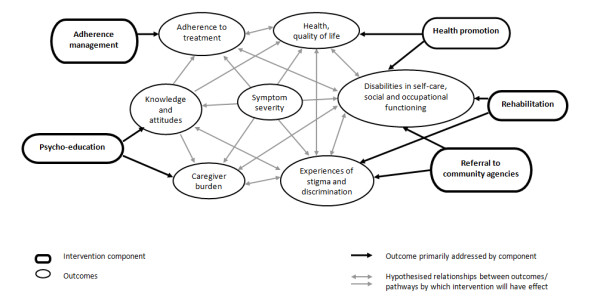
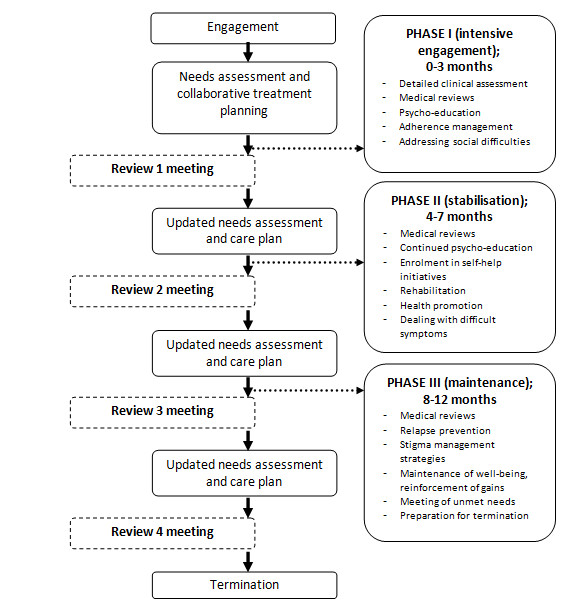
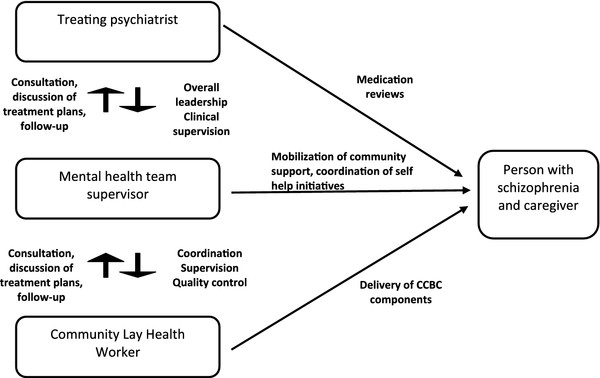
Background: Care for schizophrenia in low and middle income countries is predominantly facility based and led by specialists, with limited use of non-pharmacological treatments. Although community based psychosocial interventions are emphasised, there is little evidence about their acceptability and feasibility. Furthermore, the shortage of skilled manpower is a major barrier to improving access to these interventions. Our study aimed to develop a lay health worker delivered community based intervention in three sites in India. This paper describes how the intervention was developed systematically, following the MRC framework for the development of complex interventions. Methods: We reviewed the lierature on the burden of schizophrenia and the treatment gap in low and middle income countries and the evidence for community based treatments, and identified intervention components. We then evaluated the acceptability and feasibility of this package of care through formative case studies with individuals with schizophrenia and their primary caregivers and piloted its delivery with 30 families. Results: Based on the reviews, our intervention comprised five components (psycho-education; adherence management; rehabilitation; referral to community agencies; and health promotion) to be delivered by trained lay health workers supervised by specialists. The intervention underwent a number of changes as a result of formative and pilot work. While all the components were acceptable and most were feasible, experiences of stigma and discrimination were inadequately addressed; some participants feared that delivery of care at home would lead to illness disclosure; some participants and providers did not understand how the intervention related to usual care; some families were unwilling to participate; and there were delivery problems, for example, in meeting the targeted number of sessions. Participants found delivery by health workers acceptable, and expected them to have knowledge about the subject matter. Some had expectations regarding their demographic and personal characteristics, for example, preferring only females or those who are understanding/friendly. New components to address stigma were then added to the intervention, the collaborative nature of service provision was strengthened, a multi-level supervision system was developed, and delivery of components was made more flexible. Criteria were evolved for the selection and training of the health workers based on participants' expectations. Conclusions: A multi-component community based intervention, targeting multiple outcomes, and delivered by trained lay health workers, supervised by mental health specialists, is an acceptable and feasible intervention for treating schizophrenia in India.
Overview
The claims and statistics of this paper haven’t been checked yet.
Run the check — free, no account needed. It reads the open-access text and checks the sources it cites.
Integrity signals
Registry
Cites
Statistics
Figures
Verification
Claims the paper makes
The claims and statistics of this paper haven’t been checked yet.
Run the check — free, no account needed. It reads the open-access text and checks the sources it cites.
Claims other papers make about this one
Each is checked against this paper’s own text: does it say what the citing paper says it does?
The source backs part of the claim, not all of it — or backs it for a different population, condition or comparison.
In the citing paper
“The Chaudoir et al. [35] framework is particularly helpful for task-sharing because it explicitly includes the characteristics of the providers, which have been found to influence implementation and intervention (i.e., client and service) outcomes [10, 36–38].”
From Barriers and facilitators to implementation of evidence-based task-sharing mental health interventions in low- and middle-income countries: a systematic review using implementation science frameworks (2022) · cites this paper as [10]
Experimental — accuracy not yet measuredIn the citing paper
“For people with severe mental disorders the key factors facilitating effectiveness are rather similar and include: psycho-education interventions; adherence management; rehabilitation; referral to community agencies; and health promotion 44 .”
From Integrated care for people with long-term mental and physical health conditions in low-income and middle-income countries (2019) · cites this paper as [44]
Self-check
Percentages, sums and reported differences re-computed from the paper’s own numbers.
The self-check needs the paper’s full text.
Citations
Cites
Framework for design and evaluation of complex interventions to improve health
Campbell, M. (2000) · BMJ · doi:10.1136/bmj.321.7262.694 · Cited by 3,474
The world health report 2001 - Mental health: new understanding, new hope
Sayers, J. (2001) · Europe PMC (PubMed Central) · doi:10.1590/s0042-96862001001100014 · Cited by 3,307
Introduction to Qualitative Research Methods
Taylor, S. J., Bogdan, R., & DeVault, M. L. (2015) · Wiley eBooks · doi:10.1002/9781394260485 · Cited by 3,070
Pope, C., & Mays, N. (1995) · BMJ · doi:10.1136/bmj.311.6996.42 · Cited by 2,336
A Systematic Review of the Prevalence of Schizophrenia
Saha, S., Chant, D., Welham, J., & McGrath, J. (2005) · PLoS Medicine · doi:10.1371/journal.pmed.0020141 · Cited by 2,168
Introduction to qualitative research methods : the search for meanings
Taylor, S. J., & Bogdan, R. (1984) · Medical Entomology and Zoology · Cited by 1,660
Introduction to qualitative research methods : the search for meanings
Taylor, S. J., & Bogdan, R. (1984) · Cited by 1,640
Mental Health: New Understanding, New Hope
Brundtland, G. H. (2001) · JAMA · doi:10.1001/jama.286.19.2391 · Cited by 1,606
Treatment gap in mental health care.
Abramowitz, M. Z., Greenberg, D., & Levav, I. (2008) · PubMed · Cited by 1,483
The treatment gap in mental health care.
(2004) · Europe PMC (PubMed Central) · Cited by 1,419
Models of Community Care for Severe Mental Illness: A Review of Research on Case Management
Mueser, K. T., Bond, G. R., Drake, R. E., & Resnick, S. G. (1998) · Schizophrenia Bulletin · doi:10.1093/oxfordjournals.schbul.a033314 · Cited by 859
Scale up of services for mental health in low-income and middle-income countries
Eaton, J., McCay, L., Semrau, M., Chatterjee, S., Baingana, F., Araya, R., Ntulo, C., Thornicroft, G., & Saxena, S. (2011) · The Lancet · doi:10.1016/s0140-6736(11)60891-x · Cited by 698
Self-citationPsychoeducation for schizophrenia
Xia, J., Merinder, L. B., & Belgamwar, M. R. (2011) · Cochrane Database of Systematic Reviews · doi:10.1002/14651858.cd002831.pub2 · Cited by 669
Medical complications of anorexia nervosa and bulimia nervosa
Mitchell, J. E., & Crow, S. J. (2006) · Current Opinion in Psychiatry · doi:10.1097/01.yco.0000228768.79097.3e · Cited by 495
Family-Based Intervention for Schizophrenic Patients in China: A Randomised Controlled Trial
Xiong, W., Phillips, M. R., Hu, X., Wang, R., Dai, Q., Kleinman, J., & Kleinman, A. (1994) · British Journal of Psychiatry · doi:10.1192/bjp.165.2.239 · Cited by 341
An overview of family interventions and relapse on schizophrenia: meta-analysis of research findings
Mari, J. D. J., & Streiner, D. L. (1994) · Psychological Medicine · doi:10.1017/s0033291700027720 · Cited by 265
Psychoeducation for schizophrenia
Pekkala, E. T., & Merinder, L. B. (2002) · Cochrane Database of Systematic Reviews · doi:10.1002/14651858.cd002831 · Cited by 235
Evaluation of a community-based rehabilitation model for chronic schizophrenia in rural India
Chatterjee, S., Patel, V., Chatterjee, A., & Weiss, H. A. (2003) · The British Journal of Psychiatry · doi:10.1192/bjp.182.1.57 · Cited by 205
Self-citationRan, M., Xiang, M., Chan, C., Leff, J., Simpson, P., Huang, M., Shan, Y.-H., & Li, S. (2003) · Social Psychiatry and Psychiatric Epidemiology · doi:10.1007/s00127-003-0601-z · Cited by 195
World Health Organization's Mental Health Atlas 2005:implications for policy development.
Saxena, S., Sharan, P., Garrido‐Cumbrera, M., & Saraceno, B. (2006) · PubMed · Cited by 172
Chatterjee, S., Pillai, A., Jain, S., Cohen, A., & Patel, V. (2009) · The British Journal of Psychiatry · doi:10.1192/bjp.bp.108.057596 · Cited by 172
Self-citationCommunity mental health team management in severe mental illness: A systematic review
Simmonds, S., Coid, J., Joseph, P. L. A., Marriott, S., & Petertyrer (2001) · The British Journal of Psychiatry · doi:10.1192/bjp.178.6.497 · Cited by 155
Kulhara, P., Chakrabarti, S., Avasthi, A., Sharma, A. K., & Sharma, S. (2008) · Acta Psychiatrica Scandinavica · doi:10.1111/j.1600-0447.2008.01304.x · Cited by 152
Ten‐year course of schizophrenia—the Madras longitudinal study
THARA, R., Henrietta, M., Joseph, A. S., Rajkumar, S., & Eaton, W. W. (1994) · Acta Psychiatrica Scandinavica · doi:10.1111/j.1600-0447.1994.tb01602.x · Cited by 138
Chien, W. T., Chan, S. W., & Thompson, D. R. (2006) · The British Journal of Psychiatry · doi:10.1192/bjp.bp.105.008375 · Cited by 125
Physical health and schizophrenia
Mitchell, A. J., & Malone, D. (2006) · Current Opinion in Psychiatry · doi:10.1097/01.yco.0000228767.71473.9e · Cited by 112
Packages of Care for Schizophrenia in Low- and Middle-Income Countries
Mari, J. D. J., Razzouk, D., Thara, R., Eaton, J., & Thornicroft, G. (2009) · PLoS Medicine · doi:10.1371/journal.pmed.1000165 · Cited by 91
Self-citationCost of care of schizophrenia: a study of Indian out‐patient attenders
Grover, S., Avasthi, A., Chakrabarti, S., Bhansali, A. K., & Kulhara, P. (2005) · Acta Psychiatrica Scandinavica · doi:10.1111/j.1600-0447.2005.00512.x · Cited by 79
Xiang, Y., Weng, Y., Li, W.-Y., Gao, L., Chen, G.-L., Xie, L., Chang, Y.-L., Tang, W. K., & Ungvari, G. S. (2006) · The British Journal of Psychiatry · doi:10.1192/bjp.bp.106.023697 · Cited by 61
The COmmunity care for People with Schizophrenia in India (COPSI) group, Chatterjee, S., Leese, M., Koschorke, M., McCrone, P., Naik, S., John, S., Dabholkar, H., Goldsmith, K., Balaji, M., et al. (2011) · Trials · doi:10.1186/1745-6215-12-12 · Cited by 60
Self-citationWhat Is the Best Approach to Treating Schizophrenia in Developing Countries?
Patel, V., Farooq, S., & THARA, R. (2007) · PLoS Medicine · doi:10.1371/journal.pmed.0040159 · Cited by 46
Self-citationCornelius, V. R., Sauzet, O., Ayis, S. A., Ross, J. R., Farquhar-Smith, P. W., Branford, R., Williams, J. E., & Peacock, J. L. (2011) · Trials · doi:10.1186/1745-6215-12-s1-a12 · Cited by 10
Cited by
Sorted by citations
Kazdin, A. E. (2017) · Behaviour Research and Therapy · doi:10.1016/j.brat.2016.06.004 · Cited by 554
Novel Models for Delivering Mental Health Services and Reducing the Burdens of Mental Illness
Kazdin, A. E., & Rabbitt, S. M. (2013) · Clinical Psychological Science · doi:10.1177/2167702612463566 · Cited by 465
Barnett, M. L., Gonzalez, A., Miranda, J., Chavira, D. A., & Lau, A. S. (2018) · Administration and Policy in Mental Health and Mental Health Services Research · doi:10.1007/s10488-017-0815-0 · Cited by 431
Addressing critical gaps in the treatment of eating disorders
Kazdin, A. E., Fitzsimmons‐Craft, E. E., & Wilfley, D. E. (2017) · International Journal of Eating Disorders · doi:10.1002/eat.22670 · Cited by 389
Community mental health care worldwide: current status and further developments
Thornicroft, G., Deb, T., & Henderson, C. (2016) · World Psychiatry · doi:10.1002/wps.20349 · Cited by 374
Self-citation
Metadata
- Authors
- Balaji, M., Chatterjee, S., Koschorke, M., Rangaswamy, T., Chavan, A., Dabholkar, H., Dakshin, L., Kumar, P., John, S., Thornicroft, G., & Patel, V.
- Affiliations
- Sangath (IN)
- London School of Hygiene & Tropical Medicine (GB)
- Schizophrenia Research Foundation (IN)
- King's College London (GB)
- Corresponding author
- Patel, Vikram
- ORCID
- Venue
- BMC Health Services Research
- Published
- 2012-02-16
- Volume
- 12
- Issue
- 1
- Pages
- 42-42
- ISSN
- 1472-6963 (ISSN-L)
- PMC
- PMC3312863
- OpenAlex
- W2146617657
- Cited by
- 156
- References
- 31
- Citations by year
- 2026: 3 · 2025: 9 · 2024: 4 · 2023: 7 · 2022: 6 · 2021: 36 · 2020: 14 · 2019: 19 · 2018: 8 · 2017: 14 · 2016: 8 · 2015: 12 · 2014: 10 · 2013: 4 · 2012: 2
- FWCI
- 6.40
- Type
- journal article
- Language
- en
- Open access
- gold
- doi.org
- Licence
- Locations
- BMC Health Services Research (publishedVersion, cc-by)
- Europe PMC (PubMed Central) (publishedVersion, cc-by)
- PubMed Central (publishedVersion, cc-by)
- PubMed (publishedVersion)
- LSHTM Research Online (London School of Hygiene and Tropical Medicine) (acceptedVersion)
- Minerva Access (University of Melbourne) (submittedVersion, cc-by)
- DOAJ (DOAJ: Directory of Open Access Journals) (submittedVersion)
- Research Portal (King's College London) (submittedVersion)
- Greater South Information System
- Funders
- South London and Maudsley NHS Foundation Trust
- Wellcome Trust (084355, 091834, 084355/Z/07/Z)
- National Institute for Health and Care Research (NF-SI-0611-10053)
- Topics
- Health Sciences › Medicine › Psychiatry and Mental health › Schizophrenia research and treatment
- Health Sciences › Medicine › Psychiatry and Mental health › Mental Health Treatment and Access
- Social Sciences › Psychology › Clinical Psychology › Psychiatric care and mental health services
- Keywords
- schizophrenia, lay health workers, intervention development, feasibility and acceptability, stigma and discrimination, family caregivers, medication adherence, psychoeducation, psychiatric rehabilitation, health worker training and supervision, treatment gap, India
- MeSH terms
- Community Health Workers, Developing Countries, Female, Humans, India, Interviews as Topic, Male, Pilot Projects, Schizophrenia, Schizophrenic Psychology, Staff Development, Program Evaluation, Program Development, Caregivers, Patient Satisfaction, Social Stigma
About these checks
Registry, retraction, Cites and statistics results are computed, not judged, with one exception: a printed reference that no index lists is read once by a model before it counts as a citation error. Claims are extracted by a model and kept only when their quote appears verbatim in the text; each cited source is then checked, with a model’s help, for whether it says what the claim relies on. Those verdicts can be wrong — read the claim’s quote and the cited source before relying on one.
Statistics and arithmetic are recomputed, not judged.
Confidence bands are shown only for fields calibrated on our annotated test set. None is calibrated yet, so no band is shown.
What counts as a claim ›How we measure confidence ›How we check this ›
Are you an author, or do you see a problem with this page? Request a review
