

The DOI matches its Crossref record; 52 of the 53 references it cites were found in a registry or an index.
The influence of age, gender and socio-economic status on multimorbidity patterns in primary care. first results from the multicare cohort study
Open accessAbstract
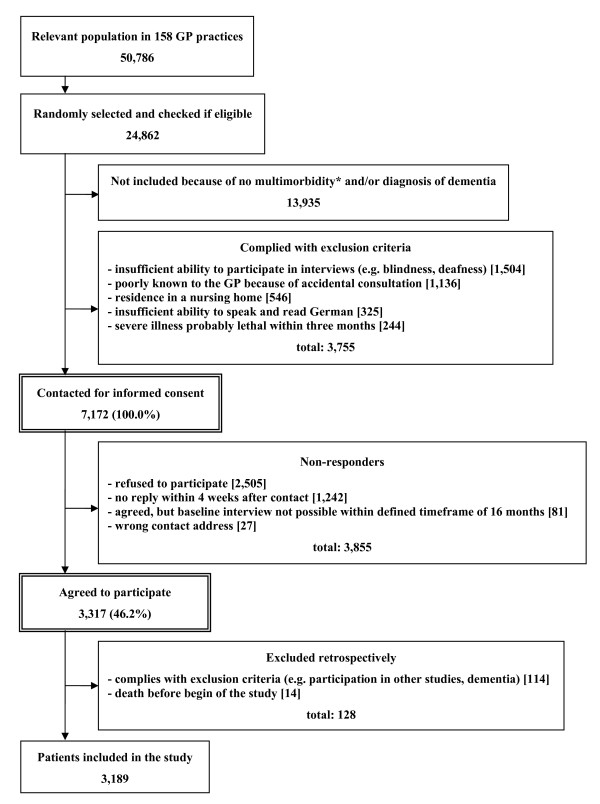
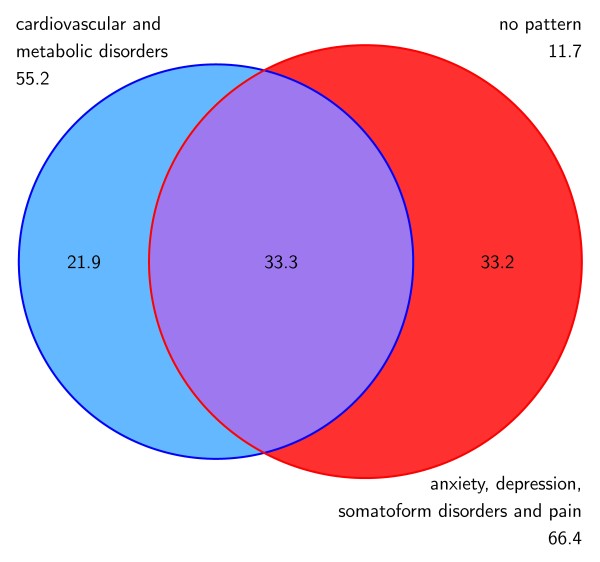
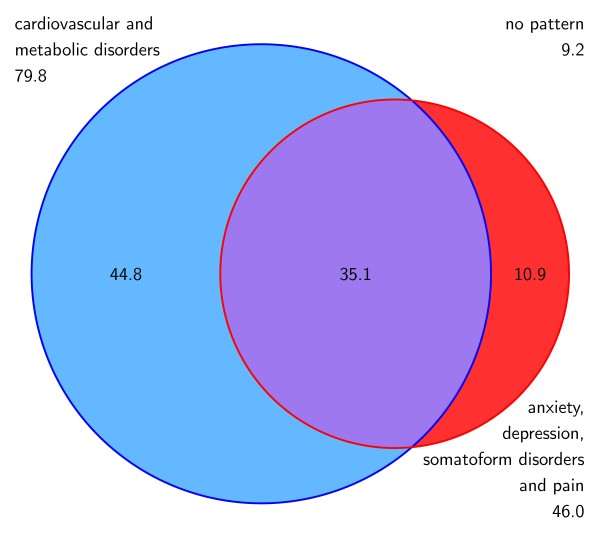
BACKGROUND: Multimorbidity is a phenomenon with high burden and high prevalence in the elderly. Our previous research has shown that multimorbidity can be divided into the multimorbidity patterns of 1) anxiety, depression, somatoform disorders (ADS) and pain, and 2) cardiovascular and metabolic disorders. However, it is not yet known, how these patterns are influenced by patient characteristics. The objective of this paper is to analyze the association of socio-demographic variables, and especially socio-economic status with multimorbidity in general and with each multimorbidity pattern. METHODS: The MultiCare Cohort Study is a multicentre, prospective, observational cohort study of 3.189 multimorbid patients aged 65+ randomly selected from 158 GP practices. Data were collected in GP interviews and comprehensive patient interviews. Missing values have been imputed by hot deck imputation based on Gower distance in morbidity and other variables. The association of patient characteristics with the number of chronic conditions is analysed by multilevel mixed-effects linear regression analyses. RESULTS: Multimorbidity in general is associated with age (+0.07 chronic conditions per year), gender (-0.27 conditions for female), education (-0.26 conditions for medium and -0.29 conditions for high level vs. low level) and income (-0.27 conditions per logarithmic unit). The pattern of cardiovascular and metabolic disorders shows comparable associations with a higher coefficient for gender (-1.29 conditions for female), while multimorbidity within the pattern of ADS and pain correlates with gender (+0.79 conditions for female), but not with age or socioeconomic status. CONCLUSIONS: Our study confirms that the morbidity load of multimorbid patients is associated with age, gender and the socioeconomic status of the patients, but there were no effects of living arrangements and marital status. We could also show that the influence of patient characteristics is dependent on the multimorbidity pattern concerned, i.e. there seem to be at least two types of elderly multimorbid patients. First, there are patients with mainly cardiovascular and metabolic disorders, who are more often male, have an older age and a lower socio-economic status. Second, there are patients mainly with ADS and pain-related morbidity, who are more often female and equally distributed across age and socio-economic groups. TRIAL REGISTRATION: ISRCTN89818205.
Overview
The claims and statistics of this paper haven’t been checked yet.
Run the check — free, no account needed. It reads the open-access text and checks the sources it cites.
Integrity signals
Registry
Cites
Statistics
Figures
Verification
Claims the paper makes
The claims and statistics of this paper haven’t been checked yet.
Run the check — free, no account needed. It reads the open-access text and checks the sources it cites.
Claims other papers make about this one
Each is checked against this paper’s own text: does it say what the citing paper says it does?
The source backs part of the claim, not all of it — or backs it for a different population, condition or comparison.
In the citing paper
“Fourth, adults are more likely to have comorbidities45, 46 that lead to immunodeficiencies and increase the risk of opportunistic infections.47”
From Global burden of bacterial antimicrobial resistance 1990–2021: a systematic analysis with forecasts to 2050 (2024) · cites this paper as [45]
Experimental — accuracy not yet measured
Self-check
Percentages, sums and reported differences re-computed from the paper’s own numbers.
The self-check needs the paper’s full text.
Citations
Cites
International physical activity questionnaire: 12-country reliability and validity
CRAIG, C. L., MARSHALL, A. L., SJ??STR??M, M., BAUMAN, A. E., BOOTH, M. L., AINSWORTH, B. E., PRATT, M., EKELUND, U., YNGVE, A., SALLIS, J. F., et al. (2003) · Medicine & Science in Sports & Exercise · doi:10.1249/01.mss.0000078924.61453.fb · Cited by 21,619
Assessment of Older People: Self-Maintaining and Instrumental Activities of Daily Living
Lawton, M. P., & Brody, E. M. (1969) · The Gerontologist · doi:10.1093/geront/9.3_part_1.179 · Cited by 18,540
EuroQol: a new facility for the measurement of health-related quality of life
(1990) · Health Policy · doi:10.1016/0168-8510(90)90421-9 · Cited by 15,736
Bundesgesundheitsblatt - Gesundheitsforschung - Gesundheitsschutz
(2013) · Bundesgesundheitsblatt - Gesundheitsforschung - Gesundheitsschutz · doi:10.1007/103.1437-1588 · Cited by 11,769
The Clinical Dementia Rating (CDR): Current version and scoring rules
Morris, J. C. (1993) · Neurology · doi:10.1212/wnl.43.11.2412-a · Cited by 9,882
Sheikh (1986) · doi:10.1300/j018v05n01_09 · Cited by 7,236
Bush, K. (1998) · Archives of Internal Medicine · doi:10.1001/archinte.158.16.1789 · Cited by 6,196
A General Coefficient of Similarity and Some of Its Properties
Gower, J. C. (1971) · Biometrics · doi:10.2307/2528823 · Cited by 5,336
Zhang, J., & Yu, K. F. (1998) · JAMA · doi:10.1001/jama.280.19.1690 · Cited by 4,138
Aging with multimorbidity: A systematic review of the literature
Marengoni, A., Angleman, S., Melis, R., Mangialasche, F., Karp, A., Garmen, A., Meinow, B., & Fratiglioni, L. (2011) · Ageing Research Reviews · doi:10.1016/j.arr.2011.03.003 · Cited by 3,092
The Barthel ADL Index: A reliability study
Collin, C., Wade, D. T., Davies, S., & Horne, V. (1988) · International Disability Studies · doi:10.3109/09638288809164103 · Cited by 2,740
Boyd, C. M., Darer, J., Boult, C., Fried, L. P., Boult, L., & Wu, A. W. (2005) · JAMA · doi:10.1001/jama.294.6.716 · Cited by 2,581
(2005) · doi:10.1093/acprof:oso/9780198565895.001.0001 · Cited by 2,155
A Review of Hot Deck Imputation for Survey Non‐response
Andridge, R., & Little, R. J. A. (2010) · International Statistical Review · doi:10.1111/j.1751-5823.2010.00103.x · Cited by 1,074
van den Akker, M., Buntinx, F., Metsemakers, J. F. M., Roos, S., & Knottnerus, J. A. (1998) · Journal of Clinical Epidemiology · doi:10.1016/s0895-4356(97)00306-5 · Cited by 1,022
Prevalence of multimorbidity among adults seen in family practice
Fortin, M. (2005) · The Annals of Family Medicine · doi:10.1370/afm.272 · Cited by 987 · cited 1×
“We defined multimorbidity as presence of three or more chronic conditions in order to avoid that almost every patient aged 65 or more is defined as multimorbid [6].”
Causes and consequences of comorbidity
Gijsen, R., Hoeymans, N., Schellevis, F. G., Ruwaard, D., Satariano, W. A., & van den Bos, G. A. M. (2001) · Journal of Clinical Epidemiology · doi:10.1016/s0895-4356(00)00363-2 · Cited by 962
Epidemiology and impact of multimorbidity in primary care: a retrospective cohort study
Salisbury, C., Johnson, L., Purdy, S., Valderas, J. M., & Montgomery, A. A. (2011) · British Journal of General Practice · doi:10.3399/bjgp11x548929 · Cited by 883
Comorbidity or multimorbidity: what's in a name? A review of literature
van den Akker, M., Buntinx, F., & Knottnerus, J. A. (1996) · European Journal of General Practice · doi:10.3109/13814789609162146 · Cited by 857
Szende, Á., Oppe, M., & Devlin, N. J. (2007) · Springer eBooks · doi:10.1007/1-4020-5511-0 · Cited by 678
The prevalence of multimorbidity in primary care and its effect on health care utilization and cost
Glynn, L. G., Valderas, J. M., Healy, P., Burke, E., Newell, J., Gillespie, P., & Murphy, A. W. (2011) · Family Practice · doi:10.1093/fampra/cmr013 · Cited by 669
Lindenberger, U., Smith, J., Mayer, K. U., & Baltes, P. B. (2010) · Cited by 550
Detection and Staging of Dementia in Alzheimer's Disease
Welsh-Bohmer, K. A. (1992) · Archives of Neurology · doi:10.1001/archneur.1992.00530290030008 · Cited by 473
Terluin, B., van Marwijk, H. W., Adèr, H. J., de Vet, H. C., Penninx, B. W., Hermens, M. L., van Boeijen, C. A., van Balkom, A. J., van der Klink, J. J., & Stalman, W. A. (2006) · BMC Psychiatry · doi:10.1186/1471-244x-6-34 · Cited by 469
Prevalence of chronic diseases and multimorbidity among the elderly population in Sweden
Marengoni, A., Winblad, B., Karp, A., & Fratiglioni, L. (2008) · American Journal of Public Health · doi:10.2105/ajph.2007.121137 · Cited by 429
Patterns of Chronic Multimorbidity in the Elderly Population
Marengoni, A., Rizzuto, D., Wang, H., Winblad, B. G., & Fratiglioni, L. (2009) · Journal of the American Geriatrics Society · doi:10.1111/j.1532-5415.2008.02109.x · Cited by 421
Schäfer, I., von Leitner, E.-C., Schön, G., Koller, D., Hansen, H., Kolonko, T., Kaduszkiewicz, H., Wegscheider, K., Glaeske, G., & van den Bussche, H. (2010) · PLoS ONE · doi:10.1371/journal.pone.0015941 · Cited by 405
Self-citationWaldron, I., Hughes, M. E., & Brooks, T. L. (1996) · Social Science & Medicine · doi:10.1016/0277-9536(95)00347-9 · Cited by 404
Prevalence and patterns of multimorbidity in Australia
Britt, H. C., Harrison, C. M., Miller, G. C., & Knox, S. A. (2008) · Medical Journal of Australia · doi:10.5694/j.1326-5377.2008.tb01919.x · Cited by 402
Gater, R., Tansella, M., Korten, A., Tiemens, B. G., Mavreas, V. G., & Olatawura, M. O. (1998) · Archives of General Psychiatry · doi:10.1001/archpsyc.55.5.405 · Cited by 390
van den Bussche, H., Koller, D., Kolonko, T., Hansen, H., Wegscheider, K., Glaeske, G., von Leitner, E.-C., Schäfer, I., & Schön, G. (2011) · BMC Public Health · doi:10.1186/1471-2458-11-101 · Cited by 346
Self-citationSES Differentials in Health by Age and Alternative Indicators of SES
Robert, S., & House, J. S. (1996) · Journal of Aging and Health · doi:10.1177/089826439600800304 · Cited by 324
Prevalence estimates of multimorbidity: a comparative study of two sources
Fortin, M., Hudon, C., Haggerty, J. L., van den Akker, M., & Almirall, J. (2010) · BMC Health Services Research · doi:10.1186/1472-6963-10-111 · Cited by 286
Brauns, H., & Steinmann, S. (1999) · Social Science Open Access Repository (GESIS – Leibniz Institute for the Social Sciences) · Cited by 286
Living Arrangements, Social Integration, and Change in Functional Health Status
Michael, Y. L., Berkman, L. F., Colditz, G. A., & Kawachi, I. I. (2001) · American Journal of Epidemiology · doi:10.1093/aje/153.2.123 · Cited by 271
Luck, T., Riedel-Heller, S. G., Kaduszkiewicz, H., Bickel, H., Jessen, F., Pentzek, M., Wiese, B., Koelsch, H., van den Bussche, H., Abholz, H. H., et al. (2007) · Dementia and Geriatric Cognitive Disorders · doi:10.1159/000108099 · Cited by 198
Self-citationThreads and Yarns: Weaving the Tapestry of Comorbidity
Starfield, B. H. (2006) · The Annals of Family Medicine · doi:10.1370/afm.524 · Cited by 194
Bevölkerungsrepräsentative Normierung der Skala zur Allgemeinen Selbstwirksamkeitserwartung
Hinz, A., Schumacher, J., Albani, C., Schmid, G., & Brähler, E. (2006) · Diagnostica · doi:10.1026/0012-1924.52.1.26 · Cited by 189
(2004) · PubMed Central · Cited by 186
Nagel, G., Peter, R., Braig, S., Hermann, S., Rohrmann, S., & Linseisen, J. (2008) · BMC Public Health · doi:10.1186/1471-2458-8-384 · Cited by 147
Patterns of multimorbidity in working Australians
Holden, L., Scuffham, P., Hilton, M. F., Muspratt, A., Ng, S., & Whiteford, H. (2011) · Population Health Metrics · doi:10.1186/1478-7954-9-15 · Cited by 97
Schäfer, I., Hansen, H., Schön, G., Maier, W., Höfels, S., Altiner, A., Fuchs, Â., Gerlach, F. M., Petersen, J. J., Gensichen, J. S., et al. (2009) · BMC Health Services Research · doi:10.1186/1472-6963-9-145 · Cited by 72
Self-citationDer Fragebogen zur Erfassung des motorischen Funktionsstatus (FFB-Mot)
Bös, K., Abel, T., Wöll, A., Niemann, S., Tittlbach, S. A., & Schott, N. (2002) · Diagnostica · doi:10.1026//0012-1924.48.2.101 · Cited by 70
Garbage in – Garbage out? Validität von Abrechnungsdiagnosen in hausärztlichen Praxen
Erler, A., Beyer, M., Muth, C., Gerlach, F. M., & Brennecke, R. (2009) · Das Gesundheitswesen · doi:10.1055/s-0029-1214399 · Cited by 67
van den Akker, M., Buntinx, F., Metsemakers, J., & Knottnerus, J. (2000) · Social Science & Medicine (1967) · doi:10.1016/s0277-9536(99)00408-6 · Cited by 59
Social determinants of health in older age
Marmot, M. G., & Wilkinson, R. G. (2005) · Oxford University Press eBooks · doi:10.1093/acprof:oso/9780198565895.003.13 · Cited by 30
Operationalisierung von "Beruf" als zentrale Variable zur Messung von sozio-ökonomischem Status
Hoffmeyer-Zlotnik, J. H. P. (1993) · Social Science Open Access Repository (GESIS – Leibniz Institute for the Social Sciences) · Cited by 28
Gesundheitliche Ungleichheit im Alter
Knesebeck, O. V. D., & Vonneilich, N. (2009) · Zeitschrift für Gerontologie und Geriatrie · doi:10.1007/s00391-009-0078-9 · Cited by 17
Busse, R., Glaeske, G., Greiner, W., Schäfer, T., & Schrappe, M. (2007) · Cited by 15
Reliabilität ärztlicher Morbiditätsangaben zu chronischen Krankheiten
Zimmermann, T. P., Kaduszkiewicz, H., van den Bussche, H., Schön, G., Wegscheider, K., Werle, J., Weyerer, S. B., Wiese, B., Olbrich, J., Weeg, D., et al. (2012) · Bundesgesundheitsblatt - Gesundheitsforschung - Gesundheitsschutz · doi:10.1007/s00103-011-1414-y · Cited by 12
Self-citationMarengoni, A. (2008) · Figshare · Cited by 11
StatMatch: Statistical Matching or Data Fusion
D'Orazio, M. (2008) · doi:10.32614/cran.package.statmatch · Cited by 9
Research works printed but not linked: 7
- Kok R, Avendano M, Mackenbach JP: The association between socioeconomic status and changes in health in Europe. Health, ageing and retirement in Europe (2004-2007): starting the longitudinal dimension. Edited by: Börsch-Supan A, Brugiavini A, Jürges H, Kapteyn A, Mackenbach J, Siegrist J, Weber G. 2008, Mannheim: Strauss, 123-128.
- Kassenärztliche Bundesvereinigung: Grunddaten 2006 zur vertragsärztlichen Versorgung in Deutschland. [Basic data for 2006 of statutory health care in Germany.]. 2006, [ http://www.kbv.de/publikationen/125.html ] zur vertragsärztlichen Versorgung in Deutschland. [Basic data for 2006 of statutory health care in Germany.]
- Fydrich T, Sommer G, Brähler E: F-SozU: Fragebogen zur Sozialen Unterstützung. [F-SozU: Questionnaire on social support.]. 2007, Göttingen: Hogrefe
- Datenreport 2006. Edited by: Statistisches Bundesamt. 2006, Bonn: Bundeszentrale für politische Bildung
- Kopetsch T: Dem deutschen Gesundheitswesen gehen die Ärzte aus! Studie zur Altersstruktur-und Arztzahlentwicklung. 2010, Berlin: Bundesärztekammer und Kassenärztliche Bundesvereinigung, [The German public health sector is running short of physicians! Study on the development of age structure and numbers of physicians.]
- Rothgang H, Kulik D, Müller R, Unger R: GEK Pflegereport 2009. 2009, Schwäbisch Gmünd: Asgard Verlagsservice, [GEK report on nursing care.]
- Im Blickpunkt: Ältere Menschen in Deutschland und der EU. Edited by: Statistisches Bundesam. 2011, Bonn: Focus on the Elderly in Germany and the EU
Cited by
Sorted by citations
Naghavi, M., Vollset, S. E., Ikuta, K. S., Swetschinski, L. R., Gray, A. P., Wool, E. E., Robles Aguilar, G., Mestrovic, T., Smith, G., Han, C., et al. (2024) · The Lancet · doi:10.1016/s0140-6736(24)01867-1 · Cited by 3,791
Violan, C., Foguet-Boreu, Q., Flores-Mateo, G., Salisbury, C., Blom, J., Freitag, M., Glynn, L., Muth, C., & Valderas, J. M. (2014) · PLoS ONE · doi:10.1371/journal.pone.0102149 · Cited by 1,125
Mika Kivimaki, B., Batty, G. D., Pentti, J., Shipley, M. J., Sipilä, P. N., Nyberg, S. T., Suominen, S., Oksanen, T., Stenholm, S., Virtanen, M., et al. (2020) · The Lancet Public Health · doi:10.1016/s2468-2667(19)30248-8 · Cited by 740
The impact of comorbidity on cancer and its treatment
Sarfati, D., Koczwara, B., & Jackson, C. (2016) · CA A Cancer Journal for Clinicians · doi:10.3322/caac.21342 · Cited by 685
Fabbri, E., Zoli, M., González‐Freire, M., Salive, M. E., Studenski, S. A., & Ferrucci, L. (2015) · Journal of the American Medical Directors Association · doi:10.1016/j.jamda.2015.03.013 · Cited by 589
Metadata
- Authors
- Schäfer, I., Hansen, H., Schön, G., Höfels, S., Altiner, A., Dahlhaus, A., Gensichen, J., Riedel-Heller, S., Weyerer, S., Blank, W. A., König, H.-H., von dem Knesebeck, O., Wegscheider, K., Scherer, M., van den Bussche, H., & Wiese, B.
- Affiliations
- University Medical Center Hamburg-Eppendorf (DE)
- University of Bonn (DE)
- University of Rostock (DE)
- Goethe University Frankfurt (DE)
- Friedrich Schiller University Jena (DE)
- Leipzig University (DE)
- Central Institute of Mental Health (DE)
- Technical University of Munich (DE)
- Medizinische Hochschule Hannover (DE)
- Corresponding author
- Schäfer, Ingmar
- ORCID
- Venue
- BMC Health Services Research
- Published
- 2012-04-03
- Volume
- 12
- Issue
- 1
- Pages
- 89-89
- ISSN
- 1472-6963 (ISSN-L)
- PMC
- PMC3348059
- OpenAlex
- W2156394420
- Cited by
- 296
- References
- 53
- Citations by year
- 2026: 6 · 2025: 13 · 2024: 16 · 2023: 20 · 2022: 28 · 2021: 22 · 2020: 28 · 2019: 19 · 2018: 22 · 2017: 22 · 2016: 17 · 2015: 32 · 2014: 32 · 2013: 15 · 2012: 4
- FWCI
- 19.88
- Type
- journal article
- Language
- en
- Open access
- gold
- doi.org
- Licence
- Locations
- BMC Health Services Research (publishedVersion, cc-by)
- Europe PMC (PubMed Central) (publishedVersion, cc-by)
- PubMed Central (publishedVersion, cc-by)
- PubMed (publishedVersion)
- DOAJ (DOAJ: Directory of Open Access Journals) (submittedVersion)
- Publication Server of Goethe University Frankfurt am Main (Goethe University Frankfurt) (submittedVersion, cc-by)
- Topics
- Health Sciences › Medicine › Epidemiology › Chronic Disease Management Strategies
- Health Sciences › Medicine › Geriatrics and Gerontology › Pharmaceutical Practices and Patient Outcomes
- Health Sciences › Medicine › Family Practice › Primary Care and Health Outcomes
- Keywords
- multimorbidity, multimorbidity patterns, socioeconomic status, gender differences, age, elderly patients, pain, income, primary care
- MeSH terms
- Age Factors, Aged, Aged, 80 and over, Chronic Disease, Diagnosis-Related Groups, Family Practice, Female, Germany, Humans, Health Knowledge, Attitudes, Practice, Male, Primary Health Care, Prospective Studies, Quality of Life, Surveys and Questionnaires, Risk Factors, Sex Factors, Social Class, Cohort Studies, Comorbidity, Prevalence, International Classification of Diseases
About these checks
Registry, retraction, Cites and statistics results are computed, not judged, with one exception: a printed reference that no index lists is read once by a model before it counts as a citation error. Claims are extracted by a model and kept only when their quote appears verbatim in the text; each cited source is then checked, with a model’s help, for whether it says what the claim relies on. Those verdicts can be wrong — read the claim’s quote and the cited source before relying on one.
Statistics and arithmetic are recomputed, not judged.
Confidence bands are shown only for fields calibrated on our annotated test set. None is calibrated yet, so no band is shown.
What counts as a claim ›How we measure confidence ›How we check this ›
Are you an author, or do you see a problem with this page? Request a review
