

Adult ADHD patient experiences of impairment, service provision and clinical management in England: a qualitative study
Open accessThe DOI matches its Crossref record; 46 of the 46 references it cites were found in a registry or an index.
Abstract
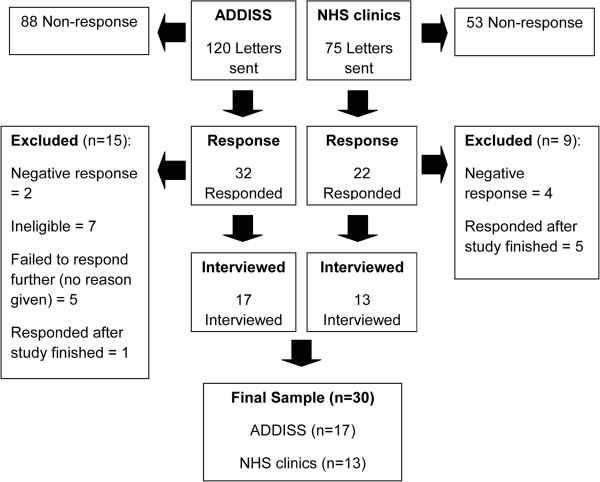
BACKGROUND: There is limited evidence of the unmet needs and experiences of adults with Attention Deficit Hyperactivity Disorder (ADHD) in the published scientific literature. This study aimed to explore the experiences of adults in England with ADHD regarding access to diagnostic and treatment services, ADHD-related impairment and to compare experiences between patients diagnosed during adulthood and childhood. METHODS: In this qualitative study, 30 adults with ADHD were recruited through an ADHD charity (n = 17) and two hospital outpatient clinics for adults with ADHD in England (n = 13). Half of the participants were diagnosed with ADHD during childhood or adolescence and the remainder during adulthood. Semi-structured interviews were conducted and data was analysed using a thematic approach based on Grounded Theory principles. RESULTS: Analysis revealed five core themes: 'An uphill struggle': the challenge of accessing services, 'Accumulated Psychosocial Burden and the Impact of ADHD', 'Weighing up Costs vs. Benefits of ADHD Pharmacological Treatment', 'Value of Non-pharmacological Treatment' and 'Barriers to Treatment Adherence'. Accessing services and the challenges associated with securing a definitive diagnosis of ADHD in adulthood was an 'uphill struggle', often due to sceptical and negative attitudes towards ADHD by healthcare professionals. ADHD-related impairment had an overwhelmingly chaotic impact on every aspect of patients' lives and many felt ill equipped to cope. A persistent sense of failure and missed potential from living with the impact of ADHD impairment had led to an accumulated psychosocial burden, especially among those diagnosed from late adolescence onwards. In contrast, positive adjustment was facilitated by a younger age at diagnosis. Although medication was perceived as necessary in alleviating impairment, many felt strongly that by itself, it was inadequate. Additional support in the form of psychological therapies or psycho-education was strongly desired. However, few patients had access to non-pharmacological treatment. In some, medication use was often inadequately monitored with little or no follow-up by healthcare professionals, leading to poor adherence and a sense of abandonment from the healthcare system. CONCLUSION: The findings suggest that the unmet needs of adults with ADHD are substantial and that there is a wide gap between policy and current practice in England.
Overview
The claims and statistics of this paper haven’t been checked yet.
Free: it reads the open-access text and checks the first 5 claims that cite a source we can check. Create a free account to check every claim.
Integrity signals
Registry
Cites
Statistics
Figures
Verification
Claims the paper makes
The claims and statistics of this paper haven’t been checked yet.
Free: it reads the open-access text and checks the first 5 claims that cite a source we can check. Create a free account to check every claim.
Claims other papers make about this one
Each is checked against this paper’s own text: does it say what the citing paper says it does?
In the citing paper
“and strain to communicate their thoughts and feelings to others (Matheson et al., 2013; Nyström et al., 2020).”
From The experiences of adults with ADHD in interpersonal relationships and online communities: A qualitative study (2023) · cites this paper as Matheson et al., 2013
In the citing paper
“Adults with ADHD have reported to struggle with maintaining relationships over their lifespan (Kwon et al., 2018; Matheson et al., 2013; Waite & Tran, 2010)”
From The experiences of adults with ADHD in interpersonal relationships and online communities: A qualitative study (2023) · cites this paper as Matheson et al., 2013
Self-check
Percentages, sums and reported differences re-computed from the paper’s own numbers.
The self-check needs the paper’s full text.
Citations
Cites
(2006) · Cited by 18,730
(1998) · Cited by 13,501
Constructing grounded theory. A practical guide through qualitative analysis
Brink, E., Dellve, L., Hallberg, U., Abrahamsson, K. H., Klingberg, G., & Wentz, K. (2006) · International Journal of Qualitative Studies on Health and Well-being · doi:10.3402/qhw.v1i3.4932 · Cited by 6,862
Diagnostic and Statistical Manual of Mental Disorders ( DSM ‐ IV ‐ TR )
Segal, D. L. (2010) · The Corsini Encyclopedia of Psychology · doi:10.1002/9780470479216.corpsy0271 · Cited by 4,666
Qualitative research in health care: Assessing quality in qualitative research
Mays, N. (2000) · BMJ · doi:10.1136/bmj.320.7226.50 · Cited by 3,742 · cited 2×
“In order to further ensure validity, member checking [29] was conducted with a random sample of participants (n = 4), who were sent a short lay summary of their individual interviews.”
BackgroundMethodMorse, J. M. (2000) · Qualitative Health Research · doi:10.1177/104973200129118183 · Cited by 3,215
Pope, C., & Mays, N. (1995) · BMJ · doi:10.1136/bmj.311.6996.42 · Cited by 2,336
Understanding and Evaluating Qualitative Research
Fossey, E., Harvey, C., Mcdermott, F., & Davidson, L. (2002) · Australian & New Zealand Journal of Psychiatry · doi:10.1046/j.1440-1614.2002.01100.x · Cited by 2,311 · cited 1×
“Moreover, the technique is particularly useful at improving knowledge of poorly understood areas of health care [19,23].”
FARAONE, S. V., BIEDERMAN, J., & MICK, E. (2006) · Psychological Medicine · doi:10.1017/s003329170500471x · Cited by 2,267 · cited 2×
“In the majority of patients diagnosed in childhood, ADHD impairment and symptoms continue to be problematic in adult life [3,8].”
BackgroundThe Prevalence of DSM-IV Attention-Deficit/Hyperactivity Disorder: A Meta-Analytic Review
Willcutt, E. G. (2012) · Neurotherapeutics · doi:10.1007/s13311-012-0135-8 · Cited by 2,160 · cited 1×
“Additionally, although the gender ratio of patients with ADHD is almost 1:1 in adults [43,44], there were more female participants in the sample.”
Background
Research works printed but not linked: 2
- QSR International Pty Ltd NVivo qualitative data analysis software, version 9 2010
- Wong IC Asherson P Bilbow A Clifford S Coghill D DeSoysa R Hollis C McCarthy S Murray M Planner C Potts L Sayal K Taylor E Cessation of attention deficit hyperactivity disorder drugs in the young (CADDY)–a pharmacoepidemiological and qualitative study Health Technol Assess 2009 13 50 1 120 19883527
Cited by
Items 101–126 of 126
Coaching for Adults With ADHD: A Prospective Study
Ahmann, E., Saviet, M., & Otto, M. (2026) · American Journal of Lifestyle Medicine · doi:10.1177/15598276261432960 · Cited by 1
Alarachi, A., McNeely, H. E., Rowa, K., & McCabe, R. E. (2026) · British Journal of Clinical Psychology · doi:10.1111/bjc.70048 · Cited by 3
“This finding converges with experiences shared in numerous previous qualitative studies of adults with ADHD (e.g., Ginapp et al., 2022, 2023; Hansson Halleröd et al., 2015; Matheson et al., 2013).”
InfluentialAdamou, M., & Wharton, L. (2026) · Frontiers in Psychiatry · doi:10.3389/fpsyt.2026.1780570 · Cited by 2
“Studies indicate that ADHD adults often seek diagnosis during periods of crisis or functional breakdown, with medication expectations prominent (28).”
Adamou, M., & Jones, S. L. (2026) · Frontiers in Psychiatry · doi:10.3389/fpsyt.2026.1860550 · Cited by 1
“Matheson (21) and colleagues described service access as an uphill struggle.”
Remembering turbulent times: accounting for Adult ADHD through the reconstruction of childhood.
Jousselin, C. (2016) · Goldsmiths (University of London) · doi:10.25602/gold.00018314 · Cited by 1
“He could nevertheless get quite despondent about the continuous changes he had seen in this clinic and generally in the NHS, as he would describe the re-organisations and other management strategies which he felt negatively affected his clinical practice.”
BackgroundInfluentialHeady, N., Watkins, A. J., John, A. M., & Hutchings, H. A. (2023) · Research Square · doi:10.21203/rs.3.rs-3344908/v1 · Cited by 2
Adult ADHD Self-Report Scale: Implementation in a Primary Care Setting
Treumer, T. N. (2015) · NDSU Repository (North Dakota State University)
الله, ش. م. ج. (2018) · دراسات نفسية · doi:10.21608/psj.2018.91949
Wilson, D., & Riches, L. (2020) · Authorea · doi:10.22541/au.160638135.50015481/v1
“Matheson et al.(22) highlighted that adult patients with a delayed diagnosis of ADHD have many unmet needs regarding treatment.”
BackgroundService evaluation of a new psychological care pathway within a specialist adult ADHD service
Buckley, S., Davidson, W. S., & Sacks, M. (2021) · Clinical Psychology Forum · doi:10.53841/bpscpf.2021.1.340.17
(2022) · Carrefour des psychothérapies · doi:10.3917/dbu.zylow.2022.01.0249
Jain, S. (2023) · Research Square · doi:10.21203/rs.3.rs-3774666/v1 · Cited by 1
Examining Barriers to Career Transition of Students With ADHD
(2024) · Advances in higher education and professional development book series · doi:10.4018/979-8-3693-2635-0.ch009
Building a Bridge to Postsecondary Success From a Neurodiverse Perspective
Tapia, M. (2025) · IGI Global eBooks · doi:10.4018/979-8-3373-6350-9.ch003
Azam, A., Barry, P. J., Bright-Thomas, R. J., Horsley, A. R., & Jones, A. M. (2025) · Pediatric Pulmonology · doi:10.1002/ppul.71266
“…with lack of understanding around ADHD from healthcare professionals, insufficient personalised approach in healthcare, perceived negative views or stigmatisation of ADHD from the perspective of people living with ADHD and lack of provision of ADHD services at time of increasing demand [3 – 6].”
Barnes, A. E., Denyer, H., Simblett, S. K., Nordby, E. S., Bilbow, A., Hayashi, W., Hovén, N., Marriott, H., Müller-Sedgwick, U., Rocks, P., et al. (2025) · Psychiatry Research · doi:10.1016/j.psychres.2025.116880
Aoki, Y., 坪井, 貴., Furuno, T., Watanabe, K., & Kayama, M. (2020) · Figshare · doi:10.6084/m9.figshare.12667935
Price, A., Mitchell, S., Janssens, A. I. W. A., Eke, H., Ford, T. J., & Newlove-Delgado, T. (2022) · Figshare · doi:10.6084/m9.figshare.19572531
Experience of the diagnostic journey for ADHD in adulthood: A quantitative and qualitative study
Verwaerde, O., Galéra, C., Bouvard, M. P., & Briot, K. (2026) · L Encéphale · doi:10.1016/j.encep.2025.12.004
van Asselt, A., Huiskes, A., Ras, Y., Reekers, D., & Roke, Y. (2026) · doi:10.2196/preprints.94907
Barriers to prescribing methylphenidate for adults with ADHD: A qualitative study
Lafarge, D., Charbit, J., Lamer, A., Trimbur, M., & Carton, L. (2026) · Therapies · doi:10.1016/j.therap.2026.05.001
A Systematic Review of Lived Experiences of Receiving a Diagnosis of ADHD in Adulthood
McGill, L., Jardim-Lalor, I., & O’Connor, C. (2026) · Journal of Attention Disorders · doi:10.1177/10870547261455946 · Cited by 5
“(Hansson Halleröd et al., 2015) For some who did receive post-diagnostic support, available interventions were primarily medical in nature (Matheson et al., 2013; Morgan, 2024; Nielsen, 2017).”
InfluentialKarimi, M., Ghasemzadeh, S., Ghasemzadeh, P., صالحی, ک., & Fami, F. S. (2026) · BMC Psychiatry · doi:10.1186/s12888-026-08293-6
“…along with an environment where problems can be articulated without fear of judgment, increases self-esteem and quality of life, while situations of neglect and aggression create feelings of loneliness, fear, and stress, which are counterproductive to engaging in treatment behaviors [101, 102].”
Kelly, T., May, B., Porter, C. N., & Palace, M. (2026) · Journal of Attention Disorders · doi:10.1177/10870547261469625
ADHD coaching since the COVID-19 pandemic: Is there a new wave of ADHD coaches?
Graham, E. D., Dvorsky, M. R., Yegüez, C. E., Holbrook, J. K., & Sibley, M. H. (2026) · Frontiers in Psychiatry · doi:10.3389/fpsyt.2026.1841020
Perspectives from Adolescents and Young Adults with ADHD: A Mixed Methods Study
Barnard-Brak, L. M., & Snider, L. A. (2026) · Journal of Applied School Psychology · doi:10.1080/15377903.2026.2734986
Metadata
- Authors
- Matheson, L., Asherson, P., Wong, I. C. K., Hodgkins, P., Setyawan, J., Sasane, R., & Clifford, S.
- Affiliations
- Oxford Brookes University (GB)
- King's College London (GB)
- University of Hong Kong (HK)
- Corresponding author
- Matheson, Lauren
- Venue
- BMC Health Services Research
- Published
- 2013-05-21
- Volume
- 13
- Issue
- 1
- Pages
- 184-184
- ISSN
- 1472-6963 (ISSN-L)
- PMC
- PMC3665585
- OpenAlex
- W2130572724
- Cited by
- 126
- References
- 46
- Citations by year
- 2026: 15 · 2025: 14 · 2024: 6 · 2023: 14 · 2022: 13 · 2021: 5 · 2020: 8 · 2019: 9 · 2018: 10 · 2017: 7 · 2016: 10 · 2015: 6 · 2014: 7 · 2013: 2
- FWCI
- 5.90
- Type
- journal article
- Language
- en
- Open access
- gold
- doi.org
- Licence
- cc-by
- creativecommons.org/licenses/by/2.0 (tdm)
- Locations
- BMC Health Services Research (publishedVersion, cc-by)
- Europe PMC (PubMed Central) (publishedVersion, cc-by)
- PubMed Central (publishedVersion, cc-by)
- PubMed (publishedVersion)
- UCL Discovery (University College London) (submittedVersion)
- The HKU Scholars Hub (University of Hong Kong) (submittedVersion, cc-by-nc-nd)
- Research Portal (King's College London) (submittedVersion)
- Radar (Oxford Brookes University) (submittedVersion)
- Funders
- University College London
- School of Pharmacy, University College London
- Topics
- Health Sciences › Medicine › Psychiatry and Mental health › Attention Deficit Hyperactivity Disorder
- Social Sciences › Psychology › Clinical Psychology › Psychology and Mental Health
- Life Sciences › Neuroscience › Cognitive Neuroscience › Autism Spectrum Disorder Research
- Keywords
- adult ADHD, patient experience, ADHD diagnosis, access to mental health care, psychosocial burden, ADHD medication, non-pharmacological treatment, medication adherence, therapeutic drug monitoring, clinician attitudes, age at diagnosis, unmet needs
- MeSH terms
- Adolescent, Adult, Age Factors, Attention Deficit Disorder with Hyperactivity, England, Female, Health Services Accessibility, Health Services Needs and Demand, Humans, Interviews as Topic, Male, Middle Aged, Physician-Patient Relations, Quality of Life, Socioeconomic Factors, Cost of Illness, Qualitative Research, Young Adult, Delayed Diagnosis
About these checks
Registry, retraction, Cites and statistics results are computed, not judged, with one exception: a printed reference that no index lists is read once by a model before it counts as a citation error. Claims are extracted by a model and kept only when their quote appears verbatim in the text; each cited source is then checked, with a model’s help, for whether it says what the claim relies on. Those verdicts can be wrong — read the claim’s quote and the cited source before relying on one.
Statistics and arithmetic are recomputed, not judged.
Confidence bands are shown only for fields calibrated on our annotated test set. None is calibrated yet, so no band is shown.
What counts as a claim ›How we measure confidence ›How we check this ›
Are you an author, or do you see a problem with this page? Request a review
Data sources
Bibliographic data: Semantic Scholar, OpenAlex, Crossref.
Contains information from the Semantic Scholar Academic Graph Datasets, made available under the ODC Attribution License (ODC-BY 1.0).
Semantic Scholar’s data is described in: Kinney, R., et al. (2023). The Semantic Scholar Open Data Platform. arXiv:2301.10140.
