

Bioluminescence imaging reveals inhibition of tumor cell proliferation by Alzheimer's amyloid β protein
Open accessThe DOI matches its Crossref record; 50 of the 50 references it cites were found in a registry or an index.
Abstract
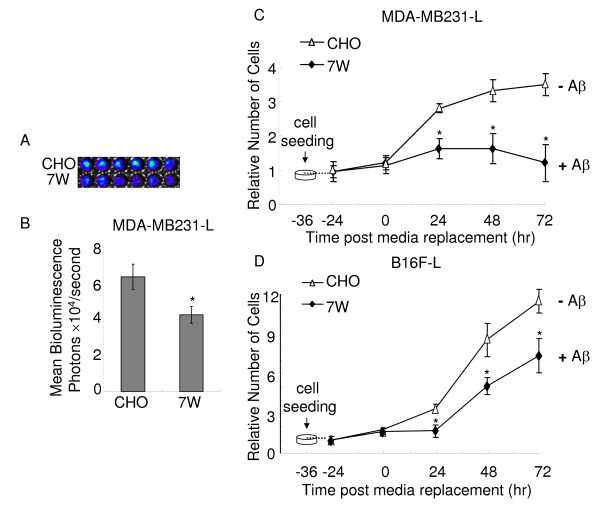
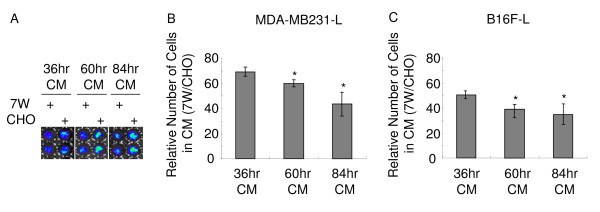
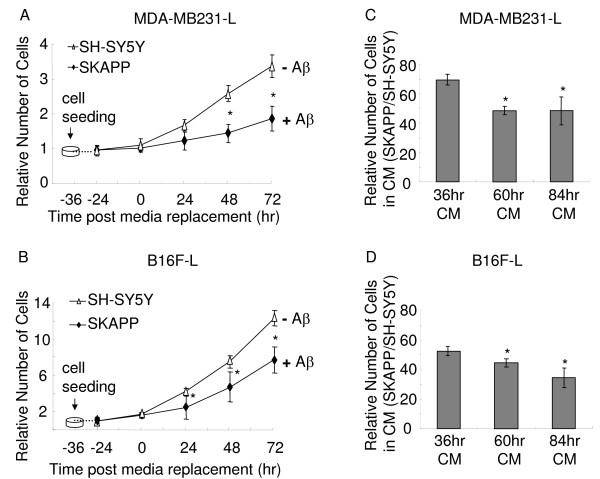
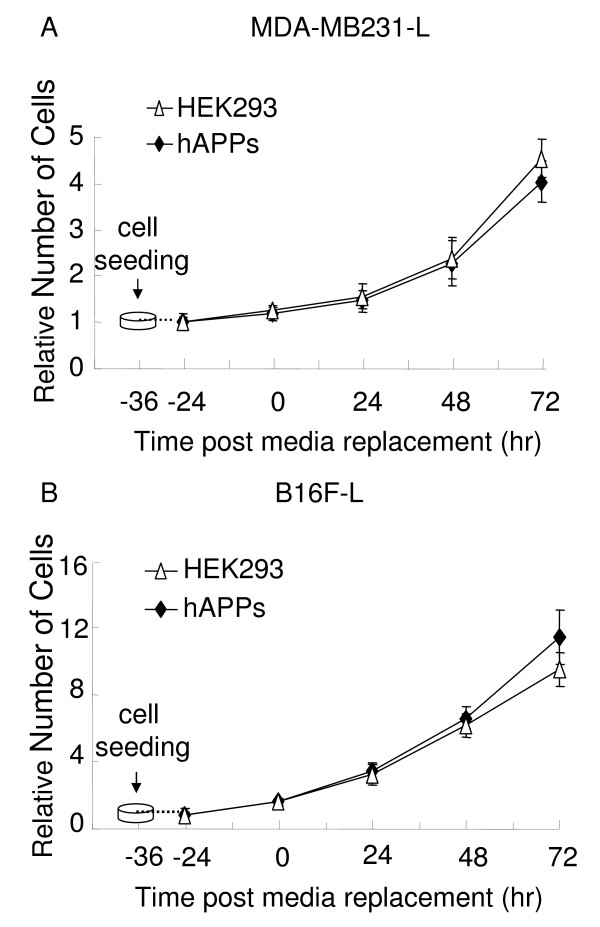
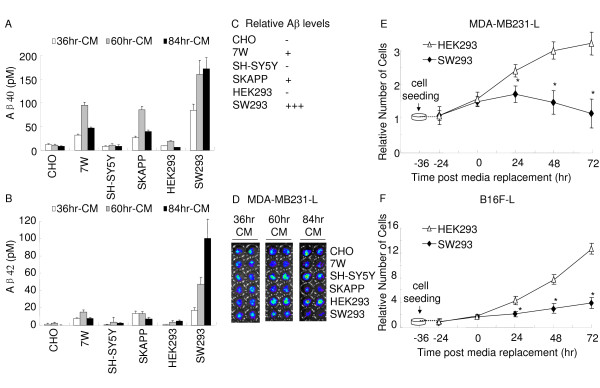
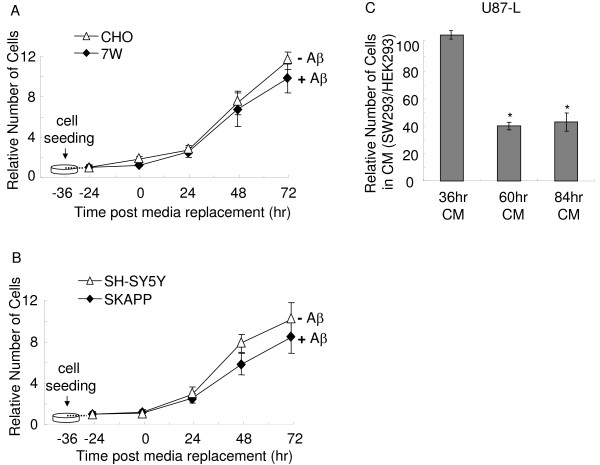
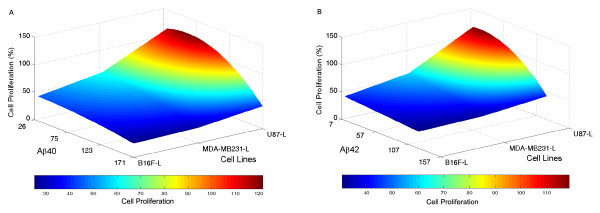
Background: Cancer and Alzheimer's disease (AD) are two seemingly distinct diseases and rarely occur simultaneously in patients. To explore molecular determinants differentiating pathogenic routes towards AD or cancer, we investigate the role of amyloid β protein (Aβ) on multiple tumor cell lines that are stably expressing luciferase (human glioblastoma U87; human breast adenocarcinoma MDA-MB231; and mouse melanoma B16F). Results: Quantification of the photons emitted from the MDA-MB231 or B16F cells revealed a significant inhibition of cell proliferation by the conditioning media (CM) derived from amyloid precursor protein (APP) over-expressing cells. The inhibition of U87 cells was observed only after the media was conditioned for longer than 2 days with APP over-expressing cells. Conclusion: Our results suggest that Aβ plays an inhibitory role in tumor cell proliferation; this effect could depend on the type of tumor cells and amount of Aβ.
Overview
The claims and statistics of this paper haven’t been checked yet.
Free: it reads the open-access text and checks the first 5 claims that cite a source we can check. Create a free account to check every claim.
Integrity signals
Registry
Cites
Statistics
Figures
Verification
Claims the paper makes
The claims and statistics of this paper haven’t been checked yet.
Free: it reads the open-access text and checks the first 5 claims that cite a source we can check. Create a free account to check every claim.
Claims other papers make about this one
Each is checked against this paper’s own text: does it say what the citing paper says it does?
In the citing paper
“In vitro, application of media containing Aβ successfully inhibits the proliferation of cells, including human glioblastoma, human breast adenocarcinoma, and mouse melanoma cells.409”
From Amyloid β-based therapy for Alzheimer’s disease: Challenges, successes and future (2023) · cites this paper as [409]
Self-check
Percentages, sums and reported differences re-computed from the paper’s own numbers.
The self-check needs the paper’s full text.
Citations
Cites
The Amyloid Hypothesis of Alzheimer’s Disease: Progress and Problems on the Road to Therapeutics
Hardy, J., & Selkoe, D. J. (2002) · Science · doi:10.1126/science.1072994 · Cited by 13,864
Walsh, D. M., Klyubin, I., Fadeeva, J. V., Cullen, W. K., Anwyl, R., Wolfe, M. S., Rowan, M. J., & Selkoe, D. J. (2002) · Nature · doi:10.1038/416535a · Cited by 4,291
Citron, M., Oltersdorf, T., Haass, C., McConlogue, L., Hung, A. Y., Seubert, P., Vigo-Pelfrey, C., Lieberburg, I., & Selkoe, D. J. (1992) · Nature · doi:10.1038/360672a0 · Cited by 1,757
Isolation and quantification of soluble Alzheimer's β-peptide from biological fluids
Seubert, P., Vigo-Pelfrey, C., Esch, F., Lee, M., Dovey, H., Davis, D., Sinha, S., Schiossmacher, M., Whaley, J., Swindlehurst, C., et al. (1992) · Nature · doi:10.1038/359325a0 · Cited by 1,731
Oligomeric and fibrillar species of amyloid-β peptides differentially affect neuronal viability
Dahlgren, K. N., Manelli, A. M., Stine, W. B., Baker, L. K., Krafft, G. A., & LaDu, M. J. (2002) · Journal of Biological Chemistry · doi:10.1074/jbc.m201750200 · Cited by 1,452
Amyloid β-protein (Aβ) assembly: Aβ40 and Aβ42 oligomerize through distinct pathways
Bitan, G., Kirkitadze, M. D., Lomakin, A., Vollers, S. S., Benedek, G. B., & Teplow, D. B. (2003) · Proceedings of the National Academy of Sciences · doi:10.1073/pnas.222681699 · Cited by 1,287
Pain: Moving from Symptom Control toward Mechanism-Specific Pharmacologic Management
Woolf, C. J. (2004) · Annals of Internal Medicine · doi:10.7326/0003-4819-140-8-200404200-00010 · Cited by 1,064
Gong, Y., Chang, L., Viola, K. L., Lacor, P. N., Lambert, M. P., Finch, C. E., Krafft, G. A., & Klein, W. L. (2003) · Proceedings of the National Academy of Sciences · doi:10.1073/pnas.1834302100 · Cited by 1,061
Amyloid β-Protein Fibrillogenesis
Walsh, D. M., Hartley, D. M., Kusumoto, Y., Fezoui, Y., Condron, M. M., Lomakin, A., Benedek, G. B., Selkoe, D. J., & Teplow, D. B. (1999) · Journal of Biological Chemistry · doi:10.1074/jbc.274.36.25945 · Cited by 1,046
Atwood, C. S., Moir, R. D., Huang, X., Scarpa, R. C., Bacarra, N. M. E., Romano, D. M., Hartshorn, M. A., Tanzi, R. E., & Bush, A. I. (1998) · Journal of Biological Chemistry · doi:10.1074/jbc.273.21.12817 · Cited by 1,009
Cited by
Amyloid β-based therapy for Alzheimer’s disease: Challenges, successes and future
Zhang, Y., Chen, H., Li, R., Sterling, K., & Song, W. (2023) · Signal Transduction and Targeted Therapy · doi:10.1038/s41392-023-01484-7 · Cited by 988
“In vitro, application of media containing Aβ successfully inhibits the proliferation of cells, including human glioblastoma, human breast adenocarcinoma, and mouse melanoma cells.(409) In vivo, injection of Aβ into mice transplanted with human glioblastoma and lung adenocarcinoma suppresses the tumor growth.”
BackgroundThe Physiological Roles of Amyloid-β Peptide Hint at New Ways to Treat Alzheimer's Disease
Brothers, H. M., Gosztyla, M. L., & Robinson, S. R. (2018) · Frontiers in Aging Neuroscience · doi:10.3389/fnagi.2018.00118 · Cited by 314
Brullé, L., Vandamme, M., Riès, D., Martel, E., Robert, E., Lerondel, S., Trichet, V., Richard, S., Pouvesle, J.-M., & Le Pape, A. (2012) · PLoS ONE · doi:10.1371/journal.pone.0052653 · Cited by 250
Physiological Roles of Monomeric Amyloid-β and Implications for Alzheimer’s Disease Therapeutics
Jeong, H., Shin, H., Hong, S., & Kim, Y. S. (2022) · Experimental Neurobiology · doi:10.5607/en22004 · Cited by 66
Strategic Role for Mitochondria in Alzheimer's Disease and Cancer
Hedskog, L., Zhang, S., & Ankarcrona, M. (2011) · Antioxidants and Redox Signaling · doi:10.1089/ars.2011.4259 · Cited by 47
Metadata
- Authors
- Zhao, H., Zhu, J., Cui, K., Xu, X., O'Brien, M., Wong, K. K., Kesari, S., Xia, W., & Wong, S. T.
- Affiliations
- Weill Cornell Medicine (US)
- Brigham and Women's Hospital (US)
- Corresponding author
- Xia, Weiming
- Venue
- Cancer Cell International
- Published
- 2009-06-01
- Volume
- 9
- Issue
- 1
- Pages
- 15-15
- ISSN
- 1475-2867 (ISSN-L)
- PMC
- PMC2701410
- OpenAlex
- W2097753140
- Cited by
- 33
- References
- 50
- Citations by year
- 2026: 4 · 2025: 1 · 2024: 2 · 2023: 1 · 2022: 1 · 2021: 2 · 2020: 4 · 2019: 2 · 2018: 1 · 2017: 1 · 2016: 1 · 2015: 3 · 2014: 4 · 2013: 2 · 2012: 2
- FWCI
- 0.88
- Type
- journal article
- Language
- en
- Open access
- gold
- doi.org
- Licence
- cc-by
- Locations
- Cancer Cell International (publishedVersion, cc-by)
- PubMed Central (publishedVersion, cc-by)
- PubMed (publishedVersion)
- Digital Access to Scholarship at Harvard (DASH) (Harvard University) (submittedVersion, cc-by)
- DOAJ (DOAJ: Directory of Open Access Journals) (submittedVersion)
- Funders
- National Institutes of Health (NIH-R01, AG015379)
- National Institute on Aging (P01AG015379, R01AG028928)
- U.S. National Library of Medicine (R01LM009161)
- Topics
- Life Sciences › Neuroscience › Cellular and Molecular Neuroscience › Alzheimer's disease research and treatments
- Health Sciences › Medicine › Oncology › Glioma Diagnosis and Treatment
- Life Sciences › Biochemistry, Genetics and Molecular Biology › Cancer Research › Protease and Inhibitor Mechanisms
- Keywords
- amyloid-beta, Alzheimer's disease, tumor cell proliferation, amyloid precursor protein, conditioned medium, glioblastoma, breast adenocarcinoma, melanoma, bioluminescence imaging
About these checks
Registry, retraction, Cites and statistics results are computed, not judged, with one exception: a printed reference that no index lists is read once by a model before it counts as a citation error. Claims are extracted by a model and kept only when their quote appears verbatim in the text; each cited source is then checked, with a model’s help, for whether it says what the claim relies on. Those verdicts can be wrong — read the claim’s quote and the cited source before relying on one.
Statistics and arithmetic are recomputed, not judged.
Confidence bands are shown only for fields calibrated on our annotated test set. None is calibrated yet, so no band is shown.
What counts as a claim ›How we measure confidence ›How we check this ›
Are you an author, or do you see a problem with this page? Request a review
Data sources
Bibliographic data: Semantic Scholar, OpenAlex, Crossref.
Contains information from the Semantic Scholar Academic Graph Datasets, made available under the ODC Attribution License (ODC-BY 1.0).
Semantic Scholar’s data is described in: Kinney, R., et al. (2023). The Semantic Scholar Open Data Platform. arXiv:2301.10140.
