

The DOI matches its Crossref record; 56 of the 56 references it cites were found in a registry or an index.
Spatial and temporal variation in the kdr allele L1014S in Anopheles gambiae s.s. and phenotypic variability in susceptibility to insecticides in Western Kenya
Open accessAbstract
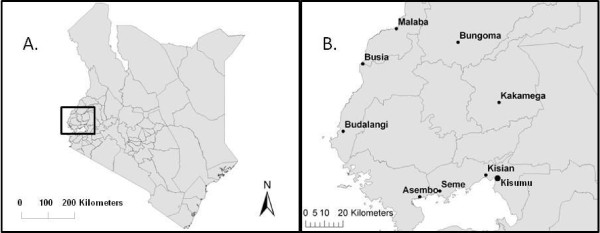
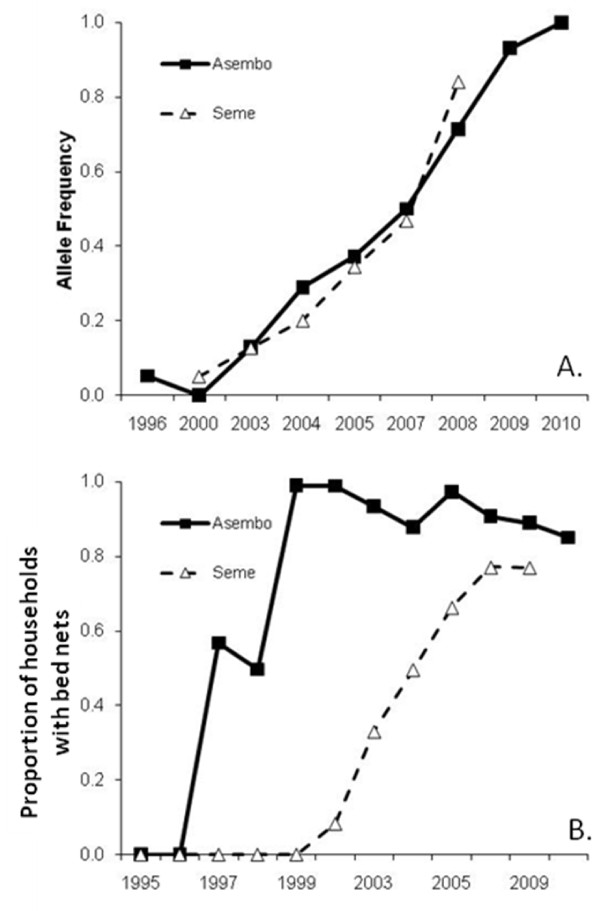
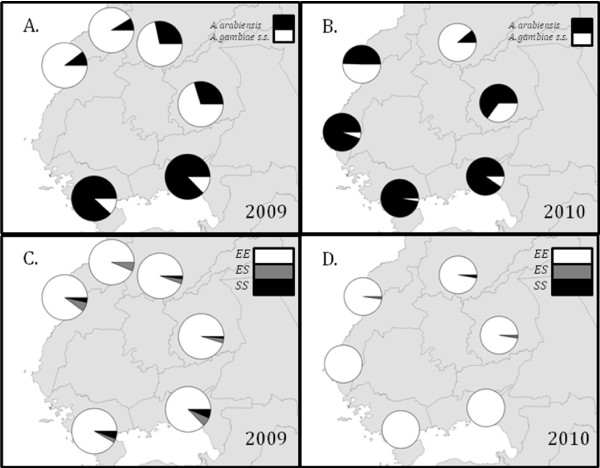
Background: Malaria vector control in Africa depends upon effective insecticides in bed nets and indoor residual sprays. This study investigated the extent of insecticide resistance in Anopheles gambiae s.l., Anopheles gambiae s.s. and Anopheles arabiensis in western Kenya where ownership of insecticide-treated bed nets has risen steadily from the late 1990s to 2010. Temporal and spatial variation in the frequency of a knock down resistance (kdr) allele in A. gambiae s.s. was quantified, as was variation in phenotypic resistance among geographic populations of A. gambiae s.l. Methods: To investigate temporal variation in kdr frequency, individual specimens of A. gambiae s.s. from two sentinel sites were genotyped using RT-PCR from 1996-2010. Spatial variation in kdr frequency, species composition, and resistance status were investigated in additional populations of A. gambiae s.l. sampled in western Kenya in 2009 and 2010. Specimens were genotyped for kdr as above and identified to species via conventional PCR. Field-collected larvae were reared to adulthood and tested for insecticide resistance using WHO bioassays. Results: Anopheles gambiae s.s. showed a dramatic increase in kdr frequency from 1996 - 2010, coincident with the scale up of insecticide-treated nets. By 2009-2010, the kdr L1014S allele was nearly fixed in the A. gambiae s.s. population, but was absent in A. arabiensis. Near Lake Victoria, A. arabiensis was dominant in samples, while at sites north of the lake A. gambiae s.s was more common but declined relative to A. arabiensis from 2009 to 2010. Bioassays demonstrated that A. gambiae s.s. had moderate phenotypic levels of resistance to DDT, permethrin and deltamethrin while A. arabiensis was susceptible to all insecticides tested. Conclusions: The kdr L1014S allele has approached fixation in A. gambiae s.s. populations of western Kenya, and these same populations exhibit varying degrees of phenotypic resistance to DDT and pyrethroid insecticides. The near absence of A. gambiae s.s. from populations along the lakeshore and the apparent decline in other populations suggest that insecticide-treated nets remain effective against this mosquito despite the increase in kdr allele frequency. The persistence of A. arabiensis, despite little or no detectable insecticide resistance, is likely due to behavioural traits such as outdoor feeding and/or feeding on non-human hosts by which this species avoids interaction with insecticide-treated nets.
Overview
The claims and statistics of this paper haven’t been checked yet.
Run the check — free, no account needed. It reads the open-access text and checks the sources it cites.
Integrity signals
Registry
Cites
Statistics
Figures
Verification
Claims the paper makes
The claims and statistics of this paper haven’t been checked yet.
Run the check — free, no account needed. It reads the open-access text and checks the sources it cites.
Claims other papers make about this one
Each is checked against this paper’s own text: does it say what the citing paper says it does?
The cited source says what the claim attributes to it.
In the citing paper
“According to Mathias et al. [32], ITN coverage for populations has been associated with a development of strong insecticide selection pressure by pyrethroid and increase of kdr allele frequency.”
From Mapping insecticide resistance in Anopheles gambiae (s.l.) from Côte d'Ivoire (2018) · cites this paper as [32]
The cited source says what the claim attributes to it.
In the citing paper
“Currently, the increasing use of insecticides for malaria vector control plays an important role in the insecticide selection pressure.”
From Mapping insecticide resistance in Anopheles gambiae (s.l.) from Côte d'Ivoire (2018) · cites this paper as [32]
Self-check
Percentages, sums and reported differences re-computed from the paper’s own numbers.
The self-check needs the paper’s full text.
Citations
Cites
ESTIMATING F -STATISTICS FOR THE ANALYSIS OF POPULATION STRUCTURE
Weir, B. S., & Cockerham, C. C. (1984) · Evolution · doi:10.1111/j.1558-5646.1984.tb05657.x · Cited by 18,909
GENEPOP (version 1.2): population genetic software for exact tests and ecumenicism
Raymond, M., & Rousset, F. (1995) · Journal of Heredity · doi:10.1093/oxfordjournals.jhered.a111573 · Cited by 16,187
Molecular Mechanisms of Metabolic Resistance to Synthetic and Natural Xenobiotics
Li, X., Schuler, M. A., & Berenbaum, M. R. (2006) · Annual Review of Entomology · doi:10.1146/annurev.ento.51.110104.151104 · Cited by 2,157
Insecticide-treated bed nets and curtains for preventing malaria
Lengeler, C. (2004) · Cochrane Database of Systematic Reviews · doi:10.1002/14651858.cd000363.pub2 · Cited by 1,700
Identification of Single Specimens of the Anopheles Gambiae Complex by the Polymerase Chain Reaction
Scott, J. A., Brogdon, W. G., & Collins, F. H. (1993) · American Journal of Tropical Medicine and Hygiene · doi:10.4269/ajtmh.1993.49.520 · Cited by 1,634
The molecular basis of insecticide resistance in mosquitoes
Hemingway, J., Hawkes, N. J., McCarroll, L., & Ranson, H. (2004) · Insect Biochemistry and Molecular Biology · doi:10.1016/j.ibmb.2004.03.018 · Cited by 1,185
Martinez‐Torres, D., Chandre, F., Williamson, M. S., Darriet, F., Bergé, J. B., Devonshire, A. L., Guillet, P., Pasteur, N., & Pauron, D. (1998) · Insect Molecular Biology · doi:10.1046/j.1365-2583.1998.72062.x · Cited by 1,040
Ranson, H., Jensen, B., Vulule, J. M., Wang, X., Hemingway, J., & Collins, F. H. (2000) · Insect Molecular Biology · doi:10.1046/j.1365-2583.2000.00209.x · Cited by 645
Self-citationA Ribosomal RNA Gene Probe Differentiates Member Species of the Anopheles gambiae Complex
Collins, F. H., Mendez, M. A., Rasmussen, M. O., Mehaffey, P. C., Besansky, N. J., & Finnerty, V. (1987) · American Journal of Tropical Medicine and Hygiene · doi:10.4269/ajtmh.1987.37.37 · Cited by 616
N’Guessan, R., Corbel, V., Akogbéto, M., & Rowland, M. (2007) · Emerging Infectious Diseases · doi:10.3201/eid1302.060631 · Cited by 548
Research works printed but not linked: 2
- W.H.O.: Pesticides and their application for the control of vectors and pests of public health importance. Department of Control of Neglected Tropical Diseases, WHO Pesticide Evaluation Scheme. Edited by: 6. 2006, Geneva, Switzerland: World Health Organization
- W.H.O.: Test procedures for insecticide resistance monitoring in malaria vectors: bio-efficacy and persistence of insecticides on treated surfaces. 1998, Geneva, Switzerland: World Health Organization
Cited by
Sorted by citations
Highly evolvable malaria vectors: The genomes of 16 Anopheles mosquitoes
Neafsey, D. E., Waterhouse, R. M., Abai, M. R., Aganezov, S. S., Alekseyev, M. A., Allen, J. E., Amon, J., Arcà, B., Arensburger, P., Николаевич, А. Г., et al. (2014) · Science · doi:10.1126/science.1258522 · Cited by 573
Residual Transmission of Malaria: An Old Issue for New Approaches
Durnez, L., & Coosemans, M. (2013) · InTech eBooks · doi:10.5772/55925 · Cited by 211
Mapping trends in insecticide resistance phenotypes in African malaria vectors
Hancock, P. A., Hendriks, C. J. M., Tangena, J.-A., Gibson, H., Hemingway, J., Coleman, M., Gething, P. W., Cameron, E., Bhatt, S., & Moyes, C. L. (2020) · PLOS Biology · doi:10.1371/journal.pbio.3000633 · Cited by 201
Zhou, G., Afrane, Y. A., Vardo-Zalik, A., Atieli, H., Zhong, D., Wamae, P., Himeidan, Y. E., Minakawa, N., Githeko, A. K., & Yan, G. (2011) · PLoS ONE · doi:10.1371/journal.pone.0020318 · Cited by 165
Silva, A. P. B., Santos, J. M. M., & Martins, A. J. (2014) · Parasites & Vectors · doi:10.1186/1756-3305-7-450 · Cited by 160
Metadata
- Authors
- Mathias, D. K., Ochomo, E., Atieli, F., Ombok, M., Nabie Bayoh, M., Olang, G., Muhia, D., Kamau, L., Vulule, J. M., Hamel, M. J., Hawley, W. A., Walker, E. D., & Gimnig, J. E.
- Affiliations
- Kenya Medical Research Institute (KE)
- Centers for Disease Control and Prevention (US)
- Michigan State University (US)
- Corresponding author
- Walker, Edward D
- Gimnig, John E
- Venue
- Malaria Journal
- Published
- 2011-01-14
- Volume
- 10
- Issue
- 1
- Pages
- 10-10
- ISSN
- 1475-2875 (ISSN-L)
- PMC
- PMC3029224
- OpenAlex
- W2106675599
- Cited by
- 158
- References
- 56
- Citations by year
- 2026: 5 · 2025: 4 · 2024: 7 · 2023: 5 · 2022: 3 · 2021: 20 · 2020: 13 · 2019: 9 · 2018: 14 · 2017: 8 · 2016: 12 · 2015: 11 · 2014: 13 · 2013: 15 · 2012: 14
- FWCI
- 14.78
- Type
- journal article
- Language
- en
- Open access
- gold
- doi.org
- Licence
- cc-by
- Locations
- Malaria Journal (publishedVersion, cc-by)
- PubMed Central (publishedVersion, cc-by)
- PubMed (publishedVersion)
- DOAJ (DOAJ: Directory of Open Access Journals) (submittedVersion, cc-by-sa)
- Kenyatta University Institutional Repository (Kenyatta University) (submittedVersion)
- Funders
- National Science Foundation (EF-072377)
- Bill and Melinda Gates Foundation
- Centers for Disease Control and Prevention
- Topics
- Health Sciences › Medicine › Public Health, Environmental and Occupational Health › Malaria Research and Control
- Life Sciences › Biochemistry, Genetics and Molecular Biology › Molecular Biology › Insect Resistance and Genetics
- Health Sciences › Medicine › Public Health, Environmental and Occupational Health › Dengue and Mosquito Control Research
- Keywords
- Anopheles arabiensis, knockdown resistance, insecticide resistance, pyrethroid resistance, DDT resistance, permethrin, deltamethrin, insecticide-treated nets, malaria vector control, species composition, spatiotemporal variation, Western Kenya
- MeSH terms
- Animals, Anopheles, Cattle, Child, Preschool, Drug Resistance, Female, Gene Frequency, Geography, Humans, Infant, Infant, Newborn, Insecticides, Kenya, Pregnancy, Time Factors, Insect Proteins, Amino Acid Substitution, Reverse Transcriptase Polymerase Chain Reaction
About these checks
Registry, retraction, Cites and statistics results are computed, not judged, with one exception: a printed reference that no index lists is read once by a model before it counts as a citation error. Claims are extracted by a model and kept only when their quote appears verbatim in the text; each cited source is then checked, with a model’s help, for whether it says what the claim relies on. Those verdicts can be wrong — read the claim’s quote and the cited source before relying on one.
Statistics and arithmetic are recomputed, not judged.
Confidence bands are shown only for fields calibrated on our annotated test set. None is calibrated yet, so no band is shown.
What counts as a claim ›How we measure confidence ›How we check this ›
Are you an author, or do you see a problem with this page? Request a review
