

The DOI matches its Crossref record; 72 of the 72 references it cites were found in a registry or an index.
A malaria transmission-directed model of mosquito life cycle and ecology
Open accessAbstract
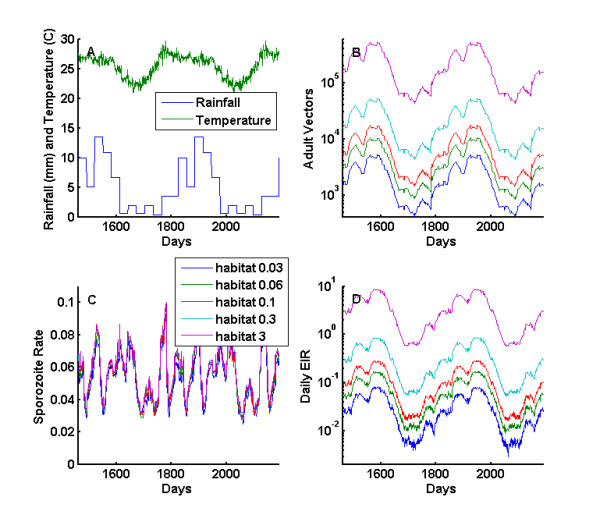
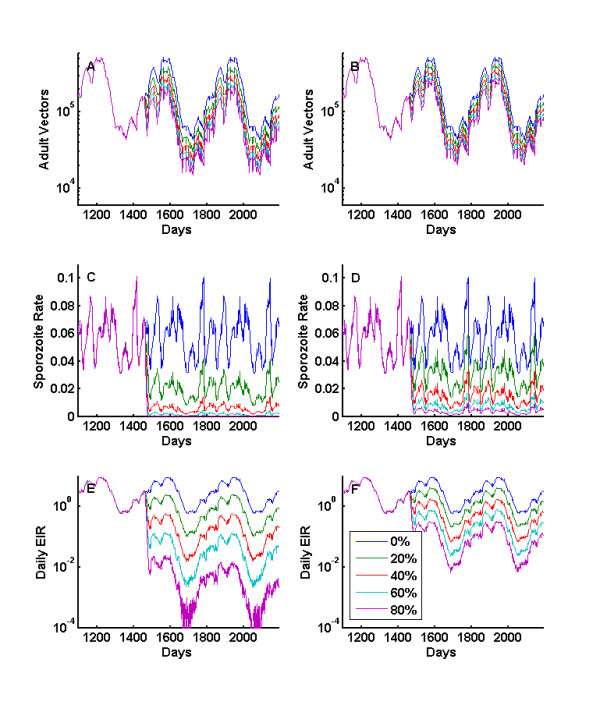
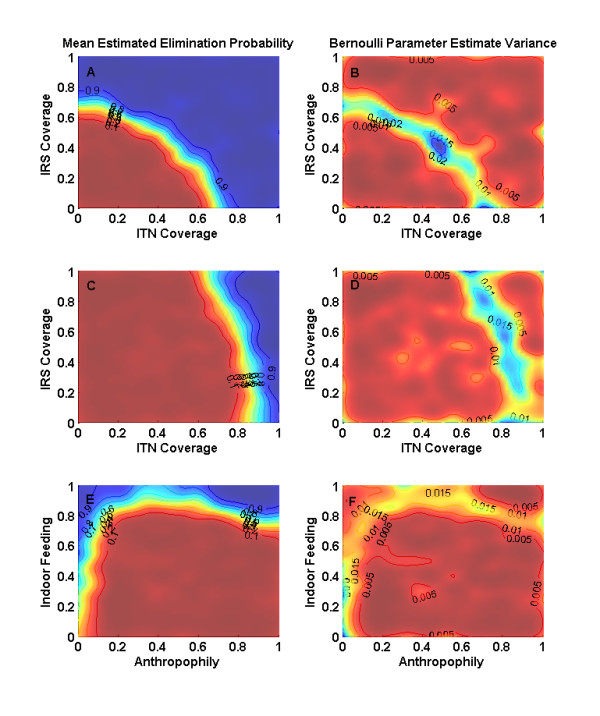
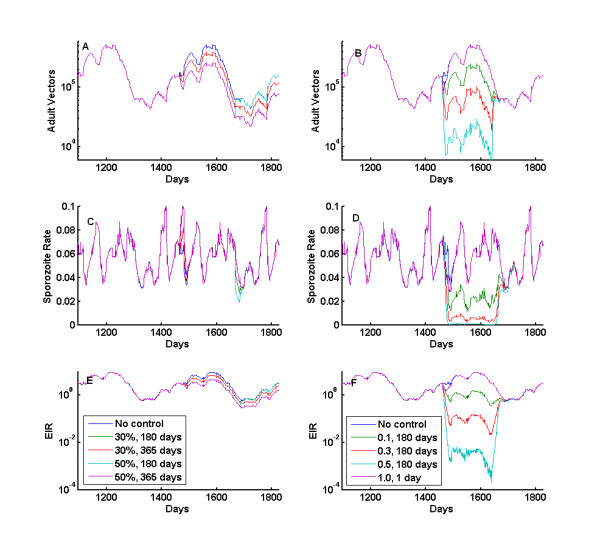
BACKGROUND: Malaria is a major public health issue in much of the world, and the mosquito vectors which drive transmission are key targets for interventions. Mathematical models for planning malaria eradication benefit from detailed representations of local mosquito populations, their natural dynamics and their response to campaign pressures. METHODS: A new model is presented for mosquito population dynamics, effects of weather, and impacts of multiple simultaneous interventions. This model is then embedded in a large-scale individual-based simulation and results for local elimination of malaria are discussed. Mosquito population behaviours, such as anthropophily and indoor feeding, are included to study their effect upon the efficacy of vector control-based elimination campaigns. RESULTS: Results for vector control tools, such as bed nets, indoor spraying, larval control and space spraying, both alone and in combination, are displayed for a single-location simulation with vector species and seasonality characteristic of central Tanzania, varying baseline transmission intensity and vector bionomics. The sensitivities to habitat type, anthropophily, indoor feeding, and baseline transmission intensity are explored. CONCLUSIONS: The ability to model a spectrum of local vector species with different ecologies and behaviours allows local customization of packages of interventions and exploration of the effect of proposed new tools.
Overview
The claims and statistics of this paper haven’t been checked yet.
Run the check — free, no account needed. It reads the open-access text and checks the sources it cites.
Integrity signals
Registry
Cites
Statistics
Figures
Verification
Claims the paper makes
The claims and statistics of this paper haven’t been checked yet.
Run the check — free, no account needed. It reads the open-access text and checks the sources it cites.
Claims other papers make about this one
Each is checked against this paper’s own text: does it say what the citing paper says it does?
The cited source doesn’t support the claim as written.
In the citing paper
“While investigating transmission dynamics is helpful, malaria models cannot be applied directly in irrigated regions as they typically rely only on rainfall as a source of water to quantify larval habitats.”
From Investigating the Impact of Irrigation on Malaria Vector Larval Habitats and Transmission Using a Hydrology‐Based Model (2023) · cites this paper as Eckhoff, 2011
Checked by a reasoning model — may be wrong.
Experimental — accuracy not yet measuredThe cited source doesn’t support the claim as written.
In the citing paper
“While widely used in malaria intervention studies (Galactionova et al., 2021), these models tend to neglect the larval habitat representation (Griffin et al., 2010; T. Smith et al., 2006) or rely only on rainfall to quantify larval habitats (Eckhoff, 2011).”
From Investigating the Impact of Irrigation on Malaria Vector Larval Habitats and Transmission Using a Hydrology‐Based Model (2023) · cites this paper as Eckhoff, 2011
Checked by a reasoning model — may be wrong.
Experimental — accuracy not yet measuredThe source backs part of the claim, not all of it — or backs it for a different population, condition or comparison.
In the citing paper
“The default habitat functions in EMOD are designed primarily to incorporate the variability of climate and the scaling factors and decay rates are usually calibrated to fit local data on vector abundance or entomological inoculation rate (EIR) rather than the habitat area per se (Eckhoff, 2011).”
From Investigating the Impact of Irrigation on Malaria Vector Larval Habitats and Transmission Using a Hydrology‐Based Model (2023) · cites this paper as Eckhoff, 2011
Experimental — accuracy not yet measured
Self-check
Percentages, sums and reported differences re-computed from the paper’s own numbers.
The self-check needs the paper’s full text.
Citations
Cites
The global distribution of clinical episodes of Plasmodium falciparum malaria
Snow, R. W., Guerra, C. A., Noor, A. M., Myint, H. Y., & Hay, S. I. (2005) · Nature · doi:10.1038/nature03342 · Cited by 2,758
The Epidemiology and Control of Malaria
(1960) · The Medical Journal of Australia · doi:10.5694/j.1326-5377.1960.tb105313.x · Cited by 1,316
A new world malaria map: Plasmodium falciparum endemicity in 2010
Gething, P. W., Patil, A. P., Smith, D. L., Guerra, C. A., Elyazar, I., Johnston, G. L., Tatem, A. J., & Hay, S. I. (2011) · Malaria Journal · doi:10.1186/1475-2875-10-378 · Cited by 1,169
Ross, R. (2010) · Cited by 940
A Climate-based Distribution Model of Malaria Transmission in Sub-Saharan Africa
Craig, M. H., Snow, R. W., & le Sueur, D. (1999) · Parasitology Today · doi:10.1016/s0169-4758(99)01396-4 · Cited by 854
The Biology of Mosquitoes, Volume 1: Development, Nutrition and Reproduction
Clements, A. N. (1992) · CABI eBooks · doi:10.1079/9780851993744.0000 · Cited by 715
A GLOBAL INDEX REPRESENTING THE STABILITY OF MALARIA TRANSMISSION
Kiszewski, A. E., Mellinger, A. D., Spielman, A., Malaney, P. N., Sachs, S. E., & Sachs, J. D. (2004) · American Journal of Tropical Medicine and Hygiene · doi:10.4269/ajtmh.2004.70.486 · Cited by 664
Griffin, J. T., Hollingsworth, T. D., Okell, L. C., Churcher, T. S., White, M., Hinsley, W., Bousema, T., Drakeley, C. J., Ferguson, N. M., Basáñez, M.-G., et al. (2010) · PLoS Medicine · doi:10.1371/journal.pmed.1000324 · Cited by 595
EPIDEMIOLOGY AND CONTROL OF MALARIA
Covell, G. (1957) · BMJ · doi:10.1136/bmj.2.5059.1477 · Cited by 542
A World Malaria Map: Plasmodium falciparum Endemicity in 2007
Hay, S. I., Guerra, C. A., Gething, P. W., Patil, A. P., Tatem, A. J., Noor, A. M., Kabaria, C. W., Manh, B. H., Elyazar, I., BROOKER, S. J., et al. (2009) · PLoS Medicine · doi:10.1371/journal.pmed.1000048 · Cited by 506
Research works printed but not linked: 1
- Gillies MT, De Meillon B: The Anophelinae of Africa, South of the Sahara. 1968, Johannesburg, South Africa: South African Institute for Medical Research
Cited by
Sorted by citations
Items 101–189 of 189
Carrillo-Bustamante, P., Costa, G., Lampe, L., & Levashina, E. A. (2023) · Nature Communications · doi:10.1038/s41467-023-43810-1 · Cited by 10
A New Test of a Theory about Old Mosquitoes
Smith, D. L., Musiime, A. K., Kilama, M., Lindsay, S. W., & Kiware, S. S. (2020) · Trends in Parasitology · doi:10.1016/j.pt.2020.10.011 · Cited by 10
García‐Longoria, L., Ahrén, D., Berthomieu, A., Kalbskopf, V., Rivero, A., & Hellgren, O. (2022) · Molecular Ecology · doi:10.1111/mec.16799 · Cited by 10
Chaturvedi, S. K., & Dwivedi, S. (2020) · Journal of Water and Health · doi:10.2166/wh.2020.148 · Cited by 10
Iacovidou, M. A., Barreaux, P., Spencer, S. E. F., Thomas, M. B., Gorsich, E. E., & Rock, K. S. (2022) · PLoS Computational Biology · doi:10.1371/journal.pcbi.1009540 · Cited by 12
Abdelwahab, S. İ., Elhassan, I. M., Albasheer, O., Taha, M. M. E., Ali, N. A., Al-Jabiri, Y. S., Madkhali, W., Sahly, A., Oraibi, B., Altraifi, A. A. A., et al. (2023) · Medicine · doi:10.1097/md.0000000000033793 · Cited by 9
Exploring Mosquito Hazards in Bangladesh: Challenges and Sustainable Solutions
Islam, J., Asif, M., Rahman, S., & Hasan, M. A. (2024) · IUBAT Review · doi:10.3329/iubatr.v7i2.78792 · Cited by 9
Debalke, S., Habtewold, T., Duchateau, L., & Christophides, G. K. (2019) · Parasites & Vectors · doi:10.1186/s13071-019-3414-y · Cited by 9
Kouassi, B. L., de Souza, D. K., Goepogui, A., Balde, S. M., Diakité, L., Sagno, A., Djameh, G. I., Chammartin, F., Vounatsou, P., Bockarie, M. J., et al. (2016) · Malaria Journal · doi:10.1186/s12936-016-1230-9 · Cited by 9
Bertozzi-Villa, A., Bever, C. A., Gerardin, J., Proctor, J. L., Wu, M., Harding, D., Hollingsworth, T. D., Bhatt, S., & Gething, P. W. (2023) · Malaria Journal · doi:10.1186/s12936-023-04535-0 · Cited by 8
Davis, E. L., Hollingsworth, T. D., & Keeling, M. J. (2024) · PLoS Computational Biology · doi:10.1371/journal.pcbi.1011440 · Cited by 8
Sequeira, J., Louçã, J. A., Mendes, A. M., & Lind, P. G. (2019) · Journal of Theoretical Biology · doi:10.1016/j.jtbi.2019.110030 · Cited by 8
From puddles to planet: modeling approaches to vector-borne diseases at varying resolution and scale
Eckhoff, P. A., Bever, C. A., Gerardin, J., Wenger, E. A., & Smith, D. L. (2015) · Current Opinion in Insect Science · doi:10.1016/j.cois.2015.05.002 · Cited by 9
Self-citationTarget Product Profiles for Mosquito Gene Drives: Incorporating Insights From Mathematical Models
Mondal, A., Vásquez, V., & Marshall, J. M. (2022) · Frontiers in Tropical Diseases · doi:10.3389/fitd.2022.828876 · Cited by 8
QUIROGA, V. M., Shuichi, K. U. R. E., Udo, K., & Mano, A. (2017) · Ribagua · doi:10.1080/23863781.2017.1332816 · Cited by 8
Luo, J., Zhang, P., Liu, R., Li, X., Hua, P., Li, S., Zhang, T., Zhang, T., Fu, Y. S., Song, X., et al. (2019) · Carbohydrate Polymers · doi:10.1016/j.carbpol.2019.03.001 · Cited by 8
A Complex Systems Approach to Infectious Disease Surveillance and Response
Shi, B., Xia, S., & Liu, J. (2013) · Lecture notes in computer science · doi:10.1007/978-3-319-02753-1_53 · Cited by 8
Amoah, L. E., Cheng, N. I., Acquah, F. K., Adu-Amankwah, S., Bredu, D., Mensah, B. A., Anang, S.-F., Abban, B. C., Busayomi, A., Kwapong, S. S., et al. (2024) · Parasites & Vectors · doi:10.1186/s13071-024-06354-x · Cited by 7
A model-informed target product profile for population modification gene drives for malaria control
Mondal, A., C., H. M. S., & Marshall, J. M. (2025) · PLOS Global Public Health · doi:10.1371/journal.pgph.0005026 · Cited by 9
Impact of Irrigation Extension on Malaria Transmission in Simret, Tigray, Ethiopia
Chung, B. (2016) · Korean Journal of Parasitology · doi:10.3347/kjp.2016.54.4.399 · Cited by 7
Resource‐explicit interactions in spatial population models
Champer, S. E., Chae, B., Haller, B. C., Champer, J., & Messer, P. W. (2024) · Methods in Ecology and Evolution · doi:10.1111/2041-210x.14432 · Cited by 6
SAMPO: an agent-based mosquito point model in OpenCL
Kofler, K., Davis, G. J., & Gesing, S. (2014) · Agent-Directed Simulation · doi:10.5555/2665049.2665054 · Cited by 6
Wallace, D. I., Prosper, O., Savos, J., Dunham, A. M., Chipman, J., Shi, X., Ndenga, B. A., & Githeko, A. K. (2016) · Journal of Medical Entomology · doi:10.1093/jme/tjw174 · Cited by 6
Agent Based Modelling and West Nile Virus: A Survey
Nasrinpour, H. R., Friesen, M., & McLeod, R. D. (2018) · Journal of Medical and Biological Engineering · doi:10.1007/s40846-018-0396-8 · Cited by 6
Climate Change Favors African Malaria Vector Mosquitoes
van der Deure, T., Nogués‐Bravo, D., Njotto, L. L., & Stensgaard, A. (2025) · Global Change Biology · doi:10.1111/gcb.70610 · Cited by 6
OpenMalaria and EMOD: a case study on model alignment
Ferris, C., Raybaud, B., & Madey, G. R. (2015) · doi:10.5555/2874916.2874952 · Cited by 5
Simoy, M. I., & Aparicio, J. P. (2021) · Bulletin of Mathematical Biology · doi:10.1007/s11538-021-00972-7 · Cited by 5
Chapter 25: Water homeostasis and hygrosensation in mosquitoes
Chu, E., Chakraborty, S., Benoit, J. B., & DeGennaro, M. (2022) · Wageningen Academic Publishers eBooks · doi:10.3920/978-90-8686-932-9_25 · Cited by 5
Partitioning the contributions of alternative malaria vector species
Dérédec, A., O’Loughlin, S. M., Hui, T. J., & Burt, A. (2016) · Malaria Journal · doi:10.1186/s12936-016-1107-y · Cited by 5
Farajzadeh, M., Halimi, M., Rahimi, Y. G., & Delavari, M. (2016) · Annals of Global Health · doi:10.1016/j.aogh.2015.12.003 · Cited by 5
Development and Analysis of Malaria Vector by Mathematical Modeling
Jothi, N. K., & Lakshmi, A. (2024) · Lecture notes in electrical engineering · doi:10.1007/978-981-99-8646-0_43 · Cited by 4
DTK-Dengue: A new agent-based model of dengue virus transmission dynamicsPreprint
Soda, K., Moore, S. M., España, G., Bloedow, J., Raybaud, B., Althouse, B. M., Johansson, M. A., Wenger, E. A., Welkhoff, P. A., Perkins, T. A., et al. (2018) · bioRxiv (Cold Spring Harbor Laboratory) · doi:10.1101/376533 · Cited by 4
Workie, G. Y., Tesema, G. A., Lakew, A. M., & Akalu, T. Y. (2019) · Research Square · doi:10.21203/rs.2.11960/v1 · Cited by 4
Jiang, A., Lee, M., Selvaraj, P., Degefa, T., Getachew, H., Merga, H., Yewhalaw, D., Yan, G., & Hsu, K. (2023) · GeoHealth · doi:10.1029/2023gh000868 · Cited by 3
“While widely used in malaria intervention studies (Galactionova et al., 2021), these models tend to neglect the larval habitat representation (Griffin et al., 2010; T. Smith et al., 2006) or rely only on rainfall to quantify larval habitats (Eckhoff, 2011).”
BackgroundMethodInfluentialKlein, D. J., Baym, M., & Eckhoff, P. A. (2014) · PLoS ONE · doi:10.1371/journal.pone.0103467 · Cited by 3
Self-citationNwonumara, G. N., & Nwele, D. E. (2021) · International Journal of Tropical Insect Science · doi:10.1007/s42690-021-00428-4 · Cited by 3
Suresh, J., Zimmermann, M. R., Maiteki‐Sebuguzi, C., Stahlfeld, A., Pratt, A., Mathanga, D. P., Staedke, S. G., Laufer, M. K., DRAKELEY, C. J., Bever, C. A., et al. (2025) · The Lancet Global Health · doi:10.1016/s2214-109x(25)00325-0 · Cited by 2
Khelifa, A., & Saadi, N. E. (2023) · Ecological Modelling · doi:10.1016/j.ecolmodel.2023.110547 · Cited by 5
Mondal, A., Anirudh, R., & Selvaraj, P. (2025) · PLoS Computational Biology · doi:10.1371/journal.pcbi.1013330 · Cited by 2
Modeling the Effects of Water Treatment and Removal in Controlling Yellow Fever
Kesselring, C. G., Ankersen, J. P., & Bodine, E. N. (2018) · Spora A Journal of Biomathematics · doi:10.30707/spora4.1kesselring · Cited by 2
Mathematical models and analysis for the transmission dynamics of malaria
Danbaba, A. (2016) · Cited by 2
A novel age-structured mosquito model for assessing the mechanisms behind vector control successPreprint
Davis, E. L., Hollingsworth, T. D., & Keeling, M. J. (2020) · Research Square · doi:10.21203/rs.3.rs-33606/v2 · Cited by 2
Wickramasooriya, S., Mahmood, I., Calinescu, A., Wooldridge, M., & Lanzaro, G. C. (2024) · Annual Modeling and Simulation Conference (ANNSIM) · doi:10.23919/annsim61499.2024.10732671 · Cited by 1
Grimée, M., Taylor, A. R., & White, M. T. (2024) · Proceedings of the Royal Society B Biological Sciences · doi:10.1098/rspb.2024.2061 · Cited by 1
Can Mosquitoes (De)Border? Geopolitical Ecologies of Malaria in the Inter-Korean Borderlands
Kim, J., & Everts, J. (2025) · The Professional Geographer · doi:10.1080/00330124.2025.2565471 · Cited by 1
Gervas, H. E., Mayengo, M. M., Chacky, F., Mlacha, Y. P., Ngowo, H. S., Okumu, F. O., & Selvaraj, P. (2026) · Parasites & Vectors · doi:10.1186/s13071-026-07611-x · Cited by 1
Models for measuring and predicting malaria vaccine efficacy
White, M. T. (2012) · doi:10.25560/12653 · Cited by 1
Community-based surveillance and control of malaria vectors in urban Dar es Salaam, Tanzania
Chaki, P. (2013) · doi:10.17638/00007933 · Cited by 1
Mathematical models for vector-borne disease: effects of periodic environmental variations.
Moschini, P. M. (2015) · Unitn-eprints PhD (University of Trento) · doi:10.15168/11572_367753 · Cited by 1
Larval thermosensitivity shapes adult population dynamics in Anopheles mosquitoesPreprint
Estupiñán, J., Weyrich, A., Schlösser, P., Naujoks, C., Gildenhard, M., Diarra, A., Diallo, M., Sangare, D., Telschow, A., Hsieh, C., et al. (2023) · bioRxiv (Cold Spring Harbor Laboratory) · doi:10.1101/2023.09.19.558414 · Cited by 1
Kiware, S. S. (2014) · e-Publications@Marquette (Marquette University)
Erlangung der Würde eines Doktors der Philosophie
Huho, B. (2013)
Causes of Increased Frequency of Malaria Patients In UPTH -Nigeria and Possible Preventive Measures
Ogbonna, O. J., Omoregha, C. U., Takem, L. P., Ogba, P. O., Onwudiwe, C., Athanasius, B. P., & Anele, E. (2015) · Journal of Pharmaceutical and Medicinal Research
COMPUTATIONAL MODELING IN SUPPORT OF GLOBAL ERADICATION OF INFECTIOUS DISEASES
Eckhoff, P. A., GATES, W. H., III, Myhrvold, N., & Wood, L. T. (2014) · International Seminar on Nuclear War and Planetary Emergencies · doi:10.1142/9789814623445_0031
Self-citationMathematical modelling of mosquito dispersal for malaria vector control
Fakult, P.-N. (2013)
Mosquito larval habitat model: a complete climate-driven approach
Ferris, C., & Madey, G. R. (2017) · Agent-Directed Simulation · doi:10.5555/3106078.3106084
Malaria Transmission: Mathematical Models
Mehlhorn, H. (2015) · Springer eBooks · doi:10.1007/978-3-642-27769-6_4740-1
Fowdar, K. (2017) · ResearchSpace (University of KwaZulu-Natal)
Gerardin, J., Bever, C. A., Bridenbecker, D., Eisele, T. P., Hamainza, B., Miller, J. M., & Wenger, E. A. (2019) · bioRxiv (Cold Spring Harbor Laboratory) · doi:10.1101/766048
When worlds collide: where and when anophelines and humans interact
Pollard, E. J. M. (2019) · ResearchOnline at James Cook University (James Cook University) · doi:10.25903/5e7947004d999
A novel age-structured mosquito model for assessing the mechanisms behind vector control successPreprint
Davis, E. L., Hollingsworth, T. D., & Keeling, M. J. (2020) · Research Square · doi:10.21203/rs.3.rs-33606/v1
Distribution Modelling of Gene Drive-Modified Mosquitoes and Their Effects on Wild Populations
Kolodziejczyk, B. (2020) · Lund University Publications Student Papers (Lund University)
(2022) · Advances in medical diagnosis, treatment, and care (AMDTC) book series · doi:10.4018/978-1-7998-8689-1.ch008
Predictive Malaria Epidemiology, Models of Malaria Control Interventions and Elimination
Watson, O. J., Routledge, I., Griffin, J. T., & Ghani, A. C. (2018) · Springer eBooks · doi:10.1007/978-1-4614-8326-7_146
Arifin, S. M. N., Madey, G. R., & Collins, F. H. (2016) · Wiley eBooks · doi:10.1002/9781118964385.refs
Malaria Transmission: Mathematical Models
Mehlhorn, H. (2016) · Springer eBooks · doi:10.1007/978-3-662-43978-4_4740
Marine Bioprospecting for the Treatment of Human Parasitic Diseases
Khare, N., Mathur, R., Jha, N. K., Taneja, P., Jha, S. K., & Jha, A. K. (2023) · Springer eBooks · doi:10.1007/978-981-19-9605-4_6
Denz, A., Kont, M. D., Sanou, A., Churcher, T. S., & Lambert, B. C. (2024) · bioRxiv (Cold Spring Harbor Laboratory) · doi:10.1101/2024.03.09.584248
Villagra, C. (2024) · Springer eBooks · doi:10.1007/978-3-031-59286-7_21
Henry, J. M., Carter, A. R., Wu, S. L., & Smith, D. L. (2025) · medRxiv · doi:10.1101/2025.03.24.25324561
HIV/AIDS Control and Stability Analysis Using Mathematical Modeling
Jothi, N. K., Lakshmi, A., Giri, J. P., Hassan, M. A., & Sunheriya, N. (2025) · Studies in systems, decision and control · doi:10.1007/978-3-031-89771-9_145
Amoah, L. E., Cheng, N. I., Acquah, F. K., Adu-Amankwah, S., Bredu, D., Mensah, B. A., Anang, S.-F., Abban, B. C., Busayomi, A., Kwapong, S. S., et al. (2024) · Figshare · doi:10.6084/m9.figshare.26143739
Additional file 7 of A minimal 3D model of mosquito flight behaviour around the human baited bed net
Jones, J., Murray, G. P. D., & McCall, P. J. (2021) · Figshare · doi:10.6084/m9.figshare.13545280
Runge, M., Mapua, S. A., Nambunga, I. H., Smith, T. A., Chitnis, N., Okumu, F., & Pothin, E. (2021) · Figshare · doi:10.6084/m9.figshare.15064551
Runge, M., Mapua, S. A., Nambunga, I. H., Smith, T. A., Chitnis, N., Okumu, F., & Pothin, E. (2021) · Figshare · doi:10.6084/m9.figshare.15064557
Leung, S., Windbichler, N., Wenger, E. A., Bever, C. A., & Selvaraj, P. (2022) · Figshare · doi:10.6084/m9.figshare.20381832
Runge, M., Mapua, S. A., Nambunga, I. H., Smith, T. A., Chitnis, N., Okumu, F., & Pothin, E. (2021) · Figshare · doi:10.6084/m9.figshare.15064548
Additional file 3 of A minimal 3D model of mosquito flight behaviour around the human baited bed net
Jones, J., Murray, G. P. D., & McCall, P. J. (2021) · Figshare · doi:10.6084/m9.figshare.13545268
Bertozzi-Villa, A., Bever, C. A., Gerardin, J., Proctor, J. L., Wu, M., Harding, D., Hollingsworth, T. D., Bhatt, S., & Gething, P. W. (2024) · Figshare · doi:10.6084/m9.figshare.26584941
Ozodiegwu, I. D., Ambrose, M. R., Galatas, B., Runge, M., Nandi, A., Okuneye, K., Dhanoa, N. P., Maikore, I., Uhomoibhi, P., Bever, C. A., et al. (2023) · Figshare · doi:10.6084/m9.figshare.22705895
Runge, M., Mapua, S. A., Nambunga, I. H., Smith, T. A., Chitnis, N., Okumu, F., & Pothin, E. (2021) · Figshare · doi:10.6084/m9.figshare.15064554
Additional file 2 of A minimal 3D model of mosquito flight behaviour around the human baited bed net
Jones, J., Murray, G. P. D., & McCall, P. J. (2021) · Figshare · doi:10.6084/m9.figshare.13545265
Martin-Makowka, A., Munday, J. D., Tompkins, A. M., Caminade, C., & Chitnis, N. (2026) · medRxiv · doi:10.64898/2026.01.31.26345292
Mokuolu, O. A., Abdulkadir, M. B., Ambrose, G. O., Ole, J. O., Mokuolu, T., Lawal, L. A., AGBOOLA, A. J., SULEIMAN, K. O., Ibrahim, S., Jegede, S. W., et al. (2026) · Frontiers in Malaria · doi:10.3389/fmala.2026.1751312
Cooperative dynamic systems applied in biology
Ji, H. (2018) · theses.fr (ABES) · doi:10.70675/9ba257f7zc55ez400az8761z826f3c3a840d
On heterogeneous exposure to malaria in the context of elimination
Grimée, M. (2024) · theses.fr (ABES) · doi:10.70675/812081eezba30z498ezb434z88713209e25a
Séparation des préoccupations dans les modèles compartimentaux étendus
Fodjo, A. Y. G. (2023) · theses.fr (ABES) · doi:10.70675/3c9de1b2z27a0z4987zb978z290e9b37e5ae
Ribado, J. V., Suresh, J., Bridenbecker, D., Russell, J. R., Lee, A. K., Wenger, E. A., Chabot‐Couture, G., Proctor, J. L., Battle, K. E., & Bever, C. A. (2026) · medRxiv · doi:10.64898/2026.06.05.26355027
Zornoza, M. G., Caminade, C., Dieng, A., Chitnis, N., & Tompkins, A. M. (2026) · medRxiv · doi:10.64898/2026.09.18.26363423
Metadata
- Authors
- Eckhoff, P. A.
- Affiliations
- Intellectual Ventures (United States) (US)
- Corresponding author
- Eckhoff, Philip A
- ORCID
- Eckhoff, Philip A
- Venue
- Malaria Journal
- Published
- 2011-10-17
- Volume
- 10
- Issue
- 1
- Pages
- 303-303
- ISSN
- 1475-2875 (ISSN-L)
- PMC
- PMC3224385
- OpenAlex
- W2136547339
- Cited by
- 191
- References
- 72
- Citations by year
- 2026: 6 · 2025: 8 · 2024: 11 · 2023: 13 · 2022: 11 · 2021: 19 · 2020: 12 · 2019: 10 · 2018: 14 · 2017: 12 · 2016: 17 · 2015: 20 · 2014: 13 · 2013: 19 · 2012: 6
- FWCI
- 11.95
- Type
- journal article
- Language
- en
- Open access
- gold
- doi.org
- Licence
- Locations
- Malaria Journal (publishedVersion, cc-by)
- PubMed Central (publishedVersion, cc-by)
- PubMed (publishedVersion)
- DOAJ (DOAJ: Directory of Open Access Journals) (submittedVersion, cc-by-sa)
- Funders
- Bill and Melinda Gates Foundation
- Topics
- Health Sciences › Medicine › Public Health, Environmental and Occupational Health › Malaria Research and Control
- Physical Sciences › Mathematics › Applied Mathematics › Mathematical and Theoretical Epidemiology and Ecology Models
- Health Sciences › Medicine › Public Health, Environmental and Occupational Health › Mosquito-borne diseases and control
- Keywords
- malaria transmission, mosquito population dynamics, mosquito life cycle, vector control, malaria elimination, anthropophily, indoor feeding, bed nets, indoor residual spraying, larval source management, space spraying, agent-based modeling, vector bionomics
- MeSH terms
- Animals, Computer Simulation, Disease Vectors, Female, Humans, Life Cycle Stages, Malaria, Mosquito Control, Culicidae, Population Dynamics, Tanzania, Weather, Ecosystem
About these checks
Registry, retraction, Cites and statistics results are computed, not judged, with one exception: a printed reference that no index lists is read once by a model before it counts as a citation error. Claims are extracted by a model and kept only when their quote appears verbatim in the text; each cited source is then checked, with a model’s help, for whether it says what the claim relies on. Those verdicts can be wrong — read the claim’s quote and the cited source before relying on one.
Statistics and arithmetic are recomputed, not judged.
Confidence bands are shown only for fields calibrated on our annotated test set. None is calibrated yet, so no band is shown.
What counts as a claim ›How we measure confidence ›How we check this ›
Are you an author, or do you see a problem with this page? Request a review
