

The DOI matches its Crossref record; 72 of the 72 references it cites were found in a registry or an index.
A malaria transmission-directed model of mosquito life cycle and ecology
Open accessAbstract
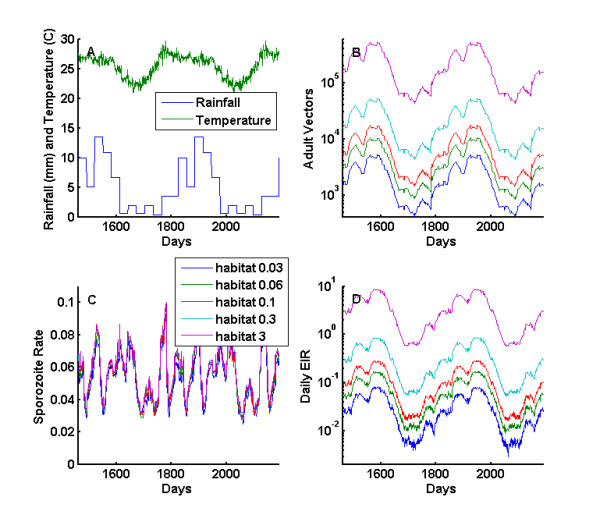
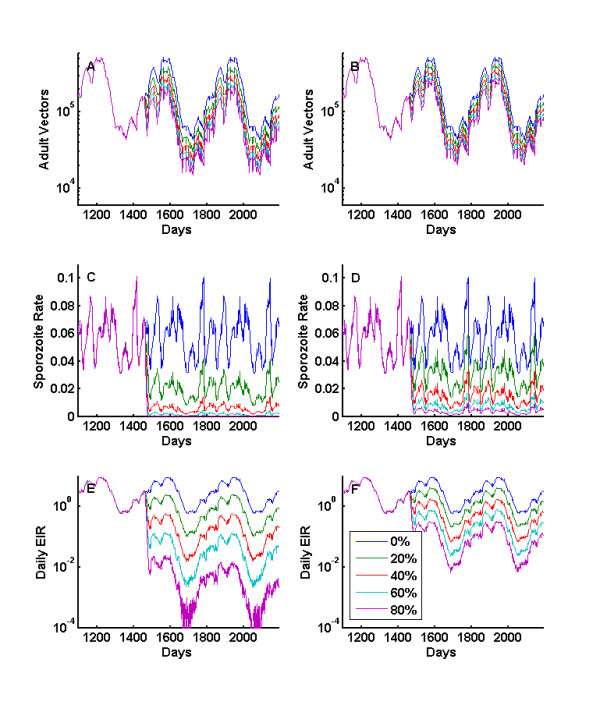
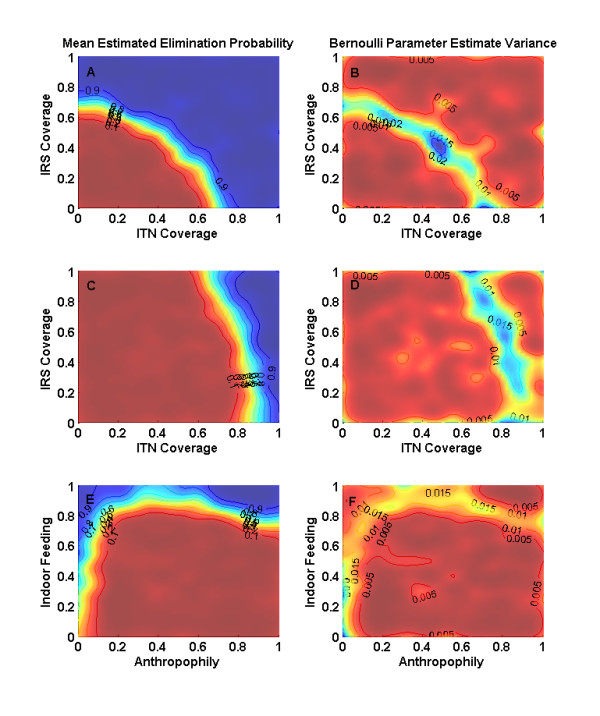
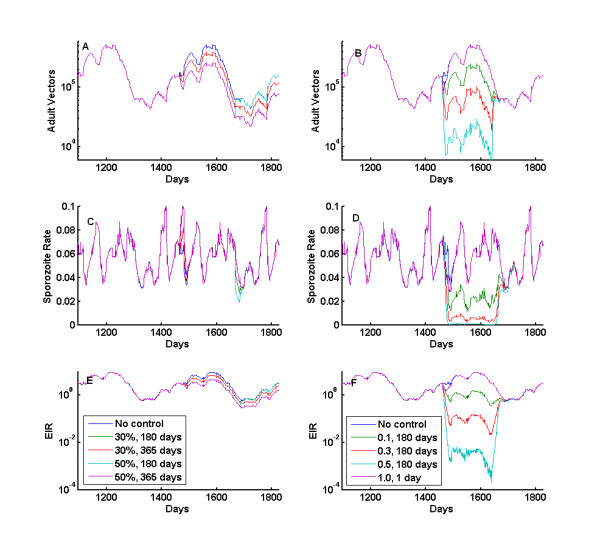
BACKGROUND: Malaria is a major public health issue in much of the world, and the mosquito vectors which drive transmission are key targets for interventions. Mathematical models for planning malaria eradication benefit from detailed representations of local mosquito populations, their natural dynamics and their response to campaign pressures. METHODS: A new model is presented for mosquito population dynamics, effects of weather, and impacts of multiple simultaneous interventions. This model is then embedded in a large-scale individual-based simulation and results for local elimination of malaria are discussed. Mosquito population behaviours, such as anthropophily and indoor feeding, are included to study their effect upon the efficacy of vector control-based elimination campaigns. RESULTS: Results for vector control tools, such as bed nets, indoor spraying, larval control and space spraying, both alone and in combination, are displayed for a single-location simulation with vector species and seasonality characteristic of central Tanzania, varying baseline transmission intensity and vector bionomics. The sensitivities to habitat type, anthropophily, indoor feeding, and baseline transmission intensity are explored. CONCLUSIONS: The ability to model a spectrum of local vector species with different ecologies and behaviours allows local customization of packages of interventions and exploration of the effect of proposed new tools.
Overview
The claims and statistics of this paper haven’t been checked yet.
Run the check — free, no account needed. It reads the open-access text and checks the sources it cites.
Integrity signals
Registry
Cites
Statistics
Figures
Verification
Claims the paper makes
The claims and statistics of this paper haven’t been checked yet.
Run the check — free, no account needed. It reads the open-access text and checks the sources it cites.
Claims other papers make about this one
Each is checked against this paper’s own text: does it say what the citing paper says it does?
The cited source doesn’t support the claim as written.
In the citing paper
“While investigating transmission dynamics is helpful, malaria models cannot be applied directly in irrigated regions as they typically rely only on rainfall as a source of water to quantify larval habitats.”
From Investigating the Impact of Irrigation on Malaria Vector Larval Habitats and Transmission Using a Hydrology‐Based Model (2023) · cites this paper as Eckhoff, 2011
Checked by a reasoning model — may be wrong.
Experimental — accuracy not yet measuredThe cited source doesn’t support the claim as written.
In the citing paper
“While widely used in malaria intervention studies (Galactionova et al., 2021), these models tend to neglect the larval habitat representation (Griffin et al., 2010; T. Smith et al., 2006) or rely only on rainfall to quantify larval habitats (Eckhoff, 2011).”
From Investigating the Impact of Irrigation on Malaria Vector Larval Habitats and Transmission Using a Hydrology‐Based Model (2023) · cites this paper as Eckhoff, 2011
Checked by a reasoning model — may be wrong.
Experimental — accuracy not yet measuredThe source backs part of the claim, not all of it — or backs it for a different population, condition or comparison.
In the citing paper
“The default habitat functions in EMOD are designed primarily to incorporate the variability of climate and the scaling factors and decay rates are usually calibrated to fit local data on vector abundance or entomological inoculation rate (EIR) rather than the habitat area per se (Eckhoff, 2011).”
From Investigating the Impact of Irrigation on Malaria Vector Larval Habitats and Transmission Using a Hydrology‐Based Model (2023) · cites this paper as Eckhoff, 2011
Experimental — accuracy not yet measured
Self-check
Percentages, sums and reported differences re-computed from the paper’s own numbers.
The self-check needs the paper’s full text.
Citations
Cites
The global distribution of clinical episodes of Plasmodium falciparum malaria
Snow, R. W., Guerra, C. A., Noor, A. M., Myint, H. Y., & Hay, S. I. (2005) · Nature · doi:10.1038/nature03342 · Cited by 2,758
The Epidemiology and Control of Malaria
(1960) · The Medical Journal of Australia · doi:10.5694/j.1326-5377.1960.tb105313.x · Cited by 1,316
A new world malaria map: Plasmodium falciparum endemicity in 2010
Gething, P. W., Patil, A. P., Smith, D. L., Guerra, C. A., Elyazar, I., Johnston, G. L., Tatem, A. J., & Hay, S. I. (2011) · Malaria Journal · doi:10.1186/1475-2875-10-378 · Cited by 1,169
Ross, R. (2010) · Cited by 940
A Climate-based Distribution Model of Malaria Transmission in Sub-Saharan Africa
Craig, M. H., Snow, R. W., & le Sueur, D. (1999) · Parasitology Today · doi:10.1016/s0169-4758(99)01396-4 · Cited by 854
The Biology of Mosquitoes, Volume 1: Development, Nutrition and Reproduction
Clements, A. N. (1992) · CABI eBooks · doi:10.1079/9780851993744.0000 · Cited by 715
A GLOBAL INDEX REPRESENTING THE STABILITY OF MALARIA TRANSMISSION
Kiszewski, A. E., Mellinger, A. D., Spielman, A., Malaney, P. N., Sachs, S. E., & Sachs, J. D. (2004) · American Journal of Tropical Medicine and Hygiene · doi:10.4269/ajtmh.2004.70.486 · Cited by 664
Griffin, J. T., Hollingsworth, T. D., Okell, L. C., Churcher, T. S., White, M., Hinsley, W., Bousema, T., Drakeley, C. J., Ferguson, N. M., Basáñez, M.-G., et al. (2010) · PLoS Medicine · doi:10.1371/journal.pmed.1000324 · Cited by 595
EPIDEMIOLOGY AND CONTROL OF MALARIA
Covell, G. (1957) · BMJ · doi:10.1136/bmj.2.5059.1477 · Cited by 542
A World Malaria Map: Plasmodium falciparum Endemicity in 2007
Hay, S. I., Guerra, C. A., Gething, P. W., Patil, A. P., Tatem, A. J., Noor, A. M., Kabaria, C. W., Manh, B. H., Elyazar, I., BROOKER, S. J., et al. (2009) · PLoS Medicine · doi:10.1371/journal.pmed.1000048 · Cited by 530
Statics and dynamics of malaria infection in Anopheles mosquitoes.
(2004) · Malaria Journal · doi:10.1186/1475-2875-3-13 · Cited by 473
Revisiting the Basic Reproductive Number for Malaria and Its Implications for Malaria Control
Smith, D. L., McKenzie, F. E., Snow, R. W., & Hay, S. I. (2007) · PLoS Biology · doi:10.1371/journal.pbio.0050042 · Cited by 468
Killeen, G. F., Smith, T. A., Ferguson, H. M., Mshinda, H., Abdulla, S., Lengeler, C., & Kachur, S. (2007) · PLoS Medicine · doi:10.1371/journal.pmed.0040229 · Cited by 418
Malaria Infection Increases Attractiveness of Humans to Mosquitoes
Lacroix, R., Mukabana, W. R., Gouagna, L., & Koella, J. C. (2005) · PLoS Biology · doi:10.1371/journal.pbio.0030298 · Cited by 376
MALARIA PARASITE DEVELOPMENT IN MOSQUITOES
Beier, J. C. (1998) · Annual Review of Entomology · doi:10.1146/annurev.ento.43.1.519 · Cited by 370
The entomological inoculation rate and Plasmodium falciparum infection in African children
Smith, D. L., Dushoff, J., Snow, R. W., & Hay, S. I. (2005) · Nature · doi:10.1038/nature04024 · Cited by 369
SUBMICROSCOPIC PLASMODIUM FALCIPARUM GAMETOCYTE DENSITIES FREQUENTLY RESULT IN MOSQUITO INFECTION
Schneider, P., Bousema, T., Gouagna, L., Otieno, S., VEGTE-BOLMER, M. V. D., Omar, S. A., & Sauerwein, R. W. (2007) · American Journal of Tropical Medicine and Hygiene · doi:10.4269/ajtmh.2007.76.470 · Cited by 318
The biology of mosquitoes Vol. 1: development, nutrition and reproduction
Clements, A. N. (2000) · Cited by 315
Unexpected High Losses of Anopheles gambiae Larvae Due to Rainfall
Paaijmans, K. P., Wandago, M. O., Githeko, A. K., & Takken, W. (2007) · PLoS ONE · doi:10.1371/journal.pone.0001146 · Cited by 269
Simard, F., Ayala, D., Kamdem, G. C., Pombi, M., Etouna, J., Osé, K., Fotsing, J.-M., Fontenille, D., Besansky, N. J., & Costantini, C. (2009) · BMC Ecology · doi:10.1186/1472-6785-9-17 · Cited by 268
Killeen, G. F., Fillinger, U., & Knols, B. G. (2002) · Malaria Journal · doi:10.1186/1475-2875-1-8 · Cited by 254
Fillinger, U., Ndenga, B. A., Githeko, A. K., & Lindsay, S. W. (2009) · Bulletin of the World Health Organization · doi:10.2471/blt.08.055632 · Cited by 247
Fillinger, U., Kannady, K., William, G., Vanek, M. J., Dongus, S., Nyika, D., Geissbühler, Y., Chaki, P. P., Govella, N. J., Mathenge, E. M., et al. (2008) · Malaria Journal · doi:10.1186/1475-2875-7-20 · Cited by 225
SMITH, T., KILLEEN, G. F., MAIRE, N., ROSS, A., MOLINEAUX, L., TEDIOSI, F., HUTTON, G., UTZINGER, J., DIETZ, K., & TANNER, M. (2006) · The American Journal of Tropical Medicine and Hygiene · doi:10.4269/ajtmh.2006.75.2_suppl.0750001 · Cited by 225
Killeen, G. F., McKenzie, F. E., Foy, B. D., Schieffelin, C., Billingsley, P. F., & Beier, J. C. (2000) · American Journal of Tropical Medicine and Hygiene · doi:10.4269/ajtmh.2000.62.535 · Cited by 220
Fillinger, U., Sonye, G. O., Killeen, G. F., Knols, B. G., & Becker, N. (2004) · Tropical Medicine & International Health · doi:10.1111/j.1365-3156.2004.01335.x · Cited by 215
Filipe, J. A. N., Riley, E. M., DRAKELEY, C. J., Sutherland, C. J., & Ghani, A. C. (2005) · PLoS Computational Biology · doi:10.1371/journal.pcbi.0030255 · Cited by 206
The Analysis of Mortality and Survival Rates in Wild Populations of Mosquitoes
Clements, A. N., & Paterson, G. D. (1981) · Journal of Applied Ecology · doi:10.2307/2402401 · Cited by 205
Depinay, J.-M. O., Mbogo, C. M., Killeen, G. F., Knols, B. G., Beier, J. C., Carlson, J. C., Dushoff, J. G., Billingsley, P. F., Mwambi, H. G., Githure, J. I., et al. (2004) · Malaria Journal · doi:10.1186/1475-2875-3-29 · Cited by 202
Gimnig, J. E., VULULE, J. M., Lo, T., Kamau, L., KOLCZAK, M. S., Phillips‐Howard, P. A., Mathenge, E. M., ter Kuile, F. O., Nahlen, B. L., Hightower, A. W., et al. (2003) · American Journal of Tropical Medicine and Hygiene · doi:10.4269/ajtmh.2003.68.16 · Cited by 202
Saul, A. J. (2003) · Malaria Journal · doi:10.1186/1475-2875-2-32 · Cited by 202
The epidemiology of Plasmodium falciparum gametocytes: weapons of mass dispersion
DRAKELEY, C. J., Sutherland, C. J., Bousema, T., Sauerwein, R. W., & Targett, G. A. T. (2006) · Trends in Parasitology · doi:10.1016/j.pt.2006.07.001 · Cited by 192
Plasmodium falciparum gametocytes: their longevity and infectivity
Smalley, M. E., & Sinden, R. E. (1977) · Parasitology · doi:10.1017/s0031182000047478 · Cited by 190
Dobson, S. L., Fox, C. W., & Jiggins, F. M. (2002) · Proceedings of the Royal Society B Biological Sciences · doi:10.1098/rspb.2001.1876 · Cited by 182
INTEGRATED URBAN MALARIA CONTROL: A CASE STUDY IN DAR ES SALAAM, TANZANIA
Castro, M. C., YAMAGATA, Y., Mtasiwa, D. M., Tanner, M., Utzinger, J., Keiser, J., & Singer, B. H. (2004) · American Journal of Tropical Medicine and Hygiene · doi:10.4269/ajtmh.2004.71.103 · Cited by 180
Jeffery, G. M., & Eyles, D. E. (1955) · American Journal of Tropical Medicine and Hygiene · doi:10.4269/ajtmh.1955.4.781 · Cited by 171
Gimnig, J. E., KOLCZAK, M. S., Hightower, A. W., VULULE, J. M., Schoute, E., Kamau, L., Phillips‐Howard, P. A., ter Kuile, F. O., Nahlen, B. L., & HAWLEY, W. A. (2003) · American Journal of Tropical Medicine and Hygiene · doi:10.4269/ajtmh.2003.68.115 · Cited by 166
Okell, L., DRAKELEY, C. J., Ghani, A. C., Bousema, T., & Sutherland, C. J. (2008) · Malaria Journal · doi:10.1186/1475-2875-7-125 · Cited by 162
The reservoir of Plasmodium falciparum malaria in a holoendemic area of western Kenya
Githeko, A. K., Brandling-Bennett, A. D., Beier, M. S., Atieli, F., Owaga, M. L., & Collins, F. H. (1992) · Transactions of the Royal Society of Tropical Medicine and Hygiene · doi:10.1016/0035-9203(92)90216-y · Cited by 161
Mágori, K., Legros, M., Puente, M. E., Focks, D. A., Scott, T. W., Lloyd, A. L., & Gould, F. L. (2009) · PLoS neglected tropical diseases · doi:10.1371/journal.pntd.0000508 · Cited by 160
Regulation of Infectivity of Plasmodium to the Mosquito Vector
Sinden, R. E., Butcher, G. A., Billker, O., & Fleck, S. L. (1996) · Advances in Parasitology/Advances in parasitology · doi:10.1016/s0065-308x(08)60033-0 · Cited by 156
Koenraadt, C. J. M., Githeko, A. K., & Takken, W. (2003) · Acta Tropica · doi:10.1016/j.actatropica.2003.11.007 · Cited by 155
Towards a comprehensive simulation model of malaria epidemiology and control
Smith, T. A., Maire, N., Ross, A. J., Penny, M. A., Chitnis, N., Schapira, A., Studer, A., Genton, B., Lengeler, C., Tediosi, F., et al. (2008) · Parasitology · doi:10.1017/s0031182008000371 · Cited by 151
Naotunne, T. D. S., Karunaweera, N. D., Giudice, G. D., Kularatne, M. U., Grau, G. E., Carter, R., & Mendis, K. (1991) · The Journal of Experimental Medicine · doi:10.1084/jem.173.3.523 · Cited by 149
Afrane, Y. A., Little, T. J., Lawson, B. W., Githeko, A. K., & Yan, G. (2008) · Emerging infectious diseases · doi:10.3201/eid1410.070781 · Cited by 144
Shrinking the Malaria Map: A Prospectus on Malaria Elimination
Feachem, R. G., Phillips, A. A., & Targett, G. R. A. (2009) · IHI Repository · Cited by 144
Snowden, F. Μ. (2006) · Yale University Press eBooks · doi:10.12987/9780300128437 · Cited by 143
Anderson, R. A., Knols, B. G., & Koella, J. C. (2000) · Parasitology · doi:10.1017/s0031182099005570 · Cited by 138
Hydrology of malaria: Model development and application to a Sahelian village
Bomblies, A., Duchemin, J., & Eltahir, E. A. B. (2008) · Water Resources Research · doi:10.1029/2008wr006917 · Cited by 138
Mutuku, F. M., Bayoh, M. N., Gimnig, J. E., VULULE, J. M., Kamau, L., WALKER, E. D., Kabiru, E. W., & HAWLEY, W. A. (2006) · American Journal of Tropical Medicine and Hygiene · doi:10.4269/ajtmh.2006.74.54 · Cited by 126
Naotunne, T. D. S., Karunaweera, N. D., Mendis, K., & Carter, R. (1993) · PubMed Central · Cited by 125
Hogg, J. C., & HURD, H. (1997) · Parasitology · doi:10.1017/s0031182096008542 · Cited by 121
The Conquest of Malaria: Italy, 1900-1962
Snowden, F. Μ. (2020) · Cited by 117
Killeen, G. F., McKenzie, F. E., Foy, B. D., Bøgh, C., & Beier, J. C. (2001) · Transactions of the Royal Society of Tropical Medicine and Hygiene · doi:10.1016/s0035-9203(01)90005-7 · Cited by 115
The Malarial Infectivity of an African Village Population to Mosquitoes (Anopheles Gambiae)
Muirhead-Thomson, R. C. (1957) · American Journal of Tropical Medicine and Hygiene · doi:10.4269/ajtmh.1957.6.971 · Cited by 110
Killeen, G. F., McKenzie, F. E., Foy, B. D., Schieffelin, C., Billingsley, P. F., & Beier, J. C. (2000) · The American journal of tropical medicine and hygiene · doi:10.4269/ajtmh.2000.62.545 · Cited by 106
Complete Development of Mosquito Phases of the Malaria Parasite in Vitro
Al-Olayan, E. M., Beetsma, A. L., Butcher, G. A., Sinden, R. E., & Hurd, H. (2002) · Science · doi:10.1126/science.1067159 · Cited by 102
Wekesa, J. W., Copeland, R. S., & Mwangi, R. (1992) · American Journal of Tropical Medicine and Hygiene · doi:10.4269/ajtmh.1992.47.484 · Cited by 95
Saul, A. J., Graves, P. M., & Kay, B. H. (1990) · Journal of Applied Ecology · doi:10.2307/2403572 · Cited by 85
Theory of the eradication of malaria.
MacDonald, G. F. (1956) · Europe PMC (PubMed Central) · Cited by 83
Bonnet, S. I., Gouagna, L., Paul, R. E. L., Safeukui, I., Meunier, J., & Boudin, C. (2003) · Transactions of the Royal Society of Tropical Medicine and Hygiene · doi:10.1016/s0035-9203(03)90022-8 · Cited by 80
INFECTIOUSNESS OF MALARIA-ENDEMIC HUMAN POPULATIONS TO VECTORS
Killeen, G. F., Ross, A. J., & Smith, T. A. (2006) · American Journal of Tropical Medicine and Hygiene · doi:10.4269/ajtmh.2006.75.2_suppl.0750038 · Cited by 78
Gorman, M. J., Cornel, A. J., Collins, F. H., & Paskewitz, S. M. (1996) · Experimental Parasitology · doi:10.1006/expr.1996.0126 · Cited by 70
Bonnet, S. I., Gouagna, L., Safeukui, I., Meunier, J., & Boudin, C. (2000) · Transactions of the Royal Society of Tropical Medicine and Hygiene · doi:10.1016/s0035-9203(00)90456-5 · Cited by 69
A mechanistic approach for accurate simulation of village scale malaria transmission
Bomblies, A., Duchemin, J., & Eltahir, E. A. B. (2009) · Malaria Journal · doi:10.1186/1475-2875-8-223 · Cited by 66
A hydrologically driven model of swamp water mosquito population dynamics
Shaman, J. L., Spiegelman, M. W., Cane, M. A., & Stieglitz, M. (2005) · Ecological Modelling · doi:10.1016/j.ecolmodel.2005.10.037 · Cited by 46
Yé, Y., Hoshen, M. B., Kyobutungi, C. K., Louis, V. R., & Sauerborn, R. (2009) · Global Health Action · doi:10.3402/gha.v2i0.1923 · Cited by 40
Cohen, J. D., Smith, D. C., Vallely, A., Taleo, G. K., Malefoasi, G., & Sabot, O. (2009) · Cited by 31
Seasonal distribution of Anopheles funestus chromosomal forms from Burkina Faso
Guelbeogo, M. W., Sagnon, N., Grushko, O., Yameogo, M. A., Boccolini, D., Besansky, N. J., & Costantini, C. (2009) · Malaria Journal · doi:10.1186/1475-2875-8-239 · Cited by 30
CARWARDINE, S. L., & HURD, H. (1997) · Medical and Veterinary Entomology · doi:10.1111/j.1365-2915.1997.tb00405.x · Cited by 30
Jacob, B. G., Muturi, E. J., HALBIG, P., MWANGANGI, J. M., Wanjogu, R. K., Mpanga, E., Funes, J., SHILILU, J. I., Githure, J. I., Regens, J. L., et al. (2007) · American Journal of Tropical Medicine and Hygiene · doi:10.4269/ajtmh.2007.76.73 · Cited by 26
Burkot, T. R., Graves, P. M., Paru, R., Battistutta, D., Barnes, A., & Saul, A. J. (1990) · American Journal of Tropical Medicine and Hygiene · doi:10.4269/ajtmh.1990.43.321 · Cited by 23
Research works printed but not linked: 1
- Gillies MT, De Meillon B: The Anophelinae of Africa, South of the Sahara. 1968, Johannesburg, South Africa: South African Institute for Medical Research
Cited by
Sorted by citations
Eckhoff, P. A., Wenger, E. A., Godfray, H. C. J., & Burt, A. (2016) · Proceedings of the National Academy of Sciences · doi:10.1073/pnas.1611064114 · Cited by 197
Self-citationHuho, B., Briët, O., Seyoum, A., Sikaala, C., Bayoh, N. M., Gimnig, J. E., Okumu, F. O., Diallo, D. A., Abdulla, S., Smith, T. A., et al. (2013) · International Journal of Epidemiology · doi:10.1093/ije/dys214 · Cited by 190
Tompkins, A. M., & Ermert, V. (2013) · Malaria Journal · doi:10.1186/1475-2875-12-65 · Cited by 155
Mathematical modeling of climate change and malaria transmission dynamics: a historical review
Eikenberry, S. E., & Gumel, A. B. (2018) · Journal of Mathematical Biology · doi:10.1007/s00285-018-1229-7 · Cited by 149
Heterogeneity, Mixing, and the Spatial Scales of Mosquito-Borne Pathogen Transmission
Perkins, T. A., Scott, T. W., Le Menach, A., & Smith, D. L. (2013) · PLoS Computational Biology · doi:10.1371/journal.pcbi.1003327 · Cited by 130
Metadata
- Authors
- Eckhoff, P. A.
- Affiliations
- Intellectual Ventures (United States) (US)
- Corresponding author
- Eckhoff, Philip A
- ORCID
- Eckhoff, Philip A
- Venue
- Malaria Journal
- Published
- 2011-10-17
- Volume
- 10
- Issue
- 1
- Pages
- 303-303
- ISSN
- 1475-2875 (ISSN-L)
- PMC
- PMC3224385
- OpenAlex
- W2136547339
- Cited by
- 191
- References
- 72
- Citations by year
- 2026: 6 · 2025: 8 · 2024: 11 · 2023: 13 · 2022: 11 · 2021: 19 · 2020: 12 · 2019: 10 · 2018: 14 · 2017: 12 · 2016: 17 · 2015: 20 · 2014: 13 · 2013: 19 · 2012: 6
- FWCI
- 11.95
- Type
- journal article
- Language
- en
- Open access
- gold
- doi.org
- Licence
- Locations
- Malaria Journal (publishedVersion, cc-by)
- PubMed Central (publishedVersion, cc-by)
- PubMed (publishedVersion)
- DOAJ (DOAJ: Directory of Open Access Journals) (submittedVersion, cc-by-sa)
- Funders
- Bill and Melinda Gates Foundation
- Topics
- Health Sciences › Medicine › Public Health, Environmental and Occupational Health › Malaria Research and Control
- Physical Sciences › Mathematics › Applied Mathematics › Mathematical and Theoretical Epidemiology and Ecology Models
- Health Sciences › Medicine › Public Health, Environmental and Occupational Health › Mosquito-borne diseases and control
- Keywords
- malaria transmission, mosquito population dynamics, mosquito life cycle, vector control, malaria elimination, anthropophily, indoor feeding, bed nets, indoor residual spraying, larval source management, space spraying, agent-based modeling, vector bionomics
- MeSH terms
- Animals, Computer Simulation, Disease Vectors, Female, Humans, Life Cycle Stages, Malaria, Mosquito Control, Culicidae, Population Dynamics, Tanzania, Weather, Ecosystem
About these checks
Registry, retraction, Cites and statistics results are computed, not judged, with one exception: a printed reference that no index lists is read once by a model before it counts as a citation error. Claims are extracted by a model and kept only when their quote appears verbatim in the text; each cited source is then checked, with a model’s help, for whether it says what the claim relies on. Those verdicts can be wrong — read the claim’s quote and the cited source before relying on one.
Statistics and arithmetic are recomputed, not judged.
Confidence bands are shown only for fields calibrated on our annotated test set. None is calibrated yet, so no band is shown.
What counts as a claim ›How we measure confidence ›How we check this ›
Are you an author, or do you see a problem with this page? Request a review
