

A systematic review of the safety and efficacy of artemether-lumefantrine against uncomplicated Plasmodium falciparum malaria during pregnancy
Open accessThe DOI matches its Crossref record; 51 of the 51 references it cites were found in a registry or an index.
Abstract
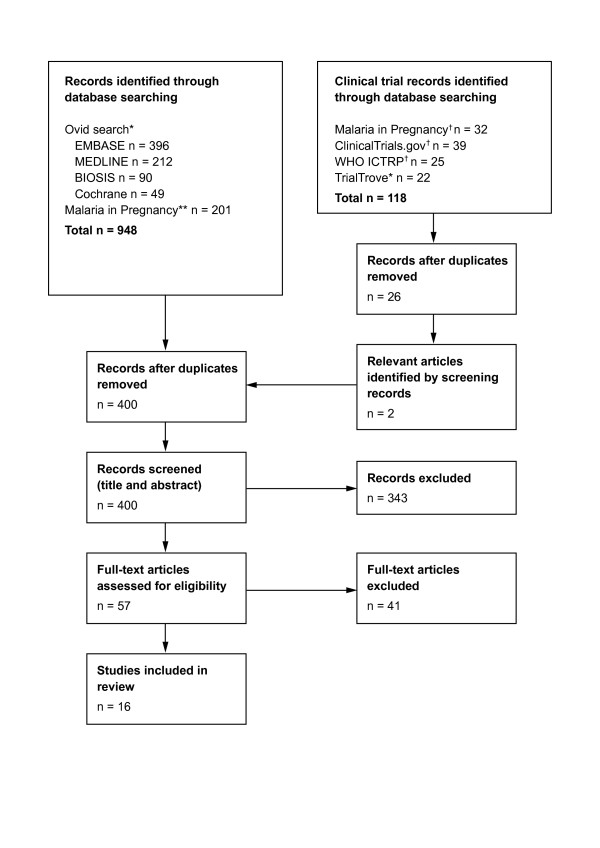
Malaria during pregnancy, particularly Plasmodium falciparum malaria, has been linked to increased morbidity and mortality, which must be reduced by both preventive measures and effective case management. The World Health Organization (WHO) recommends artemisinin-based combination therapy (ACT) to treat uncomplicated falciparum malaria during the second and third trimesters of pregnancy, and quinine plus clindamycin during the first trimester. However, the national policies of many African countries currently recommend quinine throughout pregnancy. Therefore, the aim of this article is to provide a summary of the available data on the safety and efficacy of artemether-lumefantrine (AL) in pregnancy. An English-language search identified 16 publications from 1989 to October 2011 with reports of artemether or AL exposure in pregnancy, including randomized clinical trials, observational studies and systematic reviews. Overall, there were 1,103 reports of AL use in pregnant women: 890 second/third trimester exposures; 212 first trimester exposures; and one case where the trimester of exposure was not reported. In the second and third trimesters, AL was not associated with increased adverse pregnancy outcomes as compared with quinine or sulphadoxine-pyrimethamine, showed improved tolerability relative to quinine, and its efficacy was non-inferior to quinine. There is evidence to suggest that the pharmacokinetics of anti-malarial drugs may change in pregnancy, although the impact on efficacy and safety needs to be studied further, especially since the majority of studies report high cure rates and adequate tolerability. As there are fewer reports of AL safety in the first trimester, additional data are required to assess the potential to use AL in the first trimester. Though the available safety and efficacy data support the use of AL in the second and third trimesters, there is still a need for further information. These findings reinforce the WHO recommendation to treat uncomplicated falciparum malaria with quinine plus clindamycin in early pregnancy and ACT in later pregnancy.
Overview
The claims and statistics of this paper haven’t been checked yet.
Free: it reads the open-access text and checks the first 5 claims that cite a source we can check. Create a free account to check every claim.
Integrity signals
Registry
Cites
Statistics
Figures
Verification
Claims the paper makes
The claims and statistics of this paper haven’t been checked yet.
Free: it reads the open-access text and checks the first 5 claims that cite a source we can check. Create a free account to check every claim.
Claims other papers make about this one
Each is checked against this paper’s own text: does it say what the citing paper says it does?
The source backs part of the claim, not all of it — or backs it for a different population, condition or comparison.
In the citing paper
“Artemether-lumefantrine (AL, Coartem) is effective and safe in the treatment of malaria during pregnancy [196].”
From Current update on malaria in pregnancy: a systematic review (2025) · cites this paper as [196]
Experimental — accuracy not yet measured
Self-check
Percentages, sums and reported differences re-computed from the paper’s own numbers.
The self-check needs the paper’s full text.
Citations
Cites
Weltgesundheitsorganisation (2005) · Cited by 3,799
Epidemiology and burden of malaria in pregnancy
Desai, M., ter Kuile, F. O., Nosten, F., McGready, R., Asamoa, K., Brabin, B., & Newman, R. D. (2007) · The Lancet Infectious Diseases · doi:10.1016/s1473-3099(07)70021-x · Cited by 1,432 · cited 1×
“Malaria during pregnancy is associated with an increased risk of maternal anaemia, maternal death, abortion, premature labour, low birth weight, and neonatal death [1,7,38].”
BackgroundQuantifying the Number of Pregnancies at Risk of Malaria in 2007: A Demographic Study
Dellicour, S., Tatem, A. J., Guerra, C. A., Snow, R. W., & ter Kuile, F. O. (2010) · PLoS Medicine · doi:10.1371/journal.pmed.1000221 · Cited by 490 · cited 1×
“4 million pregnancies occurred in areas of unstable transmission [4].”
BackgroundTER KUILE, F. O., PARISE, M. E., VERHOEFF, F. H., UDHAYAKUMAR, V., NEWMAN, R. D., VAN EIJK, A. M., ROGERSON, S. J., & STEKETEE, R. W. (2004) · The American Journal of Tropical Medicine and Hygiene · doi:10.4269/ajtmh.2004.71.41 · Cited by 364
Pharmacokinetics and Pharmacodynamics of Lumefantrine (Benflumetol) in Acute Falciparum Malaria
Ezzet, F., van Vugt, M., Nosten, F., Looareesuwan, S., & White, N. J. (2000) · Antimicrobial Agents and Chemotherapy · doi:10.1128/aac.44.3.697-704.2000 · Cited by 354 · cited 3×
“Small changes in AL exposure during pregnancy have been reported [21,25], but these results should be viewed with caution as they involve inter-trial comparisons, small populations, high inter-individual variation in plasma levels and the average plasma levels reported are comparable with data from non-pregnant adults…”
BackgroundResultWHO Guidelines for the treatment of malaria
Kunte, R., & Kunwar, R. (2011) · Medical Journal Armed Forces India · doi:10.1016/s0377-1237(16)30022-3 · Cited by 341
Artemisinin-based combination therapy for treating uncomplicated malaria
Sinclair, D., Zani, B., Donegan, S., Olliaro, P., & Garner, P. (2009) · Cochrane Database of Systematic Reviews · doi:10.1002/14651858.cd007483.pub2 · Cited by 286
McGready, R., Lee, S., Wiladphaingern, J., Ashley, E., Rijken, M., Boel, M., Simpson, J., Paw, M., Pimanpanarak, M., Mu, O., et al. (2012) · The Lancet Infectious Diseases · doi:10.1016/s1473-3099(11)70339-5 · Cited by 228 · cited 2×
“…[21], Dellicour et al., 2007 [14], McGready et al., 2008 [22], Kaye et al., 2008 [23], Orton et al., 2008 [61], Adam et al., 2009 [24], Tarning et al., 2009 [37], Piola et al., 2010 [25], Manyando et al., 2010 [26], McGready et al., 2011 [29], Sangaré et al., 2011 [27], Wilby and Ensom, 2011 [30].”
ResultPiola, P., Fogg, C., Bajunirwe, F., Biraro, S., Grandesso, F., Ruzagira, E., Babigumira, J., Kigozi, I., Kiguli, J., Kyomuhendo, J., et al. (2005) · The Lancet · doi:10.1016/s0140-6736(05)66416-1 · Cited by 211
Lefèvre, G., Looareesuwan, S., Treeprasertsuk, S., Krudsood, S., Silachamroon, U., Gathmann, I., Mull, R., & Bakshi, R. (2001) · The American journal of tropical medicine and hygiene · doi:10.4269/ajtmh.2001.64.247 · Cited by 178 · cited 2×
“Small changes in AL exposure during pregnancy have been reported [21,25], but these results should be viewed with caution as they involve inter-trial comparisons, small populations, high inter-individual variation in plasma levels and the average plasma levels reported are comparable with data from non-pregnant adults…”
MethodResult
Research works printed but not linked: 2
- Poespoprodjo JR Fobia W Kenangalem E Lampah DA Sugiarto P Tjitra E Anstey NM Price RN Highly effective therapy for malaria in pregnancy improves maternal and neonatal health outcome [abstract] Am J Trop Med Hyg 2011 85 Suppl 6 Abstract number 455
- Ugandan Malaria Control Programme Ugandan National Policy on Malaria 2005 http://www.health.go.ug/mcp/NationalPolicyonMalariaTreatment(07_03_06).pdf
Cited by
UK malaria treatment guidelines 2016
Lalloo, D. G., Shingadia, D., Bell, D. J., Beeching, N. J., Whitty, C. J. M., & Chiodini, P. L. (2016) · Journal of Infection · doi:10.1016/j.jinf.2016.02.001 · Cited by 250
Kajubi, R., Ochieng, T., Kakuru, A., Jagannathan, P., Nakalembe, M., Ruel, T., Opira, B., Ochokoru, H., Ategeka, J., Nayebare, P., et al. (2019) · The Lancet · doi:10.1016/s0140-6736(18)32224-4 · Cited by 136
Four Artemisinin-Based Treatments in African Pregnant Women with Malaria
The PREGACT Study Group (2016) · New England Journal of Medicine · doi:10.1056/nejmoa1508606 · Cited by 99
Lapinsky, S. E. (2013) · Critical Care Clinics · doi:10.1016/j.ccc.2013.03.006 · Cited by 88
“A World Health Organization report supported by a systematic review suggests treating first-trimester severe malaria with quinine plus clindamycin, and second-trimester and third-trimester disease with artemisinins.(44)”
BackgroundMinja, D. T. R., Schmiegelow, C., Mmbando, B., Boström, S., Oesterholt, M., Magistrado, P., Pehrson, C., John, D., Salanti, A., Luty, A. J. F., et al. (2013) · Emerging Infectious Diseases · doi:10.3201/eid1909.130133 · Cited by 81
Metadata
- Authors
- Manyando, C., Kayentao, K., D’Alessandro, U., Okafor, H. U., Juma, E., & Hamed, K.
- Affiliations
- Tropical Diseases Research Centre (ZM)
- Malaria Research and Training Center (ML)
- MRC Unit the Gambia (GM)
- University of Nigeria (NG)
- Kenya Medical Research Institute (KE)
- Corresponding author
- Manyando, Christine
- Venue
- Malaria Journal
- Published
- 2012-05-01
- Volume
- 11
- Issue
- 1
- Pages
- 141-141
- ISSN
- 1475-2875 (ISSN-L)
- PMC
- PMC3405476
- OpenAlex
- W2099127084
- Cited by
- 62
- References
- 51
- Citations by year
- 2026: 1 · 2025: 3 · 2024: 1 · 2023: 3 · 2022: 2 · 2020: 2 · 2019: 1 · 2018: 4 · 2017: 7 · 2016: 11 · 2015: 9 · 2014: 10 · 2013: 7 · 2012: 1
- FWCI
- 1.35
- Type
- journal article
- Language
- en
- Open access
- gold
- doi.org
- Licence
- cc-by
- creativecommons.org/licenses/by/2.0 (tdm)
- Locations
- Malaria Journal (publishedVersion, cc-by)
- Europe PMC (PubMed Central) (publishedVersion, cc-by)
- PubMed Central (publishedVersion, cc-by)
- PubMed (publishedVersion)
- DOAJ (DOAJ: Directory of Open Access Journals) (submittedVersion, cc-by-sa)
- Funders
- Novartis Pharma
- Topics
- Health Sciences › Medicine › Public Health, Environmental and Occupational Health › Malaria Research and Control
- Health Sciences › Medicine › Public Health, Environmental and Occupational Health › Pregnancy and Medication Impact
- Health Sciences › Medicine › Public Health, Environmental and Occupational Health › Pharmaceutical Quality and Counterfeiting
- Keywords
- artemether-lumefantrine, falciparum malaria, malaria in pregnancy, uncomplicated malaria, artemisinin-based combination therapy, drug safety in pregnancy, drug efficacy, sulfadoxine-pyrimethamine, first trimester exposure, pharmacokinetics in pregnancy, adverse pregnancy outcomes
- MeSH terms
- Artemether, Lumefantrine Drug Combination, Antimalarials, Drug Combinations, Ethanolamines, Female, Fluorenes, Humans, Pregnancy, Pregnancy Complications, Infectious, Pyrimethamine, Quinine, Sulfadoxine, Malaria, Falciparum, Treatment Outcome, Artemisinins, Drug-Related Side Effects and Adverse Reactions
About these checks
Registry, retraction, Cites and statistics results are computed, not judged, with one exception: a printed reference that no index lists is read once by a model before it counts as a citation error. Claims are extracted by a model and kept only when their quote appears verbatim in the text; each cited source is then checked, with a model’s help, for whether it says what the claim relies on. Those verdicts can be wrong — read the claim’s quote and the cited source before relying on one.
Statistics and arithmetic are recomputed, not judged.
Confidence bands are shown only for fields calibrated on our annotated test set. None is calibrated yet, so no band is shown.
What counts as a claim ›How we measure confidence ›How we check this ›
Are you an author, or do you see a problem with this page? Request a review
Data sources
Bibliographic data: Semantic Scholar, OpenAlex, Crossref.
Contains information from the Semantic Scholar Academic Graph Datasets, made available under the ODC Attribution License (ODC-BY 1.0).
Semantic Scholar’s data is described in: Kinney, R., et al. (2023). The Semantic Scholar Open Data Platform. arXiv:2301.10140.
