

Mapping malaria risk among children in Côte d’Ivoire using Bayesian geo-statistical models
Open accessThe DOI matches its Crossref record; 43 of the 43 references it cites were found in a registry or an index.
Abstract
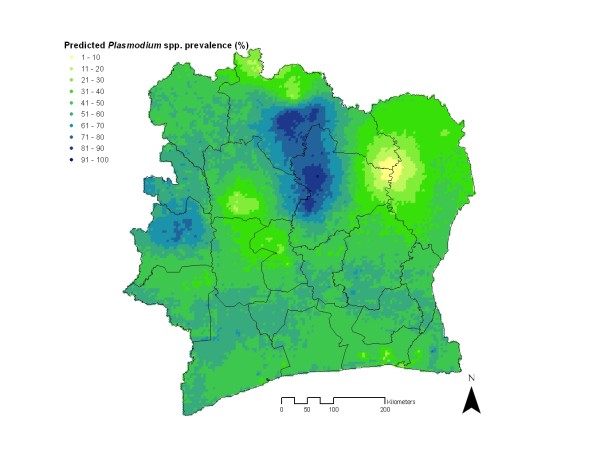
BACKGROUND: In Côte d'Ivoire, an estimated 767,000 disability-adjusted life years are due to malaria, placing the country at position number 14 with regard to the global burden of malaria. Risk maps are important to guide control interventions, and hence, the aim of this study was to predict the geographical distribution of malaria infection risk in children aged <16 years in Côte d'Ivoire at high spatial resolution. METHODS: Using different data sources, a systematic review was carried out to compile and geo-reference survey data on Plasmodium spp. infection prevalence in Côte d'Ivoire, focusing on children aged <16 years. The period from 1988 to 2007 was covered. A suite of Bayesian geo-statistical logistic regression models was fitted to analyse malaria risk. Non-spatial models with and without exchangeable random effect parameters were compared to stationary and non-stationary spatial models. Non-stationarity was modelled assuming that the underlying spatial process is a mixture of separate stationary processes in each ecological zone. The best fitting model based on the deviance information criterion was used to predict Plasmodium spp. infection risk for entire Côte d'Ivoire, including uncertainty. RESULTS: Overall, 235 data points at 170 unique survey locations with malaria prevalence data for individuals aged <16 years were extracted. Most data points (n = 182, 77.4%) were collected between 2000 and 2007. A Bayesian non-stationary regression model showed the best fit with annualized rainfall and maximum land surface temperature identified as significant environmental covariates. This model was used to predict malaria infection risk at non-sampled locations. High-risk areas were mainly found in the north-central and western area, while relatively low-risk areas were located in the north at the country border, in the north-east, in the south-east around Abidjan, and in the central-west between two high prevalence areas. CONCLUSION: The malaria risk map at high spatial resolution gives an important overview of the geographical distribution of the disease in Côte d'Ivoire. It is a useful tool for the national malaria control programme and can be utilized for spatial targeting of control interventions and rational resource allocation.
Overview
The claims and statistics of this paper haven’t been checked yet.
Free: it reads the open-access text and checks the first 5 claims that cite a source we can check. Create a free account to check every claim.
Integrity signals
Registry
Cites
Statistics
Figures
Verification
Claims the paper makes
The claims and statistics of this paper haven’t been checked yet.
Free: it reads the open-access text and checks the first 5 claims that cite a source we can check. Create a free account to check every claim.
Self-check
Percentages, sums and reported differences re-computed from the paper’s own numbers.
The self-check needs the paper’s full text.
Citations
Cites
Sampling-based approaches to calculating marginal densities
Gelfand, A. E., & Smith, A. F. M. (1990) · Journal of the American Statistical Association · doi:10.1080/01621459.1990.10476213 · Cited by 6,606 · cited 1×
“Markov chain Monte Carlo (MCMC) simulation was employed to estimate the model parameters [22].”
MethodDiggle, P. J., Tawn, J. A., & Moyeed, R. A. (1998) · Journal of the Royal Statistical Society Series C: Applied Statistics · doi:10.1111/1467-9876.00113 · Cited by 2,174
A new world malaria map: Plasmodium falciparum endemicity in 2010
Gething, P. W., Patil, A. P., Smith, D. L., Guerra, C. A., Elyazar, I. R., Johnston, G. L., Tatem, A. J., & Hay, S. I. (2011) · Malaria Journal · doi:10.1186/1475-2875-10-378 · Cited by 1,146
The Global Spread of Malaria in a Future, Warmer World
Rogers, D. J., & Randolph, S. E. (2000) · Science · doi:10.1126/science.289.5485.1763 · Cited by 696
A Research Agenda to Underpin Malaria Eradication
Alonso, P. L., Brown, G., Arevalo-Herrera, M., Binka, F., Chitnis, C., Collins, F., Doumbo, O. K., Greenwood, B., Hall, B. F., Levine, M. M., et al. (2011) · PLoS Medicine · doi:10.1371/journal.pmed.1000406 · Cited by 667 · cited 2×
“This entails different disease spectra in different population target groups from different epidemiological settings, with implications for current malaria control programmes [38].”
BackgroundSelf-citationClimate change and the resurgence of malaria in the East African highlands
Hay, S. I., Cox, J., Rogers, D. J., Randolph, S. E., Stern, D. I., Shanks, G. D., Myers, M. F., & Snow, R. W. (2002) · Nature · doi:10.1038/415905a · Cited by 525 · cited 2×
“These environmental factors had already been successfully implemented in previous geo-statistical modelling approaches employed in other African countries [5,8,13,36].”
BackgroundA World Malaria Map: Plasmodium falciparum Endemicity in 2007
Hay, S. I., Guerra, C. A., Gething, P. W., Patil, A. P., Tatem, A. J., Noor, A. M., Kabaria, C. W., Manh, B. H., Elyazar, I. R. F., Brooker, S., et al. (2009) · PLoS Medicine · doi:10.1371/journal.pmed.1000048 · Cited by 505
Suwahyono, U. (2009) · Cited by 351
The consequences of reducing transmission of Plasmodium falciparum in Africa
SNOW, R., & MARSH, K. (2002) · Advances in Parasitology · doi:10.1016/s0065-308x(02)52013-3 · Cited by 223 · cited 1×
“age groups [39].”
Standardizing estimates of the Plasmodium falciparum parasite rate
Smith, D. L., Guerra, C. A., Snow, R. W., & Hay, S. I. (2007) · Malaria Journal · doi:10.1186/1475-2875-6-131 · Cited by 207 · cited 1×
“mission models [40,41] converting age-heterogeneous survey”
Research works printed but not linked: 1
- WHO The World Health Report 2004: Changing history 2004 Geneva: World Health Organization
Cited by
Global mapping of infectious disease
Hay, S. I., Battle, K. E., Pigott, D. M., Smith, D. L., Moyes, C. L., Bhatt, S., Brownstein, J. S., Collier, N., Myers, M. F., George, D. B., et al. (2013) · Philosophical Transactions of the Royal Society B: Biological Sciences · doi:10.1098/rstb.2012.0250 · Cited by 243
Bayesian Geostatistical Modeling of Leishmaniasis Incidence in Brazil
Karagiannis-Voules, D.-A., Scholte, R. G. C., Guimarães, L. H., Utzinger, J., & Vounatsou, P. (2013) · PLoS neglected tropical diseases · doi:10.1371/journal.pntd.0002213 · Cited by 121
“Bayesian geostatistical models have been applied in the mapping of malaria [11–14] and neglected tropical diseases [15– 18].”
Self-citationRelative importance of climatic, geographic and socio-economic determinants of malaria in Malawi
Lowe, R., Chirombo, J., & Tompkins, A. M. (2013) · Malaria Journal · doi:10.1186/1475-2875-12-416 · Cited by 91
Stresman, G., Bousema, T., & Cook, J. (2019) · Trends in Parasitology · doi:10.1016/j.pt.2019.07.013 · Cited by 89
Environmental Risk Assessment of Trace Metal Pollution: A Statistical Perspective
Ogwu, M. C., Izah, S. C., Sawyer, W. E., & Amabie, T. (2025) · Environmental Geochemistry and Health · doi:10.1007/s10653-025-02405-z · Cited by 96
“Establishing dose–response curves can help identify thresholds at which adverse effects occur, which is essential for risk assessment and regulatory decision-making.”
Plasmodium falciparum parasite prevalence in East Africa: Updating data for malaria stratification
Alegana, V. A., Macharia, P. M., Muchiri, S. K., Mumo, E., Oyugi, E. O., Kamau, A., Chacky, F., Thawer, S. G., Molteni, F., Rutazana, D., et al. (2021) · PLOS Global Public Health · doi:10.1371/journal.pgph.0000014 · Cited by 69
“Modelled national parasite prevalence predictions have been used to inform sub-national approaches to malaria control in Kenya [12, 13], Uganda [14], Somalia [15, 16], Namibia [17], Senegal [18], Cote D’Ivoire [19, 20], Malawi [21–23], Angola [24], Madagascar [25], Ghana [26], Rwanda [27, 28], Mozambique [29, 30], Bur…”
BackgroundSpatial and spatio-temporal methods for mapping malaria risk: a systematic review
Odhiambo, J. N., Kalinda, C., Macharia, P. M., Snow, R. W., & Sartorius, B. K. D. (2020) · BMJ Global Health · doi:10.1136/bmjgh-2020-002919 · Cited by 76
Mapping multiple components of malaria risk for improved targeting of elimination interventions
Cohen, J. M., Le Menach, A., Pothin, E., Eisele, T. P., Gething, P. W., Eckhoff, P. A., Moonen, B., Schapira, A., & Smith, D. L. (2017) · Malaria Journal · doi:10.1186/s12936-017-2106-3 · Cited by 68
Malaria mapping: understanding the global endemicity of falciparum and vivax malaria
Dalrymple, U., Mappin, B., & Gething, P. W. (2015) · BMC Medicine · doi:10.1186/s12916-015-0372-x · Cited by 68
“spatial heterogeneity in malaria transmission and burden [26–38].”
BackgroundSpatial trend, environmental and socioeconomic factors associated with malaria prevalence in Chennai
Kumar, D. S., Ramachandran, A., Rajan, R., & Venkatesan, M. S. (2014) · Malaria Journal · doi:10.1186/1475-2875-13-14 · Cited by 71
“The other environmental parameters affecting malaria transmission were rainfall, temperature and relative humidity [26-31].”
BackgroundMultilevel and geo-statistical modeling of malaria risk in children of Burkina Faso
Samadoulougou, S., Maheu‐Giroux, M., Kirakoya‐Samadoulougou, F., Keukeleire, M. D., Castro, M. C., & Robert, A. R. (2014) · Parasites & Vectors · doi:10.1186/1756-3305-7-350 · Cited by 68
Brock, P. M., Fornace, K., Parmiter, M., Cox, J. S. H., DRAKELEY, C. J., Ferguson, H. M., & Kao, R. R. (2016) · Parasitology · doi:10.1017/s0031182015001821 · Cited by 75
“…risk by estimating transmission metrics (e.g., Clements et al. 2006; Hay et al. 2009; Vounatsou et al. 2009; Gething et al. 2011; Lau et al. 2012; Raso et al. 2012; Wardrop et al. 2013; Grimes and Templeton, 2015; Lai et al. 2015) and occurrence (e.g., Bhatt et al. 2013; Cano et al. 2014;…”
BackgroundMethodHoungbedji, C. A., N’Dri, P. B., Hürlimann, E., Yapi, R. B., Silué, K. D., Soro, G., Koudou, B. G., Acka, C. A., Assi, S.-B., Vounatsou, P., et al. (2015) · Malaria Journal · doi:10.1186/1475-2875-14-7 · Cited by 68
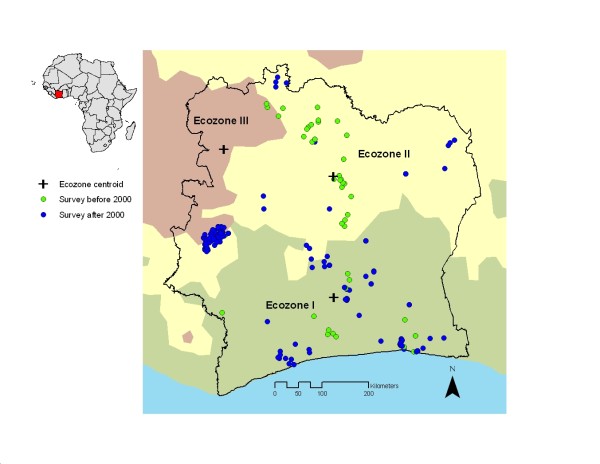
“5° was overlaid on a map of the country showing the two major ecozones; tropical rainforest in the south (ecozone 1) and the savannah in the north (ecozone 2) [12].”
BackgroundSelf-citationKoné, S., Baïkoro, N., N’Guessan, Y., Jaeger, F. N., Silué, K. D., Fürst, T., Hürlimann, E., Ouattara, M., Séka, M.-C. Y., N’Guessan, N. A., et al. (2014) · International Journal of Epidemiology · doi:10.1093/ije/dyu221 · Cited by 58
Self-citationHürlimann, E., Yapi, R. B., Houngbedji, C. A., Schmidlin, T., Kouadio, B. A., Silué, K. D., Ouattara, M., N'Goran, E. K., Utzinger, J., & Raso, G. (2014) · Parasites & Vectors · doi:10.1186/1756-3305-7-81 · Cited by 65
Self-citationYapi, R. B., Hürlimann, E., Houngbedji, C. A., N’Dri, P. B., Silué, K. D., Soro, G., Kouamé, F. N., Vounatsou, P., Fürst, T., N'Goran, E. K., et al. (2014) · PLoS neglected tropical diseases · doi:10.1371/journal.pntd.0002913 · Cited by 65
“3 software and an iterative self-organizing data analysis technique (ISODATA) was used on the environment factors to create different ecozones based on between-class similarities [18].”
MethodSelf-citationHow Well Are Malaria Maps Used to Design and Finance Malaria Control in Africa?
Omumbo, J. A., Noor, A. M., Fall, I. S., & Snow, R. W. (2013) · PLoS ONE · doi:10.1371/journal.pone.0053198 · Cited by 43
“Advances in computing and geostatistical techniques have increased the ability to define the spatial and temporal risks of malaria endemicity using probabilistic approaches at high spatial resolutions and formed the basis of a variety of country-level maps of risk including South Africa [13], Mali [14], Malawi [15], Z…”
BackgroundMalaria Risk Mapping for Control in the Republic of Sudan
Noor, A. M., Elmardi, K. A., Abdelgader, T. M., Patil, A. P., Amine, A. A. A., Bakhiet, S., Mukhtar, M. M., & Snow, R. W. (2012) · American Journal of Tropical Medicine and Hygiene · doi:10.4269/ajtmh.2012.12-0390 · Cited by 53
Ebhuoma, O., & Gebreslasie, M. T. (2016) · International Journal of Environmental Research and Public Health · doi:10.3390/ijerph13060584 · Cited by 55
Semakula, H. M., Song, G., Achuu, S. P., & Zhang, S. (2015) · Environmental Modelling & Software · doi:10.1016/j.envsoft.2015.10.006 · Cited by 52
Glinz, D., Hurrell, R. F., Righetti, A. A., Zeder, C., Adiossan, L. G., Tjalsma, H., Utzinger, J., Zimmermann, M. B., N'Goran, E. K., & Wegmüller, R. (2015) · American Journal of Clinical Nutrition · doi:10.3945/ajcn.114.090175 · Cited by 49
Self-citationBalbi, S., Villa, F., Mojtahed, V., Hegetschweiler, K. T., & Giupponi, C. (2016) · Natural hazards and earth system sciences · doi:10.5194/nhess-16-1323-2016 · Cited by 49
“Spatial Bayesian assessments are gaining attention from the scientific community in different disciplines, especially in epidemiology and human geography (e.g., Raso et al., 2012; Celio et al., 2014).”
BackgroundSpatiotemporal analysis of malaria for new sustainable control strategies
Landier, J., Rebaudet, S., Piarroux, R., & Gaudart, J. (2018) · BMC Medicine · doi:10.1186/s12916-018-1224-2 · Cited by 42
Koffi, D., Touré, A. O., Marie-Louise, V., Vigan-Womas, I., Béourou, S., Brou, S., Ehouman, M.-F., Gnamien, L., Richard, V., Djaman, J. A., et al. (2015) · Malaria Journal · doi:10.1186/s12936-015-1043-2 · Cited by 37
“gambiae to polluted water [35] or the strong natural heterogeneity in entomologic parameters of malaria transmission [36].”
BackgroundSong, Y., Ge, Y., Wang, J., Ren, Z., Liao, Y., & Peng, J. (2016) · Malaria Journal · doi:10.1186/s12936-016-1395-2 · Cited by 39
Thawer, S. G., Golumbeanu, M., Munisi, K., Aaron, S., Chacky, F., Lazaro, S., Mohamed, A., Kisoka, N., Lengeler, C., Molteni, F., et al. (2022) · Malaria Journal · doi:10.1186/s12936-022-04364-7 · Cited by 32
Pinchoff, J., Chaponda, M., Shields, T., Lupiya, J. S., Kobayashi, T., Mulenga, M., Moss, W. J., & Curriero, F. C. (2015) · American Journal of Tropical Medicine and Hygiene · doi:10.4269/ajtmh.15-0283 · Cited by 33
“These features alter the spatial distribution of malaria by directly or indirectly influencing the development, density, and location of mosquito vectors and their breeding sites.(12) The ability to predict spatial variation in malaria risk has improved with these advanced technologies.”
BackgroundGeostatistical analysis and mapping of malaria risk in children of Mozambique
Ejigu, B. A. (2020) · PLoS ONE · doi:10.1371/journal.pone.0241680 · Cited by 44
Can we use local climate zones for predicting malaria prevalence across sub‐Saharan African cities?
Brousse, O., Georganos, S., Demuzere, M., Dujardin, S., Lennert, M., Linard, C., Snow, R. W., Thiery, W., & van Lipzig, N. P. M. (2020) · Environmental Research Letters · doi:10.1088/1748-9326/abc996 · Cited by 26
Gebreslasie, M. T. (2015) · Geospatial Health · doi:10.4081/gh.2015.328 · Cited by 30
Ferreira, L. Z., Blumenberg, C., Utazi, C. E., Nilsen, K., Hartwig, F. P., Tatem, A. J., & Barros, A. J. D. (2020) · International Journal of Health Geographics · doi:10.1186/s12942-020-00239-9 · Cited by 30
“A few studies presented estimates for other subgroups such as: 6–59 months [79], under-10 years [61], under-16 years [71], 1–10 years [66, 87] and 1–14 years [65].”
BackgroundStensgaard, A., Vounatsou, P., Onapa, A. W., Utzinger, J., Pedersen, E. M., Kristensen, T. K., & Simonsen, P. E. (2016) · PLoS neglected tropical diseases · doi:10.1371/journal.pntd.0004319 · Cited by 29
Self-citationGarcía, G. A., Janko, M., Hergott, D., Donfack, O. T., Smith, J. M., Eyono, J. N. M., DeBoer, K. R., Avue, R. M. N., Phiri, W. P., Aldrich, E. M., et al. (2023) · Malaria Journal · doi:10.1186/s12936-023-04504-7 · Cited by 29
Lee, S. H., Jarvis, C. I., Edmunds, W. J., Economou, T., & Lowe, R. (2021) · Journal of The Royal Society Interface · doi:10.1098/rsif.2021.0096 · Cited by 28
Yokoly, F. N., Zahouli, J. B. Z., Small, G., Ouattara, A. F., Opoku, M., de Souza, D. K., & Koudou, B. G. (2021) · Malaria Journal · doi:10.1186/s12936-021-03938-1 · Cited by 24
Self-citationGlinz, D., Hurrell, R. F., Ouattara, M., Zimmermann, M. B., Brittenham, G. M., Adiossan, L. G., Righetti, A. A., Seifert, B., Diakité, V., Utzinger, J., et al. (2015) · Malaria Journal · doi:10.1186/s12936-015-0872-3 · Cited by 21
“falciparum since infections with Plasmodium ovale and Plasmodium malariae are rare [2].”
BackgroundSelf-citationHoungbedji, C. A., Chammartin, F., Yapi, R. B., Hürlimann, E., N’Dri, P. B., Silué, K. D., Soro, G., Koudou, B. G., Assi, S.-B., N’Goran, E. K., et al. (2016) · Parasites & Vectors · doi:10.1186/s13071-016-1775-z · Cited by 12
Self-citationGbalégba, C. G. N., Bâ, H., Silué, K. D., Bâ, O., Tia, E., Chouaïbou, M., Tian-Bi, N. T. Y., Yapi, G. Y., Koné, B., Utzinger, J., et al. (2018) · Infectious Diseases of Poverty · doi:10.1186/s40249-018-0412-9 · Cited by 24
“96); P, the expected prevalence (35%) based on [32]; i, precision or margin of error (5%) and C = 2, correction coefficient.”
Self-citationGeo-spatial modeling of access to water and sanitation in Nigeria
Ajisegiri, B., Andrés, L., Bhatt, S., Dasgupta, B., Echenique, J. A., Gething, P. W., Zabludovsky, J. G., & Joseph, G. (2019) · Journal of Water Sanitation and Hygiene for Development · doi:10.2166/washdev.2019.089 · Cited by 18
Spatial Prevalence and Determinants of Malaria among under-five Children in Ghana
Ejigu, B. A., & Wencheko, E. (2021) · doi:10.1101/2021.03.12.21253436 · Cited by 17
“Similar results were also found in other studies Raso et al. (2012); Gosoniu et al. (2012); Ssempiira et al. (2017).”
ResultHilton, E. R., Cissé, N. G., Assi, A., Eyakou, M., Koffi, J., Gnakou, B., Kouassi, B., Flatley, C., Chabi, J., Gbalégba, C. G. N., et al. (2024) · BMJ Global Health · doi:10.1136/bmjgh-2023-013324 · Cited by 17
Modelling the presence of disease under spatial misalignment using Bayesian latent Gaussian models
Barber, X., Conesa, D., Lladosa, S., & López‐Quílez, A. (2016) · Geospatial health · doi:10.4081/gh.2016.415 · Cited by 15
Hürlimann, E., Houngbedji, C. A., Yapi, R. B., N’Dri, P. B., Silué, K. D., Soro, G., Kouamé, F. N., Fürst, T., Utzinger, J., N'Goran, E. K., et al. (2014) · PLoS neglected tropical diseases · doi:10.1371/journal.pntd.0003287 · Cited by 13
Self-citationInterpolation of DHS survey data at subnational administrative level 2
Mayala, B. K., Donohue, R. E., Dontamsetti, T., Fish, T. D., & Croft, T. N. (2022) · Statistical Journal of the IAOS · doi:10.3233/sji-210895 · Cited by 14
Ouattara, A. F., Dagnogo, M., Olliaro, P., Raso, G., Tanner, M., Utzinger, J., & Koudou, B. G. (2014) · Parasites & Vectors · doi:10.1186/1756-3305-7-306 · Cited by 15
“Plasmodium falciparum infection was found to be highly prevalent among children in the three study villages in central Côte d’Ivoire, corroborating previous findings [22,23].”
ResultSelf-citationEndriyas, M., Kassa, M., Chisha, Y., Mekonnen, E., Misganaw, T., Loha, E., & Astatkie, A. (2024) · Malaria Journal · doi:10.1186/s12936-024-04909-y · Cited by 9
Geo-Spatial Modeling of Access to Water and Sanitation in Nigeria
Bhatt, S., Andrés, L., Dasgupta, B., Echenique, J. A., Gething, P. W., Zabludovsky, J. G., & Joseph, G. (2018) · World Bank, Washington, DC eBooks · doi:10.1596/1813-9450-8357 · Cited by 9
Modelling malaria susceptibility using geographic information system
Kursah, M. B. (2016) · GeoJournal · doi:10.1007/s10708-016-9732-0 · Cited by 8
“Studies have also found spatial variation in the prevalence of malaria (Raso et al. 2012; Srivastava et al. 2009) and these variations have been influenced by environmental factors such as rainfall amount, temperature, humidity and elevation (Cohen et al. 2008; Gemperli et al. 2006).”
BackgroundMethodResultInfluentialPoint prevalence mapping of malaria infection in Rivers State, Nigeria
Egbom, S. E., Nduka, F. O., & Nzeako, S. O. (2022) · Tanzania journal of health research/Tanzania Journal of Health Research · doi:10.4314/thrb.v23i4.7 · Cited by 10
“Malaria has been referred to as an environmental disease (Raso et al., 2012).”
BackgroundSystem of systems based approaches to global simulation in Africa
Adegoke, A., & Traoré, M. K. (2014) · Annual Simulation Symposium (ANSS) · doi:10.5555/2664292.2664303 · Cited by 4
Lee, E. H., Miller, R. H., Masuoka, P. M., Schiffman, E. K., Wanduragala, D., DeFraites, R. F., Dunlop, S. J., Stauffer, W. M., & Hickey, P. W. (2018) · American Journal of Tropical Medicine and Hygiene · doi:10.4269/ajtmh.18-0357 · Cited by 4
Spatiotemporal analysis of malaria incidence in Côte d'Ivoire from 2015 to 2019
Azongnibo, K. R. M., Guindo‐Coulibaly, N., Bonnet, E., Kokro-Djahouri, M. N. W., Assouho, K. F., Niamké, G. M., Fournet, F., Anoh, P., Assi, S.-B., & Adja, A. M. (2022) · Transactions of the Royal Society of Tropical Medicine and Hygiene · doi:10.1093/trstmh/trac112 · Cited by 7
Self-citationKursah, M. B. (2017) · Ghana Journal of Geography · Cited by 4
Mathurin, K., Innocent, A. A., Ahouty, B., Dieudonné, S., Konan, T. K., & Abiba, S. T. (2019) · International Journal of Genetics and Molecular Biology · doi:10.5897/ijgmb2019.0179 · Cited by 3
Climatic and governance determinants of malaria transmission in Rivers State, Nigeria
Egbom, S. E., Nduka, F. O., Nzeako, S. O., Nwafor, G. O., Bartholomew, D. C., Nwaigwe, C. C., Iwu, H. C., Ogbonna, C. J., Nwokike, C., Opara, M. C., et al. (2026) · Scientific Reports · doi:10.1038/s41598-026-35029-z · Cited by 5
Kroko-Djahouri, N. W. M., Guindo-Coulibaly, N., Assouho, K. F., Zoh, D. D., Tia, E., Sadia-Kacou, A. M. C., Azongnibo, K. R. M., Kpan, M. D. S., Kouadio, A. M. N., & Adja, A. M. (2024) · International Journal of Tropical Insect Science · doi:10.1007/s42690-024-01351-0 · Cited by 2
“In Côte d’Ivoire, malaria transmission is permanent and stable with an upsurge in the rainy season (Fofana et al. 2010; Raso et al. 2012; Edi et al. 2014).”
Hussien, H. H. (2020) · Advances in Infectious Diseases · doi:10.4236/aid.2020.105017 · Cited by 2
“Environmental changes such as deforestation and housing structure could also influence malaria transmission as they enhance mosquito breeding conditions [14].”
BackgroundMethodological framework for assessing malaria risk associated with climate change in Côte d’Ivoire
Kouakou, Y. E., Dely, I. D., Doumbia, M., Ouattara, A., N’da, E. J., Brou, K. S., Zouzou, Y. A., Cissé, G., & Koné, B. (2024) · Geospatial health · doi:10.4081/gh.2024.1285 · Cited by 1
“Moreover, the geographical distribution of malaria infection in the country is not homogeneous (Raso et al. , 2012).”
BackgroundNovel Applications of Geospatial Analysis in the Modeling of Infectious Diseases
Telionis, P. A. (2019) · VTechWorks (Virginia Tech)
A New Model for Predicting Infectious Disease Outbreaks
Demitry, P., McKnight, D., Dale, E., & Bartlett, E. (2020) · Medical Research Archives · doi:10.18103/mra.v8i10.2255
Yokoly, F. N., Zahouli, J. Z. B., Small, G. J., Ouattara, A. F., Opoku, M., de Souza, D. K., & Koudou, B. G. (2020) · doi:10.21203/rs.3.rs-77063/v1
“Thus, the south-east of Côte d’Ivoire is marked by coastal inland lagoons [27].”
BackgroundResultSelf-citationOGIDI, M., Egbom, S. E., Arene, F. O. I., Nduka, F. O., & Nzeako, S. O. (2021) · The International Journal of Science & Technoledge · doi:10.24940/theijst/2021/v9/i9/st2109-018
Egbom, S. E., Nduka, F. O., Nzeako, S. O., Nwafor, G. O., Bartholomew, D. C., Nwaigwe, C. C., Iwu, H. C., Nwokike, C., Opara, M. C., Ezenwaka, C. O., et al. (2023) · Research Square · doi:10.21203/rs.3.rs-3165555/v1
Egbom, S. E., Nduka, F. O., Nzeako, S. O., Nwafor, G. O., Bartholomew, D. C., Nwaigwe, C. C., Iwu, H. C., Ogbonna, C. J., Nwokike, C., Opara, M. C., et al. (2024) · Research Square · doi:10.21203/rs.3.rs-4384044/v1
Johannes, A., & Kazembe, L. N. (2025) · Emerging topics in statistics and biostatistics · doi:10.1007/978-3-031-97281-2_5
Thawer, S. G., Golumbeanu, M., Munisi, K., Aaron, S., Chacky, F., Lazaro, S., Mohamed, A., Kisoka, N., Lengeler, C., Molteni, F., et al. (2022) · Figshare · doi:10.6084/m9.figshare.21592702
Endriyas, M., Kassa, M., Chisha, Y., Mekonnen, E., Misganaw, T., Loha, E., & Astatkie, A. (2024) · Figshare · doi:10.6084/m9.figshare.25547141
Endriyas, M., Kassa, M., Chisha, Y., Mekonnen, E., Misganaw, T., Loha, E., & Astatkie, A. (2024) · Figshare · doi:10.6084/m9.figshare.25546932
Metadata
- Authors
- Raso, G., Schur, N., Utzinger, J., Koudou, B. G., Tchicaya, E. S., Rohner, F., N’Goran, E. K., Silué, K. D., Matthys, B., Assi, S., Tanner, M., & Vounatsou, P.
- Affiliations
- Swiss Centre for Scientific Research (CI)
- Swiss Tropical and Public Health Institute (CH)
- Université Nangui Abrogoua (CI)
- Global Alliance for Improved Nutrition (CH)
- Corresponding author
- Raso, Giovanna
- ORCID
- Venue
- Malaria Journal
- Published
- 2012-05-09
- Volume
- 11
- Issue
- 1
- Pages
- 160-160
- ISSN
- 1475-2875 (ISSN-L)
- PMC
- PMC3483263
- OpenAlex
- W2159789014
- Cited by
- 67
- References
- 43
- Citations by year
- 2026: 1 · 2025: 2 · 2024: 6 · 2023: 2 · 2022: 5 · 2021: 5 · 2020: 7 · 2019: 4 · 2018: 4 · 2017: 2 · 2016: 8 · 2015: 8 · 2014: 8 · 2013: 4 · 2012: 1
- FWCI
- 6.48
- Type
- journal article
- Language
- en
- Open access
- gold
- doi.org
- Licence
- cc-by
- creativecommons.org/licenses/by/2.0 (tdm)
- Locations
- Malaria Journal (publishedVersion, cc-by)
- Europe PMC (PubMed Central) (publishedVersion, cc-by)
- PubMed Central (publishedVersion, cc-by)
- PubMed (publishedVersion)
- LSTM Online Archive (Liverpool School of Tropical Medicine) (acceptedVersion)
- DOAJ (DOAJ: Directory of Open Access Journals) (submittedVersion, cc-by-sa)
- Greater South Information System
- Funders
- National Science Foundation
- Schweizerischer Nationalfonds zur Förderung der Wissenschaftlichen Forschung (123900, 118379, 132949, 325230, 32003B)
- Topics
- Health Sciences › Medicine › Public Health, Environmental and Occupational Health › Malaria Research and Control
- Health Sciences › Medicine › Public Health, Environmental and Occupational Health › Mosquito-borne diseases and control
- Life Sciences › Immunology and Microbiology › Parasitology › Vector-borne infectious diseases
- Keywords
- malaria risk mapping, children, Côte d'Ivoire, Bayesian geostatistical model, annual rainfall, land surface temperature, ecoregions, malaria control targeting
- MeSH terms
- Adolescent, Child, Child, Preschool, Climate, Female, Humans, Infant, Infant, Newborn, Cote d'Ivoire, Malaria, Male, Models, Statistical, Risk Assessment, Topography, Medical
About these checks
Registry, retraction, Cites and statistics results are computed, not judged, with one exception: a printed reference that no index lists is read once by a model before it counts as a citation error. Claims are extracted by a model and kept only when their quote appears verbatim in the text; each cited source is then checked, with a model’s help, for whether it says what the claim relies on. Those verdicts can be wrong — read the claim’s quote and the cited source before relying on one.
Statistics and arithmetic are recomputed, not judged.
Confidence bands are shown only for fields calibrated on our annotated test set. None is calibrated yet, so no band is shown.
What counts as a claim ›How we measure confidence ›How we check this ›
Are you an author, or do you see a problem with this page? Request a review
Data sources
Bibliographic data: Semantic Scholar, OpenAlex, Crossref.
Contains information from the Semantic Scholar Academic Graph Datasets, made available under the ODC Attribution License (ODC-BY 1.0).
Semantic Scholar’s data is described in: Kinney, R., et al. (2023). The Semantic Scholar Open Data Platform. arXiv:2301.10140.
