

The DOI matches its Crossref record; 108 of the 108 references it cites were found in a registry or an index.
Biochemical and immunological mechanisms by which sickle cell trait protects against malaria
Open accessAbstract
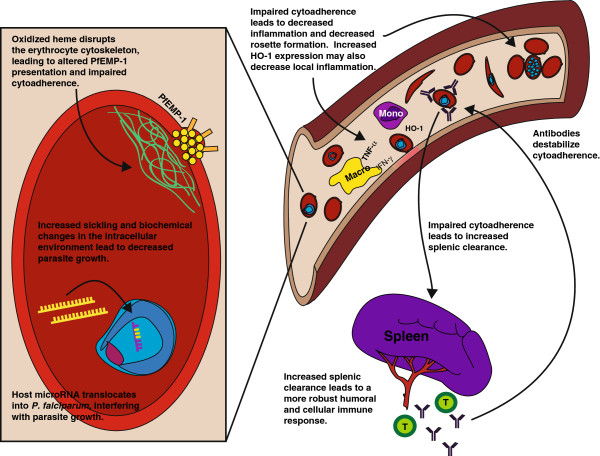
Sickle cell trait (HbAS) is the best-characterized genetic polymorphism known to protect against falciparum malaria. Although the protective effect of HbAS against malaria is well known, the mechanism(s) of protection remain unclear. A number of biochemical and immune-mediated mechanisms have been proposed, and it is likely that multiple complex mechanisms are responsible for the observed protection. Increased evidence for an immune component of protection as well as novel mechanisms, such as enhanced tolerance to disease mediated by HO-1 and reduced parasitic growth due to translocation of host micro-RNA into the parasite, have recently been described. A better understanding of relevant mechanisms will provide valuable insight into the host-parasite relationship, including the role of the host immune system in protection against malaria.
Overview
The claims and statistics of this paper haven’t been checked yet.
Run the check — free, no account needed. It reads the open-access text and checks the sources it cites.
Integrity signals
Registry
Cites
Statistics
Figures
Verification
Claims the paper makes
The claims and statistics of this paper haven’t been checked yet.
Run the check — free, no account needed. It reads the open-access text and checks the sources it cites.
Claims other papers make about this one
Each is checked against this paper’s own text: does it say what the citing paper says it does?
The source backs part of the claim, not all of it — or backs it for a different population, condition or comparison.
In the citing paper
“As a consequence, the balance between damaging prooxidative molecules such as free heme or iron and antioxidative factors such as carbon monoxide (CO) and bilirubin is shifted towards cytoprotection (Cholera et al., 2008;Ferreira et al., 2011;Gong et al., 2013;Jeney et al., 2014).”
From Iron in infection and immunity (2020) · cites this paper as Gong et al., 2013
Experimental — accuracy not yet measured
Self-check
Percentages, sums and reported differences re-computed from the paper’s own numbers.
The self-check needs the paper’s full text.
Citations
Cites
The pathogenic basis of malaria
Miller, L. H., Baruch, D. I., Marsh, K., & Doumbo, O. K. (2002) · Nature · doi:10.1038/415673a · Cited by 1,804
Common West African HLA antigens are associated with protection from severe malaria
Hill, A. V. S., Allsopp, C. E. M., Kwiatkowski, D. P., Anstey, N. M., Twumasi, P., Rowe, P. A., Bennett, S., Brewster, D., McMichael, A. J., & Greenwood, B. M. (1991) · Nature · doi:10.1038/352595a0 · Cited by 1,573
Clegg, J. B., Naughton, M. A., & Weatherall, D. J. (1966) · Journal of Molecular Biology · doi:10.1016/s0022-2836(66)80052-9 · Cited by 1,495
Protection Afforded by Sickle-cell Trait Against Subtertian Malarial Infection
ALLISON, A. C. (1954) · BMJ · doi:10.1136/bmj.1.4857.290 · Cited by 1,297
Pathogenesis and Treatment of Sickle Cell Disease
Bunn, H. F. (1997) · New England Journal of Medicine · doi:10.1056/nejm199709113371107 · Cited by 1,154 · cited 1×
“Heterozygotes for sickle haemoglobin (HbAS) have sickle cell trait and are generally asymptomatic [10].”
BackgroundImmunity to malaria: more questions than answers
Langhorne, J., Ndungu, F. M., Sponaas, A., & Marsh, K. (2008) · Nature Immunology · doi:10.1038/ni.f.205 · Cited by 908
Haldane, J. B. S. (2006) · Springer eBooks · doi:10.1007/0-387-28295-5_9 · Cited by 748
Protective effects of the sickle cell gene against malaria morbidity and mortality
Aidoo, M., Terlouw, D. J., KOLCZAK, M. S., McElroy, P. D., ter Kuile, F. O., Kariuki, S., Nahlen, B. L., Lal, A. A., & Udhayakumar, V. (2002) · The Lancet · doi:10.1016/s0140-6736(02)08273-9 · Cited by 701
Global distribution of the sickle cell gene and geographical confirmation of the malaria hypothesis
Piel, F. B., Patil, A. P., Howes, R. E., Nyangiri, O. A., Gething, P. W., Williams, T. N., Weatherall, D. J., & Hay, S. I. (2010) · Nature Communications · doi:10.1038/ncomms1104 · Cited by 629 · cited 1×
“The high prevalence of HbS in sub-Saharan Africa and some other tropical areas is almost certainly due to the protection against malaria afforded to heterozygotes [1-3,5].”
BackgroundTurner, G. D. H., Morrison, H., Jones, M., Davis, T. M. E., Looareesuwan, S., BULEY, I. D., Gatter, K. C., Newbold, C., Pukritayakamee, S., & Nagachinta, B. (1994) · PubMed Central · Cited by 596
Cited by
Sorted by citations
Iron in infection and immunity
Nairz, M., & Weiss, G. (2020) · Molecular Aspects of Medicine · doi:10.1016/j.mam.2020.100864 · Cited by 359
Parasitic Protozoa and Interactions with the Host Intestinal Microbiota
Burgess, S. L., Gilchrist, C. A., Lynn, T. C., & Petri, W. A. (2017) · Infection and Immunity · doi:10.1128/iai.00101-17 · Cited by 161
Balderston, S., Taulbee, J. J., Celaya, E., Fung, K., Jiao, A., Smith, K., Hajian, R., Gasiūnas, G., Kutanovas, S., Kim, D., et al. (2021) · Nature Biomedical Engineering · doi:10.1038/s41551-021-00706-z · Cited by 170
Feintuch, C. M., Saidi, A., Seydel, K. B., Chen, G., Goldman-Yassen, A. E., Mita-Mendoza, N. K., Kim, R. S., Frenette, P. S., Taylor, T. E., & Daily, J. P. (2016) · mBio · doi:10.1128/mbio.01300-15 · Cited by 103
Extreme Competence: Keystone Hosts of Infections
Martin, L. B., Addison, B., Bean, A. G. D., Buchanan, K. L., Crino, O. L., Eastwood, J. R., Flies, A. S., Hamede, R., Hill, G. E., Klaassen, M., et al. (2019) · Trends in Ecology & Evolution · doi:10.1016/j.tree.2018.12.009 · Cited by 70
Metadata
- Authors
- Gong, L., Parikh, S., Rosenthal, P. J., & Greenhouse, B.
- Affiliations
- University of California, San Francisco (US)
- Yale University (US)
- Corresponding author
- Greenhouse, Bryan
- Venue
- Malaria Journal
- Published
- 2013-09-11
- Volume
- 12
- Issue
- 1
- Pages
- 317-317
- ISSN
- 1475-2875 (ISSN-L)
- PMC
- PMC3847285
- OpenAlex
- W2156643348
- Cited by
- 105
- References
- 108
- Citations by year
- 2026: 6 · 2025: 9 · 2024: 4 · 2023: 10 · 2022: 9 · 2021: 8 · 2020: 7 · 2019: 9 · 2018: 12 · 2017: 7 · 2016: 6 · 2015: 12 · 2014: 6
- FWCI
- 1.14
- Type
- journal article
- Language
- en
- Open access
- gold
- doi.org
- Licence
- cc-by
- Locations
- Malaria Journal (publishedVersion, cc-by)
- Europe PMC (PubMed Central) (publishedVersion, cc-by)
- PubMed Central (publishedVersion, cc-by)
- PubMed (publishedVersion)
- eScholarship (California Digital Library) (submittedVersion)
- eScholarship (California Digital Library) (submittedVersion, cc-by)
- Funders
- Doris Duke Charitable Foundation (2011043)
- National Institutes of Health
- U.S. Public Health Service (U19 A1089674)
- National Institute of Allergy and Infectious Diseases (K23AI076614, U19AI089674)
- Topics
- Health Sciences › Medicine › Public Health, Environmental and Occupational Health › Malaria Research and Control
- Health Sciences › Medicine › Genetics (clinical) › Hemoglobinopathies and Related Disorders
- Health Sciences › Medicine › Hematology › Blood groups and transfusion
- Keywords
- sickle cell trait, falciparum malaria, malaria prevention, host-parasite interactions, host immune response, heme oxygenase-1, host genetic polymorphisms
- MeSH terms
- Humans, Sickle Cell Trait, Malaria, Falciparum, Host-Pathogen Interactions
About these checks
Registry, retraction, Cites and statistics results are computed, not judged, with one exception: a printed reference that no index lists is read once by a model before it counts as a citation error. Claims are extracted by a model and kept only when their quote appears verbatim in the text; each cited source is then checked, with a model’s help, for whether it says what the claim relies on. Those verdicts can be wrong — read the claim’s quote and the cited source before relying on one.
Statistics and arithmetic are recomputed, not judged.
Confidence bands are shown only for fields calibrated on our annotated test set. None is calibrated yet, so no band is shown.
What counts as a claim ›How we measure confidence ›How we check this ›
Are you an author, or do you see a problem with this page? Request a review
