

The DOI matches its Crossref record; 24 of the 24 references it cites were found in a registry or an index.
A controlled, parallel, cluster-randomized trial of community-wide screening and treatment of asymptomatic carriers of Plasmodium falciparum in Burkina Faso
Open accessAbstract
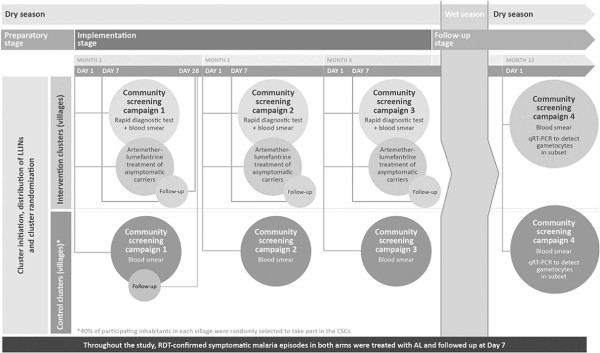
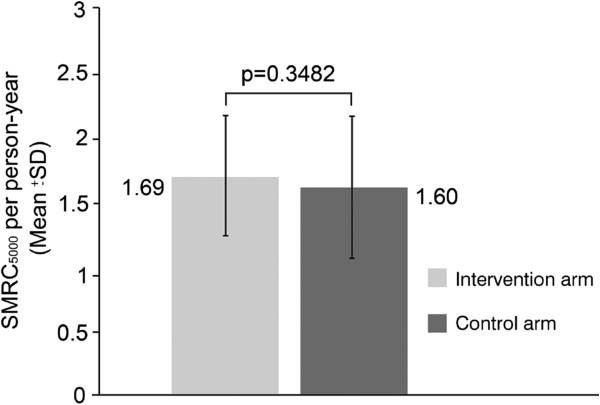
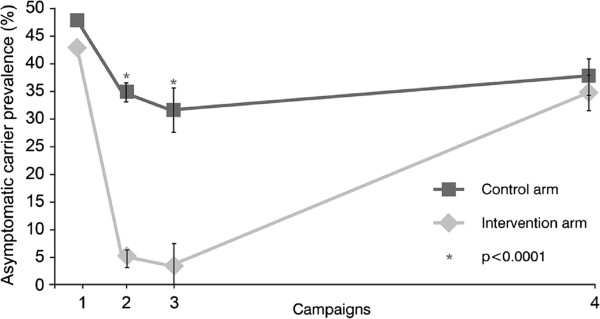
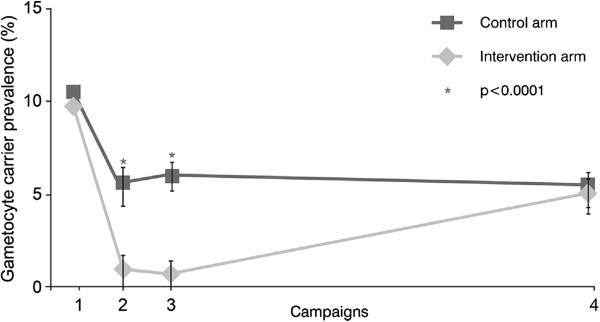
BACKGROUND: In malaria-endemic countries, large proportions of infected individuals are asymptomatic, constituting a reservoir of parasites for infection of newly hatched mosquitoes. This study evaluated the impact of screening and treatment of asymptomatic carriers of Plasmodium falciparum. METHODS: Eighteen villages were randomized (1:1) to study arms and inhabitants participated in four community screening campaigns: three before the rainy season ~1 month apart, and the fourth after the rains at ~12 months. On day 1 of campaigns 1-3, asymptomatic carriers in the intervention arm were identified by rapid diagnostic test and treated with artemether-lumefantrine. Outcomes were symptomatic malaria with parasite density >5,000/μL per person-year in children < 5 years and change in haemoglobin between days 1 and 28 of campaign 1. RESULTS: At 12 months, the number of symptomatic malaria episodes with a parasite density >5,000/μL per person-year in children < 5 years was not significantly different between arms (1.69 vs 1.60, p = 0.3482). Mean haemoglobin change in asymptomatic carriers during campaign 1 was greater in the intervention vs control arm (+0.53 g/dL vs -0.21 g/dL, p < 0.0001). ANCOVA demonstrated that mean asymptomatic carriage at the cluster level was lower in the intervention vs control arm at day 1 of campaigns 2 (5.0% vs 34.9%, p < 0.0001) and 3 (3.5% vs 31.5%, p < 0.0001), but showed only a small difference at day 1 of campaign 4 (34.6% vs 37.6%, p = 0.2982). Mean gametocyte carriage was lower in the intervention vs control arm at day 1 of campaigns 2 and 3 (0.7% vs 5.4%, p < 0.0001; 0.5% vs 5.8%, p < 0.0001), but was similar at day 1 of campaign 4 (4.9% vs 5.1%, p = 0.7208). CONCLUSIONS: Systematic screening and treatment of asymptomatic carriers at the community level did not reduce clinical malaria incidence in the subsequent transmission season, indicating greater levels of parasite clearance are required to achieve a sustained impact in this setting.
Overview
The claims and statistics of this paper haven’t been checked yet.
Run the check — free, no account needed. It reads the open-access text and checks the sources it cites.
Integrity signals
Registry
Cites
Statistics
Figures
Verification
Claims the paper makes
The claims and statistics of this paper haven’t been checked yet.
Run the check — free, no account needed. It reads the open-access text and checks the sources it cites.
Claims other papers make about this one
Each is checked against this paper’s own text: does it say what the citing paper says it does?
In the citing paper
“a community trial in Burkina Faso with 12 months of follow-up demonstrated that active detection strategy has no effect on the prevalence of Plasmodium spp. or the incidence of malaria [33,37] owing to the low sensitivity of the diagnosis.”
From Diagnostic Accuracy of a Thick Blood Smear Compared to qPCR for Malaria Associated with Pregnancy in Colombia (2023) · cites this paper as [37]
Self-check
Percentages, sums and reported differences re-computed from the paper’s own numbers.
The self-check needs the paper’s full text.
Citations
Cites
Weltgesundheitsorganisation (2005) · Cited by 3,799
Insecticide-treated bed nets and curtains for preventing malaria
Lengeler, C. (2004) · Cochrane Database of Systematic Reviews · doi:10.1002/14651858.cd000363.pub2 · Cited by 1,700
Hayes, R., & Moulton, L. H. (2009) · Chapman & Hall/CRC eBooks · doi:10.1201/9781584888178 · Cited by 881
Bousema, T., & DRAKELEY, C. J. (2011) · Clinical Microbiology Reviews · doi:10.1128/cmr.00051-10 · Cited by 776
Okell, L., Bousema, T., Griffin, J. T., Ouédraogo, A. L., Ghani, A. C., & DRAKELEY, C. J. (2012) · Nature Communications · doi:10.1038/ncomms2241 · Cited by 659
Self-citationThe complexities of malaria disease manifestations with a focus on asymptomatic malaria
Laishram, D. D., Sutton, P. L., Nanda, N., Sharma, V. L., Sobti, R. C., Carlton, J. M., & Joshi, H. (2012) · Malaria Journal · doi:10.1186/1475-2875-11-29 · Cited by 342
Homann, M. V., Troye‐Blomberg, M., Anchang-Kimbi, J. K., Garcia, A., & Migot‐Nabias, F. (2008) · Malaria Journal · doi:10.1186/1475-2875-7-17 · Cited by 150
Stresman, G. H., Kamanga, A., Moono, P., Hamapumbu, H., Mharakurwa, S., Kobayashi, T., Moss, W. J., & Shiff, C. (2010) · Malaria Journal · doi:10.1186/1475-2875-9-265 · Cited by 150
The Potential Contribution of Mass Treatment to the Control of Plasmodium falciparum Malaria
Okell, L., Griffin, J. T., Kleinschmidt, I., Hollingsworth, T. D., Churcher, T. S., White, M. T., Bousema, T., DRAKELEY, C. J., & Ghani, A. C. (2011) · PLoS ONE · doi:10.1371/journal.pone.0020179 · Cited by 147
Färnert, A., Rooth, I., Svensson, Å., Snounou, G., & Björkman, A. (1999) · The Journal of Infectious Diseases · doi:10.1086/314652 · Cited by 139
Research works printed but not linked: 2
- WHO: WHO Model List of Essential Medicines. 2010, Geneva: World Health Organization
- Mapping Malaria Risk in Africa (MARA) Collaboration: Burkina Faso: Duration of the Malaria Transmission Season. 2012, http://www.mara.org.za/pdfmaps/BukSeasonality.PDF , 10-6-2010.
Cited by
Sorted by citations
Asymptomatic malaria infections: detectability, transmissibility and public health relevance
Bousema, T., Okell, L., Felger, I., & DRAKELEY, C. J. (2014) · Nature Reviews Microbiology · doi:10.1038/nrmicro3364 · Cited by 685
New developments in anti-malarial target candidate and product profiles
Burrows, J. N., Duparc, S., Gutteridge, W. E., van Huijsduijnen, R. H., Kaszubska, W., Macintyre, F., Mazzuri, S., Möhrle, J. J., & Wells, T. N. C. (2017) · Malaria Journal · doi:10.1186/s12936-016-1675-x · Cited by 538
Hofmann, N., Mwingira, F., Shekalaghe, S., Robinson, L. J., Mueller, I., & Felger, I. (2015) · PLOS Medicine · doi:10.1371/journal.pmed.1001788 · Cited by 413
“Asymptomatic” Malaria: A Chronic and Debilitating Infection That Should Be Treated
Chen, I., Clarke, S. E., Gosling, R., Hamainza, B., Killeen, G., Magill, A., O’Meara, W., Price, R. N., & Riley, E. M. (2016) · PLOS Medicine · doi:10.1371/journal.pmed.1001942 · Cited by 386
Targeting Asymptomatic Malaria Infections: Active Surveillance in Control and Elimination
Sturrock, H. J. W., Hsiang, M. S., Cohen, J. M., Smith, D. L., Greenhouse, B., Bousema, T., & Gosling, R. D. (2013) · PLoS Medicine · doi:10.1371/journal.pmed.1001467 · Cited by 341
The role of submicroscopic parasitemia in malaria transmission: What is the evidence?
Lin, J. T., Saunders, D. L., & Meshnick, S. R. (2014) · Trends in Parasitology · doi:10.1016/j.pt.2014.02.004 · Cited by 271
Robinson, L. J., Wampfler, R., Betuela, I., Karl, S., White, M. T., Suen, C. S. N. L. W., Hofmann, N., Kinboro, B., Waltmann, A., Brewster, J., et al. (2015) · PLoS Medicine · doi:10.1371/journal.pmed.1001891 · Cited by 274
Strategies for Detection of Plasmodium species Gametocytes
Wampfler, R., Mwingira, F., Javati, S., Robinson, L., Betuela, I., Siba, P., Beck, H.-P., Mueller, I., & Felger, I. (2013) · PLoS ONE · doi:10.1371/journal.pone.0076316 · Cited by 252
Malaria in school‐age children in A frica: an increasingly important challenge
Nankabirwa, J. I., Brooker, S. J., Clarke, S. E., Fernando, D., Gitonga, C. W., Schellenberg, D. M., & Greenwood, B. M. (2014) · Tropical Medicine & International Health · doi:10.1111/tmi.12374 · Cited by 216
Slater, H., Ross, A. J., Ouédraogo, A. L., White, L. J., Nguon, C., Walker, P. G. T., Ngor, P., Aguas, R. J., Silal, S. P., Dondorp, A. M., et al. (2015) · Nature · doi:10.1038/nature16040 · Cited by 139
Self-citationCook, J. A., Xu, W., Msellem, M. I., Vonk, M. M., Bergström, B., Gosling, R. D., Al-mafazy, A.-W. H., McElroy, P. D., Molteni, F., Abass, A. K., et al. (2014) · The Journal of Infectious Diseases · doi:10.1093/infdis/jiu655 · Cited by 131
Eisele, T. P., Bennett, A. F., Silumbe, K., Finn, T. P., Chalwe, V., Kamuliwo, M., Hamainza, B., Moonga, H. B., Kooma, E. H., Kawesha, E. C., et al. (2016) · The Journal of Infectious Diseases · doi:10.1093/infdis/jiw416 · Cited by 109
Larsen, D. A., Bennett, A., Silumbe, K., Hamainza, B., Yukich, J. O., Keating, J., Littrell, M., Miller, J. M., Steketee, R. W., & Eisele, T. P. (2015) · The American Society of Tropical Medicine and Hygiene · doi:10.4269/ajtmh.14-0347 · Cited by 108
Fighting fire with fire: mass antimalarial drug administrations in an era of antimalarial resistance
von Seidlein, L., & Dondorp, A. M. (2015) · Expert Review of Anti-infective Therapy · doi:10.1586/14787210.2015.1031744 · Cited by 98
Slater, H., Walker, P. G. T., Bousema, T., Okell, L., & Ghani, A. C. (2014) · The Journal of Infectious Diseases · doi:10.1093/infdis/jiu351 · Cited by 99
How to Contain Artemisinin- and Multidrug-Resistant Falciparum Malaria
Dondorp, A. M., Smithuis, F., Woodrow, C. J., & von Seidlein, L. (2017) · Trends in Parasitology · doi:10.1016/j.pt.2017.01.004 · Cited by 94
Halliday, K. E., Okello, G. R., Turner, E. L., Njagi, K., Mcharo, C., Kengo, J., Allen, E., Dubeck, M. M., Jukes, M., & Brooker, S. J. (2014) · PLoS Medicine · doi:10.1371/journal.pmed.1001594 · Cited by 92
Slater, H., Foy, B. D., Kobylinski, K. C., Chaccour, C., Watson, O. J., Hellewell, J., Aljayyoussi, G., Bousema, T., Burrows, J. N., D’Alessandro, U., et al. (2020) · The Lancet Infectious Diseases · doi:10.1016/s1473-3099(19)30633-4 · Cited by 84
The path of least resistance: aggressive or moderate treatment?
Kouyos, R. D., Metcalf, C. J. E., Birger, R. B., Klein, E. Y., Wiesch, P. A. Z., Ankomah, P., Arinaminpathy, N., Bogich, T. L., Bonhoeffer, S., Brower, C. H., et al. (2014) · Proceedings of the Royal Society B Biological Sciences · doi:10.1098/rspb.2014.0566 · Cited by 84
Transmission, T. M. R. C. P. O. C. T. R. A. M. (2017) · PLoS Medicine · doi:10.1371/journal.pmed.1002452 · Cited by 78
Portugal, S., Tran, T. M., Ongoïba, A., Bathily, A., Li, S., Doumbo, S., Skinner, J., Doumtabé, D., Koné, Y., Sangala, J. A., et al. (2016) · Clinical Infectious Diseases · doi:10.1093/cid/ciw849 · Cited by 74
Pava, Z., Burdam, F. H., Handayuni, I., Trianty, L., Utami, R. A. S., Tirta, Y. K., Kenangalem, E., Lampah, D. A., Kusuma, A., Wirjanata, G., et al. (2016) · PLoS ONE · doi:10.1371/journal.pone.0165340 · Cited by 66
Gerardin, J., Eckhoff, P., & Wenger, E. A. (2015) · BMC Infectious Diseases · doi:10.1186/s12879-015-0887-y · Cited by 68
Staedke, S. G., Maiteki‐Sebuguzi, C., Rehman, A. M., Kigozi, S. P., Gonahasa, S., Okiring, J., Lindsay, S. W., Kamya, M. R., Chandler, C., Dorsey, G., et al. (2018) · The Lancet Global Health · doi:10.1016/s2214-109x(18)30126-8 · Cited by 64
Tiedje, K. E., Oduro, A. R., Agongo, G., Anyorigiya, T., Azongo, D., Awine, T., Ghansah, A., Pascual, M., Koram, K. A., & Day, K. P. (2017) · American Journal of Tropical Medicine and Hygiene · doi:10.4269/ajtmh.16-0959 · Cited by 61
Mwesigwa, J., Slater, H., Bradley, J., Saidy, B., Ceesay, F., Whittaker, C., Kandeh, B., Nkwakamna, D., DRAKELEY, C. J., Geertruyden, J. V., et al. (2019) · Malaria Journal · doi:10.1186/s12936-019-2929-1 · Cited by 63
Effect of transmission intensity on hotspots and micro-epidemiology of malaria in sub-Saharan Africa
on behalf of The Hotspot Group Authors, Mogeni, P., Omedo, I., Nyundo, C., Kamau, A., Noor, A., & Bejon, P. (2017) · BMC Medicine · doi:10.1186/s12916-017-0887-4 · Cited by 61
Sutanto, I., Kosasih, A. A., Elyazar, I., Simanjuntak, D. R., Larasati, T. A., Dahlan, M. S., Wahid, I., Müeller, I., Koepfli, C., Kusriastuti, R., et al. (2018) · Clinical Infectious Diseases · doi:10.1093/cid/ciy231 · Cited by 55
A Second Chance to Tackle African Malaria Vector Mosquitoes that Avoid Houses and Don't Take Drugs
Killeen, G. F. (2013) · American Journal of Tropical Medicine and Hygiene · doi:10.4269/ajtmh.13-0065 · Cited by 55
Understanding P. falciparum Asymptomatic Infections: A Proposition for a Transcriptomic Approach
Kimenyi, K. M., Wamae, K., & Ochola‐Oyier, L. I. (2019) · Frontiers in Immunology · doi:10.3389/fimmu.2019.02398 · Cited by 53
Hustedt, J. C., Canavati, S. E., Rang, C., Ashton, R. A., Khim, N., Berne, L., Kim, S., Sovannaroth, S., Ly, P., Ménard, D., et al. (2016) · Malaria Journal · doi:10.1186/s12936-016-1191-z · Cited by 50
Discovering New Transmission-Blocking Antimalarial Compounds: Challenges and Opportunities
Birkholtz, L., Coetzer, T. L., Mancama, D. T., Leroy, D., & Alano, P. (2016) · Trends in Parasitology · doi:10.1016/j.pt.2016.04.017 · Cited by 49
Gerardin, J., Ouédraogo, A. L., McCarthy, K. A., Eckhoff, P. A., & Wenger, E. A. (2015) · Malaria Journal · doi:10.1186/s12936-015-0751-y · Cited by 48
Self-citationSamuels, A. M., Odero, N., Odongo, W., Otieno, K., Were, V. O., Shi, Y. P., Sang, T., Williamson, J. M., Wiegand, R. E., Hamel, M. J., et al. (2020) · Clinical Infectious Diseases · doi:10.1093/cid/ciaa471 · Cited by 47
Determinants of Malaria Transmission at the Population LevelPreprint
Bousema, T., & Drakeley, C. (2017) · Cold Spring Harbor Perspectives in Medicine · doi:10.1101/cshperspect.a025510 · Cited by 48
Defining the biology component of the drug discovery strategy for malaria eradication
Leroy, D., Campo, B., Ding, X. C., Burrows, J. N., & Cherbuin, S. (2014) · Trends in Parasitology · doi:10.1016/j.pt.2014.07.004 · Cited by 45
A review of the effects of artemether-lumefantrine on gametocyte carriage and disease transmission
Makanga, M. M. (2014) · Malaria Journal · doi:10.1186/1475-2875-13-291 · Cited by 44
Advances in molecular diagnosis of malaria
(2017) · Advances in Clinical Chemistry · doi:10.1016/bs.acc.2016.11.006 · Cited by 41
Reduction in symptomatic malaria prevalence through proactive community treatment in rural Senegal
Linn, A., Ndiaye, Y., Hennessee, I., Gaye, S., Linn, P., Nordstrom, K., & McLaughlin, M. (2015) · Tropical Medicine & International Health · doi:10.1111/tmi.12564 · Cited by 40
Tiono, A. B., Guelbeogo, M. W., Sagnon, N., Nébié, I., Sirima, S. B., Mukhopadhyay, A., & Hamed, K. A. (2013) · BMC Infectious Diseases · doi:10.1186/1471-2334-13-535 · Cited by 40
Self-citationSmith, J. L., Auala, J. R., Tambo, M., Haindongo, E., Katokele, S. T., Uusiku, P., Gosling, R. D., Kleinschmidt, I., Mumbengegwi, D. R., & Sturrock, H. J. W. (2017) · PLoS ONE · doi:10.1371/journal.pone.0180845 · Cited by 40
Parker, D. M., Landier, J., von Seidlein, L., Dondorp, A. M., White, L. J., Hanboonkunupakarn, B., Maude, R. J., & Nosten, F. H. (2016) · Malaria Journal · doi:10.1186/s12936-016-1631-9 · Cited by 40
Novel Genotyping Tools for Investigating Transmission Dynamics of Plasmodium falciparum
Wampfler, R., Timinao, L., Beck, H., Soulama, I., Tiono, A. B., Siba, P., Müeller, I., & Felger, I. (2014) · The Journal of Infectious Diseases · doi:10.1093/infdis/jiu236 · Cited by 39
Self-citationGerardin, J., Bever, C. A., Hamainza, B., Miller, J. M., Eckhoff, P. A., & Wenger, E. A. (2016) · PLoS Computational Biology · doi:10.1371/journal.pcbi.1004707 · Cited by 39
Hamainza, B., Moonga, H. B., Sikaala, C., Kamuliwo, M., Bennett, A. F., Eisele, T. P., Miller, J., Seyoum, A., & Killeen, G. F. (2014) · Malaria Journal · doi:10.1186/1475-2875-13-128 · Cited by 40
Galatas, B., Mayor, A. G., Gupta, H., Balanza, N., Jang, I. K., Nhamússua, L., Simone, W., Cisteró, P., Chidimatembue, A., Munguambe, H., et al. (2020) · Malaria Journal · doi:10.1186/s12936-020-03526-9 · Cited by 37
Stresman, G. H., Baidjoe, A. Y., Stevenson, J. C., Grignard, L., Odongo, W., Owaga, C., Osoti, V., Makori, E., Awandu, S. S., Marube, E., et al. (2015) · The Journal of Infectious Diseases · doi:10.1093/infdis/jiv302 · Cited by 36
Tiono, A. B., Ouédraogo, A., Diarra, A., Coulibaly, S. A., Soulama, I., Konaté, A. T., Barry, A., Mukhopadhyay, A., Sirima, S. B., & Hamed, K. A. (2014) · Malaria Journal · doi:10.1186/1475-2875-13-30 · Cited by 35
Self-citationThe Failure of Screening and Treating as a Malaria Elimination Strategy
von Seidlein, L. (2014) · PLoS Medicine · doi:10.1371/journal.pmed.1001595 · Cited by 37
Perera, R., Caldera, A., & Wickremasinghe, R. (2020) · Malaria Journal · doi:10.1186/s12936-020-03478-0 · Cited by 34
Chen, I., Poirot, E., Newman, M., Kandula, D., Shah, R., Hwang, J., Cohen, J. M., Gosling, R. D., & Rooney, L. (2015) · Malaria Journal · doi:10.1186/s12936-015-0714-3 · Cited by 33
Malaria Elimination Campaigns in the Lake Kariba Region of Zambia: A Spatial Dynamical Model
Nikolov, M., Bever, C. A., Upfill-Brown, A. M., Hamainza, B., Miller, J. M., Eckhoff, P. A., Wenger, E. A., & Gerardin, J. (2016) · PLoS Computational Biology · doi:10.1371/journal.pcbi.1005192 · Cited by 33
Cheng, Z., Wang, D., Tian, X., Sun, Y., Sun, X., Xiao, N., & Zheng, Z. J. (2015) · Clinical Chemistry · doi:10.1373/clinchem.2014.237115 · Cited by 32
Stuckey, E. M., Miller, J. M., Littrell, M., Chitnis, N., & Steketee, R. W. (2016) · Malaria Journal · doi:10.1186/s12936-016-1202-0 · Cited by 33
Grossenbacher, B., Holzschuh, A., Hofmann, N., Omar, K. A., Stuck, L. H., Fakih, B. S., Ali, A., Yukich, J. O., Hetzel, M. W., & Felger, I. (2020) · Malaria Journal · doi:10.1186/s12936-020-3127-x · Cited by 31
Malaria in Middle Childhood and Adolescence
BROOKER, S. J., Clarke, S. E., Fernando, D., Gitonga, C. W., Nankabirwa, J. I., Schellenberg, D. M., & Greenwood, B. M. (2017) · World Bank, Washington, DC eBooks · doi:10.1596/978-1-4648-0423-6_ch14 · Cited by 28
Mass testing and treatment for malaria in low transmission areas in Amhara Region, Ethiopia
Scott, C. A., Yeshiwondim, A. K., Serda, B., Guinovart, C., Tesfay, B. H., Agmas, A., Zeleke, M. T., Guesses, G. S., Ayenew, A. L., Workie, W. M., et al. (2016) · Malaria Journal · doi:10.1186/s12936-016-1333-3 · Cited by 26
Testing and treatment for malaria elimination: a systematic review
Newby, G., Cotter, C., Roh, M. E., Harvard, K. E., Bennett, A. F., Hwang, J., Chitnis, N., Fine, S. R., Stresman, G. H., Chen, I., et al. (2023) · Malaria Journal · doi:10.1186/s12936-023-04670-8 · Cited by 26
Conner, R. O., Dieye, Y., Hainsworth, M., Tall, A., Cissé, B., Faye, F., Sy, M. D., Ba, A., Sène, D., Ba, S., et al. (2020) · Malaria Journal · doi:10.1186/s12936-020-03313-6 · Cited by 24
Pringle, J. C., Tessema, S. K., Wesolowski, A., Chen, A., Murphy, M., Carpi, G., Shields, T. M., Hamapumbu, H., Searle, K. M., Kobayashi, T., et al. (2018) · The Journal of Infectious Diseases · doi:10.1093/infdis/jiy640 · Cited by 23
Meibalan, E., Barry, A., Gibbins, M. P., Awandu, S. S., Meerstein‐Kessel, L., Achcar, F., Bopp, S. E. R., Moxon, C. A., Diarra, A., Débé, S., et al. (2019) · The Journal of Infectious Diseases · doi:10.1093/infdis/jiz680 · Cited by 22
Self-citationKim, S., Luande, V. N., Rocklöv, J., Carlton, J. M., & Tozan, Y. (2021) · American Journal of Tropical Medicine and Hygiene · doi:10.4269/ajtmh.21-0325 · Cited by 22
Rossi, G., Vernaeve, L., den Bergh, R. V., Nguon, C., Debackere, M., Peiri, C. A., Van, V., Khim, N., Kim, S., Eam, R., et al. (2017) · Clinical Infectious Diseases · doi:10.1093/cid/cix1064 · Cited by 21
Chourasia, M. K., Kamaraju, R., Kleinschmidt, I., Bhatt, R. M., Swain, D. K., Knox, T. B., & Valecha, N. (2017) · International Journal of Infectious Diseases · doi:10.1016/j.ijid.2017.02.001 · Cited by 20
Grabias, B. M., Essuman, E. E., Quakyi, I. A., & Kumar, S. (2019) · Malaria Journal · doi:10.1186/s12936-019-2743-9 · Cited by 20
Hofer, L. M., Kweyamba, P. A., Sayi, R. M., Chabo, M. S., Maitra, S. L., Moore, S., & Tambwe, M. M. (2023) · Parasites & Vectors · doi:10.1186/s13071-023-05761-w · Cited by 19
Silumbe, K., Chiyende, E., Finn, T. P., Desmond, M., Puta, C., Hamainza, B., Kamuliwo, M., Larsen, D. A., Eisele, T. P., Miller, J., et al. (2015) · Malaria Journal · doi:10.1186/s12936-015-0686-3 · Cited by 19
Desai, M. R., Samuels, A. M., Odongo, W., Williamson, J. M., Odero, N., Otieno, K., Shi, Y. P., Kachur, S. P., Hamel, M. J., Kariuki, S., et al. (2020) · American Journal of Tropical Medicine and Hygiene · doi:10.4269/ajtmh.19-0735 · Cited by 19
Rosas-Aguirre, Á. M., Erhart, A., Llanos‐Cuentas, A., Branch, O. H., Berkvens, D. L., Abatih, E., Lambert, P., Frasso, G., Rodríguez, H., Gamboa, D., et al. (2015) · Parasites & Vectors · doi:10.1186/s13071-015-0868-4 · Cited by 17
A stochastic model for the probability of malaria extinction by mass drug administration
Pemberton-Ross, P. J., Chitnis, N., Pothin, E., & Smith, T. A. (2017) · Malaria Journal · doi:10.1186/s12936-017-2010-x · Cited by 16
Charchuk, R., Houston, S. C., & Hawkes, M. (2015) · Pathogens and Global Health · doi:10.1080/20477724.2015.1126033 · Cited by 16
Okebe, J., Ribera, J. M., Balen, J., Jaiteh, F., Masunaga, Y., Nwakanma, D. C., Bradley, J., Yeung, S., Grietens, K. P., & D’Alessandro, U. (2018) · Trials · doi:10.1186/s13063-018-2506-x · Cited by 15
Collins, K. A., Ouédraogo, A., Guelbeogo, M. W., Awandu, S. S., Stone, W. J., Soulama, I., Ouattara, M. S., Nombré, A., Diarra, A., Bradley, J., et al. (2019) · BMJ Open · doi:10.1136/bmjopen-2019-030598 · Cited by 15
Self-citationLover, A. A., Dantzer, E., Hocini, S., Estera, R., Rerolle, F., Smith, J. L., Hwang, J., Gosling, R. D., Yukich, J. O., Greenhouse, B., et al. (2019) · Gates Open Research · doi:10.12688/gatesopenres.13088.1 · Cited by 15
Andagalu, B. M., Mativo, J., Kamau, E. T., & Ogutu, B. R. (2014) · Malaria Journal · doi:10.1186/1475-2875-13-265 · Cited by 13
Self-citationCohee, L. M., Peterson, I., Buchwald, A. G., Coalson, J. E., Valim, C., Chilombe, M., Ngwira, A., Bauleni, A., Schaffer-DeRoo, S., Seydel, K. B., et al. (2022) · The Journal of Infectious Diseases · doi:10.1093/infdis/jiac097 · Cited by 13
Chang, W., Cohen, J. L., Wang, D., Abdulla, S., Mahende, M. K., Gavana, T., Scott, V. K., Msuya, H. M., Mwanyika‐Sando, M., Njau, R., et al. (2023) · Infectious Diseases of Poverty · doi:10.1186/s40249-023-01166-0 · Cited by 11
Tiono, A. B., Sirima, S. B., & Hamed, K. A. (2013) · Malaria Journal · doi:10.1186/1475-2875-12-163 · Cited by 11
Self-citationCroft, S. L. (2016) · Genome biology · doi:10.1186/s13059-016-0916-1 · Cited by 10
Carnegie, N. B., Wang, R., & Gruttola, V. D. (2016) · Epidemiologic Methods · doi:10.1515/em-2015-0016 · Cited by 10
Toukam, L. L., Fossi, B. T., Taïwé, G. S., Mambou, H. M. A. Y., Ivo, P. E. A., & Achidi, E. A. (2023) · Life Sciences · doi:10.1016/j.lfs.2023.122056 · Cited by 8
Collins, K. A., Ouédraogo, A., Guelbeogo, M. W., Soulama, I., Ouattara, M. S., Sombié, S., Ouédraogo, N., Coulibaly, A., Coulibaly, A., Nombre, A., et al. (2024) · The Lancet Microbe · doi:10.1016/s2666-5247(24)00114-9 · Cited by 9
Self-citationBiggs, J. R., Challenger, J. D., Hellewell, J., Churcher, T. S., & Cook, J. A. (2024) · BMC Medical Research Methodology · doi:10.1186/s12874-024-02361-9 · Cited by 8
Millar, J. J., Toh, K. B., & do Valle, D. R. (2020) · BMC Medicine · doi:10.1186/s12916-020-01609-7 · Cited by 8
Ahorlu, C., Cheng, N. I., Okyere, D., Mensah, B. A., Chu, C. E., Enos, J. Y., & Abuaku, B. K. (2022) · Pathogens · doi:10.3390/pathogens11101118 · Cited by 7
Human migrations and mosquito-borne diseases in Africa
Kim, S., Tridane, A., & Chang, D. E. (2016) · Mathematical Population Studies · doi:10.1080/08898480.2015.1054221 · Cited by 7
Cardona-Arias, J. A., Higuita Gutiérrez, L. F., & Carmona-Fonseca, J. (2023) · Tropical Medicine and Infectious Disease · doi:10.3390/tropicalmed8020119 · Cited by 6
Mass Testing and Treatment to Accelerate Malaria Elimination: A Systematic Review and Meta-Analysis
Bhamani, B., Coma-Cros, E. M., Tusell, M., Mithi, V., Serra‐Casas, E., Williams, N. A., Lindblade, K. A., & Allen, K. C. (2024) · American Journal of Tropical Medicine and Hygiene · doi:10.4269/ajtmh.23-0127 · Cited by 6
Halliday, K. E., Okello, G. R., Turner, E. L., Njagi, K., Mcharo, C., Kengo, J., Allen, E., Dubeck, M. M., Jukes, M., & BROOKER, S. J. (2014) · World Bank, Washington, DC eBooks · doi:10.1596/1813-9450-6791 · Cited by 6
Brooker, S. (2017) · London School of Hygiene & Tropical Medicine · doi:10.7910/dvn/hsf7bt · Cited by 5
Tiono, A. B., Ouédraogo, A., Remy, C., & Hamed, K. A. (2013) · Infectious Diseases and Therapy · doi:10.1007/s40121-013-0005-7 · Cited by 4
Self-citationElias, S., & Massebo, F. (2024) · Frontiers in Epidemiology · doi:10.3389/fepid.2023.1305074 · Cited by 3
Dokunmu, T. M., Olasehinde, G. I., Oladejo, D. O., Olanrewaju, O., Akinbobola, A., Adjekukor, C. U., Yakubu, O. F., & Adebayo, A. H. (2018) · AIP conference proceedings · doi:10.1063/1.5033381 · Cited by 3
Malaria Elimination: Challenges and Opportunities
D’Alessandro, U. (2018) · InTech eBooks · doi:10.5772/intechopen.77092 · Cited by 3
Polyclonal Malaria Infections and Drug Resistance Evolution: Implications for Treatment Strategies
Ayemoba, G. A., Olanrewaju, A. R., Usman, H., Abdullahi, M., Maduike, I. K., Sanyaolu, E. P., Abubukar, U. H., Ali, A. S., Nwafor, P. O., & Onyeaghala, C. A. (2025) · International Journal of Pharma Growth Research Review · doi:10.54660/ijpgrr.2025.2.5.25-35 · Cited by 1
Tibiri, Y. N. G., Soulama, I., Zongo, D., Ouedraogo, O., Sombié, S., Millogo, N. O., Platon, L., Nikiema, S., Diarra, W. F. S., Yanogo, N. J., et al. (2026) · Journal of Infection and Public Health · doi:10.1016/j.jiph.2026.103275 · Cited by 1
Fontoura, P. S. (2017) · Digital Library of Theses and Dissertations (Universidade de São Paulo) · doi:10.11606/t.42.2017.tde-19052017-130115 · Cited by 1
Coalson, J. E. (2015) · Deep Blue (University of Michigan)
A second chance to tackle African malaria vector mosquitoes that avoid houses and don't take drugs
Killeen, G. F. (2016) · International Congress of Entomology (ICE) · doi:10.1603/ice.2016.95103
Metadata
- Authors
- Tiono, A. B., Ouédraogo, A., Ogutu, B., Diarra, A., Coulibaly, S., Gansané, A., Sirima, S. B., O’Neil, G., Mukhopadhyay, A., & Hamed, K.
- Affiliations
- Centre National de Recherche et de Formation sur le Paludisme (BF)
- Kenya Medical Research Institute (KE)
- Novartis (Switzerland) (CH)
- Novartis (India) (IN)
- Corresponding author
- Tiono, Alfred B
- ORCID
- Venue
- Malaria Journal
- Published
- 2013-02-27
- Volume
- 12
- Issue
- 1
- Pages
- 79-79
- ISSN
- 1475-2875 (ISSN-L)
- PMC
- PMC3599538
- OpenAlex
- W2097232649
- Cited by
- 118
- References
- 24
- Citations by year
- 2026: 2 · 2025: 1 · 2024: 6 · 2023: 8 · 2022: 2 · 2021: 2 · 2020: 19 · 2019: 7 · 2018: 6 · 2017: 13 · 2016: 16 · 2015: 15 · 2014: 15 · 2013: 6
- FWCI
- 17.73
- Type
- journal article
- Language
- en
- Open access
- gold
- doi.org
- Licence
- Locations
- Malaria Journal (publishedVersion, cc-by)
- Europe PMC (PubMed Central) (publishedVersion, cc-by)
- PubMed Central (publishedVersion, cc-by)
- PubMed (publishedVersion)
- Funders
- Novartis Pharma
- Topics
- Health Sciences › Medicine › Public Health, Environmental and Occupational Health › Malaria Research and Control
- Life Sciences › Immunology and Microbiology › Parasitology › Bird parasitology and diseases
- Health Sciences › Medicine › Genetics (clinical) › Hemoglobinopathies and Related Disorders
- Keywords
- Plasmodium falciparum, asymptomatic malaria, asymptomatic carriers, artemether-lumefantrine, gametocyte carriage, malaria transmission, malaria reservoir, hemoglobin, children under five, rapid diagnostic tests, malaria elimination, Burkina Faso, malaria-endemic countries
- MeSH terms
- Artemether, Lumefantrine Drug Combination, Adolescent, Adult, Aged, Aged, 80 and over, Antimalarials, Burkina Faso, Carrier State, Child, Child, Preschool, Drug Combinations, Ethanolamines, Female, Fluorenes, Humans, Infant, Male, Mass Screening, Middle Aged, Pregnancy, Rural Population, Incidence, Malaria, Falciparum, Treatment Outcome, Clinical Laboratory Techniques, Artemisinins, Young Adult, Asymptomatic Diseases
About these checks
Registry, retraction, Cites and statistics results are computed, not judged, with one exception: a printed reference that no index lists is read once by a model before it counts as a citation error. Claims are extracted by a model and kept only when their quote appears verbatim in the text; each cited source is then checked, with a model’s help, for whether it says what the claim relies on. Those verdicts can be wrong — read the claim’s quote and the cited source before relying on one.
Statistics and arithmetic are recomputed, not judged.
Confidence bands are shown only for fields calibrated on our annotated test set. None is calibrated yet, so no band is shown.
What counts as a claim ›How we measure confidence ›How we check this ›
Are you an author, or do you see a problem with this page? Request a review
