

The DOI matches its Crossref record; 63 of the 64 references it cites were found in a registry or an index.
Evidence of increasing Leu-Phe knockdown resistance mutation in Anopheles gambiae from Niger following a nationwide long-lasting insecticide-treated nets implementation
Open accessAbstract
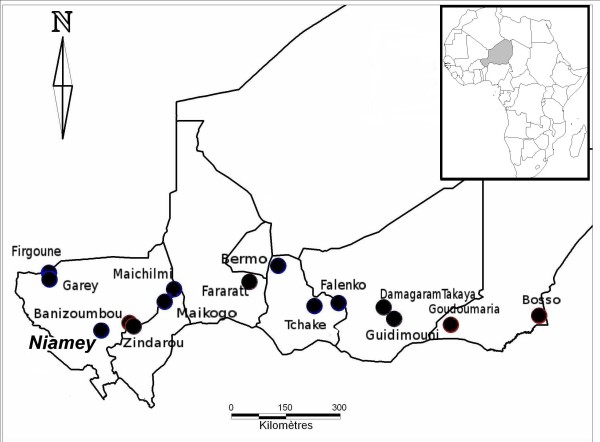
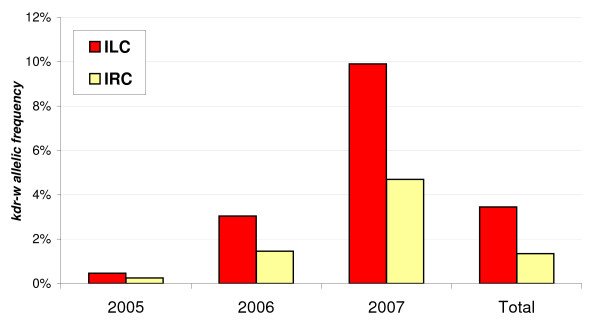
BACKGROUND: At the end of 2005, a nationwide long-lasting insecticide-treated net (LLIN) distribution targeting the most vulnerable populations was implemented throughout Niger. A large number of studies in Africa have reported the existence of anopheline populations resistant to various insecticides, partly due to knockdown resistance (kdr) mutations, but few operational wide-scale control programmes were coupled with the monitoring of such mutations. The distribution of the kdr-west (kdr-w) Leu-Phe mutation was studied in Anopheles gambiae s.l. populations from Niger and temporal variations were monitored following the nationwide LLIN implementation. METHODS: Mosquitoes were collected from 14 localities during the wet seasons of 2005, 2006 and 2007 with additional sampling in the capital city, Niamey. After morphological identification of Anopheles gambiae s.l. specimens, DNA extracts were used for the determination of species and molecular forms of the Anopheles gambiae complex and for the detection of the kdr-w mutation. RESULTS: Around 1,500 specimens collected in the three consecutive years were analysed. All Anopheles arabiensis specimens analysed were homozygous susceptible, whereas the few Anopheles gambiae S forms exhibited a high overall kdr-w frequency. The M form samples exhibited a low overall kdr-w frequency before the LLIN distribution, that increased significantly in the two wet season collections following the LLIN distribution. Higher kdr frequencies were repeatedly noticed within host-seeking females compared to resting ones in indoor collections. In addition, preliminary results in M form urban populations from Niamey showed far higher kdr frequencies than in all of the rural sites studied. DISCUSSION: This study describes the first case of kdr mutation in Anopheles gambiae populations from Niger. It is suspected that the LLIN have caused the important temporal increase of kdr-w mutation observed during this study. While the kdr mutation is still found at a low level, this rapid increase could potentially lead to high kdr frequencies within a few years. CONCLUSION: These results are of prime importance in the effort to document multiple effects of operational control programmes on mosquito vectors, and to conceive sustainable control strategies for future malaria control programmes.
Overview
The claims and statistics of this paper haven’t been checked yet.
Run the check — free, no account needed. It reads the open-access text and checks the sources it cites.
Integrity signals
Registry
Cites
Statistics
Figures
Verification
Claims the paper makes
The claims and statistics of this paper haven’t been checked yet.
Run the check — free, no account needed. It reads the open-access text and checks the sources it cites.
Claims other papers make about this one
Each is checked against this paper’s own text: does it say what the citing paper says it does?
The cited source says what the claim attributes to it.
In the citing paper
“Besides that, increase in kdr frequencies was evidenced in An. gambiae (s.l.) after the distribution of LLINs in Kenya [34], Niger [35], Senegal [36] and Benin [37].”
From Mapping insecticide resistance in Anopheles gambiae (s.l.) from Côte d'Ivoire (2018) · cites this paper as [35]
Self-check
Percentages, sums and reported differences re-computed from the paper’s own numbers.
The self-check needs the paper’s full text.
Citations
Cites
Arlequin (version 3.0): An integrated software package for population genetics data analysis
Excoffier, L., Laval, G., & Schneider, S. (2005) · Evolutionary Bioinformatics · doi:10.1177/117693430500100003 · Cited by 14,265
Performing the Exact Test of Hardy-Weinberg Proportion for Multiple Alleles
Guo, S., & Thompson, E. A. (1992) · Biometrics · doi:10.2307/2532296 · Cited by 4,884
The molecular basis of insecticide resistance in mosquitoes
Hemingway, J., Hawkes, N. J., McCarroll, L., & Ranson, H. (2004) · Insect Biochemistry and Molecular Biology · doi:10.1016/j.ibmb.2004.03.018 · Cited by 1,183
Martinez‐Torres, D., Chandre, F., Williamson, M. S., Darriet, F., Bergé, J. B., Devonshire, A. L., Guillet, P., Pasteur, N., & Pauron, D. (1998) · Insect Molecular Biology · doi:10.1046/j.1365-2583.1998.72062.x · Cited by 1,040
Ranson, H., Jensen, B., Vulule, J. M., Wang, X., Hemingway, J., & Collins, F. H. (2000) · Insect Molecular Biology · doi:10.1046/j.1365-2583.2000.00209.x · Cited by 645
N’Guessan, R., Corbel, V., Akogbéto, M., & Rowland, M. (2007) · Emerging Infectious Diseases · doi:10.3201/eid1302.060631 · Cited by 548
Diabate, A., Baldet, T., Chandre, F., Akoobeto, M., Guiguemde, T. R., Darriet, F., Brengues, C., Guillet, P., Hemingway, J., Small, G. J., et al. (2002) · The American journal of tropical medicine and hygiene · doi:10.4269/ajtmh.2002.67.617 · Cited by 459
Corbel, V., N’Guessan, R., Brengues, C., Chandre, F., Djogbénou, L., Martin, T., Akogbeto, M. C., Hougard, J.-M., & Rowland, M. (2007) · Acta Tropica · doi:10.1016/j.actatropica.2007.01.005 · Cited by 382
Status of pyrethroid resistance in Anopheles gambiae sensu lato.
Chandre, F., Darrier, F., Manga, L., Akogbeto, M. C., Faye, O., Mouchet, J., & Guillet, P. (1999) · Europe PMC (PubMed Central) · Cited by 322
Schellenberg, J. R. A., Abdulla, S., Nathan, R., Mukasa, O., Marchant, T. J., Kikumbih, N., Mushi, A. K., Mponda, H., Minja, H., Mshinda, H., et al. (2001) · The Lancet · doi:10.1016/s0140-6736(00)04404-4 · Cited by 301
SHARP, B. L., Ridl, F. C., Govender, D., Kuklinski, J., & Kleinschmidt, I. (2007) · Malaria Journal · doi:10.1186/1475-2875-6-52 · Cited by 240
Fegan, G. W., Noor, A. M., Akhwale, W. S., Cousens, S., & Snow, R. W. (2007) · The Lancet · doi:10.1016/s0140-6736(07)61477-9 · Cited by 237
Santolamazza, F., Calzetta, M., Etang, J., Barrese, E., Dia, I., Caccone, A., Donnelly, M. J., Petrarca, V., Simard, F., Pinto, J., et al. (2008) · Malaria Journal · doi:10.1186/1475-2875-7-74 · Cited by 231
Modifications of pyrethroid effects associated with kdr mutation in Anopheles gambiae
Chandre, F., Darriet, F., Duchon, S., Finot, L., Manguin, S., Carnevale, P., & Guillet, P. (2000) · Medical and Veterinary Entomology · doi:10.1046/j.1365-2915.2000.00212.x · Cited by 209
Gimnig, J. E., VULULE, J. M., Lo, T., Kamau, L., KOLCZAK, M. S., Phillips‐Howard, P. A., Mathenge, E. M., ter Kuile, F. O., Nahlen, B. L., Hightower, A. W., et al. (2003) · American Journal of Tropical Medicine and Hygiene · doi:10.4269/ajtmh.2003.68.16 · Cited by 202
The kdr mutation occurs in the Mopti form of Anopheles gambiae s .s. through introgression
Weill, M., Chandre, F., Brengues, C., Manguin, S., Akogbeto, M. C., Pasteur, N., Guillet, P., & Michel Raymond, A. (2000) · Insect Molecular Biology · doi:10.1046/j.1365-2583.2000.00206.x · Cited by 191
Lessons from the past: managing insecticide resistance in malaria control and eradication programmes
Kelly-Hope, L., Ranson, H., & Hemingway, J. (2008) · The Lancet Infectious Diseases · doi:10.1016/s1473-3099(08)70045-8 · Cited by 191
STUMP, A. D., ATIELI, F. K., VULULE, J. M., & BESANSKY, N. J. (2004) · The American Journal of Tropical Medicine and Hygiene · doi:10.4269/ajtmh.2004.70.591 · Cited by 168
The world sorghum and millet economies : facts, trends, and outlook
Division, P. (1996) · Medical Entomology and Zoology · Cited by 168
ter Kuile, F. O., Terlouw, D. J., Phillips‐Howard, P. A., HAWLEY, W. A., Friedman, J. F., KOLCZAK, M. S., Kariuki, S., Shi, Y. P., KWENA, A. M., VULULE, J. M., et al. (2003) · American Journal of Tropical Medicine and Hygiene · doi:10.4269/ajtmh.2003.68.100 · Cited by 166
Pyrethroid cross resistance spectrum among populations of Anopheles gambiae s.s. from Côte d'Ivoire.
Chandre, F., Darriet, F., Manguin, S., Brengues, C., Carnevale, P., & Guillet, P. (1999) · PubMed · Cited by 165
HENRY, M.-C., ASSI, S.-B., ROGIER, C., DOSSOU-YOVO, J., CHANDRE, F., GUILLET, P., & CARNEVALE, P. (2005) · The American Journal of Tropical Medicine and Hygiene · doi:10.4269/ajtmh.2005.73.859 · Cited by 150
Diabaté, A., Brengues, C., Baldet, T., Dabiré, R. K., Hougard, J.-M., Akogbeto, M. C., Kengne, P., Simard, F., Guillet, P., Hemingway, J., et al. (2004) · Tropical Medicine & International Health · doi:10.1111/j.1365-3156.2004.01336.x · Cited by 148
Insecticide‐treated net ownership and usage in Niger after a nationwide integrated campaign
Thwing, J. I., Hochberg, N. S., Eng, J. V., Issifi, S., Eliades, M. J., Minkoulou, E., Wolkon, A., Gado, H., Ibrahim, O., Newman, R. D., et al. (2008) · Tropical Medicine & International Health · doi:10.1111/j.1365-3156.2008.02070.x · Cited by 147
Verhaeghen, K., Bortel, W. V., Roelants, P., Backeljau, T., & Coosemans, M. (2006) · Malaria Journal · doi:10.1186/1475-2875-5-16 · Cited by 145
FIRST REPORT OF KNOCKDOWN MUTATIONS IN THE MALARIA VECTOR ANOPHELES GAMBIAE FROM CAMEROON
Etang, J., Fondjo, É., Chandre, F., Morlais, I., Brengues, C., Nwane, P. B., Chouaïbou, M., Ndjemaï, H. N. M., & Simard, F. (2006) · American Journal of Tropical Medicine and Hygiene · doi:10.4269/ajtmh.2006.74.795 · Cited by 143
Fanello, C. A., Petrarca, V., della Torre, A., Santolamazza, F., Dolo, G., Coulibaly, M., Alloueche, A., Curtis, C. F., Touré, Y. T., & Coluzzi, M. (2003) · Insect Molecular Biology · doi:10.1046/j.1365-2583.2003.00407.x · Cited by 133
Chouaïbou, M., Etang, J., Brévault, T., Nwane, P. B., Hinzoumbe, C. K., Mimpfoundi, R., & Simard, F. (2008) · Tropical Medicine & International Health · doi:10.1111/j.1365-3156.2008.02025.x · Cited by 124
Reimer, L., Fondjo, E., Patchoke, S., Diallo, B., Lee, Y., Ng, A., Ndjemai, H. M., Atangana, J., Traore, S. F., Lanzaro, G., et al. (2008) · Journal of Medical Entomology · doi:10.1093/jmedent/45.2.260 · Cited by 123
Pinto, J., Lynd, A., Vicente, J. L., Santolamazza, F., Randle, N., Gentile, G., Moreno, M., Simard, F., Charlwood, J. D., do Rosário, V. E., et al. (2007) · PLoS ONE · doi:10.1371/journal.pone.0001243 · Cited by 121
Screening of pesticide residues in soil and water samples from agricultural settings
Akogbeto, M. C., Djouaka, R. F., & Kindé-Gazard, D. A. (2006) · Malaria Journal · doi:10.1186/1475-2875-5-22 · Cited by 117
Lindblade, K. A., Gimnig, J. E., Kamau, L., Hawley, W. A., Odhiambo, F., Olang, G., ter Kuile, F. O., VULULE, J. M., & Slutsker, L. (2006) · Journal of Medical Entomology · doi:10.1093/jmedent/43.2.428 · Cited by 115
Yawson, A. E., McCall, P. J., Wilson, M. D., & Donnelly, M. J. (2004) · Medical and Veterinary Entomology · doi:10.1111/j.0269-283x.2004.00519.x · Cited by 114
Asidi, A. N., N’Guessan, R., KOFFI, A. A., Curtis, C. F., Hougard, J., Chandre, F., Corbel, V., Darriet, F., Zaim, M., & Rowland, M. (2005) · Malaria Journal · doi:10.1186/1475-2875-4-25 · Cited by 108
Maxwell, C. A., Chambo, W., Mwaimu, M., Magogo, F. S., Carneiro, I. A., & Curtis, C. F. (2003) · Malaria Journal · doi:10.1186/1475-2875-2-28 · Cited by 104
Pinto, J., Lynd, A., Élissa, N., Donnelly, M. J., Costa, C., Gentile, G., Caccone, A., & do Rosário, V. E. (2006) · Medical and Veterinary Entomology · doi:10.1111/j.1365-2915.2006.00611.x · Cited by 102
Kolaczinski, J. H., Fanello, C. A., Hervé, J. P., Conway, D. J., Carnevale, P., & Curtis, C. F. (2000) · Bulletin of Entomological Research · doi:10.1017/s0007485300000237 · Cited by 100
Malima, R. C., Magesa, S., Tungu, P., Mwingira, V., Magogo, F. S., Sudi, W., Mosha, F. W., Curtis, C. F., Maxwell, C. A., & Rowland, M. (2008) · Malaria Journal · doi:10.1186/1475-2875-7-38 · Cited by 96
Kulkarni, M. A., Rowland, M., Alifrangis, M., Mosha, F. W., Matowo, J., Malima, R., Peter, J., Kweka, E. J., Lyimo, I. N., Magesa, S., et al. (2006) · Malaria Journal · doi:10.1186/1475-2875-5-56 · Cited by 96
(2004) · Malaria Journal · doi:10.1186/1475-2875-3-22 · Cited by 83
Awolola, T. S., Oyewole, I. O., Amajoh, C., Idowu, E. T., Ajayi, M. B., Oduola, A. O., Manafa, O. U., Ibrahim, K. T., Koekemoer, L. L., & Coetzee, M. (2005) · Acta Tropica · doi:10.1016/j.actatropica.2005.06.002 · Cited by 78
Kristan, M., Fleischmann, H., della Torre, A., Stich, A. H. R., & Curtis, C. F. (2003) · Medical and Veterinary Entomology · doi:10.1046/j.1365-2915.2003.00449.x · Cited by 77
Matambo, T. S., Abdalla, H., Brooke, B. D., Koekemoer, L. L., Mnzava, A. P., Hunt, R. H., & Coetzee, M. (2007) · Medical and Veterinary Entomology · doi:10.1111/j.1365-2915.2007.00671.x · Cited by 75
Diabaté, A., Baldet, T., Chandre, C., Dabiré, R. K., Kengne, P., Robert, G. T., Simard, F., Guillet, P., Hemingway, J., & Marc, H. J. (2003) · Journal of Medical Entomology · doi:10.1603/0022-2585-40.2.195 · Cited by 74
Reimer, L. J., Tripet, F., Slotman, M., Spielman, A., Fondjo, É., & Lanzaro, G. C. (2005) · Insect Molecular Biology · doi:10.1111/j.1365-2583.2005.00599.x · Cited by 69
Tripet, F., WRIGHT, J., Cornel, A., Fofana, A., McAbee, R. D., MENESES, C., Reimer, L. J., Slotman, M., Thiemann, T. C., Dolo, G., et al. (2007) · American Journal of Tropical Medicine and Hygiene · doi:10.4269/ajtmh.2007.76.81 · Cited by 64
First report of the kdr mutation in Anopheles gambiae M form from Burkina Faso, west Africa.
Diabaté, A., Baldet, T., Chandre, F., Guiguemdé, R. T., Brengues, C., Guillet, P., Hemingway, J., & Jm, H. (2002) · PubMed · Cited by 62
Soremekun, S., Maxwell, C. A., Zuwakuu, M., Chen, C., Michael, E., & Curtis, C. F. (2004) · Tropical Medicine & International Health · doi:10.1111/j.1365-3156.2004.01250.x · Cited by 55
Kulkarni, M. A., Malima, R., Mosha, F. W., Msangi, S., Mrema, E. J., Kabula, B. I., Lawrence, B., Kinung’hi, S., Swilla, J., Kisinza, W. N., et al. (2007) · Tropical Medicine & International Health · doi:10.1111/j.1365-3156.2007.01883.x · Cited by 54
Awolola, T. S., Oduola, A. O., Oyewole, I. O., Obansa, J. B., Amajoh, C., Koekemoer, L. L., & Coetzee, M. (2007) · PubMed · Cited by 54
High Genetic Differentiation between the M and S Molecular Forms of Anopheles gambiae in Africa
Esnault, C., Boulesteix, M., Duchemin, J., KOFFI, A. A., Chandre, F., Dabiré, R. K., Robert, V., Simard, F., Tripet, F., Donnelly, M. J., et al. (2008) · PLoS ONE · doi:10.1371/journal.pone.0001968 · Cited by 52
Self-citationSantolamazza, F., della Torre, A., & Caccone, A. (2004) · American Journal of Tropical Medicine and Hygiene · doi:10.4269/ajtmh.2004.70.604 · Cited by 49
VULULE, J. M., Beach, R., Atieli, F., Mount, D. L., Roberts, J. M., & Mwangi, R. W. (1996) · Medical and Veterinary Entomology · doi:10.1111/j.1365-2915.1996.tb00084.x · Cited by 48
Eisele, T. P., Lindblade, K. A., Wannemuehler, K. A., Gimnig, J. E., Odhiambo, F., HAWLEY, W. A., ter Kuile, F. O., Phillips‐Howard, P. A., Rosen, D. H., Nahlen, B. L., et al. (2005) · American Journal of Tropical Medicine and Hygiene · doi:10.4269/ajtmh.2005.73.149 · Cited by 45
Tia, E., Akogbeto, M. C., KOFFI, A. A., Toure, M., Adja, A. M., Moussa, K., Yao, T., Carnevale, P., & Chandre, E. (2006) · PubMed · Cited by 41
Moreno, M., Vicente, J. L., Cano, J., Berzosa, P. J., de Lucio, A., Nzambo, S., Bobuakasi, L., Buatiché, J. N., Ondo, M., Micha, F., et al. (2008) · Tropical Medicine & International Health · doi:10.1111/j.1365-3156.2008.02010.x · Cited by 32
Girod, R., Orlandi‐Pradines, E., Rogier, C., & Pagès, F. (2006) · Journal of Medical Entomology · doi:10.1603/0022-2585(2006)43[1082:mtairo]2.0.co;2 · Cited by 32
Tripet, F., WRIGHT, J., & Lanzaro, G. C. (2006) · American Journal of Tropical Medicine and Hygiene · doi:10.4269/ajtmh.2006.74.658 · Cited by 22
Anopheles funestus in Sahel: new evidence from Niger
Labbo, R., Fouta, A., Jeanne, I., Ousmane, I., & Duchemin, J. (2004) · The Lancet · doi:10.1016/s0140-6736(04)15606-7 · Cited by 22
Self-citationJaneira, F., Vicente, J. L., Kanganje, Y., Moreno, M., do Rosário, V. E., Cravo, P., & Pinto, J. (2008) · Journal of Medical Entomology · doi:10.1603/0022-2585(2008)45[237:apracr]2.0.co;2 · Cited by 19
Berzosa, P. J., Cano, J., Roche, J., Rubio, J. M., García, L. V., Moyano, E. M., Guerra, A., Jc, M., Petrarca, Vd, R., et al. (2002) · PubMed · Cited by 19
Niger welcomes largest bednet distribution in history
Loewenberg, S. (2006) · The Lancet · doi:10.1016/s0140-6736(06)68630-3 · Cited by 12
ELISA study of oocyst-sporozoite transition in malaria vectors
Czeher, C., Labbo, R., Djibrilla, A., Here, L., Arzika, I., & Duchemin, J. (2006) · Parasite · doi:10.1051/parasite/2006133257 · Cited by 8
Self-citation
Cited by
Sorted by citations
How to make evolution-proof insecticides for malaria control
Read, A. F., Lynch, P. A., & Thomas, M. B. (2009) · PLoS Biology · doi:10.1371/journal.pbio.1000058 · Cited by 288
Corbel, V., Akogbeto, M. C., Damien, G. B., Djènontin, A., Chandre, F., Rogier, C., Moiroux, N., Chabi, J., Banganna, B., Padonou, G. G., et al. (2012) · The Lancet Infectious Diseases · doi:10.1016/s1473-3099(12)70081-6 · Cited by 212
Djègbé, I., Boussari, O., Sidick, A., Martin, T., Ranson, H., Chandre, F., Akogbeto, M. C., & Corbel, V. (2011) · Malaria Journal · doi:10.1186/1475-2875-10-261 · Cited by 164
Silva, A. P. B., Santos, J. M. M., & Martins, A. J. (2014) · Parasites & Vectors · doi:10.1186/1756-3305-7-450 · Cited by 160
Mathias, D. K., Ochomo, E., Atieli, F., Ombok, M., Nabie Bayoh, M., Olang, G., Muhia, D., Kamau, L., Vulule, J. M., Hamel, M. J., et al. (2011) · Malaria Journal · doi:10.1186/1475-2875-10-10 · Cited by 158
Metadata
- Authors
- Czeher, C., Labbo, R., Arzika, I., & Duchemin, J.-B.
- Affiliations
- Centre de Recherche Médicale et Sanitaire (NE)
- Corresponding author
- Czeher, Cyrille
- Venue
- Malaria Journal
- Published
- 2008-09-25
- Volume
- 7
- Issue
- 1
- Pages
- 189-189
- ISSN
- 1475-2875 (ISSN-L)
- PMC
- PMC2562389
- OpenAlex
- W2051157460
- Cited by
- 134
- References
- 64
- Citations by year
- 2026: 1 · 2025: 1 · 2024: 7 · 2023: 8 · 2022: 7 · 2021: 1 · 2020: 9 · 2019: 7 · 2018: 9 · 2017: 5 · 2016: 10 · 2015: 7 · 2014: 15 · 2013: 12 · 2012: 15
- FWCI
- 6.62
- Type
- journal article
- Language
- en
- Open access
- gold
- doi.org
- Licence
- Locations
- Malaria Journal (publishedVersion, cc-by)
- PubMed Central (publishedVersion, cc-by)
- PubMed (publishedVersion)
- HAL (submittedVersion, cc-by)
- DOAJ (DOAJ: Directory of Open Access Journals) (submittedVersion, cc-by-sa)
- Funders
- Global Fund to Fight AIDS, Tuberculosis and Malaria
- World Health Organization
- European Commission
- Topics
- Health Sciences › Medicine › Public Health, Environmental and Occupational Health › Malaria Research and Control
- Life Sciences › Biochemistry, Genetics and Molecular Biology › Molecular Biology › Insect Resistance and Genetics
- Health Sciences › Medicine › Public Health, Environmental and Occupational Health › Dengue and Mosquito Control Research
- Keywords
- kdr mutation, KDR, Anopheles gambiae s.l., Anopheles arabiensis, long-lasting insecticidal nets, insecticide resistance, malaria vector control, Niger, resistance trends, urban mosquito populations
- MeSH terms
- Alleles, Animals, Anopheles, Humans, Insecticide Resistance, Insecticides, Malaria, Mosquito Control, Niger, Protective Devices, Mutation, Missense, Polymorphism, Single Nucleotide
About these checks
Registry, retraction, Cites and statistics results are computed, not judged, with one exception: a printed reference that no index lists is read once by a model before it counts as a citation error. Claims are extracted by a model and kept only when their quote appears verbatim in the text; each cited source is then checked, with a model’s help, for whether it says what the claim relies on. Those verdicts can be wrong — read the claim’s quote and the cited source before relying on one.
Statistics and arithmetic are recomputed, not judged.
Confidence bands are shown only for fields calibrated on our annotated test set. None is calibrated yet, so no band is shown.
What counts as a claim ›How we measure confidence ›How we check this ›
Are you an author, or do you see a problem with this page? Request a review
