

Integrated vector management for malaria control
Open accessThe DOI matches its Crossref record; 62 of the 64 references it cites were found in a registry or an index.
Abstract
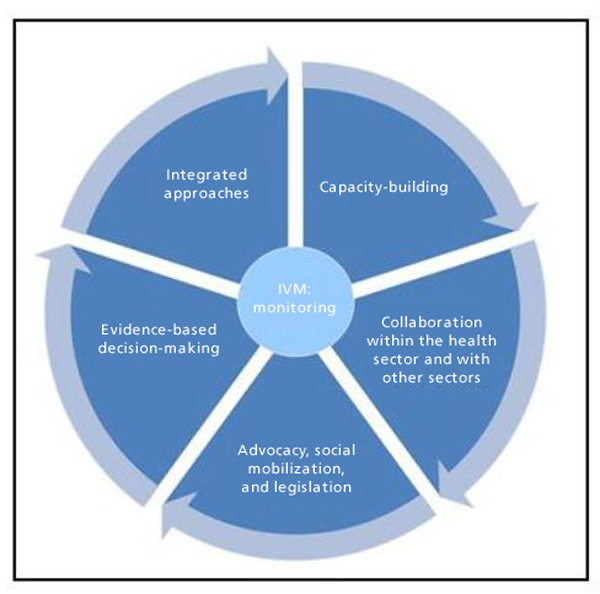
Integrated vector management (IVM) is defined as "a rational decision-making process for the optimal use of resources for vector control" and includes five key elements: 1) evidence-based decision-making, 2) integrated approaches 3), collaboration within the health sector and with other sectors, 4) advocacy, social mobilization, and legislation, and 5) capacity-building. In 2004, the WHO adopted IVM globally for the control of all vector-borne diseases. Important recent progress has been made in developing and promoting IVM for national malaria control programmes in Africa at a time when successful malaria control programmes are scaling-up with insecticide-treated nets (ITN) and/or indoor residual spraying (IRS) coverage. While interventions using only ITNs and/or IRS successfully reduce transmission intensity and the burden of malaria in many situations, it is not clear if these interventions alone will achieve those critical low levels that result in malaria elimination. Despite the successful employment of comprehensive integrated malaria control programmes, further strengthening of vector control components through IVM is relevant, especially during the "end-game" where control is successful and further efforts are required to go from low transmission situations to sustained local and country-wide malaria elimination. To meet this need and to ensure sustainability of control efforts, malaria control programmes should strengthen their capacity to use data for decision-making with respect to evaluation of current vector control programmes, employment of additional vector control tools in conjunction with ITN/IRS tactics, case-detection and treatment strategies, and determine how much and what types of vector control and interdisciplinary input are required to achieve malaria elimination. Similarly, on a global scale, there is a need for continued research to identify and evaluate new tools for vector control that can be integrated with existing biomedical strategies within national malaria control programmes. This review provides an overview of how IVM programmes are being implemented, and provides recommendations for further development of IVM to meet the goals of national malaria control programmes in Africa.
Overview
The claims and statistics of this paper haven’t been checked yet.
Free: it reads the open-access text and checks the first 5 claims that cite a source we can check. Create a free account to check every claim.
Integrity signals
Registry
Cites
Statistics
Figures
Verification
Claims the paper makes
The claims and statistics of this paper haven’t been checked yet.
Free: it reads the open-access text and checks the first 5 claims that cite a source we can check. Create a free account to check every claim.
Claims other papers make about this one
Each is checked against this paper’s own text: does it say what the citing paper says it does?
The cited source says what the claim attributes to it.
In the citing paper
“An IVM approach is important to sustain achievements and reduce transmission to critical low levels needed to eliminate malaria (Beier et al. 2009).”
From Global Status of DDT and Its Alternatives for Use in Vector Control to Prevent Disease (2009) · cites this paper as Beier et al. 2009
Self-check
Percentages, sums and reported differences re-computed from the paper’s own numbers.
The self-check needs the paper’s full text.
Citations
Cites
Disease control priorities in developing countries
(2006) · Choice Reviews Online · doi:10.5860/choice.44-0343 · Cited by 3,628
Macroeconomics and health: investing in health for economic development
Sachs, J. D. (2002) · Revista Panamericana de Salud Pública · doi:10.1590/s1020-49892002000800017 · Cited by 1,830
Disease control priorities in developing countries
Frenk, J. (2006) · Salud Pública de México · doi:10.1590/s0036-36342006000600011 · Cited by 1,599
Disease Control Priorities in Developing Countries
Mosley, W. H. (1993) · World Bank, Washington, DC eBooks · doi:10.1596/0-1952-0990-7 · Cited by 1,400
Handbook of Pesticide Toxicology
(2001) · Elsevier eBooks · doi:10.1016/b978-0-12-426260-7.x5000-9 · Cited by 1,322
Ross, R. (2010) · Cited by 940
Introduction to insect pest management
(1994) · Choice Reviews Online · doi:10.5860/choice.32-2128 · Cited by 539
Measuring the Burden of Neglected Tropical Diseases: The Global Burden of Disease Framework
Mathers, C. D., Ezzati, M., & Lopez, A. D. (2007) · PLoS Neglected Tropical Diseases · doi:10.1371/journal.pntd.0000114 · Cited by 510 · cited 1×
“Malaria and other vector-borne diseases contribute substantially to the global burden of diseases and disproportionately affect poor and under-served populations living in tropical and sub-tropical regions [1-5].”
BackgroundWALKER, K., & LYNCH, M. (2007) · Medical and Veterinary Entomology · doi:10.1111/j.1365-2915.2007.00674.x · Cited by 279 · cited 2×
“Recent reviews of environmental management [37,39] and larval control [26] contain additional examples.”
BackgroundEradication of Anopheles gambiae from Brazil: lessons for malaria control in Africa?
Killeen, G. F., Fillinger, U., Kiche, I., Gouagna, L. C., & Knols, B. G. (2002) · The Lancet Infectious Diseases · doi:10.1016/s1473-3099(02)00397-3 · Cited by 272 · cited 1×
“remaining low-levels of transmission? There is also a strong case for implementing larval control to target immature stages of anopheline mosquitoes to reduce malaria transmission [21-27], but further field trials are needed to show how these additional measures, beyond ITNs and IRS, have a substantial impact on malar…”
BackgroundKeiser, J., Singer, B. H., & Utzinger, J. (2005) · The Lancet Infectious Diseases · doi:10.1016/s1473-3099(05)70268-1 · Cited by 261 · cited 3×
“Recent reviews of environmental management [37,39] and larval control [26] contain additional examples.”
BackgroundEfficacy and cost- effectiveness of environmental management for malaria control
Utzinger, J., Tozan, Y., & Singer, B. H. (2001) · Tropical Medicine & International Health · doi:10.1046/j.1365-3156.2001.00769.x · Cited by 260 · cited 3×
“Recent reviews of environmental management [37,39] and larval control [26] contain additional examples.”
BackgroundNyarango, P. M., Gebremeskel, T., Mebrahtu, G., Mufunda, J., Abdulmumini, U., Ogbamariam, A., Kosia, A., Gebremichael, A., Gunawardena, D., Ghebrat, Y., et al. (2006) · Malaria Journal · doi:10.1186/1475-2875-5-33 · Cited by 254 · cited 1×
“When optimally employed, these vector control measures can reduce malaria parasite transmission by 90% or more and can correspondingly reduce malaria incidence, malaria prevalence, high parasite density, and clinical malaria [18-20].”
BackgroundKilleen, G. F., Fillinger, U., & Knols, B. G. (2002) · Malaria Journal · doi:10.1186/1475-2875-1-8 · Cited by 254 · cited 1×
“remaining low-levels of transmission? There is also a strong case for implementing larval control to target immature stages of anopheline mosquitoes to reduce malaria transmission [21-27], but further field trials are needed to show how these additional measures, beyond ITNs and IRS, have a substantial impact on malar…”
BackgroundFillinger, U., & Lindsay, S. W. (2006) · Tropical Medicine & International Health · doi:10.1111/j.1365-3156.2006.01733.x · Cited by 242 · cited 2×
“"Communitybased" IVM programmes incorporating larval source management have recently been implemented in two different settings: in Rusinga Island, Western Kenya [27], and in Dar es Salaam, Tanzania [46,60].”
BackgroundVector-borne disease problems in rapid urbanization: new approaches to vector control.
Knudsen, A. B., & Slooff, R. (1992) · Bulletin of the World Health Organization · Cited by 240
Fillinger, U., Kannady, K., William, G., Vanek, M. J., Dongus, S., Nyika, D., Geissbühler, Y., Chaki, P. P., Govella, N. J., Mathenge, E. M., et al. (2008) · Malaria Journal · doi:10.1186/1475-2875-7-20 · Cited by 225 · cited 4×
“Caldas de Castro M, Yamagata Y, Mtasiwa D, Tanner M, Utzinger J, Keiser J, Singer BH: Integrated urban malaria control: a case study in Dar es Salaam, Tanzania.”
BackgroundInfluentialExploiting the potential of vector control for disease prevention.
Townson, H., Nathan, M. B., Zaim, M., Guillet, P., Manga, L., Bos, R., & Kindhauser, M. K. (2005) · Europe PMC (PubMed Central) · Cited by 217
A blueprint for success: integration of neglected tropical disease control programmes
Lammie, P. J., Fenwick, A., & Utzinger, J. (2006) · Trends in Parasitology · doi:10.1016/j.pt.2006.05.009 · Cited by 204 · cited 1×
“Malaria and other vector-borne diseases contribute substantially to the global burden of diseases and disproportionately affect poor and under-served populations living in tropical and sub-tropical regions [1-5].”
BackgroundVector-borne disease problems in rapid urbanization: new approaches to vector control.
Knudsen, A. B., & Slooff, R. (1992) · PubMed · Cited by 202
INTEGRATED URBAN MALARIA CONTROL: A CASE STUDY IN DAR ES SALAAM, TANZANIA
DE CASTRO, M. C., YAMAGATA, Y., MTASIWA, D., TANNER, M., UTZINGER, J., KEISER, J., & SINGER, B. H. (2004) · The American Journal of Tropical Medicine and Hygiene · doi:10.4269/ajtmh.2004.71.103 · Cited by 179 · cited 4×
“Caldas de Castro M, Yamagata Y, Mtasiwa D, Tanner M, Utzinger J, Keiser J, Singer BH: Integrated urban malaria control: a case study in Dar es Salaam, Tanzania.”
BackgroundInfluentialPetersen, P. E. (2003) · Community Dentistry And Oral Epidemiology · doi:10.1046/j.1600-0528.2003.00124.x · Cited by 157
DO MALARIA CONTROL INTERVENTIONS REACH THE POOR? A VIEW THROUGH THE EQUITY LENS
BARAT, L. M., PALMER, N., BASU, S., WORRALL, E., HANSON, K., & MILLS, A. (2004) · The American Journal of Tropical Medicine and Hygiene · doi:10.4269/ajtmh.2004.71.174 · Cited by 155 · cited 1×
“Throughout Africa, National Malaria Control Programmes have recently embarked on emphasizing vector control as an essential component [10,17].”
BackgroundMenach, A. L., McKenzie, F. E., Flahault, A., & Smith, D. L. (2005) · Malaria Journal · doi:10.1186/1475-2875-4-23 · Cited by 142 · cited 1×
“remaining low-levels of transmission? There is also a strong case for implementing larval control to target immature stages of anopheline mosquitoes to reduce malaria transmission [21-27], but further field trials are needed to show how these additional measures, beyond ITNs and IRS, have a substantial impact on malar…”
BackgroundThe persistent problem of malaria: Addressing the fundamental causes of a global killer
Stratton, L., O’Neill, M. S., Kruk, M. E., & Bell, M. L. (2008) · Social Science & Medicine · doi:10.1016/j.socscimed.2008.05.013 · Cited by 137 · cited 1×
“Malaria and other vector-borne diseases contribute substantially to the global burden of diseases and disproportionately affect poor and under-served populations living in tropical and sub-tropical regions [1-5].”
BackgroundGU, W., & NOVAK, R. J. (2005) · The American Journal of Tropical Medicine and Hygiene · doi:10.4269/ajtmh.2005.73.546 · Cited by 135 · cited 1×
“remaining low-levels of transmission? There is also a strong case for implementing larval control to target immature stages of anopheline mosquitoes to reduce malaria transmission [21-27], but further field trials are needed to show how these additional measures, beyond ITNs and IRS, have a substantial impact on malar…”
BackgroundSelf-citationEconomic Analysis of Malaria Control in Sub-Saharan Africa
MILLS, A. J., Goodman, C. A., & Coleman, P. G. (2000) · Cited by 125
Lemon, S. M., Sparling, P. F., Hamburg, M. A., Relman, D. A., Choffnes, E. R., Mack, A., & Sparling, F. (2008) · Cited by 121
Integrated vector management: The Zambian experience
Chanda, E., Masaninga, F., Coleman, M. M., Sikaala, C., Katebe-Sakala, C., MacDonald, M. B., Baboo, K. S., Govere, J. M., & Manga, L. (2008) · Malaria Journal · doi:10.1186/1475-2875-7-164 · Cited by 116
Self-citationThe economic payoffs of integrated malaria control in the Zambian copperbelt between 1930 and 1950
Utzinger, J., Tozan, Y., Doumani, F., & Singer, B. H. (2002) · Tropical Medicine & International Health · doi:10.1046/j.1365-3156.2002.00916.x · Cited by 115 · cited 1×
“While much remains unknown about the impact of fully developed IVM programmes on malaria transmission [3336], the IVM approach continues to be a strategy with great promise for disease control in Africa [37-39].”
BackgroundKilleen, G. F., McKenzie, F. E., Foy, B. D., Schieffelin, C., Billingsley, P. F., & Beier, J. C. (2000) · The American journal of tropical medicine and hygiene · doi:10.4269/ajtmh.2000.62.545 · Cited by 106 · cited 1×
“There is evidence that IVM can complement other existing malaria control strategies (ITN use, access to effective treatment) by avoiding reliance on any single intervention to reduce the burden of malaria [43-45].”
BackgroundSelf-citationSource reduction of mosquito larval habitats has unexpected consequences on malaria transmission
Gu, W., Regens, J. L., Beier, J. C., & Novak, R. J. (2006) · Proceedings of the National Academy of Sciences · doi:10.1073/pnas.0608452103 · Cited by 100 · cited 1×
“remaining low-levels of transmission? There is also a strong case for implementing larval control to target immature stages of anopheline mosquitoes to reduce malaria transmission [21-27], but further field trials are needed to show how these additional measures, beyond ITNs and IRS, have a substantial impact on malar…”
BackgroundSelf-citationThe Evidence Base on the Cost-Effectiveness of Malaria Control Measures in Africa
Goodman, C., & Mills, A. (1999) · Health Policy and Planning · doi:10.1093/heapol/14.4.301 · Cited by 98 · cited 1×
“The absence of IVM evaluations, as well as evaluations of packages of interventions, has been noted recently by several researchers [51-53].”
BackgroundChinery, W. A. (1984) · PubMed · Cited by 91
Engineering and malaria control: learning from the past 100 years
Konradsen, F., van der Hoek, W., Amerasinghe, F. P., Mutero, C. M., & Boelee, E. (2003) · Acta Tropica · doi:10.1016/j.actatropica.2003.09.013 · Cited by 87 · cited 1×
“While much remains unknown about the impact of fully developed IVM programmes on malaria transmission [ 33- 36 ], the IVM approach continues to be a strategy with great promise for disease control in Africa [37-39].”
BackgroundWHO position statement on integrated vector management.
(2008) · PubMed · Cited by 83
Global malaria control and elimination:report of a technical review
Kai-che, W. (2010) · Zhongguo redai yixue · Cited by 82
Peiris, M. J. S., Amerasinghe, F. P., Arunagiri, C. K., Perera, L., Karunaratne, S. H. P. P., Ratnayake, C. B., Kulatilaka, T. A., & Abeysinghe, M. R. N. (1993) · Transactions of the Royal Society of Tropical Medicine and Hygiene · doi:10.1016/0035-9203(93)90080-a · Cited by 79
Spatial Targeted Vector Control Is Able to Reduce Malaria Prevalence in the Highlands of Burundi
Protopopoff, N., Van Bortel, W., Marcotty, T., Van Herp, M., Maes, P., Baza, D., D’Alessandro, U., & Coosemans, M. (2008) · The American Journal of Tropical Medicine and Hygiene · doi:10.4269/ajtmh.2008.79.12 · Cited by 77 · cited 1×
“When optimally employed, these vector control measures can reduce malaria parasite transmission by 90% or more and can correspondingly reduce malaria incidence, malaria prevalence, high parasite density, and clinical malaria [18-20].”
BackgroundImpoinvil, D. E., Ahmad, S., Troyo, A., Keating, J., Githeko, A. K., Mbogo, C. M., Kibe, L. W., Githure, J. I., Gad, A. M., Hassan, A. N., et al. (2007) · Health Policy · doi:10.1016/j.healthpol.2007.01.009 · Cited by 65 · cited 1×
“A comparative evaluation of vector-control programmes in five countries [30] suggests that one of the key challenges to successful vector control is the lack of intersectoral collaboration.”
BackgroundSelf-citationGaddal, A. A. E. (1985) · PubMed · Cited by 64
The Farmer Field School: a method for enhancing the role of rural communities in malaria control?
van den Berg, H., & Knols, B. G. (2006) · Malaria Journal · doi:10.1186/1475-2875-5-3 · Cited by 56 · cited 1×
“An important innovation involved participatory education known as the "Farmer Field Schools", making the connections between health, vectorborne disease control and agricultural productivity [59].”
BackgroundProtopopoff, N., Van Herp, M., Maes, P., Reid, T., Baza, D., D'Alessandro, U., Van Bortel, W., & Coosemans, M. (2007) · Malaria Journal · doi:10.1186/1475-2875-6-93 · Cited by 52 · cited 1×
“When optimally employed, these vector control measures can reduce malaria parasite transmission by 90% or more and can correspondingly reduce malaria incidence, malaria prevalence, high parasite density, and clinical malaria [18-20].”
BackgroundMalaria outbreaks in new foci in Sri Lanka
Wijesundera, M. D. S. (1988) · Parasitology Today · doi:10.1016/0169-4758(88)90193-7 · Cited by 51 · cited 1×
“The hydrological changes and the relocation of people between malaria endemic and non-endemic areas as a result of resettlement due to the dam reservoirs, contributed to an upsurge in malaria [55] and Japanese encephalitis [56].”
BackgroundGrépin, K. A., & Reich, M. R. (2008) · PLoS Neglected Tropical Diseases · doi:10.1371/journal.pntd.0000174 · Cited by 51 · cited 1×
“Malaria and other vector-borne diseases contribute substantially to the global burden of diseases and disproportionately affect poor and under-served populations living in tropical and sub-tropical regions [1-5].”
BackgroundIntegrated vector control. Seventh report of the WHO Expert Committee on Vector Biology and Control.
(1983) · PubMed · Cited by 51
Bang, Y. H., Sabuni, I. B., & Tonn, R. J. (1975) · PubMed · Cited by 44
Community-based rice ecosystem management for suppressing vector anophelines in Sri Lanka
Yasuoka, J., Levins, R., Mangione, T. W., & Spielman, A. (2006) · Transactions of the Royal Society of Tropical Medicine and Hygiene · doi:10.1016/j.trstmh.2005.12.014 · Cited by 43 · cited 1×
“This led to a series of integrated vector control strategies based on community participation, ITNs, and larval source management [57].”
BackgroundChinery, W. A. (1995) · PubMed · Cited by 36
Pardo‐García, G., Descalzo, M. Á., Molina, L., Custodio, E., Lwanga, M., Mangue, C., Obono, J., Nchama, A., Roche, J., Benito, A., et al. (2006) · Malaria Journal · doi:10.1186/1475-2875-5-10 · Cited by 35 · cited 1×
“For example, in Boiko Island in Equatorial Guinea, ITNs have been used for over 13 years and, in 2004, an IRS campaign was also initiated [64].”
BackgroundA biologic basis for integrated malaria control.
McKenzie, F. E., Baird, J. K., Beier, J. C., Lal, A. A., & Bossert, W. H. (2002) · American Journal of Tropical Medicine and Hygiene · doi:10.4269/ajtmh.2002.67.571 · Cited by 34 · cited 1×
“There is evidence that IVM can complement other existing malaria control strategies (ITN use, access to effective treatment) by avoiding reliance on any single intervention to reduce the burden of malaria [43-45].”
BackgroundSelf-citationReport on a Malaria Survey of Mombasa.
Wiseman, R. H., Symes, C. B., Mcmahon, J. C., & Teesdale, C. (1939) · Cited by 28
What does it take to control malaria?
Walther, B., & Walther, M. (2007) · Annals of Tropical Medicine and Parasitology · doi:10.1179/136485907x229013 · Cited by 21 · cited 1×
“Malaria and other vector-borne diseases contribute substantially to the global burden of diseases and disproportionately affect poor and under-served populations living in tropical and sub-tropical regions [1-5].”
BackgroundOkie, S. (2008) · New England Journal of Medicine · doi:10.1056/nejmp0803483 · Cited by 20 · cited 1×
“Even with substantial success in vector control and renewed enthusiasm, many experts believe that the global eradication of Plasmodium falciparum and Plasmodium vivax malaria will take at least another 50 years [29].”
BackgroundMosquito-Control by Swamp Drainage in the Coastal Belt of Nigeria
Gilroy, A. B., & Chwatt, L. J. (1945) · Annals of Tropical Medicine and Parasitology · doi:10.1080/00034983.1945.11685211 · Cited by 18 · cited 1×
“Gilroy and colleagues [47] reported decreases in malaria incidence and sporozoite prevalence rates in Nigeria using a variety of environmental management techniques, including source reduction and drainage.”
BackgroundBio-environmental control of malaria in Nadiad, Kheda district, Gujarat.
Vp, S., Rc, S., & Gautam, A. S. (1986) · PubMed · Cited by 17
Elements of a vector control program.
Challet, G. L. (1991) · PubMed · Cited by 17
Mosquito abatement district programs in the United States.
Challet, G. L. (1994) · PubMed · Cited by 14
Medical specialists’ allocation of working time
Midttun, L. (2007) · Health Policy · doi:10.1016/j.healthpol.2007.01.010 · Cited by 14
Novak, R. J., & Lampman, R. L. (2001) · Elsevier eBooks · doi:10.1016/b978-012426260-7.50007-0 · Cited by 10
Self-citationCost effectiveness of the bio-environmental control of malaria in Kheda district, Gujarat.
Vp, S., & Rc, S. (1986) · PubMed · Cited by 9
Drainage and larviciding for control of a malaria focus in Haiti.
Schliessmann, D. J., Joseph, V., Solis, M. A., & Carmichael, G. T. (1973) · Mosquito news · Cited by 8
Research works printed but not linked: 7
- Hatch CL Williams JW Jarinko PA Guidelines for measuring proficiency as an aid in mosquito abatement program assessment Mosq News 1973 33 228 233
- WHO Global strategic framework for integrated vector management World Health Organization 2004 10 1 12 WHO/CDS/CPE/PVC/2004
- WHO Report of the global partners' meeting on neglected tropical diseases: 2007 – a turning point: Geneva, Swizerland, 17–18 April 2007 2007 Geneva: World Health Organization
- Rafatjah HA Prospects and Progress on IPM in World-wide Malaria control Mosq News 1982 42 491 498
- Hinman EH The management of water for malaria control Symposium on Human Malaria: 1941; Philadelphia 1941 324 332
- Berg H van den Das PK von Hildebrand A Ragunathan V Evaluation of the Integrated Pest and Vector Management (IPVM) project in Sri Lanka 2006 New Dehli: World Health Organization, South East Asia Regional Office 1 46
- Manga L Toure A Shililu J Implementation of Integrated Vector Management in the WHO-African Region: Progress Report 2000–2003 2004 Washington, DC: Environmental Health Project, U.S. Agency for International Development 1 26
Cited by
White, N. J., Pukrittayakamee, S., Hien, T. T., Faiz, M. A., Mokuolu, O. A., & Dondorp, A. M. (2014) · The Lancet · doi:10.1016/s0140-6736(13)60024-0 · Cited by 1,123
Operational strategies to achieve and maintain malaria elimination
Moonen, B., Cohen, J. M., Snow, R. W., Slutsker, L., Drakeley, C., Smith, D. L., Abeyasinghe, R. R., Rodriguez, M. H., Maharaj, R., Tanner, M., et al. (2010) · The Lancet · doi:10.1016/s0140-6736(10)61269-x · Cited by 381
Global Status of DDT and Its Alternatives for Use in Vector Control to Prevent Disease
van den Berg, H. (2009) · Environmental Health Perspectives · doi:10.1289/ehp.0900785 · Cited by 376
“An IVM approach is important to sustain achievements and reduce transmission to criti cal low levels needed to eliminate malaria (Beier et al. 2009).”
BackgroundAlternative strategies for mosquito-borne arbovirus control
Achee, N. L., Grieco, J. P., Vatandoost, H., Seixas, G., Pinto, J., Ching-NG, L., Martins, A. J., Juntarajumnong, W., Corbel, V., Gouagna, C., et al. (2019) · PLOS Neglected Tropical Diseases · doi:10.1371/journal.pntd.0006822 · Cited by 353
Current vector control challenges in the fight against malaria
Benelli, G., & Beier, J. C. (2017) · Acta Tropica · doi:10.1016/j.actatropica.2017.06.028 · Cited by 313
Self-citation
Metadata
- Authors
- Beier, J. C., Keating, J., Githure, J. I., Macdonald, M. B., Impoinvil, D. E., & Novak, R. J.
- Affiliations
- University of Miami (US)
- Tulane University (US)
- International Centre of Insect Physiology and Ecology (KE)
- United States Agency for International Development (US)
- University of Liverpool (GB)
- University of Alabama at Birmingham (US)
- Corresponding author
- Beier, John C
- Venue
- Malaria Journal
- Published
- 2008-12
- Volume
- 7
- Issue
- S1
- Pages
- S4-S4
- ISSN
- 1475-2875 (ISSN-L)
- PMC
- PMC2604879
- OpenAlex
- W2024349624
- Cited by
- 355
- References
- 64
- Citations by year
- 2026: 12 · 2025: 25 · 2024: 26 · 2023: 18 · 2022: 14 · 2021: 24 · 2020: 23 · 2019: 25 · 2018: 16 · 2017: 21 · 2016: 19 · 2015: 20 · 2014: 21 · 2013: 26 · 2012: 21
- FWCI
- 2.21
- Type
- journal article
- Language
- en
- Open access
- gold
- doi.org
- Licence
- cc-by
- creativecommons.org/licenses/by/2.0 (tdm)
- Locations
- Malaria Journal (publishedVersion, cc-by)
- PubMed Central (publishedVersion, cc-by)
- PubMed (publishedVersion)
- DOAJ (DOAJ: Directory of Open Access Journals) (submittedVersion, cc-by-sa)
- Funders
- Foundation for the National Institutes of Health
- University of Miami
- Wellcome Trust
- National Institutes of Health
- U.S. Public Health Service (U01 A1054889)
- National Center for Research Resources (P20RR020770)
- Topics
- Health Sciences › Medicine › Public Health, Environmental and Occupational Health › Malaria Research and Control
- Health Sciences › Medicine › Public Health, Environmental and Occupational Health › Mosquito-borne diseases and control
- Health Sciences › Medicine › Public Health, Environmental and Occupational Health › Dengue and Mosquito Control Research
- Keywords
- integrated vector management, malaria control, malaria elimination, insecticide-treated nets, indoor residual spraying, vector control, evidence-based decision making, capacity building, social mobilization, advocacy, interdisciplinary collaboration, Africa
- MeSH terms
- Africa, Animals, Community Participation, Decision Making, Health Plan Implementation, Humans, Insect Vectors, Malaria, Mosquito Control, World Health Organization, Health Care Sector
About these checks
Registry, retraction, Cites and statistics results are computed, not judged, with one exception: a printed reference that no index lists is read once by a model before it counts as a citation error. Claims are extracted by a model and kept only when their quote appears verbatim in the text; each cited source is then checked, with a model’s help, for whether it says what the claim relies on. Those verdicts can be wrong — read the claim’s quote and the cited source before relying on one.
Statistics and arithmetic are recomputed, not judged.
Confidence bands are shown only for fields calibrated on our annotated test set. None is calibrated yet, so no band is shown.
What counts as a claim ›How we measure confidence ›How we check this ›
Are you an author, or do you see a problem with this page? Request a review
Data sources
Bibliographic data: Semantic Scholar, OpenAlex, Crossref.
Contains information from the Semantic Scholar Academic Graph Datasets, made available under the ODC Attribution License (ODC-BY 1.0).
Semantic Scholar’s data is described in: Kinney, R., et al. (2023). The Semantic Scholar Open Data Platform. arXiv:2301.10140.
