

“There’s no kind of respect here”. A qualitative study of racism and access to maternal health care among Romani women in the Balkans
Open accessThe DOI matches its Crossref record; 42 of the 43 references it cites were found in a registry or an index.
Abstract
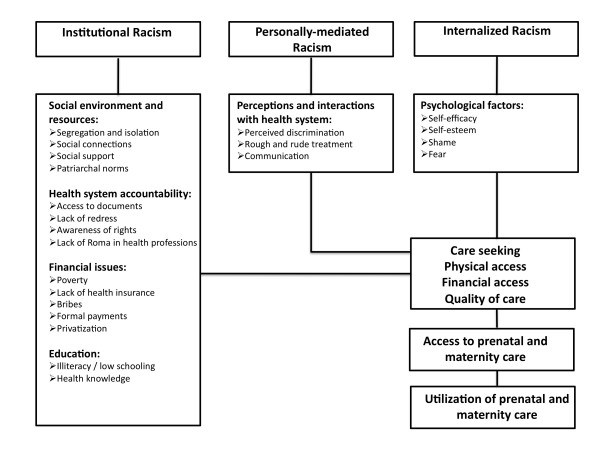
INTRODUCTION: Roma, the largest minority group in Europe, face widespread racism and health disadvantage. Using qualitative data from Serbia and Macedonia, our objective was to develop a conceptual framework showing how three levels of racism--personal, internalized, and institutional--affect access to maternal health care among Romani women. METHODS: Eight focus groups of Romani women aged 14-44 (n = 71), as well as in-depth semi-structured interviews with gynecologists (n = 8) and key informants from NGOs and state institutions (n = 11) were conducted on maternal health care seeking, experiences during care, and perceived health care discrimination. Transcripts were coded, and analyzed using a grounded theory approach. Themes were categorized into domains. RESULTS: Twenty-two emergent themes identified barriers that reflected how racism affects access to maternal health care. The domains into which the themes were classified were perceptions and interactions with health system, psychological factors, social environment and resources, lack of health system accountability, financial needs, and exclusion from education. CONCLUSIONS: The experiences of Romani women demonstrate psychosocial and structural pathways by which racism and discrimination affect access to prenatal and maternity care. Interventions to address maternal health inequalities should target barriers within all three levels of racism.
Overview
The claims and statistics of this paper haven’t been checked yet.
Free: it reads the open-access text and checks the first 5 claims that cite a source we can check. Create a free account to check every claim.
Integrity signals
Registry
Cites
Statistics
Figures
Verification
Claims the paper makes
The claims and statistics of this paper haven’t been checked yet.
Free: it reads the open-access text and checks the first 5 claims that cite a source we can check. Create a free account to check every claim.
Claims other papers make about this one
Each is checked against this paper’s own text: does it say what the citing paper says it does?
The source backs part of the claim, not all of it — or backs it for a different population, condition or comparison.
In the citing paper
“A recent qualitative evidence synthesis [4] and several recent studies [6–11] and reports [12,13] clearly indicate that many women globally experience poor treatment during childbirth, including abusive, neglectful, or disrespectful care.”
From The Mistreatment of Women during Childbirth in Health Facilities Globally: A Mixed-Methods Systematic Review (2015) · cites this paper as [8]
Experimental — accuracy not yet measuredThe source backs part of the claim, not all of it — or backs it for a different population, condition or comparison.
In the citing paper
“Across the world, women who were of lower socioeconomic status reported feeling discriminated against due to their social class or income level.”
From The Mistreatment of Women during Childbirth in Health Facilities Globally: A Mixed-Methods Systematic Review (2015) · cites this paper as [8]
Experimental — accuracy not yet measuredThe source backs part of the claim, not all of it — or backs it for a different population, condition or comparison.
In the citing paper
“Fear of such discrimination was considered a powerful disincentive to deliver in health facilities in Ghana, Sierra Leone, and Tanzania.”
From The Mistreatment of Women during Childbirth in Health Facilities Globally: A Mixed-Methods Systematic Review (2015) · cites this paper as [8]
Experimental — accuracy not yet measuredThe source backs part of the claim, not all of it — or backs it for a different population, condition or comparison.
In the citing paper
“Women frequently referred to long delays in receiving care and inattentive health workers who neglected women during labor and delivery.”
From The Mistreatment of Women during Childbirth in Health Facilities Globally: A Mixed-Methods Systematic Review (2015) · cites this paper as [8]
Experimental — accuracy not yet measuredThe source backs part of the claim, not all of it — or backs it for a different population, condition or comparison.
In the citing paper
“In several settings, women reported the need to pay bribes to different workers throughout health facilities, including to doctors, nurses, midwives, receptionists, and guards.”
From The Mistreatment of Women during Childbirth in Health Facilities Globally: A Mixed-Methods Systematic Review (2015) · cites this paper as [8]
Experimental — accuracy not yet measured
10 more claims about this paper
Create a free account to see every claim other papers make about this one.
Self-check
Percentages, sums and reported differences re-computed from the paper’s own numbers.
The self-check needs the paper’s full text.
Citations
Cites
Qualitative research and evaluation methods
Patton, M. Q. (1980) · Cited by 35,744
Revisiting the Behavioral Model and Access to Medical Care: Does it Matter?
Andersen, R. M. (1995) · Journal of Health and Social Behavior · doi:10.2307/2137284 · Cited by 9,831 · cited 1×
“This framework builds on the traditional supply-demand framework of access to health care [20,21] and Anderson’s model of healthcare utilization [22] by explicitly drawing connections between racism and barriers to access to maternal health care.”
Snowball Sampling: Problems and Techniques of Chain Referral Sampling
Biernacki, P., & Waldorf, D. (1981) · Sociological Methods & Research · doi:10.1177/004912418101000205 · Cited by 5,464
Qualitative Data Analysis for Health Services Research: Developing Taxonomy, Themes, and Theory
Bradley, E. H., Curry, L. A., & Devers, K. J. (2007) · Health Services Research · doi:10.1111/j.1475-6773.2006.00684.x · Cited by 3,437 · cited 1×
“Transcripts were transcribed and translated to English, and then coded and analyzed using the constant comparison method of qualitative data analysis [14,17] to inductively develop emerging themes.”
Self-citationDiscrimination and racial disparities in health: evidence and needed research
Williams, D. R., & Mohammed, S. A. (2009) · Journal of Behavioral Medicine · doi:10.1007/s10865-008-9185-0 · Cited by 3,371 · cited 1×
“Our framework adds to previous work by proposing that an antecedent cause of factors such as low self-esteem and low self-efficacy is internalized attitudes and beliefs due to lifetime prejudicial treatment by society, including the health care system [35].”
Racial Residential Segregation: A Fundamental Cause of Racial Disparities in Health
Williams, D. R., & Collins, C. (2001) · Public Health Reports · doi:10.1093/phr/116.5.404 · Cited by 3,153 · cited 1×
“Examples of those barriers identified in other contexts include segregation, lack of personal documents or health insurance, or education [36,39].”
Levels of racism: a theoretic framework and a gardener's tale
(2000) · American Journal of Public Health · doi:10.2105/ajph.90.8.1212 · Cited by 2,626 · cited 1×
“In the next phase, we placed themes and domains in Jones’ conceptual framework regarding three levels of racism and health [18].”
Physician Communication and Patient Adherence to Treatment: A Meta-Analysis
Haskard Zolnierek, K. B., & DiMatteo, M. R. (2009) · Medical Care · doi:10.1097/mlr.0b013e31819a5acc · Cited by 2,489
Methods For Community - Based Participatory Research For Health
Israel, B. A., & Satcher, D. S. (2013) · Cited by 2,128
Poverty and Access to Health Care in Developing Countries
Peters, D. H., Garg, A., Bloom, G., Walker, D. G., Brieger, W. R., & Hafizur Rahman, M. (2008) · Annals of the New York Academy of Sciences · doi:10.1196/annals.1425.011 · Cited by 1,522 · cited 1×
“This framework builds on the traditional supply-demand framework of access to health care [20,21] and Anderson’s model of healthcare utilization [22] by explicitly drawing connections between racism and barriers to access to maternal health care.”
Cited by
Bohren, M. A., Vogel, J. P., Hunter, E. C., Lutsiv, O., Makh, S. K., Souza, J. P., Aguiar, C., Saraiva Coneglian, F., Diniz, A. L. A., Tunçalp, Ö., et al. (2015) · PLOS Medicine · doi:10.1371/journal.pmed.1001847 · Cited by 1,656
“Women lamented their inability to express their opinions about the treatment and services rendered during childbirth [8,9,13,67,77].”
InfluentialWatson, H. L., & Downe, S. (2017) · Reproductive Health · doi:10.1186/s12978-016-0263-4 · Cited by 225
“Some Romani women reported that medical professionals were unwilling to treat them in medical facilities [58, 59];”
InfluentialBohren, M. A., Vogel, J. P., Tunçalp, Ö., Fawole, B., Titiloye, M. A., Olutayo, A. O., Ogunlade, M., Oyeniran, A. A., Osunsan, O. R., Metiboba, L., et al. (2017) · Reproductive Health · doi:10.1186/s12978-016-0265-2 · Cited by 215
Bohren, M. A., Vogel, J. P., Tunçalp, Ö., Fawole, B., Titiloye, M. A., Olutayọ, A. Ọ., Oyeniran, A. A., Ogunlade, M., Metiboba, L., Osunsan, O. R., et al. (2016) · SSM - Population Health · doi:10.1016/j.ssmph.2016.07.003 · Cited by 181
Savage, V., & Castro, A. (2017) · Reproductive Health · doi:10.1186/s12978-017-0403-5 · Cited by 201
“In-depth qualitative data on perceptions and experiences of mistreatment also provide insight on the complex intersections of inequalities that drive mistreatment and increase some populations’ vulnerability to discriminatory or abusive care [63, 70].”
Influential(2016) · PubMed Central
Hameed, W., & Avan, B. I. (2018) · PLoS ONE · doi:10.1371/journal.pone.0194601 · Cited by 114
González, C. M., Deno, M. L., Kintzer, E., Marantz, P. R., Lypson, M. L., & McKee, M. D. (2018) · Patient Education and Counseling · doi:10.1016/j.pec.2018.05.016 · Cited by 118
Vogel, J. P., Bohren, M. A., Tunçalp, Ö., Oladapo, O. T., Adanu, R., Baldé, M. D., Maung, T. M., Fawole, B., Adu‐Bonsaffoh, K., Dako‐Gyeke, P., et al. (2015) · Reproductive Health · doi:10.1186/s12978-015-0047-2 · Cited by 95
“A number of studies on women’s experiences during childbirth suggest that many women encounter poor treatment, neglect, abuse or disrespect from healthcare providers in facilities [4–16].”
Ou, Z., Yu, D., Liang, Y., He, H., He, W., Li, Y., Zhang, M., Gao, Y., Wu, F., & Chen, Q. (2022) · BMC Public Health · doi:10.1186/s12889-022-12765-1 · Cited by 72
“Adolescent mothers were very common in north Macedonia, who had considerably higher frequencies of perinatal and neonatal disorders [40], and prenatal and maternity care were also influenced by racism and discrimination [41].”
Boro, B., & Saikia, N. (2020) · PLoS ONE · doi:10.1371/journal.pone.0240096 · Cited by 78
Toh, R. K. C., & Shorey, S. (2022) · Women and Birth · doi:10.1016/j.wombi.2022.06.003 · Cited by 59
A critical interpretive synthesis of informal payments in maternal health care
Schaaf, M., & Topp, S. M. (2019) · Health Policy and Planning · doi:10.1093/heapol/czz003 · Cited by 59
“Outcomes include women bypassing facilities known to demand informal payments or avoiding facility-based delivery altogether (Birungi, 1998; McPake et al., 1999; Gilson, 2003; Mamdani and Bangser, 2004; Uslaner, 2004; Tibandebage and Mackintosh, 2005; Mrisho et al., 2007; Otis and Brett, 2008; Kruk et al., 2009; Hunt,…”
Barriers to accessing adequate maternal care in Georgia: a qualitative study
Miteniece, E., Pavlova, M., Shengelia, L., Rechel, B., & Groot, W. N. J. (2018) · BMC Health Services Research · doi:10.1186/s12913-018-3432-z · Cited by 60
“Acceptability can also be influenced by the health care provider, such as when non-acceptance of pregnant women influences care-seeking behaviour and leads to unwillingness to seek care [30].”
Chemaitelly, H., Kanaan, C., Beydoun, H., Chaaya, M., Kanaan, M., & Sibai, A. M. (2013) · Quality of Life Research · doi:10.1007/s11136-012-0273-9 · Cited by 45
“There is some evidence that people with lower economic position have lower access to health care [42], yet this may not explain disparities observed between men and women.”
Miteniece, E., Pavlova, M., Rechel, B., & Groot, W. N. J. (2017) · Social Science & Medicine · doi:10.1016/j.socscimed.2017.01.049 · Cited by 46
“Not being accepted results in an unwillingness to accept the care needed and prolong the delay in seeking maternal care services (Colombini et al., 2012; Janevic et al., 2011).”
InfluentialShibli, H., Aharonson‐Daniel, L., & Feder‐Bubis, P. (2021) · International Journal for Equity in Health · doi:10.1186/s12939-021-01464-9 · Cited by 47
Dynes, M. M., Twentyman, E., Kelly, L., Maro, G., Msuya, A., Dominico, S. A., Chaote, P., Rusibamayila, R., & Serbanescu, F. (2018) · Reproductive Health · doi:10.1186/s12978-018-0486-7 · Cited by 41
Women’s Experiences of Childbirth in Serbian Public Healthcare Institutions: a Qualitative Study
Stanković, B. (2017) · International Journal of Behavioral Medicine · doi:10.1007/s12529-017-9672-1 · Cited by 42
“There is previous evidence suggesting that this category of women is very often a target of discrimination inside the healthcare system, that their access to care is limited and the quality of care is much harder to negotiate [53].”
Aiello, E., Flecha, A., & Serradell, O. (2018) · International Journal of Environmental Research and Public Health · doi:10.3390/ijerph15020377 · Cited by 37
“Janevic, T.; Sripad, P.; Bradley, E.; Dimitrievska, V. ‘There’s no kind of respect here’ A qualitative study of racism and access to maternal health care among Romani women in the Balkans.”
InfluentialBelák, A., Gecková, A. M., van Dijk, J. P., & Reijneveld, S. A. (2018) · International Journal of Public Health · doi:10.1007/s00038-018-1134-2 · Cited by 40
“Recently, several studies qualitatively exploring specific CEE Roma health-related practices have confirmed the expected negative influences of poverty, discrimination and racism (e.g. Andreassen et al. 2017; Janevic et al. 2011; Kelly et al. 2004).”
InfluentialKabakian‐Khasholian, T., Makhoul, J., & Ghusayni, A. (2022) · BMC Pregnancy and Childbirth · doi:10.1186/s12884-022-05083-2 · Cited by 38
Associations between racial discrimination, smoking during pregnancy and low birthweight among Roma
Janevic, T. M., Osypuk, T. L., Stojanovski, K., Janković, J., Gundersen, D. A., & Rogers, M. M. (2017) · European Journal of Public Health · doi:10.1093/eurpub/ckw214 · Cited by 34
Self-citationOgunwole, S. M., Oguntade, H. A., Bower, K. M., Cooper, L. A., & Bennett, W. L. (2023) · International Journal of Environmental Research and Public Health · doi:10.3390/ijerph20136283 · Cited by 34
Shortcomings of Maternity Care in Serbia
Arsenijevic, J., Pavlova, M., & Groot, W. N. J. (2014) · Birth · doi:10.1111/birt.12096 · Cited by 26
“The amount of this fee varies from hospital to hospital (19).”
Belák, A., Bobáková, D. F., Gecková, A. M., van Dijk, J. P., & Reijneveld, S. A. (2019) · Social Science & Medicine · doi:10.1016/j.socscimed.2019.112739 · Cited by 30
Midwives’ knowledge and practice of Respectful Maternity Care: a survey from Iran
Moridi, M., Pazandeh, F., & Potrata, B. (2022) · BMC Pregnancy and Childbirth · doi:10.1186/s12884-022-05065-4 · Cited by 38
“[3, 7] Several qualitative studies have identified potential factors associated with a higher risk of disrespect and abuse from laboring women’s point of view, including race/ethnicity and religion; [8, 9] being young, unmarried woman, [10] high parity [11] and having at-risk pregnancy.”
Yalley, A. A. (2022) · Women · doi:10.3390/women3010002 · Cited by 30
Lived experience of vulnerability from a G ypsy R oma T raveller perspective
Heaslip, V., Hean, S. C. P. D., & Parker, J. (2016) · Journal of Clinical Nursing · doi:10.1111/jocn.13223 · Cited by 31
Socio cultural and geographical determinants of child immunisation in Borno State, Nigeria
Monguno, A. K. (2013) · Journal of Public Health in Africa · doi:10.4081/jphia.2013.e10 · Cited by 21
Janka, E. A., Vincze, F., Ádány, R., & Sándor, J. (2018) · International Journal of Environmental Research and Public Health · doi:10.3390/ijerph15020353 · Cited by 20
Pivetti, M., Melotti, G., & Bonomo, M. (2017) · International Journal of Intercultural Relations · doi:10.1016/j.ijintrel.2017.03.001 · Cited by 19
Pregnancy experiences of women in rural Romania: understanding ethnic and socioeconomic disparities
LeMasters, K. H., Wallis, A. B., Cherecheș, R. M., Gichane, M. W., Tehei, C., Varga, A., & Tumlinson, K. (2018) · Culture Health & Sexuality · doi:10.1080/13691058.2018.1464208 · Cited by 18
“Additionally, when women do not attend recommended care, their communication with providers is minimal, perpetuating this disconnect (Janevic et al. 2011; Watson and Downe 2017; Strickland and Strickland 1996).”
Janevic, T. M., Gundersen, D. A., Stojanovski, K., Janković, J., Nikolic, Z., & Kasapinov, B. (2015) · International Journal of Public Health · doi:10.1007/s00038-015-0712-9 · Cited by 21
Self-citationRoMoMatteR: Empowering Roma Girls’ Mattering through Reproductive Justice
Ramírez, M. G., Soto‐Ponce, B., Marín, M. J. A., Parra‐Casado, D. L., Popova, D., & Tomşa, R. (2020) · International Journal of Environmental Research and Public Health · doi:10.3390/ijerph17228498 · Cited by 27
“In fact, many studies have shown that child motherhood is often associated with emotional stability, purpose, and responsibility as well as a strong sense of belonging to a cultural community [7,18,19].”
González, C. M., Grochowalski, J. H., Garba, R., Bonner, S., & Marantz, P. R. (2021) · BMC Medical Education · doi:10.1186/s12909-021-02640-9 · Cited by 17
Loohuis, K. M. O., de Kok, B. C., Bruner, W. S., Jonker, A., Salia, E. L., Tunçalp, Ö., Portela, A. G., Mehrtash, H., Grobbee, D. E., Srofeneyoh, E., et al. (2023) · PLOS Global Public Health · doi:10.1371/journal.pgph.0002449 · Cited by 33
Chauhan, A., de Wildt, G., Virmond, M., Kyte, D. G., Galan, N. G. D. A., Prado, R. B. R., & Shyam-Sundar, V. (2018) · Ethnicity and Health · doi:10.1080/13557858.2018.1431206 · Cited by 16
“…with some showing the black racial group, in particular, to be disadvantaged (Murrell et al. 1996; Boyer-Chammard, Taylor, and Anton-Culver 1999; Janevic et al. 2011; MacDorman and Mathews 2011; Souza de Bairros et al. 2011; Quach et al. 2012; Trad, Castellanos, and Guimaraes 2012; Emmanuelli…”
Antenatal characteristics of Roma female population in Virovitica-Podravina County, Croatia
Šegregur, J., & Šegregur, D. (2016) · Slovenian Journal of Public Health · doi:10.1515/sjph-2017-0007 · Cited by 16
“Newer data indicates that 9% of Roma women in Serbia, compared to 1% in the overall population, and 21% in Macedonia, compared to 2% in the overall population, did not attend any prenatal care visits (34).”
An Assessment of Romani Women’s Autonomy and Timing of Pregnancy in Serbia and Macedonia
Stojanovski, K., Janevic, T. M., Kasapinov, B., Stamenković, Ž., & Janković, J. (2017) · Maternal and Child Health Journal · doi:10.1007/s10995-017-2292-1 · Cited by 14
Self-citationObstetric violence in the context of community violence: The case of Mexico
Torrisi, O., Svallfors, S., & Gargiulo, M. (2024) · Social Science & Medicine · doi:10.1016/j.socscimed.2024.117348 · Cited by 15
Malatzky, C. A. R., Shaburdin, Z. M., & Bourke, L. (2020) · Nursing Open · doi:10.1002/nop2.457 · Cited by 13
Informal Payments and Health System Governance in Serbia: A Pilot Study
Mejsner, S. B., & Karlsson, L. E. (2017) · SAGE Open · doi:10.1177/2158244017728322 · Cited by 11
“Lewis (2007) and Gaal and McKee (2005) emphasized that informal payments are symptoms of poor management, underfunding, poor control in health care, lack of accountability, and deficits in rule of law, that is, poor governance.”
Xin, J., Luo, Y., Xiang, W., Zhu, S., Niu, H., Feng, J., Sun, L., Zhang, B., Zhou, X., & Yang, W. (2024) · Frontiers in Public Health · doi:10.3389/fpubh.2023.1282451 · Cited by 10
Belák, A., van Dijk, J. P., & Reijneveld, S. A. (2024) · Social Science & Medicine · doi:10.1016/j.socscimed.2024.117322 · Cited by 11
Winkler, C., & Babac, E. (2022) · Österreichische Zeitschrift für Soziologie · doi:10.1007/s11614-022-00472-5 · Cited by 18
“…über den kulturellen Hintergrund (z.B. Garnweidner-Holme et al. 2017; Firdous et al. 2020), rassistische Erfahrungen (z.B. Bollini et al. 2007; Janevic et al. 2011) und respektloses, ignorierendes und verunsicherndes Verhalten der Fachkräfte den Frauen* gegenüber (z.B. Robertson 2015; Fair et…”
Stojanovski, K., Holla, A., Hoxha, I. S., Howell, E. A., & Janevic, T. M. (2017) · PubMed Central · Cited by 13
Self-citationExperiences and constructions of womanhood and motherhood among Spanish Roma women
Herrero‐Arias, R., Parra‐Casado, D. L., Ferrer, A. F., Sanchís-Ramón, M.-J., & Ortiz-Barreda, G. M. (2023) · European Journal of Women s Studies · doi:10.1177/13505068231152699 · Cited by 8
“At the same time, researchers have suggested that motherhood among Roma girls can be understood as linked to a desire to be valued and accepted by members of their community (Elliot et al., 2004; Janevic et al., 2011).”
On Living And Moving With Zor: Exploring Racism, Embodiment, And Health In Albania
Ohueri, C. W. (2020) · Medical Anthropology · doi:10.1080/01459740.2020.1807539 · Cited by 8
McFadden, A., Siebelt, L., Jackson, C., Jones, H., Innes, N., MacGillivray, S. A., Bell, K. J., Corbacho, B., Gavine, A. J., Haggi, H., et al. (2018) · Discovery Research Portal (University of Dundee) · doi:10.20933/100001117 · Cited by 7
“Gender inequality may also impact women’s ability to attend to their own health needs; Romani culture was described as patriarchal (76).”
InfluentialLow levels of modern contraceptive use and associated factors in the Western Balkans
King, E. J., Stojanovski, K., & Acosta, J. (2018) · The European Journal of Contraception & Reproductive Health Care · doi:10.1080/13625187.2018.1493100 · Cited by 6
O'Brien, M. A., Dempsey, B., & Higgins, M. (2024) · International Journal of Gynecology & Obstetrics · doi:10.1002/ijgo.15723 · Cited by 5
“18 Institutional racism is suggested to contribute to adverse birth outcomes.”
Understanding a Minority Group's (Roma) Experiences of Access and Quality in Maternity Services
Dullat, J. K., McDonnell, T., Hendrick, L., McMahon, L., Moore, G., Murphy, E., Nae, C., Nae, D., Prontera, M., & McAuliffe, É. (2025) · Health Expectations · doi:10.1111/hex.70389 · Cited by 5
Mózes, N., Takács, J., Ungvari, Z. I., & Feith, H. J. (2023) · Frontiers in Public Health · doi:10.3389/fpubh.2023.1292598 · Cited by 4
Eastern European Roma: ethnic discrimination in the public healthcare system
Muncan, B. (2018) · Journal of Global Health Reports · doi:10.29392/joghr.2.e2018025 · Cited by 6
“One multinational study has found that pregnant Romani women were unaware of their rights to care, and therefore had a higher rate of peripartum complications compared to non-Roma counterparts (7).”
Identity of Roma women and processes of international and transitional justice
Gómez, A. M. J. (2021) · The Age of Human Rights Journal · doi:10.17561/tahrj.v17.6385 · Cited by 4
Kumari, N., Saikia, N., & Subramanian, S. V. (2023) · GeroScience · doi:10.1007/s11357-023-00736-2 · Cited by 6
“…of health care utilization is relatively lower in the tribal population due to low economic status, poor quality of care at the government health facilities, higher dependence on the traditional medicines, poor health facility infrastructure, and inadequate public transport and communication [25].”
Obstetric Violence & Colonial Conditioning in South Africa's Reproductive Health System
Rucell, J. (2017) · White Rose eTheses Online (University of Leeds, The University of Sheffield, University of York) · Cited by 18
Belák, A. (2019) · University of Groningen research database (University of Groningen / Centre for Information Technology) · doi:10.33612/diss.96871255 · Cited by 5
“Recently, several studies qualitatively exploring specific CEE Roma health-related practices have confirmed the expected negative influences of poverty, discrimination and racism (e.g. Andreassen et al. 2017; Janevic et al. 2011; Kelly et al. 2004).”
InfluentialDiscrimination as A Barrier to Romani Women’s Health and Empowerment: A Qualitative Study
Ramirez, L. S. (2021) · Social Work in Public Health · doi:10.1080/19371918.2021.1935386 · Cited by 4
Mózes, N., & Feith, H. J. (2023) · Orvosi Hetilap · doi:10.1556/650.2023.32842 · Cited by 5
The Differential Impact of Religion on Self-Reported Health Among Serbian Roma Women
Čvorović, J. (2019) · Journal of Religion and Health · doi:10.1007/s10943-019-00824-8 · Cited by 5
Barriers and trust: Perceptions of the healthcare system among Roma mothers in Serbia
Pantović, L., & Djordjević, I. (2024) · Glasnik Etnografskog instituta · doi:10.2298/gei2403011p · Cited by 2
FemTech markets: Building financialised consumer access to healthcare technologies
Zokaityte, A. (2025) · Oñati Socio-legal Series · doi:10.35295/osls.iisl.2191 · Cited by 4
Chowdhury, S. K. (2023) · PLoS ONE · doi:10.1371/journal.pone.0294710 · Cited by 6
Social Protection in Health Care and Vulnerable Population Groups in Serbia
Arsenijevic, J., Pavlova, M., & Groot, W. N. J. (2015) · Frontiers in Public Health · doi:10.3389/fpubh.2015.00194 · Cited by 6
Kalu, K. U., Onyeonoro, U. U., Nwamoh, U. N., & Amuzie, C. I. (2022) · Ghana Medical Journal · doi:10.4314/gmj.v56i2.8 · Cited by 2
Containment - An examination of Roma health mediation in Romania
Kühlbrandt, C. (2018) · LSHTM Research Online (London School of Hygiene and Tropical Medicine) · doi:10.17037/pubs.04645511 · Cited by 3
“…Rechel, and Mayhew 2012; Fésüs 2012) and inequalities (Földes and Covaci 2012; Mladovsky 2007; Rosicova et al. 2015) experienced by Roma, as well as their social exclusion and marginalisation (Janevic et al. 2011; Fésüs et al. 2012; Silarova et al. 2014; Duval et al. 2016; Belak et al. 2017).”
Access to adequate maternal care in Eastern Europe
Miteniece, E. (2021) · Research Publications (Maastricht University) · doi:10.26481/dis.20211019em · Cited by 3
Health Inequities of Silent Roma Ranks from a Social Justice Perspective
Miranda, D. E., Escobar-Ballesta, M., Trigueros, E. V., Marín, M. J. A., & Ramı́rez, M. G. (2022) · Springer eBooks · doi:10.1007/978-3-030-71190-0_19 · Cited by 1
Busetta, A., Puglisi, C., & Cetorelli, V. (2024) · Journal of Ethnic and Migration Studies · doi:10.1080/1369183x.2024.2393668 · Cited by 1
“…institutions, as reported by the patients themselves as well as by NGOs and policy experts, with some Roma women in the Balkans having reported feeling partially responsible for how they are mistreated by medical staff, blaming their own appearance and hygienical conditions (Janevic et al. 2011).”
InfluentialOdnos Rominj do reproduktivnega zdravja in do stika z ginekološkimi zdravstvenimi službami
Čuček, M. L. (2020) · Slovenian Nursing Review · doi:10.14528/snr.2020.54.4.3043 · Cited by 1
Maternal Health Care Services in Zhejiang Province, China: From 1998 to 2010
Zou, C., Wang, X., & Ye, Z. H. (2014)
Trust in Maternity Care: A Contextual Exploration of Meaning and Determinants in Peri-Urban Kenya
Sripad, P. (2015) · Cited by 1
Self-citationVivaldi, E. (2018) · Bucks New University Repository (Bucks New University)
Tseng, Y.-H., Li, Y.-L., Luu, S., & Luh, D. (2022) · International Journal of Environmental Research and Public Health · doi:10.3390/ijerph19042171
“In Janevic’s study, women hesitated to seek care because they did not feel they were being treated respectfully and thought they were discriminated against [27].”
Evaluation of gender perceptions and self-efficacy levels of the Roma people living in Turkey
Gözüyeşil, E., & Manav, A. İ. (2022) · Türkiye Halk Sağlığı Dergisi · doi:10.20518/tjph.933818
Zdravstveno stanje romskih žensk in njihovo sodelovanje v preventivnih programih ZORA in DORA
Zelko, E. (2022) · Anali PAZU · doi:10.18690/analipazu.6.1-2.30-36.2016
“Dostopnost zdravstvenih ustanov in obravnava Romov v njih pa nista bili izpostavljeni negativno (28, 29), kot so to opisovale Rominje zajete v kvalitativno raziskavo Janevica s sodelavci (30).”
Giving birth is like going to war: Obstetric violence in public maternity centers in NigerPreprint
Alio, A. P., Garba, R. M., Mittal, M., McCormick, A. P., & Moha, M. (2023) · medRxiv · doi:10.1101/2023.06.26.23291780 · Cited by 1
Framework for action – Handlungs-optionen nach dem (Mit-)Erleben geburtshilflicher Gewalt
Schöne, B. (2023) · Hebamme · doi:10.1055/a-2106-6095
“Im europäischen Kontext gibt es eine wachsende Zahl an Veröffentlichungen, welche einen teils respektlosen sowie gewaltsamen Umgang mit Gebärenden thematisieren [20, 21, 23, 24, 26, 28, 29].”
HALİDİ, E., & Süt, H. K. (2024) · International Journal of Health Services Research and Policy · doi:10.33457/ijhsrp.1404851
Gómez, A. M. J. (2024) · Revista de la Facultad de Derecho y Ciencias Políticas · doi:10.18566/rfdcp.v54n141.a13
Christopoulou, C. P., Diamanti, A., Δελτσίδου, Ά., GEORGAKOPOULOU, V. E., Bakou, A., & Vivilaki, V. G. (2025) · Tobacco Prevention & Cessation · doi:10.18332/tpc/196352
“The reliance on self-reported data for smoking status and cessation efforts introduces the possibility of recall bias and social desirability bias, as participants might underreport their smoking status or overstate their cessation efforts, especially in an interview setting.”
Stanković, B. (2024) · Springer eBooks · doi:10.1007/978-3-031-77236-8_1
González, C. M., Dennehy, J., Wilkerson, R., Ravenell, J. E., Williams, R., & Greene, R. E. (2025) · Patient Education and Counseling · doi:10.1016/j.pec.2025.109335
Alio, A. P., Garba, R. M., Mittal, M., McCormick, A. P., & Mahamane, M. (2025) · Violence Against Women · doi:10.1177/10778012251397983 · Cited by 3
“…system mismanagement and inadequate systems of accountability may lead to staf fi ng shortage and situations in which women can be extorted or compelled to pay medical fees or bribes in order to receive services (Gao et al., 2010; Janevic et al., 2011; McMahon et al., 2014; Savage & Castro, 2017).”
Gonzalez, C. M., Grochowalski, J. H., Garba, R., Bonner, S., & Marantz, P. R. (2021) · Figshare · doi:10.6084/m9.figshare.14404016
Kabakian‐Khasholian, T., Makhoul, J., & Ghusayni, A. (2022) · Figshare · doi:10.6084/m9.figshare.21285729
Kabakian‐Khasholian, T., Makhoul, J., & Ghusayni, A. (2022) · Figshare · doi:10.6084/m9.figshare.21285726
Evaluation of gender perceptions and self-efficacy levels of the Roma people living in Turkey
Gözüyeşil, E., & Manav, A. İ. (2021) · DergiPark (Istanbul University)
Woolrych, R., Marinov, A., Sixsmith, J., Greenfields, M., Cisneros, R. E. K., Torak, P., Hyde, A., Morteanu, C., & Smolinska-Poffley, G. (2026) · Journal of Cross-Cultural Gerontology · doi:10.1007/s10823-026-09561-4
“We also contribute to the literature on the spatialised nature of healthcare exclusion (Janevic et al., 2011; McFadden et al., 2018).”
IVF/ICSI Outcomes in Roma Women: First Evidence from a Tertiary Fertility Center
Mitić, D., Pop-Trajković, S., Bašić, M., Petrić, A., Milošević-Stevanović, J. D., Vukomanović, P., & Stanojević, M. (2026) · Reproductive Medicine · doi:10.3390/reprodmed7020026
“Qualitative work by Janevic et al. in the Balkans documented that Roma women experienced overt racism and disre-spect in healthcare encounters, which contributed to avoidance of preventive and specialist services [26,27].”
Luoga, P., Xia, Y., & Huang, J. (2026) · Reproductive Health · doi:10.1186/s12978-026-02426-6
Vox populi: Roma perspectives on empowerment in social work practice
Šolcová, J., Kozubík, M., Hricová, A., Hanková, M., & Tokovská, M. (2026) · Social Sciences & Humanities Open · doi:10.1016/j.ssaho.2026.103763
Pesántez, M. D. L. Á. E. (2026) · Journal of Racial and Ethnic Health Disparities · doi:10.1007/s40615-026-03199-1
Metadata
- Authors
- Janevic, T., Sripad, P., Bradley, E., & Dimitrievska, V.
- Affiliations
- University of Groningen (NL)
- Corresponding author
- Janevic, Teresa
- Venue
- International Journal for Equity in Health
- Published
- 2011
- Volume
- 10
- Issue
- 1
- Pages
- 53
- ISSN
- 1475-9276 (ISSN-L)
- PMC
- PMC3226439
- OpenAlex
- W2009535222
- Cited by
- 98
- References
- 43
- Citations by year
- 2026: 5 · 2025: 5 · 2024: 10 · 2023: 10 · 2022: 13 · 2021: 7 · 2020: 5 · 2019: 4 · 2018: 15 · 2017: 10 · 2016: 5 · 2015: 5 · 2014: 2 · 2013: 1 · 2012: 1
- FWCI
- 2.38
- Type
- journal article
- Language
- en
- Open access
- gold
- doi.org
- Licence
- cc-by
- Locations
- International Journal for Equity in Health (publishedVersion, cc-by)
- PubMed Central (publishedVersion, cc-by)
- PubMed (publishedVersion)
- University of Groningen research database (University of Groningen / Centre for Information Technology) (publishedVersion, cc-by)
- DOAJ (DOAJ: Directory of Open Access Journals) (submittedVersion)
- University of Groningen research database (University of Groningen / Centre for Information Technology) (submittedVersion, cc-by)
- Topics
- Social Sciences › Sociology and Political Science › Romani and Gypsy Studies
- Social Sciences › Sociology and Political Science › Gender, Health, and Social Inequality
- Social Sciences › Sociology and Political Science › Racial and Ethnic Identity Research
- Keywords
- racism, Roma women, maternal care, health care access, health care discrimination, internalized racism, institutional racism, prenatal care, obstetric care, health disparities, minority health, Serbia, North Macedonia, barriers to care
About these checks
Registry, retraction, Cites and statistics results are computed, not judged, with one exception: a printed reference that no index lists is read once by a model before it counts as a citation error. Claims are extracted by a model and kept only when their quote appears verbatim in the text; each cited source is then checked, with a model’s help, for whether it says what the claim relies on. Those verdicts can be wrong — read the claim’s quote and the cited source before relying on one.
Statistics and arithmetic are recomputed, not judged.
Confidence bands are shown only for fields calibrated on our annotated test set. None is calibrated yet, so no band is shown.
What counts as a claim ›How we measure confidence ›How we check this ›
Are you an author, or do you see a problem with this page? Request a review
Data sources
Bibliographic data: Semantic Scholar, OpenAlex, Crossref.
Contains information from the Semantic Scholar Academic Graph Datasets, made available under the ODC Attribution License (ODC-BY 1.0).
Semantic Scholar’s data is described in: Kinney, R., et al. (2023). The Semantic Scholar Open Data Platform. arXiv:2301.10140.
