

“There’s no kind of respect here”. A qualitative study of racism and access to maternal health care among Romani women in the Balkans
Open accessThe DOI matches its Crossref record; 42 of the 43 references it cites were found in a registry or an index.
Abstract
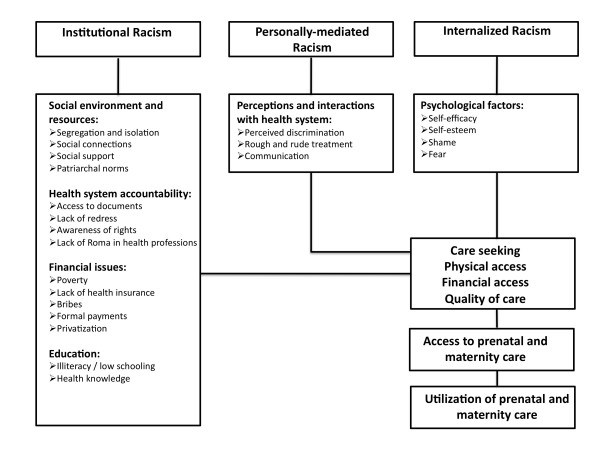
INTRODUCTION: Roma, the largest minority group in Europe, face widespread racism and health disadvantage. Using qualitative data from Serbia and Macedonia, our objective was to develop a conceptual framework showing how three levels of racism--personal, internalized, and institutional--affect access to maternal health care among Romani women. METHODS: Eight focus groups of Romani women aged 14-44 (n = 71), as well as in-depth semi-structured interviews with gynecologists (n = 8) and key informants from NGOs and state institutions (n = 11) were conducted on maternal health care seeking, experiences during care, and perceived health care discrimination. Transcripts were coded, and analyzed using a grounded theory approach. Themes were categorized into domains. RESULTS: Twenty-two emergent themes identified barriers that reflected how racism affects access to maternal health care. The domains into which the themes were classified were perceptions and interactions with health system, psychological factors, social environment and resources, lack of health system accountability, financial needs, and exclusion from education. CONCLUSIONS: The experiences of Romani women demonstrate psychosocial and structural pathways by which racism and discrimination affect access to prenatal and maternity care. Interventions to address maternal health inequalities should target barriers within all three levels of racism.
Overview
The claims and statistics of this paper haven’t been checked yet.
Free: it reads the open-access text and checks the first 5 claims that cite a source we can check. Create a free account to check every claim.
Integrity signals
Registry
Cites
Statistics
Figures
Verification
Claims the paper makes
The claims and statistics of this paper haven’t been checked yet.
Free: it reads the open-access text and checks the first 5 claims that cite a source we can check. Create a free account to check every claim.
Claims other papers make about this one
Each is checked against this paper’s own text: does it say what the citing paper says it does?
The source backs part of the claim, not all of it — or backs it for a different population, condition or comparison.
In the citing paper
“A recent qualitative evidence synthesis [4] and several recent studies [6–11] and reports [12,13] clearly indicate that many women globally experience poor treatment during childbirth, including abusive, neglectful, or disrespectful care.”
From The Mistreatment of Women during Childbirth in Health Facilities Globally: A Mixed-Methods Systematic Review (2015) · cites this paper as [8]
Experimental — accuracy not yet measuredThe source backs part of the claim, not all of it — or backs it for a different population, condition or comparison.
In the citing paper
“Across the world, women who were of lower socioeconomic status reported feeling discriminated against due to their social class or income level.”
From The Mistreatment of Women during Childbirth in Health Facilities Globally: A Mixed-Methods Systematic Review (2015) · cites this paper as [8]
Experimental — accuracy not yet measuredThe source backs part of the claim, not all of it — or backs it for a different population, condition or comparison.
In the citing paper
“Fear of such discrimination was considered a powerful disincentive to deliver in health facilities in Ghana, Sierra Leone, and Tanzania.”
From The Mistreatment of Women during Childbirth in Health Facilities Globally: A Mixed-Methods Systematic Review (2015) · cites this paper as [8]
Experimental — accuracy not yet measuredThe source backs part of the claim, not all of it — or backs it for a different population, condition or comparison.
In the citing paper
“Women frequently referred to long delays in receiving care and inattentive health workers who neglected women during labor and delivery.”
From The Mistreatment of Women during Childbirth in Health Facilities Globally: A Mixed-Methods Systematic Review (2015) · cites this paper as [8]
Experimental — accuracy not yet measuredThe source backs part of the claim, not all of it — or backs it for a different population, condition or comparison.
In the citing paper
“In several settings, women reported the need to pay bribes to different workers throughout health facilities, including to doctors, nurses, midwives, receptionists, and guards.”
From The Mistreatment of Women during Childbirth in Health Facilities Globally: A Mixed-Methods Systematic Review (2015) · cites this paper as [8]
Experimental — accuracy not yet measured
10 more claims about this paper
Create a free account to see every claim other papers make about this one.
Self-check
Percentages, sums and reported differences re-computed from the paper’s own numbers.
The self-check needs the paper’s full text.
Citations
Cites
Qualitative research and evaluation methods
Patton, M. Q. (1980) · Cited by 35,744
Revisiting the Behavioral Model and Access to Medical Care: Does it Matter?
Andersen, R. M. (1995) · Journal of Health and Social Behavior · doi:10.2307/2137284 · Cited by 9,831 · cited 1×
“This framework builds on the traditional supply-demand framework of access to health care [20,21] and Anderson’s model of healthcare utilization [22] by explicitly drawing connections between racism and barriers to access to maternal health care.”
Snowball Sampling: Problems and Techniques of Chain Referral Sampling
Biernacki, P., & Waldorf, D. (1981) · Sociological Methods & Research · doi:10.1177/004912418101000205 · Cited by 5,464
Qualitative Data Analysis for Health Services Research: Developing Taxonomy, Themes, and Theory
Bradley, E. H., Curry, L. A., & Devers, K. J. (2007) · Health Services Research · doi:10.1111/j.1475-6773.2006.00684.x · Cited by 3,437 · cited 1×
“Transcripts were transcribed and translated to English, and then coded and analyzed using the constant comparison method of qualitative data analysis [14,17] to inductively develop emerging themes.”
Self-citationDiscrimination and racial disparities in health: evidence and needed research
Williams, D. R., & Mohammed, S. A. (2009) · Journal of Behavioral Medicine · doi:10.1007/s10865-008-9185-0 · Cited by 3,371 · cited 1×
“Our framework adds to previous work by proposing that an antecedent cause of factors such as low self-esteem and low self-efficacy is internalized attitudes and beliefs due to lifetime prejudicial treatment by society, including the health care system [35].”
Racial Residential Segregation: A Fundamental Cause of Racial Disparities in Health
Williams, D. R., & Collins, C. (2001) · Public Health Reports · doi:10.1093/phr/116.5.404 · Cited by 3,153 · cited 1×
“Examples of those barriers identified in other contexts include segregation, lack of personal documents or health insurance, or education [36,39].”
Levels of racism: a theoretic framework and a gardener's tale
(2000) · American Journal of Public Health · doi:10.2105/ajph.90.8.1212 · Cited by 2,626 · cited 1×
“In the next phase, we placed themes and domains in Jones’ conceptual framework regarding three levels of racism and health [18].”
Physician Communication and Patient Adherence to Treatment: A Meta-Analysis
Haskard Zolnierek, K. B., & DiMatteo, M. R. (2009) · Medical Care · doi:10.1097/mlr.0b013e31819a5acc · Cited by 2,489
Methods For Community - Based Participatory Research For Health
Israel, B. A., & Satcher, D. S. (2013) · Cited by 2,128
Poverty and Access to Health Care in Developing Countries
Peters, D. H., Garg, A., Bloom, G., Walker, D. G., Brieger, W. R., & Hafizur Rahman, M. (2008) · Annals of the New York Academy of Sciences · doi:10.1196/annals.1425.011 · Cited by 1,522 · cited 1×
“This framework builds on the traditional supply-demand framework of access to health care [20,21] and Anderson’s model of healthcare utilization [22] by explicitly drawing connections between racism and barriers to access to maternal health care.”
Cited by
Bohren, M. A., Vogel, J. P., Hunter, E. C., Lutsiv, O., Makh, S. K., Souza, J. P., Aguiar, C., Saraiva Coneglian, F., Diniz, A. L. A., Tunçalp, Ö., et al. (2015) · PLOS Medicine · doi:10.1371/journal.pmed.1001847 · Cited by 1,656
“Women lamented their inability to express their opinions about the treatment and services rendered during childbirth [8,9,13,67,77].”
InfluentialWatson, H. L., & Downe, S. (2017) · Reproductive Health · doi:10.1186/s12978-016-0263-4 · Cited by 225
“Some Romani women reported that medical professionals were unwilling to treat them in medical facilities [58, 59];”
InfluentialBohren, M. A., Vogel, J. P., Tunçalp, Ö., Fawole, B., Titiloye, M. A., Olutayo, A. O., Ogunlade, M., Oyeniran, A. A., Osunsan, O. R., Metiboba, L., et al. (2017) · Reproductive Health · doi:10.1186/s12978-016-0265-2 · Cited by 215
Bohren, M. A., Vogel, J. P., Tunçalp, Ö., Fawole, B., Titiloye, M. A., Olutayọ, A. Ọ., Oyeniran, A. A., Ogunlade, M., Metiboba, L., Osunsan, O. R., et al. (2016) · SSM - Population Health · doi:10.1016/j.ssmph.2016.07.003 · Cited by 181
Savage, V., & Castro, A. (2017) · Reproductive Health · doi:10.1186/s12978-017-0403-5 · Cited by 201
“In-depth qualitative data on perceptions and experiences of mistreatment also provide insight on the complex intersections of inequalities that drive mistreatment and increase some populations’ vulnerability to discriminatory or abusive care [63, 70].”
Influential
Metadata
- Authors
- Janevic, T., Sripad, P., Bradley, E., & Dimitrievska, V.
- Affiliations
- University of Groningen (NL)
- Corresponding author
- Janevic, Teresa
- Venue
- International Journal for Equity in Health
- Published
- 2011
- Volume
- 10
- Issue
- 1
- Pages
- 53
- ISSN
- 1475-9276 (ISSN-L)
- PMC
- PMC3226439
- OpenAlex
- W2009535222
- Cited by
- 98
- References
- 43
- Citations by year
- 2026: 5 · 2025: 5 · 2024: 10 · 2023: 10 · 2022: 13 · 2021: 7 · 2020: 5 · 2019: 4 · 2018: 15 · 2017: 10 · 2016: 5 · 2015: 5 · 2014: 2 · 2013: 1 · 2012: 1
- FWCI
- 2.38
- Type
- journal article
- Language
- en
- Open access
- gold
- doi.org
- Licence
- cc-by
- Locations
- International Journal for Equity in Health (publishedVersion, cc-by)
- PubMed Central (publishedVersion, cc-by)
- PubMed (publishedVersion)
- University of Groningen research database (University of Groningen / Centre for Information Technology) (publishedVersion, cc-by)
- DOAJ (DOAJ: Directory of Open Access Journals) (submittedVersion)
- University of Groningen research database (University of Groningen / Centre for Information Technology) (submittedVersion, cc-by)
- Topics
- Social Sciences › Sociology and Political Science › Romani and Gypsy Studies
- Social Sciences › Sociology and Political Science › Gender, Health, and Social Inequality
- Social Sciences › Sociology and Political Science › Racial and Ethnic Identity Research
- Keywords
- racism, Roma women, maternal care, health care access, health care discrimination, internalized racism, institutional racism, prenatal care, obstetric care, health disparities, minority health, Serbia, North Macedonia, barriers to care
About these checks
Registry, retraction, Cites and statistics results are computed, not judged, with one exception: a printed reference that no index lists is read once by a model before it counts as a citation error. Claims are extracted by a model and kept only when their quote appears verbatim in the text; each cited source is then checked, with a model’s help, for whether it says what the claim relies on. Those verdicts can be wrong — read the claim’s quote and the cited source before relying on one.
Statistics and arithmetic are recomputed, not judged.
Confidence bands are shown only for fields calibrated on our annotated test set. None is calibrated yet, so no band is shown.
What counts as a claim ›How we measure confidence ›How we check this ›
Are you an author, or do you see a problem with this page? Request a review
Data sources
Bibliographic data: Semantic Scholar, OpenAlex, Crossref.
Contains information from the Semantic Scholar Academic Graph Datasets, made available under the ODC Attribution License (ODC-BY 1.0).
Semantic Scholar’s data is described in: Kinney, R., et al. (2023). The Semantic Scholar Open Data Platform. arXiv:2301.10140.
