

“There’s no kind of respect here”. A qualitative study of racism and access to maternal health care among Romani women in the Balkans
Open accessThe DOI matches its Crossref record; 42 of the 43 references it cites were found in a registry or an index.
Abstract
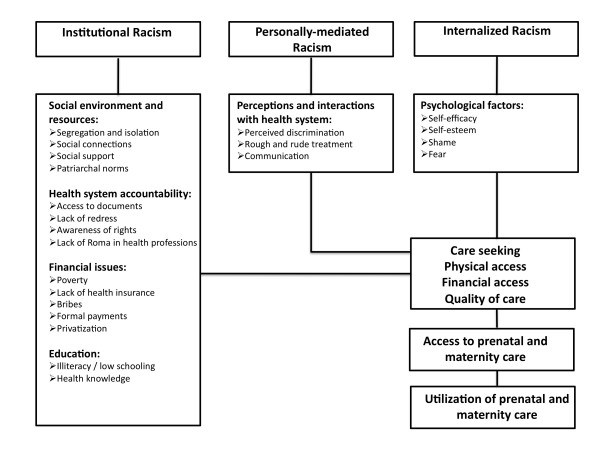
INTRODUCTION: Roma, the largest minority group in Europe, face widespread racism and health disadvantage. Using qualitative data from Serbia and Macedonia, our objective was to develop a conceptual framework showing how three levels of racism--personal, internalized, and institutional--affect access to maternal health care among Romani women. METHODS: Eight focus groups of Romani women aged 14-44 (n = 71), as well as in-depth semi-structured interviews with gynecologists (n = 8) and key informants from NGOs and state institutions (n = 11) were conducted on maternal health care seeking, experiences during care, and perceived health care discrimination. Transcripts were coded, and analyzed using a grounded theory approach. Themes were categorized into domains. RESULTS: Twenty-two emergent themes identified barriers that reflected how racism affects access to maternal health care. The domains into which the themes were classified were perceptions and interactions with health system, psychological factors, social environment and resources, lack of health system accountability, financial needs, and exclusion from education. CONCLUSIONS: The experiences of Romani women demonstrate psychosocial and structural pathways by which racism and discrimination affect access to prenatal and maternity care. Interventions to address maternal health inequalities should target barriers within all three levels of racism.
Overview
The claims and statistics of this paper haven’t been checked yet.
Free: it reads the open-access text and checks the first 5 claims that cite a source we can check. Create a free account to check every claim.
Integrity signals
Registry
Cites
Statistics
Figures
Verification
Claims the paper makes
The claims and statistics of this paper haven’t been checked yet.
Free: it reads the open-access text and checks the first 5 claims that cite a source we can check. Create a free account to check every claim.
Claims other papers make about this one
Each is checked against this paper’s own text: does it say what the citing paper says it does?
The source backs part of the claim, not all of it — or backs it for a different population, condition or comparison.
In the citing paper
“A recent qualitative evidence synthesis [4] and several recent studies [6–11] and reports [12,13] clearly indicate that many women globally experience poor treatment during childbirth, including abusive, neglectful, or disrespectful care.”
From The Mistreatment of Women during Childbirth in Health Facilities Globally: A Mixed-Methods Systematic Review (2015) · cites this paper as [8]
Experimental — accuracy not yet measuredThe source backs part of the claim, not all of it — or backs it for a different population, condition or comparison.
In the citing paper
“Across the world, women who were of lower socioeconomic status reported feeling discriminated against due to their social class or income level.”
From The Mistreatment of Women during Childbirth in Health Facilities Globally: A Mixed-Methods Systematic Review (2015) · cites this paper as [8]
Experimental — accuracy not yet measuredThe source backs part of the claim, not all of it — or backs it for a different population, condition or comparison.
In the citing paper
“Fear of such discrimination was considered a powerful disincentive to deliver in health facilities in Ghana, Sierra Leone, and Tanzania.”
From The Mistreatment of Women during Childbirth in Health Facilities Globally: A Mixed-Methods Systematic Review (2015) · cites this paper as [8]
Experimental — accuracy not yet measuredThe source backs part of the claim, not all of it — or backs it for a different population, condition or comparison.
In the citing paper
“Women frequently referred to long delays in receiving care and inattentive health workers who neglected women during labor and delivery.”
From The Mistreatment of Women during Childbirth in Health Facilities Globally: A Mixed-Methods Systematic Review (2015) · cites this paper as [8]
Experimental — accuracy not yet measuredThe source backs part of the claim, not all of it — or backs it for a different population, condition or comparison.
In the citing paper
“In several settings, women reported the need to pay bribes to different workers throughout health facilities, including to doctors, nurses, midwives, receptionists, and guards.”
From The Mistreatment of Women during Childbirth in Health Facilities Globally: A Mixed-Methods Systematic Review (2015) · cites this paper as [8]
Experimental — accuracy not yet measured
10 more claims about this paper
Create a free account to see every claim other papers make about this one.
Self-check
Percentages, sums and reported differences re-computed from the paper’s own numbers.
The self-check needs the paper’s full text.
Citations
Cites
Qualitative research and evaluation methods
Patton, M. Q. (1980) · Cited by 35,744
Revisiting the Behavioral Model and Access to Medical Care: Does it Matter?
Andersen, R. M. (1995) · Journal of Health and Social Behavior · doi:10.2307/2137284 · Cited by 9,831 · cited 1×
“This framework builds on the traditional supply-demand framework of access to health care [20,21] and Anderson’s model of healthcare utilization [22] by explicitly drawing connections between racism and barriers to access to maternal health care.”
Snowball Sampling: Problems and Techniques of Chain Referral Sampling
Biernacki, P., & Waldorf, D. (1981) · Sociological Methods & Research · doi:10.1177/004912418101000205 · Cited by 5,464
Qualitative Data Analysis for Health Services Research: Developing Taxonomy, Themes, and Theory
Bradley, E. H., Curry, L. A., & Devers, K. J. (2007) · Health Services Research · doi:10.1111/j.1475-6773.2006.00684.x · Cited by 3,437 · cited 1×
“Transcripts were transcribed and translated to English, and then coded and analyzed using the constant comparison method of qualitative data analysis [14,17] to inductively develop emerging themes.”
Self-citationDiscrimination and racial disparities in health: evidence and needed research
Williams, D. R., & Mohammed, S. A. (2009) · Journal of Behavioral Medicine · doi:10.1007/s10865-008-9185-0 · Cited by 3,371 · cited 1×
“Our framework adds to previous work by proposing that an antecedent cause of factors such as low self-esteem and low self-efficacy is internalized attitudes and beliefs due to lifetime prejudicial treatment by society, including the health care system [35].”
Racial Residential Segregation: A Fundamental Cause of Racial Disparities in Health
Williams, D. R., & Collins, C. (2001) · Public Health Reports · doi:10.1093/phr/116.5.404 · Cited by 3,153 · cited 1×
“Examples of those barriers identified in other contexts include segregation, lack of personal documents or health insurance, or education [36,39].”
Levels of racism: a theoretic framework and a gardener's tale
(2000) · American Journal of Public Health · doi:10.2105/ajph.90.8.1212 · Cited by 2,626 · cited 1×
“In the next phase, we placed themes and domains in Jones’ conceptual framework regarding three levels of racism and health [18].”
Physician Communication and Patient Adherence to Treatment: A Meta-Analysis
Haskard Zolnierek, K. B., & DiMatteo, M. R. (2009) · Medical Care · doi:10.1097/mlr.0b013e31819a5acc · Cited by 2,489
Methods For Community - Based Participatory Research For Health
Israel, B. A., & Satcher, D. S. (2013) · Cited by 2,128
Poverty and Access to Health Care in Developing Countries
Peters, D. H., Garg, A., Bloom, G., Walker, D. G., Brieger, W. R., & Hafizur Rahman, M. (2008) · Annals of the New York Academy of Sciences · doi:10.1196/annals.1425.011 · Cited by 1,522 · cited 1×
“This framework builds on the traditional supply-demand framework of access to health care [20,21] and Anderson’s model of healthcare utilization [22] by explicitly drawing connections between racism and barriers to access to maternal health care.”
STRUCTURAL RACISM AND HEALTH INEQUITIES: Old Issues, New Directions
Gee, G. C., & Ford, C. L. (2011) · Du Bois Review: Social Science Research on Race · doi:10.1017/s1742058x11000130 · Cited by 1,388
Patient Race/Ethnicity and Quality of Patient–Physician Communication During Medical Visits
Johnson, R. L., Roter, D., Powe, N. R., & Cooper, L. A. (2004) · American Journal of Public Health · doi:10.2105/ajph.94.12.2084 · Cited by 955 · cited 1×
“The communication difficulties between Romani patients and the gynecologist that we identified are examples of how implicit bias can influence quality of care and patient adherence [32,33].”
Overcoming barriers to health service access: influencing the demand side
Ensor, T. (2004) · Health Policy and Planning · doi:10.1093/heapol/czh009 · Cited by 898 · cited 1×
“This framework builds on the traditional supply-demand framework of access to health care [20,21] and Anderson’s model of healthcare utilization [22] by explicitly drawing connections between racism and barriers to access to maternal health care.”
Glossary of terms relating to ethnicity and race: for reflection and debate
Bhopal, R. (2004) · Journal of Epidemiology and Community Health · doi:10.1136/jech.2003.013466 · Cited by 547 · cited 2×
“Ethnicity is used to describe a group that shares cultural and other characteristics [8].”
Dovidio, J. F., Penner, L. A., Albrecht, T. L., Norton, W. E., Gaertner, S. L., & Shelton, J. N. (2008) · Social Science & Medicine · doi:10.1016/j.socscimed.2008.03.019 · Cited by 455 · cited 2×
“Prejudice and bias on the part of the provider, either explicit or implicit, can illicit a psychological response, and this response can in turn influence utilization [30].”
Qualitative Methods for Health Research. (2nd edition)
Green, J., & Thorogood, N. (2009) · LSHTM Research Online (London School of Hygiene and Tropical Medicine) · Cited by 428
Gender, Race, Class and Health: Intersectional Approaches
Schulz, A. J., & Mullings, L. (2010) · Cited by 424
Burgess, D. J., Ding, Y., Hargreaves, M., van Ryn, M., & Phelan, S. (2008) · Journal of Health Care for the Poor and Underserved · doi:10.1353/hpu.0.0063 · Cited by 389 · cited 1×
“Disparities in perceived health care discrimination, however, have been associated with lower utilization of health care [25-27] and lower perceived quality of care [28,29] in the U.”
Expanding the Andersen Model: The Role of Psychosocial Factors in Long‐Term Care Use
Bradley, E. H., McGraw, S. A., Curry, L., Buckser, A., King, K. L., Kasl, S. V., & Andersen, R. (2002) · Health Services Research · doi:10.1111/1475-6773.01053 · Cited by 368 · cited 1×
“Previous work has highlighted the importance of identifying psychosocial factors in understanding the role of race/ethnicity in the utilization of care [34].”
Self-citationThe impact of racism on clinician cognition, behavior, and clinical decision making
van Ryn, M., Burgess, D. J., Dovidio, J. F., Phelan, S. M., Saha, S., Malat, J., Griffin, J. M., Fu, S. S., & Perry, S. (2011) · Du Bois Review: Social Science Research on Race · doi:10.1017/s1742058x11000191 · Cited by 303 · cited 1×
“In our research, gynecologists did not perceive any bias toward Roma, but it has been shown that providers can hold implicit racial biases that can influence decision-making and behavior [31].”
Informal payments for health care in transition economies
Ensor, T. (2004) · Social Science & Medicine · doi:10.1016/s0277-9536(03)00007-8 · Cited by 300 · cited 1×
“Informal payments, or bribes, are a type of corruption in the health care sector that is endemic to many post-communist countries including Serbia and Macedonia and disproportionately affect those living in poverty, such as Roma [40-42].”
Bird, S. T., & Bogart, L. M. (2001) · PubMed · Cited by 262
Dismantling institutional racism: theory and action
Griffith, D. M., Mason, M., Yonas, M., Eng, E., Jeffries, V., Plihcik, S., & Parks, B. (2007) · American Journal of Community Psychology · doi:10.1007/s10464-007-9117-0 · Cited by 244 · cited 1×
“Thus to address equity effectively, it is essential that inequities be “dismantled” at the institutional level [38].”
Anthropology and Global Health
Janes, C. R., & Corbett, K. K. (2009) · Annual Review of Anthropology · doi:10.1146/annurev-anthro-091908-164314 · Cited by 228
A History of the Gypsies of Eastern Europe and Russia
Crowe, D. M. (2007) · Palgrave Macmillan US eBooks · doi:10.1007/978-1-137-10596-7 · Cited by 213
Ladányi, J., & Szelényi, I. (2006) · Medical Entomology and Zoology · Cited by 205
Racial/Ethnic Discrimination in Health Care: Impact on Perceived Quality of Care
Sorkin, D. H., Ngo-Metzger, Q., & De Alba, I. (2010) · Journal of General Internal Medicine · doi:10.1007/s11606-010-1257-5 · Cited by 194 · cited 1×
“Disparities in perceived health care discrimination, however, have been associated with lower utilization of health care [25-27] and lower perceived quality of care [28,29] in the U.”
Kressin, N. R., Raymond, K. L., & Manze, M. (2008) · Journal of Health Care for the Poor and Underserved · doi:10.1353/hpu.0.0041 · Cited by 174 · cited 1×
“Health care discrimination is defined as the differential allocation or quality of services based on race, ethnicity, socioeconomic status, or health insurance status [23].”
Risk factors for childhood malnutrition in Roma settlements in Serbia
Janevic, T. M., Petrovic, O., Bjelic, I., & Kubera, A. (2010) · BMC Public Health · doi:10.1186/1471-2458-10-509 · Cited by 138 · cited 1×
“Approximately a third of the women had no education, and another third had only completed primary school, similar to previously published data describing the education level among Romani women in Serbia [19].”
Self-citationPerceived Discrimination in Health Care and Use of Preventive Health Services
Hausmann, L. R. M., Jeong, K., Bost, J. E., & Ibrahim, S. A. (2008) · Journal of General Internal Medicine · doi:10.1007/s11606-008-0730-x · Cited by 106 · cited 1×
“Disparities in perceived health care discrimination, however, have been associated with lower utilization of health care [25-27] and lower perceived quality of care [28,29] in the U.”
Perceived Discrimination and Self-Reported Quality of Care Among Latinos in the United States
Perez, D., Sribney, W. M., & Rodríguez, M. A. (2009) · Journal of General Internal Medicine · doi:10.1007/s11606-009-1097-3 · Cited by 100
Janevic, T. M., Janković, J., & Bradley, E. H. (2011) · International Journal of Public Health · doi:10.1007/s00038-011-0277-1 · Cited by 70 · cited 1×
“Romani women in Southeastern Europe are in a position of triple discrimination, due to racist societal attitudes toward Roma, negative societal attitudes towards persons living in poverty, and gender discrimination in their household due to patriarchal familial norms [44-46].”
Self-citationInstitutional racism and the medical/health complex: a conceptual analysis.
King, G. (1996) · PubMed · Cited by 66
Green, L. A., Gorenflo, D. W., & Wyszewianski, L. (2002) · PubMed · Cited by 58
Internal and External Ethnic Assessments in Eastern Europe
Ahmed, P., Feliciano, C., & Emigh, R. J. (2007) · Social Forces · doi:10.1353/sof.2007.0087 · Cited by 53 · cited 1×
“There also is evidence that the classification “Roma” has features of racial classification, especially when Roma are classified by people of majority groups [11].”
Roma education in Europe: in support of the discourse of race
Miskovic, M. (2009) · Pedagogy Culture and Society · doi:10.1080/14681360902934442 · Cited by 50
Fotaki, M. (2009) · Journal of Social Policy · doi:10.1017/s0047279409003274 · Cited by 31 · cited 1×
“Informal payments, or bribes, are a type of corruption in the health care sector that is endemic to many post-communist countries including Serbia and Macedonia and disproportionately affect those living in poverty, such as Roma [40-42].”
Kapur, A., & Duvvury, N. (2006) · SAHARA-J Journal of Social Aspects of HIV/AIDS · Cited by 24
Ravnbøl, C. I. (2010) · International Journal on Minority and Group Rights · doi:10.1163/157181110x12595859744123 · Cited by 18 · cited 1×
“Romani women in Southeastern Europe are in a position of triple discrimination, due to racist societal attitudes toward Roma, negative societal attitudes towards persons living in poverty, and gender discrimination in their household due to patriarchal familial norms [44-46].”
Radin, D. (2009) · East European Politics and Societies and Cultures · doi:10.1177/0888325408327850 · Cited by 15
Kósa, K., Molnár, Á., McKee, M., & Ádány, R. (2007) · Journal of Epidemiology & Community Health · doi:10.1136/jech.2006.057158 · Cited by 13
Intersecting Identities and Human Rights: The Example of Romani Women's Reproductive Rights
Bond, J. (2004) · Cited by 12
Cited by
Bohren, M. A., Vogel, J. P., Hunter, E. C., Lutsiv, O., Makh, S. K., Souza, J. P., Aguiar, C., Saraiva Coneglian, F., Diniz, A. L. A., Tunçalp, Ö., et al. (2015) · PLOS Medicine · doi:10.1371/journal.pmed.1001847 · Cited by 1,656
“Women lamented their inability to express their opinions about the treatment and services rendered during childbirth [8,9,13,67,77].”
InfluentialWatson, H. L., & Downe, S. (2017) · Reproductive Health · doi:10.1186/s12978-016-0263-4 · Cited by 225
“Some Romani women reported that medical professionals were unwilling to treat them in medical facilities [58, 59];”
InfluentialBohren, M. A., Vogel, J. P., Tunçalp, Ö., Fawole, B., Titiloye, M. A., Olutayo, A. O., Ogunlade, M., Oyeniran, A. A., Osunsan, O. R., Metiboba, L., et al. (2017) · Reproductive Health · doi:10.1186/s12978-016-0265-2 · Cited by 215
Bohren, M. A., Vogel, J. P., Tunçalp, Ö., Fawole, B., Titiloye, M. A., Olutayọ, A. Ọ., Oyeniran, A. A., Ogunlade, M., Metiboba, L., Osunsan, O. R., et al. (2016) · SSM - Population Health · doi:10.1016/j.ssmph.2016.07.003 · Cited by 181
Savage, V., & Castro, A. (2017) · Reproductive Health · doi:10.1186/s12978-017-0403-5 · Cited by 201
“In-depth qualitative data on perceptions and experiences of mistreatment also provide insight on the complex intersections of inequalities that drive mistreatment and increase some populations’ vulnerability to discriminatory or abusive care [63, 70].”
Influential
Metadata
- Authors
- Janevic, T., Sripad, P., Bradley, E., & Dimitrievska, V.
- Affiliations
- University of Groningen (NL)
- Corresponding author
- Janevic, Teresa
- Venue
- International Journal for Equity in Health
- Published
- 2011
- Volume
- 10
- Issue
- 1
- Pages
- 53
- ISSN
- 1475-9276 (ISSN-L)
- PMC
- PMC3226439
- OpenAlex
- W2009535222
- Cited by
- 98
- References
- 43
- Citations by year
- 2026: 5 · 2025: 5 · 2024: 10 · 2023: 10 · 2022: 13 · 2021: 7 · 2020: 5 · 2019: 4 · 2018: 15 · 2017: 10 · 2016: 5 · 2015: 5 · 2014: 2 · 2013: 1 · 2012: 1
- FWCI
- 2.38
- Type
- journal article
- Language
- en
- Open access
- gold
- doi.org
- Licence
- cc-by
- Locations
- International Journal for Equity in Health (publishedVersion, cc-by)
- PubMed Central (publishedVersion, cc-by)
- PubMed (publishedVersion)
- University of Groningen research database (University of Groningen / Centre for Information Technology) (publishedVersion, cc-by)
- DOAJ (DOAJ: Directory of Open Access Journals) (submittedVersion)
- University of Groningen research database (University of Groningen / Centre for Information Technology) (submittedVersion, cc-by)
- Topics
- Social Sciences › Sociology and Political Science › Romani and Gypsy Studies
- Social Sciences › Sociology and Political Science › Gender, Health, and Social Inequality
- Social Sciences › Sociology and Political Science › Racial and Ethnic Identity Research
- Keywords
- racism, Roma women, maternal care, health care access, health care discrimination, internalized racism, institutional racism, prenatal care, obstetric care, health disparities, minority health, Serbia, North Macedonia, barriers to care
About these checks
Registry, retraction, Cites and statistics results are computed, not judged, with one exception: a printed reference that no index lists is read once by a model before it counts as a citation error. Claims are extracted by a model and kept only when their quote appears verbatim in the text; each cited source is then checked, with a model’s help, for whether it says what the claim relies on. Those verdicts can be wrong — read the claim’s quote and the cited source before relying on one.
Statistics and arithmetic are recomputed, not judged.
Confidence bands are shown only for fields calibrated on our annotated test set. None is calibrated yet, so no band is shown.
What counts as a claim ›How we measure confidence ›How we check this ›
Are you an author, or do you see a problem with this page? Request a review
Data sources
Bibliographic data: Semantic Scholar, OpenAlex, Crossref.
Contains information from the Semantic Scholar Academic Graph Datasets, made available under the ODC Attribution License (ODC-BY 1.0).
Semantic Scholar’s data is described in: Kinney, R., et al. (2023). The Semantic Scholar Open Data Platform. arXiv:2301.10140.
