

Influence of mhealth interventions on gender relations in developing countries: a systematic literature review
Open accessThe DOI matches its Crossref record; 34 of the 35 references it cites were found in a registry or an index.
Abstract
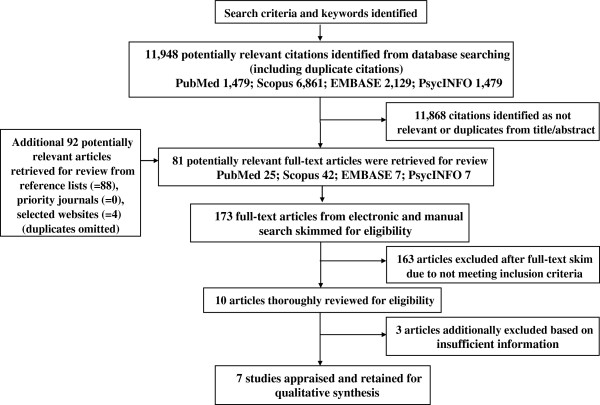
INTRODUCTION: Research has shown that mHealth initiatives, or health programs enhanced by mobile phone technologies, can foster women's empowerment. Yet, there is growing concern that mobile-based programs geared towards women may exacerbate gender inequalities. METHODS: A systematic literature review was conducted to examine the empirical evidence of changes in men and women's interactions as a result of mHealth interventions. To be eligible, studies had to have been published in English from 2002 to 2012, conducted in a developing country, included an evaluation of a mobile health intervention, and presented findings on resultant dynamics between women and men. The search strategy comprised four electronic bibliographic databases in addition to a manual review of the reference lists of relevant articles and a review of organizational websites and journals with recent mHealth publications. The methodological rigor of selected studies was appraised by two independent reviewers who also abstracted data on the study's characteristics. Iterative thematic analyses were used to synthesize findings relating to gender-transformative and non-transformative experiences. RESULTS: Out of the 173 articles retrieved for review, seven articles met the inclusion criteria and were retained in the final analysis. Most mHealth interventions were SMS-based and conducted in sub-Saharan Africa on topics relating to HIV/AIDS, sexual and reproductive health, health-based microenterprise, and non-communicable diseases. Several methodological limitations were identified among eligible quantitative and qualitative studies. The current literature suggests that mobile phone programs can influence gender relations in meaningfully positive ways by providing new modes for couple's health communication and cooperation and by enabling greater male participation in health areas typically targeted towards women. MHealth initiatives also increased women's decision-making, social status, and access to health resources. However, programmatic experiences by design may inadvertently reinforce the digital divide, and perpetuate existing gender-based power imbalances. Domestic disputes and lack of spousal approval additionally hampered women's participation. CONCLUSION: Efforts to scale-up health interventions enhanced by mobile technologies should consider the implementation and evaluation imperative of ensuring that mHealth programs transform rather than reinforce gender inequalities. The evidence base on the effect of mHealth interventions on gender relations is weak, and rigorous research is urgently needed.
Overview
The claims and statistics of this paper haven’t been checked yet.
Free: it reads the open-access text and checks the first 5 claims that cite a source we can check. Create a free account to check every claim.
Integrity signals
Registry
Cites
Statistics
Figures
Verification
Claims the paper makes
The claims and statistics of this paper haven’t been checked yet.
Free: it reads the open-access text and checks the first 5 claims that cite a source we can check. Create a free account to check every claim.
Claims other papers make about this one
Each is checked against this paper’s own text: does it say what the citing paper says it does?
The source backs part of the claim, not all of it — or backs it for a different population, condition or comparison.
In the citing paper
“Some studies found that mobile health interventions can exacerbate treatment disparities”
From Inequities in Health Care Services Caused by the Adoption of Digital Health Technologies: Scoping Review (2022) · cites this paper as [23]
Experimental — accuracy not yet measuredThe source backs part of the claim, not all of it — or backs it for a different population, condition or comparison.
In the citing paper
“In this context, women were less likely to own a mobile phone, so were less likely to directly benefit from SMS education (40, 41, 77).”
From Assessing the impact of mHealth interventions in low- and middle-income countries – what has been shown to work? (2014) · cites this paper as [77]
Experimental — accuracy not yet measuredThe cited source says what the claim attributes to it.
In the citing paper
“Nevertheless, as noted in some of the reviewed papers, attention has to be given to equity issues if mHealth strategies assume the availability of mobile phones, with the attendant risks of further marginalising already vulnerable groups (41, 77).”
From Assessing the impact of mHealth interventions in low- and middle-income countries – what has been shown to work? (2014) · cites this paper as [77]
Self-check
Percentages, sums and reported differences re-computed from the paper’s own numbers.
The self-check needs the paper’s full text.
Citations
Cites
(2014) · Medical Entomology and Zoology · Cited by 17,633
Qualitative Analysis for Social Scientists
Strauss, A. L. (1987) · doi:10.1017/cbo9780511557842 · Cited by 12,277 · cited 1×
“Similar to the analysis of textual data, the process of synthesizing findings among selected articles comprised an initial round of article memoing in which the reviewers independently documented analytical interpretations of findings to capture emerging themes [31,32].”
MethodQualitative research in health care: Assessing quality in qualitative research
Mays, N. (2000) · BMJ · doi:10.1136/bmj.320.7226.50 · Cited by 3,742
Synthesising qualitative and quantitative evidence: A review of possible methods
Dixon-Woods, M., Agarwal, S., Jones, D., Young, B., & Sutton, A. (2005) · Journal of Health Services Research & Policy · doi:10.1177/135581960501000110 · Cited by 2,132 · cited 1×
“This is commonly used to summarize themes identified in systematic literature reviews of qualitative and quantitative studies [28-30].”
MethodStandard Quality Assessment Criteria for Evaluating Primary Research Papers from a Variety of Fields
Kmet, L. M., Cook, L. S., & Lee, R. C. (2004) · University of Alberta Library · doi:10.7939/r37m04f16 · Cited by 1,682
Cummings, G. G., MacGregor, T., Davey, M., Lee, H., Wong, C. A., Lo, E., Muise, M., & Stafford, E. (2010) · International Journal of Nursing Studies · doi:10.1016/j.ijnurstu.2009.08.006 · Cited by 1,104 · cited 1×
“Inclusion of items for the quality assessments was informed by published guidelines and indexes for examining the quality of quantitative [20-24] and qualitative studies [24-27].”
Method(2003) · Routledge eBooks · doi:10.4324/9780203401491 · Cited by 963
Lucas, P. J., Baird, J., Arai, L., Law, C., & Roberts, H. M. (2007) · BMC Medical Research Methodology · doi:10.1186/1471-2288-7-4 · Cited by 553
Information and communication technologies and the moral economy of the household
(2003) · Consuming Technologies · doi:10.4324/9780203401491-9 · Cited by 450
Evaluating Shared Access: social equality and the circulation of mobile phones in rural Uganda
Burrell, J. (2010) · Journal of Computer-Mediated Communication · doi:10.1111/j.1083-6101.2010.01518.x · Cited by 221
Research works printed but not linked: 1
- Akinfaderin-Agarau F Chirtau M Ekponimo S Power S Opportunities and limitations for using new media and mobile phones to expand access to sexual and reproductive health information and services for adolescent girls and young women in six Nigerian states Afr J Reprod Health 2012 12 2 219 230 22916554
Cited by
Items 101–128 of 128
A Practical Guide to Implementation Research on Health Systems
Lucas, H. C., & Zwarenstein, M. (2016) · OpenDocs (Institute of Development Studies) · Cited by 5
Services for street-connected children and young people in low- and middle-income countries
Coren, E., Hossain, R., Ramsbotham, K., Martin, A., & Pardo, J. P. (2016) · doi:10.23846/sr31097 · Cited by 2
Craig, A., Beek, K., Godinho, M., Ansari, S., Jonnagaddala, J., Linhart, C., Hall, J., & Liaw, T. (2022) · UNSWorks (University of New South Wales, Sydney, Australia) · doi:10.26190/unsworks/28338 · Cited by 12
Essais sur l'adoption des technologies de quantification de soi : une approche critique
Moya, J. D. (2019) · theses.fr (ABES) · doi:10.70675/71fa5e23zbc1bz4e98zb8baz67f821674d90 · Cited by 4
Research and Discussions in Critical Discourses and Remedies in Global Health Education
(2024) · Frontiers research topics · doi:10.3389/978-2-8325-5215-5 · Cited by 1
Mpambije, C. J. (2026) · Discover Global Society · doi:10.1007/s44282-026-00387-6 · Cited by 1
Lathabhavan, R., Bharti, T., Mishra, N., & Sahay, V. S. (2026) · Acta Psychologica · doi:10.1016/j.actpsy.2026.106820 · Cited by 1
A Qualitative Inquiry and Review of Telemedicine: A Case Study of Cameroon
Ayeni, F. (2019) · Biomedical Journal of Scientific & Technical Research · doi:10.26717/bjstr.2019.22.003725 · Cited by 1
Otiso, L., Steege, R., Njoroge, I., Okoth, L., Tubb, P., Nyothach, E., Phillips‐Howard, P. A., Theobald, S., & Taegtmeyer, M. (2024) · BMJ Global Health · doi:10.1136/bmjgh-2023-013519 · Cited by 3
Addressing Health Equity Challenges in Women's Care: Insights from Kenya
Wambalaba, E. A. (2024) · Integrated science · doi:10.1007/978-3-031-60502-4_11 · Cited by 1
Mobile Health, Developing Countries
Chib, A. I., & Li, C. (2022) · Wiley eBooks · doi:10.1002/9781119678816.iehc0731 · Cited by 2
The Utility of Mobile Phones for Health Among Women Living with HIV in Urban Malawi
Dietrich, L. (2016) · UWM Digital Commons (University of Wisconsin–Milwaukee) · Cited by 1
Henriksen, A. (2017) · Lund University Publications Student Papers (Lund University) · Cited by 1
The effects of microcredit on women’s control over household spending
Vaessen, J., Rivas, A., Duvendack, M., Jones, R. P., Leeuw, F. L., Gils, G. H. C. V., consultant, I., Lukach, R., Holvoet, N., Bastiaensen, J., et al. (2016) · doi:10.23846/sr1013
Parental, community and familial support for children’s literacy in developing countries
Spier, E., Britto, P. R., UNICEF, Pigott, T., Roehlkapartain, E., McCarthy, M., Kidron, Y., Song, M., Scales, P. C., Wagner, D., et al. (2016) · doi:10.23846/sr51253usaid
Analysis of public preference for the development of mobile health applications (mHealth apps)
Ruiz, P. U. (2020) · eSource (Dublin Business School)
Emezue, C. (2021) · MOspace Institutional Repository (University of Missouri) · doi:10.32469/10355/90011 · Cited by 2
Undheim, T. A. (2024) · SSRN Electronic Journal · doi:10.2139/ssrn.4803564
A Narrative Review of Appointment and Medication Adherence in Socio-Demographic Contexts
Osuoha, C. B., Njoku-Obi, T., David, C. I., Igiri, V. C., & Dozie, U. W. (2025) · African Journal of Health Nursing and Midwifery · doi:10.52589/ajbmr-wzpjvb9f
Damayanti, C., & Isharianto, R. (2025) · Studia Philosophica et Theologica · doi:10.35312/studia.v25i2.793
Cheruto, S. K. (2021) · Open University of Cape Town (University of Cape Town) · Cited by 6
Fotouhinia Yepes, M. (2016) · IRIS
Su, Y., Xiao, X., Borah, P., Hong, X., & Sun, C. (2022) · International journal of communication · Cited by 2
Powelson, J., Gondwe, L., Akama, E., Kachule, H., Nkhonjera, K., Jahar, L. C., Mayenda, J., & Mulwa, E. (2026) · Oxford Open Digital Health · doi:10.1093/oodh/oqaf035
“…health system, improve efficiency and cost-effectiveness of health services, increase health workforce capacity, and improve quality of services [1]. mHealth interventions have also been shown to positively influence male and female cooperation and communication around health seeking behaviors [2].”
Nacanabo, R., Kiendrébéogo, J. A., Konsebo, N., Kaboré, I., Sory, O., Zombré, D., Kaboré, R., Tiendrébéogo, S., Tapsoba, C., Nacoulma, T. D. M., et al. (2026) · BMC Health Services Research · doi:10.1186/s12913-026-14331-6
“Scholars have long noted that women in LMICs face structural and sociocultural constraints to their participation in digital innovation, including unequal access to training, restrictive gender norms, and double work-loads linked to professional and domestic responsibilities [24].”
Aovare, P., Chilunga, F. P., Laar, A., Moens, N., van Charante, E. P. M., & Agyemang, C. O. (2026) · Journal of Global Health · doi:10.7189/jogh.16.04203 · Cited by 2
Mbongo, L. D. B. E., Messono, O. O., & Bouebe, A. T. I. A. (2026) · Telecommunications Policy · doi:10.1016/j.telpol.2026.103280
Metadata
- Authors
- Jennings, L., & Gagliardi, L.
- Affiliations
- Johns Hopkins University (US)
- Venue
- International Journal for Equity in Health
- Published
- 2013
- Volume
- 12
- Issue
- 1
- Pages
- 85
- ISSN
- 1475-9276 (ISSN-L)
- PMC
- PMC4015705
- OpenAlex
- W2165506697
- Cited by
- 117
- References
- 35
- Citations by year
- 2026: 6 · 2025: 11 · 2024: 8 · 2023: 5 · 2022: 12 · 2021: 10 · 2020: 7 · 2019: 16 · 2018: 9 · 2017: 6 · 2016: 17 · 2015: 8 · 2014: 2
- FWCI
- 1.08
- Type
- journal article
- Language
- en
- Open access
- gold
- doi.org
- Licence
- cc-by
- Locations
- International Journal for Equity in Health (publishedVersion, cc-by)
- Europe PMC (PubMed Central) (publishedVersion, cc-by)
- PubMed Central (publishedVersion, cc-by)
- PubMed (publishedVersion)
- Topics
- Health Sciences › Health Professions › General Health Professions › Mobile Health and mHealth Applications
- Physical Sciences › Computer Science › Information Systems › ICT in Developing Communities
- Social Sciences › Sociology and Political Science › Gender, Health, and Social Inequality
- Keywords
- mobile health, mobile health intervention, gender relations, gender inequality, women's empowerment, women's decision-making, digital divide, spousal approval, HIV/AIDS, sexual and reproductive health, non-communicable diseases, sub-Saharan Africa, developing countries
- MeSH terms
- Community Health Services, Developing Countries, Female, Humans, Interpersonal Relations, Male, Sexual Partners, Telemedicine, Empirical Research, Cell Phone, Health Information Systems
About these checks
Registry, retraction, Cites and statistics results are computed, not judged, with one exception: a printed reference that no index lists is read once by a model before it counts as a citation error. Claims are extracted by a model and kept only when their quote appears verbatim in the text; each cited source is then checked, with a model’s help, for whether it says what the claim relies on. Those verdicts can be wrong — read the claim’s quote and the cited source before relying on one.
Statistics and arithmetic are recomputed, not judged.
Confidence bands are shown only for fields calibrated on our annotated test set. None is calibrated yet, so no band is shown.
What counts as a claim ›How we measure confidence ›How we check this ›
Are you an author, or do you see a problem with this page? Request a review
Data sources
Bibliographic data: Semantic Scholar, OpenAlex, Crossref.
Contains information from the Semantic Scholar Academic Graph Datasets, made available under the ODC Attribution License (ODC-BY 1.0).
Semantic Scholar’s data is described in: Kinney, R., et al. (2023). The Semantic Scholar Open Data Platform. arXiv:2301.10140.
