

Convergence between Wnt-β-catenin and EGFR signaling in cancer
Open accessThe DOI matches its Crossref record; 77 of the 78 references it cites were found in a registry or an index.
Abstract
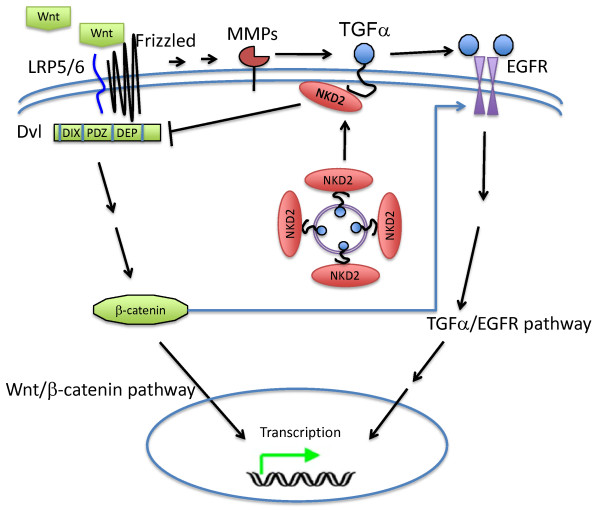
Wnt and EGFR signaling play key roles in embryonic development and cell proliferation. It is well documented that dysregulation of these two pathways often leads to tumorigenesis with poor prognosis. However, the possible crosstalk between the two pathways in cancer development is largely unknown. Although some reports show that EGFR might antagonize Wnt signaling during development in Drosophila, an increasing body of evidence indicates that Wnt and EGFR signaling crosstalk and transactivate one another in development and cancer. This review summarizes recent studies on the crosstalk between Wnt and EGFR signaling in cancers and points out several possible convergence points. Wnt ligands can activate EGFR signaling through their 7-transmembrane domain receptor Frizzled while EGFR can activate β-catenin via receptor tyrosine kinase-PI3K/Akt pathway; EGFR has been shown to form a complex with β-catenin and increase the invasion and metastasis of cancer cells. NKD2, a Wnt antagonist by interacting with Dishevelled, also escorts TGFα-containing exocytic vesicles to the basolateral membrane of polarized epithelial cells. Down-regulation of NKD2 causes Wnt activation and TGFα misdelivery, suggesting its functions in cell homeostasis and prevention of tumorigenesis.
Overview
The claims and statistics of this paper haven’t been checked yet.
Free: it reads the open-access text and checks the first 5 claims that cite a source we can check. Create a free account to check every claim.
Integrity signals
Registry
Cites
Statistics
Figures
Verification
Claims the paper makes
The claims and statistics of this paper haven’t been checked yet.
Free: it reads the open-access text and checks the first 5 claims that cite a source we can check. Create a free account to check every claim.
Claims other papers make about this one
Each is checked against this paper’s own text: does it say what the citing paper says it does?
In the citing paper
“For example, EGFR can form a complex with β-catenin to activate the Wnt pathway, and the Wnt ligand can confer anti-EGFR resistance through its Frizzled activation of EGFR signaling [192,193].”
From Drug Resistance in Colorectal Cancer: From Mechanism to Clinic (2022) · cites this paper as [192]
Self-check
Percentages, sums and reported differences re-computed from the paper’s own numbers.
The self-check needs the paper’s full text.
Citations
Cites
1 retracted
Regulation of β-Catenin Structure and Activity by Tyrosine Phosphorylation
Piedra, J., Martı́nez, D., Castaño, J., Miravet, S., Duñach, M., & de Herreros, A. G. (2001) · Journal of Biological Chemistry · doi:10.1074/jbc.m100194200 · Cited by 262 · cited 1×
“cer cell lines MDA-MB-468 can induce a strong tyrosine phosphorylation of b-catenin [63], that blocks the interaction between b-catenin and E-cadherin and increases the invasiveness and metastatic potential of cancer cells [64,65].”
BackgroundRetractedA genetic model for colorectal tumorigenesis
Fearon, E. R., & Vogelstein, B. (1990) · Cell · doi:10.1016/0092-8674(90)90186-i · Cited by 12,132 · cited 1×
“lying tumor formation and progression [1].”
EGFR Mutation and Resistance of Non–Small-Cell Lung Cancer to Gefitinib
Kobayashi, S., Boggon, T. J., Dayaram, T., Jänne, P. A., Kocher, O., Meyerson, M., Johnson, B. E., Eck, M. J., Tenen, D. G., & Halmos, B. (2005) · New England Journal of Medicine · doi:10.1056/nejmoa044238 · Cited by 3,964
Epidermal growth factor receptor mutations in lung cancer
Sharma, S. V., Bell, D. W., Settleman, J., & Haber, D. A. (2007) · Nature Reviews Cancer · doi:10.1038/nrc2088 · Cited by 3,170 · cited 1×
“For example, among non-small cell lung cancer (NSCLC) patients, 60% have been reported with EGFR overexpression and a poor prognosis (the median survival time is around 4-5 months) [29].”
BackgroundThe T790M mutation in EGFR kinase causes drug resistance by increasing the affinity for ATP
Yun, C.-H., Mengwasser, K. E., Toms, A. V., Woo, M. S., Greulich, H., Wong, K.-K., Meyerson, M., & Eck, M. J. (2008) · Proceedings of the National Academy of Sciences · doi:10.1073/pnas.0709662105 · Cited by 2,118 · cited 2×
“Yun CH, Mengwasser KE, Toms AV, Woo MS, Greulich H, Wong KK, Meyerson M, Eck MJ: The T790M mutation in EGFR kinase causes drug resistance by increasing the affinity for ATP.”
BackgroundAPC mutations occur early during colorectal tumorigenesis
Powell, S. M., Zilz, N., Beazer-Barclay, Y., Bryan, T. M., Hamilton, S. R., Thibodeau, S. N., Vogelstein, B., & Kinzler, K. W. (1992) · Nature · doi:10.1038/359235a0 · Cited by 1,924 · cited 1×
“80% of colon cancers have APC mutations [2] and 50-70% of breast, colon and lung cancers have EGFR and ErB3 mutations [28].”
BackgroundPrenzel, N., Zwick, E., Daub, H., Leserer, M., Abraham, R., Wallasch, C., & Ullrich, A. (1999) · Nature · doi:10.1038/47260 · Cited by 1,504
erb B-2 Is a Potent Oncogene When Overexpressed in NIH/3T3 Cells
Di Fiore, P. P., Pierce, J. H., Kraus, M. H., Segatto, O., King, C. R., & Aaronson, S. A. (1987) · Science · doi:10.1126/science.2885917 · Cited by 1,010 · cited 1×
“tion of NIH-3T3 cells [24,25].”
Wnt5a signaling directly affects cell motility and invasion of metastatic melanoma
Weeraratna, A. T., Jiang, Y., Hostetter, G., Rosenblatt, K., Duray, P., Bittner, M., & Trent, J. M. (2002) · Cancer Cell · doi:10.1016/s1535-6108(02)00045-4 · Cited by 959 · cited 1×
“In vitro studies also confirm that Wnt5A activity increases melanoma invasiveness and that the activity is independent of b-catenin [19].”
BackgroundProstaglandin E 2 Promotes Colon Cancer Cell Growth Through a G s -Axin-ß-Catenin Signaling Axis
Castellone, M. D., Teramoto, H., Williams, B. O., Druey, K. M., & Gutkind, J. S. (2005) · Science · doi:10.1126/science.1116221 · Cited by 883 · cited 1×
“Studies indicate that prostaglandin E2 (PGE2), a product of cyclooxygenase-2 (Cox-2) activity, promotes tumor growth by activating EGFR [43] or b-catenin [ 44 ].”
Background
Cited by
Targeting the Wnt/β-catenin signaling pathway in cancer
Zhang, Y., & Wang, X. (2020) · Journal of Hematology & Oncology · doi:10.1186/s13045-020-00990-3 · Cited by 1,431
Godoy, P., Hewitt, N. J., Albrecht, U., Andersen, M. E., Ansari, N., Bhattacharya, S., Bode, J. G., Bolleyn, J., Borner, C., Böttger, J., et al. (2013) · Archives of Toxicology · doi:10.1007/s00204-013-1078-5 · Cited by 1,280
“Hepatocytes from PXR knockout mice express higher levels of inflammatory cytokines such as IL-1b and TNF-a compared to wild-type mice (Hu and Li 2010; Zhou et al. 2006).”
InfluentialPolakis, P. (2012) · Cold Spring Harbor Perspectives in Biology · doi:10.1101/cshperspect.a008052 · Cited by 847
“These include direct binding of b-catenin to EGFR, modulation of the cadherin-b-catenin interface by EGFR, activation ofb-catenin-dependent signaling by EGFR through PI3K signaling as well as the EGFR gene itself as a Wnt target (review by Hu and Li 2011).”
BackgroundTargeting cytokine and chemokine signaling pathways for cancer therapy
Yi, M., Li, T., Niu, M., Zhang, H., Wu, Y., Wu, K., & Dai, Z. (2024) · Signal Transduction and Targeted Therapy · doi:10.1038/s41392-024-01868-3 · Cited by 455
Lu, Y., Zhao, X., Liu, Q., Li, C., Graves-Deal, R., Cao, Z., Singh, B., Franklin, J. L., Wang, J., Hu, H., et al. (2017) · Nature Medicine · doi:10.1038/nm.4424 · Cited by 425
Self-citationPharmacological basis and new insights of taxifolin: A comprehensive review
Das, A., Baidya, R., Chakraborty, T., Samanta, A. K., & Roy, S. (2021) · Biomedicine & Pharmacotherapy · doi:10.1016/j.biopha.2021.112004 · Cited by 245
Garg, M. (2013) · World Journal of Stem Cells · doi:10.4252/wjsc.v5.i4.188 · Cited by 209
Wnt signaling and colon carcinogenesis: Beyond APC
Najdi, R., Holcombe, R., & Waterman, M. (2011) · Journal of Carcinogenesis · doi:10.4103/1477-3163.78111 · Cited by 184
“[74,75] Moreover, inhibition of EGFR signaling”
Drug Resistance in Colorectal Cancer: From Mechanism to Clinic
Wang, Q., Shen, X., Chen, G., & Du, J. (2022) · Cancers · doi:10.3390/cancers14122928 · Cited by 160
Current Understanding on EGFR and Wnt/ -Catenin Signaling in Glioma and Their Possible Crosstalk
Paul, I., Bhattacharya, S., Chatterjee, A., & Ghosh, M. K. (2013) · Genes & Cancer · doi:10.1177/1947601913503341 · Cited by 151
“The convergence of EGFR and Wnt/β-catenin pathways is apparent over a wide range of molecular crosstalks giving rise to differential outcomes.(198) In the perspective of this review, we have projected several instances taken as much as possible from glioma to highlight the interdependency of these 2 pathways toward ma…”
BackgroundMorgan, E. L., & Macdonald, A. (2019) · PLoS Pathogens · doi:10.1371/journal.ppat.1007835 · Cited by 158
Wolfe, A. R., Thomas, A., Edwards, G., Jaseja, R., Guo, G. L., & Apte, U. M. (2011) · Journal of Pharmacology and Experimental Therapeutics · doi:10.1124/jpet.111.179390 · Cited by 158
Zhang, X., Chen, T., Zhang, J., Mao, Q., Shan-quan, L., Xiong, W., Qiu, Y., Xie, Q., & Ge, J. (2011) · Cancer Science · doi:10.1111/j.1349-7006.2011.02154.x · Cited by 161
Wnt/β-Catenin Signaling Pathway in the Development and Progression of Colorectal Cancer
He, K., & Gan, W.-J. (2023) · Cancer Management and Research · doi:10.2147/cmar.s411168 · Cited by 167
Dash, S., Aydın, Y., Widmer, K., & Nayak, L. (2020) · Journal of Hepatocellular Carcinoma · doi:10.2147/jhc.s221187 · Cited by 141
YAP and TAZ in Lung Cancer: Oncogenic Role and Clinical Targeting
Sardo, F. L., Strano, S., & Blandino, G. (2018) · Cancers · doi:10.3390/cancers10050137 · Cited by 131
TLR4 Activates the β-catenin Pathway to Cause Intestinal Neoplasia
Santaolalla, R., Sussman, D. A., Ruiz, J. R., Davies, J. M., Pastorini, C., España, C., Sotolongo, J. P., Burlingame, O., Bejarano, P. A., Philip, S., et al. (2013) · PLoS ONE · doi:10.1371/journal.pone.0063298 · Cited by 133
Tedesco, M., Giannese, F., Lazarević, D., Giansanti, V., Rosano, D., Monzani, S., Catalano, I., Grassi, E., Zanella, E. R., Botrugno, O. A., et al. (2021) · Nature Biotechnology · doi:10.1038/s41587-021-01031-1 · Cited by 129
Lappano, R., & Maggiolini, M. (2012) · Acta Pharmacologica Sinica · doi:10.1038/aps.2011.183 · Cited by 112
Snyder, M., Huang, X.-Y., & Zhang, J. J. (2011) · Journal of Biological Chemistry · doi:10.1074/jbc.m111.286245 · Cited by 99
ZHANG, Z., CHEN, H., XU, C., SONG, L., HUANG, L., LAI, Y., WANG, Y., CHEN, H., GU, D., REN, L., et al. (2016) · Oncology Reports · doi:10.3892/or.2016.4669 · Cited by 97
“Wnt signals can be transduced to the canonical Wnt pathway for cell-fate determination or to the non-canonical Wnt pathway for the regulation of tissue polarity and cell movement (43).”
Animal Models of Colitis‐Associated Carcinogenesis
Kanneganti, M., Mino-Kenudson, M. A., & Mizoguchi, E. (2011) · BioMed Research International · doi:10.1155/2011/342637 · Cited by 112
“EGF can form a complex with β-catenin, possibly through receptor tyrosine kinasePI3K/Akt pathway, and further activate Wnt signaling pathway [210].”
BackgroundWatson, A. L., Rahrmann, E. P., Moriarity, B. S., Choi, K., Conboy, C. B., Greeley, A. D., Halfond, A. L., Anderson, L. K., Wahl, B. R., Keng, V. W., et al. (2013) · Cancer Discovery · doi:10.1158/2159-8290.cd-13-0081 · Cited by 112
Drug resistance in colorectal cancer: An epigenetic overview
Luo, M., Yang, X., Chen, H.-N., Nice, E. C., & Huang, C. (2021) · Biochimica et Biophysica Acta (BBA) - Reviews on Cancer · doi:10.1016/j.bbcan.2021.188623 · Cited by 94
Multiple Routes to Oncogenesis Are Promoted by the Human Papillomavirus–Host Protein Network
Eckhardt, M., Zhang, W., Gross, A. M., Von Dollen, J., Johnson, J. R., Franks-Skiba, K. E., Swaney, D. L., Johnson, T. L., Jang, G. M., Shah, P. S., et al. (2018) · Cancer Discovery · doi:10.1158/2159-8290.cd-17-1018 · Cited by 95
“Dysregulation of WNT signaling is a hallmark of cancer (53, 54) and has been recently shown to play a role in the maintenance of cancer stem cells (55).”
BackgroundXie, G., Peng, Z., & Raufman, J.-P. (2012) · American Journal of Physiology-Gastrointestinal and Liver Physiology · doi:10.1152/ajpgi.00427.2011 · Cited by 93
“Such cross talk may limit the benefits of currently approved EGFR-targeted biological (3, 19, 39).”
BackgroundNotch3-dependent β-catenin signaling mediates EGFR TKI drug persistence in EGFR mutant NSCLC
Arasada, R. R., Shilo, K., Yamada, T., Zhang, J., Yano, S., Ghanem, R., Wang, W., Takeuchi, S., Fukuda, K., Katakami, N., et al. (2018) · Nature Communications · doi:10.1038/s41467-018-05626-2 · Cited by 93
Kolegraff, K. N., Nava, P., Helms, M. N., Parkos, C. A., & Nusrat, A. (2011) · Molecular Biology of the Cell · doi:10.1091/mbc.e10-10-0845 · Cited by 104
“…linked the desmosomal cadherins to the regulation of epidermal growth factor receptor (EGFR) signaling (Lorch et al., 2004; Getsios et al., 2009), a well-recognized activator of PI3K/Akt that has been shown to enhance the transcriptional activity of β-catenin (Lu et al., 2003; Hu and Li, 2010).”
InfluentialSethi, M. K., Kim, H., Park, C. K., Baker, M. S., Paik, Y., Packer, N. H., Hancock, W. S., Fanayan, S., & Thaysen‐Andersen, M. (2015) · Glycobiology · doi:10.1093/glycob/cwv042 · Cited by 108
“Equally, EGFR is a known activator of theWNT/β-Catenin signalling pathway (Hu and Li 2010).”
BackgroundEmerging Insights into Wnt/β-catenin Signaling in Head and Neck Cancer
Abalkhail, K. A., & Kukuruzinska, M. A. (2018) · Journal of Dental Research · doi:10.1177/0022034518771923 · Cited by 99
Wnt/β-Catenin Signaling in Oral Carcinogenesis
Reyes, M., Flores, T., Betancur, D. L. D., Peña‐Oyarzún, D., & Torres, V. A. (2020) · International Journal of Molecular Sciences · doi:10.3390/ijms21134682 · Cited by 103
Wang, W., Pan, Q., Fuhler, G. M., Smits, R., & Peppelenbosch, M. P. (2017) · Journal of Gastroenterology · doi:10.1007/s00535-016-1299-5 · Cited by 86
“Activated b-catenin might form heterodimers with EGFR to enhance EGFR pathway activation [116].”
BackgroundA review on epidermal growth factor receptor's role in breast and non-small cell lung cancer
Subramaniyan, V., Fuloria, S., Gupta, G., Kumar, D. H., Sekar, M., Sathasivam, K. V., Sudhakar, K., Alharbi, K. S., Almalki, W. H., Afzal, O., et al. (2021) · Chemico-Biological Interactions · doi:10.1016/j.cbi.2021.109735 · Cited by 94
Roles of the Wnt Signaling Pathway in Head and Neck Squamous Cell Carcinoma
Xie, J., Huang, L., Lu, Y., & Zheng, D. (2021) · Frontiers in Molecular Biosciences · doi:10.3389/fmolb.2020.590912 · Cited by 92
Decorin deficiency promotes hepatic carcinogenesis
Horváth, Z., Kovalszky, I., Fullár, A., Kiss, K., Schaff, Z., Iozzo, R. V., & Baghy, K. (2013) · Matrix Biology · doi:10.1016/j.matbio.2013.11.004 · Cited by 92
“We identified four RTKs, namely PDGFRα, EGFR,MSPR (also known as RON) and IGF-IR that exhibited significantly higher levels in response to the absence of decorin (Fig.”
BackgroundInfluentialKovačević, Ž., Menezes, S. V., Sahni, S., Kalinowski, D. S., Bae, D.-H., Lane, D. J. R., & Richardson, D. R. (2015) · Journal of Biological Chemistry · doi:10.1074/jbc.m115.689653 · Cited by 84
“Some of the downstream pathways affected by the EGFR, HER2, and HER3 receptors include the PI3K, RAS, MAPK, WNT, TGF- , NF- B, and c-Src pathways (28, 35), many of which have been previously shown to be modulated by NDRG1 expression (2, 6, 8, 11, 14, 17–19).”
BackgroundEpidermal Growth Factor Receptor (EGFR) Crosstalks in Liver Cancer
Berasain, C., Latasa, M. U., Urtasun, R., Goñi, S., Elizalde, M., García‐Irigoyen, O., Azcona, M., Prìeto, J., & Avila, M. A. (2011) · Cancers · doi:10.3390/cancers3022444 · Cited by 89
“In different cell types increased availability of EGFR ligands has been detected in response to ANG-II, lysophosphatidic acid (LPA), ET-1, thrombin, chemokines as IL-8 and CXCL12, Wnt and prostaglandins such as PGE2, among others [15,92-95].”
BackgroundClinical Significance and Prognosis Value of Wnt Signaling Pathway in Cervical Cancer
Bahrami, A., Hasanzadeh, M., Shahidsales, S., Yousefi, Z., Kadkhodayan, S., Farazestanian, M., Mashhad, M. J., Gharib, M., Hassanian, S. M., & Avan, A. (2017) · Journal of Cellular Biochemistry · doi:10.1002/jcb.25992 · Cited by 79
“Also, continual activation of Wnt/bcatenin signaling pathway has been showed to be an indicator of poor prognosis in several cancers [Hu and Li, 2010].”
BackgroundKey signal transduction pathways and crosstalk in cancer: Biological and therapeutic opportunities
Fu, D., Hu, Z., Xu, X., Dai, X., & Liu, Z. (2022) · Translational Oncology · doi:10.1016/j.tranon.2022.101510 · Cited by 91
Pérez-Yépez, E. A., Ayala‐Sumuano, J., Lezama, R. A., & Meza, I. (2014) · Cancer Letters · doi:10.1016/j.canlet.2014.08.015 · Cited by 81
“The Wnt/β-catenin pathway is activated by Wnt receptors and the co-receptors Fzd and RLPS [11,15], although the epithelial growth factor receptor (EGFR), belonging to the RTK family, has also been reported to activate β-catenin transcriptional activity through the RTK/PI3K/Akt pathway [17,18].”
BackgroundWang, Y., Overstreet, A.-M. C., Chen, M., Wang, J., Zhao, H., Ho, P.-C., Smith, M. A., & Wang, S. (2015) · Oncotarget · doi:10.18632/oncotarget.3441 · Cited by 80
“Multiple mechanisms of cross talk between EGFR and the Wnt pathway have been reported [30].”
BackgroundTRIM29 functions as an oncogene in gastric cancer and is regulated by miR-185.
Qiu, F., Xiong, J., Deng, J., & Xiang, X. (2015) · PubMed · Cited by 75
Emodin suppresses Wnt signaling in human colorectal cancer cells SW480 and SW620
Pooja, T., & Karunagaran, D. (2014) · European Journal of Pharmacology · doi:10.1016/j.ejphar.2014.08.028 · Cited by 79
“…may also affect other pathways relevant to colon cancer and crosstalk with other signaling pathways is known to further influence Wnt/β-catenin pathway activation at various levels (Buchanan and DuBois, 2006; Guardavaccaro and Clevers, 2012; Hu and Li, 2010; Huang and Du, 2008; Rao et al., 2013).”
BackgroundKharbanda, A., Rajabi, H. N., Jin, C., Tchaicha, J. H., Kikuchi, E., Wong, K., & Kufe, D. W. (2014) · Clinical Cancer Research · doi:10.1158/1078-0432.ccr-13-3168 · Cited by 77
“EGFR and AKT have also been linked to activation of both the NF-kB and WNT/ b-catenin pathways in NSCLC cells (33, 34).”
BackgroundYu, C., Ding, Z., Liang, H., Zhang, B., & Chen, X. (2019) · Frontiers in Oncology · doi:10.3389/fonc.2019.00979 · Cited by 78
Donovan, S. M., Monaco, M. H., Drnevich, J. M., Kvistgaard, A. S., Hernell, O., & Lönnerdal, B. L. (2014) · Journal of Nutrition · doi:10.3945/jn.114.197558 · Cited by 67
Guturi, K. K. N., Mandal, T., Chatterjee, A., Sarkar, M., Bhattacharya, S., Chatterjee, U., & Ghosh, M. K. (2012) · Journal of Biological Chemistry · doi:10.1074/jbc.m111.324798 · Cited by 65
Dasgupta, S., Menezes, M. E., Das, S. K., Emdad, L., Janjic, A., Bhatia, S., Mukhopadhyay, N. D., Shao, C., Sarkar, D., & Fisher, P. B. (2013) · Clinical Cancer Research · doi:10.1158/1078-0432.ccr-13-0585 · Cited by 66
Genomic characterization of explant tumorgraft models derived from fresh patient tumor tissue
Monsma, D. J., Monks, N. R., Cherba, D., Dylewski, D., Eugster, E., Jahn, H., Srikanth, S., Scott, S. B., Richardson, P. J., Everts, R. E., et al. (2012) · Journal of Translational Medicine · doi:10.1186/1479-5876-10-125 · Cited by 67
“In those patient tumors that formed tumorgrafts, upregulated genes show enrichment in pathways considered “usual suspects” in highly proliferative, late stage tumors; these canonical pathways include cell cycle, cytoskeletal remodeling, and those known drivers of tumorigenesis WNT and AKT signaling [35-37].”
BackgroundMa, L., Lin, K., Chang, G., Chen, Y., Chen, Y., Guo, Q., Zhang, S., Jia, Z., Huang, T. T., Zhou, A., et al. (2018) · Cancer Research · doi:10.1158/0008-5472.can-18-1304 · Cited by 65
Lee, S.-K., Hwang, J.-H., & Choi, K.-Y. (2018) · Advances in Biological Regulation · doi:10.1016/j.jbior.2018.01.001 · Cited by 61
Nieß, H., Čamaj, P., Renner, A., Ischenko, I., Zhao, Y., Krebs, S., Mysliwietz, J., Jäckel, C., Nelson, P. J., Blum, H., et al. (2014) · Targeted Oncology · doi:10.1007/s11523-014-0323-z · Cited by 65
“EGFR can also activate β-catenin [54].”
Agarwal, S., Behring, M. P., Kim, H., Chandrashekar, D. S., Chakravarthi, B. V. S. K., Gupta, N., Bajpai, P., Elkholy, A., Diffalha, S. A., Datta, P. K., et al. (2020) · Molecular Oncology · doi:10.1002/1878-0261.12821 · Cited by 60
Connolly, J. G., Tan, K. S., Mastrogiacomo, B., Dycoco, J., Caso, R., Jones, G. D., McCormick, P. J., Sánchez-Vega, F., Irie, T., Scarpa, J. R., et al. (2021) · British Journal of Anaesthesia · doi:10.1016/j.bja.2021.03.030 · Cited by 67
The use of heparin and heparin-like molecules in cancer treatment: a review
Atallah, J., Khachfe, H. H., Berro, J., & Assi, H. I. (2020) · Cancer Treatment and Research Communications · doi:10.1016/j.ctarc.2020.100192 · Cited by 56
Nuclear Translocation of β-catenin is Essential for Glioma Cell Survival
Shi, Z., Qian, X., Li, L., Zhang, J., Zhu, S., Zhu, J., Chen, L., Zhang, K., Han, L., Yu, S., et al. (2012) · Journal of Neuroimmune Pharmacology · doi:10.1007/s11481-012-9354-3 · Cited by 55
“In particular, human neurogliomas represent a paradigm for the molecular and genetic mechanisms underlying tumor formation and progression (Hu and Li 2010).”
BackgroundFan, F., Shen, C., Tao, L., Tian, C., Liu, Z.-G., Zhu, Z., Liu, Y.-P., Pei, C.-S., Wu, H., Zhang, L., et al. (2014) · Asian Pacific Journal of Cancer Prevention · doi:10.7314/apjcp.2014.15.5.1961 · Cited by 60
Zhang, X., Zhu, J., Li, Y., Lin, T., Siclari, V. A., Chandra, A., Candela, E. M., Koyama, E., Enomoto‐Iwamoto, M., & Qin, L. (2013) · Journal of Biological Chemistry · doi:10.1074/jbc.m113.463554 · Cited by 62
Shepard, J. B., Jeong, J., Maihle, N. J., O'Brien, S. P., & Dealy, C. N. (2013) · Arthritis Research & Therapy · doi:10.1186/ar4233 · Cited by 58
“Intriguingly, synergistic interactions occur among the TGF-b, Wnt and EGFR network in other systems [53-57].”
BackgroundLatasa, M. U., Salis, F., Urtasun, R., García‐Irigoyen, O., Elizalde, M., Uriarte, I., Santamaría, M., Feo, F., Pascale, R. M., Prìeto, J., et al. (2012) · PLoS ONE · doi:10.1371/journal.pone.0052711 · Cited by 59
“In HC11 mammary epithelial cells, constitutive expression of Wnt1 and Wnt5a accompanies activation of EGFR and MAPK (Hu and Li 2010).”
BackgroundChapman, C. G., Mariani, C. J., Wu, F., Meckel, K. R., Butun, F. A., Chuang, A., Madžo, J., Bissonnette, M. B., Kwon, J. H., & Godley, L. A. (2015) · Scientific Reports · doi:10.1038/srep17568 · Cited by 55
An evolving web of signaling networks regulated by Cripto-1
Nagaoka, T., Karasawa, H., Castro, N. P., Rangel, M. C., Salomon, D. S., & Bianco, C. (2012) · Growth Factors · doi:10.3109/08977194.2011.641962 · Cited by 55
“…synthase kinase (GSK)-3b activity leading to the stabilization ofb-catenin and Snail, which can enhance proliferation and epithelial to mesenchymal transition (EMT) through a canonical Wnt/b-catenin signaling pathway (Figure 2B) (Qiao et al. 2008; Bikkavilli and Malbon 2009; Hu and Li 2010).”
BackgroundGharib, E., & Robichaud, G. A. (2024) · International Journal of Molecular Sciences · doi:10.3390/ijms25179463 · Cited by 65
Togashi, Y., Hayashi, H., Terashima, M., Velasco, M. A. D., Sakai, K., Fujita, Y., Tomida, S., Nakagawa, K., & Nishio, K. (2014) · Journal of Thoracic Oncology · doi:10.1097/jto.0000000000000353 · Cited by 56
EGFL7 is an intercellular EGFR signal messenger that plays an oncogenic role in glioma
Wang, F., Kang, C., Wanggou, S., Huang, C., Feng, C.-Y., & Li, X. (2016) · Cancer Letters · doi:10.1016/j.canlet.2016.10.009 · Cited by 51
Peng, Z., Raufman, J., & Xie, G. (2012) · PLoS ONE · doi:10.1371/journal.pone.0048461 · Cited by 58
Leung, R. W. H., & Lee, T. K. (2022) · Cancers · doi:10.3390/cancers14215468 · Cited by 57
Pyszniak, M., Tabarkiewicz, J., & Łuszczki, J. J. (2016) · OncoTargets and Therapy · doi:10.2147/ott.s106944 · Cited by 59
Etnyre, D., Stone, A. L., Fong, J., Jacobs, R. J., Uppada, S. B., Botting, G. M., Rajanna, S., Moravec, D. N., Shambannagari, M. R., Crees, Z. D., et al. (2014) · Cancer Biology & Therapy · doi:10.4161/cbt.29451 · Cited by 55
Marić, G., Annis, M. G., MacDonald, P. A., Russo, C., Perkins, D., Siwak, D. R., Mills, G. B., & Siegel, P. M. (2019) · Oncogene · doi:10.1038/s41388-019-0793-7 · Cited by 53
Fong, J., Jacobs, R. J., Moravec, D. N., Uppada, S. B., Botting, G. M., Nlend, M., & Puri, N. (2013) · PLoS ONE · doi:10.1371/journal.pone.0078398 · Cited by 47
“Hyperactivity of Wnt in breast cancer has been shown to transactivate EGFR and conversely, activated EGFR may contribute to increased effect of the canonical Wnt pathway [30–33].”
BackgroundThapa, R., Afzal, M., Goyal, A., Gupta, G., Bhat, A. A., Almalki, W. H., Kazmi, I. A., Alzarea, S. I., Shahwan, M. J., Kukreti, N., et al. (2024) · Life Sciences · doi:10.1016/j.lfs.2024.122613 · Cited by 50
Botting, G. M., Rastogi, I., Chhabra, G., Nlend, M., & Puri, N. (2015) · PLoS ONE · doi:10.1371/journal.pone.0136155 · Cited by 46
Hemalatha, A., Prabhakara, C., & Mayor, S. (2016) · Proceedings of the National Academy of Sciences · doi:10.1073/pnas.1610565113 · Cited by 51
“In mammalian cells and in certain cancers, PI3K signaling has been known to converge on Wg signaling downstream (45, 46); this is via the recruitment and activation of Akt, which inactivates GSK3-β and thus prevents degradation of β-catenin.”
BackgroundTargeting Wnt/β-Catenin Pathway by Flavonoids: Implication for Cancer Therapeutics
Pandey, P., Khan, F., Seifeldin, S., Alshaghdali, K., Siddiqui, S., Abdelwadoud, M. E., Vyas, M., Saeed, M., Mazumder, A., & Saeed, A. (2023) · Nutrients · doi:10.3390/nu15092088 · Cited by 50
PHF19 and Akt control the switch between proliferative and invasive states in melanoma
Ghislin, S., Deshayes, F., Middendorp, S., Boggetto, N., & Alcaïde‐Loridan, C. (2012) · Cell Cycle · doi:10.4161/cc.20095 · Cited by 47
Lung cancer and epithelial-mesenchymal transition
Menju, T., & Date, H. (2021) · General Thoracic and Cardiovascular Surgery · doi:10.1007/s11748-021-01595-4 · Cited by 52
“Additionally, two non-canonical Wnt pathways, rather than the β-catenin complex, comprise the calcium-dependent pathway and the planar cell polarity pathway [47], leading to activation of the Rho family of small GTPases, Rhoassociated coiled-coil kinase, and c-Jun N-terminal kinase.”
BackgroundRole of thyroid hormone-integrin αvβ3-signal and therapeutic strategies in colorectal cancers
Yang, Y.-C. S. H., Ko, P.-J., Pan, Y.-S., Lin, H., Whang‐Peng, J., Davis, P. J., & Wang, K. (2021) · Journal of Biomedical Science · doi:10.1186/s12929-021-00719-5 · Cited by 53
“Additionally, tumor cells with a low EGFR expression have low tumor metastatic risk and better survival rates in CRC patients [44].”
BackgroundLu, X., Xie, S., Ye, L., Zhu, L., & Yu, Q. (2020) · Molecular Nutrition & Food Research · doi:10.1002/mnfr.201900655 · Cited by 50
Convergence in parameters and predictions using computational experimental design
Hagen, D. R., White, J. K., & Tidor, B. (2013) · Interface Focus · doi:10.1098/rsfs.2013.0008 · Cited by 41
TRIM29 prevents hepatocellular carcinoma progression by inhibiting Wnt/β-catenin signaling pathway
Xu, M., Hu, J., Zhou, B., Zhong, Y., Lin, N., & Xu, R. (2018) · Acta Biochimica et Biophysica Sinica · doi:10.1093/abbs/gmy151 · Cited by 46
Therapeutic Targets for Malignant Peripheral nerve Sheath Tumors
Wu, L. M. N., & Lu, Q. R. (2019) · Future Neurology · doi:10.2217/fnl-2018-0026 · Cited by 44
Lawford‐Smith, H. (2015) · Journal of Social Ontology · doi:10.1515/jso-2015-0008 · Cited by 61
Association of PYGO2 and EGFR in esophageal squamous cell carcinoma
Moghbeli, M., Abbaszadegan, M. R., Farshchian, M., Montazer, M., Raeisossadati, R., Abdollahi, A., & Forghanifard, M. M. (2013) · Medical Oncology · doi:10.1007/s12032-013-0516-9 · Cited by 41
Merlin inhibits Wnt/β-catenin signaling by blocking LRP6 phosphorylation
Kim, M., Kim, S., Lee, S.-H., Kim, W., Sohn, M.-J., Kim, H., Kim, J., & Jho, E. (2016) · Cell Death and Differentiation · doi:10.1038/cdd.2016.54 · Cited by 44
Shome, R., & Ghosh, S. S. (2021) · Cellular Oncology · doi:10.1007/s13402-020-00576-8 · Cited by 50
“Transactivation of β-catenin via EGFR-mediated PI3K/Akt activation suggests β-catenin activation via receptor tyrosine kinase pathways [15].”
BackgroundMechanisms of RAS/β-catenin interactions
Zeller, E., Hammer, K., Kirschnick, M., & Braeuning, A. (2013) · Archives of Toxicology · doi:10.1007/s00204-013-1035-3 · Cited by 48
PKG II Inhibits EGF/EGFR-Induced Migration of Gastric Cancer Cells
Jiang, L., Lan, T., Chen, Y., Sang, J., Li, Y., Wu, M. C., Tao, Y., Wang, Y., Qian, H., & Gu, L. (2013) · PLoS ONE · doi:10.1371/journal.pone.0061674 · Cited by 38
“In vitro experiments confirmed that over-expression of EGFR caused transformation of NIH-3T3, Rat-1 and NRK cells and blocking EGFR activation inhibited proliferation of some tumor cells [27].”
BackgroundHu, N., Li, Y., Zhao, Y., Wang, Q., You, J., Zhang, X., & Ye, L. (2011) · Acta Pharmacologica Sinica · doi:10.1038/aps.2011.40 · Cited by 38
Applications of Lgr5-Positive Cochlear Progenitors (LCPs) to the Study of Hair Cell Differentiation
Lenz, D. R., Gunewardene, N., Abdul‐Aziz, D., Wang, Q., Gibson, T. M., & Edge, A. S. B. (2019) · Frontiers in Cell and Developmental Biology · doi:10.3389/fcell.2019.00014 · Cited by 39
“An interplay of Wnt signaling and ErbB signaling has been suggested to occur both during development and in cancer (Hu and Li, 2010), as seen in LCPs with a combined treatment of CHIR and WS3/6.”
Mechanisms of Action by Which Local Anesthetics Reduce Cancer Recurrence: A Systematic Review
Grandhi, R. K., & Perona, B. (2019) · Pain Medicine · doi:10.1093/pm/pnz139 · Cited by 47
Kowalczyk, W., Waliszczak, G., Jach, R., & Dulińska-Litewka, J. (2021) · Cancers · doi:10.3390/cancers13194779 · Cited by 42
Hu, Y., Gao, Q., Ma, S., Yu, P., Ding, S., Yao, X., Zhang, Z., Lu, S., Lu, M., Zhang, J., et al. (2022) · Cell Death and Disease · doi:10.1038/s41419-022-05391-7 · Cited by 39
Bocca, C., Bozzo, F., Cannito, S., Parola, M., & Miglietta, A. (2011) · Molecular Carcinogenesis · doi:10.1002/mc.20846 · Cited by 38
“As a matter of fact, epidermal growth factor (EGF) is a potent stimulator of EMT in several cell types and its receptor (EGFR) has been shown to directly interact with β-catenin, leading to its tyrosine phosphorylation and disruption of cadherin-dependent junctions (8).”
Fichter, C. D., Gudernatsch, V., Przypadlo, C. M., Follo, M., Schmidt, G., Werner, M., & Laßmann, S. (2014) · Journal of Molecular Medicine · doi:10.1007/s00109-014-1187-5 · Cited by 36
Suppression of Wnt/β-catenin signaling by EGF receptor is required for hair follicle development
Tripurani, S. K., Wang, Y., Fan, Y., Rahimi, M., Wong, L., Lee, M.-H., Starost, M. F., Rubin, J. S., & Johnson, G. R. (2018) · Molecular Biology of the Cell · doi:10.1091/mbc.e18-08-0488 · Cited by 39
“The EGFR and Wnt/β-catenin signaling pathways are evolutionarily conserved across a wide range of species and are well studied individually within the context of various developmental processes and diseases and as therapeutic targets (Holbro and Hynes, 2004; Logan and Nusse, 2004; Hu and Li, 2010).”
BackgroundWnt Signaling in the Development of Bone Metastasis
Ben-Ghedalia-Peled, N., & Vago, R. (2022) · Cells · doi:10.3390/cells11233934 · Cited by 38
Shi, J., Liu, W., Sui, F., Lu, R., He, Q., Yang, Q., Lv, H., Shi, B., & Hou, P. (2015) · Oncotarget · doi:10.18632/oncotarget.3852 · Cited by 34
“In addition, β-catenin may form heterodimer with ErbB1/EGFR to activate ErbB1 pathway, and ErbB1 can also transactivate β-catenin through receptor tyrosine kinase-PI3K/Akt pathway [46].”
Wif1 Hypermethylation as Unfavorable Prognosis of Non-Small Cell Lung Cancers with EGFR Mutation
Lee, S. M., Park, J. Y., & Kim, D. S. (2013) · Molecules and Cells · doi:10.1007/s10059-013-0060-7 · Cited by 33
Chang, T., Chin, Y., Nana, A. W., Wang, S.-H., Liao, Y.-M., Chen, Y., Shih, Y.-J., Changou, C. A., Yang, Y. S. H., Wang, K., et al. (2018) · Hormones and Cancer · doi:10.1007/s12672-018-0341-x · Cited by 33
“Low tumor EGFR expression in patients with colorectal cancer is associated with low tumor metastasis risk and better survival [5].”
Background
Metadata
- Authors
- Hu, T., & Li, C.
- Affiliations
- Xiamen University (CN)
- Vanderbilt University (US)
- Corresponding author
- Hu, Tianhui
- Li, Cunxi
- ORCID
- Venue
- Molecular Cancer
- Published
- 2010
- Volume
- 9
- Issue
- 1
- Pages
- 236
- ISSN
- 1476-4598 (ISSN-L)
- PMC
- PMC2944186
- OpenAlex
- W2130473918
- Semantic Scholar
- 37699e551487b2e80611f69ed570cf299df50f6e
- Cited by
- 291
- References
- 78
- Citations by year
- 2026: 16 · 2025: 14 · 2024: 21 · 2023: 18 · 2022: 11 · 2021: 18 · 2020: 19 · 2019: 14 · 2018: 21 · 2017: 19 · 2016: 19 · 2015: 26 · 2014: 20 · 2013: 21 · 2012: 19
- FWCI
- 1.55
- Type
- journal article
- Language
- en
- Open access
- gold
- doi.org
- Licence
- cc-by
- Locations
- Molecular Cancer (publishedVersion, cc-by)
- PubMed Central (publishedVersion, cc-by)
- PubMed (publishedVersion)
- DOAJ (DOAJ: Directory of Open Access Journals) (submittedVersion)
- Funders
- National Natural Science Foundation of China (30971524)
- Topics
- Life Sciences › Biochemistry, Genetics and Molecular Biology › Molecular Biology › Wnt/β-catenin signaling in development and cancer
- Health Sciences › Medicine › Oncology › Colorectal Cancer Treatments and Studies
- Health Sciences › Medicine › Oncology › HER2/EGFR in Cancer Research
- Keywords
- Wnt signaling, EGFR signaling, pathway crosstalk, β-catenin, Frizzled receptors, PI3K/Akt signaling, NKD2, epithelial polarization, tumor invasion and metastasis, carcinogenesis, Dishevelled
- MeSH terms
- Animals, Humans, Models, Biological, Neoplasms, Signal Transduction, Wnt Proteins, beta Catenin, ErbB Receptors
About these checks
Registry, retraction, Cites and statistics results are computed, not judged, with one exception: a printed reference that no index lists is read once by a model before it counts as a citation error. Claims are extracted by a model and kept only when their quote appears verbatim in the text; each cited source is then checked, with a model’s help, for whether it says what the claim relies on. Those verdicts can be wrong — read the claim’s quote and the cited source before relying on one.
Statistics and arithmetic are recomputed, not judged.
Confidence bands are shown only for fields calibrated on our annotated test set. None is calibrated yet, so no band is shown.
What counts as a claim ›How we measure confidence ›How we check this ›
Are you an author, or do you see a problem with this page? Request a review
Data sources
Bibliographic data: Semantic Scholar, OpenAlex, Crossref.
Contains information from the Semantic Scholar Academic Graph Datasets, made available under the ODC Attribution License (ODC-BY 1.0).
Semantic Scholar’s data is described in: Kinney, R., et al. (2023). The Semantic Scholar Open Data Platform. arXiv:2301.10140.
