

Convergence between Wnt-β-catenin and EGFR signaling in cancer
Open accessThe DOI matches its Crossref record; 77 of the 78 references it cites were found in a registry or an index.
Abstract
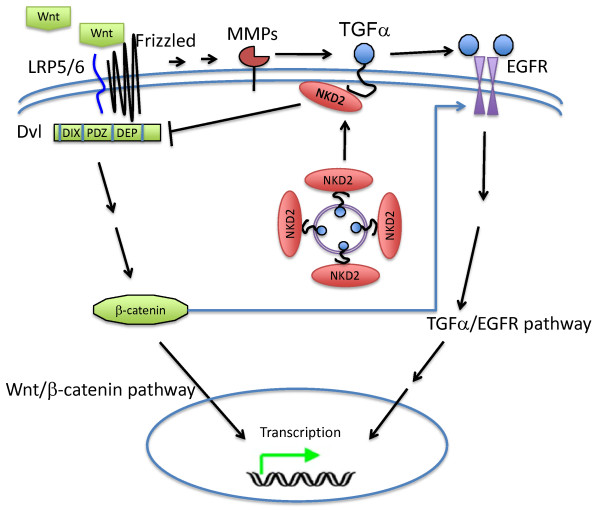
Wnt and EGFR signaling play key roles in embryonic development and cell proliferation. It is well documented that dysregulation of these two pathways often leads to tumorigenesis with poor prognosis. However, the possible crosstalk between the two pathways in cancer development is largely unknown. Although some reports show that EGFR might antagonize Wnt signaling during development in Drosophila, an increasing body of evidence indicates that Wnt and EGFR signaling crosstalk and transactivate one another in development and cancer. This review summarizes recent studies on the crosstalk between Wnt and EGFR signaling in cancers and points out several possible convergence points. Wnt ligands can activate EGFR signaling through their 7-transmembrane domain receptor Frizzled while EGFR can activate β-catenin via receptor tyrosine kinase-PI3K/Akt pathway; EGFR has been shown to form a complex with β-catenin and increase the invasion and metastasis of cancer cells. NKD2, a Wnt antagonist by interacting with Dishevelled, also escorts TGFα-containing exocytic vesicles to the basolateral membrane of polarized epithelial cells. Down-regulation of NKD2 causes Wnt activation and TGFα misdelivery, suggesting its functions in cell homeostasis and prevention of tumorigenesis.
Overview
The claims and statistics of this paper haven’t been checked yet.
Free: it reads the open-access text and checks the first 5 claims that cite a source we can check. Create a free account to check every claim.
Integrity signals
Registry
Cites
Statistics
Figures
Verification
Claims the paper makes
The claims and statistics of this paper haven’t been checked yet.
Free: it reads the open-access text and checks the first 5 claims that cite a source we can check. Create a free account to check every claim.
Claims other papers make about this one
Each is checked against this paper’s own text: does it say what the citing paper says it does?
In the citing paper
“For example, EGFR can form a complex with β-catenin to activate the Wnt pathway, and the Wnt ligand can confer anti-EGFR resistance through its Frizzled activation of EGFR signaling [192,193].”
From Drug Resistance in Colorectal Cancer: From Mechanism to Clinic (2022) · cites this paper as [192]
Self-check
Percentages, sums and reported differences re-computed from the paper’s own numbers.
The self-check needs the paper’s full text.
Citations
Cites
1 retracted
Regulation of β-Catenin Structure and Activity by Tyrosine Phosphorylation
Piedra, J., Martı́nez, D., Castaño, J., Miravet, S., Duñach, M., & de Herreros, A. G. (2001) · Journal of Biological Chemistry · doi:10.1074/jbc.m100194200 · Cited by 262 · cited 1×
“cer cell lines MDA-MB-468 can induce a strong tyrosine phosphorylation of b-catenin [63], that blocks the interaction between b-catenin and E-cadherin and increases the invasiveness and metastatic potential of cancer cells [64,65].”
BackgroundRetractedA genetic model for colorectal tumorigenesis
Fearon, E. R., & Vogelstein, B. (1990) · Cell · doi:10.1016/0092-8674(90)90186-i · Cited by 12,132 · cited 1×
“lying tumor formation and progression [1].”
EGFR Mutation and Resistance of Non–Small-Cell Lung Cancer to Gefitinib
Kobayashi, S., Boggon, T. J., Dayaram, T., Jänne, P. A., Kocher, O., Meyerson, M., Johnson, B. E., Eck, M. J., Tenen, D. G., & Halmos, B. (2005) · New England Journal of Medicine · doi:10.1056/nejmoa044238 · Cited by 3,964
Epidermal growth factor receptor mutations in lung cancer
Sharma, S. V., Bell, D. W., Settleman, J., & Haber, D. A. (2007) · Nature Reviews Cancer · doi:10.1038/nrc2088 · Cited by 3,170 · cited 1×
“For example, among non-small cell lung cancer (NSCLC) patients, 60% have been reported with EGFR overexpression and a poor prognosis (the median survival time is around 4-5 months) [29].”
BackgroundThe T790M mutation in EGFR kinase causes drug resistance by increasing the affinity for ATP
Yun, C.-H., Mengwasser, K. E., Toms, A. V., Woo, M. S., Greulich, H., Wong, K.-K., Meyerson, M., & Eck, M. J. (2008) · Proceedings of the National Academy of Sciences · doi:10.1073/pnas.0709662105 · Cited by 2,118 · cited 2×
“Yun CH, Mengwasser KE, Toms AV, Woo MS, Greulich H, Wong KK, Meyerson M, Eck MJ: The T790M mutation in EGFR kinase causes drug resistance by increasing the affinity for ATP.”
BackgroundAPC mutations occur early during colorectal tumorigenesis
Powell, S. M., Zilz, N., Beazer-Barclay, Y., Bryan, T. M., Hamilton, S. R., Thibodeau, S. N., Vogelstein, B., & Kinzler, K. W. (1992) · Nature · doi:10.1038/359235a0 · Cited by 1,924 · cited 1×
“80% of colon cancers have APC mutations [2] and 50-70% of breast, colon and lung cancers have EGFR and ErB3 mutations [28].”
BackgroundPrenzel, N., Zwick, E., Daub, H., Leserer, M., Abraham, R., Wallasch, C., & Ullrich, A. (1999) · Nature · doi:10.1038/47260 · Cited by 1,504
erb B-2 Is a Potent Oncogene When Overexpressed in NIH/3T3 Cells
Di Fiore, P. P., Pierce, J. H., Kraus, M. H., Segatto, O., King, C. R., & Aaronson, S. A. (1987) · Science · doi:10.1126/science.2885917 · Cited by 1,010 · cited 1×
“tion of NIH-3T3 cells [24,25].”
Wnt5a signaling directly affects cell motility and invasion of metastatic melanoma
Weeraratna, A. T., Jiang, Y., Hostetter, G., Rosenblatt, K., Duray, P., Bittner, M., & Trent, J. M. (2002) · Cancer Cell · doi:10.1016/s1535-6108(02)00045-4 · Cited by 959 · cited 1×
“In vitro studies also confirm that Wnt5A activity increases melanoma invasiveness and that the activity is independent of b-catenin [19].”
BackgroundProstaglandin E 2 Promotes Colon Cancer Cell Growth Through a G s -Axin-ß-Catenin Signaling Axis
Castellone, M. D., Teramoto, H., Williams, B. O., Druey, K. M., & Gutkind, J. S. (2005) · Science · doi:10.1126/science.1116221 · Cited by 883 · cited 1×
“Studies indicate that prostaglandin E2 (PGE2), a product of cyclooxygenase-2 (Cox-2) activity, promotes tumor growth by activating EGFR [43] or b-catenin [ 44 ].”
Background
Cited by
Items 101–200 of 291
O-linked mucin-type glycosylation regulates the transcriptional programme downstream of EGFR
Tajadura‐Ortega, V., Gambardella, G., Skinner, A., Halim, A., Coillie, J. V., Schjoldager, K. T.-B. G., Beatson, R., Graham, R. A., Achkova, D., Taylor‐Papadimitriou, J., et al. (2020) · Glycobiology · doi:10.1093/glycob/cwaa075 · Cited by 42
Dasgupta, S., Jang, J. S., Shao, C., Mukhopadhyay, N. D., Sokhi, U. K., Das, S. K., Brait, M., Talbot, C. C., Yung, R., Begum, S., et al. (2012) · Journal of Molecular Medicine · doi:10.1007/s00109-012-0955-3 · Cited by 36
“Some studies also demonstrated EGFR-PI3KAKT-mediated transactivation of CTNNB1 pathway in prostate cancer [27].”
Filho, M. F. S., Gonella-Diaza, A. M., Sponchiado, M., Mendanha, M. F., Pugliesi, G., Ramos, R. S., Andrade, S. C. S., Gasparin, G. R., Coutinho, L. L., Goissis, M. D., et al. (2017) · Journal of Animal Science and Biotechnology/Journal of animal science and biotechnology · doi:10.1186/s40104-017-0211-3 · Cited by 40
“In addition, the oncogene EGFR, which is associated with growth of placental tissue [56], was downregulated by ECP-treatment suggesting a suppression of the endometrial ability to respond to mitogenic stimuli.”
BackgroundLiu, Y., Zhang, Y., Chen, S., Zhong, X., & Liu, Q. (2023) · Cytokine · doi:10.1016/j.cyto.2023.156185 · Cited by 33
Takahashi, K., Hosono, M., Sato, I., Hata, K., Wada, T., Yamaguchi, K., Nitta, K., Shima, H., & Miyagi, T. (2015) · International Journal of Cancer · doi:10.1002/ijc.29527 · Cited by 40
Huang, J., Duan, L.-X., Liu, Q., Li, H.-F., Hu, A.-P., Song, J., Lin, C., Huang, B., Yao, D., Peng, B., et al. (2023) · Oncogene · doi:10.1038/s41388-023-02645-2 · Cited by 35
“Cross-talk between the Wnt/β-catenin and EGFR signaling pathways has been reported, in which the binding of Wnt ligands to receptors activates the EGFR signaling pathway, and EGFR activate β-catenin via the receptor tyrosine kinase-PI3K/Akt pathway [41].”
BackgroundHuang, T.-Y., Chang, T., Chin, Y., Pan, Y.-S., Chang, W.-J., Liu, F., Hastuti, E. D., Chiu, S.-J., Wang, S.-H., Changou, C. A., et al. (2020) · Cells · doi:10.3390/cells9081830 · Cited by 35
Tseng, J., Wang, B., Wang, Y., Kuo, Y., Chen, J., Hour, T., Kuo, L., Hsiao, P.-J., Yeh, C.-C., Kao, C.-L., et al. (2023) · Phytomedicine · doi:10.1016/j.phymed.2023.154860 · Cited by 34
Chen, Y. (2012) · Oncology Reports · doi:10.3892/or.2012.1726 · Cited by 31
“For example, EGFR overexpression was detected in 60% of non-small cell lung cancer (NSCLC) patients and the prognosis of the patients were poor, with a survival of 4-5 months (29).”
Zaid, K. W. (2014) · Asian Pacific Journal of Cancer Prevention · doi:10.7314/apjcp.2014.15.20.8847 · Cited by 39
“At the same time, β-catenin plays the role of an important marker in the signal transduction mediated by the proto-oncogene byproduct c-erbB2 and epidermal growth factor receptor (EGFR) (Hu and Li, 2010) (Ougolkov et al.”
BackgroundWnt5A expression is associated with the tumor metastasis and clinical survival in cervical cancer.
Lin, L., Liu, Y., Zhao, W., Sun, B., & Chen, Q. (2014) · PubMed Central · Cited by 32
Bestard-Escalas, J., Garate, J., Maimó‐Barceló, A., Fernández, R., Lopez, D. H., Lage, S., Reigada, R., Khorrami, S., Ginard, D., Reyes, J., et al. (2016) · Biochimica et Biophysica Acta (BBA) - Molecular and Cell Biology of Lipids · doi:10.1016/j.bbalip.2016.09.013 · Cited by 32
Perysinakis, I., Minaidou, E., Leontara, V., Mantas, D., Sotiropoulos, G. C., Tsipras, H., Zografos, G. N., Margaris, I., & Kouraklis, G. (2016) · International Journal of Surgical Pathology · doi:10.1177/1066896916664987 · Cited by 30
Sulaiman, A., Sulaiman, B., Khouri, L., McGarry, S., Nessim, C., Arnaout, A., Li, X., Addison, C., Dimitroulakos, J., & Wang, L. (2016) · FEBS Letters · doi:10.1002/1873-3468.12496 · Cited by 31
Dyrk1B overexpression is associated with breast cancer growth and a poor prognosis
Chen, Y., Wang, S., He, Z., Sun, F., Huang, Y., Ni, Q., Wang, H., Wang, Y., & Cheng, C. (2017) · Human Pathology · doi:10.1016/j.humpath.2017.02.033 · Cited by 31
Au, T. H., Wang, K., Stenehjem, D. D., & Garrido‐Laguna, I. (2017) · Journal of Gastrointestinal Oncology · doi:10.21037/jgo.2017.01.04 · Cited by 32
“More than 80% of colonic adenomas and carcinomas have APC gene mutations, where loss of APC function leads to constitutive activation of Wnt signaling (86).”
BackgroundLee, S. G., Cho, Y., Cha, P.-H., Yoon, J.-S., Ro, E. J., Jeong, W.-J., Park, J., Kim, H., Kim, T. I., Min, D. S., et al. (2018) · Experimental & Molecular Medicine · doi:10.1038/s12276-018-0182-2 · Cited by 29
Qiyusanlong decoction suppresses lung cancer in mice via Wnt/β-catenin pathway
Tong, J., Zhang, X., Wang, X., Zeng, S., Wang, D., Zhang, Z., Hu, J. M., Yang, C., & Li, Z. (2018) · Molecular Medicine Reports · doi:10.3892/mmr.2018.8478 · Cited by 36
“Dysregulation of the Wnt/ β -catenin pathway may be an important factor contributing to increased maintenance and proliferation signaling in various cancers (11), including lung cancer (12).”
Kim, N. Y., Mohan, C. D., Chinnathambi, A., Alharbi, S. A., Sethi, G., Rangappa, K. S., & Ahn, K. S. (2022) · Molecules · doi:10.3390/molecules27123824 · Cited by 29
Zhang, H., Li, J., Luo, H., Zhao, L., Zhang, Z., & Shen, X. (2018) · Phytomedicine · doi:10.1016/j.phymed.2018.11.019 · Cited by 29
Nonmicrobial Activation of TLRs Controls Intestinal Growth, Wound Repair, and Radioprotection
Stenson, W. F., & Ciorba, M. A. (2021) · Frontiers in Immunology · doi:10.3389/fimmu.2020.617510 · Cited by 31
“There are points of convergence of EGFR signaling and theWnt/b-catenin pathway (65, 72).”
BackgroundHanisch, C., Sharbati, J., Kutz-Lohroff, B., Huber, O., Einspanier, R., & Sharbati, S. (2017) · Cell Death Discovery · doi:10.1038/cddiscovery.2016.106 · Cited by 27
Wingless promotes EGFR signaling in follicle stem cells to maintain self-renewal
Kim, R., & Nystul, T. G. (2018) · Development · doi:10.1242/dev.168716 · Cited by 25
“Both EGFR and Notch signaling are known to interact with Wnt signaling in other tissues (Cordero et al., 2012; Freeman andBienz, 2001; Hing et al., 1994; Hu and Li, 2010;Nagaraj and Banerjee, 2009; Szüts et al., 1997) and have spatially restricted activity in the FSC lineage (Castanieto et al.”
BackgroundImproving the efficacy of anti-EGFR drugs in GBM: Where we are going?
Ge, M., Zhu, Y., Wei, M., Piao, H., & He, M. (2023) · Biochimica et Biophysica Acta (BBA) - Reviews on Cancer · doi:10.1016/j.bbcan.2023.188996 · Cited by 27
Effects of Wnt/β-catenin signaling on bisphenol A exposure in male mouse reproductive cells
FANG, Z., Liu, X., YANG, X., Song, X., & Chen, X. (2015) · Molecular Medicine Reports · doi:10.3892/mmr.2015.4028 · Cited by 26
Wang, K., Park, J. O., & Zhang, M. (2013) · The Journal of Gene Medicine · doi:10.1002/jgm.2693 · Cited by 24
“An interesting finding was that the inhibition of EGFR also suppressed the mRNA expression of b-catenin, suggesting that cross-talk between these two pathways which has been described in many other types of cancers [29,37,38] may also be present in GBM.”
BackgroundZou, J., Zhang, W., & Li, X. (2017) · Calcified Tissue International · doi:10.1007/s00223-016-0231-6 · Cited by 28
Chemopreventive effects of berberine on intestinal tumor development in Apc min/+mice
Cao, H., Song, S., Zhang, H., Zhang, Y., Qu, R., Yang, B., Yang, J., Hu, T., Yan, F., & Wang, B. (2013) · BMC Gastroenterology · doi:10.1186/1471-230x-13-163 · Cited by 27
“Recently, increasing evidence indicates that both Wnt and EGFR signaling pathways mediate β-catenin activation [32].”
Self-citationAhmed, H. H., El-Abhar, H. S., Hassanin, E. A. K., Abdelkader, N. F., & Shalaby, M. B. (2017) · Biomedicine & Pharmacotherapy · doi:10.1016/j.biopha.2017.08.103 · Cited by 24
Grzes, M., Oroń, M., Staszczak, Z., Jaiswar, A., Nowak-Niezgoda, M., & Walerych, D. (2020) · Cancers · doi:10.3390/cancers12061532 · Cited by 26
Han, Y., Park, J., Cha, J.-Y., Jeong, M., Go, E., & Hahm, K. B. (2015) · International Journal of Cancer · doi:10.1002/ijc.29956 · Cited by 24
“Normally b-catenin phosphorylation leads to its degradation, which is triggered by the formation of a complex containing Axin and b-catenin.(31) As shown in Figure 2a, GSK3b phosphorylation was increased in Apcmice, resulting in abundant b-catenin accumulation in the cytoplasm, increased Tcf-4 and Lef-1levels in nucle…”
BackgroundCaspi, M., Firsow, A., Rajkumar, R., Skalka, N., Moshkovitz, I., Munitz, A., Pasmanik‐Chor, M., Greif, H., Megido, D., Kariv, R., et al. (2015) · Journal of Molecular Medicine · doi:10.1007/s00109-015-1364-1 · Cited by 24
“Most genes were downregulated (455 out of 654), and among these are many that are known to be tightly involved in the Wnt signaling cascade, such as EGF [60].”
BackgroundChen, J., Xie, Z.-R., & Wu, Y. (2014) · PLoS ONE · doi:10.1371/journal.pone.0100702 · Cited by 22
“Furthermore, other signaling pathways such as notch [72] or EGF [73] can bring additional effects through the signaling crosstalk.”
BackgroundLoss of EGFR-ASAP1 signaling in metastatic and unresectable hepatoblastoma
Ranganathan, S., Ningappa, M., Ashokkumar, C., Higgs, B. W., Min, J., Sun, Q., Schmitt, L. A., Subramaniam, S., Hakonarson, H. H., & Sindhi, R. K. (2016) · Scientific Reports · doi:10.1038/srep38347 · Cited by 23
Morgan, G., Mortensson, E., Legge, D., Gupta, B., Collard, T. J., Greenhough, A., & Williams, A. C. (2017) · British Journal of Cancer · doi:10.1038/bjc.2017.412 · Cited by 23
“Given that LGR5 is a Wnt target gene (Barker et al, 2007), and crosstalk exists between EGFR and Wnt/b-catenin signalling pathways (Hu and Li, 2010), we examined whether EGF regulation of LGR5 was indirect through inhibition of Wnt signalling.”
BackgroundZhang, Y., Xue, Q., Pan, G., Meng, Q. H., Tuo, X., Cai, X., Chen, Z., Li, Y., Huang, T., Duan, X., et al. (2017) · PLoS ONE · doi:10.1371/journal.pone.0169098 · Cited by 23
FASN Knockdown Inhibited Anoikis Resistance of Gastric Cancer Cells via P-ERK1/2/Bcl-xL Pathway
Li, Y., Wang, X., Du, Y., Zhang, X., & Ling, Y. (2021) · Gastroenterology Research and Practice · doi:10.1155/2021/6674204 · Cited by 23
“PERK1/2 may serve as an important hub in the network, as it occurs crosstalk with other pathways, including phosphatidylinositol 3-kinase (PI3K) [35], and Wnt [36].”
BackgroundTemporal photoproximity labeling of ligand-activated EGFR neighborhoods using MultiMap
Lin, Z., Ngo, W., Chou, Y., Wu, H., Susa, K. J., Jun, Y., Bivona, T. G., Doudna, J. A., & Wells, J. A. (2025) · Nature Chemical Biology · doi:10.1038/s41589-025-02076-y · Cited by 30
“Activated EGFR also drives transcription through the regulation of a number of transcription factors including STAT3 and β-catenin 47,48,70,71 .”
Sex Differences in Colon Cancer: Genomic and Nongenomic Signalling of Oestrogen
Harvey, B. J., & Harvey, H. M. (2023) · Genes · doi:10.3390/genes14122225 · Cited by 25
“The receptor tyrosine kinase pathway, particularly the EGFR pathway, can cross-regulate Wnt signalling in colon cancer [213].”
BackgroundAutocrine Motility Factor Modulates EGF-Mediated Invasion Signaling
Kho, D. H., Zhang, T., Balan, V., Wang, Y., Ha, S.-W., Xie, Y., & Raz, A. (2014) · Cancer Research · doi:10.1158/0008-5472.can-13-2937 · Cited by 20
“As EGF/EGFR can activate -catenin via receptor tyrosine kinase-PI3K/AKT pathway in invasion and metastasis of cancer cells (25) and chimeric AMF can also induce PI3K/AKT, we addressed whether EGF/EGFR and/or PI3K/AKT is associated with AMFactivated -catenin pathway.”
BackgroundYin, X., Yi, H., Wang, L., Wu, W., Wu, X., & Yu, L. (2017) · Oncology Letters · doi:10.3892/ol.2017.6339 · Cited by 21
“Activation of Wnt/β-catenin results in the increased expression level of its target genes, including cyclin D1 and c-Myc, which are important for driving tumorigenesis in numerous types of cancer (24).”
BackgroundNCOA3 is a critical oncogene in thyroid cancer via the modulation of major signaling pathways
Li, Y., Liang, J., Dang, H., Zhang, R., Chen, P., & Shao, Y. (2021) · Endocrine · doi:10.1007/s12020-021-02819-6 · Cited by 20
Kong, K., Kumar, M., Taruishi, M., & Javier, R. T. (2015) · Journal of Virology · doi:10.1128/jvi.01463-15 · Cited by 20
Xu, Y., Wu, G., Zhang, J., Li, J., Ruan, N., Zhang, J., Zhang, Z., Chen, Y., Zhang, Q., & Xia, Q. (2020) · BioMed Research International · doi:10.1155/2020/8409239 · Cited by 20
Identification of Genetic Mutations in Human Lung Cancer by Targeted Sequencing
Feng, H., Wang, X., Zhang, Z., Tang, C., Ye, H., Jones, L. E., Lou, F., Zhang, D., Jiang, S., Sun, H., et al. (2015) · Cancer Informatics · doi:10.4137/cin.s22941 · Cited by 22
Flowers, S. A., Zhou, X., Wu, J., Wang, Y., Makambi, K. H., Kallakury, B., Singer, M. S., Rosen, S. D., Davidson, B. J., & Goldman, R. (2016) · Oncotarget · doi:10.18632/oncotarget.9506 · Cited by 21
“Interestingly, the epidermal growth factor receptor (EGFR), an important pathway in HNSCC and current target for treatment [39], and Wnt signaling pathways have potential crosstalk via β-catenin [40].”
BackgroundHuang, Y.-H., Zhang, R., Lyu, H., Xiao, S., Guo, D. S., Chen, X., Zhou, C., & Tang, J. (2024) · International Journal of Biological Sciences · doi:10.7150/ijbs.91832 · Cited by 21
Hsp70 exerts oncogenic activity in the Apc mutant Min mouse model
Tao, Y., Messer, J. S., Goss, K. H., Hart, J. A. L., Bissonnette, M., & Chang, E. B. (2016) · Carcinogenesis · doi:10.1093/carcin/bgw056 · Cited by 21
Caspi, M., Firsow, A., Rajkumar, R., Skalka, N., Moshkovits, I., Munitz, A., Pasmanik‐Chor, M., Greif, H., Megiddo, D., Kariv, R., et al. (2016) · Journal of Molecular Medicine · doi:10.1007/s00109-016-1394-3 · Cited by 18
“Plasmid design pEGFP-C2-BFPwas constructed by inserting the BFP ORF into the pEGFP-C2 vector (catalog number 6083-1; Invitrogen) using the KpnI and HindIII restriction enzymes (for the full map, see supplementary data).”
InfluentialSireci, S., Kocagöz, Y., Alkiraz, A. S., Güler, K., Dokuzluoglu, Z., Balcioglu, E., Meydanli, S., Demirler, M. C., Söğünmez, N., & Fuss, S. H. (2023) · FEBS Journal · doi:10.1111/febs.17033 · Cited by 18
“9), synergistically or redundantly to Notch, may play a more prominent role through direct induction of Wnt signaling [93,99,106] in zebrafish HBCs.”
Backgroundβ-catenin interaction with NHERF1 and RASSF1A methylation in metastatic colorectal cancer patients
Schirosi, L., Mazzotta, A., Opinto, G., Pinto, R., Graziano, G., Tommasi, S., Fucci, L., Simone, G., & Mangia, A. (2016) · Oncotarget · doi:10.18632/oncotarget.12280 · Cited by 17
“The Wilcoxon signedrank test showed that the median expression of the RASSF1A protein in T was significantly lower that LM (30[2-70] and 60[25-85], respectively with p = 0.”
BackgroundSur, S., Pal, D., Banerjee, K., Mandal, S., Das, A., Roy, A. K., & Panda, C. K. (2015) · Molecular Carcinogenesis · doi:10.1002/mc.22356 · Cited by 16
Transcription Factor Zbtb20 as a Regulator of Malignancy and Its Practical Applications
Stoyanov, D. S., Stoyanov, G. S., Ivanov, M. N., Spasov, R. H., & Tonchev, A. B. (2023) · International Journal of Molecular Sciences · doi:10.3390/ijms241813763 · Cited by 16
Nakamoto, M., & Hisaoka, M. (2016) · Journal of UOEH · doi:10.7888/juoeh.38.1 · Cited by 18
Dittmar, Y., & Settmacher, U. (2015) · World Journal of Gastrointestinal Oncology · doi:10.4251/wjgo.v7.i11.292 · Cited by 16
Multiple gene aberrations and breast cancer: lessons from super-responders
Wheler, J. J., Atkins, J. T., Jankú, F., Moulder, S., Yelensky, R., Stephens, P. J., & Kurzrock, R. (2015) · BMC Cancer · doi:10.1186/s12885-015-1439-y · Cited by 15
“Systems biology approaches that map convergence pathways may therefore enhance treatment for patients [5, 6, 44, 45].”
BackgroundChandler, K. B., Alamoud, K. A., Stahl, V. L., Nguyen, B.-C., Kartha, V. K., Bais, M. V., Nomoto, K., Owa, T., Monti, S., Kukuruzinska, M. A., et al. (2020) · Molecular Omics · doi:10.1039/d0mo00009d · Cited by 15
PKM2: A New Player in the β-Catenin Game
Canal, F., & Perret, C. (2012) · Future Oncology · doi:10.2217/fon.12.11 · Cited by 15
Wang, D., Zhang, S., Chen, Y., Hu, B., & Lu, C. (2017) · Human Pathology · doi:10.1016/j.humpath.2017.09.016 · Cited by 15
Koltes, J. E., Kumar, D., Kataria, R. S., Cooper, V. L., & Reecy, J. M. (2015) · BMC Research Notes · doi:10.1186/s13104-015-1136-6 · Cited by 16
“Many over-represented pathways detected by Pathway studio appear to be involved primarily in the control of proliferation, apoptosis or a combination of both processes [14-22].”
BackgroundMartinez, H. D., Hsiao, J. J., Jasavala, R. J., Hinkson, I. V., Eng, J. K., & Wright, M. E. (2011) · Genes & Cancer · doi:10.1177/1947601912436422 · Cited by 16
Pfefferle, A. D., Darr, D. B., Calhoun, B. C., Mott, K. R., Rosen, J. M., & Perou, C. M. (2019) · Disease Models & Mechanisms · doi:10.1242/dmm.037192 · Cited by 14
“…In addition to canonical and non-canonical signaling, Wntassociated genes can also crosstalk with a variety of other signal transduction pathways (Collu et al., 2014; Nishita et al., 2000; Shackleford et al., 1993), including epidermal growth factor receptor (EGFR) signaling (Hu and Li, 2010).”
BackgroundSHP2 Potentiates the Oncogenic Activity of β-Catenin to Promote Triple-Negative Breast Cancer
Martin, E., & Agazie, Y. M. (2021) · Molecular Cancer Research · doi:10.1158/1541-7786.mcr-21-0060 · Cited by 14
“Although not in the context of SHP2, previous studies have shown a positive role for RTKs in stabilizing b-catenin in the absence ofWnt signaling (39, 40).”
ResultRe, V. D., Alessandrini, L., Brisotto, G., Caggiari, L., Zorzi, M. D., Casarotto, M., Miolo, G., Puglisi, F., Garattini, S. K., Lonardi, S., et al. (2022) · Cancers · doi:10.3390/cancers14051266 · Cited by 13
Stache, C., Bils, C., Fahlbusch, R., Flitsch, J., Buchfelder, M., Stefanits, H., Czech, T., Gaipl, U. S., Frey, B., Buslei, R., et al. (2016) · Neurosurgical FOCUS · doi:10.3171/2016.9.focus16316 · Cited by 13
Lee, S., Lee, C. H., Choi, S. H., Ahn, S. H., Son, B. H., Lee, J. W., Yu, J. H., Kwon, N., Lee, W. C., Yang, K., et al. (2017) · Oncology Letters · doi:10.3892/ol.2017.5807 · Cited by 12
“Previous studies have reported several genetic mutations, including HER2, BRCA, PIK3CA, TP53, GATA3 and PTEN in patients with breast cancer (20-25).”
Niiro, E., Morioka, S., Iwai, K., Yamada, Y., Ogawa, K., Kawahara, N., & Kobayashi, H. (2018) · Biomedical Reports · doi:10.3892/br.2018.1045 · Cited by 15
“The WNT receptors and their downstream components are being investigated as potential targets in the development of novel anticancer therapies (5,6).”
Al‐Hamaly, M. A., Cox, A. H., Haney, M. G., Zhang, W., Arvin, E. C., Sampathi, S., Wimsett, M., Liu, C., & Blackburn, J. S. (2023) · Biomedicine & Pharmacotherapy · doi:10.1016/j.biopha.2023.116013 · Cited by 13
“Components of the EGFR pathway translocate into the nucleus and promote β -catenin’s transcriptional activity [86,87].”
BackgroundKhan, I. R., Sadida, H. Q., Hashem, S., Singh, M. K., Macha, M. A., Akil, A. S. A.-S., Khurshid, I., & Bhat, A. A. (2024) · Biomedicine & Pharmacotherapy · doi:10.1016/j.biopha.2024.116873 · Cited by 13
Rasha, F. A., Boligala, G. P., Yang, M. V., Martinez‐Marin, D., Castro‐Piedras, I., Furr, K. L., Snitman, A., Khan, S. Y., Brandi, L., Castro, M., et al. (2023) · BMC Cancer · doi:10.1186/s12885-023-10647-2 · Cited by 12
“Previous studies reported that Wnt and EGFR plays key role in embryonic development and cell proliferation and the crosstalk between two pathways often leads to tumorigenesis with poor prognosis [41, 56].”
BackgroundSingh, G., Hossain, M. S., Bhat, A. Q., Ayaz, M. O., Bano, N., Eachkoti, R., & Dar, M. J. (2020) · Cellular Signalling · doi:10.1016/j.cellsig.2020.109885 · Cited by 11
Beck, M., Baranger, M., Moufok-Sadoun, A., Bersuder, E., Hinkel, I., Mellitzer, G., Martin, E., Marisa, L., Duluc, I., de Reyniès, A., et al. (2020) · Oncogene · doi:10.1038/s41388-020-01546-y · Cited by 11
“One attractive candidate for MUCDHL M is the epithelial growth factor receptor (EGFR) that has been connected to both cadherins and ßcatenin signaling [25, 26].”
BackgroundSIRT7 stabilizes β-catenin and promotes canonical Wnt activation via upregulating FZD7
Gu, Y., Wang, Z., Liang, G., Peng, J., Zhang, X., Yu, T., Ding, C., & Li, Z. (2024) · Life Sciences · doi:10.1016/j.lfs.2024.123240 · Cited by 11
Li, C.-J., Tsai, H., Chen, Y., Wang, C., Lin, Y.-H., Chu, P., Chi, H., Huang, Y.-C., & Chen, C. (2023) · Journal of Hepatocellular Carcinoma · doi:10.2147/jhc.s385238 · Cited by 11
“Additionally, several signaling pathways, such as the epidermal growth factor receptor, mitogen-activated protein kinase, PI3K/Akt and Wnt pathways, are associated with chemoresistance in cancer.(47) Previously, Guo et al reported that the phosphatase activity of PTP4A3 is important and correlated with tumorassociated…”
BackgroundSelf-citationShahzad, U., Taccone, M. S., Kumar, S. A., Okura, H., Krumholtz, S. L., Ishida, J., Mine, C., Gouveia, K., Edgar, J. M., Smith, C. A., et al. (2020) · Neuro-Oncology · doi:10.1093/neuonc/noaa306 · Cited by 13
Characterization of Hepatitis B Virus Integrations Identified in Hepatocellular Carcinoma Genomes
Mathkar, P. P., Chen, X., Sulovari, A., & Li, D. (2021) · Viruses · doi:10.3390/v13020245 · Cited by 10
Marttinen, M., Päivärinta, E., Storvik, M., Huikko, L., Luoma-Halkola, H., Piironen, V. I., Pajari, A., & Mutanen, M. L. (2012) · The Journal of Nutritional Biochemistry · doi:10.1016/j.jnutbio.2012.07.002 · Cited by 11
Trefoil factor 3 mediates resistance to apoptosis in colon carcinoma cells by a regulatory RNA axis
Hanisch, C., Sharbati, J., Kutz-Lohroff, B., Huber, O., Einspanier, R., & Sharbati, S. (2017) · Cell Death and Disease · doi:10.1038/cddis.2017.84 · Cited by 10
Dong, Y., Wu, X., Hao, Y., Liu, W., Hu, X., Zhou, J., Li, X., & Wang, B. (2025) · Journal of Bone and Mineral Research · doi:10.1093/jbmr/zjaf017 · Cited by 9
Saadh, M. J., Ghnim, Z. S., Mahdi, M. S., Mandaliya, V. B., Ballal, S., Bareja, L., Chaudhary, K., Sharma, R., Gupta, S., Taher, W. M., et al. (2025) · Pathology - Research and Practice · doi:10.1016/j.prp.2025.155904 · Cited by 9
Thyroid Hormone Induces Oral Cancer Growth via the PD-L1-Dependent Signaling Pathway
Su, K.-W., Lin, H., Chiu, H., Shen, S.-Y., Changou, C. A., Crawford, D. R., Yang, Y. S. H., Shih, Y.-J., Li, Z., Huang, H., et al. (2022) · Cells · doi:10.3390/cells11193050 · Cited by 11
Piperonylic Acid Promotes Hair Growth by Activation of EGFR and Wnt/β-Catenin Pathway
Han, S. H., Jo, K. W., Kim, Y., & Kim, K. (2024) · International Journal of Molecular Sciences · doi:10.3390/ijms251910774 · Cited by 11
“In summary, piperonylic acid activates the EGFR signaling pathway in KNU201 cells and pDPCs. Crosstalk between the EGFR and the Wnt/ β -catenin signaling pathway is widely reported [39–41].”
BackgroundDownregulation of PIK3CA via antibody-esiRNA-complexes suppresses human xenograft tumor growth
Bäumer, N., Rehkämper, J., Appel, N., Terheyden, L., Hartmann, W., Wardelmann, E., Buchholz, F., Müller‐Tidow, C., Berdel, W. E., & Bäumer, S. (2018) · PLoS ONE · doi:10.1371/journal.pone.0200163 · Cited by 9
Nkd2 promotes the differentiation of dental follicle stem/progenitor cells into osteoblasts
Chen, C., Zhan, J., Ling, J., Du, Y., & Hou, Y. (2018) · International Journal of Molecular Medicine · doi:10.3892/ijmm.2018.3822 · Cited by 9
Fujimura, T., Furugaki, K., Mizuta, H., Muraoka, S., Nishio, M., Adachi, J., Uchibori, K., Miyauchi, E., Hayashi, H., Katayama, R., et al. (2024) · npj Precision Oncology · doi:10.1038/s41698-024-00757-w · Cited by 9
“However, some studies have suggested that dysregulation of the Wnt pathway may be an important factor contributing to enhanced maintenance and proliferation signaling in various cancers 47,48 , and crosstalk between EGFR and the Wnt signal pathway may enhance lung cancer tumorigenesis 47,49,50 .”
Intestinal Wnt in the transition from physiology to oncology
Swoboda, J., Mittelsdorf, P., Chen, Y., Weiskirchen, R., Stallhofer, J., Schüle, S., & Gaßler, N. (2022) · World Journal of Clinical Oncology · doi:10.5306/wjco.v13.i3.168 · Cited by 10
Wu, M. C., Wu, Y. R., Lan, T., Jiang, L., Qian, H., & Chen, Y. (2016) · Molecular Medicine Reports · doi:10.3892/mmr.2016.5452 · Cited by 8
“In vitro experiments have previously confirmed that overexpression of EGFR caused transformation of NIH-3T3, Rat-1 and NRK cells, and blocking EGFR activation inhibited proliferation of certain tumor cells (21).”
Shikonin enhances chemosensitivity of oral cancer through β‐catenin pathway
Xiang, Y., Si, L., Zheng, Y. F., & Wang, H. (2022) · Oral Diseases · doi:10.1111/odi.14458 · Cited by 8
Kim, Y. R., & Kim, S. Y. (2018) · Journal of Cancer Research and Clinical Oncology · doi:10.1007/s00432-018-2676-7 · Cited by 10
Wnt pathway markers in molecular subgroups of glioblastoma
Tompa, M., Nagy, Á., Komoly, S., & Kalman, B. (2019) · Brain Research · doi:10.1016/j.brainres.2019.05.008 · Cited by 8
Battling Glioblastoma: A Novel Tyrosine Kinase Inhibitor with Multi-Dimensional Anti-Tumor Effect
Viswanathan, A., Musa, A., Murugesan, A., Vale, J. R., Afonso, C. A. M., Saravanan, K. M., Yli-Harja, O. P., Candeias, N. R., & Kandhavelu, M. (2019) · Cells · doi:10.3390/cells8121624 · Cited by 8
Prognostic significance of WNT signaling in pancreatic ductal adenocarcinoma
Nakamoto, M., Matsuyama, A., Shiba, E., Shibuya, R., Kasai, T., Yamaguchi, K., & Hisaoka, M. (2014) · Archiv für Pathologische Anatomie und Physiologie und für Klinische Medicin · doi:10.1007/s00428-014-1642-2 · Cited by 8
“The WNT signaling pathway is essential for proliferation, morphogenesis, and differentiation of several organs [9], and has been implicated in the development or progression of various cancers [10].”
BackgroundDenčić, T. I., Bartolome, A., Šelemetjev, S., Đorić, I., Tatic, S. B., Zivaljevic, V. R., & Cvejic, D. S. (2018) · Experimental and Molecular Pathology · doi:10.1016/j.yexmp.2018.08.001 · Cited by 8
ZHANG, Y., Xiao, Q., Zhang, H., Sun, X., GE, H., Liu, X., GUAN, L., & Sun, M. (2014) · Oncology Reports · doi:10.3892/or.2014.3041 · Cited by 7
“In addition, the Wnt/β-catenin and EGFR signaling pathways can crosstalk in cancer (22).”
BackgroundCell-based assay for low- and high-scale screening of the Wnt/β-catenin signaling modulators
Mazur, M., Bujak, A., Matłoka, M., Janowska, S., Gunerka, P., Bojarski, Ł., Stanczak, A. M., Klejman, A., Bednarek, A. K., Lamparska‐Przybysz, M., et al. (2015) · Analytical Biochemistry · doi:10.1016/j.ab.2015.01.016 · Cited by 8
Expression and prognostic significance of NKD2 in ovarian cancer
Wei, W., Zheng, L., Gao, Y., He, M., & Yang, F. (2020) · Japanese Journal of Clinical Oncology · doi:10.1093/jjco/hyaa244 · Cited by 7
The Conflicting Prognostic Role of the Stroma–Tumor Ratio in Breast Cancer Molecular Subtypes
Ghannam, S. F., Makhlouf, S., Alsaleem, M. A., Rutland, C. S., Allegrucci, C., Mongan, N. P., & Rakha, E. A. (2024) · Modern Pathology · doi:10.1016/j.modpat.2024.100607 · Cited by 11
Samandar, F., Mohsenpour, A., Rastin, F., Doustmohammadi-Salmani, S., Saberi, M. R., & Chamani, J. (2024) · Spectrochimica Acta Part A Molecular and Biomolecular Spectroscopy · doi:10.1016/j.saa.2024.125638 · Cited by 7
Reilly, K. M. (2013) · Cancer Discovery · doi:10.1158/2159-8290.cd-13-0192 · Cited by 7
Chaikhumwang, P., Nilubol, D., Tantituvanont, A., & Chanvorachote, P. (2017) · European Journal of Pharmaceutical Sciences · doi:10.1016/j.ejps.2017.05.054 · Cited by 8
Metadata
- Authors
- Hu, T., & Li, C.
- Affiliations
- Xiamen University (CN)
- Vanderbilt University (US)
- Corresponding author
- Hu, Tianhui
- Li, Cunxi
- ORCID
- Venue
- Molecular Cancer
- Published
- 2010
- Volume
- 9
- Issue
- 1
- Pages
- 236
- ISSN
- 1476-4598 (ISSN-L)
- PMC
- PMC2944186
- OpenAlex
- W2130473918
- Semantic Scholar
- 37699e551487b2e80611f69ed570cf299df50f6e
- Cited by
- 291
- References
- 78
- Citations by year
- 2026: 16 · 2025: 14 · 2024: 21 · 2023: 18 · 2022: 11 · 2021: 18 · 2020: 19 · 2019: 14 · 2018: 21 · 2017: 19 · 2016: 19 · 2015: 26 · 2014: 20 · 2013: 21 · 2012: 19
- FWCI
- 1.55
- Type
- journal article
- Language
- en
- Open access
- gold
- doi.org
- Licence
- cc-by
- Locations
- Molecular Cancer (publishedVersion, cc-by)
- PubMed Central (publishedVersion, cc-by)
- PubMed (publishedVersion)
- DOAJ (DOAJ: Directory of Open Access Journals) (submittedVersion)
- Funders
- National Natural Science Foundation of China (30971524)
- Topics
- Life Sciences › Biochemistry, Genetics and Molecular Biology › Molecular Biology › Wnt/β-catenin signaling in development and cancer
- Health Sciences › Medicine › Oncology › Colorectal Cancer Treatments and Studies
- Health Sciences › Medicine › Oncology › HER2/EGFR in Cancer Research
- Keywords
- Wnt signaling, EGFR signaling, pathway crosstalk, β-catenin, Frizzled receptors, PI3K/Akt signaling, NKD2, epithelial polarization, tumor invasion and metastasis, carcinogenesis, Dishevelled
- MeSH terms
- Animals, Humans, Models, Biological, Neoplasms, Signal Transduction, Wnt Proteins, beta Catenin, ErbB Receptors
About these checks
Registry, retraction, Cites and statistics results are computed, not judged, with one exception: a printed reference that no index lists is read once by a model before it counts as a citation error. Claims are extracted by a model and kept only when their quote appears verbatim in the text; each cited source is then checked, with a model’s help, for whether it says what the claim relies on. Those verdicts can be wrong — read the claim’s quote and the cited source before relying on one.
Statistics and arithmetic are recomputed, not judged.
Confidence bands are shown only for fields calibrated on our annotated test set. None is calibrated yet, so no band is shown.
What counts as a claim ›How we measure confidence ›How we check this ›
Are you an author, or do you see a problem with this page? Request a review
Data sources
Bibliographic data: Semantic Scholar, OpenAlex, Crossref.
Contains information from the Semantic Scholar Academic Graph Datasets, made available under the ODC Attribution License (ODC-BY 1.0).
Semantic Scholar’s data is described in: Kinney, R., et al. (2023). The Semantic Scholar Open Data Platform. arXiv:2301.10140.
