

Convergence between Wnt-β-catenin and EGFR signaling in cancer
Open accessThe DOI matches its Crossref record; 77 of the 78 references it cites were found in a registry or an index.
Abstract
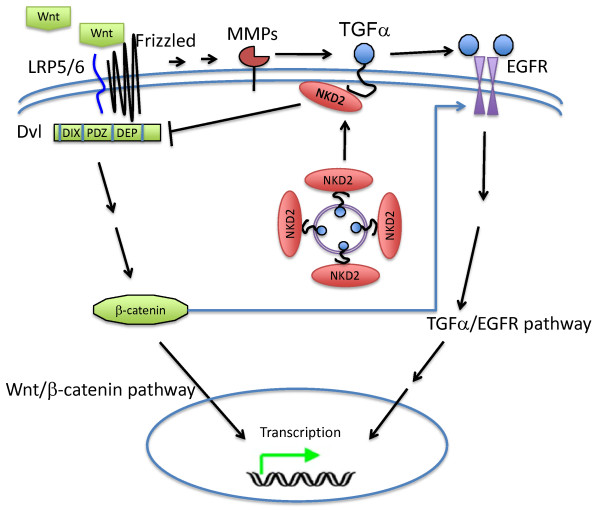
Wnt and EGFR signaling play key roles in embryonic development and cell proliferation. It is well documented that dysregulation of these two pathways often leads to tumorigenesis with poor prognosis. However, the possible crosstalk between the two pathways in cancer development is largely unknown. Although some reports show that EGFR might antagonize Wnt signaling during development in Drosophila, an increasing body of evidence indicates that Wnt and EGFR signaling crosstalk and transactivate one another in development and cancer. This review summarizes recent studies on the crosstalk between Wnt and EGFR signaling in cancers and points out several possible convergence points. Wnt ligands can activate EGFR signaling through their 7-transmembrane domain receptor Frizzled while EGFR can activate β-catenin via receptor tyrosine kinase-PI3K/Akt pathway; EGFR has been shown to form a complex with β-catenin and increase the invasion and metastasis of cancer cells. NKD2, a Wnt antagonist by interacting with Dishevelled, also escorts TGFα-containing exocytic vesicles to the basolateral membrane of polarized epithelial cells. Down-regulation of NKD2 causes Wnt activation and TGFα misdelivery, suggesting its functions in cell homeostasis and prevention of tumorigenesis.
Overview
The claims and statistics of this paper haven’t been checked yet.
Free: it reads the open-access text and checks the first 5 claims that cite a source we can check. Create a free account to check every claim.
Integrity signals
Registry
Cites
Statistics
Figures
Verification
Claims the paper makes
The claims and statistics of this paper haven’t been checked yet.
Free: it reads the open-access text and checks the first 5 claims that cite a source we can check. Create a free account to check every claim.
Claims other papers make about this one
Each is checked against this paper’s own text: does it say what the citing paper says it does?
In the citing paper
“For example, EGFR can form a complex with β-catenin to activate the Wnt pathway, and the Wnt ligand can confer anti-EGFR resistance through its Frizzled activation of EGFR signaling [192,193].”
From Drug Resistance in Colorectal Cancer: From Mechanism to Clinic (2022) · cites this paper as [192]
Self-check
Percentages, sums and reported differences re-computed from the paper’s own numbers.
The self-check needs the paper’s full text.
Citations
Cites
1 retracted
Regulation of β-Catenin Structure and Activity by Tyrosine Phosphorylation
Piedra, J., Martı́nez, D., Castaño, J., Miravet, S., Duñach, M., & de Herreros, A. G. (2001) · Journal of Biological Chemistry · doi:10.1074/jbc.m100194200 · Cited by 262 · cited 1×
“cer cell lines MDA-MB-468 can induce a strong tyrosine phosphorylation of b-catenin [63], that blocks the interaction between b-catenin and E-cadherin and increases the invasiveness and metastatic potential of cancer cells [64,65].”
BackgroundRetractedA genetic model for colorectal tumorigenesis
Fearon, E. R., & Vogelstein, B. (1990) · Cell · doi:10.1016/0092-8674(90)90186-i · Cited by 12,132 · cited 1×
“lying tumor formation and progression [1].”
EGFR Mutation and Resistance of Non–Small-Cell Lung Cancer to Gefitinib
Kobayashi, S., Boggon, T. J., Dayaram, T., Jänne, P. A., Kocher, O., Meyerson, M., Johnson, B. E., Eck, M. J., Tenen, D. G., & Halmos, B. (2005) · New England Journal of Medicine · doi:10.1056/nejmoa044238 · Cited by 3,964
Epidermal growth factor receptor mutations in lung cancer
Sharma, S. V., Bell, D. W., Settleman, J., & Haber, D. A. (2007) · Nature Reviews Cancer · doi:10.1038/nrc2088 · Cited by 3,170 · cited 1×
“For example, among non-small cell lung cancer (NSCLC) patients, 60% have been reported with EGFR overexpression and a poor prognosis (the median survival time is around 4-5 months) [29].”
BackgroundThe T790M mutation in EGFR kinase causes drug resistance by increasing the affinity for ATP
Yun, C.-H., Mengwasser, K. E., Toms, A. V., Woo, M. S., Greulich, H., Wong, K.-K., Meyerson, M., & Eck, M. J. (2008) · Proceedings of the National Academy of Sciences · doi:10.1073/pnas.0709662105 · Cited by 2,118 · cited 2×
“Yun CH, Mengwasser KE, Toms AV, Woo MS, Greulich H, Wong KK, Meyerson M, Eck MJ: The T790M mutation in EGFR kinase causes drug resistance by increasing the affinity for ATP.”
BackgroundAPC mutations occur early during colorectal tumorigenesis
Powell, S. M., Zilz, N., Beazer-Barclay, Y., Bryan, T. M., Hamilton, S. R., Thibodeau, S. N., Vogelstein, B., & Kinzler, K. W. (1992) · Nature · doi:10.1038/359235a0 · Cited by 1,924 · cited 1×
“80% of colon cancers have APC mutations [2] and 50-70% of breast, colon and lung cancers have EGFR and ErB3 mutations [28].”
BackgroundPrenzel, N., Zwick, E., Daub, H., Leserer, M., Abraham, R., Wallasch, C., & Ullrich, A. (1999) · Nature · doi:10.1038/47260 · Cited by 1,504
erb B-2 Is a Potent Oncogene When Overexpressed in NIH/3T3 Cells
Di Fiore, P. P., Pierce, J. H., Kraus, M. H., Segatto, O., King, C. R., & Aaronson, S. A. (1987) · Science · doi:10.1126/science.2885917 · Cited by 1,010 · cited 1×
“tion of NIH-3T3 cells [24,25].”
Wnt5a signaling directly affects cell motility and invasion of metastatic melanoma
Weeraratna, A. T., Jiang, Y., Hostetter, G., Rosenblatt, K., Duray, P., Bittner, M., & Trent, J. M. (2002) · Cancer Cell · doi:10.1016/s1535-6108(02)00045-4 · Cited by 959 · cited 1×
“In vitro studies also confirm that Wnt5A activity increases melanoma invasiveness and that the activity is independent of b-catenin [19].”
BackgroundProstaglandin E 2 Promotes Colon Cancer Cell Growth Through a G s -Axin-ß-Catenin Signaling Axis
Castellone, M. D., Teramoto, H., Williams, B. O., Druey, K. M., & Gutkind, J. S. (2005) · Science · doi:10.1126/science.1116221 · Cited by 883 · cited 1×
“Studies indicate that prostaglandin E2 (PGE2), a product of cyclooxygenase-2 (Cox-2) activity, promotes tumor growth by activating EGFR [43] or b-catenin [ 44 ].”
Background
Cited by
Items 201–291 of 291
Yang, F., Yang, L., Liu, B., You, J., & Zhou, Q. (2017) · Experimental Cell Research · doi:10.1016/j.yexcr.2017.11.017 · Cited by 7
Xia, C., Li, Q., Cheng, X., Wu, T., & Gao, P. (2021) · Pathology - Research and Practice · doi:10.1016/j.prp.2021.153544 · Cited by 7
Erlotinib suppresses tumorigenesis in a mouse model of colitis-associated cancer
Liu, M., Zhong, X. S., Krishnachaitanya, S. S., Ou, R., Dashwood, R. H., Powell, D. W., & Li, Q. (2024) · Biomedicine & Pharmacotherapy · doi:10.1016/j.biopha.2024.116580 · Cited by 8
An Introduction to Cell Signalling Pathways and Their Dysregulation in Cancer
Talath, S., Wali, A. F., El‐Tanani, M., Al-Dhaheri, Y., Jain, P., & Mottershead, R. (2025) · Springer eBooks · doi:10.1007/978-981-96-2763-9_1 · Cited by 9
Hassan, A. F., Hussein, O., Al-Barazenji, T., Allouch, A., Kamareddine, L., Malki, A. M., Moustafa, A. A., & Khalil, A. A. (2024) · Heliyon · doi:10.1016/j.heliyon.2024.e27002 · Cited by 7
Scholl, S., Kenter, G. G., Kurzeder, C., & Beuzeboc, P. (2011) · ISRN Oncology · doi:10.5402/2011/403098 · Cited by 7
Su, T., Washington, M. K., Ness, R. M., Rex, D. K., Smalley, W. E., Ulbright, T. M., Cai, Q., Zheng, W., & Shrubsole, M. J. (2016) · Molecular Carcinogenesis · doi:10.1002/mc.22533 · Cited by 8
Chen, D., & Jiang, L. (2022) · Computational and Mathematical Methods in Medicine · doi:10.1155/2022/9351921 · Cited by 7
Jing, C., Qu, X., Li, Z., Wu, C., Zhao, M., Wang, Y., Sun, S., Zhang, S., Chen, J., Qiao, Y., et al. (2017) · PubMed Central · Cited by 7
Arega, S., Dey, S., Pani, S., Dash, S. R., Budhwar, R., Kundu, C. N., & Ganguly, N. (2024) · Genomics · doi:10.1016/j.ygeno.2024.110957 · Cited by 6
Wang, S., Li, F., Fan, H., & Bai, J. (2025) · Journal of Cellular and Molecular Medicine · doi:10.1111/jcmm.70342 · Cited by 5
“KKD2 can physically associate with DISHEVELLED 1 (homologous to Drosophila Dsh) (DVL1) and promote its degradation via K48-linked polyubiquitylation, lowering cellular β-catenin levels and attenuating the Wnt/β-catenin pathway [6, 9].”
Jiang, J., Protopopov, A. I., Sun, R., Lyle, S. R., & Russell, M. K. (2018) · Journal of Personalized Medicine · doi:10.3390/jpm8020013 · Cited by 7
Poloznikov, A. A., Muyzhnek, E., Nikulin, S. V., Каприн, А. Д., Ashrafyan, L. А., Ni, R., Гаджимурадовна, Л. П., & Kiselev, V. I. (2020) · Applied Biochemistry and Microbiology · doi:10.1134/s0003683820090070 · Cited by 5
“Hu & Li [60] showed that EGFR forms a complex with β-catenin and stimulates the invasion and metastasis of tumor cells.”
BackgroundZhang, F., Tang, J., Wang, L., Shen, J., Zheng, L., Wu, P., Zhang, M., & Zhao Wen, Y. A. N. (2012) · Journal of Digestive Diseases · doi:10.1111/j.1751-2980.2012.00597.x · Cited by 5
miRNAs as Modulators of EGFR Therapy in Colorectal Cancer
Pereira, D. M., & Rodrigues, C. M. P. (2018) · Advances in experimental medicine and biology · doi:10.1007/978-3-030-02771-1_9 · Cited by 5
Moriyama, G., Tanigawa, M., Sakai, K., Hirata, Y., Kikuchi, S., Saito, Y., Kyoyama, H., Matsuda, K., Seike, M., Gemma, A., et al. (2017) · Oncology Letters · doi:10.3892/ol.2017.7382 · Cited by 5
“An interaction between EGFR and Wnt signaling has been identified (22,23).”
BackgroundAn extragenital cell population contributes to urethra closure during mouse penis development
Amato, C. M., Xu, X., & Yao, H. H. (2024) · Science Advances · doi:10.1126/sciadv.adp0673 · Cited by 5
Yang, J., Wu, T., Xue, F., Gong, J., & Niu, X. (2025) · Journal of Translational Medicine · doi:10.1186/s12967-025-07371-9 · Cited by 8
“Nota-bly, the prominent Wnt signaling enrichment reflects well-documented EGFR-Wnt crosstalk mechanisms, as converging EGFR and Wnt pathways can synergistically promote tumorigenesis and therapeutic resistance [41].”
Das, A., Bhattacharya, B., Gayen, S., & Roy, S. (2024) · Translational Oncology · doi:10.1016/j.tranon.2024.102107 · Cited by 5
“It was also demonstrated that EGFR forms a complex with β -catenin, which promotes cancer cell invasion and metastasis [15].”
Activation of voltage gated K+ channel Kv1.5 by β-catenin
Muñoz, C., Haddad-Tóvolli, R., Sopjani, M., Alesutan, I., Lam, R. S., Seebohm, G., Föller, M., & Lang, F. J. W. (2011) · Biochemical and Biophysical Research Communications · doi:10.1016/j.bbrc.2011.11.156 · Cited by 5
“As b-catenin expression is up-regulated in various tumor cells [76], it could well contribute to the enhanced activity of Kv1.”
BackgroundUp-Regulation of Corticocerebral NKD2 in Lipopolysaccharide-Induced Neuroinflammation
Cui, Z., Zhou, L., Song, Y., Liu, C., Zhu, G., Wu, X., Yan, Y., Xia, X., Duan, C., Zhou, Y., et al. (2015) · Cellular and Molecular Neurobiology · doi:10.1007/s10571-015-0219-1 · Cited by 4
MicroRNA-185: A non-invasive diagnostic and prognostic tumor marker
Ghasaban, F. T., Akhlaghipour, I., Taghehchian, N., Maharati, A., Memar, B., & Moghbeli, M. (2023) · Process Biochemistry · doi:10.1016/j.procbio.2023.05.024 · Cited by 4
Loss of ZNRF3/RNF43 unleashes EGFR in cancerPreprint
Yue, F., Ku, A. T., Stevens, P. D., Michalski, M. N., Jiang, W., Tu, J., Shi, Z., Dou, Y., Wang, Y., Feng, X., et al. (2026) · eLife · doi:10.7554/elife.95639 · Cited by 10
“By identifying ZNRF3/RNF43 as crucial regulators linking EGFR and WNT signaling at the membrane receptor level, our work reveals a novel mechanism of EGFR and WNT co-activation, which is commonly observed in human cancers ( Hu and Li, 2010 ).”
Mechanistic insights into intestinal stem cell disruption during infection
Chege, N., & Finney, C. A. M. (2025) · American Journal of Physiology-Gastrointestinal and Liver Physiology · doi:10.1152/ajpgi.00352.2024 · Cited by 3
Targeting Wnt Signaling in Acute Lymphoblastic Leukemia
Hurwitz, S., Lee, K. J., Fourfouris, T., Choi, I. F., Parikh, K., Friedmann, R., Zarrabi, M., & Kim, Y. (2025) · Cancers · doi:10.3390/cancers17152456 · Cited by 4
“Wnt11 activates both canonical and non-canonical Wnt signaling pathways [73,74].”
Identification of Rare EIF3E::RSPO2 Fusion in Recurrent and Aggressive Urachal Adenocarcinoma
Jha, P., Pengal, R., Shah, M. J., Kulkarni, P. M., Mishra, R., Menon, N. S., Vikkath, N., Menon, S. G., Ramachandran, V., Prakash, G. J., et al. (2024) · Genes Chromosomes and Cancer · doi:10.1002/gcc.23250 · Cited by 3
Chen, J., Zeng, C., Jin, J., Zhang, P., Zhang, Y., Zhang, H., Li, Y., & Guan, H. (2024) · Endocrine · doi:10.1007/s12020-023-03675-2 · Cited by 3
“The Wnt/ β -catenin pathway crosstalks with multiple cell signaling cascades, such as EGFR, Hippo/YAP and PI3K/Akt pathway [35 – 38].”
Kindlin-1 promotes gastric cancer cell motility through the Wnt/β-catenin signaling pathway
Jang, J.-H., Jung, J. Y., Kang, H., Kim, W., Kim, W.-J., Lee, H., Cho, J., Hong, R., Kim, J. W., Chung, J., et al. (2025) · Scientific Reports · doi:10.1038/s41598-025-86220-7 · Cited by 8
Ramanayake-Mudiyanselage, V., Embogama, D. M., & Pflum, M. K. H. (2021) · Journal of Proteome Research · doi:10.1021/acs.jproteome.1c00562 · Cited by 3
Loss of ZNRF3/RNF43 unleashes EGFR in cancer
Yue, F., Ku, A. T., Stevens, P. D., Michalski, M. N., Jiang, W., Tu, J., Shi, Z., Dou, Y., Wang, Y., Feng, X., et al. (2026) · eLife · doi:10.7554/elife.95639.3 · Cited by 6
Wang, J., Sato, A., Fujimori, H., Miki, Y., & Masutani, M. (2015) · Cancer drug discovery and develogment/Cancer drug discovery and development · doi:10.1007/978-3-319-14151-0_5 · Cited by 3
Faden, D. L., Gomez-Casal, R., Alvarado, D., & Duvvuri, U. (2019) · JCO Precision Oncology · doi:10.1200/po.18.00174 · Cited by 3
“The mechanism by which FZD3 confers sensitivity to ErbB3 inhibition is unclear; however, the Wnt and ErbB pathways have been reported to closely interact and collude in tumorigenesis.(16,17) It remains to be seen whether this is by convergence on a common downstream molecule, such as β-catenin,(18) or via effects on d…”
BackgroundEl-Sawy, L., Rubin, J. R., Broses, L. J., Patsalis, C., Henderson, M. L., Wilson, S. J., Glase, S. A., Munson, K. A., Hiles, G. L., Cates, A. L., et al. (2025) · Journal of Biological Chemistry · doi:10.1016/j.jbc.2025.110531 · Cited by 2
Sarkar, M. M., Gonsalves, N., Davarzani, A., Mitchell, E., Singh, A. M., Karumbaiah, L., & Stice, S. L. (2026) · Journal of Neuro-Oncology · doi:10.1007/s11060-026-05428-3 · Cited by 4
“Akt hyperactivation occurs in most human cancers, including GBM, and can be triggered by Wnt activation of epidermal growth factor receptor (EGFR) signaling, result - ing in PI3K activation, which promotes β-catenin–depen - dent tumor immune evasion [27, 28].”
AKT1 and AKT2 promote malignant transformation in human brain glioma LN229 cells
Zou, J., Wang, K., Han, L., Zhang, A., Shi, Z., Pu, P., & Kang, C. (2011) · Clinical Oncology and Cancer Research · doi:10.1007/s11805-011-0573-9 · Cited by 2
Loss of ZNRF3/RNF43 Unleashes EGFR in CancerPreprint
Yue, F., Ku, A. T., Stevens, P. D., Michalski, M. N., Jiang, W., Tu, J., Shi, Z., Dou, Y., Wang, Y., Feng, X., et al. (2024) · eLife · doi:10.7554/elife.95639.1 · Cited by 4
Loss of ZNRF3/RNF43 Unleashes EGFR in CancerPreprint
Yue, F., Ku, A. T., Stevens, P. D., Michalski, M. N., Jiang, W., Tu, J., Shi, Z., Dou, Y., Wang, Y., Feng, X., et al. (2025) · eLife · doi:10.7554/elife.95639.2 · Cited by 3
Activation of Wnt Pathway Suppresses Growth of MUG-Chor1 Chordoma Cell Line
Şişli, H. B., Hayal, T. B., Şenkal, S., Okumuş, E. B., Kıratlı, B., Asutay, A. B., Şahi̇n, F., Bayrak, Ö. F., & Doğan, A. (2023) · Cell Biochemistry and Biophysics · doi:10.1007/s12013-023-01178-5 · Cited by 1
BCAA metabolism promotes lung cancer tumorigenesis by enhancing cholesterol biosynthesis
Ma, H., Zhang, E., Cai, J., Hang, D., Ma, X., Yang, Y., Zhu, M., Sun, Q., Huang, J., Zhang, J., et al. (2026) · Cell Reports · doi:10.1016/j.celrep.2026.117641 · Cited by 1
Arora, A., & Ghosh, S. S. (2026) · Biochemical Pharmacology · doi:10.1016/j.bcp.2026.118029 · Cited by 1
Transcriptional states define dependencies and therapeutic vulnerabilities in head and neck cancer
Vaz, J. M., Zhu, S., Useche, M., Shih, L., Marchiano, E. J., Beronja, S., Clurman, B. E., Rodriguez, C. P., Barber, B. R., Chan, M., et al. (2026) · npj Precision Oncology · doi:10.1038/s41698-026-01509-8 · Cited by 2
“S6G, S6H) using a 38-gene model, which included WNT2B , a gene implicated in EGFR-WNT signaling cross-talk, particularly in modulating epithelial plasticity and resistance mechanisms 47 .”
Liu, L., 陈颖君, Guo, M., Yun, F., Li, X., Chen, L., Li, Y. M., & Li, F. (2026) · Frontiers in Pharmacology · doi:10.3389/fphar.2026.1782130 · Cited by 1
“Interactions commonly arise through the following mechanisms: firstly, MAPK signaling upregulates Wnt activity—upon EGFR activation, promotion of AXIN1 phosphorylation leads to disassembly of the β -catenin destruction complex, thereby enhancing β -catenin stability (Hu and Li, 2010).”
Lım, W., Kim, J., Kim, S., Bong, H., Park, K., & Jeon, M. (2026) · BMC Medical Genomics · doi:10.1186/s12920-026-02434-2 · Cited by 1
“Another report supported a close link between the Wnt and EGFR signaling pathways [43].”
Audrey, J. (2012) · InTech eBooks · doi:10.5772/38035 · Cited by 1
“CaMKII activation can lead to activation of a nemo-like kinase (NLK), which prevents -Catenin intranuclear signaling (Hu & Li, 2010; Roa & Khul, 2010).”
BackgroundPérez‐Plasencia, C., Pia-Snchez, P., Vaca‐Paniagua, F., Fragoso-Ontiveros, V., Jacobo-Herrera, N. J., L�pez‐Camarillo, C., & Vargas-Hernndez, O. (2012) · InTech eBooks · doi:10.5772/28022 · Cited by 1
“…adhesion (Kuhl et al., 2000); and 3) the Wnt/beta-catenin or “canonical” pathway, which we will further discuss in this chapter, and that is involved in the regulation of proliferation and that is considered as a hallmark of cancer as well (Ying & Tao, 2009; Hu & Li, 2010; Morris et al., 2010.).”
BackgroundNew helpers in TF‐dependent migration
Versteeg, H. H., & Ruf, W. (2013) · Journal of Thrombosis and Haemostasis · doi:10.1111/jth.12378 · Cited by 1
Muyzhnek, E., Nikulin, S. V., Каприн, А. Д., Ashrafyan, L. А., Ni, R., Гаджимурадовна, Л. П., & Kiselev, V. I. (2020) · Biotekhnologiya · doi:10.21519/0234-2758-2020-36-2-43-55 · Cited by 1
Growing Directed Acyclic Graphs: Optimization Functions for Pathway Reconstruction Algorithms
Köse, T. B., Li, J., & Ritz, A. (2023) · Journal of Computational Biology · doi:10.1089/cmb.2022.0376 · Cited by 1
“The DAG min_paths_cost also appears to be enriched in many signaling pathways that are known to cross-talk with Wnt, including T cell signaling (Li et al, 2019), B cell signaling (Ma and Hottiger, 2016), and EGFR signaling (Hu and Li, 2010), among others.”
The Wnt signaling network in cancer
Apfel-Starke, J., Parikh, J. R., Reischmann, P., Ewing, R. M., Müller, O. J., Xia, Y., & Dominguez, I. M. (2015) · Cambridge University Press eBooks · doi:10.1017/cbo9780511979811.016 · Cited by 2
Therapeutic Targetingof the Wnt Signaling Network
Rudge, F., & Dale, T. C. (2014) · Wiley eBooks · doi:10.1002/9781118444122.ch32 · Cited by 1
Sharifi, N., Delgoshae, G., Palomi, B. S., Parvaz, P., Khezrian, D., Esfahani, N. N., Ebrahimi, H., Dehghan, E., Shirdeli, S. Z., Rezaei, M., et al. (2024) · Research Square · doi:10.21203/rs.3.rs-5092400/v1 · Cited by 1
Williams, K. A. (2013) · Digital Commons - University of South Florida (University of South Florida) · Cited by 1
Gene Signatures in Gastric Cancer
Ottini, L., Falchetti, M., & Nesi, G. (2011) · Humana Press eBooks · doi:10.1007/978-1-61779-358-5_7
Functional networks of events that modulate phenotypic manifestation of cancer
Thiagalingam, S. (2015) · Cambridge University Press eBooks · doi:10.1017/cbo9780511979811.012
Paudel, N. (2014) · DSpace@MIT (Massachusetts Institute of Technology) · Cited by 1
Parameter and topology uncertainty for optimal experimental design
Hagen, D. (2014) · DSpace@MIT (Massachusetts Institute of Technology) · Cited by 2
Zhong, Z. A., Williams, B. O., & Steensma, M. R. (2012) · IBMS BoneKEy · doi:10.1038/bonekey.2012.113
Watson, A. L. (2013) · University of Minnesota Digital Conservancy (University of Minnesota)
Ahmed, S. (2012) · Arrow@dit (Dublin Institute of Technology)
Gene Expression and Genetic Evaluation of the Skin
Benech, P. D. (2015) · Springer eBooks · doi:10.1007/978-3-319-26594-0_126-1
Frizzled receptor 6 and risk of metastatic recurrence in early triple negative breast cancer
Corda, G. (2015) · Brunel University Research Archive (BURA) (Brunel University London) · Cited by 1
Tiwary, S. (2015) · UR Research (University of Rochester) · doi:10.13140/rg.2.2.13512.93444
Towards functional multiscale analysis of colorectal cancer
Briffa, R. (2014) · ERA
Mooney, B. (2016) · Scholars Archive - University at Albany (University at Albany, State University of New York) · doi:10.54014/4ace-mhb7
Abalkhail, K. A., & Kukuruzinska, M. A. (2018) · Current cancer research · doi:10.1007/978-3-319-78762-6_18
Pfefferle, A. D. (2015) · Carolina Digital Repository (University of North Carolina at Chapel Hill) · doi:10.17615/6bg2-dy11
New Approaches for the Treatment of Triple Negative Breast Cancer
Sulaiman, A. (2019) · uO Research (University of Ottawa) · doi:10.20381/ruor-23348
Maselli, K. M., Schlieve, C. R., Frey, M. R., & Grikscheit, T. C. (2020) · Elsevier eBooks · doi:10.1016/b978-0-12-818422-6.00039-3
Regulation of Sox2 by Ionizing Radiation
Wu, M. H. (2019) · ERA: Education and Research Archive (University of Alberta) · doi:10.7939/r3-k48t-1w60
Yamoah, E. N. (2021) · Faculty Opinions – Post-Publication Peer Review of the Biomedical Literature · doi:10.3410/f.735335253.793584992
Staser, K. W. (2012) · IUScholarWorks (Indiana University) · doi:10.7912/c2/1859
Gene Expression and Genetic Evaluation of the Skin
Benech, P. D. (2017) · Springer eBooks · doi:10.1007/978-3-319-32383-1_126
Yadav, A., Singh, S., Sarin, N., Pujani, M., Wadhwa, R., Sarohi, M., & Aiswarya, A. B. (2023) · Indian Journal of Surgical Oncology · doi:10.1007/s13193-023-01825-6
“Tianhui Hu et al. [18] studied convergence between Wnt and EGFR pathways.”
Anticancer chemotherapies targeting Wnt/β-catenin signaling pathway: a review on molecular insights
Nguyen, T. Q. H., Tran, T. T., Nguyen, V.-Q.-N., Pham, T.-L., Nguyen, T.-T., Ngo, T.-K.-D., Vu, T.-T., Pham, T.-P.-T., & Ha, H. (2024) · Jurnal Ilmiah Farmasi (Scientific Journal of Pharmacy) · doi:10.20885/jif.vol20.iss1.art4
“…signaling cascades, such as EGFR, Hippo/YAP, NF-κB, Notch, Sonic Hedgehog, and the PI3K/Akt pathway, influencing critical molecular mechanisms in cancer development (Chen et al ., 2012; Hu & Li, 2010; Krishnamurthy & Kurzrock, 2018; Liu et al. , 2020; Perry et al ., 2020; Tomar et al. , 2020).”
Chen, X., Ni, D., Cheng, J., Liang, B., Zhang, R., Xiao, W., & Liu, R. (2025) · Frontiers in Oncology · doi:10.3389/fonc.2025.1641979 · Cited by 2
“While in Figure 5H, Lenvatinib failed to inhibit VEGFR/ EGFR signalings in Lenvatinib resistant HCC cells, while C504244 suppresses b -catenin signaling, which meanwhile contributes to decreased EGFR activation (36), which might explain the synergistic effects of these drugs in HCC cells.”
Derakhshan-sefidi, M., Bakhshi, B., Rasekhi, A., & Saeidnejad, R. (2025) · Asian Journal of Pharmaceutical Sciences · doi:10.1016/j.ajps.2025.101106 · Cited by 3
“Because EGFR activation feeds directly into the PI3K/AKT axis, it also engages the mTOR pathway [ 68 ], and Wnt ligands could further amplify EGFR activity through transactivation mechanisms [ 69 ].”
Rasha, F. A., Boligala, G. P., Yang, M. V., Martinez‐Marin, D., Castro‐Piedras, I., Furr, K. L., Snitman, A., Khan, S. Y., Brandi, L., Castro, M., et al. (2023) · Figshare · doi:10.6084/m9.figshare.22609411
Additional file 1 of Targeting the Wnt/β-catenin signaling pathway in cancer
Zhang, Y., & Wang, X. (2020) · Figshare · doi:10.6084/m9.figshare.13336327
Rasha, F. A., Boligala, G. P., Yang, M. V., Martinez‐Marin, D., Castro‐Piedras, I., Furr, K. L., Snitman, A., Khan, S. Y., Brandi, L., Castro, M., et al. (2023) · Figshare · doi:10.6084/m9.figshare.22609408
Li, Y., Zhang, Y., Wang, R., Yin, R., Liu, W., & Zhu, L. (2025) · MedScience · doi:10.1007/s11684-025-1180-0
Innovative Drug Combinations for Enhanced Solid Tumor Treatment Efficacy
(2026) · Frontiers research topics · doi:10.3389/978-2-8325-7377-8
Dissecting the non-cell autonomous impact of cellular senescence on cellular reprogramming
von Joest, M. (2019) · theses.fr (ABES) · doi:10.70675/01382339z05d9z4aacz911dz62afcc7c9191
Natesan, M., Mohan, S. S., Brindha, G. R., & Nagarajan, D. (2026) · Molecular Genetics and Genomics · doi:10.1007/s00438-026-02413-3
Huang, M., Chen, R., Wen, Y., Lan, M., Lian, S., Xie, J., Liu, Q., Liu, Y., Lu, W., Xu, G., et al. (2026) · Journal of Translational Medicine · doi:10.1186/s12967-026-08608-x
“It has been reported that EGFR closely interacted with the Wnt/β-catenin signaling pathway in tumorigenesis, in particular, EGFR can activate β-catenin via receptor tyrosine kinase-PI3K/AKT pathway [25].”
Hao, Y., Zhao, L., Sun, Y., Peng, F., Xu, T., Deng, W., & Xia, Q. (2026) · Genetics Research · doi:10.1155/genr/1270981
Targeting EGFR Endocytosis and Signaling for Cancer Drug Delivery and Cancer Treatment
Chen, X., & Wang, Z. (2026) · Cancers · doi:10.3390/cancers18152451 · Cited by 3
“Conversely, Wnt ligands can activate EGFR signaling via Frizzled receptors and metalloproteinase-mediated release of EGFR ligands [187].”
Bechard, M. E., Chen, Z., Zhao, P., Aramandla, R., Yang, Y., Simmons, A. J., Washington, M. K., Franklin, J. L., Lau, K. S., & Coffey, R. J. (2026) · Cellular and Molecular Gastroenterology and Hepatology · doi:10.1016/j.jcmgh.2026.101873
Targeting receptor tyrosine kinases: from molecular mechanisms to clinical therapeutics
Wu, K., Ji, J., Sun, T., Lv, D., Pan, J., Wei, M., Zhu, M., Wang, M., Li, L., & Yao, H. (2026) · Signal Transduction and Targeted Therapy · doi:10.1038/s41392-026-02840-z
“174,176 Furthermore, certain RTKs, such as ROR2, PTK7, RYK, and MuSK, are coreceptors or alternative receptors for Wnt ligands.”
Sharifi, N., Parvaz, P., Khezrian, D., Palomi, B. S., Esfahani, N. N., Ebrahimi, H., Delgoshae, G., Dehghan, E., Shirdeli, S. Z., Rezaei, M., et al. (2026) · Molecular Genetics and Metabolism Reports · doi:10.1016/j.ymgmr.2026.101370
“TRIM29 has been shown to enhance malignant cell proliferation and invasiveness via the stabilization of β -catenin [47].”
Metadata
- Authors
- Hu, T., & Li, C.
- Affiliations
- Xiamen University (CN)
- Vanderbilt University (US)
- Corresponding author
- Hu, Tianhui
- Li, Cunxi
- ORCID
- Venue
- Molecular Cancer
- Published
- 2010
- Volume
- 9
- Issue
- 1
- Pages
- 236
- ISSN
- 1476-4598 (ISSN-L)
- PMC
- PMC2944186
- OpenAlex
- W2130473918
- Semantic Scholar
- 37699e551487b2e80611f69ed570cf299df50f6e
- Cited by
- 291
- References
- 78
- Citations by year
- 2026: 16 · 2025: 14 · 2024: 21 · 2023: 18 · 2022: 11 · 2021: 18 · 2020: 19 · 2019: 14 · 2018: 21 · 2017: 19 · 2016: 19 · 2015: 26 · 2014: 20 · 2013: 21 · 2012: 19
- FWCI
- 1.55
- Type
- journal article
- Language
- en
- Open access
- gold
- doi.org
- Licence
- cc-by
- Locations
- Molecular Cancer (publishedVersion, cc-by)
- PubMed Central (publishedVersion, cc-by)
- PubMed (publishedVersion)
- DOAJ (DOAJ: Directory of Open Access Journals) (submittedVersion)
- Funders
- National Natural Science Foundation of China (30971524)
- Topics
- Life Sciences › Biochemistry, Genetics and Molecular Biology › Molecular Biology › Wnt/β-catenin signaling in development and cancer
- Health Sciences › Medicine › Oncology › Colorectal Cancer Treatments and Studies
- Health Sciences › Medicine › Oncology › HER2/EGFR in Cancer Research
- Keywords
- Wnt signaling, EGFR signaling, pathway crosstalk, β-catenin, Frizzled receptors, PI3K/Akt signaling, NKD2, epithelial polarization, tumor invasion and metastasis, carcinogenesis, Dishevelled
- MeSH terms
- Animals, Humans, Models, Biological, Neoplasms, Signal Transduction, Wnt Proteins, beta Catenin, ErbB Receptors
About these checks
Registry, retraction, Cites and statistics results are computed, not judged, with one exception: a printed reference that no index lists is read once by a model before it counts as a citation error. Claims are extracted by a model and kept only when their quote appears verbatim in the text; each cited source is then checked, with a model’s help, for whether it says what the claim relies on. Those verdicts can be wrong — read the claim’s quote and the cited source before relying on one.
Statistics and arithmetic are recomputed, not judged.
Confidence bands are shown only for fields calibrated on our annotated test set. None is calibrated yet, so no band is shown.
What counts as a claim ›How we measure confidence ›How we check this ›
Are you an author, or do you see a problem with this page? Request a review
Data sources
Bibliographic data: Semantic Scholar, OpenAlex, Crossref.
Contains information from the Semantic Scholar Academic Graph Datasets, made available under the ODC Attribution License (ODC-BY 1.0).
Semantic Scholar’s data is described in: Kinney, R., et al. (2023). The Semantic Scholar Open Data Platform. arXiv:2301.10140.
