

The DOI matches its Crossref record; 22 of the 22 references it cites were found in a registry or an index.
Endotoxin levels correlate positively with a sedentary lifestyle and negatively with highly trained subjects
Open accessAbstract
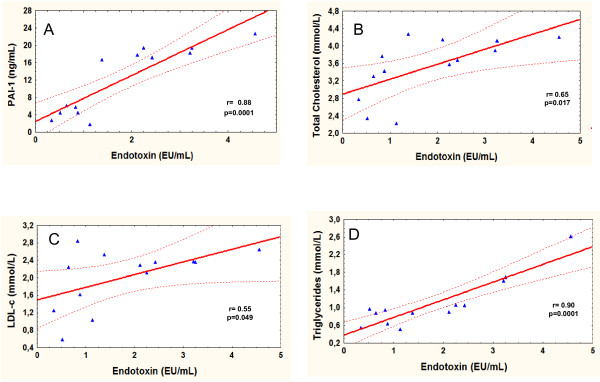
INTRODUCTION: A sedentary lifestyle increases the risk of developing cardiovascular disease, obesity, and diabetes. This phenomenon is supported by recent studies suggesting a chronic, low-grade inflammation status. Endotoxin derived from gut flora may be key to the development of inflammation by stimulating the secretion of inflammatory factors. This study aimed to examine plasma inflammatory markers and endotoxin levels in individuals with a sedentary lifestyle and/or in highly trained subjects at rest. METHODS: Fourteen male subjects (sedentary lifestyle n = 7; highly trained subjects n = 7) were recruited. Blood samples were collected after an overnight fast (approximately 12 h). The plasmatic endotoxin, plasminogen activator inhibitor type-1 (PAI-1), monocyte chemotactic protein-1 (MCP1), ICAM/CD54, VCAM/CD106 and lipid profile levels were determined. RESULTS: Endotoxinemia was lower in the highly trained subject group relative to the sedentary subjects (p < 0.002). In addition, we observed a positive correlation between endotoxin and PAI-1 (r = 0.85, p < 0.0001), endotoxin and total cholesterol (r = 0.65; p < 0.01), endotoxin and LDL-c (r = 0.55; p < 0.049) and endotoxin and TG levels (r = 0.90; p < 0.0001). The plasma levels of MCP-1, ICAM/CD54 and VCAM/CD106 did not differ. CONCLUSION: These results indicate that a lifestyle associated with high-intensity and high-volume exercise induces favorable changes in chronic low-grade inflammation markers and may reduce the risk for diseases such as obesity, diabetes and cardiovascular diseases.
Overview
The claims and statistics of this paper haven’t been checked yet.
Run the check — free, no account needed. It reads the open-access text and checks the sources it cites.
Integrity signals
Registry
Cites
Statistics
Figures
Verification
Claims the paper makes
The claims and statistics of this paper haven’t been checked yet.
Run the check — free, no account needed. It reads the open-access text and checks the sources it cites.
Claims other papers make about this one
Each is checked against this paper’s own text: does it say what the citing paper says it does?
In the citing paper
“In contrast, athletes have been noted to have lower levels of circulating LPS compared to sedentary individuals [70].”
From The athletic gut microbiota (2020) · cites this paper as [70]
In the citing paper
“Exercise training attenuates inflammation in part by reducing elevated blood LPS [70].”
From The athletic gut microbiota (2020) · cites this paper as [70]
In the citing paper
“the superior microbial milieu in exercise trained persons may explain lower levels of plasma endotoxin and inflammatory markers (plasminogen activator inhibitor type-1) in active vs sedentary individuals [104].”
From Gut Microbiota Contribute to Age-Related Changes in Skeletal Muscle Size, Composition, and Function: Biological Basis for a Gut-Muscle Axis (2018) · cites this paper as [104]
Self-check
Percentages, sums and reported differences re-computed from the paper’s own numbers.
The self-check needs the paper’s full text.
Citations
Cites
Friedewald, W. T., Levy, R. I., & Fredrickson, D. S. (1972) · Clinical Chemistry · doi:10.1093/clinchem/18.6.499 · Cited by 32,423
Obesity alters gut microbial ecology
Ley, R. E., Bäckhed, F., Turnbaugh, P., Lozupone, C. A., Knight, R. D., & Gordon, J. I. (2005) · Proceedings of the National Academy of Sciences · doi:10.1073/pnas.0504978102 · Cited by 6,176
Cani, P. D., Neyrinck, A. M., Fava, F., Knauf, C., Burcelin, R., Tuohy, K. M., Gibson, G. R., & Delzenne, N. M. (2007) · Diabetologia · doi:10.1007/s00125-007-0791-0 · Cited by 1,770
Creely, S. J., McTernan, P. G., Kusminski, C. M., Fisher, F. M., Da Silva, N. F., Khanolkar, M., Evans, M., Harte, A. L., & Kumar, S. (2007) · American Journal of Physiology-Endocrinology and Metabolism · doi:10.1152/ajpendo.00302.2006 · Cited by 1,043
Exercise and IL‐6 infusion inhibit endotoxin‐induced TNF‐α production in humans
Starkie, R., Ostrowski, S. R., Jauffred, S., Febbraio, M., & Pedersen, B. K. (2003) · The FASEB Journal · doi:10.1096/fj.02-0670fje · Cited by 790
The Role of Inflammatory Cytokines in Diabetes and Its Complications
King, G. L. (2008) · Journal of Periodontology · doi:10.1902/jop.2008.080246 · Cited by 689
Effect of exercise training on chronic inflammation
Beavers, K. M., Brinkley, T. E., & Nicklas, B. J. (2010) · Clinica Chimica Acta · doi:10.1016/j.cca.2010.02.069 · Cited by 637
The diseasome of physical inactivity – and the role of myokines in muscle–fat cross talk
Pedersen, B. K. (2009) · The Journal of Physiology · doi:10.1113/jphysiol.2009.179515 · Cited by 631
Hamburg, N. M., McMackin, C. J., Huang, A. L., Shenouda, S. M., Widlansky, M. E., Schulz, E., Gokce, N., Ruderman, N. B., Keaney, J. F., & Vita, J. A. (2007) · Arteriosclerosis, Thrombosis, and Vascular Biology · doi:10.1161/atvbaha.107.153288 · Cited by 474
Physical activity and modulation of systemic low-level inflammation
Bruunsgaard, H. (2005) · Journal of Leukocyte Biology · doi:10.1189/jlb.0505247 · Cited by 429
Research works printed but not linked: 1
- Friedewald WT, Levy RI, Fredrickson DS: Estimation Of The Concentration Of LDL-Cholesterol In Plasma, Without Use Of The Ultracentrifuge. Clin Clem. 1972, 18: 499-502.
Cited by
Sorted by citations
Sepsis: a roadmap for future research
Cohen, J., Vincent, J., Adhikari, N. K. J., Machado, F. R., Angus, D. C., Calandra, T., Jaton, K., Giulieri, S. G., Delaloye, J., Opal, S. M., et al. (2015) · The Lancet Infectious Diseases · doi:10.1016/s1473-3099(15)70112-x · Cited by 1,038
Exercise benefits in cardiovascular disease: beyond attenuation of traditional risk factors
Fiuza-Luces, C., Santos-Lozano, A., Joyner, M., Carrera-Bastos, P., Picazo, O., Zugaza, J. L., Izquierdo, M., Ruilope, L. M., & Lucia, A. (2018) · Nature Reviews Cardiology · doi:10.1038/s41569-018-0065-1 · Cited by 803
Guo, S., Al–Sadi, R., Said, H. M., & Ma, T. Y. (2012) · American Journal Of Pathology · doi:10.1016/j.ajpath.2012.10.014 · Cited by 722
Mailing, L. J., Allen, J. M., Buford, T. W., Fields, C. J., & Woods, J. A. (2019) · Exercise and Sport Sciences Reviews · doi:10.1249/jes.0000000000000183 · Cited by 521
Cancer and Inflammation: An Old Intuition with Rapidly Evolving New Concepts
Trinchieri, G. (2012) · Annual Review of Immunology · doi:10.1146/annurev-immunol-020711-075008 · Cited by 522
Metadata
- Authors
- Lira, F. S., Rosa, J. C., Pimentel, G. D., Souza, H. A., Caperuto, E. C., Carnevali, L. C., Seelaender, M., Damaso, A. R., Oyama, L. M., de Mello, M. T., & Santos, R. V.
- Affiliations
- Universidade Federal de São Paulo (BR)
- Universidade de São Paulo (BR)
- Corresponding author
- Santos, Ronaldo V
- Venue
- Lipids in Health and Disease
- Published
- 2010-08-04
- Volume
- 9
- Issue
- 1
- Pages
- 82-82
- ISSN
- 1476-511X (ISSN-L)
- PMC
- PMC2922209
- OpenAlex
- W2147866514
- Cited by
- 112
- References
- 22
- Citations by year
- 2026: 5 · 2025: 4 · 2024: 9 · 2023: 6 · 2022: 10 · 2021: 10 · 2020: 7 · 2019: 8 · 2018: 3 · 2017: 10 · 2016: 7 · 2015: 7 · 2014: 5 · 2013: 4 · 2012: 12
- FWCI
- 4.90
- Type
- journal article
- Language
- en
- Open access
- gold
- doi.org
- Licence
- Locations
- Lipids in Health and Disease (publishedVersion, cc-by)
- PubMed Central (publishedVersion, cc-by)
- PubMed (publishedVersion)
- Scientific Electronic Library Online (São Paulo Research Foundation, Latin American and Caribbean Center on Health Sciences Information, Conselho Nacional de Desenvolvimento Científico e Tecnológico) (publishedVersion)
- Americanae (AECID Library) (submittedVersion, other-oa)
- DOAJ (DOAJ: Directory of Open Access Journals) (submittedVersion)
- LA Referencia (Red Federada de Repositorios Institucionales de Publicaciones Científicas) (submittedVersion, other-oa)
- Funders
- Fundação de Amparo à Pesquisa do Estado de São Paulo (08/03533-1)
- Topics
- Health Sciences › Medicine › Endocrinology, Diabetes and Metabolism › Adipokines, Inflammation, and Metabolic Diseases
- Life Sciences › Biochemistry, Genetics and Molecular Biology › Molecular Biology › Gut microbiota and health
- Health Sciences › Medicine › Physiology (medical) › Exercise and Physiological Responses
- Keywords
- endotoxemia, sedentary lifestyle, highly trained athletes, low-grade inflammation, gut microbiota, plasminogen activator inhibitor-1, MCP-1, lipid profile, serum cholesterol, triglycerides, cardiovascular risk, obesity, diabetes mellitus
- MeSH terms
- Adult, Bicycling, Endotoxins, Humans, Hypercholesterolemia, Lipids, Male, Hypertriglyceridemia, Biomarkers, Exercise, Plasminogen Activator Inhibitor 1, Intercellular Adhesion Molecule-1, Inflammation Mediators, Chemokine CCL2, Vascular Cell Adhesion Molecule-1, Endotoxemia, Young Adult, Athletes, Sedentary Behavior
About these checks
Registry, retraction, Cites and statistics results are computed, not judged, with one exception: a printed reference that no index lists is read once by a model before it counts as a citation error. Claims are extracted by a model and kept only when their quote appears verbatim in the text; each cited source is then checked, with a model’s help, for whether it says what the claim relies on. Those verdicts can be wrong — read the claim’s quote and the cited source before relying on one.
Statistics and arithmetic are recomputed, not judged.
Confidence bands are shown only for fields calibrated on our annotated test set. None is calibrated yet, so no band is shown.
What counts as a claim ›How we measure confidence ›How we check this ›
Are you an author, or do you see a problem with this page? Request a review
