

Chronic granulomatous disease: a review of the infectious and inflammatory complications
The DOI matches its Crossref record; 199 of the 199 references it cites were found in a registry or an index.
Abstract
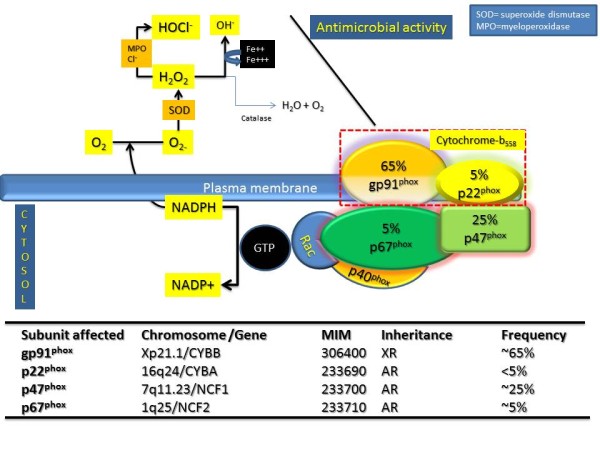
Chronic Granulomatous Disease is the most commonly encountered immunodeficiency involving the phagocyte, and is characterized by repeated infections with bacterial and fungal pathogens, as well as the formation of granulomas in tissue. The disease is the result of a disorder of the NADPH oxidase system, culminating in an inability of the phagocyte to generate superoxide, leading to the defective killing of pathogenic organisms. This can lead to infections with Staphylococcus aureus,Psedomonas species,Nocardia species, and fungi (such as Aspergillus species and Candida albicans). Involvement of vital or large organs can contribute to morbidity and/or mortality in the affected patients. Major advances have occurred in the diagnosis and treatment of this disease, with the potential for gene therapy or stem cell transplantation looming on the horizon.
Overview
The claims and statistics of this paper haven’t been checked yet.
Free: it reads the open-access text and checks the first 5 claims that cite a source we can check. Create a free account to check every claim.
Integrity signals
Registry
Cites
Statistics
Figures
Verification
Claims the paper makes
The claims and statistics of this paper haven’t been checked yet.
Free: it reads the open-access text and checks the first 5 claims that cite a source we can check. Create a free account to check every claim.
Claims other papers make about this one
Each is checked against this paper’s own text: does it say what the citing paper says it does?
In the citing paper
“Moreover, none of the known patients with myeloid PIDs, including disorders affecting mononuclear or polymorphonuclear phagocytes, display persistent EV-HPV infections (41,42).”
From Human RHOH deficiency causes T cell defects and susceptibility to EV-HPV infections (2012) · cites this paper as [42]
Self-check
Percentages, sums and reported differences re-computed from the paper’s own numbers.
The self-check needs the paper’s full text.
Citations
Cites
Chronic Granulomatous Disease: Report on a National Registry of 368 Patients
Winkelstein, J. A., Marino, M. C., Johnston, R. B., Boyle, J., Curnutte, J., Gallin, J. I., Malech, H. L., Holland, S. M., Ochs, H., Quie, P., et al. (2000) · Medicine · doi:10.1097/00005792-200005000-00003 · Cited by 1,728
Quie, P. G., White, J. G., Holmes, B., & Good, R. A. (1967) · Journal of Clinical Investigation · doi:10.1172/jci105568 · Cited by 906
Quantitative Nitroblue Tetrazolium Test in Chronic Granulomatous Disease
Baehner, R. L., & Nathan, D. G. (1968) · New England Journal of Medicine · doi:10.1056/nejm196805022781801 · Cited by 875
Chronic Granulomatous Disease: The European Experience
van den Berg, J. M., van Koppen, E., Åhlin, A., Belohradsky, B. H., Bernatowska, E., Corbeel, L., Español, T., Fischer, A., Kurenko-Deptuch, M., Mouy, R., et al. (2009) · PLoS ONE · doi:10.1371/journal.pone.0005234 · Cited by 687
Francke, U., Ochs, H. D., de Martinville, B., Giacalone, J. C., Lindgren, Distèche, C. M., Ra, P., Hofker, M. H., van Ommen, G. B., & Pearson, P. L. (1985) · PubMed · Cited by 453
Leukocyte Oxidase: Defective Activity in Chronic Granulomatous Disease
Baehner, R. L., & Nathan, D. G. (1967) · Science · doi:10.1126/science.155.3764.835 · Cited by 435
Report of four cases and review of the literature
Axton, A. W. L., & Perrin, R. G. (2006) · Cited by 429
FATAL GRANULOMATOUS DISEASE OF CHILDHOOD
Holmes, B., Quie, P., Windhorst, D., & Good, R. (1966) · The Lancet · doi:10.1016/s0140-6736(66)90238-8 · Cited by 418
Cloning of a 67-kD Neutrophil Oxidase Factor with Similarity to a Noncatalytic Region of p60 c-src
Leto, T. L., Lomax, K. J., Volpp, B. D., Nunoi, H., Sechler, J. M. G., Nauseef, W. M., Clark, R. A., Gallin, J. I., & Malech, H. L. (1990) · Science · doi:10.1126/science.1692159 · Cited by 386 · cited 1×
“Several reports of fungal brain infection [89], Aspergillus abscess resembling a brain tumor [90], spinal cord infection by Aspergillus [91] and fungal granuloma of the brain have been described [92].”
BackgroundDefective Superoxide Production by Granulocytes from Patients with Chronic Granulomatous Disease
Curnutte, J. T., Whitten, D. M., & Babior, B. M. (1974) · New England Journal of Medicine · doi:10.1056/nejm197403142901104 · Cited by 371
Research works printed but not linked: 1
- Janeway CA Hypergammaglobulinemia associated with severe, recurrent and chronic non-specific infection Am J Dis Child 1954 88 388 392
Cited by
Dunnill, C., Patton, T., Brennan, J., Barrett, J., Dryden, M., Cooke, J., Leaper, D., & Georgopoulos, N. T. (2017) · International Wound Journal · doi:10.1111/iwj.12557 · Cited by 1,380
The Neutrophil’s Role During Health and Disease
Liew, P. X., & Kubes, P. (2019) · Physiological Reviews · doi:10.1152/physrev.00012.2018 · Cited by 1,175
Lee, M. J., Liu, H., Barker, B. M., Snarr, B. D., Gravelat, F. N., Al Abdallah, Q., Gavino, C., Baistrocchi, S. R., Ostapska, H., Xiao, T., et al. (2015) · PLOS Pathogens · doi:10.1371/journal.ppat.1005187 · Cited by 180
Human RHOH deficiency causes T cell defects and susceptibility to EV-HPV infections
Crequer, A., Troeger, A., Patin, E., Ma, C. S., Picard, C., Pedergnana, V., Fieschi, C., Lim, A., Abhyankar, A., Gineau, L., et al. (2012) · Journal of Clinical Investigation · doi:10.1172/jci62949 · Cited by 159
“Moreover, none of the known patients with myeloid PIDs, including disorders affecting mononuclear or polymorphonuclear phagocytes, display persistent EV-HPV infections (41, 42).”
Mashruwala, A. A., Pang, Y. Y., Rosario‐Cruz, Z., Chahal, H. K., Benson, M. A., Mike, L. A., Skaar, E. P., Torres, V. J., Nauseef, W. M., & Boyd, J. M. (2015) · Molecular Microbiology · doi:10.1111/mmi.12860 · Cited by 79
A Perspective on the Role of Extracellular Hemoglobin on the Innate Immune System
Lee, S. K., & Ding, J. L. (2013) · DNA and Cell Biology · doi:10.1089/dna.2012.1897 · Cited by 52
Bacillithiol has a role in Fe–S cluster biogenesis in Staphylococcus aureus
Rosario‐Cruz, Z., Chahal, H. K., Mike, L. A., Skaar, E. P., & Boyd, J. M. (2015) · Molecular Microbiology · doi:10.1111/mmi.13115 · Cited by 50
“aureus infections, thereby highlighting the importance of ROS in preventing and combating infection (Song et al., 2011).”
BackgroundKotagama, O. W., Jayasinghe, C. D., & Abeysinghe, T. (2019) · BioMed Research International · doi:10.1155/2019/1369682 · Cited by 48
Metadata
- Authors
- Song, E., Jaishankar, G. B., Saleh, H., Jithpratuck, W., Sahni, R., & Krishnaswamy, G.
- Venue
- Clinical and Molecular Allergy
- Published
- 2011-05-31
- Volume
- 9
- Issue
- 1
- ISSN
- 1476-7961
- PMC
- PMC3128843
- Cited by
- 148
- References
- 199
- Language
- en
About these checks
Registry, retraction, Cites and statistics results are computed, not judged, with one exception: a printed reference that no index lists is read once by a model before it counts as a citation error. Claims are extracted by a model and kept only when their quote appears verbatim in the text; each cited source is then checked, with a model’s help, for whether it says what the claim relies on. Those verdicts can be wrong — read the claim’s quote and the cited source before relying on one.
Statistics and arithmetic are recomputed, not judged.
Confidence bands are shown only for fields calibrated on our annotated test set. None is calibrated yet, so no band is shown.
What counts as a claim ›How we measure confidence ›How we check this ›
Are you an author, or do you see a problem with this page? Request a review
Data sources
Bibliographic data: Semantic Scholar, OpenAlex, Crossref.
Contains information from the Semantic Scholar Academic Graph Datasets, made available under the ODC Attribution License (ODC-BY 1.0).
Semantic Scholar’s data is described in: Kinney, R., et al. (2023). The Semantic Scholar Open Data Platform. arXiv:2301.10140.
