

The DOI matches its Crossref record; 44 of the 44 references it cites were found in a registry or an index.
Evaluating the responsiveness of the Warwick Edinburgh Mental Well-Being Scale (WEMWBS): Group and individual level analysis
Open accessAbstract
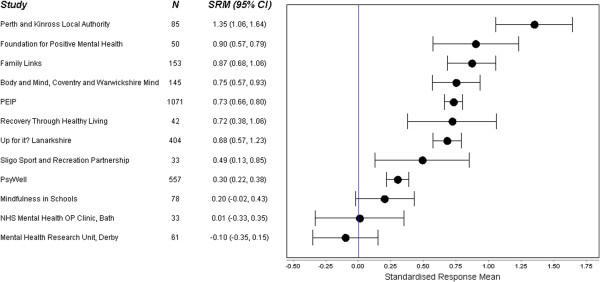
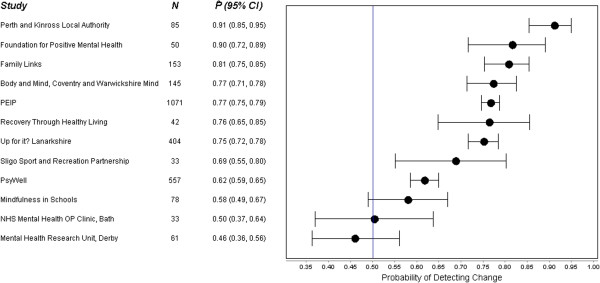
BACKGROUND: Mental well-being now features prominently in UK and international health policy. However, progress has been hampered by lack of valid measures that are responsive to change. The objective of this study was to evaluate the responsiveness of the Warwick Edinburgh Mental Well-being Scale (WEMWBS) at both the individual and group level. METHODS: Secondary analysis of twelve different interventional studies undertaken in different populations using WEMWBS as an outcome measure. Standardised response mean (SRM), probability of change statistic (P(^)) and standard error of measurement (SEM) were used to evaluate whether WEMWBS detected statistically important changes at the group and individual level, respectively. RESULTS: Mean change in WEMWBS score ranged from -0.6 to 10.6. SRM ranged from -0.10 (95% CI: -0.35, 0.15) to 1.35 (95% CI: 1.06, 1.64). In 9/12 studies the lower limit of the 95% CI for P(^) was greater than 0.5, denoting responsiveness. SEM ranged from 2.4 to 3.1 units, and at the threshold 2.77 SEM, WEMWBS detected important improvement in at least 12.8% to 45.7% of participants (lower limit of 95% CI>5.0%). CONCLUSIONS: WEMWBS is responsive to changes occurring in a wide range of mental health interventions undertaken in different populations. It offers a secure base for research and development in this rapidly evolving field. Further research using external criteria of change is warranted.
Overview
The claims and statistics of this paper haven’t been checked yet.
Run the check — free, no account needed. It reads the open-access text and checks the sources it cites.
Integrity signals
Registry
Cites
Statistics
Figures
Verification
Claims the paper makes
The claims and statistics of this paper haven’t been checked yet.
Run the check — free, no account needed. It reads the open-access text and checks the sources it cites.
Claims other papers make about this one
Each is checked against this paper’s own text: does it say what the citing paper says it does?
The cited source says what the claim attributes to it.
In the citing paper
“At an individual level, a change of three or more units is interpreted as representing ‘meaningful change’. 45”
From Feasibility of RESTORE: An online Acceptance and Commitment Therapy intervention to improve palliative care staff wellbeing. (2023) · cites this paper as [45]
Self-check
Percentages, sums and reported differences re-computed from the paper’s own numbers.
The self-check needs the paper’s full text.
Citations
Cites
Coefficient Alpha and the Internal Structure of Tests
Cronbach, L. J. (1951) · Psychometrika · doi:10.1007/bf02310555 · Cited by 43,931 · cited 1×
“In the one study undertaken in the adolescent population, WEMWBS demonstrated satisfactory internal consistency [44], however, the Cronbach’s alpha score was lower than that found in the validation study undertaken in an adolescent population [17].”
ResultOn Happiness and Human Potentials: A Review of Research on Hedonic and Eudaimonic Well-Being
Ryan, R. M., & Deci, E. L. (2001) · Annual Review of Psychology · doi:10.1146/annurev.psych.52.1.141 · Cited by 11,567 · cited 1×
“; licensee BioMed Ce Creative Commons Attribution License (http:/ distribution, and reproduction in any medium and that it covers both eudaimonic (psychological functioning) and hedonic (affective) dimensions [12].”
BackgroundJacobson, N. S., & Truax, P. (1991) · Journal of Consulting and Clinical Psychology · doi:10.1037/0022-006x.59.1.12 · Cited by 7,770 · cited 1×
“96√2 × SEM) takes into account measurement error, the combined variability across the baseline and post intervention samples, and chance at the 95% confidence interval [32,33].”
BackgroundThe Warwick-Edinburgh Mental Well-being Scale (WEMWBS): development and UK validation
Tennant, R., Hiller, L., Fishwick, R., Platt, S., Joseph, S., Weich, S., Parkinson, J., Secker, J., & Stewart-Brown, S. (2007) · Health and Quality of Life Outcomes · doi:10.1186/1477-7525-5-63 · Cited by 5,031 · cited 5×
“WEMWBS is a valid, reliable and acceptable measure [13], which we have demonstrated, is responsive to change in a wide variety of settings from the community settings, to schools, and psychiatric hospitals, making it suitable for use in evaluation of interventions at group and individual level.”
BackgroundMethodResultInfluentialSelf-citationJaeschke, R., Singer, J., & Guyatt, G. H. (1989) · Controlled Clinical Trials · doi:10.1016/0197-2456(89)90005-6 · Cited by 4,982 · cited 1×
“5 units on each item on a Likert scale would equate to an improvement deemed important by individuals [45].”
BackgroundMental illness and/or mental health? Investigating axioms of the complete state model of health
Keyes, C. L. M. (2005) · Journal of Consulting and Clinical Psychology · doi:10.1037/0022-006x.73.3.539 · Cited by 3,357 · cited 1×
“While debate surrounds the precise definitions of both well-being and mental well-being [10,11], there is broad consensus that the latter is more than the absence of mental illness”
BackgroundReport by the commission on the measurement of economic performance and social progress
Fitoussi, J., Sen, A. K., & Stiglitz, J. E. (2011) · Cited by 2,887
Effect Sizes for Interpreting Changes in Health Status
Kazis, L. E., Anderson, J. J., & Meenan, R. F. (1989) · Medical Care · doi:10.1097/00005650-198903001-00015 · Cited by 2,401 · cited 1×
“However, in the literature a variety of statistics have been used to evaluate responsiveness at the group-level, including the paired t-test [35] and Cohen’s effect size (mean change in score by the standard deviation of the baseline score) [36].”
MethodIndividual-patient monitoring in clinical practice: are available health status surveys adequate?
McHorney, C. A., & Tarlov, A. R. (1995) · Quality of Life Research · doi:10.1007/bf01593882 · Cited by 2,206
Measuring change over time: assessing the usefulness of evaluative instruments.
Guyatt, G., Walter, S. D., & Norman, G. (1987) · Journal of Chronic Diseases · doi:10.1016/0021-9681(87)90069-5 · Cited by 1,997 · cited 2×
“Responsive instruments should have the ability to detect changes in health status where these occur [19].”
Background
Cited by
Sorted by citations
Ng Fat, L., Scholes, S., Boniface, S., Mindell, J., & Stewart-Brown, S. (2017) · Quality of Life Research · doi:10.1007/s11136-016-1454-8 · Cited by 548
“This difference may prove important in small-scale evaluations of community-based mental wellbeing interventions [29].”
BackgroundSelf-citationAmmar, A., Trabelsi, K., Brach, M., Chtourou, H., Boukhris, O. F., Masmoudi, L., Bouaziz, B., Bentlage, E., How, D., Ahmed, M. G. A. E., et al. (2020) · Biology of Sport · doi:10.5114/biolsport.2020.96857 · Cited by 445
Savage, M. J., James, R. M., Magistro, D., Donaldson, J. A., Healy, L. C., Nevill, M. E., & Hennis, P. J. (2020) · Mental health and physical activity · doi:10.1016/j.mhpa.2020.100357 · Cited by 401
Psychological consequences of COVID-19 home confinement: The ECLB-COVID19 multicenter study
Ammar, A., Mueller, P., Trabelsi, K., Chtourou, H., Boukhris, O. F., Masmoudi, L., Bouaziz, B., Brach, M., Schmicker, M., Bentlage, E., et al. (2020) · PLoS ONE · doi:10.1371/journal.pone.0240204 · Cited by 314
Koushede, V., Lasgaard, M., Hinrichsen, C., Meilstrup, C., Nielsen, L., Rayce, S. B., Torres-Sahli, M., Guðmundsdóttir, D. G., Stewart-Brown, S. L., & Santini, Z. I. (2018) · Psychiatry Research · doi:10.1016/j.psychres.2018.12.003 · Cited by 230
“Information regarding survey and sampling in Iceland, England, and Catalonia is provided in Appendix 1.”
BackgroundMethodInfluentialSelf-citation
Metadata
- Authors
- Maheswaran, H., Weich, S., Powell, J., & Stewart-Brown, S.
- Affiliations
- University of Warwick (GB)
- University of Oxford (GB)
- Corresponding author
- Maheswaran, Hendramoorthy
- Venue
- Health and Quality of Life Outcomes
- Published
- 2012
- Volume
- 10
- Issue
- 1
- Pages
- 156
- ISSN
- 1477-7525 (ISSN-L)
- PMC
- PMC3560098
- OpenAlex
- W2139610815
- Cited by
- 265
- References
- 44
- Citations by year
- 2026: 20 · 2025: 29 · 2024: 27 · 2023: 28 · 2022: 22 · 2021: 27 · 2020: 23 · 2019: 19 · 2018: 14 · 2017: 19 · 2016: 12 · 2015: 15 · 2014: 4 · 2013: 6
- FWCI
- 10.61
- Type
- journal article
- Language
- en
- Open access
- gold
- doi.org
- Licence
- cc-by
- Locations
- Health and Quality of Life Outcomes (publishedVersion, cc-by)
- Europe PMC (PubMed Central) (publishedVersion, cc-by)
- PubMed Central (publishedVersion, cc-by)
- PubMed (publishedVersion)
- White Rose Research Online (University of Leeds, The University of Sheffield, University of York) (acceptedVersion)
- Warwick Research Archive Portal (University of Warwick) (acceptedVersion)
- DOAJ (DOAJ: Directory of Open Access Journals) (submittedVersion)
- Funders
- NHS Health Scotland
- University of Warwick
- University of Bath
- University of Edinburgh
- Topics
- Social Sciences › Decision Sciences › Management Science and Operations Research › Psychometric Methodologies and Testing
- Social Sciences › Economics, Econometrics and Finance › Economics and Econometrics › Health Systems, Economic Evaluations, Quality of Life
- Social Sciences › Psychology › Social Psychology › Psychological Well-being and Life Satisfaction
- Keywords
- Warwick-Edinburgh Mental Well-being Scale, responsiveness to change, psychological well-being, mental health interventions, standardized response mean, standard error of measurement, psychometric properties, outcome measurement
- MeSH terms
- Adolescent, Adult, Aged, Female, United Kingdom, Humans, Male, Mental Health, Middle Aged, Personal Satisfaction, Psychometrics, Surveys and Questionnaires, Reproducibility of Results, Confidence Intervals, Young Adult
About these checks
Registry, retraction, Cites and statistics results are computed, not judged, with one exception: a printed reference that no index lists is read once by a model before it counts as a citation error. Claims are extracted by a model and kept only when their quote appears verbatim in the text; each cited source is then checked, with a model’s help, for whether it says what the claim relies on. Those verdicts can be wrong — read the claim’s quote and the cited source before relying on one.
Statistics and arithmetic are recomputed, not judged.
Confidence bands are shown only for fields calibrated on our annotated test set. None is calibrated yet, so no band is shown.
What counts as a claim ›How we measure confidence ›How we check this ›
Are you an author, or do you see a problem with this page? Request a review
