

Predictors of quality of life in a longitudinal study of users with severe mental disorders
Open accessThe DOI matches its Crossref record; 94 of the 94 references it cites were found in a registry or an index.
Abstract
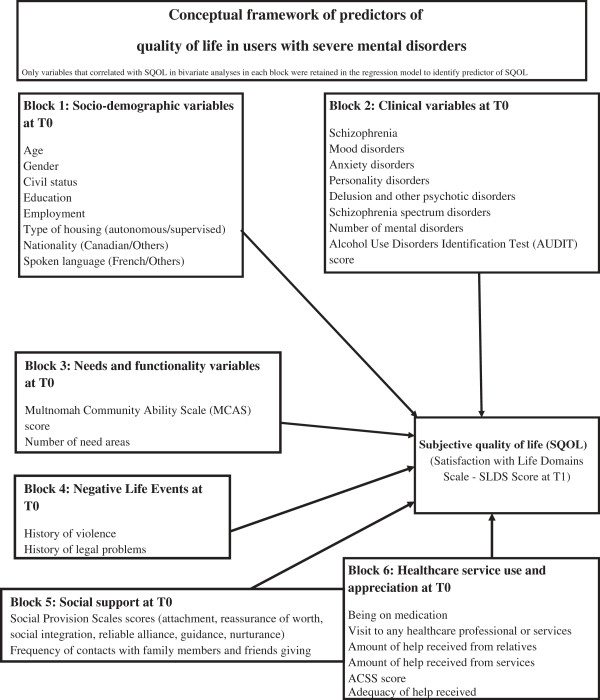
BACKGROUND: Since the end of the 20th century, quality of life has become a key outcome indicator in planning and evaluation of health services. From a sample of 297 users with severe mental disorders from Montreal (Canada), this study aimed to identify the key predictors of subjective quality of life (SQOL). METHODS: Users were recruited and interviewed from December 2008 to September 2010 and re-interviewed approximately 18 months later. A comprehensive framework including socio-demographic data, clinical, needs and functionality variables, negative life events, social support and healthcare service use, and appreciation data were considered as predictors. Clinical records and eight standardized instruments were used. RESULTS: Lower severity of needs, schizophrenia, better social integration, better reassurance of worth, fewer drug abuse problems, and living in supervised housing are predictors of SQOL. With regard to needs, absence or lower severity of needs in the areas of company, daytime activities, social exclusion, safety to self, and benefits are linked to SQOL. CONCLUSION: Reducing the severity of needs is especially beneficial to ensure a higher SQOL for users with severe mental disorders. To improve SQOL, priority must be given to programs and interventions that promote the development of a stimulating and supportive social network, and maintain a plurality of residential services matching the functional abilities of users.
Overview
The claims and statistics of this paper haven’t been checked yet.
Free: it reads the open-access text and checks the first 5 claims that cite a source we can check. Create a free account to check every claim.
Integrity signals
Registry
Cites
Statistics
Figures
Verification
Claims the paper makes
The claims and statistics of this paper haven’t been checked yet.
Free: it reads the open-access text and checks the first 5 claims that cite a source we can check. Create a free account to check every claim.
Claims other papers make about this one
Each is checked against this paper’s own text: does it say what the citing paper says it does?
The cited source says what the claim attributes to it.
In the citing paper
“They reported that greater perceived social support was significantly predictive of higher subjective quality of life at 18 months (beta 0.136 to 0.196, 95% CI 0.255 to 3.410).”
From Associations between loneliness and perceived social support and outcomes of mental health problems: a systematic review (2018) · cites this paper as [67]
Self-check
Percentages, sums and reported differences re-computed from the paper’s own numbers.
The self-check needs the paper’s full text.
Citations
Cites
Diagnostic and Statistical Manual of Mental Disorders, 5th Edition
(2013) · American Psychiatric Association Publishing eBooks · doi:10.1176/appi.books.9780890425596.893619 · Cited by 4,383
Recovery from mental illness: the guiding vision of the mental health service system in the 1990s
Anthony, W. A. (1993) · Psychosocial Rehabilitation Journal · doi:10.1037/h0095655 · Cited by 3,700
Bohn, M. J., Babor, T. F., & Kranzler, H. R. (1995) · Journal of Studies on Alcohol · doi:10.15288/jsa.1995.56.423 · Cited by 1,356
Chronic mental patients: the quality of life issue
(1982) · American Journal of Psychiatry · doi:10.1176/ajp.139.10.1271 · Cited by 466 · cited 4×
“The first mental health studies of QOL [6,7] occurred at a time when it became necessary to expand community services for users discharged from psychiatric hospitals.”
BackgroundInfluentialQuality of life in the evaluation of community support systems
Baker, F., & Intagliata, J. (1982) · Evaluation and Program Planning · doi:10.1016/0149-7189(82)90059-3 · Cited by 409 · cited 9×
“Satisfaction with Life Domains Scale (SLDS) [6] Assesses satisfaction in 20 life domains; seven-point Likert scale, questions; Cronbach alpha: 0.”
BackgroundMethodInfluentialSocial support and adaptation to stress by the elderly
Cutrona, C., Russell, D., & Rose, J. (1986) · Psychology and Aging · doi:10.1037/0882-7974.1.1.47 · Cited by 337 · cited 9×
“Abbreviations ACSS-MH: Alberta Continuity of Services Scale for Mental Health; AUDIT: Alcohol use disorders identification test; CAN: Camberwell assessment of need; CCHS: Canadian community health survey; DAST20: Drug abuse screening test-20; HSSC: Health and social services centers; MANQ: Montreal assessment of needs…”
BackgroundMethodInfluentialPsychometric properties of the Drug Abuse Screening Test in psychiatric outpatients.
Cocco, K. M., & Carey, K. B. (1998) · Psychological Assessment · doi:10.1037//1040-3590.10.4.408 · Cited by 336 · cited 7×
“The six other standardized instruments used for this study both at T0 and TI are described in detail in Table 1: the Social Provisions Scale (SPS), the Multnomah Community Ability Scale (MCAS), the Alcohol Use Disorders Identification Test (AUDIT), the Drug Abuse Screening Test-20 (DAST-20), the Alberta Continuity of…”
BackgroundInfluentialThe Canadian Community Health Survey: Mental Health and Well-Being
Gravel, R., & Béland, Y. (2005) · The Canadian Journal of Psychiatry · doi:10.1177/070674370505001002 · Cited by 302 · cited 3×
“Service Utilization Questionnaire (SUQ) [68] Derived from the Canadian Health Survey Questionnaire (CCHS) Evaluates types and frequency of professionals and services used Visit to any healthcare professional or services”
MethodSubjective and objective quality of life in schizophrenia
Narvaez, J. M., Twamley, E. W., McKibbin, C. L., Heaton, R. K., & Patterson, T. L. (2008) · Schizophrenia Research · doi:10.1016/j.schres.2007.09.001 · Cited by 269
Becker, M., Diamond, R., & Sainfort, F. (1993) · Quality of Life Research · doi:10.1007/bf00434796 · Cited by 260 · cited 1×
“The SLDS is among the scales that were included in their entirety in the Wisconsin Quality of Life index, a multidimensional instrument containing 113 items [71,72].”
Research works printed but not linked: 2
- Kirby MJL Out of the shadows at last The Standing Senate Committe on Social Affairs 2006 SaT ed Ottawa: The Senate of Canada 28 pp. 281
- APA Diagnostic and Statistic Manual of Mental Disorders, 4th edition 1994 Washington, DC: American Psychiatric Association
Cited by
Wang, J., Mann, F., Lloyd-Evans, B., Ma, R., & Johnson, S. (2018) · BMC Psychiatry · doi:10.1186/s12888-018-1736-5 · Cited by 1,494
“(2013) [67] Perceived social support Subjective quality of life ++ Social support variables at baseline accounted for 7.”
BackgroundZhou, Y., Cao, Z., Yang, M., Xi, X., Guo, Y., Fang, M., Cheng, L., & Du, Y. (2017) · Scientific Reports · doi:10.1038/srep40511 · Cited by 152
Iorfino, F., Cross, S. P., Davenport, T., Carpenter, J. S., Scott, E., Shiran, S., & Hickie, I. B. (2019) · Frontiers in Psychiatry · doi:10.3389/fpsyt.2019.00595 · Cited by 125
“A higher severity of needs tends to be associated with poorer outcomes over time, and so strategies that address these problems may be able to improve long-term outcomes (61).”
BackgroundMuller, A. E., Skurtveit, S. O., & Clausen, T. (2016) · Health and Quality of Life Outcomes · doi:10.1186/s12955-016-0439-1 · Cited by 127
Defar, S., Abraham, Y., Reta, Y., Deribe, B., Jisso, M., Yeheyis, T. Y., Mengistu, K., Beyene, B., & Ayalew, M. (2023) · Frontiers in Public Health · doi:10.3389/fpubh.2023.1134032 · Cited by 115
Alessandrini, M., Lançon, C., Fond, G. B., Faget, C., Richieri, R. M., Faugère, M., Metairie, E., Boucékine, M., Llorca, P., Auquier, P., et al. (2016) · Schizophrenia Research · doi:10.1016/j.schres.2016.01.012 · Cited by 99
Wang, J., Lloyd-Evans, B., Marston, L., Mann, F., Ma, R., & Johnson, S. (2020) · BMC Psychiatry · doi:10.1186/s12888-020-02665-2 · Cited by 57
Bryła, M., Burzyńska, M., & Maniecka‐Bryła, I. (2013) · Health and Quality of Life Outcomes · doi:10.1186/1477-7525-11-181 · Cited by 61
“This will have biological, medical, economic and social implications [57–59].”
BackgroundProfiles of Quality of Life in a Homeless Population
Gentil, L., Grenier, G., Bamvita, J., Dorvil, H., & Fleury, M. (2019) · Frontiers in Psychiatry · doi:10.3389/fpsyt.2019.00010 · Cited by 66
“Scores assigned to each of the items—“none” (0), “mild” (1) “moderate” (2), “severe” (3), and “extreme” (4).”
BackgroundSelf-citationGomes, E., Bastos, T. C. L., Probst, M., Ribeiro, J. C., Silva, G., & Corredeira, R. (2014) · Mental health and physical activity · doi:10.1016/j.mhpa.2014.07.002 · Cited by 69
Loh, S. Y., Abdullah, A., Abu Bakar, A. K., Thambu, M., & Nik Jaafar, N. R. (2015) · Global Journal of Health Science · doi:10.5539/gjhs.v8n1p238 · Cited by 45
“In chronic schizophrenia, in the field of physical activity and quality of life (QOL), there have been controversial results (Barnes et al., 2012; Fleury et al., 2013).”
ResultAn Examination of Correlates of Quality of Life in Children and Youth With Mental Health Issues
Celebre, A., Stewart, S. L., Theall, L., & Lapshina, N. (2021) · Frontiers in Psychiatry · doi:10.3389/fpsyt.2021.709516 · Cited by 52
Siegrist, K., Millier, A., Amri, I., Aballéa, S., & Toumi, M. (2015) · Psychiatry Research · doi:10.1016/j.psychres.2015.11.039 · Cited by 44
“Integration in the labour market is rare; participation in social networks is low as is psychosocial functioning (Fleury et al., 2013).”
Cognitive Impairment and Quality of Life among Elderly in India
Singh, P., Govil, D., Kumar, V., & Kumar, J. (2016) · Applied Research in Quality of Life · doi:10.1007/s11482-016-9499-y · Cited by 43
Zaboski, B. A., Gilbert, A., Hamblin, R. J., Andrews, J., Ramos, A., Nadeau, J. M., & Storch, E. A. (2019) · Bulletin of the Menninger Clinic · doi:10.1521/bumc_2019_83_03 · Cited by 40
Fleury, M., Grenier, G., Bamvita, J., Perreault, M., & Caron, J. (2015) · Psychiatric Services · doi:10.1176/appi.ps.201400363 · Cited by 42
Self-citationBitter, N. A., Roeg, D. P. K., van Nieuwenhuizen, C., & van Weeghel, J. (2016) · BMC Psychiatry · doi:10.1186/s12888-016-1122-0 · Cited by 36
“Therefore, treatment and support for people with SMI mental illness should focus on all three dimensions of recovery [25], and should be centred around their individual needs and quality of life [31].”
BackgroundBaiden, P., den Dunnen, W., & Fallon, B. (2016) · Social Indicators Research · doi:10.1007/s11205-015-1224-y · Cited by 38
Gender differences in health-related quality of life in people with severe mental illness
Colillas-Malet, E., Prat, G., Espelt, A., & Juvinyà, D. (2020) · PLoS ONE · doi:10.1371/journal.pone.0229236 · Cited by 39
“Self-perception is a belief, and believing that social relationships and leisure activities, and therefore the social network status (previously mentioned as a protective factor determinant of health), have been maintained or improved is associated with MCS of HRQOL[53,54].”
BackgroundFleury, M., Sabetti, J., Bamvita, J., & Grenier, G. (2019) · International Journal of Social Psychiatry · doi:10.1177/0020764019831310 · Cited by 26
Self-citationPerformance of the WHOQOL-BREF among Norwegian substance use disorder patients
Muller, A. E., Skurtveit, S. O., & Clausen, T. (2019) · BMC Medical Research Methodology · doi:10.1186/s12874-019-0690-3 · Cited by 32
Prigent, A., Auraaen, A., Kamendje-Tchokobou, B., Durand‐Zaleski, I., & Chevreul, K. (2014) · International Journal of Environmental Research and Public Health · doi:10.3390/ijerph110302804 · Cited by 26
“However, complementary multivariate analyses based on appropriate non-parametric approaches and including a complete set of demographic and clinical characteristics, as well as information on types of mental health care received, is necessary in order to fully identify factors associated with HRQoL and utility scores…”
BackgroundFleury, M., Grenier, G., & Bamvita, J. (2015) · Health and Quality of Life Outcomes · doi:10.1186/s12955-015-0346-x · Cited by 25
“The variables taken into consideration were those which, according to previous studies, could influence a change in SQOL in individuals with severe mental disorders [21, 30, 32, 33, 36, 40, 45].”
BackgroundMethodSelf-citationUtility of the Montreal Assessment of Need Questionnaire for Community Mental Health Planning
Tremblay, J., Bamvita, J., Grenier, G., & Fleury, M. (2014) · The Journal of Nervous and Mental Disease · doi:10.1097/nmd.0000000000000180 · Cited by 22
“In social eptember 2014 www.jonmd.com 677 thorized reproduction of this article is prohibited. needs domains, for example, help is often not adequate for moderate problems such as lack of company, intimate relationships, or sexual expression (Fleury et al., 2013c).”
BackgroundMethodResultInfluentialSelf-citationA Systematic Review of Quality of Life Assessments of Offenders
Muller, A. E. (2020) · International Journal of Offender Therapy and Comparative Criminology · doi:10.1177/0306624x19881929 · Cited by 27
“…population (Caron, Cargo, Daniel, & Liu, 2019; Solis & Lotufo-Neto, 2019) and people with chronic diseases (Akhtari-Zavare et al., 2018; Björkman & Hansson, 2002; Fleury et al., 2013; Hansson & Björkman, 2007; Lehto, Ojanen, & Kellokumpu-Lehtinen, 2005; Rabin, Heldt, Hirakata, & Fleck, 2008).”
BackgroundInfluentialYi, S., Tuot, S., Chhoun, P., Pal, K., Choub, S. C., & Mburu, G. (2016) · International Journal for Equity in Health · doi:10.1186/s12939-016-0342-8 · Cited by 22
“There was also a strong association between psychological distress and cognitive self-awareness of self-rated quality of life in our study, which is consistent with other research findings [48, 49].”
ResultMeasuring the quality of life of incarcerated individuals
Muller, A. E., & Bukten, A. (2019) · International Journal of Prisoner Health · doi:10.1108/ijph-02-2018-0005 · Cited by 24
Chen, C., Chen, Y., Huang, Q., Yan, S., & Zhu, J. (2022) · Frontiers in Public Health · doi:10.3389/fpubh.2022.847098 · Cited by 27
Averous, P., Charbonnier, É., & Dany, L. (2020) · Frontiers in Psychology · doi:10.3389/fpsyg.2020.01167 · Cited by 22
“, 2015), with a lower quality of life (Alonso et al., 2004; Fleury et al., 2013) and a higher level of disability (Alonso et al.”
BackgroundFleury, M., Grenier, G., & Bamvita, J. (2017) · Quality of Life Research · doi:10.1007/s11136-017-1717-z · Cited by 18
“Serious or unmet needs in all of these categories have been identified as contributors to lower QoL [14, 35, 37, 41].”
BackgroundSelf-citationDeterminants of Quality of Life in Spanish outpatients with schizophrenia spectrum disorders
Arrarás, J. I., Ibáñez, B., Basterra, I., Pereda, N., Martin, M., & Iribarren, S. (2017) · The European Journal of Psychiatry · doi:10.1016/j.ejpsy.2017.11.001 · Cited by 20
Fleury, M., Bamvita, J., Grenier, G., Schmitz, N., Piat, M., & Tremblay, J. (2015) · Administration and Policy in Mental Health and Mental Health Services Research · doi:10.1007/s10488-015-0695-0 · Cited by 18
Self-citationSu, Y., D’Arcy, C., Li, M., & Meng, X. (2022) · Scientific Reports · doi:10.1038/s41598-022-13794-x · Cited by 19
Quality of Life in Jail: Gender, Correlates, and Drivers in a Carceral Space
Prost, S. G., Panisch, L. S., & Bedard, L. E. (2019) · International Journal of Offender Therapy and Comparative Criminology · doi:10.1177/0306624x19896906 · Cited by 20
“jails despite the intimate connections between physical and mental health and QOL in non-carceral settings (Bize, Johnson, & Plotnikoff, 2007; Fleury et al., 2013; Fortin et al., 2004; Nunes, Flores, Mielke, Thume, & Facchini, 2016).”
BackgroundRios, S., & Perlman, C. M. (2017) · The Journal of Behavioral Health Services & Research · doi:10.1007/s11414-017-9554-y · Cited by 17
Relatives’ experiences of an equine-assisted intervention for people with psychotic disorders
Fridén, L., Hultsjö, S., Lydell, M., & Jormfeldt, H. (2022) · International Journal of Qualitative Studies on Health and Well-Being · doi:10.1080/17482631.2022.2087276 · Cited by 15
“A link between cognitive difficulties and a lack of social contexts, passivity and inactivity has been recognized (Fleury et al., 2013).”
BackgroundPredictors of Frequent Recourse to Health Professionals by People with Severe Mental Disorders
Fleury, M., Grenier, G., & Bamvita, J. (2015) · The Canadian Journal of Psychiatry · doi:10.1177/070674371506000205 · Cited by 15
Self-citationPrigent, A., Kamendje-Tchokobou, B., & Chevreul, K. (2017) · Quality of Life Research · doi:10.1007/s11136-017-1623-4 · Cited by 10
“noses of mental and behavioral disorders [7, 8, 15, 16] and disease severity [8–10].”
BackgroundResultInfluentialJohnson, C. A., Tran, D. N., Mwangi, A., Sosa-Rubí, S. G., Chivardi, C., Romero-Martínez, M., Pastakia, S. D., Robinson, E., Mayo‐Wilson, L. J., & Galárraga, O. (2022) · Health Services and Outcomes Research Methodology · doi:10.1007/s10742-021-00266-4 · Cited by 10
“These attributes represented both subjective and objective components of quality of life (Baker and Intagliata 1982; Caron 2012; Fleury et al. 2013), and were applicable across countries.”
BackgroundSubjective Quality of Life and Its Associations among First Episode Psychosis Patients in Singapore
Satghare, P., Abdin, E., Shahwan, S., Chua, B. Y., Poon, L. Y., Chong, S. A., & Subramaniam, M. (2019) · International Journal of Environmental Research and Public Health · doi:10.3390/ijerph17010260 · Cited by 10
Zheng, S., Wang, R., Zhang, S., Ou, Y., Sheng, X., Yang, M., Ge, M., Xia, L., Li, J., & Zhou, X. (2023) · BMC Psychiatry · doi:10.1186/s12888-023-05355-x · Cited by 14
Valiente, C., Espinosa, R., Contreras, A., Trucharte, A., Caballero, R., & Peinado, V. (2021) · The Journal of Positive Psychology · doi:10.1080/17439760.2021.1871940 · Cited by 10
“Fleury et al. (2013) indicated that life satisfaction in people with severe mental conditions is related to aspects such as the maintenance of social support and the response of services to their needs (such as those related to housing), so it is reasonable that this intervention does not have a…”
BackgroundEsquizofrenia refratária: qualidade de vida e fatores associados
de Freitas, P. H. B., Pinto, J. A. F., Nunes, F. D. D., Souza, A. R. S., & Machado, R. M. (2016) · Acta Paulista de Enfermagem · doi:10.1590/19820194201600009 · Cited by 8
Meiring, L., Visser, M. J., & Themistocleous, N. (2017) · Health SA Gesondheid · doi:10.1016/j.hsag.2017.04.004 · Cited by 16
“MHC users with psychosis often have small social networks and strained interpersonal relationships (Fleury et al., 2013).”
BackgroundFleury, M., Grenier, G., & Bamvita, J. (2020) · International Journal of Integrated Care · doi:10.5334/ijic.4718 · Cited by 7
Self-citationLundqvist, L., Rytterström, P., Rask, M., Brunt, D. A., Sellin, T., Grim, K., Rystedt, I., & Schröder, A. (2024) · Frontiers in Psychiatry · doi:10.3389/fpsyt.2023.1282466 · Cited by 9
Quality of life and its influencing factors in patients with schizophrenia.
Lin, C., Wan, X., Zhang, R., Yang, X., & Liu, Y. (2023) · PubMed Central · doi:10.11817/j.issn.1672-7347.2023.220438 · Cited by 11
Ogundare, T., Onifade, P. O., Ogundapo, D., Ghebrehiwet, S., Borba, C. P. C., & Henderson, D. C. (2021) · Quality of Life Research · doi:10.1007/s11136-021-02764-x · Cited by 5
Fleury, M., Bamvita, J., Grenier, G., & Caron, J. (2015) · International Journal of Environmental Research and Public Health · doi:10.3390/ijerph121013016 · Cited by 5
“The sampling strategy and data collection (T1 and T2) have been described in detail in related publications [33,37].”
BackgroundSelf-citationVerhagen, S. J. W., Simons, C. J. P., van Zelst, C., & Delespaul, P. (2017) · Frontiers in Psychology · doi:10.3389/fpsyg.2017.01917 · Cited by 5
“Other cross-sectional QoL measures either assess the impact of mental illness (Auquier et al., 2003; Fayers and Machin, 2013) or monitor successes in treatment (Ruggeri et al., 2005; Yamauchi et al., 2008; Fleury et al., 2013).”
BackgroundBrink, M., & Andersen, K. (2020) · Nordic Journal of Psychiatry · doi:10.1080/08039488.2020.1769186 · Cited by 4
Assessment of illness representations in mental disorders: A mini review
Averous, P., Charbonnier, É., & Dany, L. (2021) · L Encéphale · doi:10.1016/j.encep.2020.09.011 · Cited by 7
Analysis of correlated data with feedback for time‐dependent covariates in psychiatry research
Arreola, E. V., Wilson, J. R., & Chen, D. (2020) · General Psychiatry · doi:10.1136/gpsych-2020-100263 · Cited by 3
Profiles of quality of life among patients using emergency departments for mental health reasons
Fleury, M., Cao, Z., Grenier, G., & Ferland, F. (2023) · Health and Quality of Life Outcomes · doi:10.1186/s12955-023-02200-3 · Cited by 5
“QoL studies usually focus on patients with specific MD: serious MD [14], bipolar disorders [15, 16], depressive disorders [17–19], borderline personality disorders [20], and SRD [35].”
BackgroundInfluentialSelf-citationMuller, A. E. (2017) · NVA (Nasjonalt vitenarkiv) · doi:10.13140/rg.2.2.15227.21286 · Cited by 6
Dalliou, M., & Bonotis, K. S. (2025) · Cureus · doi:10.7759/cureus.77462 · Cited by 1
Caqueo‐Urízar, A., Ponce-Correa, F., Santibáñez-Palma, J. F., Alfonso Urzúa, M., & Boyer, L. (2025) · International Journal of Psychiatry in Clinical Practice · doi:10.1080/13651501.2025.2517049 · Cited by 2
“…education, employment, nationality, spoken language) have come to be positioned as the second-best predictor of quality of life, with 8% variance (Fleury et al., 2013). studies on the quality of life in patients with schizophrenia underscore the necessity for a treatment approach that…”
Adrian, Q., Cohen, R. F., Plasse, J., Chéreau, I., Gouache, B., Legros-Lafarge, E., Massoubre, C., Guillard-Bouhet, N., Temblay, L., Franck, N., et al. (2025) · Comprehensive Psychiatry · doi:10.1016/j.comppsych.2025.152651 · Cited by 2
Profiles of Service Users with Severe Mental Disorders Based on Adequacy of Help
Fleury, M., Grenier, G., & Bamvita, J. (2019) · Psychiatric Quarterly · doi:10.1007/s11126-019-09652-1 · Cited by 1
Self-citationAntipsychotics: Clinical Effectiveness
Freudenreich, O. (2019) · Current clinical psychiatry · doi:10.1007/978-3-030-29450-2_16 · Cited by 1
Social Support and Health-Related Quality of Life among Mental Health Service Users in Japan
Miyamoto, Y. (2014) · SOJ Psychology · doi:10.15226/2374-6874/1/4/00118
“In both the general population, and for people with various mental health challenges, social support has been considered to be related to quality of life [9-19], and recovery [20,21].”
BackgroundCommunity-based support groups for mental health care users : a social constructionist approach
Meiring, L. (2015) · Unisa Institutional Repository (University of South Africa)
Physical Activity and Quality of Life of Outpatients with Schizophrenia
Gomes, E. (2015) · Portuguese National Funding Agency for Science, Research and Technology (RCAAP Project by FCT) · doi:10.34626/rp0s-8s94 · Cited by 3
Extraordinary system of delusions and the social functioning - a case study
Skoczeń, N., Masternak, S., & Olajossy, M. (2016) · Current Problems of Psychiatry · doi:10.1515/cpp-2016-0003
“Unfortunately, people suffering from schizophrenia are still rarely active participants of the labor market, and they often find it extremely difficult to function in social networks [10].”
BackgroundHenrique, P., de Freitas, B., Pinto, J. A. F., Daniela, F., Nunes, D., Silva, A. R., & Machado, R. M. (2016)
Bae, S., 김이영, & 박병선 (2016) · Korean Journal of Social Welfare · doi:10.20970/kasw.2016.68.3.006
Living on the Edge: the Influence of Marginalization on Mental Health Needs and Service Use
Rios, S. (2018) · UWSpace (University of Waterloo) · Cited by 2
Hirst, S. A., O’Neill, M. L., & Sorochan, J. (2021) · Springer eBooks · doi:10.1007/978-3-319-69909-7_1791-2
Hirst, S. A., O’Neill, M. L., & Sorochan, J. (2023) · Springer eBooks · doi:10.1007/978-3-031-17299-1_1791 · Cited by 1
Barbalat, G., Plasse, J., Chéreau, I., Gouache, B., Legros-Lafarge, É., Guillard-Bouhet, N., & Franck, N. (2025) · Scientific Reports · doi:10.1038/s41598-025-26747-x · Cited by 1
Fleury, M., Cao, Z., Grenier, G., & Ferland, F. (2023) · Figshare · doi:10.6084/m9.figshare.24439234
Self-citationQualité de vie des usagers des services de psychiatrie et facteurs associés
Prigent, A. (2014) · theses.fr (ABES) · doi:10.70675/0492e79cz1525z473bza0ebzf0be207a4f5e
“Par effet miroir, nos travaux ont également souligné une plus faible qualité de vie des patients souffrant de troubles de l’humeur (par comparaison aux troubles psychotiques), ce qui va également dans le sens des études antérieures, certaines ayant mobilisé des scores d’utilité [37-38, 45-46].”
BackgroundInfluentialGkintoni, E., Farmakopoulou, I., Theodoratou, M., & Panagioti, M. (2026) · Brain Sciences · doi:10.3390/brainsci16090993
Metadata
- Authors
- Fleury, M.-J., Grenier, G., Bamvita, J.-M., Tremblay, J., Schmitz, N., & Caron, J.
- Affiliations
- Douglas Mental Health University Institute (CA)
- Corresponding author
- Fleury, Marie-Josée
- Venue
- Health and Quality of Life Outcomes
- Published
- 2013
- Volume
- 11
- Issue
- 1
- Pages
- 92
- ISSN
- 1477-7525 (ISSN-L)
- PMC
- PMC3681595
- OpenAlex
- W2144910706
- Cited by
- 73
- References
- 94
- Citations by year
- 2026: 1 · 2025: 4 · 2024: 1 · 2023: 6 · 2022: 4 · 2021: 5 · 2020: 7 · 2019: 10 · 2018: 2 · 2017: 8 · 2016: 10 · 2015: 9 · 2014: 5 · 2013: 1
- FWCI
- 5.90
- Type
- journal article
- Language
- en
- Open access
- gold
- doi.org
- Licence
- cc-by
- Locations
- Health and Quality of Life Outcomes (publishedVersion, cc-by)
- Europe PMC (PubMed Central) (publishedVersion, cc-by)
- PubMed Central (publishedVersion, cc-by)
- PubMed (publishedVersion)
- Funders
- Canadian Institutes of Health Research (CIHR-MOP-84512, MOP-84512)
- Topics
- Health Sciences › Medicine › Psychiatry and Mental health › Schizophrenia research and treatment
- Social Sciences › Psychology › Clinical Psychology › Psychiatric care and mental health services
- Health Sciences › Health Professions › General Health Professions › Mental Health and Patient Involvement
- Keywords
- quality of life, severe mental illness, subjective quality of life, predictive factors, schizophrenia, social integration, social support, needs assessment, supervised housing, drug abuse, social exclusion, self-worth, residential services
- MeSH terms
- Adolescent, Adult, Mental Disorders, Canada, Community Mental Health Services, Female, Humans, Interpersonal Relations, Interviews as Topic, Longitudinal Studies, Male, Middle Aged, Quality of Life, Regression Analysis, Severity of Illness Index, Social Support, Socioeconomic Factors, Cohort Studies, Outcome Assessment, Health Care, Quality Indicators, Health Care, Needs Assessment, Diagnostic and Statistical Manual of Mental Disorders, Young Adult
About these checks
Registry, retraction, Cites and statistics results are computed, not judged, with one exception: a printed reference that no index lists is read once by a model before it counts as a citation error. Claims are extracted by a model and kept only when their quote appears verbatim in the text; each cited source is then checked, with a model’s help, for whether it says what the claim relies on. Those verdicts can be wrong — read the claim’s quote and the cited source before relying on one.
Statistics and arithmetic are recomputed, not judged.
Confidence bands are shown only for fields calibrated on our annotated test set. None is calibrated yet, so no band is shown.
What counts as a claim ›How we measure confidence ›How we check this ›
Are you an author, or do you see a problem with this page? Request a review
Data sources
Bibliographic data: Semantic Scholar, OpenAlex, Crossref.
Contains information from the Semantic Scholar Academic Graph Datasets, made available under the ODC Attribution License (ODC-BY 1.0).
Semantic Scholar’s data is described in: Kinney, R., et al. (2023). The Semantic Scholar Open Data Platform. arXiv:2301.10140.
