

The DOI matches its Crossref record; 62 of the 64 references it cites were found in a registry or an index, and 2 are not checked yet.
Factor structure of the Hospital Anxiety and Depression Scale in Japanese psychiatric outpatient and student populations
Open accessAbstract
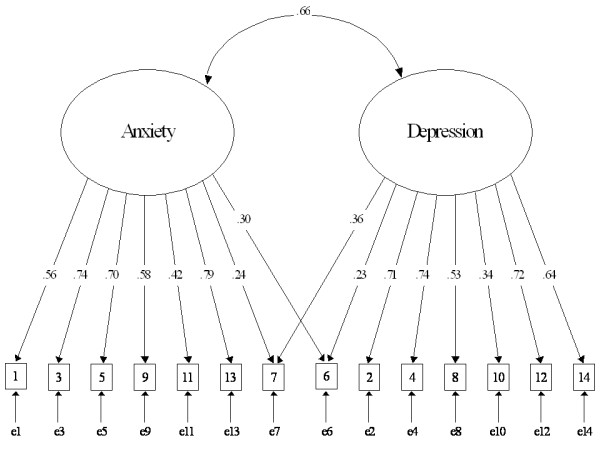
BACKGROUND: The Hospital Anxiety and Depression Scale (HADS) is a common screening instrument excluding somatic symptoms of depression and anxiety, but previous studies have reported inconsistencies of its factor structure. The construct validity of the Japanese version of the HADS has yet to be reported. To examine the factor structure of the HADS in a Japanese population is needed. METHODS: Exploratory and confirmatory factor analyses were conducted in the combined data of 408 psychiatric outpatients and 1069 undergraduate students. The data pool was randomly split in half for a cross validation. An exploratory factor analysis was performed on one half of the data, and the fitness of the plausible model was examined in the other half of the data using a confirmatory factor analysis. Simultaneous multi-group analyses between the subgroups (outpatients vs. students, and men vs. women) were subsequently conducted. RESULTS: A two-factor model where items 6 and 7 had dual loadings was supported. These factors were interpreted as reflecting anxiety and depression. Item 10 showed low contributions to both of the factors. Simultaneous multi-group analyses indicated a factor pattern stability across the subgroups. CONCLUSION: The Japanese version of HADS indicated good factorial validity in our samples. However, ambiguous wording of item 7 should be clarified in future revisions.
Overview
The claims and statistics of this paper haven’t been checked yet.
Run the check — free, no account needed. It reads the open-access text and checks the sources it cites.
Integrity signals
Registry
Cites
Statistics
Figures
Verification
Claims the paper makes
The claims and statistics of this paper haven’t been checked yet.
Run the check — free, no account needed. It reads the open-access text and checks the sources it cites.
Claims other papers make about this one
Each is checked against this paper’s own text: does it say what the citing paper says it does?
The cited source says what the claim attributes to it.
In the citing paper
“The validity and reliability of both the original and Japanese versions of the HADS have been confirmed [23,24].”
From Validation of the Tinnitus Acceptance Questionnaire: Japanese Version (2022) · cites this paper as [24]
Self-check
Percentages, sums and reported differences re-computed from the paper’s own numbers.
The self-check needs the paper’s full text.
Citations
Cites
The Hospital Anxiety and Depression Scale
Zigmond, A. S., & Snaith, R. P. (1983) · Acta Psychiatrica Scandinavica · doi:10.1111/j.1600-0447.1983.tb09716.x · Cited by 47,139
Alternative Ways of Assessing Model Fit
Browne, M. W., & Cudeck, R. (1992) · Sociological Methods & Research · doi:10.1177/0049124192021002005 · Cited by 27,200
Comparative fit indexes in structural models.
Bentler, P. M. (1990) · Psychological Bulletin · doi:10.1037/0033-2909.107.2.238 · Cited by 25,266
(1970) · Cited by 24,983
Testing Structural Equation Models.
Mueller, C. W., Bollen, K. A., & Long, J. S. (1994) · Contemporary Sociology A Journal of Reviews · doi:10.2307/2074955 · Cited by 14,211
The Scree Test For The Number Of Factors
Cattell, R. B. (1966) · Multivariate Behavioral Research · doi:10.1207/s15327906mbr0102_10 · Cited by 13,554
The validity of the Hospital Anxiety and Depression Scale
Bjelland, I., Dahl, A. A., Haug, T. T., & Neckelmann, D. (2002) · Journal of Psychosomatic Research · doi:10.1016/s0022-3999(01)00296-3 · Cited by 9,779
Evaluating the use of exploratory factor analysis in psychological research.
Fabrigar, L. R., Wegener, D. T., MacCallum, R. C., & Strahan, E. J. (1999) · Psychological Methods · doi:10.1037/1082-989x.4.3.272 · Cited by 9,587
Testing Structural Equation Models.
Clogg, C. C., Bollen, K. A., & Long, J. S. (1995) · Social Forces · doi:10.2307/2580595 · Cited by 8,246
The Varimax Criterion for Analytic Rotation in Factor Analysis
Kaiser, H. F. (1958) · Psychometrika · doi:10.1007/bf02289233 · Cited by 7,605
Research works printed but not linked: 5
- Kitamura T: The Hospital Anxiety and Depression Scale. Archives of Psychiatric Diagnostics and Clinical Evaluation 1993, 4: 371–372. (in Japanese).
- SPSS Inc: SPSS 10.0 for Windows. Chicago, SPSS Inc; 1999.
- Arbuckle JL, Wothke W: AMOS 4.0 User's Guide. Chicago, Smallwaters; 1999.
- Kanba S: Utsubyou no koudouidengakutekikouzou [Behaviour genetic structure of depression]. In Modern perspectives in the clinical psychiatry of the depressive disorders. Edited by: Hirose T, Utsumi T. Tokyo, Seiwa shoten; 2005:1–23. (in Japanese)
- Beck AT, Steer RA, Brown GK: Manual for the Beck Depression Inventory. 2nd edition. San Antonio, Psychological Corporation; 1996.
Cited by
Sorted by citations
Djukanovic, I., Carlsson, J., & Årestedt, K. (2017) · Health and Quality of Life Outcomes · doi:10.1186/s12955-017-0759-9 · Cited by 326
Iani, L., Lauriola, M., & Costantini, M. (2014) · Health and Quality of Life Outcomes · doi:10.1186/1477-7525-12-84 · Cited by 158
Roberge, P., Doré, I., Menear, M., Chartrand, E., Ciampi, A., Duhoux, A., & Fournier, L. (2012) · Journal of Affective Disorders · doi:10.1016/j.jad.2012.10.029 · Cited by 153
Ho, G. W. K., Bressington, D. T., Karatzias, T., Chien, W. T., Înoue, S., Yang, P., Chan, A. C. Y., & Hyland, P. (2019) · Social Psychiatry and Psychiatric Epidemiology · doi:10.1007/s00127-019-01768-w · Cited by 91
Psychological well-being, depression, and anxiety in Japanese university students
Liu, Q., Shono, M., & Kitamura, T. (2009) · Depression and Anxiety · doi:10.1002/da.20455 · Cited by 96
Self-citation
Metadata
- Authors
- Matsudaira, T., Igarashi, H., Kikuchi, H., Kano, R., Mitoma, H., Ohuchi, K., & Kitamura, T.
- Affiliations
- Kumamoto University (JP)
- Tokyo International University (JP)
- Corresponding author
- Matsudaira, Tomomi
- Venue
- Health and Quality of Life Outcomes
- Published
- 2009-05-17
- Volume
- 7
- Issue
- 1
- Pages
- 42-42
- ISSN
- 1477-7525 (ISSN-L)
- PMC
- PMC2687424
- OpenAlex
- W2146508862
- Cited by
- 134
- References
- 61
- Citations by year
- 2026: 6 · 2025: 9 · 2024: 11 · 2023: 12 · 2022: 14 · 2021: 15 · 2020: 9 · 2019: 10 · 2018: 6 · 2017: 9 · 2016: 5 · 2015: 6 · 2014: 8 · 2013: 5 · 2012: 7
- FWCI
- 3.81
- Type
- journal article
- Language
- en
- Open access
- gold
- doi.org
- Licence
- Locations
- Health and Quality of Life Outcomes (publishedVersion, cc-by)
- Europe PMC (PubMed Central) (publishedVersion, cc-by)
- PubMed Central (publishedVersion, cc-by)
- PubMed (publishedVersion)
- DOAJ (DOAJ: Directory of Open Access Journals) (submittedVersion, cc-by-sa)
- Topics
- Social Sciences › Psychology › Experimental and Cognitive Psychology › Anxiety, Depression, Psychometrics, Treatment, Cognitive Processes
- Social Sciences › Decision Sciences › Management Science and Operations Research › Psychometric Methodologies and Testing
- Health Sciences › Nursing › Research and Theory › Health Education and Validation
- Keywords
- Hospital Anxiety and Depression Scale, factor structure, construct validity, Japanese version, anxiety, depression, psychiatric outpatients, university students, multigroup analysis, item wording, screening tool
- MeSH terms
- Adult, Aged, Anxiety, Mental Disorders, Depression, Factor Analysis, Statistical, Female, Humans, Japan, Male, Middle Aged, Outpatients, Psychiatric Status Rating Scales, Psychometrics, Surveys and Questionnaires
About these checks
Registry, retraction, Cites and statistics results are computed, not judged, with one exception: a printed reference that no index lists is read once by a model before it counts as a citation error. Claims are extracted by a model and kept only when their quote appears verbatim in the text; each cited source is then checked, with a model’s help, for whether it says what the claim relies on. Those verdicts can be wrong — read the claim’s quote and the cited source before relying on one.
Statistics and arithmetic are recomputed, not judged.
Confidence bands are shown only for fields calibrated on our annotated test set. None is calibrated yet, so no band is shown.
What counts as a claim ›How we measure confidence ›How we check this ›
Are you an author, or do you see a problem with this page? Request a review
