

Lifestyle impact and the biology of the human scrotum
Open accessThe DOI matches its Crossref record; 50 of the 52 references it cites were found in a registry or an index, and 2 are not checked yet; none of the 58 sources its claims cite is checked for support yet.
Abstract
The possession of a scrotum to contain the male gonads is a characteristic feature of almost all mammals, and appears to have evolved to allow the testes and epididymis to be exposed to a temperature a few degrees below that of core body temperature. Analysis of cryptorchid patients, and those with varicocele suggest that mild scrotal warming can be detrimental to sperm production, partly by effects on the stem cell population, and partly by effects on later stages of spermatogenesis and sperm maturation. Recent studies on the effects of clothing and lifestyle emphasize that these can also lead to chronically elevated scrotal temperatures. In particular, the wearing of nappies by infants is a cause for concern in this regard. Together all of the evidence indirectly supports the view that lifestyle factors in addition to other genetic and environmental influences could be contributing to the secular trend in declining male reproductive parameters. The challenge will be to provide relevant and targeted experimental results to support or refute the currently circumstantial evidence.
Checked 2026-11-27 · 2 references not checked yet
Overview
CoChat Summary
TL;DR
This narrative review argues that the mammalian scrotum evolved to keep the testes and epididymis several degrees below core body temperature, and that lifestyle-related scrotal warming may impair sperm production, maturation, and storage. It concludes that clothing, posture, sedentary behavior, and nappy use could contribute to secular declines in male reproductive parameters, but that the evidence remains largely circumstantial.
Key findings
- Normal scrotal surface temperature is approximately 34°C in a normally clothed man walking or maintaining a loose stance; intratesticular temperature is estimated 0.1–0.6°C higher. Clothing contributes about 0.5–1.0°C, sitting with thighs apart raises scrotal temperature to about 35°C, and sitting with thighs together quickly raises it above 36°C, i.e. to abdominal temperature.
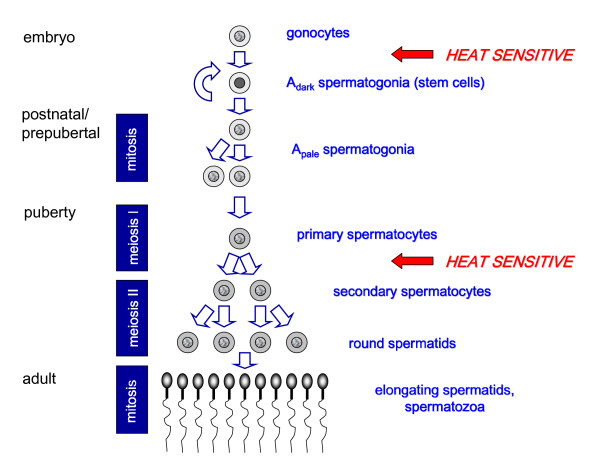
- Cryptorchidism and varicocele are associated with impaired spermatogenesis; mild testicular heating increases germ cell apoptosis, and the number of Adark spermatogonia in testis biopsies is inversely related to the age at orchidopexy, with earlier descent improving chances of full adult spermatogenesis.
- Nappy use increases scrotal temperature by 1–2°C compared with air exposure, with little difference between modern disposable and cloth nappies plus plastic cover; wet or soiled nappies may raise temperature further.
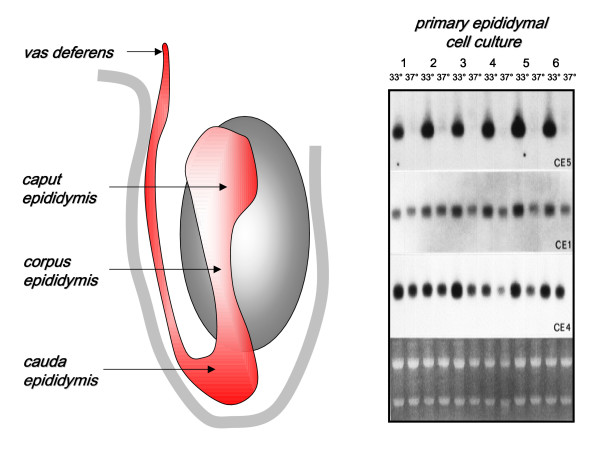
- In adult men, sedentary occupations and vehicle driving are associated with higher average scrotal temperatures and lower average sperm production or reduced fertility; nocturnal scrotal cooling in men with oligozoospermia or oligoasthenozoospermia improved semen quality over 12 weeks. Epididymal cell culture showed CD52 mRNA was almost completely and specifically inhibited by switching from scrotal temperature (33°C) to abdominal temperature (37°C).
Methods
- Narrative review/synthesis of cited human, animal, and cell-culture literature; no primary study design, sample, or statistical analysis is reported.
- Sources discussed include studies of cryptorchidism, varicocele, clothing and posture, nappy use, sedentary behavior and driving, nocturnal scrotal cooling, and epididymal epithelial cell cultures.
- Main analysis is qualitative and interpretive, linking scrotal thermoregulation, testicular pathology, lifestyle heat exposure, and epididymal function to male reproductive parameters.
Limitations
- Stated: most evidence is circumstantial; direct proof of lifestyle effects remains “untestable” in the context of evidence-based medicine, partly because of the absence of appropriate matched control groups, such as men who do not wear clothes or infants who wear no nappies.
- Stated: animal models are not biologically comparable to humans because humans have a prepubertal testicular quiescence of more than 8 years, whereas rodents have about 2 weeks and sheep or dogs up to 2–3 months; humans may also be genetically subfertile and more predisposed to subtle environmental influences.
- Stated and evident: it is not possible to distinguish pure effects of unnatural testicular heating from effects linked to the original cause of cryptorchidism or to endocrine disruptors; there is no information on early epididymal development or long-term adaptive effects. Evident: as a narrative review, it reports no systematic search, meta-analysis, or original data.
Model-written summary. Check it against the paper before relying on it.
Integrity signals
Registry
Cites
Statistics
Figures
Verification
Claims the paper makes
0 Valid · 2 Not valid · 35 Not checked · 17 Own results and interpretations
In the paper
“The possession of a scrotum to contain the male gonads is a characteristic feature of almost all mammals, and appears to have evolved to allow the testes and epididymis to be exposed to a temperature a few degrees below that of core body temperature.”
- Also stated in: § Background · hedged
“The most plausible evolutionary explanation relates to the requirement of spermatogenesis for an optimum temperature lower than core abdominal temperature [1].”
§ Lifestyle impact and the biology of the human scrotum > Abstract
What the sources say
- Not checked yetcites [1] Werdelin L Nilsonne A The evolution of the scrotum and testicular descent in mammals: a phylogenetic view J Theor Biol 1999 196 61 72 9892556 10.1006/jtbi.1998.0821 source
hedgedstates a cause- Asserted: passes — The authors put it forward as true.
- Checkable: passes — It can be checked against evidence.
- Load-bearing: passes — The paper’s conclusions depend on it.
- Based: passes — The paper gives a reason why it holds.
- Also stated in: § Background · hedged
A conclusion the paper draws from its own results — it cites no other source for it, so there is none to check. The quote shows it is in the paper.
In the paper
“Together, these features point to an environmental influence, which is associated with increased industrialization.”
§ Lifestyle impact and the biology of the human scrotum > Conclusions and consequences
plainstates an association- Asserted: passes — The authors put it forward as true.
- Checkable: passes — It can be checked against evidence.
- Load-bearing: passes — The paper’s conclusions depend on it.
- Based: passes — The paper gives a reason why it holds.
None of the sources cited for this claim have been checked yet.
In the paper
“Men with oligozoospermia or oligoasthenozoospermia who were allowed to sleep with a small apparatus which permitted nocturnal scrotal cooling showed significant improvements in semen quality over a period of 12 weeks [32,33].”
§ Lifestyle impact and the biology of the human scrotum > Lifestyle factors and scrotal function
What the sources say
- Not checked yetcites [32] Jung A Eberl M Schill WB Improvement of semen quality by nocturnal scrotal cooling and moderate behavioural change to reduce genital heat stress in men with oligoasthenoteratozoospermia Reproduction 2001 121 595 603 11277880 10.1530/rep.0.1210595 source
- Not checked yetcites [33] Jung A Schill WB Schuppe HC Improvement of semen quality by nocturnal scrotal cooling in oligozoospermic men with a history of testicular maldescent Int J Androl 2005 28 93 98 15811070 10.1111/j.1365-2605.2004.00517.x source
plainstates a cause- Asserted: passes — The authors put it forward as true.
- Checkable: passes — It can be checked against evidence.
- Load-bearing: passes — The paper’s conclusions depend on it.
- Based: passes — The paper gives a reason why it holds.
In the paper
“Recent observations show that this is incorrect, and that abdominal temperature can markedly influence the number of spermatogonial stem cells that are available to generate all sperm in later life [20].”
§ Lifestyle impact and the biology of the human scrotum > Scrotal pathology and temperature
What the sources say
- Not checked yetcites [20] Hadziselimovic F Herzog B The importance of both an early orchidopexy and germ cell maturation for fertility Lancet 2001 358 1156 1157 11597673 10.1016/S0140-6736(01)06274-2 source
plainstates a cause- Asserted: passes — The authors put it forward as true.
- Checkable: passes — It can be checked against evidence.
- Load-bearing: passes — The paper’s conclusions depend on it.
- Based: passes — The paper gives a reason why it holds.
None of the sources cited for this claim have been checked yet.
In the paper
“Recent studies on the effects of clothing and lifestyle emphasize that these can also lead to chronically elevated scrotal temperatures.”
§ Lifestyle impact and the biology of the human scrotum > Abstract
What the sources say
- Not checked yetcites [32] Jung A Eberl M Schill WB Improvement of semen quality by nocturnal scrotal cooling and moderate behavioural change to reduce genital heat stress in men with oligoasthenoteratozoospermia Reproduction 2001 121 595 603 11277880 10.1530/rep.0.1210595 source
- Not checked yetcites [33] Jung A Schill WB Schuppe HC Improvement of semen quality by nocturnal scrotal cooling in oligozoospermic men with a history of testicular maldescent Int J Androl 2005 28 93 98 15811070 10.1111/j.1365-2605.2004.00517.x source
- Not checked yetcites [36] Hjolland NHI Storgaard L Ernst E Bonde JP Olsen J The relation between daily activities and scrotal temperature Reprod Toxicol 2002 16 209 214 12128093 10.1016/S0890-6238(02)00026-6 source
- Not checked yetcites [37] Jung A Leonhardt F Schill WB Schuppe HC Influence of the type of undertrousers and physical activity on scrotal temperature Hum Reprod 2005 20 1022 1027 15618251 10.1093/humrep/deh697 source
plainstates a cause- Asserted: passes — The authors put it forward as true.
- Checkable: passes — It can be checked against evidence.
- Load-bearing: passes — The paper’s conclusions depend on it.
- Based: passes — The paper gives a reason why it holds.
28 more claims
Create a free account to see all 54 claims and to verify the 58 references still open.
- It may state two separate claims as one. 19
- Probably not a substantial claim. 3
Claims other papers make about this one
Each is checked against this paper’s own text: does it say what the citing paper says it does?
In the citing paper
“Moreover, normal testicular function requires a substantial temperature reduction of 2–8 °C below core body temperature [89].”
From Mechanisms of Hormonal, Genetic, and Temperature Regulation of Germ Cell Proliferation, Differentiation, and Death During Spermatogenesis (2025) · cites this paper as [89]
Citations
Cites
Skakkebæk, N. E., Rajpert-De Meyts, E., & Main, K. M. (2001) · Human Reproduction · doi:10.1093/humrep/16.5.972 · Cited by 2,260
Main, K. M., Mortensen, G. K., Kaleva, M. M., Boisen, K. A., Damgaard, I. N., Chellakooty, M., Schmidt, I. M., Suomi, A.-M., Virtanen, H. E., Petersen, J. H., et al. (2006) · Environmental Health Perspectives · doi:10.1289/ehp.8075 · Cited by 696
FOSTER, P. M. D. (2006) · International Journal of Andrology · doi:10.1111/j.1365-2605.2005.00563.x · Cited by 578
The Parkes Lecture Heat and the testis
Setchell, B. P. (1998) · Reproduction · doi:10.1530/jrf.0.1140179 · Cited by 418
Anatomical and Functional Aspects of Testicular Descent and Cryptorchidism*
Hutson, J. M., Hasthorpe, S., & Heyns, C. F. (1997) · Endocrine Reviews · doi:10.1210/edrv.18.2.0298 · Cited by 400
A Population-Level Decline in Serum Testosterone Levels in American Men
Travison, T. G., Araujo, A. B., O’Donnell, A. B., Kupelian, V., & McKinlay, J. B. (2007) · The Journal of Clinical Endocrinology & Metabolism · doi:10.1210/jc.2006-1375 · Cited by 335
Pathways of endocrine disruption during male sexual differentiation and masculinisation
Sharpe, R. M. (2006) · Best Practice & Research Clinical Endocrinology & Metabolism · doi:10.1016/j.beem.2005.09.005 · Cited by 302
The importance of both an early orchidopexy and germ cell maturation for fertility
Hadziselimovic, F., & Herzog, B. (2001) · The Lancet · doi:10.1016/s0140-6736(01)06274-2 · Cited by 233
The molecular basis of cryptorchidism
Ivell, R., & Hartung, S. (2003) · Molecular Human Reproduction · doi:10.1093/molehr/gag025 · Cited by 180
Self-citationKubota, Y., Temelcos, C., Bathgate, R. A. D., Smith, K. J., Scott, D., Zhao, C., & Hutson, J. M. (2002) · Molecular Human Reproduction · doi:10.1093/molehr/8.10.900 · Cited by 160
Diurnal scrotal skin temperature and semen quality
Hjollund, N. H. I., Bonde, J. P. E., Jensen, T. K., Olsen, J., & The Danish First Pregnancy Planner Study Team (2000) · International Journal of Andrology · doi:10.1046/j.1365-2605.2000.00245.x · Cited by 144
The study of varicocele through the use of animal models
Turner, T. T. (2001) · Human Reproduction Update · doi:10.1093/humupd/7.1.78 · Cited by 132
Emmen, J. M. A., McLuskey, A., Adham, I. M., Engel, W., Grootegoed, J. A., & Brinkmann, A. O. (2000) · Endocrinology · doi:10.1210/endo.141.12.7830 · Cited by 128
McKinnell, C., Sharpe, R. M., Mahood, K., Hallmark, N., Scott, H., Ivell, R., Staub, C., Jégou, B., Haag, F., Koch-Nolte, F., et al. (2005) · Endocrinology · doi:10.1210/en.2005-0676 · Cited by 128
Self-citationThe importance of mini-puberty for fertility in cryptorchidism
HADZISELIMOVIC, F., ZIVKOVIC, D., BICA, D. T. G., & EMMONS, L. R. (2005) · Journal of Urology · doi:10.1097/01.ju.0000181506.97839.b0 · Cited by 122
The testis: the witness of the mating system, the site of mutation and the engine of desire
Short, R. V. (1997) · Acta Paediatrica · doi:10.1111/j.1651-2227.1997.tb18336.x · Cited by 117
Anatomical and Functional Aspects of Testicular Descent and Cryptorchidism
Hutson, J. M. (1997) · Endocrine Reviews · doi:10.1210/er.18.2.259 · Cited by 116
Gene Expression in the Epididymis
Kirchhoff, C. (1999) · International Review of Cytology · doi:10.1016/s0074-7696(08)61567-3 · Cited by 115
Increase in scrotal temperature in car drivers
Bujan, L., Daudin, M., Charlet, J.-P., Thonneau, P., & Mieusset, R. (2000) · Human Reproduction · doi:10.1093/humrep/15.6.1355 · Cited by 108
Effect of heat stress on the fertility of male mice in vivo and in vitro
Yaeram, J., Setchell, B. P., & Maddocks, S. (2006) · Reproduction, Fertility and Development · doi:10.1071/rd05022 · Cited by 104
Gaeth, A. P., Short, R. V., & Renfree, M. B. (1999) · Proceedings of the National Academy of Sciences · doi:10.1073/pnas.96.10.5555 · Cited by 87
Influence of the type of undertrousers and physical activity on scrotal temperature
Jung, A., Leonhardt, F., Schill, W.-B., & Schuppe, H.-C. (2005) · Human Reproduction · doi:10.1093/humrep/deh697 · Cited by 83
Anatomical evidence for the epididymis as the prime mover in the evolution of the scrotum
Bedford, J. M. (1978) · American Journal of Anatomy · doi:10.1002/aja.1001520404 · Cited by 83
The Evolution of the Scrotum and Testicular Descent in Mammals: a Phylogenetic View
Werdelin, L., & Nilsonne, Å. (1999) · Journal of Theoretical Biology · doi:10.1006/jtbi.1998.0821 · Cited by 74
The relation between daily activities and scrotal temperature
Hjollund, N. H. I., Storgaard, L., Ernst, E., Bonde, J. P., & Olsen, J. (2002) · Reproductive Toxicology · doi:10.1016/s0890-6238(02)00026-6 · Cited by 70
Jung, A., Eberl, M., & Schill, W. B. (2001) · Reproduction · doi:10.1530/rep.0.1210595 · Cited by 69
Cryptorchidism, Its Impact on Male Fertility
Hadziselimovic, F. (2002) · European Urology · doi:10.1016/s0302-2838(01)00040-9 · Cited by 69
The evolution of the scrotum: A new hypothesis
Freeman, S. (1990) · Journal of Theoretical Biology · doi:10.1016/s0022-5193(05)80479-5 · Cited by 66
LERCHL, A., KECK, C., SPITERI‐GRECH, J., NIESCHLAG, E., & Bergh, A. (1993) · International Journal of Andrology · doi:10.1111/j.1365-2605.1993.tb01179.x · Cited by 56
Xue-Sen, Z. (2005) · Frontiers in bioscience · doi:10.2741/1767 · Cited by 50
13 Years’ Experience with the Combined Hormonal Therapy of Cryptorchidism
Giannopoulos, M. F., Vlachakis, I., & Charissis, G. C. (2001) · Hormone Research in Paediatrics · doi:10.1159/000049961 · Cited by 49
Scrotal temperature is increased in disposable plastic lined nappies
Partsch, C.-J. (2000) · Archives of Disease in Childhood · doi:10.1136/adc.83.4.364 · Cited by 47
Pera, I., Ivell, R., & Kirchhoff, C. (1996) · Endocrinology · doi:10.1210/endo.137.10.8828507 · Cited by 47
Self-citationHeat exposure as a hazard to male fertility
Thonneau, P., Ducot, B., Bujan, L., Mieusset, R., & Spira, A. (1996) · The Lancet · doi:10.1016/s0140-6736(96)90391-8 · Cited by 45
Kumagai, J., Fukuda, J., Kodama, H., Murata, M., Kawamura, K., Itoh, H., & Tanaka, T. (2000) · European Journal of Biochemistry · doi:10.1046/j.1432-1033.2000.01336.x · Cited by 44
The pathophysiology of varicocele-associated male infertility
Schoor, R. A., Elhanbly, S. M., & Niederberger, C. S. (2001) · Current Urology Reports · doi:10.1007/s11934-001-0035-7 · Cited by 43
Testis Histopathology in Boys With Cryptorchidism Correlates With Future Fertility Potential
RUSNACK, S. L., WU, H.-Y., HUFF, D. S., SNYDER, H. M., CARR, M. C., BELLAH, R. D., ZDERIC, S. A., & CANNING, D. A. (2003) · Journal of Urology · doi:10.1016/s0022-5347(05)63986-9 · Cited by 41
CarcinomaIn situ of the testis: Review of biological and clinical features
Dieckmann, K.-P., & Skakkebaek, N. E. (1999) · International Journal of Cancer · doi:10.1002/(sici)1097-0215(19991210)83:6<815::aid-ijc21>3.0.co;2-z · Cited by 39
HST-1/FGF-4 protects male germ cells from apoptosis under heat-stress condition
Hirai, K., Sasaki, H., Yamamoto, H., Sakamoto, H., Kubota, Y., Kakizoe, T., Terada, M., & Ochiya, T. (2003) · Experimental Cell Research · doi:10.1016/j.yexcr.2003.11.012 · Cited by 34
Jury, J. A., Frayne, J., & Hall, L. (1998) · Molecular Reproduction and Development · doi:10.1002/(sici)1098-2795(199809)51:1<92::aid-mrd11>3.0.co;2-w · Cited by 34
Scrotal Temperature and Semen Quality in Men With and Without Varicocele
Ali, J. I., Weaver, D. J., Weinstein, S. H., & Grimes, E. M. (1990) · Archives of Andrology · doi:10.3109/01485019008986882 · Cited by 31
Shetty, G., Weng, C. C. Y., Porter, K. L., Zhang, Z., Pakarinen, P., Kumar, T. R., & Meistrich, M. L. (2006) · Endocrinology · doi:10.1210/en.2006-0159 · Cited by 27
Thermoregulation of the Scrotum and Testis: Studies in Animals and Significance for Man
Waites, G. M. H. (1991) · Advances in Experimental Medicine and Biology · doi:10.1007/978-1-4684-5913-5_2 · Cited by 25
Childhood Obesity and the Metabolic Syndrome
Chia, D. J., & Boston, B. A. (2006) · Advances in Pediatrics · doi:10.1016/j.yapd.2006.04.005 · Cited by 24
JUNG, A., SCHILL, W. ‐., & SCHUPPE, H. ‐. (2005) · International Journal of Andrology · doi:10.1111/j.1365-2605.2004.00517.x · Cited by 22
Pera, I. (1996) · Endocrinology · doi:10.1210/en.137.10.4451 · Cited by 20
Shetty, G., & Weng, C. C. Y. (2003) · Endocrinology · doi:10.1210/en.2003-0928 · Cited by 19
Ivell, R., Pusch, W., Balvers, M., Valentin, M., Walther, N., & Weinbauer, G. (2000) · Gene · doi:10.1016/s0378-1119(00)00317-6 · Cited by 13
Self-citationScrotal temperatures do not differ among young boys wearing disposable or reusable diapers
Grove, G. L., Grove, M. J., Bates, N. T., Wagman, L. M., & Leyden, J. J. (2002) · Skin Research and Technology · doi:10.1034/j.1600-0846.2002.00336.x · Cited by 8
Lyet, L., Vigier, B., & van der Schoot, P. (1996) · Reproduction · doi:10.1530/jrf.0.1080281 · Cited by 8
How vulnerable is the developing testis to the external environment?
HUGHES, P. I. A. (2000) · Archives of Disease in Childhood · doi:10.1136/adc.83.4.281 · Cited by 4
Testicular cancer risk in relation to use of disposable nappies
Moller, H. (2002) · Archives of Disease in Childhood · doi:10.1136/adc.86.1.28 · Cited by 1
Cited by
Causes, effects and molecular mechanisms of testicular heat stress
Durairajanayagam, D., Agarwal, A., & Ong, C. (2015) · Reproductive BioMedicine Online · doi:10.1016/j.rbmo.2014.09.018 · Cited by 431
Impact of obesity on male fertility, sperm function and molecular composition
Palmer, N. O., Bakos, H. W., Fullston, T., & Lane, M. (2012) · Spermatogenesis · doi:10.4161/spmg.21362 · Cited by 403
Reactive oxygen species and male reproductive hormones
Darbandi, M., Darbandi, S., Agarwal, A., Sengupta, P., Durairajanayagam, D., Henkel, R., & Sadeghi, M. R. (2018) · Reproductive Biology and Endocrinology · doi:10.1186/s12958-018-0406-2 · Cited by 379
Impact of male obesity on infertility: a critical review of the current literature
Hammoud, A. O., Gibson, M., Peterson, C. M., Meikle, A. W., & Carrell, D. T. (2008) · Fertility and Sterility · doi:10.1016/j.fertnstert.2008.08.026 · Cited by 364
Paul, C., Teng, S., & Saunders, P. T. K. (2009) · Biology of Reproduction · doi:10.1095/biolreprod.108.071779 · Cited by 355
Metadata
- Authors
- Ivell, R.
- Affiliations
- The University of Adelaide (AU)
- Corresponding author
- Ivell, Richard
- ORCID
- Ivell, Richard
- Venue
- Reproductive Biology and Endocrinology
- Published
- 2007-04-20
- Volume
- 5
- Issue
- 1
- Pages
- 15-15
- ISSN
- 1477-7827 (ISSN-L)
- PMC
- PMC1863418
- OpenAlex
- W2169721147
- Cited by
- 190
- References
- 50
- Citations by year
- 2026: 7 · 2025: 4 · 2024: 11 · 2023: 8 · 2022: 15 · 2021: 9 · 2020: 14 · 2019: 14 · 2018: 12 · 2017: 14 · 2016: 10 · 2015: 13 · 2014: 16 · 2013: 8 · 2012: 11
- FWCI
- 3.47
- Type
- journal article
- Language
- en
- Open access
- gold
- doi.org
- Licence
- cc-by
- creativecommons.org/licenses/by/2.0 (tdm)
- Locations
- Reproductive Biology and Endocrinology (publishedVersion, cc-by)
- PubMed Central (publishedVersion, cc-by)
- PubMed (publishedVersion)
- Adelaide Research & Scholarship (AR&S) (University of Adelaide) (submittedVersion, cc-by)
- DOAJ (DOAJ: Directory of Open Access Journals) (submittedVersion)
- Funders
- Medical Research Council
- Australian Research Council
- National Health and Medical Research Council
- Topics
- Health Sciences › Medicine › Reproductive Medicine › Sperm and Testicular Function
- Health Sciences › Medicine › Urology › Male Reproductive Health Studies
- Health Sciences › Medicine › Reproductive Medicine › Reproductive Health and Technologies
- Keywords
- scrotum, scrotal temperature, spermatogenesis, cryptorchidism, varicocele, nappies, clothing, lifestyle factors, epididymis, testis, stem cells
- MeSH terms
- Animals, Body Temperature, Fertility, Humans, Life Style, Male, Scrotum
About these checks
Registry, retraction, Cites and statistics results are computed, not judged, with one exception: a printed reference that no index lists is read once by a model before it counts as a citation error. Claims are extracted by a model and kept only when their quote appears verbatim in the text; each cited source is then checked, with a model’s help, for whether it says what the claim relies on. Those verdicts can be wrong — read the claim’s quote and the cited source before relying on one.
A language model drew the claims from the paper on 2026-11-27, under version 3 of the claim definition (model deepseek-v4.1-flash, prompt extract-v3).
A second model labelled each claim on 2026-11-27 (model jev-1.13-20260917, definition revision gold-guideline-v0.2).
Statistics and arithmetic are recomputed, not judged.
Confidence bands are shown only for fields calibrated on our annotated test set. None is calibrated yet, so no band is shown.
What counts as a claim ›How we measure confidence ›How we check this ›
Are you an author, or do you see a problem with this page? Request a review
Data sources
Bibliographic data: Semantic Scholar, OpenAlex, Crossref.
Contains information from the Semantic Scholar Academic Graph Datasets, made available under the ODC Attribution License (ODC-BY 1.0).
Semantic Scholar’s data is described in: Kinney, R., et al. (2023). The Semantic Scholar Open Data Platform. arXiv:2301.10140.
