

Improving the public health utility of global cardiovascular mortality data: the rise of ischemic heart disease
Open accessThe DOI matches its Crossref record; 43 of the 45 references it cites were found in a registry or an index.
Abstract
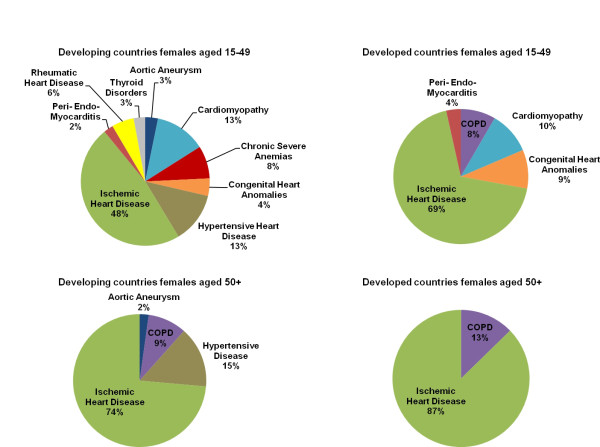
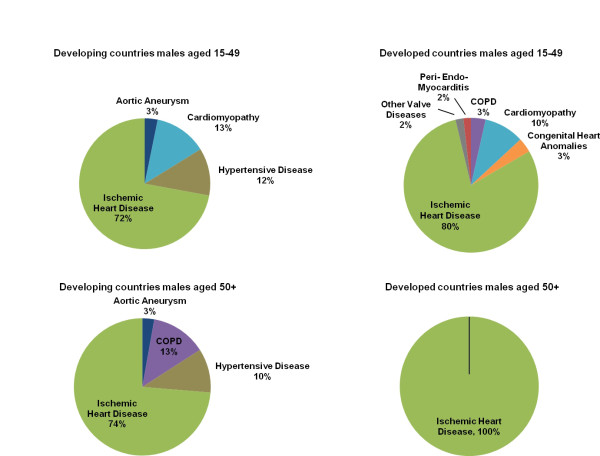
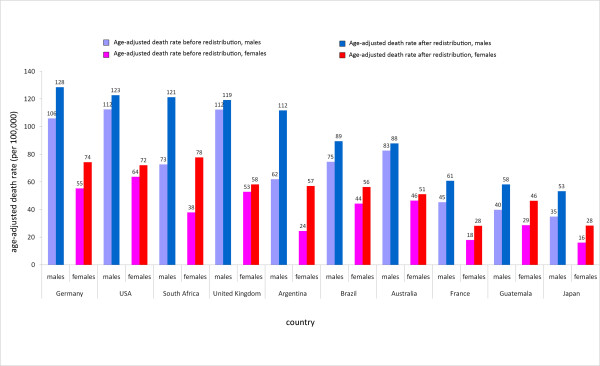
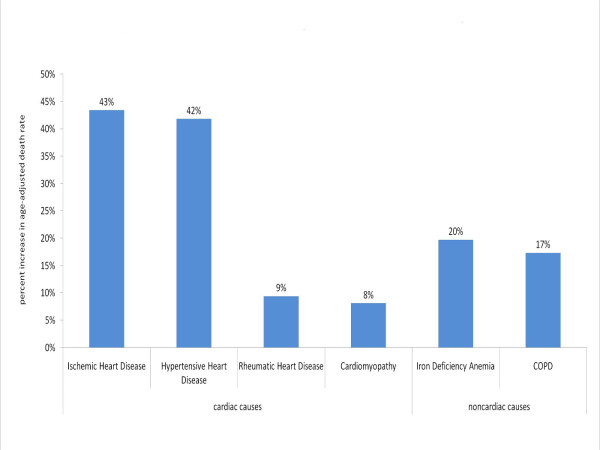
BACKGROUND: High-quality, cause-specific mortality data are critical for effective health policy. Yet vague cause of death codes, such as heart failure, are highly prevalent in global mortality data. We propose an empirical method correcting mortality data for the use of heart failure as an underlying cause of death. METHODS: We performed a regression analysis stratified by sex, age, and country development status on all available ICD-10 mortality data, consisting of 142 million deaths across 838 country-years. The analysis yielded predicted fractions with which to redistribute heart failure-attributed deaths to the appropriate underlying causes of death. Age-adjusted death rates and rank causes of death before and after correction were calculated. RESULTS: Heart failure accounts for 3.1% of all deaths in the dataset. Ischemic heart disease has the highest redistribution proportion for ages 15-49 and 50+ in both sexes and country development levels, causing gains in age-adjusted death rates in both developed and developing countries. COPD and hypertensive heart disease also make significant rank gains. Reproductive-aged women in developing country-years yield the most diverse range of heart failure causes. CONCLUSIONS: Ischemic heart disease becomes the No. 1 cause of death in several developed countries, including France and Japan, underscoring the cardiovascular epidemic in high-income countries. Age-adjusted death rate increases for ischemic heart disease in low- and middle-income countries, such as Argentina and South Africa, highlight the rise of the cardiovascular epidemic in regions where public health efforts have historically focused on infectious diseases. This method maximizes the use of available data, providing better evidence on major causes of death to inform policymakers in allocating finite resources.
Overview
The claims and statistics of this paper haven’t been checked yet.
Free: it reads the open-access text and checks the first 5 claims that cite a source we can check. Create a free account to check every claim.
Integrity signals
Registry
Cites
Statistics
Figures
Verification
Claims the paper makes
The claims and statistics of this paper haven’t been checked yet.
Free: it reads the open-access text and checks the first 5 claims that cite a source we can check. Create a free account to check every claim.
Claims other papers make about this one
Each is checked against this paper’s own text: does it say what the citing paper says it does?
In the citing paper
“Garbage code redistribution algorithms are largely based on expert opinion, although some empirical approaches have been applied [51].”
From Modeling causes of death: an integrated approach using CODEm (2012) · cites this paper as [51]
Self-check
Percentages, sums and reported differences re-computed from the paper’s own numbers.
The self-check needs the paper’s full text.
Citations
Cites
Global burden of hypertension: analysis of worldwide data
Kearney, P. M., Whelton, M., Reynolds, K., Muntner, P., Whelton, P. K., & He, J. (2005) · The Lancet · doi:10.1016/s0140-6736(05)17741-1 · Cited by 8,594 · cited 1×
“The rise of hypertensive heart disease in developing country-years is likely due to a combination of the increasing burden of hypertension in developing nations coupled with the relative decreased access to antihypertensive medication in the developing world [ 32-34 ].”
Background(1996) · Cited by 6,884
Self-citationHiggins, S. M. F., Macken, A. P., Cullen, W., Saunders, J., Dunne, C. P., & O’Gorman, C. S. (2013) · PubMed · doi:10.34961/9953 · Cited by 4,806
Estimating the world cancer burden: Globocan 2000
Parkin, D. M., Bray, F., Ferlay, J., & Pisani, P. (2001) · International Journal of Cancer · doi:10.1002/ijc.1440 · Cited by 3,721 · cited 1×
“Even for countries with high vital registration coverage, the quality of the data is often substandard [2,4-7].”
BackgroundWine, alcohol, platelets, and the French paradox for coronary heart disease
Renaud, S., & de Lorgeril, M. (1992) · The Lancet · doi:10.1016/0140-6736(92)91277-f · Cited by 3,643 · cited 1×
“The relative increase in the age-adjusted death rate of ischemic heart disease in France - by 55% for women and 35% for men - prompts questions about the validity of the French paradox, an analysis using coronary heart disease as the cause of death variable without accounting for heart failure-attributed deaths [30].”
Global Burden of Disease and Risk Factors
(2006) · World Bank, Washington, DC eBooks · doi:10.1596/978-0-8213-6262-4 · Cited by 2,605 · cited 4×
“) to one underlying cause of death, ischemic heart disease [2,4,18].”
BackgroundInfluentialSelf-citationThe epidemiology of heart failure: The Framingham Study
Ho, K. K. L., Pinsky, J. L., Kannel, W. B., & Levy, D. (1993) · Journal of the American College of Cardiology · doi:10.1016/0735-1097(93)90455-a · Cited by 2,247
Evidence-based health policy—lessons from the Global Burden of Disease Study
Murray, C. J. L., & Lopez, A. D. (1996) · Science · doi:10.1126/science.274.5288.740 · Cited by 2,178 · cited 2×
“Though the problem of miscoded mortality data is appreciated in the literature [2-6,10,12,14-20], there is a paucity of redistribution methods described in the literature.”
BackgroundSelf-citationInternational Statistical Classification of Diseases and Related Health Problems 10th Revision
(2013) · A Companion to the Classification of Mental Disorders · doi:10.1093/med/9780199669493.005.0005 · Cited by 2,059
(2005) · Europe PMC (PubMed Central) · Cited by 1,975
Baldasseroni, S., Opasich, C., Gorini, M., Lucci, D., Marchionni, N., Marini, M., Campana, C., Perini, G., Deorsola, A., Masotti, G., et al. (2002) · American Heart Journal · doi:10.1067/mhj.2002.121264 · Cited by 800 · cited 1×
“Consistent with the epidemiology of heart failure discussed in the literature [23-28], ischemic heart disease has the highest redistribution proportion for adults in all sex and country development stratifications.”
BackgroundKannel, W. B., & Belanger, A. J. (1991) · American Heart Journal · doi:10.1016/0002-8703(91)90225-7 · Cited by 797
Chronic Heart Failure in the United States: A Manifestation of Coronary Artery Disease
Gheorghiade, M., & Bonow, R. O. (1998) · Circulation · doi:10.1161/01.cir.97.3.282 · Cited by 787 · cited 1×
“Consistent with the epidemiology of heart failure discussed in the literature [23-28], ischemic heart disease has the highest redistribution proportion for adults in all sex and country development stratifications.”
BackgroundPathophysiology of cor pulmonale in chronic obstructive pulmonary disease. Part One.
MacNee, W. (1994) · American Journal of Respiratory and Critical Care Medicine · doi:10.1164/ajrccm.150.3.8087359 · Cited by 488
Accuracy of Death Certificates for Coding Coronary Heart Disease as the Cause of Death
Lloyd-Jones, D. M., Martin, D. O., Larson, M. G., & Levy, D. (1998) · Annals of Internal Medicine · doi:10.7326/0003-4819-129-12-199812150-00005 · Cited by 480
Algorithms for enhancing public health utility of national causes-of-death data
Naghavi, M., Makela, S., Foreman, K., O'Brien, J., Pourmalek, F., & Lozano, R. (2010) · Population Health Metrics · doi:10.1186/1478-7954-8-9 · Cited by 440 · cited 4×
“Though the problem of miscoded mortality data is appreciated in the literature [2-6, 10 ,12,14-20], there is a paucity of redistribution methods described in the literature.”
BackgroundMethodInfluentialSelf-citationCivil registration systems and vital statistics: successes and missed opportunities
Mahapatra, P., Shibuya, K., Lopez, A. D., Coullare, F., Notzon, F. C., Rao, C., & Szreter, S. (2007) · The Lancet · doi:10.1016/s0140-6736(07)61308-7 · Cited by 352 · cited 1×
“Previous literature has noted that countries have varying rates of data completeness and that correction for this incompleteness may enhance the comparability of national cause of death data [45].”
Changing epidemiological features of cardiac failure
Kannel, W. B., Ho, K., & Thom, T. (1994) · Heart · doi:10.1136/hrt.72.2_suppl.s3 · Cited by 334 · cited 1×
“Consistent with the epidemiology of heart failure discussed in the literature [23-28], ischemic heart disease has the highest redistribution proportion for adults in all sex and country development stratifications.”
BackgroundThyrotoxicosis complicating pregnancy
Davis, L. E., Lucas, M. J., Hankins, G. D. V., Roark, M. L., & Gary Cunningham, F. (1989) · American Journal of Obstetrics and Gynecology · doi:10.1016/0002-9378(89)90088-4 · Cited by 324
Accuracy of cause-of-death coding in Taiwan: types of miscoding and effects on mortality statistics
Lu, T.-H., Lee, M.-C., & Chou, M.-C. (2000) · International Journal of Epidemiology · doi:10.1093/ije/29.2.336 · Cited by 322 · cited 1×
“Though the problem of miscoded mortality data is appreciated in the literature [2-6,10,12,14-20], there is a paucity of redistribution methods described in the literature.”
BackgroundEpidemiology and Etiology of Cardiomyopathy in Africa
Sliwa, K., Damasceno, A., & Mayosi, B. M. (2005) · Circulation · doi:10.1161/circulationaha.105.542894 · Cited by 266 · cited 1×
“In the absence of adequate antenatal care, including iron supplementation and routine monitoring, causes such as anemia, thyrotoxicosis, peripartum cardiomyopathy, and hypertension-induced heart disease become significant targets for heart failure redistribution [36-40].”
BackgroundThe epidemiological features of heart failure in developing countries: a review of the literature
Mendez, G. F., & Cowie, M. R. (2001) · International Journal of Cardiology · doi:10.1016/s0167-5273(01)00497-1 · Cited by 264 · cited 1×
“Consistent with the epidemiology of heart failure discussed in the literature [23-28], ischemic heart disease has the highest redistribution proportion for adults in all sex and country development stratifications.”
BackgroundSiu, S. C., & Colman, J. M. (2001) · Heart · doi:10.1136/heart.85.6.710 · Cited by 247 · cited 1×
“Increased cardiac work in pregnancy will expose underlying cardiac conditions, such as congenital heart anomalies and rheumatic valve disease, which were less likely to have been diagnosed prior to pregnancy in developing countries [41].”
BackgroundStewart, S., Wilkinson, D., Hansen, C., Vaghela, V., Mvungi, R., McMurray, J., & Sliwa, K. (2008) · Circulation · doi:10.1161/circulationaha.108.786244 · Cited by 220 · cited 1×
“The rise of hypertensive heart disease in developing country-years is likely due to a combination of the increasing burden of hypertension in developing nations coupled with the relative decreased access to antihypertensive medication in the developing world [32-34].”
BackgroundLampert, M. B., & Lang, R. M. (1995) · American Heart Journal · doi:10.1016/0002-8703(95)90089-6 · Cited by 198
'Inaccuracy' in death certification - where are we now?
Maudsley, G., & Williams, E. M. I. (1996) · Journal of Public Health · doi:10.1093/oxfordjournals.pubmed.a024463 · Cited by 183 · cited 2×
“Though the problem of miscoded mortality data is appreciated in the literature [2-6,10,12,14-20], there is a paucity of redistribution methods described in the literature.”
BackgroundThe Epidemiologic Transition Revisited: Compositional Models for Causes of Death by Age and Sex
Salomon, J. A., & Murray, C. J. L. (2002) · Population and Development Review · doi:10.1111/j.1728-4457.2002.00205.x · Cited by 162 · cited 1×
“countries become increasingly developed [29].”
Self-citationLakkireddy, D. R., Gowda, M. S., Murray, C. W., Basarakodu, K. R., & Vacek, J. L. (2004) · The American Journal of Medicine · doi:10.1016/j.amjmed.2004.04.018 · Cited by 135 · cited 2×
“They may be inadequately trained to complete death certificates [ 17 ], or, in some cases, may intentionally miscode deaths in the face of political, financial, or social pressure (i.e., HIV-related stigma).”
BackgroundSelf-citationDeath Certificates Are Not Reliable: Revivification of the Autopsy
Ravakhah, K. (2006) · Southern Medical Journal · doi:10.1097/01.smj.0000224337.77074.57 · Cited by 126 · cited 1×
“However, even with a wide-scale autopsy study, it would be difficult to ascertain the etiology of heart failure-attributed deaths with certainty [16,44].”
BackgroundIron supplementation during pregnancy: is it effective?
Yip, R. (1996) · American Journal of Clinical Nutrition · doi:10.1093/ajcn/63.6.853 · Cited by 84 · cited 1×
“In the absence of adequate antenatal care, including iron supplementation and routine monitoring, causes such as anemia, thyrotoxicosis, peripartum cardiomyopathy, and hypertension-induced heart disease become significant targets for heart failure redistribution [36-40].”
BackgroundMaternal and perinatal mortality due to eclampsia.
Swain, S., Ojha, K. N., Prakash, A., & Bhatia, B. D. (1993) · PubMed · Cited by 79
The necessary role of the autopsy in cardiovascular epidemiology
Smith, C. J., Scott, S. M., & Wagner, B. M. (1998) · Human Pathology · doi:10.1016/s0046-8177(98)90018-1 · Cited by 67 · cited 3×
“Though the problem of miscoded mortality data is appreciated in the literature [2-6,10,12,14-20], there is a paucity of redistribution methods described in the literature.”
BackgroundMortality certification and cause-of-death reporting in developing countries.
Sibai, A. M. (2004) · PubMed · doi:10.1590/s0042-96862004000200002 · Cited by 62
Deaths from heart failure: using coarsened exact matching to correct cause-of-death statistics
Stevens, G. A., King, G., & Shibuya, K. (2010) · Population Health Metrics · doi:10.1186/1478-7954-8-6 · Cited by 62 · cited 1×
“A recent paper by Stevens et al proposes a coarsened exact matching method to redistribute heart failure that includes nonpathophysiologicallyrelated causes [ 42 ].”
MethodInadequacies of death certification in Beirut: who is responsible?
Sibai, A. M., Nuwayhid, I. A., Beydoun, M. A., & Chaaya, M. (2002) · PubMed · doi:10.1590/s0042-96862002000700007 · Cited by 42
Underreporting and misclassification of maternal mortality in Taiwan
Kao, S., Chen, L., Shi, L., & Weinrich, M. C. (1997) · Acta Obstetricia et Gynecologica Scandinavica · doi:10.3109/00016349709024602 · Cited by 41
The role of diagnostic inconsistency in changing rates of occurrence for coronary heart disease
Burnand, B., & Feinstein, A. R. (1992) · Journal of Clinical Epidemiology · doi:10.1016/0895-4356(92)90109-z · Cited by 40 · cited 1×
“These codes are often misrecorded as an underlying cause of death on death certificates or in mortality datasets for a number of reasons [11-15].”
BackgroundThe global burden of hypertension: good news and bad news
Mensah, G. A. (2002) · Cardiology Clinics · doi:10.1016/s0733-8651(02)00002-4 · Cited by 39 · cited 1×
“The rise of hypertensive heart disease in developing country-years is likely due to a combination of the increasing burden of hypertension in developing nations coupled with the relative decreased access to antihypertensive medication in the developing world [32-34].”
BackgroundLarge arteries are more than passive conduits.
Ramsey, M. W., & Jones, C. J. (1994) · Heart · doi:10.1136/hrt.72.1.3 · Cited by 39
New approaches for epidemiologic studies of mortality statistics.
Puffer, R. R. (1989) · PubMed · Cited by 14
Tobias, M. I., Chan, W. C., Wright, C., Jackson, R., Mann, S., & Yeh, L. (2008) · Australian and New Zealand Journal of Public Health · doi:10.1111/j.1753-6405.2008.00161.x · Cited by 10
[New approaches for epidemiologic studies of mortality statistics].
Puffer, R. R. (1989) · PubMed · Cited by 8
Thyrotoxicosis Complicating Pregnancy
Davis, L. E., Lucas, M. J., Hankins, G. D. V., Roark, M., & Cunningham, F. G. (1989) · Obstetric Anesthesia Digest · doi:10.1097/00132582-198910000-00009 · Cited by 2
Research works printed but not linked: 4
- Frenk J La Salud de la Poblacion: hacia una nueva salud pública 1994 Mexico City: Fondo de cultura economica
- Lozano R Murray C Lopez A Satoh T Miscoding and misclassification of ischemic heart disease mortality Global Programme on Evidence for Health Policy discussion paper 12 2001 Geneva: World Health Organization
- Mathers CD Truelson T Begg S Satoh T Global burden of ischemic heart disease in the year 2000 Global Burden of Disease 2000 2004 Geneva: World Health Organization
- Murray CJL Lopez A The Global Burden of Disease: A comprehensive assessment of mortality and disability from diseases, injuries and risk factors in 1990 and projected to 2020 1996 Boston: Harvard University Press 131 figure 3.3
Cited by
Lozano, R., Naghavi, M., Foreman, K., Lim, S., Shibuya, K., Aboyans, V., Abraham, J., Adair, T., Aggarwal, R., Ahn, S. Y., et al. (2012) · The Lancet · doi:10.1016/s0140-6736(12)61728-0 · Cited by 14,070
Self-citationMurray, C. J. L., Vos, T., Lozano, R., Naghavi, M., Flaxman, A. D., Michaud, C., Ezzati, M., Shibuya, K., Salomon, J. A., Abdalla, S., et al. (2012) · The Lancet · doi:10.1016/s0140-6736(12)61689-4 · Cited by 8,888
Self-citationGlobal Burden of Disease Cancer Collaboration, Fitzmaurice, C., Allen, C., Barber, R. M., Barregard, L., Bhutta, Z. A., Brenner, H., Dicker, D. J., Chimed-Orchir, O., Dandona, R., et al. (2017) · JAMA Oncology · doi:10.1001/jamaoncol.2016.5688 · Cited by 6,215
Global Burden of Disease Liver Cancer Collaboration, Akinyemiju, T., Abera, S., Ahmed, M., Alam, N., Alemayohu, M. A., Allen, C., Al-Raddadi, R., Alvis-Guzman, N., Amoako, Y., et al. (2017) · JAMA Oncology · doi:10.1001/jamaoncol.2017.3055 · Cited by 1,987
“causes of death or cancer to themost likely underlying cause accounts for underdiagnosis.(44)”
BackgroundSelf-citation
Metadata
- Authors
- Ahern, R. M., Lozano, R., Naghavi, M., Foreman, K., Gakidou, E., & Murray, C. J.
- Affiliations
- Institute for Health Metrics and Evaluation (US)
- Venue
- Population Health Metrics
- Published
- 2011-03-15
- Volume
- 9
- Issue
- 1
- Pages
- 8-8
- ISSN
- 1478-7954 (ISSN-L)
- PMC
- PMC3064613
- OpenAlex
- W2099899053
- Cited by
- 106
- References
- 45
- Citations by year
- 2026: 1 · 2025: 4 · 2024: 9 · 2023: 9 · 2022: 12 · 2021: 10 · 2020: 11 · 2019: 5 · 2018: 5 · 2017: 4 · 2016: 6 · 2015: 7 · 2014: 4 · 2013: 10 · 2012: 8
- FWCI
- 5.54
- Type
- journal article
- Language
- en
- Open access
- gold
- doi.org
- Licence
- cc-by
- creativecommons.org/licenses/by/2.0 (tdm)
- Locations
- Population Health Metrics (publishedVersion, cc-by)
- PubMed Central (publishedVersion, cc-by)
- PubMed (publishedVersion)
- DOAJ (DOAJ: Directory of Open Access Journals) (submittedVersion)
- Funders
- Bill and Melinda Gates Foundation
- Topics
- Health Sciences › Medicine › Epidemiology › Healthcare Systems and Public Health
- Health Sciences › Medicine › Public Health, Environmental and Occupational Health › Global Health and Epidemiology
- Social Sciences › Demography › Insurance, Mortality, Demography, Risk Management
- Keywords
- heart failure, underlying cause of death, cause-specific mortality, ischemic heart disease, ICD-10, cardiovascular mortality, age-adjusted death rates, low- and middle-income countries, public health policy
About these checks
Registry, retraction, Cites and statistics results are computed, not judged, with one exception: a printed reference that no index lists is read once by a model before it counts as a citation error. Claims are extracted by a model and kept only when their quote appears verbatim in the text; each cited source is then checked, with a model’s help, for whether it says what the claim relies on. Those verdicts can be wrong — read the claim’s quote and the cited source before relying on one.
Statistics and arithmetic are recomputed, not judged.
Confidence bands are shown only for fields calibrated on our annotated test set. None is calibrated yet, so no band is shown.
What counts as a claim ›How we measure confidence ›How we check this ›
Are you an author, or do you see a problem with this page? Request a review
Data sources
Bibliographic data: Semantic Scholar, OpenAlex, Crossref.
Contains information from the Semantic Scholar Academic Graph Datasets, made available under the ODC Attribution License (ODC-BY 1.0).
Semantic Scholar’s data is described in: Kinney, R., et al. (2023). The Semantic Scholar Open Data Platform. arXiv:2301.10140.
