

Motivational interviewing and problem solving treatment to reduce type 2 diabetes and cardiovascular disease risk in real life: a randomized controlled trial
Open accessThe DOI matches its Crossref record; 44 of the 45 references it cites were found in a registry or an index.
Abstract
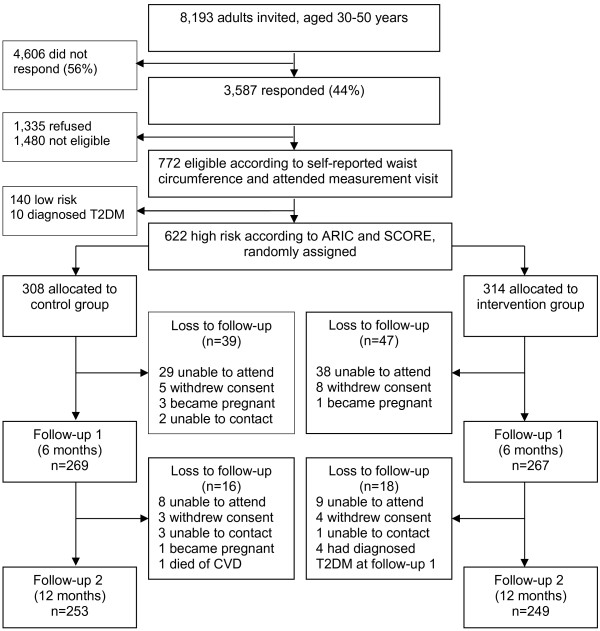
BACKGROUND: Intensive lifestyle interventions in well-controlled settings are effective in lowering the risk of chronic diseases such as type 2 diabetes (T2DM) and cardiovascular diseases (CVD), but there are still no effective lifestyle interventions for everyday practice. In the Hoorn Prevention Study we aimed to assess the effectiveness of a primary care based lifestyle intervention to reduce the estimated risk of developing T2DM and for CVD mortality, and to motivate changes in lifestyle behaviors. METHODS: The Hoorn Prevention Study is a parallel group randomized controlled trial, implemented in the region of West-Friesland, the Netherlands. 622 adults with ≥10% estimated risk of T2DM and/or CVD mortality were randomly assigned and monitored over a period of 12 months. The intervention group (n=314) received a theory-based lifestyle intervention based on an innovative combination of motivational interviewing and problem solving treatment, provided by trained practice nurses in 12 general practices. The control group (n=308) received existing health brochures. Primary outcomes was the estimated diabetes risk according to the formula of the Atherosclerosis Risk In Communities (ARIC) Study, and the estimated risk for CVD mortality according to the Systematic COronary Risk Evaluation (SCORE) formula. Secondary outcomes included lifestyle behavior (diet, physical activity and smoking). The research assistants, the principal investigator and the general practitioners were blinded to group assignment. Linear and logistic regression analysis was applied to examine the between-group differences in each outcome measure, adjusted for baseline values. RESULTS: 536 (86.2%) of the 622 participants (age 43.5 years) completed the 6-month follow-up, and 502 (81.2%) completed the 12-month follow-up. The mean baseline T2DM risk was 18.9% (SD 8.2) and the mean CVD mortality risk was 3.8% (SD 3.0). The intervention group participated in a median of 2 sessions. Intention-to-treat analyses showed no significant differences in outcomes between the two groups at 6 or 12-months follow-up. CONCLUSIONS: The lifestyle intervention was not more effective than health brochures in reducing risk scores for T2DM and CVD or improving lifestyle behavior in an at-risk population. TRIAL REGISTRATION: Current Controlled Trials: ISRCTN59358434.
Overview
The claims and statistics of this paper haven’t been checked yet.
Free: it reads the open-access text and checks the first 5 claims that cite a source we can check. Create a free account to check every claim.
Integrity signals
Registry
Cites
Statistics
Figures
Verification
Claims the paper makes
The claims and statistics of this paper haven’t been checked yet.
Free: it reads the open-access text and checks the first 5 claims that cite a source we can check. Create a free account to check every claim.
Claims other papers make about this one
Each is checked against this paper’s own text: does it say what the citing paper says it does?
The source backs part of the claim, not all of it — or backs it for a different population, condition or comparison.
In the citing paper
“However, so far, randomized controlled trials evaluating the effectiveness of programs that target lifestyle behavior have shown mixed effects and, if effective, they have generally resulted in only small changes in target behaviors [11-15].”
From Successful behavior change in obesity interventions in adults: a systematic review of self-regulation mediators (2015) · cites this paper as [15]
Experimental — accuracy not yet measured
Self-check
Percentages, sums and reported differences re-computed from the paper’s own numbers.
The self-check needs the paper’s full text.
Citations
Cites
From Intentions to Actions: A Theory of Planned Behavior
Ajzen, I. (1985) · Action Control · doi:10.1007/978-3-642-69746-3_2 · Cited by 19,057
Reduction in the incidence of type 2 diabetes with lifestyle intervention or metformin
(2002) · New England Journal of Medicine · doi:10.1056/nejmoa012512 · Cited by 19,011
Yusuf, S., Hawken, S., Ôunpuu, S., Dans, T., Avezum, A., Lanas, F., McQueen, M., Budaj, A., Pais, P., Varigos, J., et al. (2004) · The Lancet · doi:10.1016/s0140-6736(04)17018-9 · Cited by 12,026
Tuomilehto, J., Lindström, J., Eriksson, J. G., Valle, T. T., Hämäläinen, H., Ilanne-Parikka, P., Keinänen-Kiukaanniemi, S., Laakso, M., Louheranta, A., Rastas, M., et al. (2001) · New England Journal of Medicine · doi:10.1056/nejm200105033441801 · Cited by 10,873 · cited 1×
“Six or less face-to-face sessions as we provided may not have been enough to induce a sustainable lifestyle behavioral change, given that previous efficacious lifestyle interventions provided at least 12 sessions [40-42].”
Mail and internet surveys : the tailored design method
Dillman, D. A. (2007) · Cited by 9,587
Motivational interviewing: preparing people for change.
Miller, W. R., & Rollnick, S. (2002) · Guilford Press eBooks · Cited by 7,915
Estimation of ten-year risk of fatal cardiovascular disease in Europe: the SCORE project
Conroy, R. (2003) · European Heart Journal · doi:10.1016/s0195-668x(03)00114-3 · Cited by 5,290 · cited 3×
“This made it possible to identify a potentially high risk at the age of 60 [22].”
BackgroundMethodPan, X.-R., Li, G.-W., Hu, Y.-H., Wang, J.-X., Yang, W.-Y., An, Z.-X., Hu, Z.-X., Juan-Lin, Xiao, J.-Z., Cao, H.-B., et al. (1997) · Diabetes Care · doi:10.2337/diacare.20.4.537 · Cited by 4,320 · cited 1×
“Six or less face-to-face sessions as we provided may not have been enough to induce a sustainable lifestyle behavioral change, given that previous efficacious lifestyle interventions provided at least 12 sessions [40-42].”
Compendium of Physical Activities: Classification of energy costs of human physical activities
AINSWORTH, B. E., HASKELL, W. L., LEON, A. S., JACOBS, D. R., MONTOYE, H. J., SALLIS, J. F., & PAFFENBARGER, R. S. (1993) · Medicine & Science in Sports & Exercise · doi:10.1249/00005768-199301000-00011 · Cited by 4,102
Motivational interviewing: a systematic review and meta-analysis.
Rubak, S., Sandbæk, A., Lauritzen, T., & Christensen, B. (2005) · Europe PMC (PubMed Central) · Cited by 2,469
Wendel-Vos, G. (2003) · Journal of Clinical Epidemiology · doi:10.1016/s0895-4356(03)00220-8 · Cited by 1,401
Active Smoking and the Risk of Type 2 Diabetes: A Systematic Review and Meta-analysis
Willi, C., Bodenmann, P., Ghali, W. A., Faris, P. D., & Cornuz, J. (2007) · JAMA · doi:10.1001/jama.298.22.2654 · Cited by 1,268
Pathophysiology of insulin resistance in human disease
Reaven, G. M. (1995) · Physiological Reviews · doi:10.1152/physrev.1995.75.3.473 · Cited by 1,226
Saris, W. H. M., Blair, S. N., Van Baak, M. A., Eaton, S. B., Davies, P. S. W., Di Pietro, L., Fogelholm, M., Rissanen, A., Schoeller, D., Swinburn, B., et al. (2003) · Obesity Reviews · doi:10.1046/j.1467-789x.2003.00101.x · Cited by 865
Translating the Diabetes Prevention Program into the Community
Ackermann, R. T., Finch, E. A., Brizendine, E., Zhou, H., & Marrero, D. G. (2008) · American Journal of Preventive Medicine · doi:10.1016/j.amepre.2008.06.035 · Cited by 622 · cited 1×
“So far, randomized controlled trials evaluating the effectiveness of programs that target lifestyle behavior(s) to prevent T2DM or CVD in primary health care settings have had various different results, and if they were effective, the effects were small and unsustainable [8-13].”
BackgroundIdentifying Individuals at High Risk for Diabetes
Schmidt, M. I., Duncan, B. B., Bang, H., Pankow, J. S., Ballantyne, C. M., Golden, S. H., Folsom, A. R., Chambless, L. E., & for the Atherosclerosis Risk in Communities Investigators (2005) · Diabetes Care · doi:10.2337/diacare.28.8.2013 · Cited by 455
Malouff, J. M., Thorsteinsson, E. B., & Schutte, N. S. (2007) · Clinical Psychology Review · doi:10.1016/j.cpr.2005.12.005 · Cited by 368
Type 2 Diabetes Prevention in the Real World
Absetz, P., Oldenburg, B., Hankonen, N., Valve, R., Heinonen, H., Nissinen, A., Fogelholm, M., Talja, M., & Uutela, A. (2009) · Diabetes Care · doi:10.2337/dc09-0039 · Cited by 281
Pragmatic Trials — Guides to Better Patient Care?
Ware, J. H., & Hamel, M. B. (2011) · New England Journal of Medicine · doi:10.1056/nejmp1103502 · Cited by 267
Laatikainen, T., Dunbar, J. A., Chapman, A., Kilkkinen, A., Vartiainen, E., Heistaro, S., Philpot, B., Absetz, P., Bunker, S., O'Neil, A., et al. (2007) · BMC Public Health · doi:10.1186/1471-2458-7-249 · Cited by 253
Kinmonth, A.-L., Wareham, N. J., Hardeman, W., Sutton, S., Prevost, A. T., Fanshawe, T., Williams, K. M., Ekelund, U., Spiegelhalter, D., & Griffin, S. J. (2008) · The Lancet · doi:10.1016/s0140-6736(08)60070-7 · Cited by 200
Bogers, R. P. (2004) · American Journal of Epidemiology · doi:10.1093/aje/kwh123 · Cited by 183
Cardona-Morrell, M., Rychetnik, L., Morrell, S. L., Espinel, P. T., & Bauman, A. (2010) · BMC Public Health · doi:10.1186/1471-2458-10-653 · Cited by 147 · cited 1×
“Most diabetes prevention studies that were carried out in primary care had insufficient power, used singlegroup designs, and/or had high rates of attrition, and should therefore be interpreted with caution [37,38].”
BackgroundEriksson, M. K., Franks, P. W., & Eliasson, M. (2009) · PLoS ONE · doi:10.1371/journal.pone.0005195 · Cited by 123 · cited 1×
“So far, randomized controlled trials evaluating the effectiveness of programs that target lifestyle behavior(s) to prevent T2DM or CVD in primary health care settings have had various different results, and if they were effective, the effects were small and unsustainable [8-13].”
BackgroundMotives for (not) participating in a lifestyle intervention trial
Lakerveld, J., IJzelenberg, W., van Tulder, M. W., Hellemans, I. M., Rauwerda, J. A., van Rossum, A. C., & Seidell, J. C. (2008) · BMC Medical Research Methodology · doi:10.1186/1471-2288-8-17 · Cited by 120
Self-citationvan Sluijs, E. M. F., van Poppel, M. N. M., Twisk, J. W. R., Chin A Paw, M. J., Calfas, K. J., & van Mechelen, W. (2005) · American Journal of Public Health · doi:10.2105/ajph.2004.044537 · Cited by 114
Self-citationHorton, E. S. (2009) · Obesity · doi:10.1038/oby.2009.388 · Cited by 111
Lakerveld, J., Brug, J., Bot, S., Teixeira, P. J., Rutter, H., Woodward, E., Samdal, O., Stockley, L., De Bourdeaudhuij, I., van Assema, P., et al. (2012) · BMC Public Health · doi:10.1186/1471-2458-12-793 · Cited by 80 · cited 1×
“In addition, the role of participants’ social and physical environment may be of greater importance [34].”
BackgroundSelf-citationSimmons, R. K., Unwin, N. C., & Griffin, S. J. (2009) · Diabetes Research and Clinical Practice · doi:10.1016/j.diabres.2009.10.003 · Cited by 77
Koelewijn-van Loon, M. S., van der Weijden, T., van Steenkiste, B., Ronda, G., Winkens, B., Severens, J. L., Wensing, M., Elwyn, G., & Grol, R. (2009) · Canadian Medical Association Journal · doi:10.1503/cmaj.081591 · Cited by 75
Welschen, L. M. C., van Oppen, P., Bot, S. D. M., Kostense, P. J., Dekker, J. M., & Nijpels, G. (2012) · Journal of Behavioral Medicine · doi:10.1007/s10865-012-9451-z · Cited by 60
Self-citationPrevention of type 2 diabetes in a primary health care setting
Kilkkinen, A., Heistaro, S., Laatikainen, T. K., Janus, E. D., Chapman, A., Absetz, P., & Dunbar, J. (2006) · Diabetes Research and Clinical Practice · doi:10.1016/j.diabres.2006.09.027 · Cited by 59
Lakerveld, J., Bot, S. D., Chinapaw, M. J., van Tulder, M. W., van Oppen, P., Dekker, J. M., & Nijpels, G. (2008) · BMC Endocrine Disorders · doi:10.1186/1472-6823-8-6 · Cited by 59
Self-citationYates, T., Davies, M. J., Sehmi, S., Gorely, T., & Khunti, K. (2011) · Diabetic Medicine · doi:10.1111/j.1464-5491.2011.03357.x · Cited by 56 · cited 2×
“Nevertheless, a number of non-randomized and small randomized studies have shown promising results [14-16].”
BackgroundResultLifestyle Counseling for Type 2 Diabetes Risk Reduction in Dutch Primary Care
Vermunt, P. W. A., Milder, I. E. J., Wielaard, F., de Vries, J. H. M., van Oers, H. A. M., & Westert, G. P. (2011) · Diabetes Care · doi:10.2337/dc10-2293 · Cited by 52
Problem-solving treatment in general psychiatric practice
Mynors-Wallis, L. (2001) · Advances in Psychiatric Treatment · doi:10.1192/apt.7.6.417 · Cited by 51
Baan, C. A., van Baal, P. H. M., der Bruggen, M. A. M. J.-V., Verkleij, H., Poos, M. J. J. C., Hoogenveen, R. T., & Schoemaker, C. (2009) · PubMed · Cited by 45
van Wier, M. F., Ariëns, G. A., Dekkers, J. C., Hendriksen, I. J., Pronk, N. P., Smid, T., & van Mechelen, W. (2006) · BMC Public Health · doi:10.1186/1471-2458-6-140 · Cited by 43
Kraushaar, L. E., & Krämer, A. (2009) · BMC Public Health · doi:10.1186/1471-2458-9-64 · Cited by 40
Lakerveld, J., Bot, S. D. M., Chinapaw, M. J. M., van Tulder, M. W., Kingo, L., & Nijpels, G. (2012) · Health Promotion Practice · doi:10.1177/1524839912437366 · Cited by 36
Self-citationPreventing type 2 diabetes: can we make the evidence work?
Yates, T. E., Davies, M. J., & Khunti, K. (2009) · Postgraduate Medical Journal · doi:10.1136/pgmj.2008.076166 · Cited by 35
The Prevention of Type 2 Diabetes: An Overview
Marrero, D. G. (2009) · Journal of Diabetes Science and Technology · doi:10.1177/193229680900300423 · Cited by 29
van Wier, M. F., Lakerveld, J., Bot, S. D. M., Chinapaw, M. J. M., Nijpels, G., & van Tulder, M. W. (2013) · BMC Family Practice · doi:10.1186/1471-2296-14-45 · Cited by 26
Self-citationScreening for and prevention of type 2 diabetes
Goyder, E. (2008) · BMJ · doi:10.1136/bmj.39553.480706.80 · Cited by 21
Cited by
Teixeira, P. J., Carraça, E. V., Marques, M. M., Rutter, H., Oppert, J.-M., De Bourdeaudhuij, I., Lakerveld, J., & Brug, J. (2015) · BMC Medicine · doi:10.1186/s12916-015-0323-6 · Cited by 711
“However, so far, randomized controlled trials evaluating the effectiveness of programs that target lifestyle behavior have shown mixed effects and, if effective, they have generally resulted in only small changes in target behaviors [11-15].”
BackgroundSelf-citationNursing interventions for smoking cessation
Rice, V. H., & Stead, L. F. (2008) · Cochrane Database of Systematic Reviews · doi:10.1002/14651858.cd001188.pub3 · Cited by 649
Motivational interviewing for smoking cessation
Lindson-Hawley, N., Thompson, T. P., & Begh, R. (2015) · Cochrane Database of Systematic Reviews · doi:10.1002/14651858.cd006936.pub3 · Cited by 386
Patnode, C. D., Evans, C. V., Senger, C. A., Redmond, N., & Lin, J. S. (2017) · JAMA · doi:10.1001/jama.2017.3303 · Cited by 380
Lin, J. S., O'Connor, E., Evans, C. V., Senger, C. A., Rowland, M. G., & Groom, H. C. (2014) · Annals of Internal Medicine · doi:10.7326/m14-0130 · Cited by 191
Metadata
- Authors
- Lakerveld, J., Bot, S. D., Chinapaw, M. J., van Tulder, M. W., Kostense, P. J., Dekker, J. M., & Nijpels, G.
- Affiliations
- Amsterdam Public Health (NL)
- Corresponding author
- Lakerveld, Jeroen
- Venue
- International Journal of Behavioral Nutrition and Physical Activity
- Published
- 2013
- Volume
- 10
- Issue
- 1
- Pages
- 47
- ISSN
- 1479-5868 (ISSN-L)
- PMC
- PMC3639181
- OpenAlex
- W2154939346
- Cited by
- 84
- References
- 45
- Citations by year
- 2026: 1 · 2025: 2 · 2024: 3 · 2023: 10 · 2022: 2 · 2021: 4 · 2020: 9 · 2019: 3 · 2018: 12 · 2017: 11 · 2016: 2 · 2015: 9 · 2014: 11 · 2013: 4
- FWCI
- 8.86
- Type
- journal article
- Language
- en
- Open access
- gold
- doi.org
- Licence
- cc-by
- Locations
- International Journal of Behavioral Nutrition and Physical Activity (publishedVersion, cc-by)
- Europe PMC (PubMed Central) (publishedVersion, cc-by)
- PubMed Central (publishedVersion, cc-by)
- PubMed (publishedVersion)
- VU Research Portal (publishedVersion, other-oa)
- Pure Amsterdam UMC (acceptedVersion, other-oa)
- Digital Academic REpository of VU University Amsterdam (Vrije Universiteit Amsterdam) (submittedVersion)
- Data Archiving and Networked Services (DANS) (submittedVersion, other-oa)
- Funders
- ZonMw
- Topics
- Health Sciences › Medicine › Public Health, Environmental and Occupational Health › Health Promotion and Cardiovascular Prevention
- Health Sciences › Medicine › Endocrinology, Diabetes and Metabolism › Diabetes Management and Education
- Health Sciences › Medicine › Endocrinology, Diabetes and Metabolism › Diabetes, Cardiovascular Risks, and Lipoproteins
- Keywords
- motivational interviewing, problem-solving therapy, type 2 diabetes prevention, cardiovascular mortality, lifestyle intervention, primary care, practice nurses, health brochures, diet, physical activity, smoking, diabetes risk, cardiovascular risk, real-world effectiveness
- MeSH terms
- Adult, Cardiovascular Diseases, Diabetes Mellitus, Type 2, Female, Follow-Up Studies, Health Promotion, Humans, Life Style, Male, Middle Aged, Motivation, Netherlands, Primary Health Care, Problem Solving, Risk, Risk Factors, Health Behavior, Linear Models, Logistic Models, Single-Blind Method, Intention to Treat Analysis, Motivational Interviewing
About these checks
Registry, retraction, Cites and statistics results are computed, not judged, with one exception: a printed reference that no index lists is read once by a model before it counts as a citation error. Claims are extracted by a model and kept only when their quote appears verbatim in the text; each cited source is then checked, with a model’s help, for whether it says what the claim relies on. Those verdicts can be wrong — read the claim’s quote and the cited source before relying on one.
Statistics and arithmetic are recomputed, not judged.
Confidence bands are shown only for fields calibrated on our annotated test set. None is calibrated yet, so no band is shown.
What counts as a claim ›How we measure confidence ›How we check this ›
Are you an author, or do you see a problem with this page? Request a review
Data sources
Bibliographic data: Semantic Scholar, OpenAlex, Crossref.
Contains information from the Semantic Scholar Academic Graph Datasets, made available under the ODC Attribution License (ODC-BY 1.0).
Semantic Scholar’s data is described in: Kinney, R., et al. (2023). The Semantic Scholar Open Data Platform. arXiv:2301.10140.
