

The DOI matches its Crossref record; 61 of the 61 references it cites were found in a registry or an index.
Meta-analysis of internet-delivered interventions to increase physical activity levels
Open accessAbstract
Many internet-delivered physical activity behaviour change programs have been developed and evaluated. However, further evidence is required to ascertain the overall effectiveness of such interventions. The objective of the present review was to evaluate the effectiveness of internet-delivered interventions to increase physical activity, whilst also examining the effect of intervention moderators. A systematic search strategy identified relevant studies published in the English-language from Pubmed, Proquest, Scopus, PsychINFO, CINHAL, and Sport Discuss (January 1990 - June 2011). Eligible studies were required to include an internet-delivered intervention, target an adult population, measure and target physical activity as an outcome variable, and include a comparison group that did not receive internet-delivered materials. Studies were coded independently by two investigators. Overall effect sizes were combined based on the fixed effect model. Homogeneity and subsequent exploratory moderator analysis was undertaken. A total of 34 articles were identified for inclusion. The overall mean effect of internet-delivered interventions on physical activity was d = 0.14 (p = 0.00). Fixed-effect analysis revealed significant heterogeneity across studies (Q = 73.75; p = 0.00). Moderating variables such as larger sample size, screening for baseline physical activity levels and the inclusion of educational components significantly increased intervention effectiveness. Results of the meta-analysis support the delivery of internet-delivered interventions in producing positive changes in physical activity, however effect sizes were small. The ability of internet-delivered interventions to produce meaningful change in long-term physical activity remains unclear.
Overview
The claims and statistics of this paper haven’t been checked yet.
Run the check — free, no account needed. It reads the open-access text and checks the sources it cites.
Integrity signals
Registry
Cites
Statistics
Figures
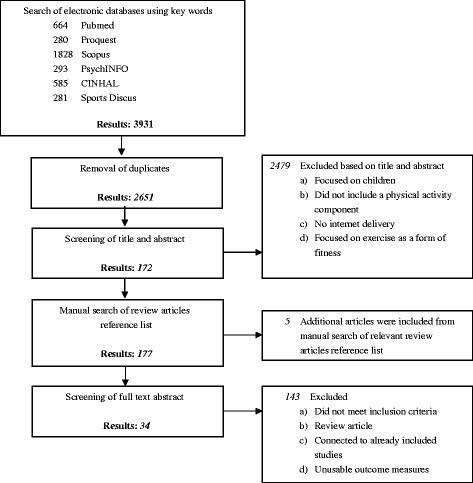
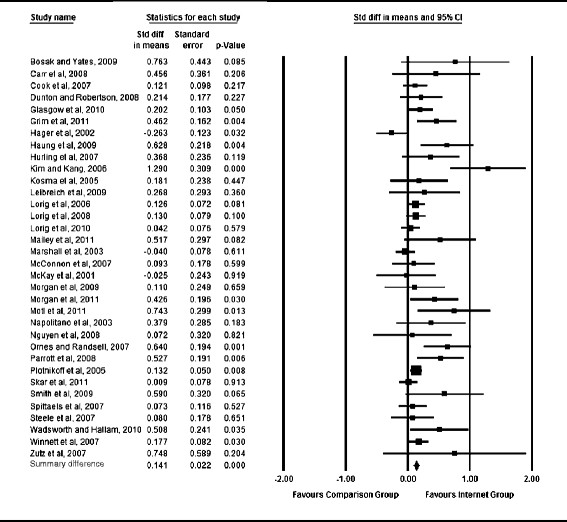
Verification
Claims the paper makes
The claims and statistics of this paper haven’t been checked yet.
Run the check — free, no account needed. It reads the open-access text and checks the sources it cites.
Claims other papers make about this one
Each is checked against this paper’s own text: does it say what the citing paper says it does?
The source backs part of the claim, not all of it — or backs it for a different population, condition or comparison.
In the citing paper
“Current evidence demonstrates that DHIs effectively promote physical activity in adult populations (21, 22).”
From The effectiveness of digital health intervention on glycemic control and physical activity in patients with type 2 diabetes: a systematic review and meta-analysis (2025) · cites this paper as [22]
Experimental — accuracy not yet measured
Self-check
Percentages, sums and reported differences re-computed from the paper’s own numbers.
The self-check needs the paper’s full text.
Citations
Cites
Bias in meta-analysis detected by a simple, graphical test
Egger, M., Smith, G. D., Schneider, M., & Minder, C. (1997) · BMJ · doi:10.1136/bmj.315.7109.629 · Cited by 56,722
Cochrane Handbook for Systematic Reviews of Interventions: Cochrane Book Series
(2008) · doi:10.1002/9780470712184 · Cited by 25,048
Borenstein, M., Hedges, L. V., Higgins, J. P. T., & Rothstein, H. R. (2021) · doi:10.1002/9781119558378 · Cited by 9,799
Sick individuals and sick populations
Rose, G. (2001) · International Journal of Epidemiology · doi:10.1093/ije/30.3.427 · Cited by 3,736
Webb, T. L., Joseph, J., Yardley, L., & Michie, S. (2010) · Journal of Medical Internet Research · doi:10.2196/jmir.1376 · Cited by 2,517
Investigating and dealing with publication and other biases in meta-analysis
Sterne, J. A. C., Egger, M., & Smith, G. D. (2001) · BMJ · doi:10.1136/bmj.323.7304.101 · Cited by 2,225
Does tailoring matter? Meta-analytic review of tailored print health behavior change interventions
Noar, S. M., Benac, C. N., & Harris, M. S. (2007) · Psychological Bulletin · doi:10.1037/0033-2909.133.4.673 · Cited by 2,136
Haynes, R. B., Taylor, D. W., & Sackett, D. L. (1979) · DigitalGeorgetown (Georgetown University Library) · Cited by 1,627
Wantland, D. J., Portillo, C. J., Holzemer, W. L., Slaughter, R., & McGhee, E. M. (2004) · Journal of Medical Internet Research · doi:10.2196/jmir.6.4.e40 · Cited by 966 · cited 5×
“The list was developed based on previous reviews [2,5-8,10,50] and perusal of original research articles published on the topic.”
BackgroundMethodInfluentialCancer Survivors and Unemployment
de Boer, A. G. E. M., Taskila, T. K., Ojajärvi, A., van Dijk, F. J. H., & Verbeek, J. H. A. M. (2009) · JAMA · doi:10.1001/jama.2009.187 · Cited by 830
Cited by
Sorted by citations
Items 301–400 of 482
A Computational Agent Model of Influences on Physical Activity Based on the Social Cognitive Theory
Mollee, J. S., & van der Wal, C. N. (2013) · Lecture notes in computer science · doi:10.1007/978-3-642-44927-7_37 · Cited by 10
Would you Find Thirty online? Website use in a Western Australian physical activity campaign
Leavy, J. E., Rosenberg, M., Barnes, R., Bauman, A. E., & Bull, F. (2013) · Health Promotion Journal of Australia · doi:10.1071/he12916 · Cited by 10
Melnyk, B. M., Orsolini, L., Gawlik, K. S., Braun, L. T., Chyun, D. A., Conn, V. S., Dunbar‐Jacob, J. M., Lewis, L. M., Melkus, G. D., Millán, A., et al. (2016) · The Nurse Practitioner · doi:10.1097/01.npr.0000476372.04620.7a · Cited by 10
Abqari, U., Noordende, A. T. V. ‘., Richardus, J. H., Isfandiari, M. A., & Korfage, I. J. (2022) · International Journal of Medical Informatics · doi:10.1016/j.ijmedinf.2022.104737 · Cited by 9
Park, A. (2022) · Journal of Medical Internet Research · doi:10.2196/15055 · Cited by 9
Müller, A. M., & Khoo, S. (2015) · Acta Paediatrica · doi:10.1111/apa.13307 · Cited by 9
Zwerenz, R., Baumgarten, C., Dahn, I., Labitzke, N., Schwarting, A., Rudolph, M., Ferdinand, P., Dederichs-Masius, U., & Beutel, M. E. (2019) · Journal of Medical Internet Research · doi:10.2196/12285 · Cited by 9
Yarn: Adding Meaning to Shared Personal Data through Structured Storytelling
Epstein, D. A., Dontcheva, M., Fogarty, J. A., & Munson, S. A. (2020) · Proceedings · doi:10.20380/gi2020.18 · Cited by 9
Tinsel, I., Metzner, G., Schlett, C., Sehlbrede, M., Bischoff, M., Anger, R., Brame, J., König, D., Wurst, R., Fuchs, R., et al. (2021) · Trials · doi:10.1186/s13063-021-05470-8 · Cited by 9
Kókai, L. L., Ceallaigh, D. O., Wijtzes, A. I., van Lennep, J. E. R., Hagger, M. S., Cawley, J., Rohde, K. I. M., van Kippersluis, H., & Alex Burdorf, A. (2022) · BMJ Open · doi:10.1136/bmjopen-2021-053711 · Cited by 9
Mäurer, M., Schuh, K., Seibert, S. M., Baier, M. L., Hentschke, C., Streber, R., Tallner, A., & Pfeifer, K. (2018) · Multiple Sclerosis Journal - Experimental Translational and Clinical · doi:10.1177/2055217318756688 · Cited by 9
Ingram, W. M., Webb, D., Taylor, R. S., Anokye, N., Yardley, L., Jolly, K. B., Mutrie, N., Campbell, J. L., Dean, S. G., Greaves, C. J., et al. (2018) · BMJ Open · doi:10.1136/bmjopen-2018-022382 · Cited by 11
Coumans, J. M. J., Bolman, C. A. W., Friederichs, S. A. H., Oenema, A., & Lechner, L. (2019) · JMIR Research Protocols · doi:10.2196/14491 · Cited by 10
Bhundoo, A. K., Pillay, J. D., & Wilke, J. (2025) · Journal of Medical Internet Research · doi:10.2196/64856 · Cited by 8
Kritz, M., Riddell, H., Olsen, D., Harden, S. M., Burke, S. M., Ntoumanis, N., & Thøgersen‐Ntoumani, C. (2026) · Nature Human Behaviour · doi:10.1038/s41562-026-02429-0 · Cited by 8
Kim, T.-Y., Lee, Y.-S., Yu, E.-J., Kim, M.-S., Yang, S.-Y., Hur, Y., & Kang, J. (2019) · Nutrition Research and Practice · doi:10.4162/nrp.2019.13.6.509 · Cited by 8
Design and Implementation of Behavioral Informatics Interventions
Laranjo, L., Lau, A. Y. S., & Coiera, E. W. (2017) · Health informatics · doi:10.1007/978-3-319-51732-2_2 · Cited by 8
Test–retest reliability of the Brunel Lifestyle Physical Activity Questionnaire
Vencato, M. M., Karageorghis, C. I., Nevill, A. M., & Priest, D.-L. (2017) · Psychology of sport and exercise · doi:10.1016/j.psychsport.2017.07.003 · Cited by 8
Brown, H., Collins, C. E., Bucher, T., & Rollo, M. E. (2019) · Journal of Human Nutrition and Dietetics · doi:10.1111/jhn.12660 · Cited by 10
Fischer, X., Donath, L., Zwygart, K., Gerber, M., Faude, O., & Zahner, L. (2019) · International Journal of Environmental Research and Public Health · doi:10.3390/ijerph16030331 · Cited by 8
Kwaśnicka, D., Łuszczyńska, A., Hagger, M. S., Quested, E., Pagoto, S., Verboon, P., Robinson, S., Januszewicz, A., Idziak, P., Palacz-Poborczyk, I., et al. (2020) · BMJ Open · doi:10.1136/bmjopen-2020-040183 · Cited by 10
Hayotte, M., Iannelli, A., Nègre, V., Pradier, C., Thérouanne, P., Fuch, A., Diagana, O., Garbarino, J.-M., Vuillemin, A., Colson, S. S., et al. (2021) · BMJ Open · doi:10.1136/bmjopen-2020-046184 · Cited by 10
Buis, L. R., McCant, F., Gierisch, J. M., Bastian, L. A., Oddone, E. Ž., Richardson, C. R., Kim, H. M., Evans, R. R., Hooks, G., Kadri, R., et al. (2018) · JMIR Research Protocols · doi:10.2196/12526 · Cited by 10
Web-based intervention to promote physical activity in Taiwanese children
Huang, S.-J., Hung, W.-C., Shyu, M.-L., Chang, K.-C., & Chen, C. (2019) · Journal of Pediatric Nursing · doi:10.1016/j.pedn.2018.12.016 · Cited by 8
von Ash, T., DUNSIGER, S. I., Williams, D. M., Larsen, B. A., Bohlen, L. C., Pekmezi, D., Mendoza-Vasconez, A. S., Benitez, T. J., Bock, B. C., Hartman, S. J., et al. (2024) · American Journal of Preventive Medicine · doi:10.1016/j.amepre.2024.03.006 · Cited by 7
Vandelanotte, C., Hodgetts, D., Peiris, D. L. I. H. K., Karki, A., Maher, C. A., Imam, T., Rashid, M. M., To, Q. G., & Trost, S. G. (2024) · Applied Psychology Health and Well-Being · doi:10.1111/aphw.12594 · Cited by 7
Self-citationJosefsson, K. W., Johnson, U., & Lindwall, M. (2016) · Current Psychology · doi:10.1007/s12144-016-9508-1 · Cited by 8
Gans, K. M., Dulin, A., Palomo, V., Benitez, T. J., DUNSIGER, S. I., Dionne, L. A., Champion, G., Edgar, R., & Marcus, B. H. (2020) · JMIR Research Protocols · doi:10.2196/23690 · Cited by 7
Collombon, E. H. G. M., Bolman, C. A. W., Peels, D. A., de Bruijn, G., de Groot, R. H. M., & Lechner, L. (2022) · JMIR Research Protocols · doi:10.2196/31677 · Cited by 7
Moutzouri, M., & Gioftsos, G. (2022) · PLoS ONE · doi:10.1371/journal.pone.0268652 · Cited by 7
Alsaleh, E. (2023) · Frontiers in Public Health · doi:10.3389/fpubh.2023.1098953 · Cited by 7
Bernardo, D. F. S., Bobadilla-Agouborde, C., Festas, C., Carvalho, C., Abdalla, P. P., Amezcua‐Prieto, C., Naia, Z., Mesquita, C., Mota, J. A. P. S., & Santos, P. C. (2024) · Clinical and Experimental Obstetrics & Gynecology · doi:10.31083/j.ceog5103070 · Cited by 9
Service evaluation of a digital behavioural change programme
Hampton, J., Allen, E., & Edson, C. (2017) · Future Healthcare Journal · doi:10.7861/futurehosp.4-3-173 · Cited by 7
Efficacy of Wearable Devices to Measure and Promote Physical Activity in the Management of Diabetes
Hamasaki, H. (2018) · EMJ Diabetes · doi:10.33590/emjdiabet/10312817 · Cited by 7
Technology to Enhance Engagement in Physical Activity
Robinson, S. A., Troosters, T., & Moy, M. L. (2020) · Respiratory medicine · doi:10.1007/978-3-030-44889-9_8 · Cited by 7
Smart-phone application design for lasting behavioral changes
Stroulia, E., Fairbairn, S. M., Bazelli, B., Gibbs, D., Lederer, R., Faulkner, R. K., Ferguson-Roberts, J., & Mullen, B. (2013) · Proceedings - IEEE Symposium on Computer-Based Medical Systems · doi:10.1109/cbms.2013.6627804 · Cited by 6
Brunet, J., Price, J., Srikanthan, A., Gillison, F., Standage, M., Taljaard, M., Beauchamp, M. R., Reed, J. L., & Wurz, A. J. (2022) · PLoS ONE · doi:10.1371/journal.pone.0273045 · Cited by 8
Shimoda, T., Tomida, K., Nakajima, C., Kawakami, A., & Shimada, H. (2024) · Journal of the American Medical Directors Association · doi:10.1016/j.jamda.2024.105356 · Cited by 6
Cox, A. C., & Rhodes, R. E. (2023) · Journal of Aging and Physical Activity · doi:10.1123/japa.2022-0285 · Cited by 6
Development of an online secondary prevention programme for stroke survivors: Prevent 2nd Stroke
Denham, A. M. J., Guillaumier, A., McCrabb, S., Turner, A., Baker, A., Spratt, N. J., Pollack, M. R. P., Magin, P. J., Oldmeadow, C. J., Collins, C. E., et al. (2019) · BMJ Innovations · doi:10.1136/bmjinnov-2017-000257 · Cited by 6
Oppermann, L., & Dierks, M. (2023) · BMJ Open Sport & Exercise Medicine · doi:10.1136/bmjsem-2022-001464 · Cited by 7
Boudreau, F., Dagenais, G. R., de Vries, H., Walthouwer, M. J. L., Côté, J., Turbide, G., Bourlaud, A.-S., & Poirier, P. (2020) · Health Psychology and Behavioral Medicine · doi:10.1080/21642850.2020.1850287 · Cited by 6
Remote Exercise Training Intervention During the COVID-19 Pandemic: Randomized Controlled Trial
Philippi, K. F. A., Zeier, P., Brahmer, A., Neuberger, E. W. I., Sandner, M., Hagenah, M., Porten, T., Lenz, R., Ochmann, D. T., Wedekink, F., et al. (2024) · Journal of Medical Internet Research · doi:10.2196/53145 · Cited by 6
Lee, S., Ahn, S., Patel, P., & Myers, N. D. (2025) · Obesity Reviews · doi:10.1111/obr.13898 · Cited by 6
Divine, A., & Astill, S. L. (2025) · British Journal of Health Psychology · doi:10.1111/bjhp.12795 · Cited by 5
Kayser, J. W., Cossette, S., Côté, J., Bourbonnais, A., Purden, M., Juneau, M., Tanguay, J., Simard, M.-J., Dupuis, J., Diodati, J. G., et al. (2017) · JMIR Research Protocols · doi:10.2196/resprot.6430 · Cited by 5
Rasera, M., Jayasinghe, H., Parker, F., Short, C. E., Conroy, D. E., Jackson, B., Dimmock, J. A., Rhodes, R. E., de Vries, H., Vandelanotte, C., et al. (2021) · Sport Exercise and Performance Psychology · doi:10.1037/spy0000278 · Cited by 5
Self-citationGrant, S. J., Liu, S., & Rhodes, R. E. (2024) · Psychology and Health · doi:10.1080/08870446.2024.2372658 · Cited by 5
Hawkins, J. L., Edwards, M., Charles, J. M., Jago, R., Kelson, M. J., Morgan, K., Murphy, S., Oliver, E. J., Simpson, S. A., Edwards, R. T., et al. (2017) · Pilot and Feasibility Studies · doi:10.1186/s40814-017-0194-z · Cited by 5
Perspectives on Using Online Platforms for Promoting Running and Walking Activities
Wattanapisit, A., Amaek, W., Sukkriang, N., Wattanapisit, S., & Wongsiri, S. (2020) · Frontiers in Public Health · doi:10.3389/fpubh.2020.00150 · Cited by 5
Tacchino, A., Ponzio, M., Confalonieri, P. A., Leocani, L., Inglese, M., Centonze, D., Cocco, E. E., Gallo, P., Paolicelli, D., Rovaris, M., et al. (2023) · JMIR Serious Games · doi:10.2196/41371 · Cited by 5
Hemmis, L., de Vries, H., Vandelanotte, C., Short, C. E., Duncan, M. J., Burton, N. W., & Rebar, A. L. (2015) · Mental health and physical activity · doi:10.1016/j.mhpa.2015.08.001 · Cited by 5
Self-citationProcess Evaluation of the BearStand Behavioral Intervention
Wilkerson, A. H., Hamilton, C. N. B., Wu, C., McClendon, M., Walsh, S. M., Patterson, M. S., & Meyer, R. U. (2019) · Journal of Occupational and Environmental Medicine · doi:10.1097/jom.0000000000001704 · Cited by 5
Krämer, L. V., Eschrig, N., Keinhorst, L., Schöchlin, L., Stephan, L., Stiene, M., & Bengel, J. (2021) · Trials · doi:10.1186/s13063-021-05333-2 · Cited by 6
Older adults, physical activity and internet: Exploring their behaviours, beliefs and opinions
Mouton, A., & Cloes, M. (2014) · International Journal of Physical Education · doi:10.5771/2747-6073-2014-1-18 · Cited by 5
Rudolph, S., Göring, A., & Padrok, D. (2018) · Das Gesundheitswesen · doi:10.1055/s-0043-121888 · Cited by 5
Vandelanotte, C., Short, C. E., Plotnikoff, R. C., Schöeppe, S., Alley, S., To, Q. G., Rebar, A. L., & Duncan, M. J. (2024) · Frontiers in Digital Health · doi:10.3389/fdgth.2024.1356067 · Cited by 4
Self-citationPersonalized technology for supporting health behaviors
Wangberg, S. C., & Psychol, C. (2013) · IEEE International Conference on Cognitive Infocommunications · doi:10.1109/coginfocom.2013.6719267 · Cited by 4
Black, S. C. (2017) · Journal of the Australian and New Zealand Student Services Association · doi:10.30688/janzssa.2017.13 · Cited by 4
Lin, J., Wurst, R., Paganini, S., Hohberg, V., Kinkel, S., Göhner, W., Ramsenthaler, C., & Fuchs, R. (2020) · Trials · doi:10.1186/s13063-020-04438-4 · Cited by 4
Original Research Article_Effect of Internet Addiction on Mental Health of Adolescent Boys and Girls
Raina, G., & Bhatt, S. (2021) · Indian Journal of Mental Health(IJMH) · doi:10.30877/ijmh.8.2.2021.218-230 · Cited by 4
Landais, L. L., Damman, O. C., Jelsma, J. G. M., Verhagen, E. A. L. M., & Timmermans, D. R. M. (2022) · International Journal of Behavioral Nutrition and Physical Activity · doi:10.1186/s12966-022-01288-y · Cited by 4
Robertson, M. C., Cox-Martin, E., Shegog, R., Markham, C. M., Fujimoto, K., Durand, C. P., Brewster, A. M., Lyons, E., Liao, Y., Flores, S. A., et al. (2022) · JMIR Cancer · doi:10.2196/31815 · Cited by 4
Measurement and Assessment of Physical Activity by Information and Communication Technology.
Zhang, Q., Yang, X., Liu, D., & Zhao, W. H. (2017) · PubMed · doi:10.3967/bes2017.062 · Cited by 4
Kayser, J. W., Cossette, S., Côté, J., Tanguay, J., Tremblay, J., Diodati, J. G., Bourbonnais, A., Purden, M., Juneau, M., Terrier, J., et al. (2019) · Journal of Advanced Nursing · doi:10.1111/jan.14119 · Cited by 4
Moran, J., Kelly, G. A., Haberlin, C., Mockler, D., & Broderick, J. M. (2018) · HRB Open Research · doi:10.12688/hrbopenres.12796.2 · Cited by 4
The Healthy Elderly: Case Studies in Persuasive Design
van Turnhout, K., Jeurens, J., Verhey, M., Wientjes, P., & Bakker, R. (2014) · Interaction design & architecture(s)/ID&A Interaction design & architecture(s) · doi:10.55612/s-5002-023-010 · Cited by 4
Dan, A. S. M., Linoby, A., Kasim, S. S., Zaki, S., Sazali, R., Yusoff, Y., Nasir, Z., & Abidin, A. H. (2026) · Journal of Technology in Behavioral Science · doi:10.1007/s41347-026-00618-2 · Cited by 3
Mat, Y. L., Casali, C., Mat, F. L., Féasson, L., Foschia, C., Géry, M., Rossi, J., & Millet, G. Y. (2024) · JMIR Formative Research · doi:10.2196/45461 · Cited by 3
Ramos, P. G. F., Júdice, P. B., Valadas, G., Bento, A., Nobre, I., Rodrigues, B., & Carraça, E. V. (2025) · Rehabilitation Oncology · doi:10.1097/01.reo.0000000000000382 · Cited by 3
Clarke, J. V., Spence, A., Helms, E. R., & Cross, M. R. (2025) · The Journal of Strength and Conditioning Research · doi:10.1519/jsc.0000000000005099 · Cited by 3
Expectations Regarding Workplace Health Coaching: A Qualitative Study With Stakeholders
Dejonghe, L. A. L., Biallas, B., McKee, L., Rudolf, K., Froböse, I., & Schaller, A. (2019) · Workplace Health & Safety · doi:10.1177/2165079919836682 · Cited by 3
Egészséggel kapcsolatos célok Crohn-betegek körében.
Festő, B., Njers, S., Dávid, A., Horvát, B., Sallay, V., Molnár, T., Rafael, B., & Martos, T. (2023) · Orvosi Hetilap · doi:10.1556/650.2023.32801 · Cited by 3
Brame, J., Kohl, J., Centner, C., Wurst, R., Fuchs, R., Tinsel, I., Maiwald, P., Fichtner, U. A., Sehlbrede, M., Farin‐Glattacker, E., et al. (2023) · Healthcare · doi:10.3390/healthcare11212847 · Cited by 3
Rote, A. E. (2013) · UWM Digital Commons (University of Wisconsin–Milwaukee) · Cited by 3
Alley, S., Andersson, M., Burton, N. W., Vandelanotte, C., Duncan, M. J., Happell, B., Short, C. E., & Rebar, A. L. (2017) · Health Psychology Bulletin · doi:10.5334/hpb.3 · Cited by 3
Self-citationHaberlin, C., Broderick, J. M., Guinan, E. M., Darker, C. D., Hussey, J. M., & O’Donnell, D. M. (2019) · BMJ Open · doi:10.1136/bmjopen-2018-024999 · Cited by 3
Noormohammadpour, P., Taee, F., Selk-Ghaffari, M., Taee, F., Mansournia, M. A., & Kordi, R. (2021) · European Journal of Integrative Medicine · doi:10.1016/j.eujim.2021.101356 · Cited by 3
Richards, E. A., Woodcox, S. G., & Förster, A. (2022) · Journal of Primary Care & Community Health · doi:10.1177/21501319211070683 · Cited by 3
Hypertension Treatment Using an Internet-based Lifestyle Intervention
Liu, S. X. (2015) · TSpace (University of Toronto) · Cited by 3
Rocha, J. Q. S., da Silva, L. S., Freitas, M. P., Delpino, F. M., Rombaldi, A. J., Paz, I. D. A., Schröeder, N., Feter, J. S., da Silva, C. N., da Cunha, L. L., et al. (2024) · Preventive Medicine Reports · doi:10.1016/j.pmedr.2024.102816 · Cited by 2
Hollman, H., Sui, W., Zhang, H., & Rhodes, R. E. (2025) · JMIR Formative Research · doi:10.2196/59477 · Cited by 2
Sun, Y., Gao, Y., Ou, A. Y. T., Wang, X., Xie, Y., Chen, X., Fong, S. S. M., Huang, W. Y., Zhang, C., Baker, J. S., et al. (2026) · Journal of Medical Internet Research · doi:10.2196/80249 · Cited by 2
Vreeburg, L., Diekstra, R. F. W., & Hosman, C. M. H. (2018) · Data Archiving and Networked Services (DANS) · Cited by 2
Sustained Effectiveness of the Walk Across Texas Program: A Follow-up Study
López, M., Faries, M. D., Lankford, E. G., & Green, S. D. (2023) · American Journal of Health Behavior · doi:10.5993/ajhb.47.6.19 · Cited by 2
Peters, M., Ratz, T., Muellmann, S., Voelcker‐Rehage, C., Lippke, S., & Pischke, C. R. (2024) · Journal of Public Health · doi:10.1007/s10389-024-02322-y · Cited by 2
Gesundheitsförderungsmaßnahmen für ältere Menschen mittels neuer Medien
Lippke, S., & Kuhlmann, T. (2013) · Zeitschrift für Gesundheitspsychologie · doi:10.1026/0943-8149/a000082 · Cited by 4
Krūmiņa, A. A., & Ļubenko, J. (2016) · Journal of Teacher Education for Sustainability · doi:10.1515/jtes-2016-0006 · Cited by 2
Dennett, R., Coulter, E. H., Paul, L., & Freeman, J. A. (2016) · The JBI Database of Systematic Reviews and Implementation Reports · doi:10.11124/jbisrir-2016-003174 · Cited by 2
Kaseva, K., Tervaniemi, M. H., Heikura, E. E., Kostilainen, K., Pöyhönen‐Alho, M., Shoemaker, J. K., Petrella, R. J., & Peltonen, J. E. (2022) · JMIR Formative Research · doi:10.2196/30285 · Cited by 3
Thomson, M. D., & Peter, M. E. (2016) · Preventive Medicine Reports · doi:10.1016/j.pmedr.2016.11.005 · Cited by 2
Lippke, S. (2017) · Springer eBooks · doi:10.1007/978-3-658-14550-7_8 · Cited by 2
Price, J., & Brunet, J. (2019) · University of Ottawa Journal of Medicine · doi:10.18192/uojm.v9i2.4449 · Cited by 2
Fielden, A. L. (2012) · Northumbria Research Link (Northumbria University) · doi:10.25405/ncl.34215243 · Cited by 2
The Emerging Area of E‐health Communication Research
Kreps, G. L. (2020) · Wiley eBooks · doi:10.1002/9781119399926.ch53 · Cited by 2
Golsteijn, R. H. J., Bolman, C. A. W., Peels, D. A., Volders, E., de Vries, H., & Lechner, L. (2017) · doi:10.2196/preprints.7838 · Cited by 2
Challenges and opportunities for e- and m-health-based behaviour change interventions
Vandelanotte, C. (2018) · Perspectives in Public Health · doi:10.1177/1757913918801509 · Cited by 1
Self-citationSmart Water Conservation: A Behaviourally-Grounded Recommender System for Demand Management Programs
Rahim, M. S., Nguyen, K. A., Stewart, R. A., Giurco, D., & Blumenstein, M. (2025) · Water · doi:10.3390/w17192798 · Cited by 1
Husain, M. P. M., Salman, A., Universiti Malaysia Kelantan, M., Ali, M. N. S., Universiti Kebangsaan Malaysia, M., & Khazin, K. M. (2024) · SEARCH. · doi:10.58946/search-16.2.p6 · Cited by 1
Metadata
- Authors
- Davies, C. A., Spence, J. C., Vandelanotte, C., Caperchione, C. M., & Mummery, W.
- Affiliations
- Central Queensland University (AU)
- University of Alberta (CA)
- University of British Columbia (CA)
- Corresponding author
- Davies, Cally A
- Venue
- International Journal of Behavioral Nutrition and Physical Activity
- Published
- 2012
- Volume
- 9
- Issue
- 1
- Pages
- 52
- ISSN
- 1479-5868 (ISSN-L)
- PMC
- PMC3464872
- OpenAlex
- W2138928597
- Cited by
- 488
- References
- 61
- Citations by year
- 2026: 7 · 2025: 21 · 2024: 24 · 2023: 19 · 2022: 36 · 2021: 39 · 2020: 55 · 2019: 52 · 2018: 46 · 2017: 41 · 2016: 40 · 2015: 41 · 2014: 31 · 2013: 32 · 2012: 3
- FWCI
- 3.68
- Type
- journal article
- Language
- en
- Open access
- gold
- doi.org
- Licence
- cc-by
- Locations
- International Journal of Behavioral Nutrition and Physical Activity (publishedVersion, cc-by)
- Europe PMC (PubMed Central) (publishedVersion, cc-by)
- PubMed Central (publishedVersion, cc-by)
- PubMed (publishedVersion)
- cIRcle (University of British Columbia) (submittedVersion, cc-by)
- DOAJ (DOAJ: Directory of Open Access Journals) (submittedVersion)
- Figshare (submittedVersion, cc-by)
- Funders
- National Heart Foundation of Australia (PH 07B 3303, 07B 3303)
- Medical Research Council
- National Health and Medical Research Council (519778)
- Topics
- Health Sciences › Medicine › Public Health, Environmental and Occupational Health › Physical Activity and Health
- Health Sciences › Health Professions › General Health Professions › Mobile Health and mHealth Applications
- Social Sciences › Psychology › Applied Psychology › Digital Mental Health Interventions
- Keywords
- online intervention, physical activity, behavior change, intervention moderators, sample size, educational components, adults, intervention effectiveness
- MeSH terms
- Humans, Health Knowledge, Attitudes, Practice, Motor Activity, Sports, Randomized Controlled Trials as Topic, Databases, Factual, Internet
About these checks
Registry, retraction, Cites and statistics results are computed, not judged, with one exception: a printed reference that no index lists is read once by a model before it counts as a citation error. Claims are extracted by a model and kept only when their quote appears verbatim in the text; each cited source is then checked, with a model’s help, for whether it says what the claim relies on. Those verdicts can be wrong — read the claim’s quote and the cited source before relying on one.
Statistics and arithmetic are recomputed, not judged.
Confidence bands are shown only for fields calibrated on our annotated test set. None is calibrated yet, so no band is shown.
What counts as a claim ›How we measure confidence ›How we check this ›
Are you an author, or do you see a problem with this page? Request a review
