

Transplantation of human cord blood mononuclear cells and umbilical cord-derived mesenchymal stem cells in autism
Open accessThe DOI matches its Crossref record; 52 of the 53 references it cites were found in a registry or an index.
Abstract
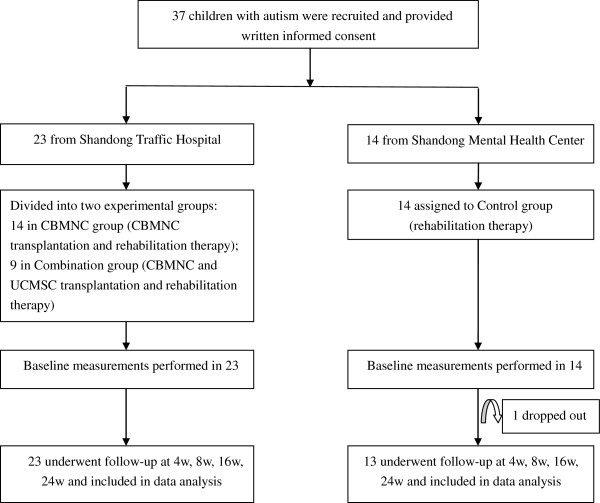
Background: Autism is a pervasive neurodevelopmental disorder. At present there are no defined mechanisms of pathogenesis and therapy is mostly limited to behavioral interventions. Stem cell transplantation may offer a unique treatment strategy for autism due to immune and neural dysregulation observed in this disease. This non-randomized, open-label, single center phase I/II trial investigated the safety and efficacy of combined transplantation of human cord blood mononuclear cells (CBMNCs) and umbilical cord-derived mesenchymal stem cells (UCMSCs) in treating children with autism. Methods: 37 subjects diagnosed with autism were enrolled into this study and divided into three groups: CBMNC group (14 subjects, received CBMNC transplantation and rehabilitation therapy), Combination group (9 subjects, received both CBMNC and UCMSC transplantation and rehabilitation therapy), and Control group (14 subjects, received only rehabilitation therapy). Transplantations included four stem cell infusions through intravenous and intrathecal injections once a week. Treatment safety was evaluated with laboratory examinations and clinical assessment of adverse effects. The Childhood Autism Rating Scale (CARS), Clinical Global Impression (CGI) scale and Aberrant Behavior Checklist (ABC) were adopted to assess the therapeutic efficacy at baseline (pre-treatment) and following treatment. Results: There were no significant safety issues related to the treatment and no observed severe adverse effects. Statistically significant differences were shown on CARS, ABC scores and CGI evaluation in the two treatment groups compared to the control at 24 weeks post-treatment (p < 0.05). Conclusions: Transplantation of CBMNCs demonstrated efficacy compared to the control group; however, the combination of CBMNCs and UCMSCs showed larger therapeutic effects than the CBMNC transplantation alone. There were no safety issues noted during infusion and the whole monitoring period. Trial registration: ClinicalTrials.gov: NCT01343511, Title “Safety and Efficacy of Stem Cell Therapy in Patients with Autism”.
Overview
The claims and statistics of this paper haven’t been checked yet.
Free: it reads the open-access text and checks the first 5 claims that cite a source we can check. Create a free account to check every claim.
Integrity signals
Registry
Cites
Statistics
Figures
Verification
Claims the paper makes
The claims and statistics of this paper haven’t been checked yet.
Free: it reads the open-access text and checks the first 5 claims that cite a source we can check. Create a free account to check every claim.
Claims other papers make about this one
Each is checked against this paper’s own text: does it say what the citing paper says it does?
In the citing paper
“a recent study failed to find any benefit of wild-type microglia in three rodent models of Rett syndrome including the model used in the original study235.”
From Immune mediators in the brain and peripheral tissues in autism spectrum disorder (2015) · cites this paper as [235]
Self-check
Percentages, sums and reported differences re-computed from the paper’s own numbers.
The self-check needs the paper’s full text.
Citations
Cites
Diagnostic and Statistical Manual of Mental Disorders
American Psychiatric Association (2013) · doi:10.1176/appi.books.9780890425596 · Cited by 116,369
Diagnostic and Statistical Manual of Mental Disorders
Williams, J. B. W., & First, M. (2013) · Encyclopedia of Social Work · doi:10.1093/acrefore/9780199975839.013.104 · Cited by 109,519
(1976) · Medical Entomology and Zoology · Cited by 8,899
Isolation of Putative Progenitor Endothelial Cells for Angiogenesis
Asahara, T., Murohara, T., Sullivan, A., Silver, M., van der Zee, R., Li, T., Witzenbichler, B., Schatteman, G., & Isner, J. M. (1997) · Science · doi:10.1126/science.275.5302.964 · Cited by 8,725 · cited 1×
“It has been proved that the endothelial progenitor cell, contained in a CD34 cell population enriched in CBMNCs, has the capacity to trigger angiogenesis in the ischemic tissues [42].”
BackgroundDiagnostic and Statistical Manual of Mental Disorders, 5th Edition
(2013) · American Psychiatric Association Publishing eBooks · doi:10.1176/appi.books.9780890425596.893619 · Cited by 4,383
Neuroglial activation and neuroinflammation in the brain of patients with autism
Vargas, D. L., Nascimbene, C., Krishnan, C., Zimmerman, A. W., & Pardo, C. A. (2005) · Annals of Neurology · doi:10.1002/ana.20315 · Cited by 2,149 · cited 2×
“Studies demonstrated an ongoing neuroinflammatory process with marked activation of microglia and astroglia in the cerebral cortex, white matter and cerebellum of individuals with autism [22].”
BackgroundRisperidone in Children with Autism and Serious Behavioral Problems
McCracken, J. T., McGough, J., Shah, B., Cronin, P., Hong, D., Aman, M. G., Arnold, L. E., Lindsay, R., Nash, P., Hollway, J., et al. (2002) · New England Journal of Medicine · doi:10.1056/nejmoa013171 · Cited by 1,574
(1985) · PubMed · Cited by 1,427
Ashwood, P., Krakowiak, P., Hertz-Picciotto, I., Hansen, R., Pessah, I., & Van de Water, J. (2011) · Brain, Behavior, and Immunity · doi:10.1016/j.bbi.2010.08.003 · Cited by 940 · cited 1×
“A unique proinflammatory cytokine profile in autistic patients has been documented in the cerebrospinal fluid, including a marked increase in macrophage chemoattractant protein-1 [22], and in the peripheral plasma, such as significantly elevated levels of interleukin (IL)-1β, IL-8 and IL-12p40 [23].”
BackgroundSelf-citationLu, L., Liu, Y.-J., Yang, S.-G., Zhao, Q., Wang, X., Gong, W., Han, Z., Xu, Z., Lu, Y., Liu, D., et al. (2006) · PubMed · Cited by 852
Cited by
Immune mediators in the brain and peripheral tissues in autism spectrum disorder
Estes, M. L., & McAllister, A. K. (2015) · Nature Reviews Neuroscience · doi:10.1038/nrn3978 · Cited by 514
Immune Dysfunction and Autoimmunity as Pathological Mechanisms in Autism Spectrum Disorders
Hughes, H. K., Mills Ko, E., Rose, D., & Ashwood, P. (2018) · Frontiers in Cellular Neuroscience · doi:10.3389/fncel.2018.00405 · Cited by 245
Self-citationConcise Review: Wharton's Jelly: The Rich, but Enigmatic, Source of Mesenchymal Stromal Cells
Davies, J. E., Walker, J. T., & Keating, A. (2017) · Stem Cells Translational Medicine · doi:10.1002/sctm.16-0492 · Cited by 215
Fibroblasts and mesenchymal stem cells: Two sides of the same coin?
Soundararajan, M., & Kannan, S. (2018) · Journal of Cellular Physiology · doi:10.1002/jcp.26860 · Cited by 190
“, 2005), and psychiatric disorders, such as autism (Bradstreet et al., 2014; Dawson et al., 2017; Lv et al., 2013).”
BackgroundUmbilical cord mesenchymal stromal cell transplantations: A systemic analysis of clinical trials
Can, A., Çelikkan, F. T., & Çınar, Ö. (2017) · Cytotherapy · doi:10.1016/j.jcyt.2017.08.004 · Cited by 145
“[30] transplanted 1 × 10(6)/kg UC-MSCs together with 2 × 10(6)/kg cord blood (CB) MNCs, and 2 × 10(6)/kg of CB-MNCs to patients with autism (n = 14 and n = 9, respectively) via IV and intrathecal routes.”
MethodImmune Abnormalities in Autism Spectrum Disorder—Could They Hold Promise for Causative Treatment?
Gładysz, D., Krzywdzińska, A., & Hozyasz, K. K. (2018) · Molecular Neurobiology · doi:10.1007/s12035-017-0822-x · Cited by 127
“Another study [319] used cord blood MNC along with Wharton’s jelly-derived MSC (WJ-MSC) in one of three study arms.”
MethodProgress of mesenchymal stem cell therapy for neural and retinal diseases
Ng, T. K., Fortino, V. R., Pelaez, D., & Cheung, H. S. (2014) · World Journal of Stem Cells · doi:10.4252/wjsc.v6.i2.111 · Cited by 127
The role and potential of umbilical cord blood in an era of new therapies: a review
Roura, S., Pujal, J. M., Gálvez‐Montón, C., & Bayés‐Genís, A. (2015) · Stem Cell Research & Therapy · doi:10.1186/s13287-015-0113-2 · Cited by 122
“[81] have also reported preliminary results from a non-randomized, open-label, single-center phase I/II trial investigating the safety and efficacy of combined transplantation of human cord blood-derived MNCs and MSCs from umbilical cord in children with autism.”
ResultTian, J., Gao, X., & Yang, L. (2022) · Frontiers in Neuroscience · doi:10.3389/fnins.2022.780407 · Cited by 146
Segal‐Gavish, H., Karvat, G., Barak, N., Barzilay, R., Ganz, J., Edry, L., Aharony, I., Offen, D., & Kimchi, T. (2016) · Autism Research · doi:10.1002/aur.1530 · Cited by 92
“In the context of ASD, several studies have provided encouraging data on the potential of fetal stem cells as well as umbilical cord-and bone mar- row-derived mononuclear cells, which include MSC, in children suffering from ASD (Bradstreet et al., 2014; Lv et al., 2013; Sharma et al., 2013).”
Barrett, A. N., Fong, C., Subramanian, A., Liu, W., Feng, Y., Choolani, M. A., Biswas, A., Rajapakse, J. C., & Bongso, A. (2018) · Stem Cells and Development · doi:10.1089/scd.2018.0132 · Cited by 103
“Clinical trials using hWJSCs to treat a variety of diseases have shown early success [9,14,15].”
Pham, P. V., Truong, N. C., Le, P. T.-B., Tran, T. D.-X., Vu, N. B., Bui, K. H.-T., & Phan, N. K. (2015) · Cell and Tissue Banking · doi:10.1007/s10561-015-9541-6 · Cited by 101
Guan, L.-X., Guan, H., Li, H.-B., Ren, C., Liu, L., Chu, J.-J., & Dai, L. (2015) · Experimental and Therapeutic Medicine · doi:10.3892/etm.2015.2339 · Cited by 93
“This observation is in accordance with previous studies performed by Shi et al (53) and Lv et al (54), where the results also suggested that transplantation with UCMSCs may be a safe approach.”
Stefańska, K., Ożegowska, K., Hutchings, G., Popis, M., Moncrieff, L., Dompé, C., Janowicz, K., Pieńkowski, W., Gutaj, P., Shibli, J. A., et al. (2020) · Journal of Clinical Medicine · doi:10.3390/jcm9041102 · Cited by 104
Pham, P. V., Vu, N. B., Pham, V. M., Truong, N. H., Pham, T. L.-B., Dang, L. T.-T., Nguyen, T. T., Bui, A. N.-T., & Phan, N. K. (2014) · Journal of Translational Medicine · doi:10.1186/1479-5876-12-56 · Cited by 78
“of autism [37], hereditary spinocerebellar ataxia [38], foot disease in patients with type 2 diabetes mellitus [39], and”
BackgroundImmunological Dysfunction in Autism Spectrum Disorder: A Potential Target for Therapy
Marchezan, J., Winkler dos Santos, E. G. A., Deckmann, I., & Riesgo, R. D. S. (2018) · Neuroimmunomodulation · doi:10.1159/000492225 · Cited by 70
Current Status and Future Prospects of Perinatal Stem Cells
Torre, P. D. L., & Flores, A. I. (2020) · Genes · doi:10.3390/genes12010006 · Cited by 68
Nitkin, C. R., & Bonfield, T. L. (2016) · Stem Cells Translational Medicine · doi:10.5966/sctm.2015-0427 · Cited by 79
Bradstreet, J. J., Sych, N., Antonucci, N., Klunnik, M., Ivankova, O., Matyashchuk, I., Demchuk, M., & Siniscalco, D. (2014) · Cell Transplantation · doi:10.3727/096368914x684916 · Cited by 68
“It has already been demonstrated that intravenous injection is a safe and efficacious route for cell therapy in autistic children (14).”
BackgroundChez, M. G., Lepage, C., Parise, C. A., Dang-Chu, A., Hankins, A. I., & Carroll, M. P. (2018) · Stem Cells Translational Medicine · doi:10.1002/sctm.17-0042 · Cited by 75
Sun, J. M., Dawson, G., Franz, L., Howard, J., McLaughlin, C., Kistler, B., Waters-Pick, B., Meadows, N., Troy, J., & Kurtzberg, J. (2020) · Stem Cells Translational Medicine · doi:10.1002/sctm.19-0434 · Cited by 67
Mesenchymal Stem Cells from Wharton's Jelly and Amniotic Fluid
Joerger-Messerli, M. S., Marx, C. E., Oppliger, B., Mueller, M., Surbek, D., & Schoeberlein, A. (2015) · Best Practice & Research Clinical Obstetrics & Gynaecology · doi:10.1016/j.bpobgyn.2015.07.006 · Cited by 67
Dawson, G., Sun, J. M., Baker, J., Carpenter, K. L. H., Compton, S. N., Deaver, M., Franz, L., Heilbron, N., Herold, B., Horrigan, J. P., et al. (2020) · The Journal of Pediatrics · doi:10.1016/j.jpeds.2020.03.011 · Cited by 73
“An unblinded, controlled trial of combined humanCBmononuclear cells and umbilical cord-derived mesenchymal stem cells found improved ASD symptoms.(13) We conducted an open-label phase I study with 25 children with ASD, aged 2-6 years, to examine the safety and efficacy of a single intravenous (IV) infusion of autologo…”
MethodRiordan, N. H., Hincapié, M. L., Morales, I., Fernández, G., Allen, N., Leu, C., Madrigal, M., Paz Rodríguez, J., & Novarro, N. (2019) · Stem Cells Translational Medicine · doi:10.1002/sctm.19-0010 · Cited by 61
RetractedMesenchymal Stem Cell-Derived Exosomes for Treatment of Autism Spectrum Disorder
Liang, Y., Duan, L., Xu, X., Li, X., Liu, M., Chen, H., Lu, J., & Xia, J. (2020) · ACS Applied Bio Materials · doi:10.1021/acsabm.0c00831 · Cited by 59
Self-citationQu, L., Gao, L., Xu, H., Duan, P., Zeng, Y., Liu, Y., & Yin, Z. Q. (2017) · Scientific Reports · doi:10.1038/s41598-017-00241-5 · Cited by 57
Perets, N., Segal‐Gavish, H., Gothelf, Y., Barzilay, R., Barhum, Y., Abramov, N., Hertz, S., Morozov, D., London, M., & Offen, D. (2017) · Behavioural Brain Research · doi:10.1016/j.bbr.2017.03.047 · Cited by 55
“showed in a smaller set of ASD patients that intravenous and intrathecal infusions of human cord blood mononuclear cells and umbilical cord-derived MSC result in improved scores in different ASD scales 24 weeks post-treatment [29].”
Stem cell therapy in autism: recent insights
Siniscalco, D., Kannan, S., Semprún-Hernández, N., Eshraghi, A. A., Brigida, A. L., & Antonucci, N. (2018) · Stem Cells and Cloning Advances and Applications · doi:10.2147/sccaa.s155410 · Cited by 64
“For ASDs, several studies using stem cells have been conducted in humans (detailed in Stem cells and autism: animal models section); a study by Lv et al analyzed the safety and efficacy of using human cord blood mononuclear cells (CBMNCs) and umbilical cord-derived mesenchymal stem cells (UCMSCs) in treating children…”
InfluentialReyhani, S., Abbaspanah, B., & Mousavi, S. H. (2020) · Regenerative Medicine · doi:10.2217/rme-2019-0119 · Cited by 54
Cognitive impairment in psychiatric diseases: Biomarkers of diagnosis, treatment, and prevention
Wang, Y., Meng, W., Liu, Z., An, Q., & Hu, X. (2022) · Frontiers in Cellular Neuroscience · doi:10.3389/fncel.2022.1046692 · Cited by 57
“Multiple clinical trials have reported favorable safety and efficacy of MSCs transplantation in children with ASD, including improvements in social relationships and reciprocity, emotional reactivity, speech, language, communication, behavioral patterns, sensory aspects, and cognition (Lv et al., 2013; Sharma et al.,…”
BackgroundSelf-citationThanh, L. N., Nguyen, H.-P., Ngo, M., Bui, V. A., Dam, P. T. M., Bui, H. T. P., Ngo, D. V., Kiên, T. T., Dang, T. T. T., Duong, B. D., et al. (2020) · Stem Cells Translational Medicine · doi:10.1002/sctm.20-0102 · Cited by 54
Pistollato, F., Forbes-Hernández, T. Y., Iglesias, R. C., Ruíz, R., Elexpuru-Zabaleta, M., Cianciosi, D., Giampieri, F., & Battino, M. A. (2019) · Pharmacological Research · doi:10.1016/j.phrs.2019.104579 · Cited by 52
Umbilical cord as a long-term source of activatable mesenchymal stromal cells for immunomodulation
Selich, A., Zimmermann, K., Tenspolde, M., Dittrich‐Breiholz, O., von Kaisenberg, C., Schambach, A., & Rothe, M. (2019) · Stem Cell Research & Therapy · doi:10.1186/s13287-019-1376-9 · Cited by 50
Ha, S., Park, H., Mahmood, U., Ra, J. C., Suh, Y., & Chang, K.-A. (2016) · Behavioural Brain Research · doi:10.1016/j.bbr.2016.10.004 · Cited by 50
Umbilical cord mesenchymal stromal cells—from bench to bedside
Chetty, S. S., Yarani, R., Swaminathan, G., Primavera, R., Regmi, S., Rai, S., Zhong, J., Ganguly, A., & Thakor, A. S. (2022) · Frontiers in Cell and Developmental Biology · doi:10.3389/fcell.2022.1006295 · Cited by 53
“…cells Numerous recent clinical trials have demonstrated the importance of UC-MSCs in the treatment of numerous diseases, as presented in Table 3 (Lv et al., 2013; Chang et al., 2014; Kim et al., 2015; Bartolucci et al., 2017; Riordan et al., 2018; Powell and Silvestri, 2019; He et al., 2020;…”
BackgroundResultImmune regulation of neurodevelopment at the mother–foetus interface: the case of autism
Sotgiu, S., Manca, S., Gagliano, A., Minutolo, A., Melis, M. C., Pisuttu, G., Scoppola, C., Bolognesi, E., Clerici, M., Guerini, F. R., et al. (2020) · Clinical & Translational Immunology · doi:10.1002/cti2.1211 · Cited by 44
“This result speaks against a peripherally maintained B-cell immune process and suggests that we need more careful pathophysiological studies.(89) Dietary intervention with Vit.”
BackgroundAntonucci, N., Cirillo, A., & Siniscalco, D. (2015) · Case Reports in Psychiatry · doi:10.1155/2015/325061 · Cited by 47
“With similar immunological properties, human cord blood mononuclear cells and umbilical cord-derived mesenchymal stem cells were transplanted into children with autism and again positive benefits were noted [27].”
BackgroundEbrahimi, A., Ahmadi, H., Ghasrodashti, Z. P., Tanide, N., Shahriarirad, R., Erfani, A., Ranjbar, K., & Ashkani‐Esfahani, S. (2021) · Biomolecules and Biomedicine · doi:10.17305/bjbms.2021.5508 · Cited by 57
“improvements in body use, adaptation responses, and non-verbal communications [155-157]”
BackgroundStem cell therapies in cerebral palsy and autism spectrum disorder
Sun, J. M., & Kurtzberg, J. (2021) · Developmental Medicine & Child Neurology · doi:10.1111/dmcn.14789 · Cited by 42
“Lv et al.(49) NCT01343511 Nonrandomized China 37 3–12 Allogeneic CBMNC +/-UC-MSCs Intravenous and intrathecal Sharma et al.”
BackgroundFong, C., Subramanian, A., Biswas, A., & Bongso, A. (2015) · Journal of Cellular Biochemistry · doi:10.1002/jcb.25375 · Cited by 41
“To date several clinical trials have been successfully carried out with WJSCs for the treatment of a variety of diseases [Wu et al., 2011; Zhang et al., 2012a; Hu et al., 2013; Lv et al., 2013].”
MethodCross-Talk Between Cancer and Its Cellular Environment—A Role in Cancer Progression
Turlej, E., Domaradzka, A., Radzka, J., Drulis‐Fajdasz, D., Kulbacka, J., & Gizak, A. (2025) · Cells · doi:10.3390/cells14060403 · Cited by 50
Gobshtis, N., Tfilin, M., Wolfson, M., Fraifeld, V. E., & Turgeman, G. (2017) · Oncotarget · doi:10.18632/oncotarget.15245 · Cited by 38
“Such potentially therapeutic effect of MSC on similar behavioural traits has been reported in the BTBR genetic mice model for autism and even in humans [13, 28].”
BackgroundZhang, R., Cai, Y., Xiao, R., Zhong, H., Li, X., Guo, L., Xu, H., & Fan, X. (2019) · Stem Cell Research & Therapy · doi:10.1186/s13287-019-1267-0 · Cited by 37
Sharifzadeh, N., Ghasemi, A., Afshari, J. T., Moharari, F., Soltanifar, A., Talaeı, A., Pouryousof, H. R., Nahidi, M., Bordbar, M. R. F., & Ziaee, M. (2020) · Asia-Pacific Psychiatry · doi:10.1111/appy.12445 · Cited by 38
“One similarity between our study and the above mentioned work is that we found the injection of BMMSCs to be associated with a significant reduction in CGI severity of illness, which is in line with the findings of Lv et al. (2013).”
BackgroundMethodResultInfluentialCell therapy for diverse central nervous system disorders: inherited metabolic diseases and autism
Sun, J. M., & Kurtzberg, J. (2017) · Pediatric Research · doi:10.1038/pr.2017.254 · Cited by 33
Microglia as possible therapeutic targets for autism spectrum disorders
Andoh, M., Ikegaya, Y., & Koyama, R. (2019) · Progress in molecular biology and translational science · doi:10.1016/bs.pmbts.2019.06.012 · Cited by 35
Pan, K., Deng, L., Chen, P., Peng, Q., Pan, J., Wu, Y., & Wang, Y. (2019) · Stem Cells International · doi:10.1155/2019/8421281 · Cited by 33
“These non-MSCs stems cells included autologous bone marrow haematopoietic stem cells [40], autologous bone marrow mononuclear cells [35, 41–44], allogeneic cord blood mononuclear cells [38, 45], autologous bone marrow progenitor cells [46], autologous bone marrow aspirate concentrate [47], and autologous bone marrow s…”
BackgroundSun, J. M., & Kurtzberg, J. (2015) · Cytotherapy · doi:10.1016/j.jcyt.2015.03.004 · Cited by 38
“Autologous CB and/or bone marrow treatment in children with autism is currently under investigation in several countries [70,79].”
BackgroundHuang, H., Chen, L., Mao, G., & Sharma, H. S. (2020) · Journal of Neurorestoratology · doi:10.26599/jnr.2020.9040009 · Cited by 35
“Intravenous transplantation or the intrathecal injection of human cord blood MNCs with umbilical cord‐derived MSCs induced a marked benefit in autism patients [184].”
BackgroundMartinez, L. V., González‐Martínez, G., Sáenz-Flores, M., Bautista-Gómez, A. J., González-Martínez, A., Ortiz-Castillo, M., Robles-Sáenz, D. A., & Garza-López, E. (2021) · Stem Cell Reviews and Reports · doi:10.1007/s12015-021-10257-0 · Cited by 32
“Explored approaches have included autologous bone marrow mononuclear cell (BMMNC) [21, 22], allogeneic and autologous stored cord blood mononuclear cell (CBMNC), and CBMNC combined with umbilical cord MSC transplantation [11, 23], infused by intrathecal and intravenous route respectively.”
BackgroundMethodInfluentialMesenchymal stem cells in treating autism: Novel insights
Siniscalco, D., Bradstreet, J. J., Sych, N., & Antonucci, N. (2014) · World Journal of Stem Cells · doi:10.4252/wjsc.v6.i2.173 · Cited by 30
Advances in the Treatment of Autism Spectrum Disorder: Current and Promising Strategies
Yenkoyan, K. B., Ounanian, Z., Mirumyan, M., Hayrapetyan, L., Zakaryan, N., Sahakyan, R., & Bjørklund, G. (2023) · Current Medicinal Chemistry · doi:10.2174/0109298673252910230920151332 · Cited by 33
Kabataş, S., Çivelek, E., Aydemir, Ç. İ., Yalçınkaya, E. Y., Günel, G., Kır, G., Albayrak, E., Öztürk, E., Adaş, G., & Karaöz, E. (2018) · Cell Transplantation · doi:10.1177/0963689718786692 · Cited by 33
Investigational drugs in early-stage clinical trials for autism spectrum disorder
Hong, M. P., & Erickson, C. A. (2019) · Expert Opinion on Investigational Drugs · doi:10.1080/13543784.2019.1649656 · Cited by 27
“Another open-label study comparing human cord blood mononuclear cells and human cord bloodmononuclear cells with umbilical cord-derived mesenchymal stem cells to placebo revealed improved ratings of social withdrawal, stereotypic behavior, hyperactivity, inappropriate speech, andoverall autism symptomatology 24 weeks…”
BackgroundCurrent Status of Mesenchymal Stem/Stromal Cells for Treatment of Neurological Diseases
Soares, M. B. P., Gonçalves, R. G. D. J., Vasques, J. F., da Silva‐Junior, A. J., Gubert, F., Santos, G. C., de Santana, T. A., Sampaio, G. L. D. A., Silva, D. N., Dominici, M., et al. (2022) · Frontiers in Molecular Neuroscience · doi:10.3389/fnmol.2022.883378 · Cited by 36
Rational use of mesenchymal stem cells in the treatment of autism spectrum disorders
Liu, Q., Chen, M.-X., Sun, L., Wallis, C. U., Zhou, J., Ao, L., Li, Q., & Sham, P. C. (2019) · World Journal of Stem Cells · doi:10.4252/wjsc.v11.i2.55 · Cited by 34
Salloum‐Asfar, S., Zawia, N., & Abdulla, S. A. (2023) · Pharmacology & Therapeutics · doi:10.1016/j.pharmthera.2023.108564 · Cited by 37
Embryonic stem cell transplants as a therapeutic strategy in a rodent model of autism
Donegan, J. J., Boley, A. M., & Lodge, D. J. (2018) · Neuropsychopharmacology · doi:10.1038/s41386-018-0021-0 · Cited by 32
Criss‐crossing autism spectrum disorder and adult neurogenesis
Bicker, F., Nardi, L., Maier, J., Vasić, V., & Schmeißer, M. J. (2021) · Journal of Neurochemistry · doi:10.1111/jnc.15501 · Cited by 28
Sharma, A. K., Gokulchandran, N., Kulkarni, P., Sane, H. M., Sharma, R., Jose, A., & Badhe, P. B. (2020) · Europe PMC (PubMed Central) · Cited by 31
Are We Ready for Cell Therapy to Treat Stroke?
Rascón-Ramírez, F. J., Esteban-García, N., Barcia, J. A., Trondin, A., Nombela, C., & Sánchez-Sánchez-Rojas, L. (2021) · Frontiers in Cell and Developmental Biology · doi:10.3389/fcell.2021.621645 · Cited by 26
Nabetani, M., Mukai, T., & Shintaku, H. (2021) · American Journal of Perinatology · doi:10.1055/s-0041-1726451 · Cited by 30
Neural Stem Cells from Shank3-ko Mouse Model Autism Spectrum Disorders
Grasselli, C., Carbone, A., Panelli, P., Giambra, V., Bossi, M., Mazzoccoli, G., & Filippis, L. D. (2019) · Molecular Neurobiology · doi:10.1007/s12035-019-01811-6 · Cited by 25
“duced some rescue of ASD-related hallmarks [59, 60].”
Amadeo, F., Trivino Cepeda, K., Littlewood, J., Wilm, B., Taylor, A., & Murray, P. (2021) · Emerging Topics in Life Sciences · doi:10.1042/etls20210013 · Cited by 20
Qu, J., Liu, Z., Li, L., Zou, Z., He, Z., Zhou, L., Luo, Y., Zhang, M., & Ye, J. (2022) · Frontiers in Pediatrics · doi:10.3389/fped.2022.897398 · Cited by 27
“(19) China CCT 37/36 35/1 3–12 DSM-4 Lv 2013a: CBMNC and UCMSCs,cells per serving was 2 × 10⁶/kg.”
BackgroundInfluentialMills, D. R., Mao, Q., Chu, S., Girard, K. F., Kraus, M., Padbury, J. F., & Paepe, M. E. D. (2017) · Experimental Lung Research · doi:10.1080/01902148.2017.1300713 · Cited by 22
“Similarly, combined administration of human cord bloodMNCs and MSCs has shown larger therapeutic effects than the administration of MNCs alone in children with autism.[90] It is important to note that the current experimental design may have resulted in underestimation of the true clinical potential of cord blood MNCs…”
BackgroundBMI1 Regulation of Self-Renewal and Multipotency in Human Mesenchymal Stem Cells
Jung, Y., & Nolta, J. A. (2016) · Current Stem Cell Research & Therapy · doi:10.2174/1574888x1102160107171432 · Cited by 22
Cell therapy approaches to autism: a review of clinical trial data
Price, J. (2020) · Molecular Autism · doi:10.1186/s13229-020-00348-z · Cited by 19
Ethical issues concerning a pay-to-participate stem cell study
Turner, L. G., & Snyder, J. (2021) · Stem Cells Translational Medicine · doi:10.1002/sctm.20-0428 · Cited by 18
The use of stem cells to study autism spectrum disorder.
Ardhanareeswaran, K., Coppola, G., & Vaccarino, F. M. (2015) · PubMed Central · Cited by 22
Toward a better understanding of T cell dysregulation in autism: An integrative review
Moreno, R. J., Amara, R. A., & Ashwood, P. (2024) · Brain Behavior and Immunity · doi:10.1016/j.bbi.2024.10.009 · Cited by 19
“Furthermore, behavioral improvements after hematopoietic stem cell (HSC) transplantation in ASD children have been found (Lv, 2013).”
Self-citationSchultz, S. T., Gould, G. G., Antonucci, N., Brigida, A. L., & Siniscalco, D. (2021) · Molecules · doi:10.3390/molecules26071845 · Cited by 18
Therapeutic properties of mesenchymal stem cells for autism spectrum disorders
Gesundheit, B., Ashwood, P., Keating, A., Naor, D., Melamed, M., & Rosenzweig, J. P. (2014) · Medical Hypotheses · doi:10.1016/j.mehy.2014.12.016 · Cited by 20
“Studies with MSC derived from cord blood are currently ongoing [164].”
BackgroundSelf-citationWong, R. S.-Y. (2022) · The Egyptian Journal of Neurology Psychiatry and Neurosurgery · doi:10.1186/s41983-022-00525-2 · Cited by 20
Cell Therapy Targets for Autism Spectrum Disorders: Hopes, Challenges and Future Directions
Larijani, B. A., Heravani, N. F., Alavi-Moghadam, S., Goodarzi, P., Rezaei–Tavirani, M., Payab, M., Gholami, M., Razi, F., & Arjmand, B. (2020) · Advances in experimental medicine and biology · doi:10.1007/5584_2020_491 · Cited by 15
Cell Therapies for Autism Spectrum Disorder Based on New Pathophysiology: A Review
Nabetani, M., Mukai, T., & Taguchi, A. (2023) · Cell Transplantation · doi:10.1177/09636897231163217 · Cited by 13
Rapid Communication: Plasma Interleukin-35 in Children with Autism
Rose, D. R., & Ashwood, P. (2019) · Brain Sciences · doi:10.3390/brainsci9070152 · Cited by 12
“Cord blood cell transplantation was rich in Tregs and induced significant behavioral improvements in ASD [42,43]; although the specific cell type responsible for these positive outcomes has not yet been identified.”
BackgroundSelf-citationLi, Q., Chen, C.-F., Wang, D. Y., Lü, Y.-T., Huan, Y., Liu, M., Ge, R.-C., Chen, X.-W., Qi, H., Liu, A., et al. (2015) · Genetics and Molecular Research · doi:10.4238/2015.july.31.21 · Cited by 14
“Based on these data we postulate that increased levels of NGF may at least account for the therapeutic efficacy of CBMNC transplantation in patients with autism as we reported previously (Lü et al., 2013).”
MethodSelf-citationRetractedPham, P. V., & Phan, N. K. (2014) · Methods in molecular biology · doi:10.1007/7651_2014_125 · Cited by 11
Stem Cells for Improving the Treatment of Neurodevelopmental Disorders
Donegan, J. J., & Lodge, D. J. (2020) · Stem Cells and Development · doi:10.1089/scd.2019.0265 · Cited by 14
“For example, Lv et al. found that intravenous (i.v.) and intrathecal injections (one infusion per week for 4 weeks) of human cord blood mononuclear cells and umbilical cord-derived MSCs produced overall improvements on the Childhood Autism Rating Scale, Clinical Global Impressions (CGI) Scale, and Aberrant Behavior Ch…”
MethodInfluentialMesenchymal Stromal Cell Therapy: Different Sources Exhibit Different Immunobiological Properties
Neofytou, E. A., Deuse, T., Beygui, R. E., & Schrepfer, S. (2015) · Transplantation · doi:10.1097/tp.0000000000000734 · Cited by 16
Therapeutic uses of post-partum tissue-derived mesenchymal stromal cell secretome
Udalamaththa, V. L., Kaluarachchi, A., Wijeratne, S., & Udagama, P. V. (2020) · The Indian Journal of Medical Research · doi:10.4103/ijmr.ijmr_1450_18 · Cited by 12
Adipose stem cells in the clinic
Pham, P. V. (2014) · Biomedical Research and Therapy · doi:10.7603/s40730-014-0011-8 · Cited by 14
“However, some studies demonstrate that various kinds of stem cells are included in MNCs or SVFs, which contribute to their regeneration (Lv et al., 2013).”
Kobinia, G. S., Zaknun, J. J., Pabinger, C., & Laky, B. (2021) · Frontiers in Pediatrics · doi:10.3389/fped.2021.620188 · Cited by 12
“Two studies reported significant improvements (18, 19), while the remaining two only a trend towards improvement in a sub-analysis in children without intellectual disability (20, 21).”
ResultTamouza, R., Volt, F., Richard, J., Wu, C., Bouassida, J., Boukouaci, W., Lansiaux, P., Cappelli, B., Scigliuolo, G. M., Rafii, H., et al. (2022) · Frontiers in Cell and Developmental Biology · doi:10.3389/fcell.2022.809686 · Cited by 12
“A summary of the publications associated with the clinical trials on ASD using UCB or MSCs in patients with ASD (Lv et al., 2013; Dawson et al., 2017; Chez et al., 2018; Murias et al., 2018; Carpenter et al., 2019; Simhal et al., 2020; Sun et al., 2020), including those detailed above, are provided in Table 2.”
BackgroundHuman Embryonic Stem Cells in the Treatment of Autism: A Case Series.
Shroff, G. (2017) · Europe PMC (PubMed Central) · Cited by 11
Moral obligations in conducting stem cell-based therapy trials for autism spectrum disorder
Yeo-Teh, N. S. L., & Tang, B. L. (2021) · Journal of Medical Ethics · doi:10.1136/medethics-2020-107106 · Cited by 11
Barmada, A., Sharan, J., Band, N., & Prodromos, C. C. (2022) · Current Stem Cell Research & Therapy · doi:10.2174/1574888x17666220817125324 · Cited by 10
Li, J., Lin, W., Yuan, C., Lingling, Z., Qianqian, J., Xu, A., & Yansong, G. (2023) · Life Sciences · doi:10.1016/j.lfs.2023.122330 · Cited by 9
Cell therapy for neurological disorders: The elusive goal
Tandon, P., & Seth, P. (2016) · Neurology India · doi:10.4103/0028-3886.185418 · Cited by 10
Immune Modulatory Treatments for Autism Spectrum Disorder
Thom, R. P., & McDougle, C. J. (2020) · Seminars in Pediatric Neurology · doi:10.1016/j.spen.2020.100836 · Cited by 12
Wikarska, A., Roszak, K., & Roszek, K. (2024) · Biomedicines · doi:10.3390/biomedicines12061310 · Cited by 10
“There were also no serious side effects reported during this treatment [229].”
BackgroundInfluentialZhao, L., Li, Y., Kou, X., Chen, B., Cao, J., Li, J., Zhang, J., Wang, H., Zhao, J., & Shi, S. (2022) · Stem Cells Translational Medicine · doi:10.1093/stcltm/szac028 · Cited by 10
Ren, C., Chen, M., Ren, B., Zeng, Y., Tan, Q., Li, Q., Zhang, X. J., Fang, Y., Zhou, Y., Zhang, W., et al. (2024) · Neural Regeneration Research · doi:10.4103/nrr.nrr-d-23-02108 · Cited by 7
“Lv et al. (2013) reported that the combined intravenous or intrathecal infusion of human cord blood mononuclear cells and umbilical cord–derived mesenchymal stromal cells offered better outcomes for autism patients compared with single-cell infusions, although the long-term safety and efficacy were…”
The Use of Umbilical Stem Cells
Cassar, P., & Blundell, R. A. (2016) · Open Journal of Pathology · doi:10.4236/ojpathology.2016.61007 · Cited by 7
Pharmaceuticals and Stem Cells in Autism Spectrum Disorders: Wishful Thinking?
Sivanesan, S., Tan, A., Jeyaraj, R., Lam, J. M., Gole, M., Hardan, A. Y., Ashkan, K., & Rajadas, J. (2016) · World Neurosurgery · doi:10.1016/j.wneu.2016.09.100 · Cited by 9
Simberlund, J., Ferretti, C. J., & Hollander, E. (2015) · The World Journal of Biological Psychiatry · doi:10.3109/15622975.2015.1067372 · Cited by 9
Darwish, M., Hajj, R. E., Khayat, L., & Alaaeddine, N. (2024) · Stem Cell Reviews and Reports · doi:10.1007/s12015-024-10724-4 · Cited by 10
“Moreover, a Phase I/II non-randomized clinical trial showed that the combination of UCBS and human umbilical cord mesenchymal stem cells (UC-MSCs) infusion through intravenous and intrathecal injections showed larger therapeutic effects than UCB transplantation alone after 24 weeks [ 94 ].”
Barmada, A., Sharan, J., Band, N., Rumschlag, T., Yaqub, A., Liebman, E., & Prodromos, C. C. (2022) · Current Stem Cell Research & Therapy · doi:10.2174/1574888x17666220823092202 · Cited by 8
Chen, W., Ren, Q., Zhou, J., & Liu, W. (2024) · Applied Biochemistry and Biotechnology · doi:10.1007/s12010-023-04752-y · Cited by 7
Metadata
- Authors
- Lv, Y.-T., Zhang, Y., Liu, M., Qiuwaxi, J.-N.-T., Ashwood, P., Cho, S. C., Huan, Y., Ge, R.-C., Chen, X.-W., Wang, Z.-J., Kim, B.-J., & Hu, X.
- Affiliations
- Beike Biotechnology (China) (CN)
- Shandong Jiaotong Hospital (CN)
- University of California, Davis (US)
- Korea University (KR)
- Corresponding author
- Hu, Xiang
- Venue
- Journal of Translational Medicine
- Published
- 2013-08-27
- Volume
- 11
- Issue
- 1
- Pages
- 196-196
- ISSN
- 1479-5876 (ISSN-L)
- PMC
- PMC3765833
- OpenAlex
- W2149113453
- Cited by
- 174
- References
- 53
- Citations by year
- 2026: 6 · 2025: 11 · 2024: 14 · 2023: 13 · 2022: 14 · 2021: 16 · 2020: 23 · 2019: 13 · 2018: 11 · 2017: 13 · 2016: 13 · 2015: 15 · 2014: 12
- FWCI
- 7.31
- Type
- journal article
- Language
- en
- Open access
- gold
- doi.org
- Licence
- cc-by
- Locations
- Journal of Translational Medicine (publishedVersion, cc-by)
- Europe PMC (PubMed Central) (publishedVersion, cc-by)
- PubMed Central (publishedVersion, cc-by)
- PubMed (publishedVersion)
- eScholarship (California Digital Library) (submittedVersion)
- Topics
- Life Sciences › Neuroscience › Cognitive Neuroscience › Autism Spectrum Disorder Research
- Life Sciences › Biochemistry, Genetics and Molecular Biology › Cell Biology › Mesenchymal stem cell research
- Life Sciences › Biochemistry, Genetics and Molecular Biology › Genetics › Genetics and Neurodevelopmental Disorders
- Keywords
- autism spectrum disorder, stem cell transplantation, cord blood mononuclear cells, human umbilical cord mesenchymal stem cells, intrathecal administration, treatment safety, treatment efficacy, children, rehabilitation therapy, aberrant behavior, neurodevelopmental disorders
- MeSH terms
- Autistic Disorder, Child, Child, Preschool, Female, Humans, Leukocytes, Mononuclear, Male, Umbilical Cord, Treatment Outcome, Cord Blood Stem Cell Transplantation, Mesenchymal Stem Cell Transplantation
About these checks
Registry, retraction, Cites and statistics results are computed, not judged, with one exception: a printed reference that no index lists is read once by a model before it counts as a citation error. Claims are extracted by a model and kept only when their quote appears verbatim in the text; each cited source is then checked, with a model’s help, for whether it says what the claim relies on. Those verdicts can be wrong — read the claim’s quote and the cited source before relying on one.
Statistics and arithmetic are recomputed, not judged.
Confidence bands are shown only for fields calibrated on our annotated test set. None is calibrated yet, so no band is shown.
What counts as a claim ›How we measure confidence ›How we check this ›
Are you an author, or do you see a problem with this page? Request a review
Data sources
Bibliographic data: Semantic Scholar, OpenAlex, Crossref.
Contains information from the Semantic Scholar Academic Graph Datasets, made available under the ODC Attribution License (ODC-BY 1.0).
Semantic Scholar’s data is described in: Kinney, R., et al. (2023). The Semantic Scholar Open Data Platform. arXiv:2301.10140.
